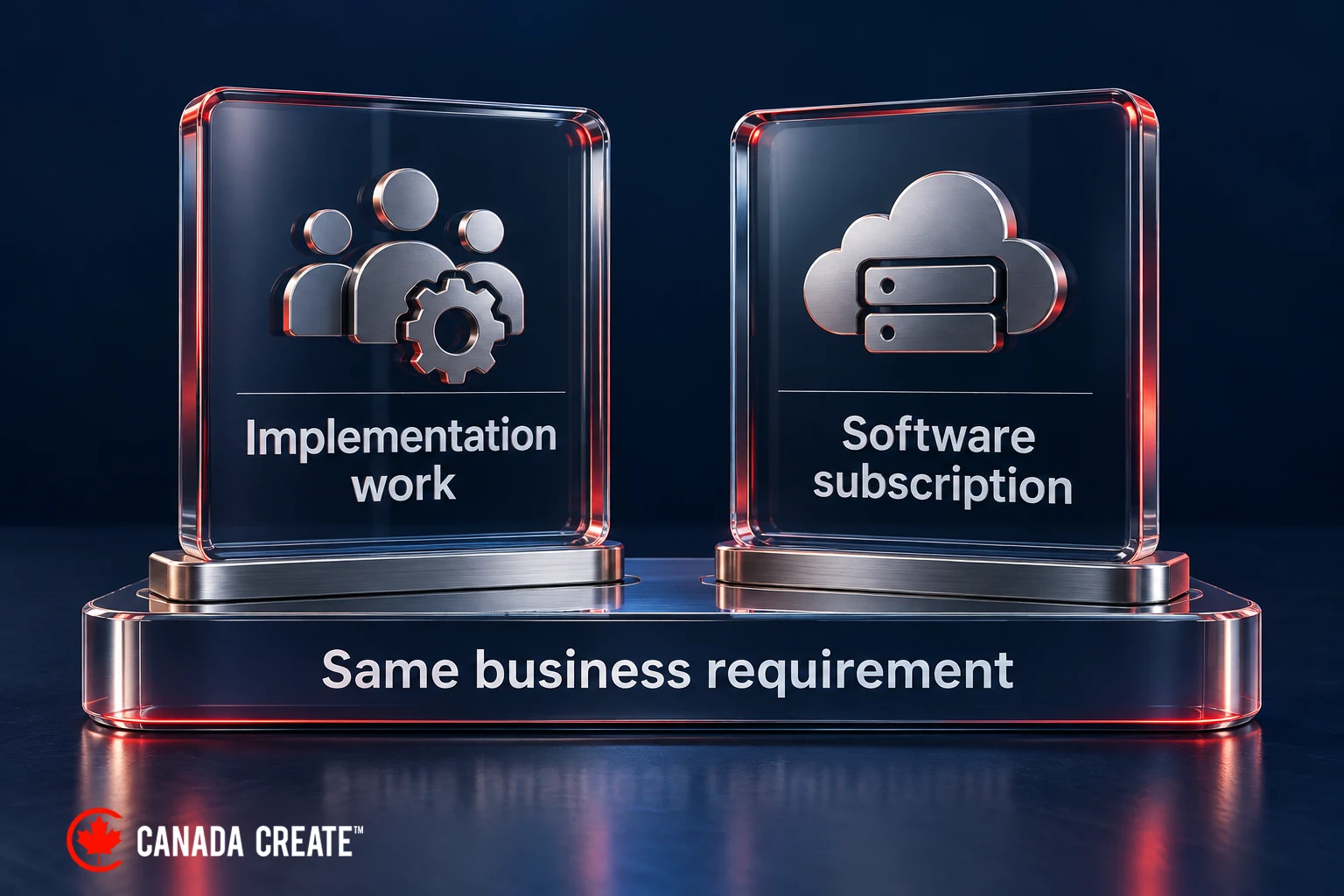
A useful Funeral Home CRM quote tells you what will be delivered, what your team must contribute and what you will continue paying after setup. The implementation fee is only one part of that commitment. Software subscriptions, usage charges, vendor dependencies, staff training and later changes can sit in separate agreements.
Compare proposals against the same business need before comparing their totals. “CRM setup” could mean a limited configuration project or a broader engagement involving website enquiries, selected records, staff access and handover. Those are different purchases even when both proposals use the same heading.
This guide is for Canadian funeral-home owners and operators evaluating an implementation engagement. It provides a scope comparison, an illustrative proposal example and the questions that make costs and responsibilities clearer. It does not give a market price range or suggest that a software purchase guarantees additional arrangements.
Give each provider the same requirement
Begin with the work the business needs to improve: for example, staff responsibility for enquiries across locations, requested pre-planning appointments or an accurate view of outstanding follow-up. Name the existing software, the locations and staff roles involved, and the functions that must remain with the operator’s current systems.
The proposal should identify the selected product and edition, the users and locations included, the agreed deliverables and the exclusions. If a provider has not assessed the current software or the permitted records, its migration or connection estimate may still be conditional. That is a useful distinction to have in writing.
Keep the agency engagement separate from the software subscription. The agency may assess requirements and configure an agreed platform, while a vendor controls the product licence, available interfaces and subscription terms. Ask who invoices each component, who can approve changes and who is responsible when a requirement depends on another supplier.
Also distinguish the enquiry-management job from professional funeral work. A proposal to organise planning appointments is not automatically a proposal to replace arrangement contracts, payment reconciliation or required records. Those functions need their own confirmed requirements and operator approval.
Separate the cost components before asking for a total
The categories below are a way to compare offers, not a universal package. A provider may combine some charges, exclude others or leave them subject to assessment. Ask it to state that clearly rather than assuming an unmentioned item is free.
| Cost component | What the written offer should make clear |
|---|---|
| Assessment and implementation | The requirements review, configuration, agreed functions, deliverables, acceptance criteria and payment milestones. |
| Software subscription | The product, edition, included users or locations, billing currency, term, renewal conditions and any activation charge. |
| Connections and migration | The named supported connections, permitted record categories, historical coverage, exclusions, vendor charges and responsibility for exceptions. |
| Messaging and other usage | Which usage is included, how additional use is charged, which provider bills it and whether spending controls are available. |
| Training and handover | The staff roles covered, sessions or materials included, required attendance and the cost of later onboarding or retraining. |
| Support and ongoing management | Defect support, routine administration, reporting, change requests, response targets and the duration of each commitment. |
| Transition or exit work | Available exports, vendor assistance, archive access and separately priced work if the business moves to another provider. |
We assess your existing tools and scope enquiry management, approved communications and staff handover.

For Canadian budgeting, confirm the currency on every agreement and invoice. Do not assume an international vendor’s displayed dollar amount is CAD. Ask whether applicable taxes are included and how foreign-currency billing, if selected, will affect the amount the business pays. There is no need to assume a particular exchange rate to recognise that uncertainty.
Compare the full agreed term, not just the first invoice or an attractive monthly figure. Monthly billing does not, by itself, establish a month-to-month right to leave. Renewal dates, notice requirements, deposits and payment milestones belong beside the price.
Make migration and connection assumptions visible
“Import your contacts” does not describe whether contact purposes, permissions, opt-outs, attachments or historical notes are included. Nor does it establish that every existing record should be copied into an additional system. The operator must approve the information needed for the agreed purpose and the requirements for retaining material elsewhere.
The quote should distinguish confirmed work from work that depends on vendor access or further assessment. Ask which system controls shared records, what updates are supported and which historical periods or record conditions fall outside the connection. Those details make the quoted responsibility and its limits clear.
Agree who reviews transferred information and what will count as acceptance. A record count alone may not show whether the information staff need is usable or whether contact preferences remain meaningful. Unsupported history, remaining manual work and vendor involvement should be visible before the final implementation commitment.
In Ontario, pre-planning does not necessarily involve prepayment. That distinction matters when a proposal refers loosely to “pre-need customers” or “arrangements”. Ask which records the provider means. An enquiry label is not a signed contract, completed payment or authority to give funeral instructions.

An illustrative comparison: the lower setup fee is not yet the lower commitment
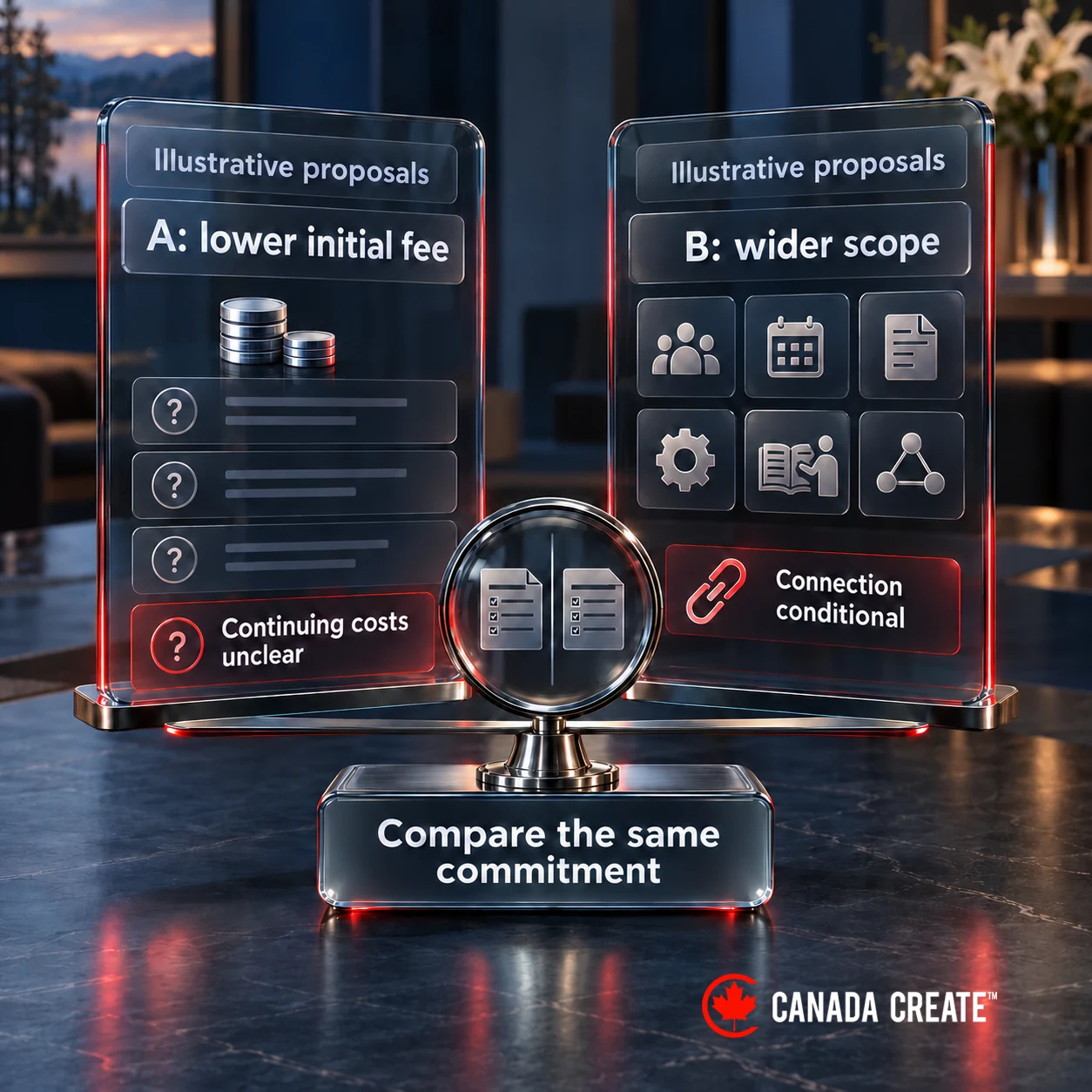
Illustrative example, not actual supplier quotes or a Canada Create client case. An Ontario funeral home wants its current location to have a clearer view of website enquiries. It also wants a quote for adding another location later. Two proposals arrive: Proposal A has a lower initial implementation fee; Proposal B describes a wider initial scope. The missing terms have to be resolved before their prices can be compared fairly.
| Buying question | Proposal A as received | Proposal B as received |
|---|---|---|
| Who is included? | Current location only; additional-location work not stated. | Current location included; future location separately quoted when its requirements are known. |
| What will migrate? | “Contact import”, with no description of permissions or history. | Named permitted contact records and preferences, subject to vendor access; attachments excluded. |
| What will staff receive? | “Training included”, with no roles or materials specified. | Agreed staff handover and materials, with later onboarding outside the initial scope. |
| What continues after setup? | Software, usage and support commitments need clarification. | Software and usage billed separately; ongoing agency management optional under its own scope. |
| What remains uncertain? | The missing inclusions and charges above. | Vendor approval of the proposed connection and the cost of any necessary alternative. |
The owner cannot reasonably call A cheaper overall or B better value from these descriptions alone. A may be sufficient once its scope and continuing charges are clarified. B may include useful work, or work the business does not need. Its more detailed wording does not remove the unresolved vendor dependency.
The next buying action is to ask both providers for a comparable scope and a written commitment for the same term. For A, clarify migration, training and continuing charges. For B, resolve or price the connection dependency and confirm whether the broader work is necessary. Keep the future location as a clearly identified option rather than treating it as already included.
The resulting comparison should let the owner identify confirmed fees, conditional costs and exclusions separately. If a material dependency cannot yet be resolved, a defined assessment may be the appropriate first engagement. It is better to purchase a bounded answer than to approve a complete implementation on an assumption.
Put timing, staff input and acceptance beside the price
A schedule should explain what it depends on. Software access, vendor responses, the condition of existing records and the availability of staff reviewers can affect delivery. Ask which work is confirmed, which work cannot begin until a dependency is met and how a material change would affect the quote.
Your team will need time for decisions as well as training. The operator approves the record purposes, authorised contacts, access requirements and communications. A nominated project contact coordinates business decisions and staff review. These responsibilities should be realistic for the people also handling daily funeral-home work.
Acceptance needs to refer to the commissioned functions. Examples include authorised staff being able to identify the owner of an outstanding enquiry, review the agreed transferred information or use a supported appointment handoff. A completed configuration is different from a promise that families will book more arrangements or that every employee will immediately adopt the system.
Ask what happens if the scope changes. Adding another location, requesting a different vendor connection or expanding historical coverage can be a new requirement rather than a defect. Written change approval helps the business understand the additional fee and schedule before that work begins.

Understand what “support included” means
Software-vendor support, agency implementation support and the operator’s family-response arrangements are separate. A provider should explain which issues it handles, how requests are received, when a person is expected to respond and what is outside the agreement.
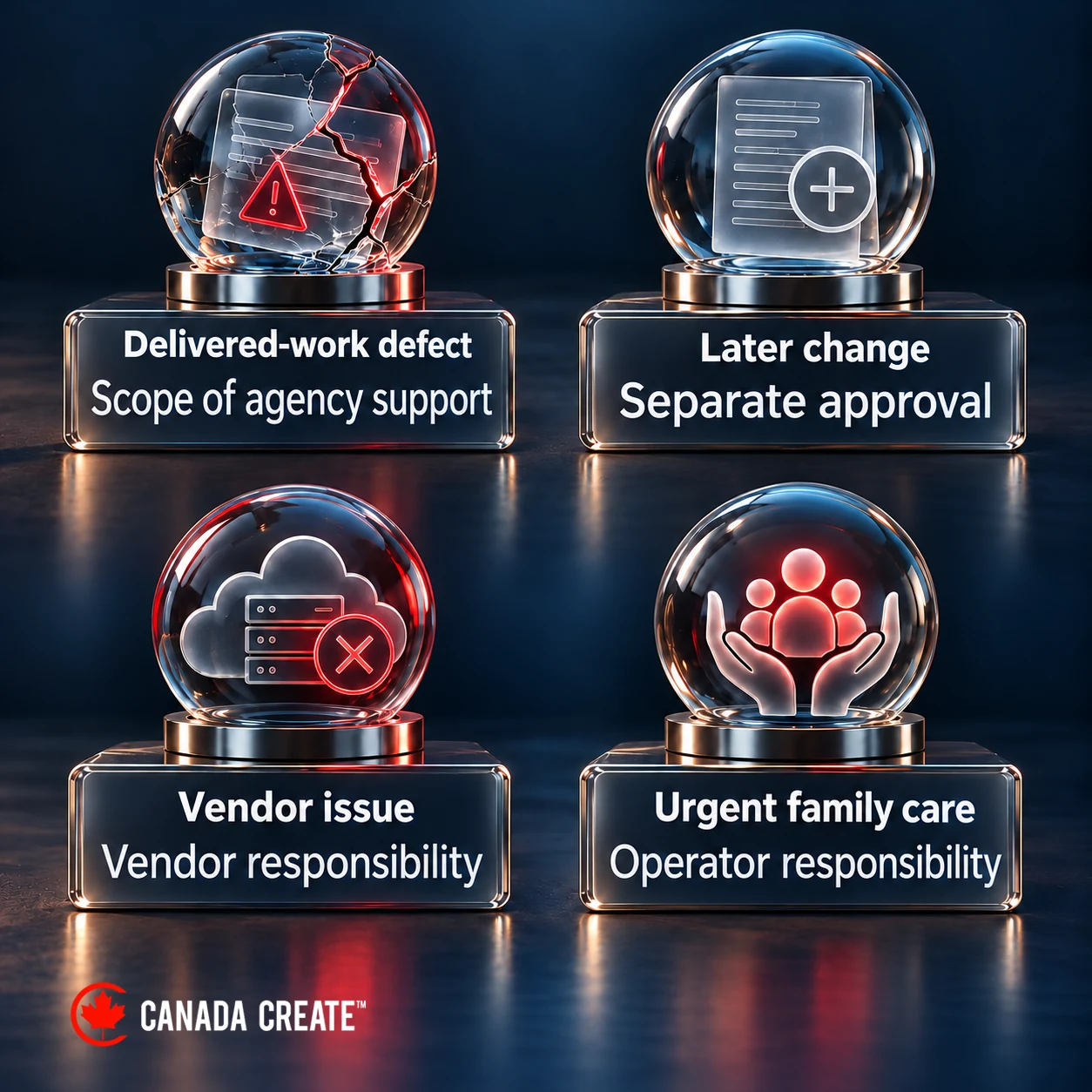
Ask the provider to distinguish a defect in delivered work, a later change request, a vendor outage and an urgent family enquiry. Those situations can have different owners and different commercial terms. A support form that accepts requests around the clock does not establish continuous human response or immediate repair.
For Canada Create one-time projects, the Terms of Service provide reasonable handover training and 90 days of limited post-acceptance support to correct defects in the delivered work. Ongoing changes and management need their own agreed scope. Sales and AI-assisted support intake are available 24/7; the standard team-response target is 24 to 48 hours during business days, subject to the Terms. Those targets are not urgent family-care coverage.
Ask separately about staff who join later, refresher training and changes caused by a vendor update. Do not assume that “training included” means indefinite individual onboarding, or that a monthly management fee includes every future request.
Separate access, ownership and a usable exit
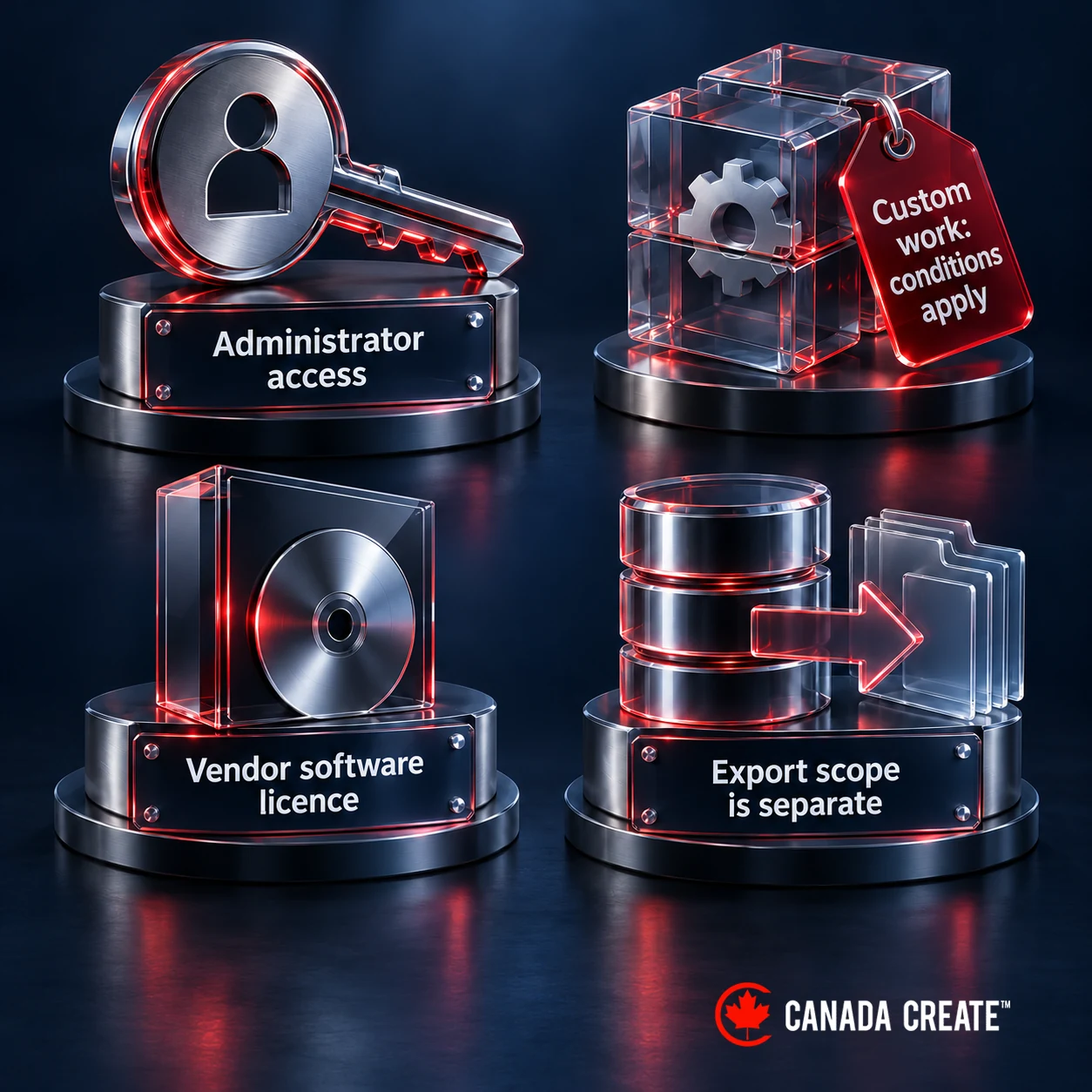
Administrator access, the right to use software and ownership of custom work answer different questions. Confirm the named account holder, the access your business receives and the vendor’s export and transition arrangements. A login does not prove ownership of the underlying platform, and an export button does not establish that all records, permissions and attachments will be usable in a different system.
The Office of the Privacy Commissioner’s cloud guidance makes provider contracts, accountability and information handling relevant to outsourcing decisions. The operator should assess permitted access, retention and exit requirements for the selected service. Do not assume unlimited transfer rights or that sensitive professional records belong in an agency’s quote form.
Under Canada Create’s Terms, full and final payment and the continuing agency-credit requirements are conditions of ownership of finalized work created specifically for the client. Third-party materials and pre-existing agency tools are excluded. The Terms provide a non-exclusive, perpetual licence to pre-existing tools as embedded in the deliverables, solely as delivered; they do not transfer the underlying software.
Where included in the engagement, advertising accounts, analytics properties, Google Business Profiles, domains and social media accounts are set up in the client’s name where the platform allows and remain theirs. That named marketing-account provision should not be read as a promise to transfer ownership of a CRM vendor’s platform or provide an unrestricted export.
Before committing, ask whether transition assistance is included, how additional work is priced and which subscriptions or records must remain accessible during a move. Those answers help compare future flexibility without assuming the business will change providers.
Review the complete business commitment
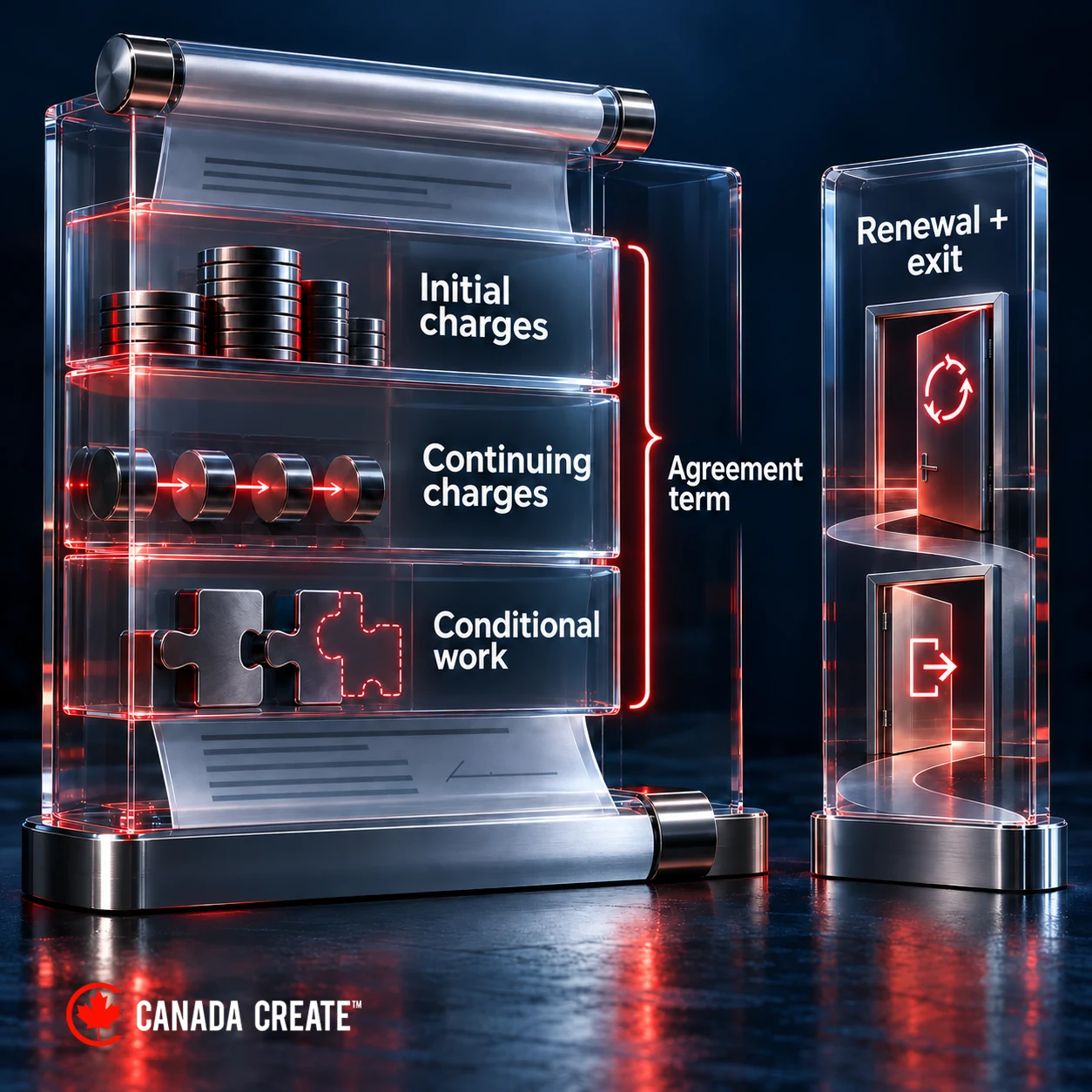
For Canada Create engagements, fees are quoted in writing in CAD unless stated otherwise, plus applicable taxes. The agreement specifies scope, payment schedule and term. The Terms provide that fees and deposits are non-refundable and that all fees for the agreed term remain payable if the client chooses not to continue. Read those conditions before approving the engagement; do not infer an early-exit right from the billing frequency.
These are terms for the funeral home’s purchase of agency services. They are separate from the rights and obligations governing a family’s funeral or prepaid arrangement. A CRM implementation proposal should not blur the two.
For any provider, ask for a written view of the initial commitment and the continuing commitment over the same agreed period. Keep conditional work visible rather than entering an unknown charge as zero. If usage varies, ask what is billed and what information is available to assess it; a made-up allowance would only make the total look more certain than it is.
Consider staff effort alongside supplier charges. The manager’s review time, attendance at training and responsibility for reliable ongoing records are real parts of adoption, even where the agency does not invoice for them. The business should decide whether that commitment is justified by the specific work it wants to improve.
Approve a scope you can describe without the sales presentation
A decision-ready proposal lets you explain the selected platform, the delivered functions, permitted records, staff and vendor responsibilities, acceptance criteria, exclusions and the full agreed commercial commitment. If a material answer is still missing, request it in writing or commission a narrower assessment.
Canada Create’s Funeral Home CRM implementation service starts with your existing tools and enquiry-management requirements. Tell us the locations, software and staff needs the proposal should address. Keep family names, arrangement documents, payment records and passwords out of the enquiry; a written scope and fees follow discovery.
Frequently asked questions
What should be included in a funeral home CRM implementation quote?
The quote should identify the selected product and edition, users and locations, agreed functions, permitted records and supported connections. It should also define training, staff and vendor responsibilities, acceptance criteria, exclusions, payment schedule and term. Work that still depends on access or assessment should be clearly conditional rather than presented as an unconditional delivery commitment.
Are software subscriptions and message charges included in the implementation fee?
Only if the written offer expressly includes them. Ask the provider to distinguish its implementation work from software activation or subscription charges, messaging usage and optional ongoing management. Confirm who invoices each item, its currency and taxes, what continues after setup and the applicable agreement term. An unmentioned charge should not be assumed to be zero.
Why can two CRM proposals have different prices or timelines?
They may cover different users, locations, records, connections, training or support. Existing data quality, vendor permissions and staff review can also affect what is feasible and when it can be delivered. Compare the same business requirement, exclusions and term before comparing totals. A lower setup fee does not establish a lower overall commitment, and a longer feature list does not establish better value.
Which costs and commitments should we confirm before approving a proposal?
Confirm initial fees, continuing software and usage charges, taxes and currency, payment milestones, the agreement term, renewal conditions and change-request pricing. Clarify handover, defect support, administrator access, export availability and any transition fees. For Canada Create, the proposal and Terms also address non-refundable fees, full-term payment obligations and conditional custom-work rights. Those business-service conditions are separate from a family’s funeral-contract rights.