
Toronto · Branding agency
Branding and creative agency in Toronto
Canada Create is a branding agency in Toronto: positioning, logo and identity design, voice and guidelines, then the website, signage and social profiles that carry the brand.
Brand identity, logos, guidelines and creative for Toronto and GTA businesses, from North York to downtown.
- BBB A+ accredited
- 18 years in business
- Mon to Fri 9 to 6, Sat 10 to 2
Get a branding quote
Tell us about your business and what is prompting the project. A branding specialist replies within one business day.
Please do not share passwords or other sensitive details here. We never sell your contact information and we comply with Canadian privacy law
(privacy policy).
What a strong brand does for your business
Recognition
Every ad, post, sign and invoice builds on the last.
Trust
A business that looks established and organized.
Pricing power
A premium look supports premium fees.
Consistency
Guidelines that keep the brand together as you grow.
What our brand identity work covers
Scoped in writing after a discovery conversation.
- Brand positioningAudience, values, personality and a clear reason to choose you.
- Logo designPrimary, secondary and symbol versions tested at every size.
- Colour and typographyPalettes and licensed type for print and screen.
- Brand voiceTone, tagline and the core messages your team reuses.
- Brand guidelinesRules your staff and suppliers follow.
- Brand architectureStructure for services, locations and sub-brands.
- Templates and collateralStationery, proposals, decks and social graphics.
- Brand rolloutWebsite, listings, signs and ads switched over together.
Branding pricing
Quoted in writing after discovery, never in fixed tiers.
Logo refresh
Quoted in writing
Modernize a recognized mark and fix inconsistencies.
- Review of current brand
- Refined logo set
- Updated palette and type
- Short usage guide
Brand identity
Quoted in writing
A new brand or a full identity system.
- Positioning and brand platform
- Logo concepts and full set
- Colour, type and voice
- Brand guidelines
Rebrand and rollout
Quoted in writing
A new identity launched across every channel.
- Positioning and identity
- Materials and templates
- Website and listings update
- Launch plan protecting search visibility
Every branding project is quoted in writing after discovery. Cost depends on research depth, concepts and revision rounds, naming, brand architecture and rollout. Printing, signage, font licences and ad spend are listed separately.
Strategy, identity, guidelines, rollout
How we build brands that last
A branding agency that builds brands you can use every day
A brand your team can apply consistently for years. Branding in Toronto is the work of deciding what your business stands for and expressing it in one consistent identity: positioning, logo, colour, typography, voice and the materials that carry it into the market. Canada Create is a branding and creative agency in Toronto, in business since 2008, BBB Accredited with an A+ rating and based at 126 Willowdale Ave. in North York. We design brand identities from the ground up and refresh the ones that have drifted: positioning, logo and brand identity design, colour and typography, brand voice, brand guidelines, and the business cards, signage, website and social profiles that carry the brand. Our branding services are built for owners who want a brand their team can use without calling a designer every time they need a flyer.
We have designed and marketed for businesses since 2008. Because the same agency runs SEO, Google Ads, websites and lead generation, the identity we design is built to work where your customers actually see it: on a phone screen, in a search result, on a van, on a sign and in an inbox. A brand that looks good in a presentation and fails on a profile image is not finished.
What does a branding agency do?
A branding agency helps a business decide what it stands for and then expresses that decision in a consistent set of words, visuals and experiences. In practice, the work falls into four parts.
- Thinking. Research into your customers, competitors and category, leading to a clear position: who you serve, what you offer and why someone should choose you.
- Design. The visual identity: logo, colour palette, typography, graphic elements, photography direction and layouts.
- Language. Brand voice, tagline where one helps, a short brand story and the core messages your team reuses.
- Application. Guidelines, templates and the first set of materials, plus a rollout plan so the new brand appears everywhere at once.
A graphic designer can produce a logo. A branding agency connects the logo to a strategy and makes sure the whole system holds together when many different people use it. If you only need individual pieces such as a brochure, a trade show banner or a social media set, our graphic design team handles that work on its own. Focused projects have their own pages: rebranding in Toronto, brand strategy in Toronto and brand guidelines in Toronto.
Branding services we provide
Every project is scoped in writing after a discovery conversation, so you pay for what the business needs and nothing more. These are the branding services we combine most often.
Positioning and brand platform
Every identity project starts with the questions that shape everything else: who your best customers are, what they are trying to solve, who else they are considering and what makes you the better choice. We review your category and the brands you compete with to find the space your brand can own, then write a positioning statement, brand values and a short personality description. When a business needs deeper planning across marketing channels, budgets and growth targets, that work sits with our brand strategy and fractional CMO team, and the identity project builds on it.
Logo design
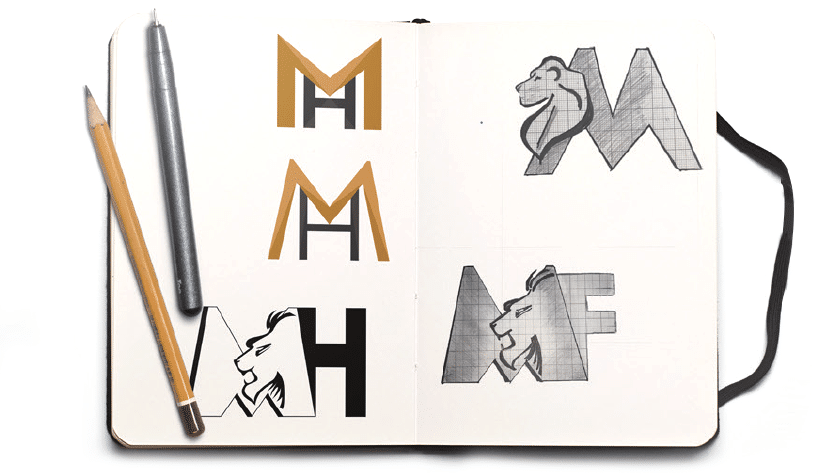
The logo is the most visible part of the identity and the part people remember longest. We design logos from concept sketches through to finished artwork, exploring several directions before refining the one that fits your positioning. Every logo is tested in full colour, one colour and reversed, at the size of a browser icon and the size of a building sign. You receive a full logo set: primary logo, secondary and stacked versions, a symbol on its own where it makes sense, and files for print, web and signage.
Colour palette and typography
Colour and type do much of the work of recognition. We build a palette with primary and supporting colours, specified for print (CMYK and Pantone where needed) and screens (RGB and HEX), and tested in the intended text and background combinations against the agreed contrast requirements. Typography is chosen for character and for practicality: fonts with a licence that covers your use, available on the platforms your team works in, and readable at small sizes on a phone.

Brand messaging and voice
How a brand sounds matters as much as how it looks. We define your voice and tone, then write the core messages your team will reuse: a tagline where one is useful, a short brand story, a one-paragraph description of what you do, and the key points that explain why it matters. Clear messaging makes your website, ads, proposals and social posts easier to write and more consistent when several people write them.
Brand guidelines
Brand guidelines are the instruction manual for your identity. They show how to use the logo and how not to, the exact colour codes, the type hierarchy, photography and illustration style, voice examples and the brand applied correctly to real materials. Staff, printers, sign makers, web developers and future agencies all work from the same document, so the brand stays consistent long after the project ends.
Brand collateral and templates
An identity is only useful once it is in use. We apply your new brand to the pieces you need first: business cards, letterhead and email signatures, presentation and proposal templates, social media profile and cover images, brochures, menus, packaging and signage. Each piece is designed to the guidelines so the rollout looks like one brand from day one, and editable templates let your team produce everyday material without starting from a blank page.

Brand experience and physical spaces
A brand is also what people experience: the storefront, the reception desk, the vehicle, how the phone is answered and how a quote is presented. We carry the identity into signage, wayfinding, window graphics, uniforms and vehicle wraps, and we help you connect your brand values to everyday moments with practical tools such as a short brand introduction for new staff, email and phone scripts in the brand voice, and quote templates. When staff understand what the brand stands for, they represent it more consistently.
Brand architecture
Businesses with several services, locations, divisions or product lines need a clear structure for how those brands relate. Some work best as one master brand with descriptive names underneath. Others need distinct sub-brands that share a family resemblance, and a few need fully separate brands. We map your offers, recommend a structure and design the naming and visual rules that keep it clear to customers as the business adds new services.
Logo and brand identity: why a logo is only the start
Many owners ask for a logo when what they need is a brand identity. A logo is a single mark. A brand identity is the whole system that surrounds it: the colours, type, imagery, layouts and voice that make every piece recognizably yours, even when the logo is small or missing. Think of the brands you recognize from across a room by colour and shape alone. That recognition comes from the system, applied the same way for years.
Brand identity design gives you three practical advantages over a standalone logo. First, it is easier to apply: anyone can produce a social post or a sign that looks right because the rules are written down. Second, it scales: new services, locations and staff fit into the existing system instead of inventing their own look. Third, it lasts: a system built on your positioning can be refreshed in small steps instead of being replaced every few years.
When businesses call a branding agency
Owners usually contact us at a turning point. The right project depends on how much recognition your current brand has earned and how far it is from where the business is going. We recommend the option that fits after reviewing your brand, and we tell you when a smaller project would do the job.
Launching a new business or product
For new businesses, new divisions and new products, we build the positioning, name support where needed, logo and full identity system from scratch, so the brand is right before you print, sign or advertise anything. Getting it right before launch costs far less than fixing it after the signs, vehicles and packaging are ordered.
Refreshing an established brand
For businesses whose brand is recognized but looks dated or inconsistent. A refresh keeps the core of what people know, often the name, the main colour or the shape of the mark, while modernizing the logo, tightening the palette, updating typography and fixing the materials that have drifted. Customers see an improvement rather than a new company.
Repositioning or a full rebrand
For businesses that have changed what they do, who they serve or how they want to be seen: a move upmarket, a shift in services, new ownership or a new market. A rebrand revisits positioning and may change the name, logo and messaging. It needs a careful launch plan, including redirects and updates to your website, Google Business Profile and directory listings, to reduce avoidable disruption and monitor search visibility during the change.
Merging organizations
When two businesses combine, customers and staff from both sides need to understand what the new organization stands for. We help you decide whether to keep one brand, blend the two or create a new one, and we plan the transition so neither customer base feels abandoned.
Scaling across markets
Expanding into new provinces or new cities puts pressure on a brand that was built for one location. We check that your name, messaging and visuals travel well, adapt materials for new audiences where needed and give local teams the templates to stay on brand.
Restructuring a portfolio of brands
Companies that have grown through acquisitions or side projects often end up with a collection of logos that no longer make sense together. We audit the portfolio, recommend which brands to keep, merge or retire, and design the architecture that ties the survivors together.
Our branding process
A brand identity project follows a clear sequence, so decisions are made in the right order and each stage builds on the last. The number of concepts, revision rounds and deliverables is agreed in writing before work starts.
1. Discovery
We begin with a working session with the owners and the people who know your customers best. We review your current brand, your marketing, your competitors and your goals, and we ask about the customers you want more of. If you have customer feedback, reviews or sales data, we use it. The output is a written brief that captures what the brand must achieve.
2. Positioning
From the discovery work, we write your positioning, brand values, audience summary and personality. You review and approve this platform before any design begins, because every design decision after this point is judged against it.
3. Concepts
We develop several logo and identity directions, each presented with a short rationale and shown in real applications such as a business card, a website header, a social profile and a sign. Seeing the concepts in use makes it much easier to choose than looking at a logo on a white page.
4. Refinement
You choose a direction, and we refine it: adjusting shapes, spacing, colour and type until the identity is right. Feedback is gathered in organized rounds, so comments from partners or managers arrive together rather than one at a time.
5. System and guidelines
With the logo approved, we build out the full system: palette, typography, graphic elements, photography direction and voice. Everything is documented in your brand guidelines.
6. Rollout
We design the first set of branded materials and deliver organized final files. If you want help launching the brand across your website, Google Business Profile, social profiles, signage and advertising, our team can handle the rollout so everything changes over together. Project tasks, approvals and files are tracked in CS+, our CRM, so you always know what is waiting on whom.

Branding and your online presence
Most customers meet your brand online first, so an identity has to work on a screen before anything else. We design with digital use in mind from the first sketch: logos that stay clear as a small profile image, colours that hold up on phones, fonts that load quickly on a website and graphic elements that adapt to social formats and short video.
A new brand is also a chance to fix your online presence at the same time. When we roll out an identity, we can update your website, your Google Business Profile logo and photos, your social profiles and your ad creative together, so customers see one consistent brand wherever they find you. Our web design team can rebuild or restyle the site around the new identity, and for a rebrand our SEO team plans redirects, listing updates and monitoring. Rankings can fluctuate during a migration, and Google determines whether a renamed business can retain its existing profile and reviews.
Social media and content
Social media is where many customers see your brand most often. We create profile images, cover graphics, post and story templates, and a simple visual style for photos and video, so your feed looks consistent whether your team or ours publishes it. Content marketing, from blog articles to email newsletters, uses the voice and messages defined in the brand platform, which makes it faster to write and easier to recognize.
Advertising
Ads work harder when people recognize the brand behind them. A clear visual system makes display, social and video ads easier to produce and easier to spot, and consistent messaging from ad to landing page supports trust at the moment someone decides whether to call. If you advertise, our Google Ads team builds campaigns and landing pages that follow your guidelines.

The 3 7 27 rule of branding and why consistency matters
The 3 7 27 rule is an informal marketing rule of thumb, not a research finding. It is usually explained this way: you have about 3 seconds to make a first impression, a person needs around 7 encounters with a brand before they remember it, and it can take around 27 exposures before they recognize it well enough to act. Different writers describe the numbers slightly differently, and none of them should be treated as precise.
The useful idea behind the rule holds up: recognition builds through repetition, and repetition only works when the brand looks and sounds the same every time. If your website, van, invoices and social posts each use a different logo version or colour, every encounter starts from zero. A consistent identity lets every ad, post, sign and email add to what came before. That is the practical reason brand guidelines matter.
Recognition, trust and pricing
People tend to choose businesses they recognize. A professional identity signals that a business is organized and here to stay, and for service businesses where the buyer cannot see the work in advance, such as law firms, clinics, contractors and consultants, that signal often decides who gets the call. A dated or inconsistent brand can also lead buyers to expect a lower price, even when your service is better than the competition.
What a branding agency in Toronto costs, and what changes the fee
Branding fees vary widely because the projects vary widely. A logo refresh for a single-location business and a full identity with brand architecture for a multi-location company are very different pieces of work. At Canada Create, every branding project is quoted in writing after a discovery conversation. We do not sell branding in fixed tiers, and the quote lists exactly what is included so you can compare it fairly with any other proposal.
These are the factors that move the cost of a branding project up or down:
- Depth of research and positioning. Interviews, competitor reviews and customer research take time, and larger or more complex businesses need more of it.
- Number of concepts and revision rounds. More directions and more rounds mean more design hours.
- Naming and messaging. Developing a new name or a full set of brand messages adds a separate stream of work.
- Brand architecture. Several services, locations or sub-brands need a structure and more design decisions.
- Size of the rollout. The number of templates, printed pieces, signs, packaging items and digital assets in scope.
- Launch support. Whether our team updates your website, listings, social profiles and ads as part of the launch.
It helps to separate three kinds of cost. The one-time project fee covers strategy, design and guidelines. Optional ongoing work, such as monthly design support, social content or SEO, is billed separately. These services are custom-scoped and quoted in writing after discovery. Third-party costs such as printing, signage fabrication, font licences, stock photography and ad spend are paid to those suppliers and are listed separately so nothing is hidden.
How long a branding project takes and when you see results
Timelines depend on scope and on how quickly decisions are made. As a guide, a logo refresh can be completed in a few weeks, while a full brand identity with positioning, several concepts, guidelines and a first set of materials usually takes one to three months. A rebrand with a coordinated launch across a website, signage and listings takes longer, because the rollout has to be scheduled around printers, sign makers and your own operations.
The step that most often slows a project is feedback. When several partners or managers need to approve the brand, we recommend naming one decision maker and collecting everyone’s comments before each review. We confirm the timeline in the written quote and flag early if anything puts it at risk.
Owners often ask when a new brand starts to pay off. Some effects are immediate: materials look consistent, proposals look more professional and staff find it easier to produce on-brand work. Recognition builds more slowly, through repeated exposure over months and years. We do not promise sales results from a brand identity, because results depend on your market, your offer and how the brand is used, but we design every identity to support the marketing channels that do generate leads.
What we need from you
You do not need a finished brief to start. Bring what you have: your current logo and materials, examples of brands you admire and dislike, any customer feedback or reviews, and a sense of where the business is heading over the next few years. The more we understand about your customers and plans, the more specific the brand will be.
What you receive at the end of a branding project
Deliverables are agreed in writing at the start and depend on the scope. A typical brand identity project includes:
- A written brand platform: positioning, audience, values and personality.
- The logo set: primary, secondary and symbol versions in full colour, one colour and reversed.
- Logo files in vector (AI, EPS, SVG, PDF) and raster (PNG, JPG) formats for print, web and signage.
- A colour palette with CMYK, Pantone where needed, RGB and HEX values.
- Typography with licensing notes and web alternatives.
- Brand voice and core messaging.
- Brand guidelines as a PDF your team and suppliers can share.
- The first set of branded materials agreed in the scope, such as business cards, letterhead, email signatures, templates and social profile images.
You own the custom final logo and identity we create for you and receive the agreed source files. Licensed fonts, stock assets and other third-party materials keep their own usage rights and licences.
Naming and trademarks
A name is the one brand element that is hardest to change later. When a project includes naming, we develop options that fit your positioning, look at domain and social handle availability, and test how each one sounds when spoken on the phone and read on a sign. Registering a trademark with the Canadian Intellectual Property Office (CIPO) is a separate legal step, and we recommend working with a trademark agent or lawyer for it.
Personal branding and premium brands
Not every brand is a company. Consultants, advisors, coaches, realtors and professionals who are the face of their business often need a personal brand: a consistent look, a clear statement of what they do and for whom, professional photography direction, and templates for speaking, social media and proposals. We apply the same process, starting with positioning, so the personal brand supports the business rather than competing with it.
Premium and luxury brands need particular restraint. Space, typography, photography quality and material choices such as paper stock and packaging finishes carry much of the message. We design premium identities with fewer elements used with more care, and we plan how the brand appears in every touchpoint, from the website to the invoice, because inconsistency is most visible at the top of a market.
Branding for professional services, clinics, trades, restaurants and tech
Every kind of business has its own expectations. A brand that fits a restaurant would feel wrong on a law firm, and a contractor’s identity has to work on a truck as well as a website. These are some of the businesses we regularly brand.
Professional services
Law firms, accounting practices, financial advisors and consultants need identities that signal expertise and trust, with polished proposal templates, letterhead and presentation decks.
Healthcare and wellness
Dental offices, physiotherapy and chiropractic clinics, medical spas and specialists need calm, welcoming brands that work on signage, patient materials and websites. We develop the messaging for the practice and its qualified advisers to review against the advertising rules that apply.
Home services and construction
Contractors, HVAC, plumbing, roofing and renovation companies need bold, readable identities for vehicles, job site signs, uniforms and quote sheets.
Restaurants, retail and consumer products
Restaurant branding covers the name, logo, menu, interior graphics, packaging and social presence, all of which need to work together from the street to the table. Retail and consumer product brands need identities that stand out on a shelf, a storefront and a feed.
Technology and B2B
SaaS companies, manufacturers and industrial firms need brands that make complex offers easy to understand, with pitch decks, product sheets and trade show material to match.
Common branding mistakes we help businesses avoid
Many of the businesses that come to us are fixing a problem rather than starting fresh. These are the issues we see most often, and each one is avoidable.
- Designing before deciding. A logo chosen because it looks nice, without a clear position behind it, rarely says anything specific. Positioning first saves time and money.
- Following trends too closely. A look that is everywhere this year will date quickly. We aim for identities that stay current for many years with small updates.
- Too many colours and fonts. Every extra colour and typeface makes the brand harder to apply consistently. A focused system is easier to recognize.
- Logos that fail at small sizes. Fine detail that looks good on a large screen disappears on a phone or a profile image. We test at every size before finalizing.
- No guidelines. Without written rules, every new supplier and staff member interprets the brand differently. Guidelines keep it together.
- Launching in pieces. Changing the logo on the website but not the sign, the van or the Google Business Profile confuses customers. A planned rollout switches everything over together.
- Losing search visibility in a rebrand. Changing a name or domain without redirects and listing updates can cost rankings and reviews. Our SEO team plans for this from the start.
A creative agency for campaigns, content and launches
A brand identity is the system; creative work is how that system shows up in the world. As a branding and creative agency in Toronto, we design the identity and then produce the campaigns, ads, content and materials that carry it, so the brand looks and sounds the same wherever customers meet it.
What a creative agency does
A creative agency turns a business goal into ideas people notice and remember: a campaign concept, a launch, a seasonal promotion, a video, a set of ads or a trade show presence. It writes, designs, films and edits, and it makes sure each piece fits the channel where it will appear.
Branding agency or creative agency?
A branding agency defines who you are: positioning, name, logo, colour, type, voice and guidelines. A creative agency uses that foundation to make the work that sells. Many businesses need both at different times. Because we do both, campaigns start from the brand rather than reinventing it.
Creative services we provide
- Campaign concepts for launches, new services and seasonal pushes.
- Ad creative for search, social, video and display, sized for every placement.
- Video and photography from our video production and photography teams.
- Social creative such as templates, carousels and short clips that keep posts on brand.
- Print and environment including brochures, signage, packaging and trade show materials.
- Website design through our website design team in Toronto.
- Content planned and produced by our content marketing agency.
Creative that stays on brand
Every campaign is checked against your guidelines before it goes out: logo use, colour, type, tone and claims. That consistency is what makes a brand recognizable over time, and it is easier when the same team builds the identity and the creative.
How to compare branding agencies in Toronto
Owners often search for the best branding agency or a top 10 list of branding companies. Rankings and directory lists use their own criteria, and the agency at the top of a list may not be the right fit for your size, budget or market. The better question is which agency fits your business. Whoever you consider, ask these questions before you decide:
- Do they start with positioning? An agency that shows logo options at the first meeting is guessing about your business.
- Can they show complete identities? Look for brand systems applied across real materials, not only logos on a blank background.
- Do they understand your kind of business? Ask how they would approach your customers and competitors, and listen for specific answers.
- Is the scope in writing? Concepts, revision rounds, deliverables and timeline should all be clear before work starts.
- Who owns the work? Confirm that you own the final identity and receive the source files.
- How do they use AI tools? Ask how research, exploration and production are reviewed by designers, how the work fits your brief, and how third-party assets and usage rights are checked. Human judgement and client approval remain part of the process.
- Can they help launch it? A brand only pays off once it is in use. An agency that can also roll it out across your website, search listings and advertising saves you coordinating several suppliers.
Is it worth hiring a branding or marketing agency?
It depends on where the business is and what it needs. Hiring an agency makes sense when the brand is holding back sales conversations, when you are about to spend on signs, vehicles, packaging or a new website, when the business has changed and the brand has not, or when your team keeps producing materials that look different from each other. In those moments, the cost of getting the brand right is usually small next to the cost of printing, launching and advertising the wrong one.
It is less worth it when the business is still testing whether its offer works, or when the real problem is something a brand cannot fix, such as pricing, service quality or a lack of leads. We will tell you plainly if we think a smaller project, such as a logo cleanup and a one-page guide, is enough, or if your money is better spent on marketing first. When you do need both, one agency handling branding, website, SEO and advertising keeps the brand consistent across every channel and gives you one accountable team.
How we work with businesses across Canada
Our office is at 126 Willowdale Ave., Suite #3, Toronto, and we build brands for businesses across Canada. Discovery sessions and concept presentations can run in person or by video call, and many projects run entirely online, with shared files, recorded presentations and organized feedback rounds. You work with the same team from discovery to rollout, and you always know who is responsible for your project. Canada Create has been in business since 2008, is a BBB Accredited Business with an A+ rating. Call (416) 273-9030, Monday to Friday, 9 am to 6 pm, and Saturday, 10 am to 2 pm. After hours, our 24/7 AI agent answers the toll-free line, +1 (800) 808-9235, and we’ll follow up the next business morning. AI-assisted intake captures support requests for team follow-up under the agreed service terms.
Related guides: what branding is and why it matters, building brand credibility on your website, Canva alternatives for small teams, and ways to deal with creative block.
Related work is explained on its own pages: banner printing and trade show booth design.
Why Toronto businesses choose Canada Create for branding
Canada Create has been in business since 2008 and is a BBB Accredited Business with an A+ rating. The team that designs your identity also builds websites and runs search and advertising, so the brand is designed for the places customers will meet it. Our portfolio includes a custom logo and branded website for a GTA metal roofing company, luxury branding and a website for a Toronto artist and furniture maker and branding and an online store for a natural health products company. You can read our live Google reviews on this page.
Tell us about your business, what is prompting the project and your timeline. Request your custom proposal: a branding specialist will arrange a discovery conversation, then send a written quote that lists every deliverable. Call (416) 273-9030, Monday to Friday, 9 am to 6 pm, and Saturday, 10 am to 2 pm. After hours, our 24/7 AI agent answers the toll-free line, +1 (800) 808-9235, and we’ll follow up the next business morning.
Talk to a strategist
Ready when you are?
Request a custom proposal
Tell us your goals, budget and timeline. You get a custom proposal and a named strategist, so your next stage of growth starts now.
How a branding project runs
Decisions in the right order, each stage approved before the next.
- Discovery Week 1
Business, customers, competitors and goals.
- Strategy Weeks 1 to 2
Positioning and values approved.
- Concepts Weeks 2 to 4
Directions shown in real use.
- Refinement Agreed rounds
Organized feedback, one direction refined.
- Guidelines After approval
The full system documented.
- Rollout Launch
Materials and channels switched over.
Branding work for Toronto companies
Brand identity projects from our portfolio, described by the work we delivered.

Canadian Lifetime Metal Roof
GTA roofing company
A custom logo and a new branded website that presents the company's roofing products and services with clear calls to action.

Dean Jackson Designs
Toronto artist and furniture maker
Luxury branding carried through a new website that shows the detail of each sculpture and custom furniture piece.

Organica Natural Health Products
Natural health products
Brand positioning for a crowded health products category and an ecommerce website for the full product range.

Miriam Holdings
Investment holding company
A refreshed brand identity, custom logo design and a new website that explains the company's fields of investment.
You own the brand: one team for branding, marketing and approvals
One accountable team
SEO, ads, website and intake run together.
Brand and marketing together
Identity built for your real channels.
Your approval first
Nothing published without your review.
You own the brand
You own the custom final identity we create and receive the agreed source files. Third-party licence conditions remain.
Transparent pricing
Design fees and third-party production costs are identified separately in the written proposal.
Quoted in writing
Every fee is confirmed in writing before work starts. Request your custom proposal.
Since 2008
Eighteen years of digital marketing.
BBB Accredited, A+ rating
Accredited by the Better Business Bureau.
Branding agency Toronto: questions buyers ask
What does a branding agency do beyond designing a logo?
A branding agency helps a business decide what it stands for, then expresses that decision consistently in words, visuals and experiences. The work has four parts: research that ends in a clear position, the visual identity, the brand voice and core messages, and application through guidelines, templates and a rollout plan. A logo on its own covers only part of the design step.
How much does a branding agency cost in Toronto?
Branding is quoted per project rather than in fixed tiers, because cost rises with research depth, the number of concepts and revision rounds, naming, brand architecture and the size of the rollout. A logo refresh with a short usage guide is a much smaller job than a new identity launched across every channel. Printing, signage, font licences and ad spend appear on separate lines. Your quote is written up after a discovery conversation, which is free.
What should a small business look for in a branding agency?
Ask whether the agency settles positioning before it shows logo concepts, and whether marks are tested at browser icon size and on a building sign. Check that guidelines, templates and a rollout plan are part of the scope, so the brand survives once many people use it. Canada Create designs identities alongside its own SEO, ads and web teams, which keeps the brand working in search results and on phones.
What logo mistakes should a new brand identity avoid?
The common mistake is a logo that looks fine in a presentation and fails as a profile image or on a van. Others include skipping one colour and reversed versions, choosing fonts whose licence does not cover your use and picking colours that fail contrast checks on screen. Each version should be tested at its real size before it is approved.
Can AI create a complete brand identity for a business?
AI can produce logo ideas and colour suggestions in seconds. A brand identity also needs a position based on your customers and competitors, a voice your staff can use, licensed fonts, guidelines and a rollout across signs, listings and ads. Those decisions depend on knowing your business, so treat AI output as a sketch rather than a finished brand.
Can a new business design its own logo for free before hiring a branding agency?
Yes, many owners start with a simple logo they make themselves, and that can be enough while the business finds its footing. Problems usually appear once the mark has to work on signs, vehicles, uniforms and small profile images. At that stage a refresh can keep what customers recognize and rebuild the rest properly.
What is the difference between a branding agency and a graphic designer?
A graphic designer can produce a logo or a brochure. A branding agency connects the logo to a strategy and makes sure the whole system holds together when many people use it, through guidelines, templates and messaging. If you only need individual pieces such as a trade show banner, our graphic design team handles that on its own.
Which branding services are usually combined in one project?
Most identity projects pair positioning and a brand platform with logo design, a colour palette and licensed typography, and a defined brand voice. Brand guidelines, templates for stationery, proposals and social graphics, and brand architecture for services or locations are added as needed. The rollout then switches the website, listings, signs and ads over together.
Why use a marketing and branding agency for a brand launch?
When the same agency runs SEO, Google Ads and websites, the identity is designed for where customers will actually see it: a phone screen, a search result, a sign or an inbox. A rebrand launched this way includes a plan that protects search visibility while pages and listings change. Canada Create has designed and marketed for businesses since 2008.
Get a custom proposal for your next project
Review the offer, budget and enquiry process before committing your marketing spend.