
Toronto · Law firm website design
Law Firm Website Design in Toronto
Law firm website design in Toronto: practice area pages, lawyer profiles and contact routes, written for your clients and reviewed by your lawyers before launch.
Law firm website design for Toronto and GTA practices: practice area pages, lawyer profiles and intake routes, from North York to downtown.
- BBB A+ accredited
- 18 years in business
- Mon to Fri 9 to 6, Sat 10 to 2
Get a custom proposal for your law firm website
Tell us about your practice areas and goals. We reply within one business day. After discovery, you receive a written proposal with scope and fees before work starts.
Please do not share passwords or other sensitive details here. We never sell your contact information and we comply with Canadian privacy law
(privacy policy).
What your new website should help your firm achieve
A clearer fit for enquiries
Help prospective clients understand the matters you handle, the people you serve and whether to contact your firm.
A credible first impression
Present your lawyers, practice focus and approved experience in a way that reflects the firm behind the website.
A practical route to contact
Give visitors contact options that match your working hours, intake responsibilities and consultation arrangements.
A manageable website
Agree how your team will review, use and maintain the site, with handover and ongoing responsibilities made clear.
Scope your law firm website around what you need
Your proposal confirms the exact deliverables. We discuss these core needs with you, including which content and features belong in the first phase.
- Practice-area planningA clear brief for the matters, audiences and locations your website needs to represent.
- Custom website designVisual direction and page designs shaped around your firm, your people and your prospective clients.
- WordPress developmentA website with editing access and handover training for the agreed features.
- Lawyer profiles and contentWriting or editing for the agreed pages, using your input and presented for your firm’s approval.
- Contact and enquiry featuresThe agreed forms, calling or booking options, with firm-approved notices and CS+ routing where scoped.
- Accessibility requirementsThe standard, page coverage and testing your firm needs, specified in the written agreement.
- Launch readinessTesting of the agreed website and contact features, with existing-site migration addressed in scope.
- Handover and support
How law firm website pricing works
We quote after discovery, based on the pages, content, design and features your firm needs. These examples help frame the conversation; your agreement confirms what is included.
Solo and small firm site
Quoted after discovery
A focused practice needing a professional presence and straightforward first contact
- Custom design and WordPress build
- Agreed practice and lawyer pages
- Contact features and firm-approved notices
- Launch review and handover
Multi-practice firm site
Quoted after discovery
Firms with several practice groups, lawyers or offices to represent clearly
- Scope for practice groups and office information
- Lawyer profiles and agreed content support
- Enquiry handling suited to the firm
- Agreed accessibility testing and site migration
Website plus ongoing marketing
Custom-scoped engagements; proposal after discovery
Firms that want ongoing support reaching prospective clients after launch
- Website build or redesign
- Separately scoped SEO and local visibility services
- Optional Google Ads management; ad spend separate
- Reporting measures agreed with the firm
Fees are quoted in writing after a free consultation. The proposal separates project fees, hosting, ongoing management and third-party costs. Applicable taxes are additional.
Law firm website development
What to expect from your law firm website project
Law firm website design in Toronto is about one thing: helping a worried person decide, quickly and with confidence, that your firm is the one to call. A good law firm website explains each practice area in plain language, introduces the lawyers who would handle the matter, shows where the offices are, makes contact easy on a phone and gives search engines and AI tools a clear, accurate picture of the firm. Canada Create has designed and built websites since 2008 from our office at 126 Willowdale Ave. in Toronto, and we are a BBB Accredited Business with an A+ rating. We design law firm websites for solo practitioners, boutique firms and multi-office practices, with your lawyers approving every word of legal content before launch.
Law firms already trust us with their websites. We designed the website for Ghasemi Law, where we also ran Google Ads and social media advertising, and redesigned the website for Azimi Law, alongside a YouTube advertising campaign.
A law firm website project with Canada Create can include:
- Planning: the matters you want more of, the audiences you serve and a site structure built around them.
- Design: a custom look that suits your firm’s character, from calm and approachable to formal and corporate.
- Practice area pages: one page for each matter you want to be found for, written for the client and approved by your lawyers.
- Lawyer profiles and office pages: credentials, languages, photos, directions and hours presented accurately.
- Intake: phone, form, booking and chat routes that suit how your firm takes new enquiries.
- Accessibility, speed and security: built to WCAG, fast on phones and protected with secure forms and hosting.
- SEO-ready build: structure, metadata, structured data and redirects so the site can rank from launch.
- Launch and care: content migration, testing, redirects, analytics and ongoing maintenance if you want it.
If you also want search, advertising and intake handled together, see our law firm marketing in Toronto.
What a law firm website needs to do
A law firm website has more jobs than most business websites. It is the place referrals check before they call, the landing page for every ad and search result, the firm’s public record of its lawyers and services, and, for many people, the first contact with the legal system on a difficult day. If you need a site for a business other than a law firm, see our web design in Toronto.
To do those jobs, the website needs to answer the questions every prospective client brings with them. Do you handle matters like mine? Who would I be dealing with? Where are you and when can I reach you? What happens if I get in touch, and roughly what will it involve? Can I trust you? Pages that answer those questions clearly, in the client’s words, convert better than pages that list services and describe the firm’s history.
The website also carries obligations. It is marketing under the Law Society of Ontario’s Rules of Professional Conduct, it collects personal information, and it should be usable by people with disabilities. A well-built law firm site handles all three as a matter of course.
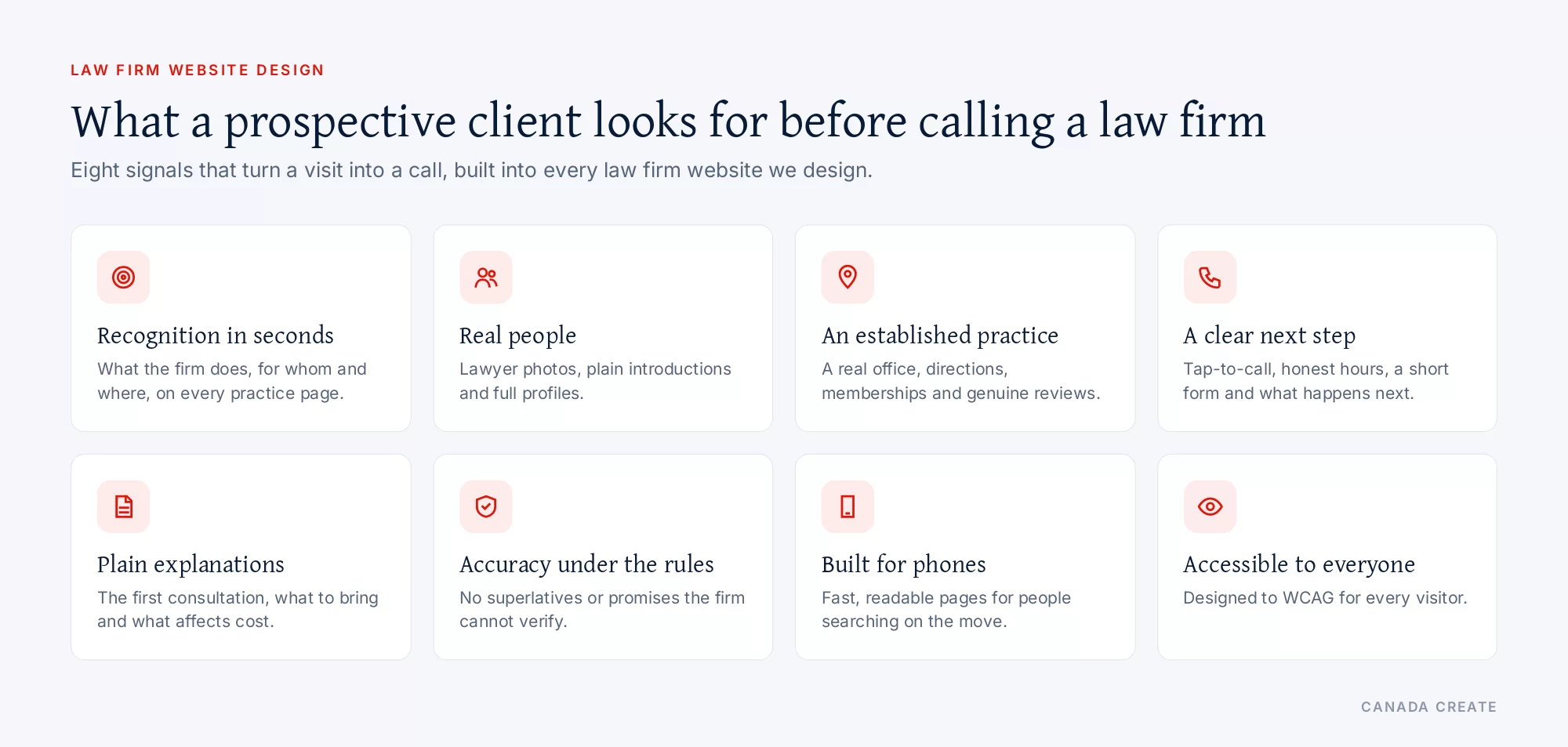
What prospective clients look for on a law firm website
When people describe how they chose a lawyer online, the same things come up again and again: proof that the firm handles matters like theirs, a lawyer they could picture speaking with, signs that the firm is established and close by, and a sense of what would happen next. Our design process is built around those signals.
- Recognition within seconds: the home page and each practice page say plainly what the firm does, for whom and where.
- Real people: professional photos of the lawyers and staff, short plain-language introductions and full profiles a click away.
- Signs of an established practice: a real address with directions, memberships the lawyers hold, publications and talks, and live Google reviews where the firm chooses to show them.
- A clear next step: a visible phone number, honest hours, a short form and a simple explanation of what happens after someone gets in touch.
- Plain explanations: what a first consultation involves, what to bring and what affects the cost and timing of a matter.
Practice area pages and site structure
The structure of a law firm website decides how easily people and search engines find what they need. We plan it before any design work starts, from the matters you want rather than from a template.
A typical structure has a home page that introduces the firm and its main practice areas, a page for each practice area, sub-pages for distinct matters within a practice, a profile for each lawyer, a page for each office, guides and FAQs, and contact and booking pages. Internal links connect each practice page to the lawyers who handle it, the offices where it is offered and the guides that answer related questions.
Practice pages carry most of the weight. Each one has one main matter, a plain opening that says who it helps, an explanation of how the matter usually unfolds in Ontario, the lawyers involved, what affects cost and timing, common questions and an easy next step. For an employment practice that might mean separate pages for wrongful dismissal, constructive dismissal, workplace harassment and employer advice; for a real estate practice, purchases, sales, refinancing and commercial leases.
Practice areas we design websites for
- Personal injury: case type pages, plain fee explanations and fast contact for people writing from a phone after an accident. See personal injury lawyer SEO in Toronto.
- Family and divorce: a calm design, Divorce Act terminology and a quick exit option on sensitive pages. See family lawyer marketing in Toronto.
- Criminal defence: charge-specific pages and honest availability for urgent calls. See criminal lawyer SEO in Toronto.
- Immigration: multilingual pages for each program, kept current. See immigration lawyer SEO in Toronto.
- Employment: separate routes for employees and employers. See SEO for employment lawyers in Toronto.
- Real estate: transaction pages and, where you advertise prices, wording that meets Rule 4.2-2.1. See real estate lawyer SEO in Toronto.
- Wills and estates: planning and estate administration pages with a gentle tone. See estate lawyer SEO in Toronto.
- Corporate and business: lawyer profiles and practice pages that support referral relationships.
Lawyer profiles and office pages
Lawyer profiles are among the most visited pages on any law firm website, because people want to know who they will be speaking with. A complete profile includes a professional photo, the lawyer’s name, year of call and jurisdictions, practice focus, education, languages, memberships, publications and talks, and links to the practice pages the lawyer works on.
Two rules shape profiles. Rule 4.2-1.1 requires a lawyer marketing legal services to identify in all marketing materials that they are licensed as a lawyer, so profiles and practice pages should make clear that services are provided by licensed lawyers (and, where relevant, by licensed paralegals). Rule 4.3-1 allows “specialist” only for lawyers certified by the Law Society, so the word appears only on the profile of a Certified Specialist.
Office pages help both clients and local search. Each real office gets its own page with the address, directions, parking and transit, accessibility details, hours, the lawyers who meet clients there and the Google Business Profile it connects to.
Photography and video for law firm websites
Real photography changes how a law firm website feels. Prospective clients respond to the faces of the lawyers they might meet and to the office they might visit, and generic images of gavels, scales and handshakes make one firm look like every other. We recommend a half-day shoot for most firms: individual portraits in a consistent style, a few team and office images, and details of the reception and meeting rooms that show a welcoming, professional space. Photos should never show files, screens or whiteboards with client information, and anyone who is not staff appears only with written consent.
Video adds a voice. A short introduction from each lawyer, a clip explaining what happens at a first meeting, or answers to the three questions clients ask most often can sit on practice pages and on YouTube. Scripts follow the Law Society’s marketing rules, with no outcome promises, superlatives or implied aggression. Our video production team can film in your office, and captions keep every video accessible.
Intake, forms and first contact
The contact route is where a website succeeds or fails. We design first contact around how your firm actually takes new matters.
- Phone first: a tap-to-call number in the header on every phone screen, with hours shown honestly.
- Short forms: only what the firm needs to call back and run a conflict check, with a clear note not to send confidential details before the firm agrees to act.
- Booking: online consultation booking where your calendar allows it.
- Chat and after-hours answers: an AI receptionist or chat that takes messages and books callbacks when the office is closed.
- Tracking: calls and forms recorded by page and source, without sending legal matter details to analytics.
- CRM connection: enquiries flow into a CRM for law firms so each one has an owner and a follow-up.
Accessibility, speed and security
Ontario’s Accessibility for Ontarians with Disabilities Act sets web accessibility requirements for many organizations, and building to WCAG makes a site easier for everyone to use, including people reading on a phone in difficult circumstances. We design for readable text, good colour contrast, keyboard navigation, descriptive links, image alternative text, captions for video and forms that work with screen readers.
Speed matters because many legal searches happen on phones. We keep pages light, load images efficiently, avoid unnecessary scripts and test real performance before launch. A fast site helps visitors and supports search rankings.
Security protects the firm and its clients. Every site we build uses HTTPS, secure forms, regular updates and backups, and hosting configured for business websites. Managed web hosting in Toronto and website maintenance and security are available as separate services.
Design that suits your firm’s character
Law firms are not all the same, and their websites should not look the same either. A Bay Street corporate practice, a neighbourhood family law office in Scarborough, a multilingual immigration firm in North York and an injury firm that advertises on television all speak to different people in different moments.
We start design from your firm’s clients and how you want them to feel when they arrive: reassured, respected, confident in the firm’s competence, comfortable picking up the phone. That shapes typography, colour, photography and the density of each page. Calm layouts with generous spacing suit family and estates practices. Clear, direct layouts with prominent contact routes suit urgent practices. Formal, restrained design suits business clients comparing firms on reputation.
What every law firm design shares is clarity. Headlines say what the page is about, body text is easy to read on a phone, contact routes are always visible and nothing decorative gets in the way of a worried reader finding what they need.
Writing content for a law firm website
Content is usually the slowest part of a law firm website project, because lawyers are busy and legal content needs care. We plan it so your lawyers spend their time reviewing rather than writing from scratch.
For each practice page, we interview the responsible lawyer for twenty or thirty minutes about the matters they handle, the questions clients ask, what they explain on every first call and what they wish clients knew earlier. We turn that into a draft written for the client, in plain Canadian English with correct Ontario terminology, and send it for review. Lawyers mark changes, we revise, and nothing legal is published without approval.
Profiles follow the same approach. We gather the facts each lawyer wants to share, write a short introduction in a consistent voice across the firm and confirm credentials, years of call and memberships before publishing.
Guides and FAQs come next: short, accurate answers to the questions people search, each one linked to the relevant practice page. They keep working after launch, both for prospective clients and for search engines and AI tools that look for clear answers.
How a law firm website project runs
Every project follows the same path, adjusted to the size of the firm.
Discovery and planning
We learn about the firm, its clients, the matters it wants more of and how it takes new enquiries, review the current site and its search data, and agree a site map with a page for each practice area, lawyer and office.
Content and design
Content is drafted from lawyer interviews and approved by the firm. In parallel, design concepts for key pages are presented, refined and approved, starting with the home page and a practice page.
Build and testing
The site is built on the chosen platform with forms, booking, tracking, structured data and accessibility features. We test on phones, tablets and desktops, check speed, validate markup, test every form and review accessibility before showing the site to your team for final approval.
Launch and the weeks after
At launch, redirects go live, search engines are asked to recrawl, Google Business Profiles are linked to the right office pages and analytics is confirmed. We watch search data and enquiries over the following weeks and fix anything that needs attention.
Signs your law firm website needs a redesign
A firm usually knows its website is holding it back when several of these apply:
- The site is hard to use on a phone or slow to load.
- Practice areas are listed on one page instead of having their own pages.
- Lawyer profiles are missing, outdated or inconsistent.
- The site still shows lawyers who have left, old offices or outdated rules.
- Referral sources say they do not send people to the website.
- Enquiries from the site are few, or nobody knows how many there are.
- Updating a page needs a developer every time.
- The design no longer matches the firm the partners describe.
Common law firm website mistakes
The same problems appear on many law firm websites in Toronto: a home page that talks about the firm’s history before saying what it does, stock photos instead of real lawyers, a single services page for every practice area, contact details hidden in the footer, long forms that ask for confidential information, testimonials and “best lawyer” badges used without checking the Law Society rules, missing redirects after a redesign and no tracking of calls or forms. Each one is straightforward to fix once it is identified.
Marketing after launch
A new website is the start of the firm’s online growth, not the end. After launch, firms usually choose one or more of: ongoing SEO for lawyers and law firms in Toronto to build visibility for each practice area, lawyer advertising in Toronto for urgent matters and new practice areas, review management within the Law Society rules, and regular content updates as the law and the firm change. Because the site was built for search and tracking from the start, every one of those channels has a strong foundation.
Law Society rules for law firm websites
Every page of a law firm website is marketing under the Law Society of Ontario’s Rules of Professional Conduct. Rule 4.2-1 requires marketing to be demonstrably true, accurate and verifiable, not misleading, confusing or deceptive, and in the best interests of the public. For a website, that affects headlines, practice pages, profiles, testimonials, results pages and even image alt text.
Points we design around, for your lawyers to confirm:
- No unverifiable superlatives: the commentary treats “best”, “super” and “#1” as rankings that must be bona fide and not misleading.
- Results with the required statement: amounts recovered or past success may contravene the rule unless accompanied by a statement that past results are not necessarily indicative of future results and outcomes vary with the facts.
- Careful testimonials: testimonials or endorsements with emotional appeals are among the practices that may contravene the rule.
- No second opinion offers: Rule 4.2-1.2 prohibits marketing second opinion services.
- Fees: fee advertising must meet Rule 4.2-2, residential real estate prices Rule 4.2-2.1, and contingency fee marketing Rule 3.6-2.2.
- Licensing: pages make clear whether services come from licensed lawyers, licensed paralegals or both.
Our guide to lawyer advertising rules in Canada covers these rules in depth, and the full text is on the Law Society of Ontario’s Chapter 4 page. This is general information, not legal advice; your firm approves all content before publication.
An SEO-ready law firm website
A website that looks good but cannot be found does not help a firm grow. We build law firm sites so they are ready to rank from launch: a clear page hierarchy, one practice page per matter, descriptive titles and meta descriptions, clean URLs, internal links between practice, lawyer and office pages, LegalService, Person, BreadcrumbList and FAQPage structured data that matches the visible content, an XML sitemap and fast, accessible pages.
After launch, SEO for lawyers and law firms in Toronto can build on that foundation with content, local search, reviews and links. Firms that want to be described correctly in AI answers can also look at our AI SEO and AI search optimization in Toronto.
Redesigns, migrations and launch
A redesign should keep everything the old site earned. Before we move a law firm site, we inventory every page, the search terms each one ranks for and the links pointing to it. Every old URL gets a one-hop redirect to its new home, so search history and bookmarks are kept.
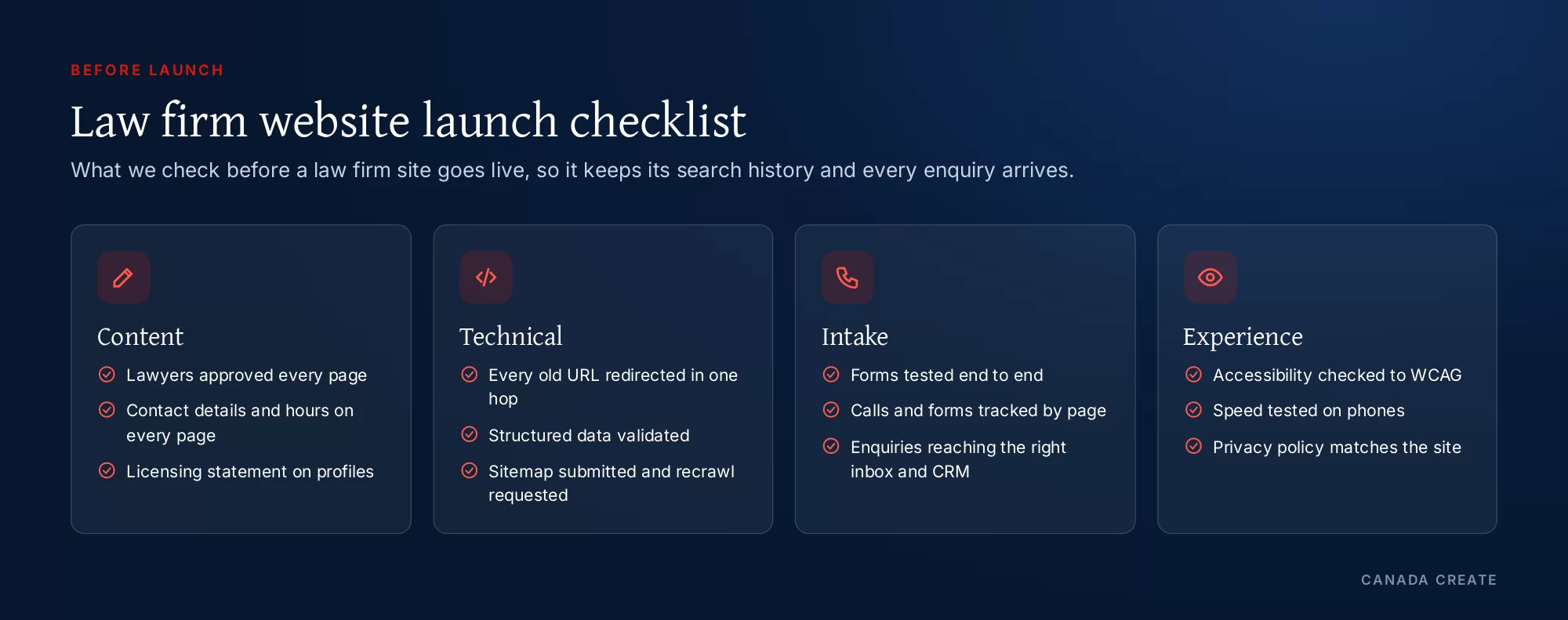
A launch checklist for a law firm website covers content approval by your lawyers, contact details and hours on every page, forms tested end to end, tracking checked, redirects in place, structured data validated, accessibility and speed tested, privacy policy updated, Google Business Profile links pointed to the right office pages and a search engine recrawl requested. In the weeks after launch we watch search data and fix anything that slips. Our website redesign in Toronto page covers redesigns for every kind of business.
Platforms for law firm websites
Most law firm websites we build run on WordPress, which gives firms full ownership, flexibility for practice and lawyer pages and a large range of accessibility and security tools. Some firms prefer a hosted platform they can edit easily. We work with:
WordPress
Our usual choice for law firms that want flexibility, multilingual pages and room to grow. See WordPress developer in Toronto.
Webflow
A good fit for firms that want a design-led site with a visual editor and hosted infrastructure. See Webflow agency in Toronto.
Squarespace and Wix
Suitable for a small or solo practice that wants a simple, low-maintenance site it can update itself. See Squarespace website design in Toronto and Wix website design in Toronto.
Templates or custom design for a law firm
Templates can work for a new solo practice that needs a credible site quickly. They become limiting when a firm needs several practice areas, multiple offices, multilingual content or a distinct brand, and many template sites look alike in a crowded Toronto market.
A custom design starts from your firm’s clients and positioning, so the site reflects how the firm actually works. It also lets us build the structure, accessibility and search features in from the start rather than adding them afterwards. We can recommend the right level of design for your firm’s stage and budget.
What law firm website design costs in Toronto
Law firm website projects are quoted in writing after a free consultation. The cost depends on the number of practice areas, lawyers and offices, how much content needs writing or rewriting, the number of languages, custom features such as booking or calculators, content migration from an old site, the platform and the level of design. The proposal separates the project fee from hosting, maintenance and third-party costs.
How to compare law firm web design agencies in Toronto
Questions worth asking any agency, including us:
- Which law firm websites have you designed, and can we see them?
- Who writes the practice content, and how do our lawyers review it?
- How do you handle the Law Society’s marketing rules on a website?
- How do you meet accessibility requirements?
- What happens to our old URLs and search history?
- How will enquiries be tracked, and where do form submissions go?
- Who owns the domain, the website and the content?
- What support is available after launch?
Related guides: what prospective clients look for on a law firm website, the law firm website launch checklist and the law firm website content review checklist.
Talk to a strategist
Ready when you are?
Request a custom proposal
Tell us your goals, budget and timeline. You get a custom proposal and a named strategist, so your next stage of growth starts now.
Law firm website design stages, from discovery to launch approval
Your agreement sets the scope, schedule and review responsibilities. These are the main decisions your firm participates in, with timing based on the size of the project and content approvals.
- Discuss the firm Discovery
Tell us about your practice areas, preferred matters, current website and intake capacity. We discuss whether a focused improvement or a wider redesign fits the need.
- Agree scope and fees Before work starts
Review a written proposal covering deliverables, content responsibilities, review points, schedule and costs. Hosting and ongoing services are identified separately.
- Review content and design Agreed milestones
Your firm reviews the proposed pages, copy and visual direction. The right lawyers approve legal explanations, credentials, fee wording and any results or testimonials.
- Review the website Before launch
Review the completed pages and agreed enquiry features against the written scope. Accessibility coverage and testing are defined in your agreement.
- Launch and handover Agreed launch date
Receive handover training for the delivered website. Ongoing care is separately scoped.
Law firm websites from our portfolio
Law firm websites we designed, with the advertising we ran alongside them.


Why choose Canada Create for your firm
In business since 2008
An established Toronto business bringing design, content and website development into one agreed engagement.
BBB Accredited, A+ rating
Our BBB business profile lists an A+ rating and accreditation, with business history dating to 2008.
Your firm controls approval
Content is presented for your review. Your lawyers approve professional claims and remain responsible for legal and regulatory requirements.
Intake considered from the start
Contact options and enquiry handling are agreed around your practice areas and the staff responsible for responding.
Law firm website design in Toronto: questions firms ask
The basics
What makes a good law firm website?
A good law firm website tells a prospective client within seconds what the firm does, for whom and where, introduces the lawyers who would help, makes contact easy on a phone and explains what happens next. It is accurate under the Law Society rules, accessible, fast, secure and built so search engines can understand every practice, lawyer and office page.
How do you build a website for a law firm?
Start with the matters the firm wants and the clients it serves, plan a structure with a page for each practice area, lawyer and office, then design, write and build. Content is approved by the firm's lawyers, forms and tracking are tested, accessibility and speed are checked and old URLs are redirected before launch.
Is a new law firm website design still worth it in 2026?
Yes, when the current site is slow, hard to use on a phone, missing practice or lawyer pages, or no longer reflects the firm. The website is where referrals, search results, ads and AI answers all send people, so a weak site reduces the return from every other channel. A sound site may need only new content.
What legally needs to be on a law firm website in Ontario?
Marketing must meet the Law Society's Rule 4.2-1, and Rule 4.2-1.1 requires lawyers to identify that they are licensed as lawyers in marketing materials. A privacy policy that matches how the site collects information is expected, and many organizations have accessibility obligations under the AODA. This is general information, not legal advice.
What pages should a law firm website have?
A home page, a page for each practice area and distinct matter, a profile for each lawyer, a page for each office, guides and FAQs, a contact and booking page, an about page and a privacy policy. Pages that explain the first consultation and how fees are discussed also help prospective clients decide to call.
What does a small or solo law firm website need?
A clear home page, one strong page for each practice area the lawyer wants, a full profile with a professional photo, an office page with directions and hours, a short contact form and a tap-to-call phone number. A solo site can be small and still outperform larger firms if it is focused, fast and accurate.
What is the difference between law firm web design and law firm web development?
Design covers how the site looks and how people move through it: layout, typography, colour, photography and page structure. Development is the build: the platform, templates, forms, integrations, speed, security and structured data. A law firm website needs both, planned together so the design works on every screen.
Design and content
What do prospective clients look for on a law firm website?
Proof that the firm handles matters like theirs, a lawyer they can picture speaking with, signs that the firm is established and nearby, plain explanations of what happens next and an easy way to get in touch. Real photos, accurate profiles, honest hours and clear practice pages answer those questions.
Is a law firm website template enough, or is custom design better?
A template can work for a new solo practice that needs a credible site quickly. Custom design suits firms with several practice areas, offices or languages, or a distinct brand, and it lets accessibility, structure and search features be built in from the start. Many template sites look alike in a crowded market.
Who writes the content for a law firm website?
We write drafts from interviews with your lawyers and our research, and your lawyers review and approve every legal statement before publication. Lawyers who prefer to write can send drafts for us to edit for clarity, structure and search. Either way, the firm decides what it publishes.
How should practice area pages be written?
For the client, not the firm. Each page should name the situations it helps with, explain how the matter usually unfolds in Ontario, introduce the lawyers involved, describe what affects cost and timing, answer common questions and offer an easy next step, all in plain language and reviewed by the firm's lawyers.
Should a law firm website show lawyer photos?
Yes. Professional photos of the lawyers and team are one of the strongest trust signals on a law firm website, because people want to see who they will be dealing with. Stock photos of handshakes and gavels add little. Photos should be current and consistent across profiles.
Should a law firm website publish fees?
That is the firm's choice. Fee advertising must be reasonably precise, say whether disbursements, third-party charges and taxes are extra and be honoured, under Rule 4.2-2. Residential real estate prices follow Rule 4.2-2.1. Many firms explain instead what affects the cost and how fees are discussed at the first consultation.
Can a law firm website show testimonials and case results?
It can, with care. Testimonials with emotional appeals may contravene Rule 4.2-1, and amounts recovered or past success need a statement that past results are not necessarily indicative of future results and outcomes vary. Client permission and confidentiality apply, and your lawyers decide what is appropriate.
Should a law firm website be multilingual?
If your lawyers serve clients in other languages, yes. Each language version should be a properly translated and reviewed page with language markup, not an automatic translation widget. That helps search engines show the right version and shows clients the firm genuinely works in their language.
What tone should a family or criminal law website use?
Calm, clear and respectful. People reading these pages are often stressed or frightened, so plain language, practical next steps and honest availability matter more than dramatic wording. The Law Society's commentary also flags marketing that implies the lawyer is aggressive, so confident wording should stay factual.
What are some examples of good law firm websites?
Good examples share a few traits: a clear statement of what the firm does on the first screen, real lawyer photos, a page for each practice area, honest hours and a tap-to-call number, plain explanations of the first consultation and fast pages. Our portfolio includes the Ghasemi Law and Azimi Law websites.
Intake and features
What contact options should a law firm website offer?
A tap-to-call phone number on every page, a short form, online booking where the calendar allows it, and a way to leave a message or book a callback after hours. Office hours should be shown honestly, and urgent matters, such as criminal arrests, may need their own clear route.
What should a law firm contact form ask?
Only what the firm needs to call back and run a conflict check, such as name, contact details, the type of matter and the other party's name where relevant. Add a clear note not to send confidential details until the firm agrees to act. Shorter forms are completed more often.
Can a law firm website use chat or an AI receptionist?
Yes. Chat or an AI receptionist can answer simple questions, take messages and book callbacks outside office hours, so enquiries are not lost. It should not give legal advice or collect confidential details, and it should hand people to a person for screening and conflict checks.
Should a law firm website have online booking?
It helps for practices with planned appointments, such as wills, real estate and many family matters, because people can pick a time without waiting for a callback. Urgent practices may prefer a phone-first route. Booking should still allow a conflict check before the consultation.
Should a family law website have a quick exit button?
It is good practice on pages about separation, family violence or child protection, because someone may need to leave the page quickly if another person walks in. A quick exit button takes the reader to a neutral site in one tap. Privacy-conscious design also avoids remarketing on these topics.
How do we track enquiries from a law firm website?
With tracked phone numbers, form tracking and booking events recorded by page and source, connected to your CRM where possible. Tracking should record which page and channel led to the enquiry, never the details of the legal matter, and intake should note which enquiries become consultations and retained matters.
Can a law firm website connect to our practice management software?
Often, yes. Form submissions and bookings can flow into a CRM or practice management tool through built-in integrations or a connector, so every enquiry is recorded with its source. We confirm what your software supports during planning and keep confidential matter details out of marketing systems.
Accessibility, speed and security
Does a law firm website need to meet AODA accessibility standards?
Many Ontario organizations have web accessibility obligations under the AODA, depending on their size and type, and building to WCAG is the usual way to meet them. Accessible design also helps every visitor and search engines. Your firm should confirm its own obligations; we build to WCAG either way.
How fast should a law firm website load?
As fast as possible on a phone, because many legal searches happen on mobile, sometimes in stressful situations. Pages should show their main content quickly and respond immediately to taps. Light images, few scripts and good hosting usually make the biggest difference.
How do you keep a law firm website secure?
HTTPS on every page, secure forms, regular updates to the platform and plugins, strong logins with two-factor authentication, daily backups, monitoring and hosting configured for business sites. Forms should not collect more information than needed, and access to the site should be limited to the people who need it.
Should our law firm host its own website or use managed hosting?
Most firms are better served by managed hosting, where updates, backups, security monitoring and performance are handled for them. Self-managed hosting gives control but needs someone to maintain it. Hosting and maintenance with Canada Create are separate services you can choose with or without a website project.
What privacy policy does a law firm website need?
One that explains accurately what information the site collects, through forms, chat, cookies and analytics, why it is collected, how it is used and protected and how people can contact the firm about it. It should match what the site actually does, so it needs updating when tracking or tools change.
SEO and rules
Does SEO work for a law firm website?
Yes, when the site is built for it: one page per practice area and matter, clear titles and headings, internal links between practice, lawyer and office pages, structured data, fast pages and a matching Google Business Profile. Ongoing SEO then adds content, local search, reviews and links on top of that foundation.
Will a new website hurt our law firm's Google rankings?
It can if old URLs are not redirected, ranking content is removed or the new site is slower. A careful redesign maps every old page to its new home with a one-hop redirect, keeps or improves the content that ranks, tests speed and tracking and monitors search data closely after launch.
Which Law Society rules apply to law firm website design?
Chapter 4 of the Law Society of Ontario's Rules of Professional Conduct, mainly Rule 4.2-1 on accurate, verifiable marketing, 4.2-1.1 on identifying licensed lawyers, 4.2-1.2 on second opinion marketing, 4.2-2 and 4.2-2.1 on fees and 4.3-1 on specialist claims. Your lawyers approve content against them.
Can a law firm website say best lawyer or top law firm?
Avoid it. The Law Society's commentary treats best, super and number one as rankings that must be bona fide and not misleading, and suggesting superiority over other lawyers may contravene the rule. That applies to headings, titles, image alt text and meta descriptions as well as body text.
What structured data should a law firm website use?
Organization and LegalService or LocalBusiness markup for the firm and each office, Person markup for lawyers, BreadcrumbList for site structure and FAQPage for visible FAQs. The markup must match what the page shows. We validate it before launch and after any major change.
Can ChatGPT or another AI tool create a website for a law firm?
AI tools can produce a basic layout and draft text, but a law firm site needs accurate legal content reviewed by lawyers, compliance with the Law Society rules, accessibility, security, tracking and a structure built around the firm's practice. AI can help a team work faster; it does not replace that review.
How does a law firm website help with AI search answers?
AI answers draw on pages that are indexed, clear and consistent with what other sources say about the firm. Practice pages that answer questions directly, accurate profiles, structured data and consistent business details across the web make an accurate description of the firm in AI answers more likely.
Should each office have its own page on a law firm website?
Yes. Each real office should have a page with its address, directions, parking and transit, accessibility details, hours and the lawyers who meet clients there, linked from its Google Business Profile. Office pages help people choose a location and help the firm appear in local search for that area.
Platforms and redesigns
Which website builder is best for lawyers?
It depends on the firm. WordPress suits most firms that want flexibility, ownership and multilingual pages. Webflow suits design-led sites with a visual editor. Squarespace and Wix suit small practices that want simple, low-maintenance sites they can edit themselves. We recommend a platform after understanding your needs.
Is WordPress a good platform for a law firm website?
For most firms, yes. It supports any number of practice, lawyer and office pages, multilingual content, accessibility and security tools, and the firm owns its site outright. It needs regular updates and good hosting, which managed maintenance can take care of.
How often should a law firm redesign its website?
There is no fixed schedule. Redesign when the site no longer reflects the firm, works poorly on phones, is hard to update or fails accessibility and speed checks. Between redesigns, keep content, profiles and practice pages current, which often matters more to clients and search engines than a new look.
What happens to our old content when we redesign?
We inventory every page, keep or improve the content that ranks or brings enquiries, merge thin or duplicate pages and redirect every old URL to its best new home in one hop. Outdated legal information is updated or removed with your lawyers' approval.
Can you redesign our site without changing our domain?
Yes, and keeping the domain is usually best for search. If a rename or merger requires a new domain, we redirect the old domain page by page, update listings and Google Business Profiles and monitor search data closely so the firm keeps the visibility it has earned.
How long does a law firm website project take?
It depends on the number of practice areas, lawyers, offices and languages, how much content needs writing and how quickly your lawyers can review drafts. A focused solo site is much faster than a multi-office redesign with migration. The proposal sets out a realistic schedule for your project.
Can we update the law firm website ourselves after launch?
Yes. We set up the editor so your team can change text, add lawyers, update hours and publish guides without touching code, and we show staff how to do it. Changes to legal content should still go through a lawyer's review, and larger changes can be handled by maintenance.
Cost and choosing an agency
What do law firms pay for a professionally designed website?
Canada Create quotes law firm websites in writing after a free consultation, because cost depends on the number of pages, practice areas, offices and languages, content writing, custom features, migration, the platform and the level of design. The proposal separates the project fee from hosting, maintenance and third-party costs.
What drives the cost of a law firm website?
The main factors are the number of practice area, lawyer and office pages, how much content needs writing, languages, custom features such as booking or calculators, migration of an old site, accessibility testing, integrations with CRM or practice software and the level of custom design.
What should lawyers compare when choosing among law firm website design companies?
Law firm examples, who writes the content and how lawyers review it, the approach to the Law Society rules and accessibility, how redirects and search history are handled, how enquiries are tracked, who owns the domain and site, and what support is offered after launch.
Who owns the law firm website after it is built?
Your firm does. With Canada Create, the domain, website, content and analytics are in your firm's name where the platform allows, and you can host and maintain the site with us or elsewhere. We provide the access and files your firm needs.
Do you offer ongoing maintenance for law firm websites?
Yes, as a separate service. Maintenance can cover updates, backups, security monitoring, uptime checks, small content changes and performance reviews. Many firms combine it with managed hosting so one team looks after the site after launch.
Can you design a law firm website and run SEO and ads too?
Yes. We design law firm websites, run SEO and Google Ads for lawyers and set up intake tools, and these can be combined in one program with shared reporting. Each part is scoped separately in your custom proposal, so the firm chooses what it needs.
Do you design websites for law firms outside Toronto?
Yes. Our office is in Toronto and most of our law firm work is in Toronto and the GTA, including Mississauga, Vaughan and Markham, but we design websites for firms elsewhere in Ontario and across Canada. Content follows the rules of the provinces where the firm practises.
How do we start a law firm website project with Canada Create?
Request a custom proposal or call (416) 273-9030. We discuss your practice, the matters you want more of, your offices and your current site, review what exists today and send a written proposal with scope, fees, schedule and responsibilities before work begins.


Refresh, redesign or ongoing marketing for your law firm website?
Send your website address and the main problem you want to solve. We can discuss whether a refresh, redesign or ongoing marketing best fits your firm. A written proposal follows discovery.