
How local businesses get cited in AI search and turn it into phone calls

A monthly report that celebrates impressions, followers and “visibility” while the phone stays quiet is not a marketing report. It is a receipt.
Search has changed in a way most reports still ignore. A homeowner in Etobicoke looking for furnace repair, or a clinic manager in Calgary comparing billing services, now often gets an answer before seeing a single website. Google’s AI Overviews summarize the options at the top of the page. AI chat assistants name two or three businesses and explain why. The businesses named in those answers get the call. Everyone else gets impressions.
This guide is for owners and marketing directors in Canada and the US who are measured in booked jobs, not dashboards. It covers what changed, what to measure, what Google and AI systems need before they trust a local business, and how to back every claim on your website so you are worth citing. The goal is simple: get cited in AI search, then turn that mention into a qualified call. If you are in the GTA and want the service side of this work, see what local SEO in Toronto covers.
Why ranking stopped being the finish line
For years the goal was clear: rank in the top three, win the click. That still matters, but a results page now has four places where a local buyer can stop.
Where local buyers stop now
- The map pack, where calls and direction requests happen without a website visit.
- Organic results, still the main route to your service pages.
- Google AI Overviews, which summarize options and name sources at the top of the page.
- AI chat assistants such as ChatGPT, Gemini, Copilot and Perplexity, which shortlist businesses in a conversation.
What a citation is worth
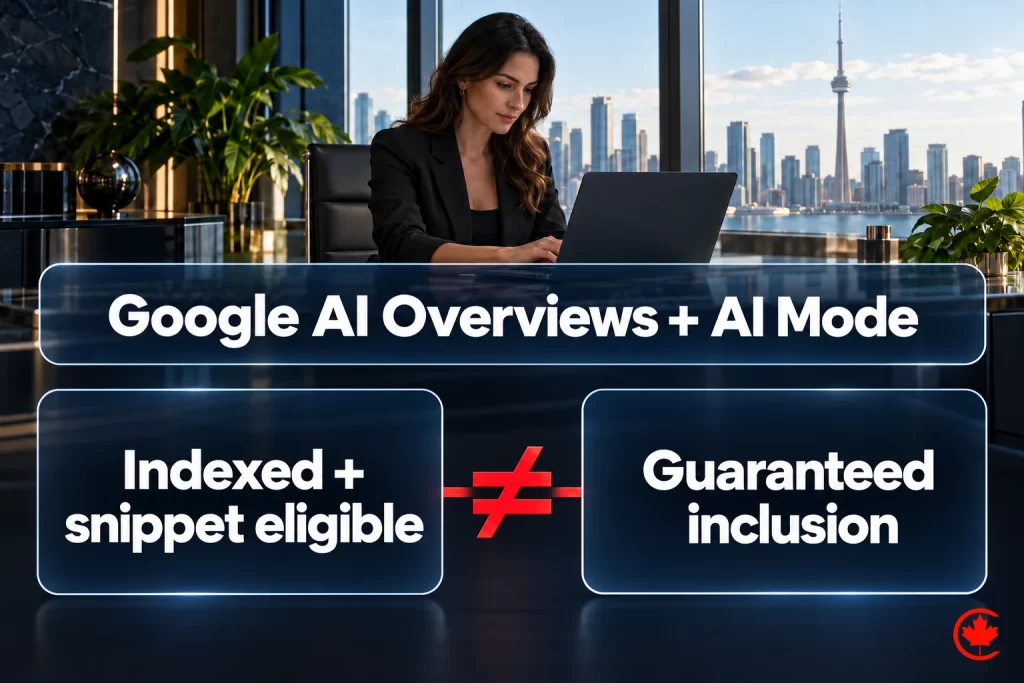
A citation in an AI answer works like a referral. The buyer did not compare ten websites; a system they trust did the shortlisting for them. That shortlist tends to favour businesses with consistent facts, clear service pages and proof that matches across the web. Ranking still feeds the process, because AI Overviews draw on pages Google already considers relevant. Treat traditional SEO as the entry ticket and Google AI Overviews optimization as the next round, not a replacement.
Measure revenue, not visibility
Vanity metrics are easy to grow and easy to report. Impressions, reach, average position and sessions can all rise while revenue stays flat. Before you change a single page, agree on the numbers that decide whether the work is paying.
The five numbers every local SEO report should show
- Tracked phone calls by source, with call length.
- Qualified form submissions, with spam, job seekers and vendor pitches removed.
- Booked jobs or appointments that came from those calls and forms.
- Cost per qualified lead, by channel.
- Revenue per channel, even as a range.
If your current report shows none of these, the first fix is measurement, not content.
Separating qualified calls from noise
Not every call is a lead. Set a minimum call length that reflects a real conversation in your trade, tag each call by outcome in your CRM, and listen to a sample every month. One call that books a job is worth more than ten that ask for your hours, and your reporting should show that difference.

The entity signals Google and AI systems trust
Search engines and AI systems describe the world as entities: a business, the services it offers, the places it serves and the evidence that it is real. The clearer those relationships are, the easier it is for a system to name you with confidence.
One name, address and phone everywhere
Your business name, address and phone number should read the same on your website, Google Business Profile, directories, social profiles and invoices. Small differences, such as “Suite 3” in one place and “#3” in another, or an old number on a directory, create doubt. Doubt keeps you out of answers.
A complete Google Business Profile
Choose the most accurate primary category, list every real service, keep hours current, add recent photos of your team and your work, and answer the questions customers actually ask. Our Google Business Profile optimization guide walks through each field.
Structured data that matches the page
LocalBusiness structured data tells search engines your name, address, phone, hours and service areas in a format they read directly. It must match what a visitor sees on the page. Markup that claims something the page does not show weakens trust instead of building it. Google’s own documentation on local business structured data is the plain reference. You can confirm the markup is readable with the Rich Results Test after each change.

Reviews and owner replies
Reviews are evidence written by someone other than you. Ask every satisfied customer, reply to every review with specifics, and handle complaints in public with the same care you would give in private. Do not add review stars to your own site through markup; Google does not show them for a business reviewing itself.
Storefront or service area
A clinic that customers visit and a contractor who drives to job sites are set up differently. Service-area businesses hide the street address and list the cities or regions they serve. Pick the setup that matches how you actually work.
What does it take for a local business to be cited in AI search?
A local business gets cited in AI search when its name, services, location and proof are consistent wherever they appear, its website answers buyer questions directly on clear service pages, and independent sources such as reviews, directories and local media confirm the same facts. AI systems repeat what they can verify.
Six steps make a business citable:
- Make your core facts identical across the web: name, address, phone, hours and services.
- Build one page for each real service, and name the city or region you serve in plain words.
- Answer the main buyer question in the first 40 to 60 words of each section, then expand.
- Describe the business and its services with structured data that matches the visible page.
- Earn independent confirmation: reviews, industry associations, local news, supplier and partner listings.
- Show the people behind the work: named authors, credentials, licence numbers and real project photos.
Think of it as a chain a machine can check: business → offers service → in a place → proven by evidence. A Scarborough plumbing company that offers drain camera inspections across Scarborough and Pickering, lists the licences it holds, and has reviews mentioning drain work by name gives every link in that chain something to confirm. For the content-editing side, see how to get your business cited in AI search answers.
Lead generation websites: turning a visit into a call
A buyer who arrives from an AI answer has half made the decision. Your page then has a few seconds to confirm it. The best lead generation websites in Toronto, and anywhere else, share four habits.
Fast and stable on a phone
Pages should load quickly on mobile data and not jump while loading. Google’s Core Web Vitals measure exactly this, and you can check any page for free in Google’s PageSpeed Insights.
Click to call where the eye lands
Put a tap-to-call number in the header and in the first screen of every service page, next to your hours. A buyer ready to call should never have to scroll to find out how.
One page per real service
A single services page that lists everything cannot answer specific questions. Give each real service its own page with its own proof, and avoid two pages chasing the same search; they compete with each other instead of with your competitors.
Forms that qualify
Ask for what you need to quote: the service, the location and the timing. Every extra field costs you some submissions, but the right fields save your team hours of back and forth.
Proof you can stand behind: the message-evidence matrix
Every claim on your website is either backed by evidence or a liability. A message-evidence matrix is a simple table that keeps the two connected. Build it before you write or rewrite a page.
| Claim | Evidence you can show | Where it appears |
|---|---|---|
| Licensed and insured | Licence number and insurer name | Footer, service pages, Google Business Profile |
| Same-day service in North York | Dispatch records showing typical arrival times | Service page, FAQ |
| Hundreds of kitchens renovated | Project gallery with dates and neighbourhoods | Portfolio, service page |
| Trusted by local families | Reviews that mention the service by name | Review section, Google Business Profile |
We help businesses show up in Google AI Overviews, ChatGPT and other answer engines.
If you cannot fill the evidence column for a claim, rewrite the claim or remove it.
Feed E-E-A-T with raw data from your business
Experience, expertise, authoritativeness and trustworthiness are not added by a writer after the fact. They come from the business. Give whoever writes your pages:
- Real numbers you can stand behind, such as jobs completed in a season or typical turnaround times.
- Original photos of your team, vehicles and finished work, with written permission from anyone identifiable.
- Licence, registration and association numbers.
- The questions customers ask on the phone, in their own words.
- A named author or reviewer for each page, with a short bio.
Keep a human editor in charge
AI writing tools can speed up drafting, but they also state invented facts with confidence. Every page should be read and approved by someone who knows the work before it goes live, and reviewed again whenever prices, services or staff change.
Calibrating for Toronto and for US markets
Toronto and the GTA
Demand in the GTA is local down to the neighbourhood. A buyer in Scarborough, North York or Mississauga often searches with the neighbourhood name, and map results reflect distance. Name the areas you truly serve on pages that show work there, rather than listing every city in a footer. The GTA is also multilingual: if your team serves customers in Farsi, Mandarin, Punjabi or Tagalog, say so, and offer pages in those languages written by fluent speakers.
Canadian rules worth knowing
Write Canadian pages in Canadian English. Follow-up emails and texts to leads fall under Canada’s Anti-Spam Legislation (CASL), which requires consent, clear sender identification and a working unsubscribe option.
Serving US buyers too
US searches often use state and county names, US spelling and different licensing terms. If you serve both countries, give each market its own pages rather than one page trying to speak to both.
How to choose a Canadian digital marketing agency
If you hire help, judge any agency, including ours, by its answers to these questions:
- Which numbers will you report each month, and can I see a sample report?
- How do you track calls and separate qualified leads from noise?
- Who writes the content, and who checks the facts before it goes live?
- Will the website, profiles and ad accounts be in my business’s name?
- What will you need from me each month?
An agency that answers in impressions and rankings alone is selling visibility. Look for one that answers in calls and booked work.

See where your website is losing calls
If your reports show more visibility than revenue, start with a clear picture of where calls are being lost. Claim your free website SEO audit to see what is helping your site and what is holding it back, or get a proposal in one business day.
Call (416) 273-9030, Monday to Friday, 9 am to 6 pm, and Saturday, 10 am to 2 pm. After hours, our 24/7 AI agent answers the toll-free line, +1 (800) 808-9235, and we’ll follow up the next business morning.
Frequently asked questions
What steps help a local service business get named in AI search answers?
Make your name, address, phone, hours and services identical everywhere they appear. Build one page per real service that names the city or region you serve, answer the main buyer question in the opening lines of each section, and add structured data that matches the visible page. Reviews, industry associations, local news, partner listings, named people and licence numbers then give AI systems facts they can check.
What is a citation in an AI search answer, from a local business point of view?
It is a mention of your business, often with a link, inside an answer from Google's AI Overviews or an assistant such as ChatGPT, Gemini, Copilot or Perplexity. For a buyer it works much like a referral, because a system they trust did the shortlisting. Those shortlists tend to favour businesses with consistent facts, clear service pages and proof that matches across the web.
How can I check whether AI search tools are citing my business?
Ask Google and the main AI assistants the questions your buyers ask, such as your service plus your city, and note which businesses are named and which pages are linked. Repeat the same questions on a regular schedule so changes stand out. Pair that with tracked calls and forms by source, since a mention only counts once it turns into a qualified lead.
How does ordinary Google ranking feed into AI search for a local business?
AI Overviews draw on pages Google already considers relevant, so ranking is still the entry ticket. A results page now has four places a local buyer can stop: the map pack, organic results, AI Overviews and chat assistants. Treat traditional SEO as round one and AI Overviews work as the round that follows.
What should a local business measure to know whether AI search is paying off?
Look at tracked phone calls by source with call length, qualified form submissions with spam and job seekers removed, booked jobs from those calls and forms, cost per qualified lead by channel, and revenue per channel, even as a range. Impressions and average position can climb while revenue stays flat. If your report shows none of those five, measurement is the first fix.
How do I sort real leads from noise once AI search starts sending phone calls?
Set a minimum call length that reflects a real conversation in your trade. Tag each call by outcome in your CRM and listen to a sample every month. One call that books a job is worth more than ten asking for your hours, and your reports should make that difference visible.
Why do small differences in my business address hurt my chances in AI-powered search?
AI systems repeat what they can verify, and mismatched details create doubt. Writing Suite 3 on one site and #3 on another, or leaving an old phone number on a directory, makes it harder to tie every listing to one business. Keep the details the same on your website, Google Business Profile, directories, social profiles and invoices.
Will review stars in my own structured data help my business show up in AI-powered search engines?
No. Google does not show review stars for a business reviewing itself, so marking up your own reviews adds nothing. LocalBusiness structured data should describe your name, address, phone, hours and service areas, and it must match what a visitor sees on the page. The Rich Results Test confirms the markup is readable after each change.