
Toronto · AI SEO
AI SEO and AI Search Optimization in Toronto
AI SEO helps ChatGPT, Gemini, Perplexity and Google's AI Overviews find, understand and cite your business, built on the SEO foundations those tools still rely on.
AI SEO and AI search optimization for Toronto and GTA companies, from North York to downtown.
- BBB A+ accredited
- 18 years in business
- Mon to Fri 9 to 6, Sat 10 to 2
Get your custom AI SEO proposal
Tell us about your business and we will show you what AI assistants say about you today.
Please do not share passwords or other sensitive details here. We never sell your contact information and we comply with Canadian privacy law
(privacy policy).
What AI search optimization gives you
Build your AI search presence
Identify relevant buyer questions, observed mentions and gaps in the sources describing your business.
Clearer business information
Correct outdated or conflicting information in the sources you control and recheck observed answers.
Stronger Google visibility
The same work supports rankings and AI Overview appearances.
Clear reporting
Review the tracked prompts, observed answers, identifiable referrals and recorded enquiries, with measurement limits explained.
What is included in our AI SEO services
Every program covers the technical, content and reputation work AI search depends on.
- AI visibility auditPrompt testing across major assistants with a record of who gets cited.
- LLM SEO contentAnswer-first rewrites of your key pages and new question pages.
- Schema and entity setupAccurate structured data where applicable, matched to visible content. Google does not require special AI markup.
- Crawler access reviewRobots.txt, rendering and speed checks so AI crawlers can read your site.
- Google Business ProfileAccurate profile information for eligible businesses, coordinated with the website and other official listings.
- Citation and mention buildingDirectory cleanup and outreach for genuine third-party mentions.
- Review generationHonest review requests built into your customer process.
- Prompt tracking and reportsMonthly reporting on AI visibility, rankings and leads.
AI search optimization pricing
AI search optimization is built into our SEO programs, because the same work serves both.
SEO with AI search
Custom-scoped engagements; proposal after discovery
Local and service businesses that want to rank and be cited in AI answers
- AI visibility audit
- Schema and entity setup
- Answer-first content
- Google Business Profile management
- Monthly prompt tracking and reporting
Multi-location or competitive markets
By proposal
Businesses with several locations, many services or tough competition
- Everything in the core program
- More content and question pages
- Wider mention and PR outreach
- Location-level tracking
One-time setup work, monthly management and any third-party costs are listed separately in your proposal.
Generative engine optimization
Improve how your business is represented in AI search
When customers ask an AI assistant which company to call, your business should be in the answer. AI SEO in Toronto, also called AI search optimization, is the work that helps ChatGPT, Gemini, Perplexity, Copilot and Google’s AI Overviews and AI Mode find, understand and cite your business when buyers ask about your services. Canada Create has worked in search from its Toronto office at 126 Willowdale Ave., Suite #3, since 2008, and is a BBB Accredited Business with an A+ rating. Our generative engine optimization (GEO) and answer engine optimization (AEO) work sits on top of the SEO services in Toronto that AI tools still rely on.
The work has seven areas, and your proposal names the ones your business needs:
- AI visibility audit: what the main assistants say about your business today for the questions your buyers ask, and which competitors and sources they name instead.
- Technical access: crawler access, indexing, page speed, structured data and clean HTML, so AI systems can read your pages.
- Answer-first content: service and question pages that state facts plainly, in passages an assistant can quote.
- Entity and local signals: one consistent name, address, phone number and set of business profiles across the web.
- Mentions and reputation: listings, reviews and third-party pages that AI answers draw on.
- Competitor and gap research: the questions where rivals get named and you do not, and what their cited pages have that yours lack.
- Tracking and reporting: an agreed set of buyer prompts checked over time, alongside calls and form leads.
What is AI SEO, or AI search optimization?
AI search optimization is the work of making your business easy for AI systems to find, read, trust and mention when someone asks a question your business can answer. GEO, AEO and LLM SEO are commonly used labels for overlapping work on discoverability, content and measurement. The objective is more useful visibility, including accurate mentions and citations, while each platform decides what it retrieves and displays.
A quick note on the name: in software engineering, “LLM optimization” also means making a model run faster or cheaper. That is not what this page covers. Here it means the marketing discipline of improving your AI visibility: how often and how accurately AI assistants describe and recommend your business.
GEO, AEO and LLM SEO: one goal, three angles
- Generative engine optimization (GEO) focuses on being included and cited when a tool writes a full answer, such as a Google AI Overview or a ChatGPT response.
- Answer engine optimization (AEO) focuses on giving the single best answer to a specific question, which also helps with featured snippets and voice assistants.
- LLM SEO is the umbrella label for everything that shapes what language models know and say about your brand.
We coordinate them in one program, then assess results separately because platforms retrieve and present information differently.
What Google says about AEO and GEO
Google’s own guide to optimizing for generative AI features in Search, last updated in July 2026, puts it plainly: from Google Search’s point of view, optimizing for AI search is optimizing for search, so it is still SEO. Its AI Overviews and AI Mode are built on the same ranking and quality systems as regular results. That is good news for a business owner. The work that helps you rank is the same work that gets you cited, and anyone selling AEO or GEO as a separate trick deserves careful questions.
How AI search works, from question to cited source
Most AI answers that name businesses are grounded in a live search index. Google describes two techniques. Retrieval-augmented generation, also called grounding, pulls relevant pages from the search index so the answer rests on current web content. Query fan-out runs several related searches at once to cover the parts of a question. A question such as “who can fix a flat roof in Etobicoke this week” can fan out into searches about flat roof repair, emergency roofers, Etobicoke roofing companies and reviews.
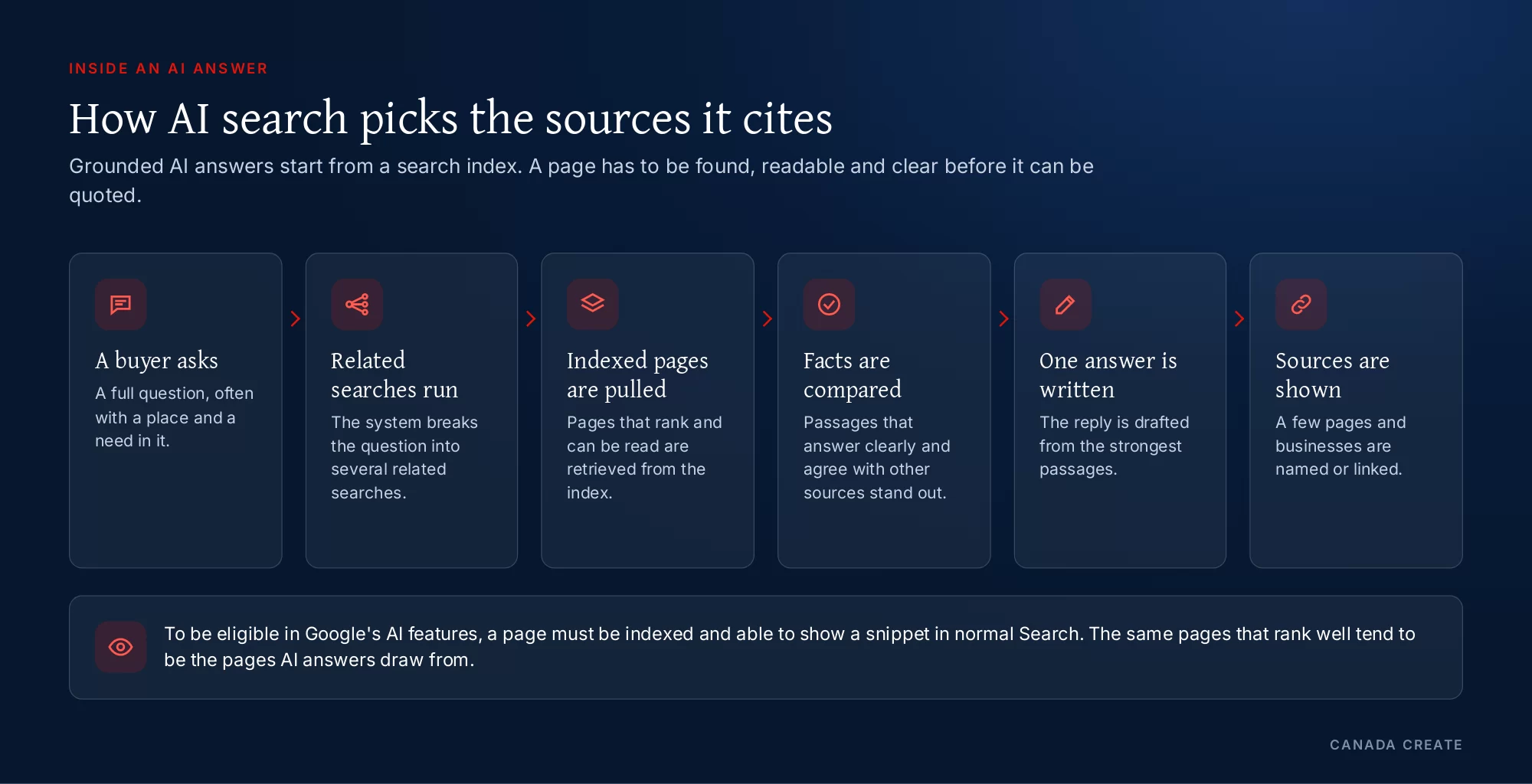
Other assistants work in a similar way. ChatGPT search, Perplexity and Microsoft Copilot read the live web through their own crawlers and through search indexes, then write one reply and show a few links. That has three practical consequences:
- A page has to be crawlable and indexed before it can be used. Google says a page must be indexed and eligible to show a snippet in normal Search to appear in its AI features.
- Each fan-out search is a separate chance to be found. A business that ranks well for the specific parts of a question is more likely to be drawn into the answer.
- Agreement matters. When your site, your business profiles, your reviews and other sites describe you the same way, the answer has fewer reasons to leave you out or get you wrong.
How AI search differs from traditional SEO
SEO and LLMs are not competitors. SEO is the practice of earning visibility in search engines. An LLM, or large language model, is the technology behind tools like ChatGPT and Gemini. The difference that matters to a business owner is how each one presents results.
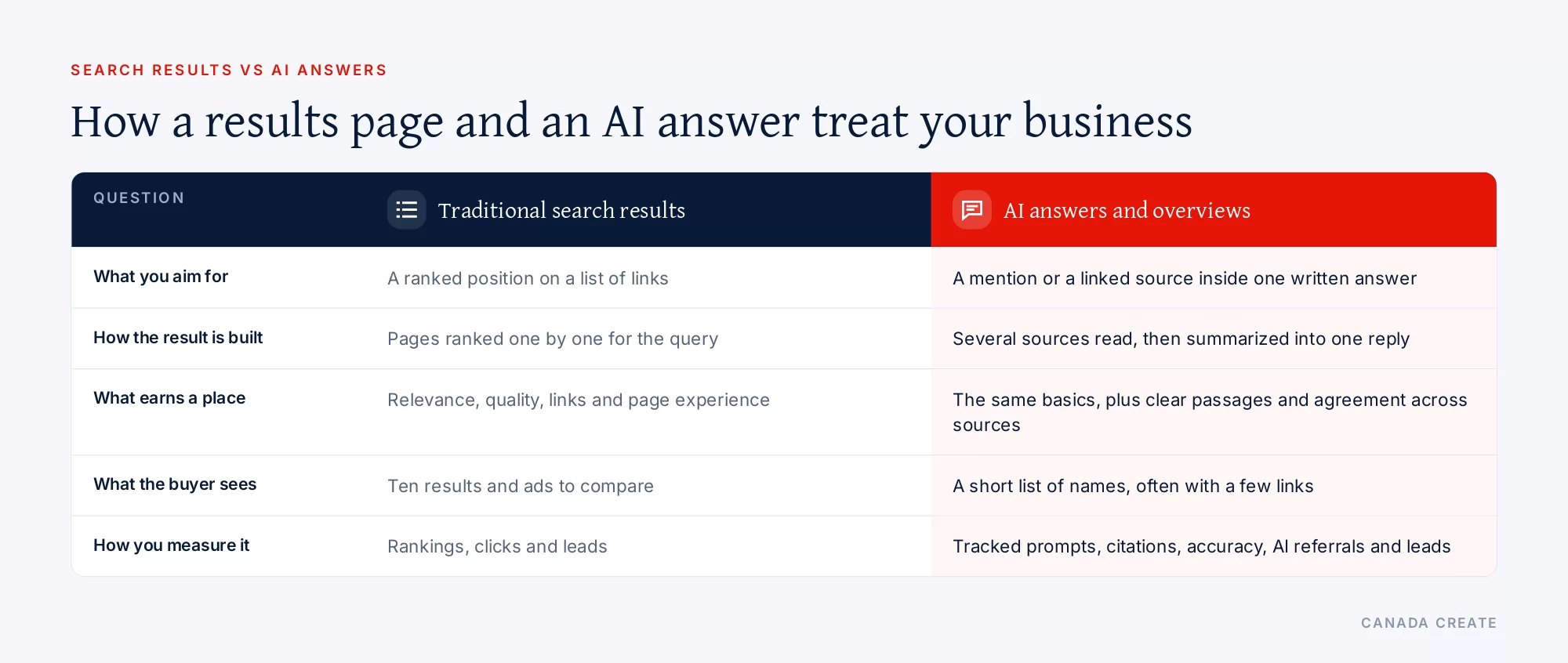
- A search engine ranks pages. The searcher scans the list and picks one.
- An AI answer synthesizes. The tool reads several sources, writes one response and names a few businesses or links. Everyone not named is invisible for that question.
- Many AI tools search the live web before they answer. That means strong rankings and well-structured pages still feed the answer.
- Consistent business facts reduce ambiguity. If your name, services and location are described the same way on your site, your Google Business Profile, directories and reviews, customers and systems have a clearer basis for identifying the correct business.
- Check the quality of referral visits. Compare identifiable AI referrals by engagement and recorded enquiries rather than assuming those visitors are closer to buying.
Is SEO still worth it in 2026?
Yes. AI Overviews sit on top of Google results, and assistants that browse the web lean on the pages that search engines already trust. A business that ignores SEO has very little for an AI tool to find. What has changed is the target: you now optimize to be the source an answer is built from, as well as a link on the results page.
AI search in Canada and in Toronto
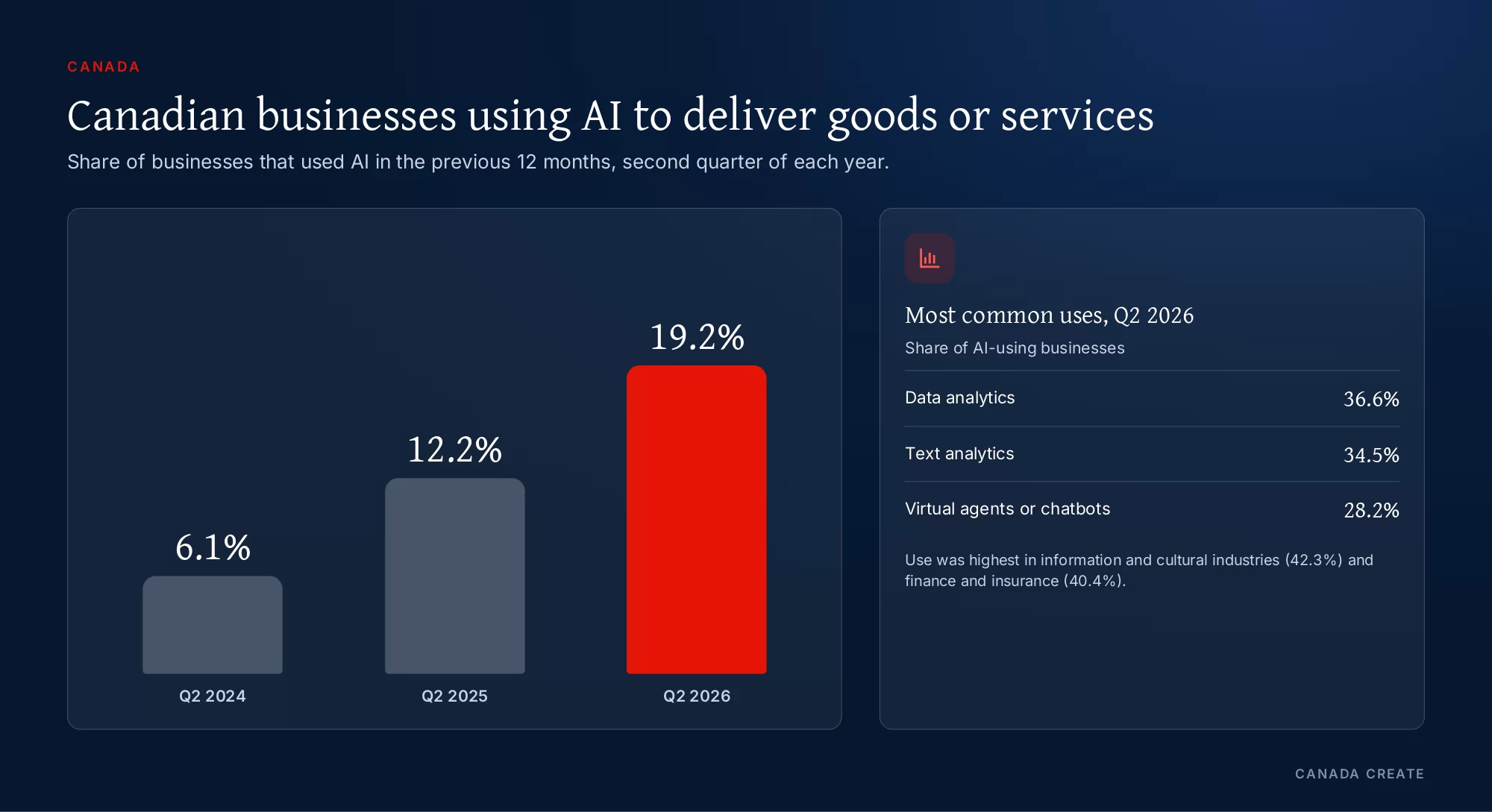
AI is now part of everyday business in Canada. Statistics Canada’s analysis of AI use by businesses, released June 11, 2026, found that 19.2% of Canadian businesses used AI to produce goods or deliver services in the 12 months before the second quarter of 2026, up from 12.2% a year earlier and 6.1% in 2024. Use was highest in information and cultural industries (42.3%), finance and insurance (40.4%) and professional, scientific and technical services (32.4%). The people who buy from those businesses are using the same tools to research suppliers.
A few things make AI search different for a Canadian business:
- Location wording. Buyers in the GTA ask about neighbourhoods and cities: North York, Scarborough, Etobicoke, downtown Toronto, Vaughan, Markham, Mississauga. Pages and profiles that name the areas you serve, in plain words, give fan-out searches something to match.
- Canadian spelling and terms. Write the way your buyers write: colour, centre, licence, postal code, lawyer rather than attorney. An answer built from US pages may describe US rules, prices or providers, so clear Canadian pages have room to stand out.
- English and French. If you serve Quebec or French-speaking clients, a properly translated French page gives AI tools a French source to cite. A machine-translated copy with errors does the opposite. Our multilingual SEO work covers that side.
- Canadian sources. Assistants often name businesses that appear on Canadian directories, provincial and professional association listings, the BBB, local news sites and Canadian review platforms. Those are the places to be listed accurately.
- Regulated professions. Lawyers, dentists, physiotherapists and other regulated providers in Ontario have advertising rules set by their regulators. The content we write for AI search follows those rules, because an assistant can quote a careless claim back to a prospect.
How to optimize content for LLMs and AI answers
This is the core of generative engine optimization. Each item below is part of every program we run.
Answer the question in the first sentences
AI tools may retrieve passages or other source material in different ways. Every key page should state the direct answer first, in plain words, and then support it. A clear introduction helps readers understand the offer before they reach the supporting detail.
Write passages that stand on their own
Clear headings phrased the way customers ask, short paragraphs, lists for steps and tables only where options are truly compared. Each section should still make sense if it is the only part a tool reads. Google says there is no need to break content into tiny chunks for AI; the goal is a page that reads well for a person, which also happens to be easy to quote.
Publish what only you can say
Google’s guidance separates commodity content, the common knowledge anyone could write, from non-commodity content built on first-hand experience. A page that explains how your clinic handles a first visit, what your crew checks before a roof quote or how your firm prepares a client for a hearing gives an AI system something it cannot find elsewhere. Your process, your service areas, your photos and your project notes are original information you own.
Make your business an unmistakable entity
Consistent name, address and phone number everywhere, complete business profiles, Organization and LocalBusiness schema, service schema and links from your site to your official profiles. This is where local SEO in Toronto and AI search optimization overlap most.
Earn mentions on the sources AI tools read
Models form opinions from the wider web: review platforms, respected directories, local news, association listings, community discussions and comparison articles. We help you earn accurate, genuine mentions in those places. We never buy fake reviews or plant posts, because that damages trust with both people and platforms, and Google says inauthentic mentions are not as helpful as they might seem.
Keep technical access open
If crawlers cannot read your pages, nothing else matters. We check that your robots.txt does not block the search crawlers you want, such as OAI-SearchBot for ChatGPT search and PerplexityBot, that key content is in the HTML rather than hidden behind scripts, and that pages load fast. Google-Extended is a separate control for Gemini model training and does not remove you from Google Search, so we set it based on your own preference. Speed and uptime also depend on your website hosting.
Use images and video that explain
Google’s AI features can show relevant images and video beside the text. Original photos of your work, diagrams that explain a process and short videos that answer a common question give those features more to show, as long as each one has a descriptive file name, alt text and a caption that matches the page. Our video production team films that kind of footage in Toronto.
Show proof and expertise
Named authors, real credentials you actually hold, clear service areas, transparent policies and honest pricing explanations give AI tools, and people, reasons to trust the page.

Where AI tools read about your business
An AI answer about your business is assembled from everything the web says about you, not only your website. The more of these places describe you accurately and in the same words, the easier you are to recommend.
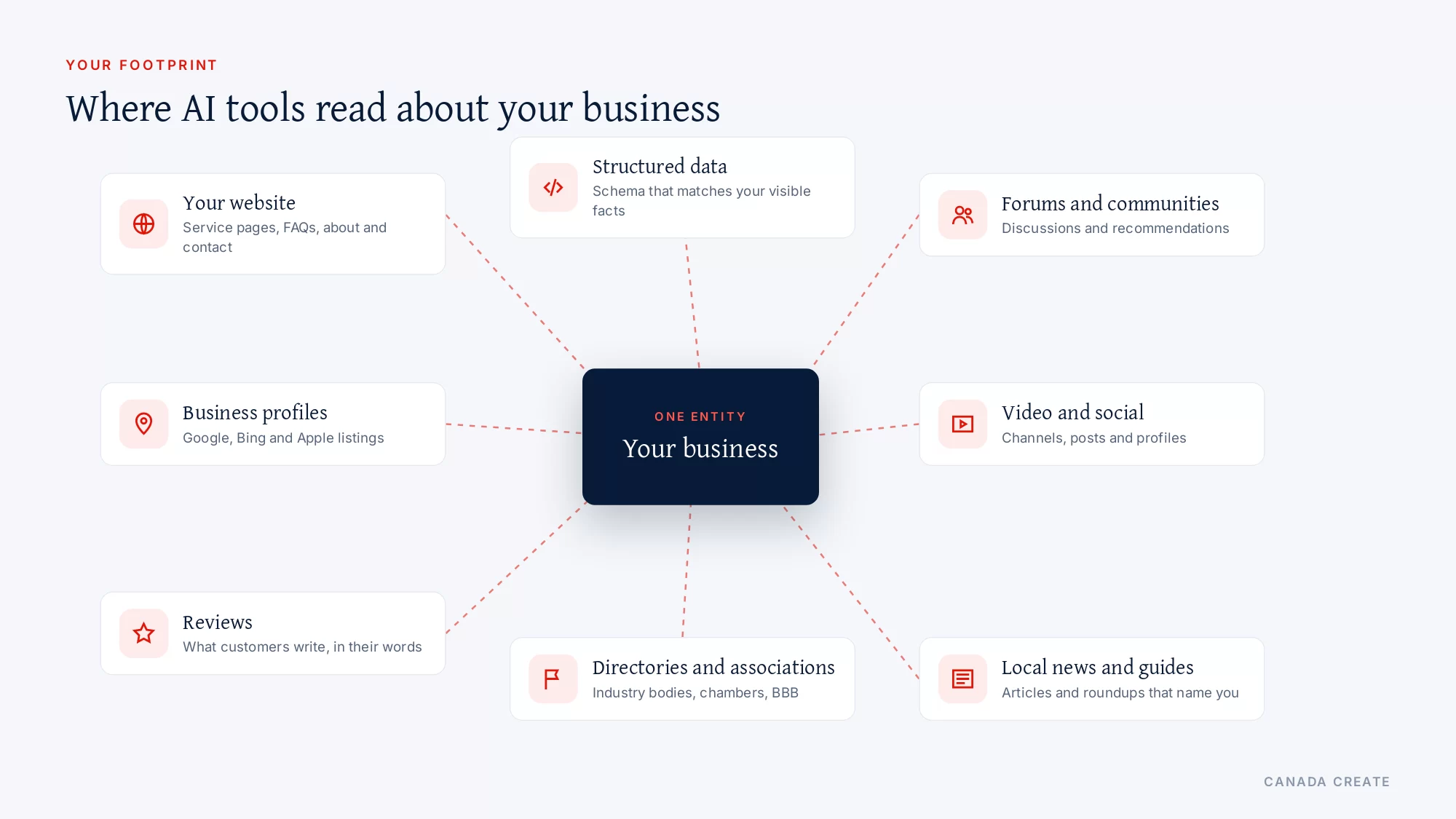
- Your website: service pages, FAQs, about, contact and location pages.
- Business profiles: Google Business Profile, Bing Places and Apple Business Connect, with the same name, hours, categories and service areas.
- Reviews: what customers write, in their own words, on Google and the review sites your industry uses. Our review management work builds honest requests into your customer flow.
- Directories and associations: industry bodies, chambers of commerce, the BBB and Canadian business directories.
- Local news and guides: articles, roundups and interviews that name your business.
- Forums and communities: discussion threads where people ask for recommendations.
- Video and social: your channels and profiles, especially video that answers buyer questions.
- Structured data: schema that matches the facts visible on your pages.
When an assistant gets something wrong about you, the cause is usually one of these sources. We trace the error, correct what you control and ask other publishers to fix what they control. For damaging content that you did not write, our reputation management team can help.
An AI search optimization checklist
If you want the short version of the work, this is the checklist we use to review a site before any new content is written. Each step can be checked by a business owner, a web developer or an agency.
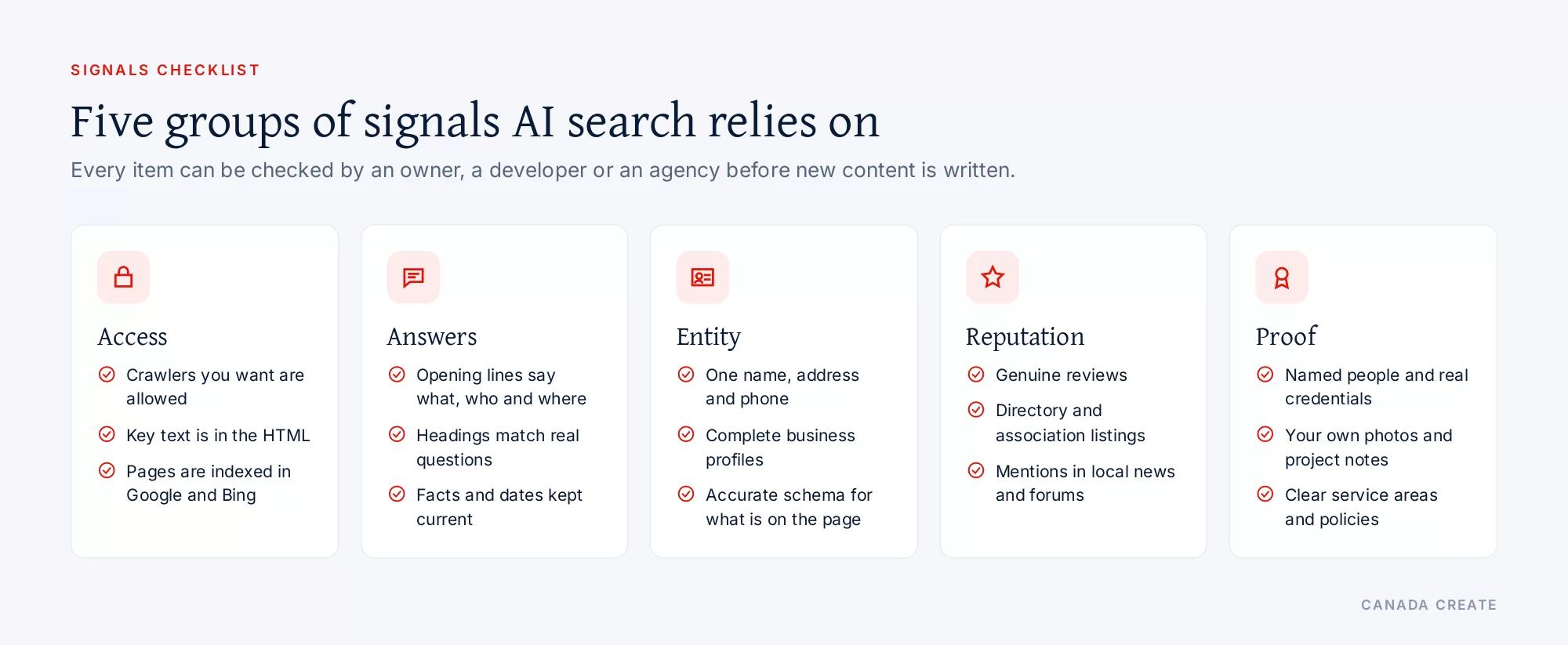
- Confirm crawler access. Check robots.txt, firewall rules and bot protection settings so the search crawlers you want can reach your pages.
- Confirm indexing. Your key pages should appear in Google Search Console and Bing Webmaster Tools, because several AI assistants draw on those search indexes when they answer.
- Match your business facts everywhere. Name, address, phone number, hours, service areas and categories should read the same on your site, your business profiles and the major directories.
- Add structured data. Organization, LocalBusiness, Service and Article schema where they honestly apply, validated with no errors.
- Rewrite the opening of every key page. The first two sentences should say what you do, for whom and where.
- Build question pages. Turn the questions your sales team hears every week into clear pages or FAQ answers.
- Show who is behind the content. Author names, real qualifications and an about page that explains the business in plain words.
- Keep content current. Update hours, policies, service lists and pricing explanations when they change, since outdated facts get repeated by AI tools.
- Earn third-party mentions. Reviews, directory listings, association pages and local coverage that describe you accurately.
- Track a fixed prompt set. Ask the same questions on a schedule and record who gets named and which sources are cited.
Technical settings that decide whether AI can use your pages
Most of the technical work is ordinary technical SEO, done carefully. A handful of settings deserve a closer look because they apply only to AI features.
Crawler access in robots.txt
Each AI company publishes the names of its crawlers. Some fetch pages to answer a user’s search right now, such as OAI-SearchBot and PerplexityBot. Others collect material for model training, such as GPTBot and Google-Extended. Blocking a training crawler is a business decision about your content; blocking a search crawler removes you from that assistant’s answers. Firewalls and bot protection services can block these crawlers without anyone noticing, so we test access from the outside as well as reading the file.
The Search generative AI setting in Search Console
Search Console now has a Search generative AI control under Settings. It decides whether your site’s links and content can appear in AI Overviews, AI Mode and generative features in Discover. Including your site is the default. Excluding it removes your links from those features and stops your content from grounding their answers; Google says the choice is not used as a ranking signal for the rest of Search. We check this setting first on every site, because an exclusion made by a past developer would undo everything else on this page.
Snippet controls
The nosnippet and max-snippet rules limit how much text Google can show from a page, and they apply to AI features too. A page that blocks snippets is not eligible to appear in them. We look for these tags in templates and plugins, where they are sometimes added by accident.
Indexing on Bing
Copilot and several other assistants draw on Bing’s index. Verify your site in Bing Webmaster Tools, submit your sitemap and use IndexNow, a protocol that tells Bing and other participating search engines about new and changed pages within minutes. Bing Webmaster Tools also has an AI performance report that shows how often your pages are cited in Copilot and Bing’s AI answers.
JavaScript and rendering
Google can process content in JavaScript when it is not blocked, but many AI crawlers read only the HTML a server sends. If your prices, service lists or contact details appear only after scripts run, some assistants never see them. We test pages with scripts turned off and move key facts into the HTML where needed.
Schema and structured data for AI search
Structured data is code that labels the facts on a page: your business name, address, services, opening hours, products, authors and dates. Google says no special schema is needed for its AI features, and structured data is not required to appear in them. It still helps search systems confirm what a page is about, and it keeps you eligible for rich results in regular Search.
What matters is accuracy. Schema should describe only what a visitor can see on the page, match your business profiles and stay current when hours or services change. The types that do the most for a local or service business are Organization, LocalBusiness or a more specific subtype, Service, BreadcrumbList, Article with a real author, and Product with Merchant Center feeds for online stores. FAQ markup still describes questions and answers, though Google limited FAQ rich results to well-known government and health websites in 2023, so it should never be the reason a page is built.
What about llms.txt?
llms.txt is a proposed plain-text file that lists a site’s most useful pages for AI tools, and many owners ask whether they need one. Google’s guide answers for Google Search: it does not use llms.txt or any other special AI file, and creating one neither helps nor harms your visibility there. Some other tools may read these files. Our view is simple: an llms.txt file is harmless and quick to maintain, so we add one when a client wants it, and we spend the real effort on pages, profiles and reputation.
What kinds of content AI tools cite
AI assistants tend to quote content that answers a specific question clearly and that other sources agree with. The formats that work best are the ones that make a passage easy to lift and easy to verify:
- Direct definitions that explain a concept or a service in one or two sentences.
- Comparison pages that set out options fairly, including when a different approach is the better fit for the reader.
- Step-by-step guides with a clear outcome.
- Cost explainers that list what drives the price, even when you cannot publish a fixed number.
- FAQ sections built from real customer questions, not from keyword lists.
- Original information you own, such as your process, your policies, your service areas and your own photos and project notes, which no other site can supply.
Thin pages written only to catch a keyword, with no clear answer and no facts a model can check, rarely get cited. Neither do pages that repeat what every competitor already says. The goal is to publish the clearest, most accurate answer to the questions your buyers actually ask. Our SEO content writing team writes those pages with your subject experts.

Myths and tactics to skip
AI search attracts shortcuts. These are the ones we see sold most often, and why we leave them out:
- Chunking every page into tiny blocks. Google says its systems understand pages with several topics and there is no ideal page length.
- Rewriting pages in a special style for AI. AI systems understand synonyms and meaning, so you do not need to cover every long-tail variation of a phrase.
- Building a page for every fan-out query. Creating large numbers of near-duplicate pages to catch variations breaks Google’s spam policy on scaled content abuse.
- Buying or planting mentions. Fake reviews, paid forum posts and self-written roundups put your reputation at risk with people and platforms.
- Hidden instructions for AI. Text written to steer a chatbot, hidden from human visitors, is manipulation, and AI companies work to detect and ignore it.
- Promises of a placement in ChatGPT or Google’s AI. No agency controls what these systems say. Be wary of anyone who claims access to internal Google metrics; Google says no third-party tool has that access.
What happens in each stage of the work
Every engagement starts with evidence, not assumptions.
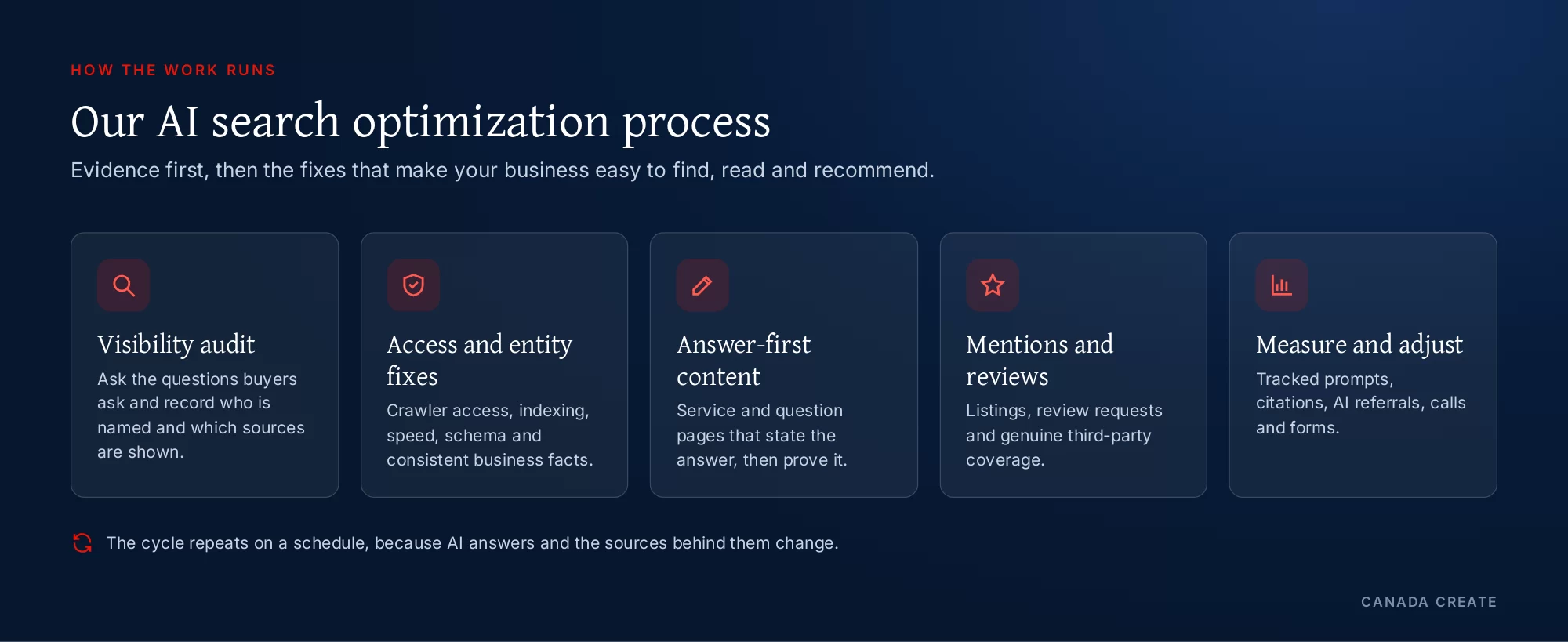
- Visibility audit. We ask the major assistants the questions your customers ask, in the way they ask them, and record who gets named, what sources are cited and what the tools say about you, including anything wrong. We also research the conversational questions buyers put to AI tools in your category.
- Competitor gap review. For the questions where a competitor is named and you are not, we study the pages and profiles the answer cites and list what they offer that yours do not.
- Access and entity fixes. Schema, business profile consistency across Google, Bing and Apple, crawler access, site speed and indexing.
- Answer-first content. We rewrite key service pages and build the question pages your market is missing, working inside your existing WordPress website or a new web design when the current site holds you back.
- Mentions and reviews. Directory cleanup, review requests through your normal customer flow and outreach for genuine third-party mentions.
- Tracking and reporting. A fixed set of prompts checked on a regular schedule, alongside rankings, AI impressions, calls and form leads.
Leads from your site can flow straight into CS+, Canada Create’s CRM, so you can see which enquiries came from search and AI referrals.
A first-year AI search roadmap
The order of the work matters more than its speed. Access and facts come first, because nothing else counts until AI systems can read you and describe you correctly. Content comes next, then the reputation work that gives answers a reason to trust you.
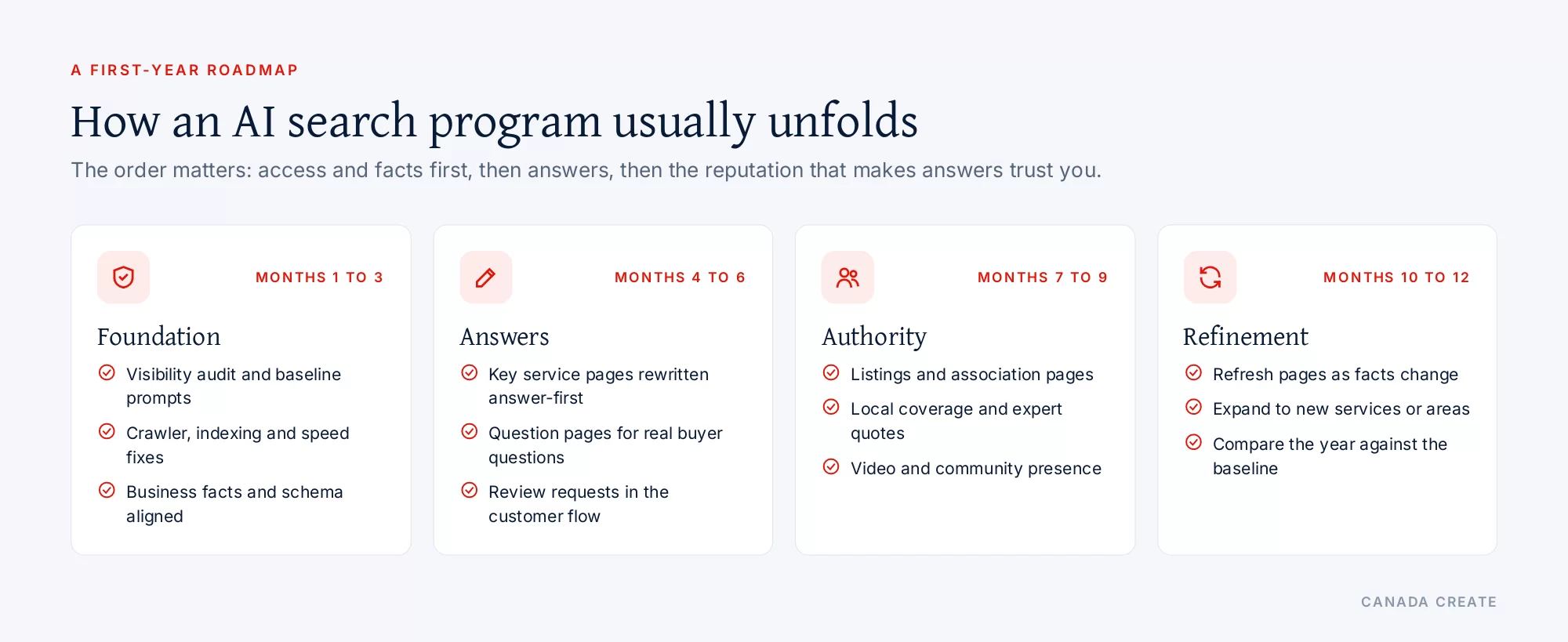
- Months 1 to 3, foundation: visibility audit and baseline prompts, crawler, indexing and speed fixes, business facts and schema aligned across your site and profiles.
- Months 4 to 6, answers: key service pages rewritten answer-first, question pages for real buyer questions and review requests built into the customer flow.
- Months 7 to 9, authority: association and directory listings, local coverage and expert quotes, video and community presence where your buyers spend time.
- Months 10 to 12, refinement: refresh pages as facts change, extend the work to new services or areas and compare the year against the baseline.
A small business with one location and a healthy site may move faster. A business with years of inconsistent listings, a site that is hard to edit or several locations needs more time in the foundation stage. The roadmap is adjusted every month from what the tracked prompts show.
How we measure AI search optimization results
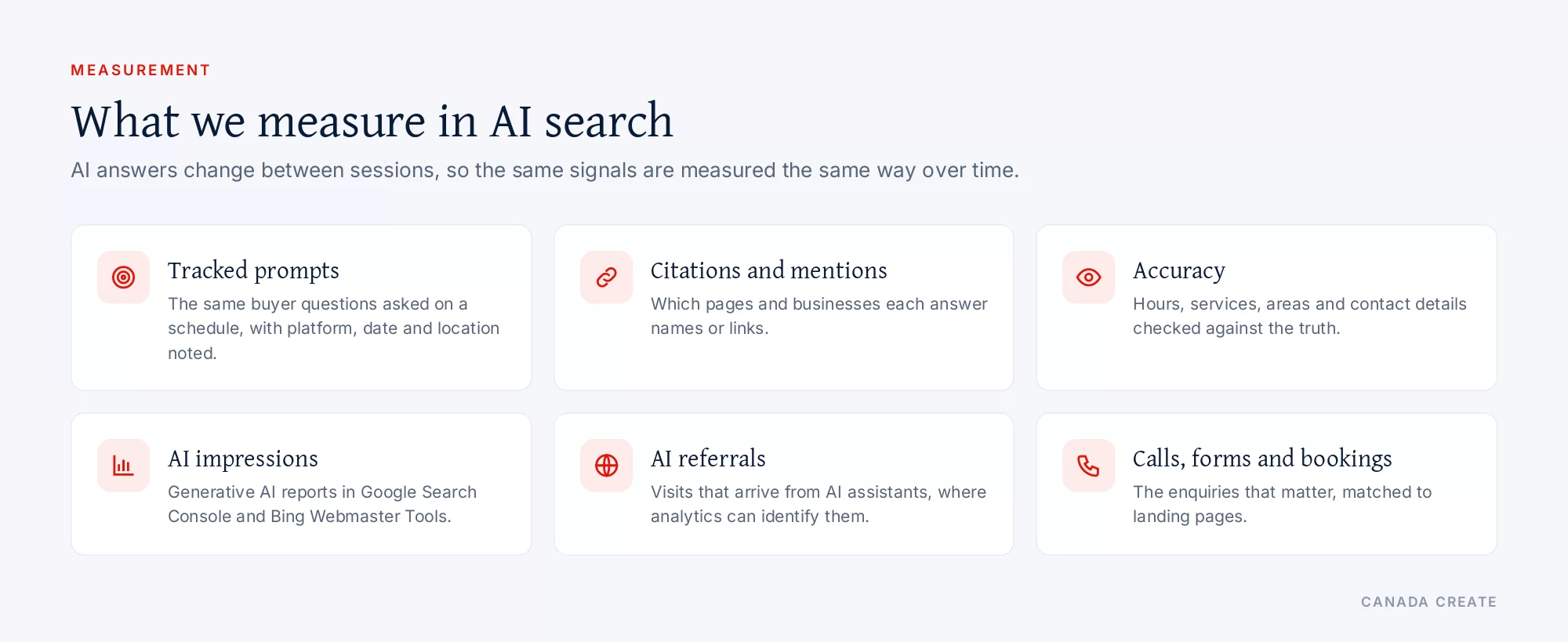
AI visibility is harder to measure than a keyword ranking, because answers can change from one session to the next. We handle that by measuring the same things, the same way, over time.
Prompt tracking
We agree on prompts that reflect real buyer questions, then record the platform, date, location context and relevant settings with the answer and visible sources. Repeat observations help distinguish a pattern from a single response. The sample measures those tracked conditions; it is not a count of every answer your customers see.

Citation sources
When a tool displays sources, we record them and inspect the relevant pages. A citation is evidence of that response’s visible sourcing, not a complete explanation of the model’s reasoning or every input it used. Repeated observations help us choose which information and sources merit attention.
Accuracy of what AI says about you
Incorrect hours, old contact details and mixed-up services can confuse prospective customers. We document the error, compare it with sources we can inspect and correct information your business controls. Other publishers can be contacted where appropriate, then the prompts are checked again to see whether the answer changed.
Search Console and Bing AI reports
Google’s Generative AI performance report in Search Console, available to all sites since August 31, 2026, shows impressions from AI Overviews and AI Mode by page, country, device and date. Bing Webmaster Tools reports how often your pages are cited in Copilot and Bing’s AI answers. These are the platforms’ own numbers, so they anchor our reporting.
Traffic and leads
Analytics can identify some AI referral visits when a referring source is passed through. Other visits may appear as direct traffic or within ordinary search reporting. We compare identifiable referrals with landing pages and recorded leads in CS+, while showing the gaps rather than assigning every enquiry to an AI answer. Our SEO reporting puts all of it in one monthly report.
Goals and KPIs to set before you start
A program without a goal turns into a list of tasks. Before work starts, agree on what success looks like for your business, then pick the measures that show progress toward it:
- Visibility goal: be named for a defined set of buyer questions in your area. Measure the share of tracked prompts that mention you and the share that cite your pages.
- Accuracy goal: every assistant describes your services, hours, areas and contact details correctly. Measure the errors found and fixed.
- Coverage goal: answer-first pages exist for the questions that matter. Measure the number of key questions with a clear page or FAQ answer.
- Authority goal: accurate listings and mentions in the sources AI tools read. Measure listings corrected, reviews received and genuine mentions earned.
- Business goal: more calls, forms and bookings. Measure enquiries by landing page and the identifiable AI referrals among them.
We set a baseline in the first month, so every later report compares like with like.
How long does AI search optimization take?
There is no fixed timeline, and anyone who gives you an exact one is guessing. Some fixes act quickly: once a crawler can read a page it was blocked from, or a wrong business listing is corrected, assistants that search the live web can pick up the change the next time they look. Other work builds slowly, such as earning mentions on respected sites, publishing a library of answer-first pages and collecting genuine reviews.
For answers produced without live retrieval, a website update may not change the response. Model updates and any later inclusion of new information are controlled by the provider. That is why we report progress as a trend across the tracked prompts rather than a single snapshot, and why the technical and entity work comes first.
Will AI search optimization stop working when AI changes?
AI tools change often: new models, new features and new ways of showing sources. Tactics built on tricks tend to break when that happens. The work described on this page is built on things every search engine and AI assistant has reasons to reward: accurate facts, clear answers, pages crawlers can read, consistent business information and a genuine reputation on the wider web.
When a platform changes how it selects sources, we see it in the tracked prompts and adjust the plan. The foundation stays useful because it serves people first, and every assistant is trying to give people a correct answer. Google’s guide also points to agents, AI systems that complete tasks such as booking or comparing products for a person. Pages with clear structure, readable forms and accurate details are easier for those agents to use as well.
Which AI platform matters most for your business?
There is no single best AI platform for search optimization. The right focus depends on where your customers ask, and each platform finds and shows sources a little differently.
Google AI Overviews and AI Mode
They reach anyone already searching on Google, so they matter for almost every local and service business. Both draw on Google’s index and ranking systems, and local answers draw on Business Profile data, so strong SEO and an accurate profile are the starting point. See Google AI Overviews and AI Mode optimization in Toronto.
ChatGPT
Many people now ask ChatGPT for recommendations and comparisons in a conversation. Its search feature reads the web through its own crawler, OAI-SearchBot, and outside search providers, so allowing that crawler and being indexed in Bing both matter. See ChatGPT SEO in Toronto.
Gemini
Gemini is built into Google’s apps, Android phones and Workspace. It leans on Google’s index and on the same business information that appears in Search and Maps. See Gemini SEO in Toronto.
Claude
Claude can search the web when a user asks a question that needs current information, using its own search crawler. Clear, crawlable pages and accurate third-party listings are what it has to work with. See SEO for Claude in Toronto.
Perplexity
Perplexity shows numbered sources with every answer, which makes the displayed citations easy to inspect. It is a useful place to see which pages are cited for your category’s questions. See Perplexity SEO in Toronto.
Microsoft Copilot
Copilot appears inside Windows, Edge and Microsoft 365, which matters for business buyers. It draws on Bing’s index, and Bing Webmaster Tools reports how often your pages are cited there. See Microsoft Copilot SEO in Toronto.
Grok
Grok, the assistant built into X, draws on posts on X as well as the web. It matters most for brands whose buyers are active on that network. See Grok SEO in Toronto.
We track the platforms your buyers use, then put the effort where they are.
AI search by type of business
The same principles apply everywhere, but the priorities change with how your customers buy.
Local service companies
Contractors, clinics, salons, restaurants and repair shops are usually recommended from a short list of nearby options. Business profiles, reviews, service-area pages and consistent contact details carry the most weight. When someone asks for a recommendation near them, AI Mode and assistants lean on the same local data that powers the map results.
Regulated professions
Law firms, dental offices, medical and physiotherapy clinics and financial advisers compete on trust, and their regulators limit what marketing can say. Accurate credentials, clear practice areas, plain-language answers to common questions and strict claim discipline matter more than volume. We build that work into law firm SEO, dental SEO and healthcare SEO programs.
B2B and software companies
Business buyers research long before they talk to sales, and they ask AI tools to compare vendors, explain categories and shortlist options. Comparison pages, documentation, case studies with real detail and mentions in industry publications shape those answers. Our B2B SEO work focuses on those buying questions.
Online stores
Shopping answers draw on product data. Complete product pages, accurate prices and stock, Merchant Center feeds and genuine product reviews help your products appear in AI shopping results. New protocols that let AI agents check out on a shopper’s behalf are starting to appear, and clean product data is the first requirement for them. See our ecommerce SEO service.
Multi-location brands
Each location needs its own accurate profile, page and reviews, because assistants answer for a specific place. One wrong address or set of hours can send a customer to the wrong branch. We track prompts per location and fix the listings that drift.
How to compare AI SEO agencies in Toronto
Lists of the “best AI SEO agencies” are common, and many are written by the agencies on them. Use these questions instead:
- Will they show you the exact prompts they track? If they cannot show what they measure, they cannot show progress.
- Do they still do the SEO basics? An AI SEO agency that skips technical SEO, local signals and content quality is selling a label.
- Do they promise placements? Nobody controls what an AI model says, so be wary of any promise of placement. Results depend on competitors, platform changes and your own reputation, which no agency controls.
- Do they report on leads, not only mentions? Visibility matters because it brings calls and bookings.
- Do they have a track record you can verify? Look at their history, their BBB standing and their own reviews.
- Who does the work, and who owns the accounts? Ask who writes and fixes your pages each month, and confirm your website, analytics and business profiles stay in your name.
For a longer checklist, read how to choose an SEO agency in Toronto.
What AI SEO costs in Toronto and what changes the fee
Professional SEO programs at Canada Create are custom-scoped, with a proposal after discovery. AI search optimization is usually built into that program rather than sold as a separate product, because the same work serves both.
What moves the price:
- Number of locations and services you want visible in AI answers.
- The state of your site, including technical debt, thin pages or a platform that is hard to edit.
- Content volume, meaning how many question pages and service pages your market needs.
- Competition in your city and category.
- Mentions and reputation work needed to build third-party trust.
We separate one-time setup work (audit, schema, technical fixes, page rebuilds) from monthly management (content, tracking, outreach), and from any third-party costs such as paid directory listings or tools. If you also want immediate visibility while organic work builds, Google Ads can run alongside, with ad spend paid directly to Google. For the wider budget picture, read how much SEO costs in Canada.
Can you do AI SEO yourself?
You can do the basics yourself, and you should:
- Keep your Google Business Profile accurate if your business is eligible.
- Make sure your name, address and phone number match everywhere.
- Invite genuine customer reviews without filtering requests to positive experiences.
- Rewrite your main pages so the first paragraph answers what you do, where and for whom.
- Add a clear FAQ that answers real customer questions.
- Check the Search generative AI setting in Search Console and verify your site in Bing Webmaster Tools.
Where owners usually need help is schema, crawler access, prompt tracking, content at scale and earning mentions from sources that carry weight. That is the part we take off your plate.
AI SEO tools: what they do and what they cannot do
AI SEO tools can track prompts, spot which sources get cited, check schema and speed up research and drafting. They cannot build trust for you, earn real reviews or decide what your business stands for. We use tools for research, drafting and measurement. Our team reviews the work, checks facts and applies editorial judgement, then presents it for your approval before publication. Regulated claims also need your responsible professional’s approval.
Can you optimize for Google and AI search at the same time?
Yes, and for most businesses it is the only approach that makes sense. The overlap is large: crawlable pages, clear answers, structured data, a strong Google Business Profile and trusted mentions help your rankings and your chances of being cited. The differences are in emphasis.
- Traditional SEO puts more weight on rankings for specific keywords, page experience and clicks from the results page.
- Answer engine optimization puts more weight on answering one question per passage, question-style headings and FAQ content.
- Generative engine optimization puts more weight on consensus across the web, third-party mentions and how accurately your brand is described.
We plan each page so it can rank, be quoted and turn a visitor who arrives already half decided into a call or a booking.
What AI answers mean for your website traffic
When an AI answer covers a simple question in full, fewer people click through to any website. Informational questions, such as definitions and quick facts, are the most affected. Questions that lead to a purchase or a booking still send people to websites, because the buyer wants to check prices, availability, reviews and who they will be dealing with. Google notes that people who do click from its AI features may be more inclined to engage with a site and convert.
That changes what your site needs to do. Pages should give the short answer an AI tool can quote, then give a reason to visit: detail, proof, a clear next step and an easy way to call or book. We judge success by calls, forms and bookings, not by raw visit counts alone.
How we use AI in content research and review
There is no standard percentage of content work that should be assigned to AI. We use tools where they help with research, drafting or monitoring, and apply editorial checks for evidence, originality, accuracy and usefulness. The level of review follows the subject and the consequences of an error.
The content needs to reflect your real services, experience and evidence. We check important claims, remove unsupported conclusions and make the next step clear for the reader. Meeting a word-count target does not make a page useful on its own.
Does your business need AI search optimization yet?
If your customers research before they buy, the answer is probably yes. It matters most when:
- Buyers compare several providers before they call, as with professional services, home services, clinics and B2B suppliers.
- Questions come before purchases. If your team answers the same questions every week, those questions are already being asked of AI tools.
- You serve a defined area and want to be named when someone asks for a recommendation nearby.
- You sell online and want product and category pages to feed shopping answers.
- AI tools already describe you incorrectly, which is worth fixing before it costs more leads.
If your site has basic technical problems or very little content, we usually start there, because AI search optimization sits on that foundation.
How to learn SEO and AI search as a beginner
If you want to understand the work before you hire anyone, start with what the platforms publish themselves. Google Search Central explains how Google crawls, indexes and ranks pages, and its guide to generative AI features explains how AI Overviews and AI Mode treat websites. Bing Webmaster Tools has its own guidelines, and the major AI companies document how their search crawlers work and how to allow or block them.
Then practise on your own site:
- Set up Google Search Console and Bing Webmaster Tools and read what they report, including the generative AI reports.
- Claim and complete your Google Business Profile if your business is eligible.
- Pick five questions customers ask you and write a clear answer to each.
- Ask ChatGPT, Gemini, Perplexity and Copilot those same questions and note who gets named.
- Repeat the check every month and see what changes.
That hands-on routine teaches more than most courses. When the work grows past the time you have, that is the point where an agency earns its fee.
Related guides: getting cited in AI search, GEO vs AEO vs SEO, AI SEO vs traditional SEO, how local businesses get cited in AI search, Google AI Overviews vs Perplexity for Canadian B2B buyers and how to improve your website for Google AI Overviews.
Why Toronto companies choose Canada Create for AI SEO
We have helped businesses across Canada get found online for more than 18 years. We combine SEO, local search, content, web development and ecommerce under one roof, so the fixes AI search needs do not stall between vendors. If you also want an assistant on your own site that answers visitors’ questions, see our AI chatbot development service. Your proposal follows discovery. Call (416) 273-9030, Monday to Friday, 9 am to 6 pm, and Saturday, 10 am to 2 pm. After hours, our 24/7 AI agent answers the toll-free line, +1 (800) 808-9235, and we’ll follow up the next business morning.
Talk to a strategist
Ready when you are?
Request a custom proposal
Tell us your goals, budget and timeline. You get a custom proposal and a named strategist, so your next stage of growth starts now.
How our AI search optimization works
Every program starts with evidence from the AI tools your customers already use.
- AI visibility audit Week 1 to 2
Record observed mentions and displayed sources for agreed buyer questions, with the platform, date and testing conditions.
- Entity and technical fixes Week 2 to 4
Schema, business profile consistency, crawler access, speed and indexing.
- Answer-first content Month 1 to 3
Service pages rewritten to answer first, plus the question pages your market is missing.
- Mentions and reviews Ongoing
Directory cleanup, honest review requests and outreach for genuine third-party mentions.
- Tracking and reporting Monthly
A fixed prompt set, AI Overview appearances, rankings, calls and form leads in one report.
Why Canada Create for AI search
18+ years in search
We have helped businesses get found online since 2008.
BBB Accredited, A+
An A+ rating with the Better Business Bureau.
SEO and AI in one program
Coordinate technical SEO, useful content and AI visibility monitoring in one scoped plan.
Quoted in writing
Every fee is confirmed in writing before work starts. Request your custom proposal.
AI SEO Toronto: questions buyers ask
The basics
What is AI search optimization?
AI search optimization is the work of making your business easy for AI tools such as Google AI Overviews, AI Mode, ChatGPT, Gemini, Perplexity and Copilot to find, read and cite. It combines technical SEO, answer-first content, consistent business information and a genuine reputation on the web.
What is AI SEO called now?
You will see it called AI SEO, AI search optimization, generative engine optimization (GEO), answer engine optimization (AEO) or LLM SEO. They are overlapping labels for the same goal: accurate, useful visibility in AI-generated answers.
What is answer engine optimization (AEO)?
Answer engine optimization focuses on giving the clearest answer to a specific question, so a search feature, voice assistant or AI tool can quote it. It overlaps heavily with featured snippet work and with GEO.
What does GEO stand for in marketing?
In search marketing, GEO stands for generative engine optimization: improving how often and how accurately AI tools that write answers include and cite your business. It has nothing to do with geography or geotargeting, although local signals matter to it.
What is the difference between GEO, AEO and SEO?
SEO earns visibility in search results, AEO aims to supply the direct answer to a question, and GEO aims to be included and cited in AI-written answers. In practice they share the same foundation, and Google treats work for its AI features as SEO.
Is SEO dead now that AI answers questions directly?
No. Google's AI Overviews and AI Mode are built on its core ranking systems, and other assistants read pages that search engines already index. What changed is the target: you now aim to be a source the answer is built from, as well as a result people click.
Is GEO replacing SEO?
No. GEO adds emphasis on clear passages, consistent facts and third-party mentions, but it depends on the same crawling, indexing and content quality as SEO. A site without SEO foundations has little for an AI tool to find.
Does Google want businesses to do AEO or GEO?
Google's guide to its generative AI features says optimizing for AI search is still SEO, and it asks site owners to evaluate third-party AEO and GEO advice carefully. Its recommendations are helpful, original content, a sound technical setup and accurate business details.
How AI search picks sources
How does AI search find information?
Most AI answers that name businesses are grounded in a search index: the system runs one or more searches, reads the pages it retrieves and writes a reply from the strongest passages. Google calls the extra searches query fan-out.
What is query fan-out?
Query fan-out is when an AI system breaks a question into several related searches and runs them at the same time. Each of those searches is a separate chance for a well-ranked, clearly written page to be drawn into the answer.
How does Google choose which sites appear in AI Overviews?
Google uses its core ranking and quality systems to retrieve pages, then shows links to pages that support the answer. A page must be indexed and eligible to show a snippet in regular Search to be considered.
Does ChatGPT use Google or Bing to search the web?
ChatGPT search uses its own crawler, OAI-SearchBot, along with third-party search providers. Because several assistants rely on Bing's index, being indexed in Bing Webmaster Tools is part of the work.
Why does an AI assistant recommend my competitor and not me?
Usually because the competitor has clearer pages for that question, more consistent business information or more mentions on the sites the assistant read. A visibility audit compares the cited sources with yours to show the gap.
Can AI answers about my business be wrong?
Yes. Answers can repeat outdated hours, old addresses or mixed-up services from any page that mentions you. The fix is to correct the sources you control, ask other publishers to update theirs and check the answer again.
Content, schema and technical setup
How do I optimize my website for AI search?
Make sure crawlers can reach and index your pages, open each key page with a direct answer, keep business facts identical everywhere, use accurate structured data and publish original information only you can provide. Then earn genuine reviews and mentions.
How should content be written so AI tools can quote it?
State the answer in the first sentences, use headings phrased the way customers ask and keep each section understandable on its own. Write for people first; Google says there is no need for a special AI style.
Do I need to break my pages into small chunks for AI?
No. Google says its systems understand pages that cover several topics and there is no ideal page length. Clear sections help readers, and that is enough.
Do I need special schema markup for AI Overviews?
No special schema is required for Google's AI features. Accurate Organization, LocalBusiness, Service, Product and Article markup still helps search systems confirm your facts and keeps you eligible for rich results.
Do I need an llms.txt file?
Not for Google: its guide says Google Search does not use llms.txt and the file neither helps nor harms your visibility there. Some other tools may read it, so it is a harmless extra, not a priority.
Should I block AI crawlers in robots.txt?
Block only what you mean to block. Search crawlers such as OAI-SearchBot and PerplexityBot fetch pages for live answers, so blocking them removes you from those answers; training crawlers such as GPTBot and Google-Extended are a separate choice.
What is the Search generative AI setting in Search Console?
It is a control under Settings in Search Console that decides whether your site can appear in AI Overviews, AI Mode and generative features in Discover. Including your site is the default, and excluding it removes your links and content from those features.
Do nosnippet tags affect AI Overviews?
Yes. Snippet controls such as nosnippet and max-snippet limit what Google can show from a page, and a page that cannot show a snippet is not eligible for its AI features. Check templates and plugins for tags added by accident.
Can AI crawlers read content that loads with JavaScript?
Google can render JavaScript, but many AI crawlers read only the HTML the server sends. Put prices, services, locations and contact details in the HTML so every crawler sees them.
Does AI-written content hurt SEO or AI visibility?
Google judges content by its quality and usefulness, not by how it was produced, but mass-produced pages made to manipulate rankings break its spam policies. Content that reflects real experience and has been checked by people is what gets cited.
Which content formats get cited most by AI tools?
Clear definitions, fair comparisons, step-by-step guides, cost explainers and FAQ answers built from real customer questions are the easiest to quote. Original material such as your own process, policies, photos and project notes gives AI tools something no other site has.
Local, Toronto and Canada
How do local businesses in Toronto get recommended by AI assistants?
Keep your Google Business Profile, Bing Places and Apple Business Connect listings accurate, collect genuine reviews and name the neighbourhoods and cities you serve on your site. Assistants lean on the same local data that powers map results.
Does my Google Business Profile affect AI Overviews and AI Mode?
Yes. Google's guide says business details from Business Profiles can appear in AI responses about local businesses. Complete categories, hours, services, photos and reviews give those answers accurate facts.
Should I mention Toronto neighbourhoods on my pages?
Name the areas you actually serve, in plain sentences on your service and contact pages. That gives AI searches about North York, Scarborough, Etobicoke or downtown Toronto something accurate to match, without stuffing city names into every heading.
Do French pages help with AI search in Quebec?
A properly translated French page gives AI tools a French source to cite for French questions. Machine-translated pages with errors can do more harm than good, so translation quality matters.
How many Canadian businesses use AI?
Statistics Canada reported that 19.2% of Canadian businesses used AI to produce goods or deliver services in the 12 months before the second quarter of 2026, up from 12.2% a year earlier and 6.1% in 2024.
Can regulated professionals in Ontario do AI search optimization?
Yes, within their regulator's advertising rules. Lawyers, dentists and health practitioners should keep claims factual, credentials accurate and testimonials within the rules, because an AI answer can repeat any claim on the page.
Measuring results and timing
How is AI search visibility measured?
By tracking a fixed set of buyer prompts over time, recording which businesses and sources each answer names, checking the accuracy of what is said about you and comparing AI referrals and enquiries. Google and Bing now also report AI impressions and citations.
What is the Generative AI performance report in Search Console?
It is a Search Console report, available to all sites since August 31, 2026, that shows how often links to your site appeared in AI Overviews and AI Mode. You can group the data by page, country, device and date.
Can I see when ChatGPT or Perplexity sends visitors to my site?
Often, yes. Analytics can identify referral visits when the assistant passes its source, though some AI visits show up as direct traffic. Reports should show those gaps rather than credit every enquiry to AI.
Which KPIs should I track for AI search optimization?
Track the share of tracked prompts that mention or cite you, the accuracy of what assistants say, AI impressions in Search Console, identifiable AI referrals and the calls, forms and bookings that follow. Set a baseline before work starts.
How long does AI search optimization take to show results?
There is no fixed timeline. Fixes such as unblocking a crawler or correcting a listing can be picked up the next time an assistant searches, while content, reviews and mentions build over months.
Why do AI answers change from one day to the next?
AI systems generate each answer fresh, so wording and named sources can vary between sessions, users and locations. That is why we measure the same prompts repeatedly and report trends instead of single screenshots.
What happens to AI search optimization when platforms change their algorithms?
Tactics built on tricks tend to break, while accurate facts, readable pages, consistent business information and a genuine reputation stay useful because every platform is trying to give a correct answer. Tracked prompts show when a change happens, so the work can be adjusted.
Does AI search reduce website traffic?
For simple informational questions, fewer people click through when the answer is complete on the page. Questions that lead to a purchase still send visitors, and pages should give a reason to visit beyond the quick answer.
Platforms
Which AI platform matters most for my business?
It depends on where your customers ask. Google AI Overviews and AI Mode matter for almost every local business; ChatGPT, Gemini, Perplexity and Copilot matter more for researched purchases and business buyers.
What are the main AI search engines?
The ones most people use today are Google AI Overviews and AI Mode, ChatGPT search, Google Gemini, Perplexity and Microsoft Copilot. Each retrieves and shows sources differently, so results are tracked separately.
What is Google AI Mode?
AI Mode is a conversational search experience in Google that answers complex questions with a written response and links, using query fan-out to search several subtopics at once. Sites appear in it through the same indexing and ranking as regular Search.
How do I get my business mentioned in ChatGPT?
Allow OAI-SearchBot to crawl your site, publish clear pages that answer buyer questions, keep your business facts consistent and earn genuine reviews and mentions on sites people trust. No one controls whether you are mentioned, because the assistant chooses its sources.
Does Perplexity show which sites it uses?
Yes. Perplexity displays numbered sources with its answers, which makes it useful for seeing which pages are cited for your category's questions.
Does optimizing for Bing help with Copilot?
Yes. Copilot draws on Bing's index, so verifying your site in Bing Webmaster Tools, submitting a sitemap and using IndexNow helps your pages get found and cited there.
Cost and choosing an agency
How much does AI SEO cost in Toronto?
It depends on your number of locations and services, the state of your site, the content your market needs and the competition. At Canada Create it is scoped into an SEO program, with fees quoted in writing in a custom proposal after discovery.
What does an AI SEO agency do?
An AI SEO agency audits what AI tools say about you, fixes crawler access and business information, writes answer-first content, builds genuine reviews and mentions and tracks prompts, citations and leads over time.
How do I choose an AI SEO agency in Toronto?
Ask to see the exact prompts they track, check that they still do technical and local SEO, avoid anyone promising AI placements and confirm your accounts stay in your name. Verify their history, BBB standing and reviews.
Is AI search optimization worth it for a small business?
If customers research before they call, usually yes, because the same work improves your Google rankings and your local profile. If your site has basic technical problems, those come first.
Can a small or new website appear in AI Overviews?
Yes, if its pages are indexed, eligible to show a snippet and answer the question clearly. Google's AI features use the same ranking systems as Search, so a new site usually starts with specific local and service questions where competition is lighter.
Can an agency promise a spot in ChatGPT or AI Overviews?
No. AI systems choose their own sources and change often, so any promised placement is a warning sign. An honest agency improves the information those systems draw on and measures the effect.
Is AI search optimization a separate service from SEO at Canada Create?
It is usually built into our SEO programs, because the technical, content and local work serves both. Your proposal lists any AI-specific work, such as prompt tracking, separately.
Doing it yourself
Can I do AI SEO myself?
You can do the basics: keep your business profiles accurate, match your name, address and phone everywhere, invite genuine reviews, rewrite page openings to answer clearly and add a real FAQ. Help is most useful for schema, crawler access, tracking and earning mentions.
Can ChatGPT do SEO for me?
AI tools can help with research, outlines and drafts, but they cannot build your reputation, earn reviews or know your business the way you do. Every draft needs checking for accuracy and first-hand detail before it is published.
What is the quickest AI search fix for most websites?
Check that nothing blocks search crawlers, confirm your key pages are indexed in Google and Bing, and make sure your hours, address and phone number match on your site and profiles. Those fixes cost little and remove common reasons to be left out.
How can I check what AI tools say about my business?
Ask ChatGPT, Gemini, Perplexity, Copilot and Google the questions your customers ask, note who is named and which sources are shown, and repeat the check monthly. Write down the date and location each time so changes are comparable.


Do AI answers describe your business accurately?
Review the questions that matter to your buyers, the businesses named and the information shown about your services. That gives the next improvements a clear starting point.