
Toronto · Automotive marketing
Automotive marketing in Toronto for repair shops and dealers
Canada Create plans and runs automotive marketing in Toronto for auto repair shops, collision centres, tire shops and dealerships, measured by booked jobs and sales.
Auto repair marketing and dealer advertising for Toronto and GTA shops, from North York to downtown: local SEO, Google Ads, websites and follow-up.
- BBB A+ accredited
- 18 years in business
- Mon to Fri 9 to 6, Sat 10 to 2
Get more booked jobs for your shop
Tell us about your shop or dealership and the work you want more of. We reply with a custom proposal.
Please do not share passwords or other sensitive details here. We never sell your contact information and we comply with Canadian privacy law
(privacy policy).
What better automotive marketing changes
More calls from nearby drivers
Stronger map and search visibility for the jobs you want more of.
Fewer wasted ad dollars
Campaigns built around real repair and sales searches, with exclusions that protect the budget.
More repeat visits
Reminders and follow-up that bring customers back for maintenance and their next vehicle.
Clear numbers
Reports on calls, bookings and cost per booked job, not only clicks.
Channels included in automotive marketing for shops and dealers
Each plan combines the channels your business needs, ordered around likely value, readiness and the evidence from your accounts.
- Digital marketing for auto repair shopsLocal SEO, job-specific pages and a stronger Google Business Profile.
- Auto repair advertisingGoogle search campaigns scheduled around your hours, with call and location assets.
- Automotive dealer advertisingInventory-driven campaigns that follow provincial price advertising rules.
- Websites that book workFast WordPress sites with booking, quote and trade-in forms.
- Reputation managementReview requests for every customer and professional replies.
- Call and conversion trackingSource-level tracking for calls, forms and bookings.
- CRM and remindersCS+ follow-up, service reminders and consent records built for CASL.
- Social and videoShort shop and inventory videos that build trust before the first call.
How much does automotive marketing cost in Toronto?
We separate setup, monthly management and ad spend so you can see where every dollar goes.
Local SEO
Custom-scoped engagements; proposal after discovery
Shops and dealers that want more map and organic visibility
- Google Business Profile optimization
- Job-specific service pages
- Review strategy
- Monthly reporting
Growth
By proposal
Shops adding paid search and reminders
- Everything in Local SEO
- Google Ads management
- Call tracking
- Service reminders
Dealer and multi-location
By proposal
Dealerships and groups with several locations
- Inventory campaigns
- CRM lead handling
- Per-location profiles
- Source-level sales reporting
Website build
By proposal
Businesses that need a faster site that books work
- WordPress build
- Booking and quote forms
- Structured data
- Hosting options
Ad spend is paid directly to Google or Meta. Third-party tools such as call tracking, booking software and inventory feeds are billed separately.
Automotive marketing guide
How automotive marketing works in Canada
Fill service bays and showroom appointments with drivers who are ready to book. Automotive marketing in Toronto is the mix of local search, Google Ads, a booking-ready website, reviews and follow-up that brings repair, collision, tire and sales customers to your business. Canada Create has run this work since 2008 from our Toronto office and is BBB Accredited with an A+ rating.
For an auto repair shop or dealership, the work falls into six areas:
- Google Business Profile and local search: categories, services, photos and reviews for the map pack; see automotive SEO for the organic side.
- Google Ads and Local Services Ads: campaigns for brakes, tires, diagnostics and inventory searches.
- Website and booking: service pages, online appointment requests and click-to-call on every page.
- Call and form tracking: every enquiry tied to the campaign and the job it became.
- Customer retention: service reminders and automotive email marketing that bring customers back.
- Reviews: a steady, rule-compliant way to ask every customer for a Google review.
- What automotive marketing means for a shop or dealership
- How drivers choose a mechanic or a dealer
- Rules that shape vehicle and service advertising in Canada
- How automotive advertising has changed
- The core framework: five channels that work together
- Local search and Google Business Profile for auto repair shops
- Google Ads and paid search for service and sales
- Websites that book appointments
- Tracking calls, forms and booked jobs
- Repair, collision and tire shops
- Car, van and truck rental fleets
- Car washes, wrap shops and parts sellers
- What automotive marketing costs in Canada
- Benchmarks that matter more than clicks
- Plans for each type of automotive business
- Social media, video and guerrilla marketing for automotive brands
- How to choose an automotive advertising agency
- Request an automotive marketing proposal for your shop or dealership
Automotive marketing in Toronto: what it means for a shop or dealership
Automotive marketing is every paid and earned effort that brings a vehicle owner to your business and then brings them back. For a service shop, the real product is trust: a driver hands over the keys to one of the most expensive things they own and hopes the final bill matches the estimate. For a dealership, the product is a large, considered purchase that often starts online weeks before anyone walks onto the lot.
Auto repair marketing is local and urgent
Auto repair marketing targets drivers within a short drive of your bays, usually at the moment something goes wrong. A warning light, a grinding brake or a failed safety inspection creates demand that lasts hours, not weeks. The shops that win appear first in maps and search, look trustworthy within a few seconds, and answer the phone.
Automotive dealer marketing is research heavy
Automotive dealer marketing supports a purchase that shoppers research across many websites, videos and reviews before they contact a store. Inventory pages, trade-in tools, finance pre-approval forms and fast follow-up are what move a shopper from browsing to booking a test drive.
Both models rely on the same foundation
Both models depend on a findable website, an accurate Google Business Profile, real reviews and a system that follows up with every lead. Canada Create builds that foundation first, then adds paid reach where the numbers support it.
How drivers choose a mechanic or a dealer
Most service searches start on a phone
Drivers who need a repair usually search on a phone, often from the driveway, a parking lot or the side of the road. Searches such as mechanic near me, brake repair open now or tire shop trigger the map results, so proximity, opening hours, business category and reviews decide who gets the call.
Reviews carry the trust decision
Reviews are the main way a stranger judges a shop they have never visited. Shoppers read what past customers say about honesty, pricing, turnaround time and communication. A shop that replies to every review, including the unhappy ones, shows how it treats people when something goes wrong.
Dealership shoppers compare stores, not only vehicles
Dealership shoppers often choose the vehicle before they choose the store. Once they know the model, they compare price transparency, stock, trade-in offers, financing options, reviews and how quickly someone replies. Reply speed matters: a lead that waits until the next morning has often already booked a visit somewhere else.
The buying cycle continues after the sale
The customer relationship continues after the invoice. Every repair order or vehicle sale produces a customer who will need maintenance, tires, seasonal changeovers and eventually another vehicle. Marketing that ignores this group spends money to buy new customers while losing easy repeat visits.
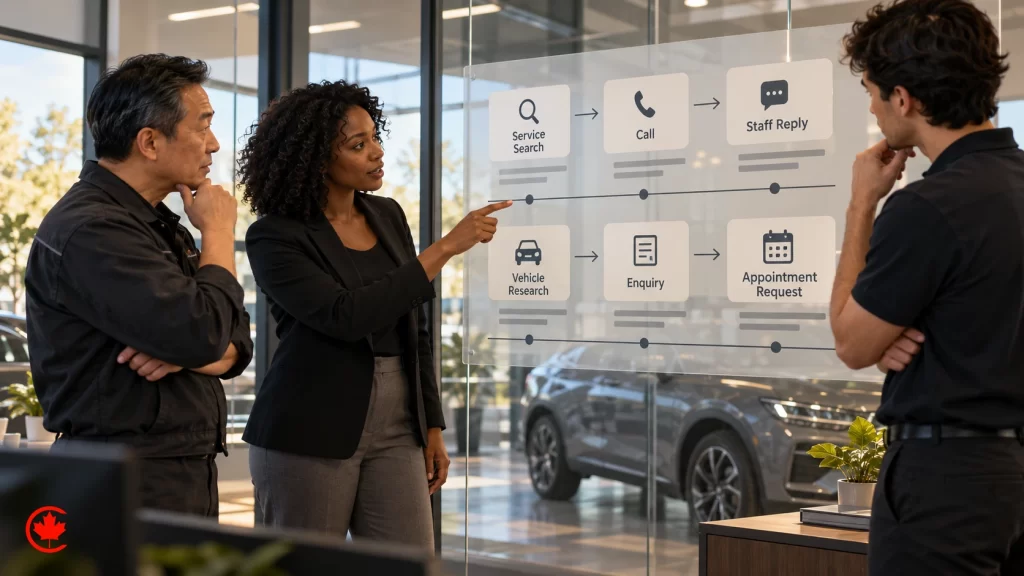
Rules that shape vehicle and service advertising in Canada
Automotive advertising in Canada sits under federal and provincial rules. This section is general information for planning campaigns, not legal advice; your lawyer or your provincial regulator is the right source for your specific situation.
The Competition Act prohibits misleading advertising
The federal Competition Act prohibits false or misleading representations, and it specifically names drip pricing, where an advertised price cannot actually be paid because mandatory fees are added later. Every advertised price, discount and starting rate needs to be one a customer can actually get.
Provincial dealer regulators set sales advertising rules
Each province regulates vehicle sales, and several have a dedicated regulator, such as OMVIC in Ontario and AMVIC in Alberta. In Ontario, dealers are expected to advertise all-in prices that include every fee except HST and licensing. We build ad copy and inventory templates around the rules of the province where you sell.
CASL governs commercial email and text messages
Canada’s anti-spam legislation, known as CASL, requires consent before you send commercial email or text messages, clear identification of the sender and a working unsubscribe option. A past purchase can create implied consent for a limited period, so service reminders need a consent record and an expiry plan. Our automotive email marketing service is built around that record.
Privacy law covers customer and vehicle data
Names and contact details are personal information, and vehicle identifiers or service histories can be personal information when linked to an identifiable person. Applicable privacy obligations depend on the business and jurisdiction, including PIPEDA and Quebec’s private-sector privacy law. Your forms, CRM and tracking should collect only what you use and explain why you collect it.
Quebec requires French in commercial advertising
Businesses advertising in Quebec must follow the Charter of the French Language, which requires French in commercial advertising and signage. Bilingual campaigns need French copy that reads naturally, not a rough machine translation.
Reviews must be honest and unpaid
Fake or paid reviews can be treated as misleading advertising, and Google’s policies prohibit offering incentives for reviews. We help you ask every customer for a review, not only the happy ones, and never with a reward attached.
How automotive advertising has changed
Directories and print once decided who got the call
Service shops once competed for the largest directory ad, while dealers relied on newspaper pages, radio spots and flyers. The business that bought the most space usually got the most calls, whatever its service was like.
Search and maps moved the decision to the phone
Search engines and map apps shifted the decision to reviews, proximity and websites. A small independent shop with strong reviews can now outrank a large chain on the searches that matter within a few kilometres of its bays. Canada Create has worked through this shift with local businesses since 2008.
AI answers are the next change
Search engines now show AI-generated summaries above many results, including answers about local services. Clear, useful pages and consistent business information support the same search fundamentals used for AI features. Google does not require special AI markup, and citation in AI answers depends on factors no business controls. The foundation stays the same: accurate facts, strong reviews and useful pages.
The core framework: five channels that work together
The digital strategy for automotive businesses that we use has five parts. Each one feeds the others, and dropping one usually weakens the rest.
Visibility brings the driver to you
Visibility means local search, a complete Google Business Profile and content that ranks for the jobs you sell. Our SEO and local SEO work covers this layer.
Paid search fills gaps and slow weeks
Paid search buys placement on searches you cannot yet win organically, and it can be turned up for slow weeks or seasonal pushes. See our Google Ads management.
The website converts attention into bookings
The website turns a click into a call, a booking or a trade-in request. Speed, clear service pages, prices where you can publish them and an easy booking path decide how many visitors act.
Reputation builds trust before the first visit
Reputation is a steady flow of recent reviews and professional replies. It supports map rankings and it shapes the choice a driver makes between three shops on the same street.
Retention turns one visit into many
Retention uses service reminders, seasonal offers and follow-up through a CRM. Canada Create uses CS+ as its CRM, and dealerships can review our dealership CRM service for lead handling and sales follow-up.
Local search and Google Business Profile for auto repair shops
Choose a primary category that describes the business
Google Business Profile categories describe the business. Choose the most specific primary category that represents the main business, such as auto repair shop, auto body shop or tire shop, and add only relevant secondary categories. Categories work alongside the other local relevance, distance and prominence signals.
Service pages rank for specific jobs
Each major job deserves its own page: brake repair, oil changes, diagnostics, suspension, air conditioning, tire changeovers, safety inspections, and hybrid or EV service if you offer it. A single services page rarely ranks for all of them. Our automotive SEO service builds these pages around what drivers in your area actually search for.
Consistent name, address and phone data supports rankings
Your business name, address and phone number should match everywhere they appear, including directories, social profiles and supplier shop locators. Inconsistent listings confuse both search engines and customers.
Photos and posts show the shop is real
Real photos of your bays, team, equipment and finished work help a profile look active and trustworthy. Short posts about seasonal services, such as winter tire changeovers or air conditioning checks, keep the profile current.
Mobile businesses need a service area setup
Mobile mechanics and detailers that do not receive customers at their business address should hide that address and set a service area. A staffed shop that also travels to customers may qualify as a hybrid business and show both. We configure the profile around the actual operating model and Google’s guidelines.
Google Ads and paid search for service and sales
Search campaigns catch drivers with an urgent need
Search campaigns show your ad when a driver types a repair query, so the intent already exists. We build ad groups around specific jobs, add call and location assets, and schedule ads around your opening hours so calls land when someone can answer.
Negative keywords protect the budget
Negative keywords stop ads from showing on searches you cannot serve, such as parts retail, do-it-yourself tutorials or jobs outside your specialty. On automotive accounts, this exclusion list often matters as much as the keyword list.
Dealership campaigns follow inventory
Dealership campaigns work best when ads reflect what is actually on the lot. We structure campaigns by make, model, new, used and service, and we keep price claims in line with the advertising rules of your province.
Display, video and social ads build demand before the search
Display, YouTube and Meta ads reach drivers before they search, which suits dealerships, detailing and seasonal services. They also reach people who visited your site but did not book, with a reminder and a clear offer.

Websites that book appointments
Speed and mobile layout come first
A service website must load quickly on a phone and put the call button, hours and address within reach of a thumb. We build on WordPress with clean code, compressed media and dependable hosting.
Booking paths should take under a minute
An online booking or quote form should ask only for what the shop needs: name, phone, vehicle year, make and model, and a short description of the problem. Keep fields that help the shop qualify or schedule the work, and test unnecessary friction.
Trust signals belong near every call to action
Warranty terms, certifications your technicians actually hold, brands you service, payment options and review highlights reassure a first-time customer. We place them next to the booking button, not buried on an about page.
Dealer websites need inventory and finance tools
Dealership websites need searchable inventory, vehicle detail pages, trade-in forms and finance applications that feed your CRM. We connect these to your inventory provider or build them as custom WordPress features. For parts and accessory sales, see our ecommerce builds, and for a full redesign, our web design service.
Tracking calls, forms and booked jobs
Call tracking shows which channel rang the phone
Call tracking assigns numbers by source so you can see whether a call came from maps, organic search or paid ads. For shops that book most of their work by phone, this is the most important report you will read.
Conversion tracking should measure booked work, not clicks
Google Analytics 4 and Google Ads conversion tracking record form submissions, calls and bookings. We connect those events to your CRM so reports show booked appointments and, where your shop system allows, invoiced work.
Missed calls are a marketing problem
A missed call can waste demand your marketing helped create. We report missed and after-hours calls and set up text-back or callback workflows with appropriate consent and staff handoff, so the team can respond to more enquiries.
Structured data helps search engines read your business
Schema markup for local businesses, services, reviews and vehicles helps search engines understand your pages. We add it as part of every build.
Want to see where your shop or dealership stands? We review your Google Business Profile, website, ads and reviews, then send a custom proposal with costs. Request your custom proposal.
Repair, collision and tire shops
Service businesses share the same foundation, but each one fills its bays in a different way. The work below is scoped to the trade rather than to automotive in general.
Paid ads for independent mechanics
Repair customers type the job or the symptom, such as brake repair or a check engine light, and most of those searches behave locally even without a place name. Mechanic advertising ties search and map ads to specific repair jobs, runs them during the hours someone can answer the phone, and slows spending when the bays are already full for the week. Service specials are written to match how your estimates are actually built, so the advertised job does not turn into a surprise at the counter. Fleet and commercial accounts can run as their own campaign. After the visit, review requests and service reminders turn a single ad click into a regular customer, which is where most of the value for a garage sits.
Tire changeovers and wheel sales
Two changeover rushes shape a tire shop’s year. Most drivers book those days ahead after comparing shops, while a flat or a TPMS warning sends others searching on the spot. Tire shop advertising runs shorter, heavier bursts before spring and fall, paired with online booking so the schedule fills without tying up the front counter. Ads can let a driver search by tire size or ask for a quote on rims and new sets. Past customers hear from you on Facebook and Instagram when it is time to swap or collect stored tires, and commercial and fleet tire buyers are reached separately. Rebate and pricing claims are checked against what the shop can honour in person.
Collision repair visibility and referrals
Nobody plans a collision. The driver who needs a body shop is usually stressed, holding a phone and waiting to hear from an adjuster. Body shop marketing covers the full plan: how the shop is positioned, the network of dealers, fleets, brokers and mechanics that refers work, and keeping customers updated while the car is apart. SEO for auto body shops makes the shop appear in the map pack and organic results for searches like bumper repair or paintless dent repair, with a page for each repair you actually perform and estimate pages that accept photos. Body shop advertising adds paid campaigns built around damage types and insurance claim questions, with schedules that respond to storms and icy weeks.
Car, van and truck rental fleets
Independent rental companies compete with national brands on narrower ground. These services cover positioning, organic search and paid campaigns for a local fleet.
Positioning and organic search for a rental company
An independent fleet rarely wins by copying the airport giants. It wins on things that are easier to prove: a counter that can make a decision, a final bill that matches the quote, and vehicles the big lots do not keep, such as passenger vans, cube trucks or cars by the month. Car rental marketing builds the plan around that position, adding partners that send renters, corporate accounts and campaigns that fill idle vehicle classes. Car rental SEO gives every real branch its own page and Google Business Profile, with vehicle class pages and requirement pages that answer common counter questions, such as age limits, before the renter picks up the phone.
Ads that follow fleet availability
Rental searches carry a date in the renter’s head: a cargo van for Saturday’s move, an SUV for a long weekend, a car from the airport next Tuesday. Car rental advertising organizes search and map campaigns by branch and vehicle class, then shifts budget toward the classes sitting on the lot and away from those already booked out. Facebook and Instagram ads sell getaways and specialty vehicles, while LinkedIn reaches people who book rentals for their employer. Renters who leave the booking engine halfway can be brought back with retargeting. Landing pages show the all in price, because price display rules apply to rental ads and because a surprise fee at the counter costs the next booking.
Car washes, wrap shops and parts sellers
These businesses meet drivers in very different moments: a quick decision at a red light, a planned upgrade for a new vehicle, or a hunt for one exact part.
Car wash clubs and weather-driven demand
Road salt after a storm or pollen on the windshield in May sends a driver looking for a wash within minutes, and the choice is made on a phone screen or from the road. Marketing for car washes covers the map listing, a website that sells the wash menu and the wash club, entrance signs and menu boards, and consent-based messages to members. Car wash advertising adds radius-targeted search and map ads, short tunnel videos for Instagram and Facebook that promote the club, and fleet campaigns aimed at dealers and delivery managers. Budgets rise after snow and fall back when the tunnel is closed, and success is counted in club sign-ups and redemptions rather than clicks.
Wrap, tint and PPF shops
A wrap shop sells to two buyers who never search the same way. A car owner with a new vehicle looks for a colour change wrap, window tint, chrome delete or paint protection film, often after watching install videos. An office manager at a plumbing company or a moving firm wants vans lettered and branded. Car wrap advertising runs separate campaigns for each group, with before and after creative for retail buyers, quote forms that collect vehicle details, and retargeting for people who are still deciding. Fleet graphics campaigns speak to business owners about consistent branding on every vehicle. Tint ads are written with provincial window tint rules in mind.
Parts sellers, from counters to online catalogues
Parts buyers type some of the most exact queries in search: a part number copied off the old box, front brake pads plus a year, make and model, or a used door shell in a matching paint code. SEO for auto parts builds fitment pages search engines can read, keeps a large catalogue from splitting into duplicate URLs, and sets up a Google Business Profile for the counter or the recycler yard. Auto parts advertising covers Google Shopping and product ads for online catalogues, search ads on part numbers and fitment, campaigns that bring repair shops and fleets to the counter, and social and video ads for performance enthusiasts. Both are measured by calls, counter visits and orders.

What automotive marketing costs in Toronto and what changes the fee
Cost depends on the number of locations, competition in your area, the services you want to grow, the condition of your website and the channels involved. We separate three kinds of cost so you can see exactly where your money goes.
Setup costs are one-time work
Setup covers audits, Google Business Profile repairs, tracking, website fixes or a new site, and campaign builds. It is quoted after we see your current accounts and assets.
Monthly management pays for ongoing work
Monthly management covers SEO, content, ad optimization, review replies and reporting. SEO engagements are custom-scoped after discovery, including the requirements of multi-location shops and dealer groups. Other services are quoted after an audit.
Ad spend and third-party tools are paid separately
Ad spend goes directly to Google or Meta and scales with your goals. Call tracking, booking software, inventory feeds and CRM licences are third-party costs. We explain each one before you commit.
| Component | How it is billed | What drives the price |
|---|---|---|
| Local SEO and content | Monthly management. Custom-scoped engagements; proposal after discovery | Locations, services and local competition |
| Google Business Profile optimization | Setup, then monthly by proposal | Profile condition and number of locations |
| Google Ads management | Setup and monthly by proposal | Campaigns, locations and inventory feeds |
| Ad spend | Paid directly to Google or Meta | Your targets and local competition |
| Website build or rebuild | One-time, by proposal | Pages, booking, inventory and integrations |
| Hosting and maintenance | Hosting and additional maintenance by proposal | Published hosting plan and any additional update requirements |
| CRM, email and reminders | Setup and monthly, by proposal | Contacts, workflows and integrations |
Quoted in writing
Every fee is confirmed in writing before work starts, and clients stay because the reports show booked work.
Benchmarks that matter more than clicks
Cost per booked job is the core number
Cost per booked job equals your total marketing cost for a period divided by the number of jobs booked from marketing in that period. It is a better measure than cost per click because it reflects the website, the phone and the front counter as well as the ads.
Average repair order and return rate decide what you can spend
Average repair order, the cost of delivering the work and repeat visits help estimate a new customer’s contribution over a defined period. Use that contribution, rather than revenue alone, to set an acquisition budget your shop can sustain.
Dealerships should track each step from lead to sale
Dealerships should track leads, appointments set, appointments shown and vehicles sold, all by source. Gaps between those steps show whether the problem is marketing, response time or the sales process.
Review growth is a leading indicator
New reviews and rating trends help show how customers experience the shop. We assess them alongside local visibility, calls, bookings and cost per booked job; a change in reviews does not by itself establish what caused a ranking change.
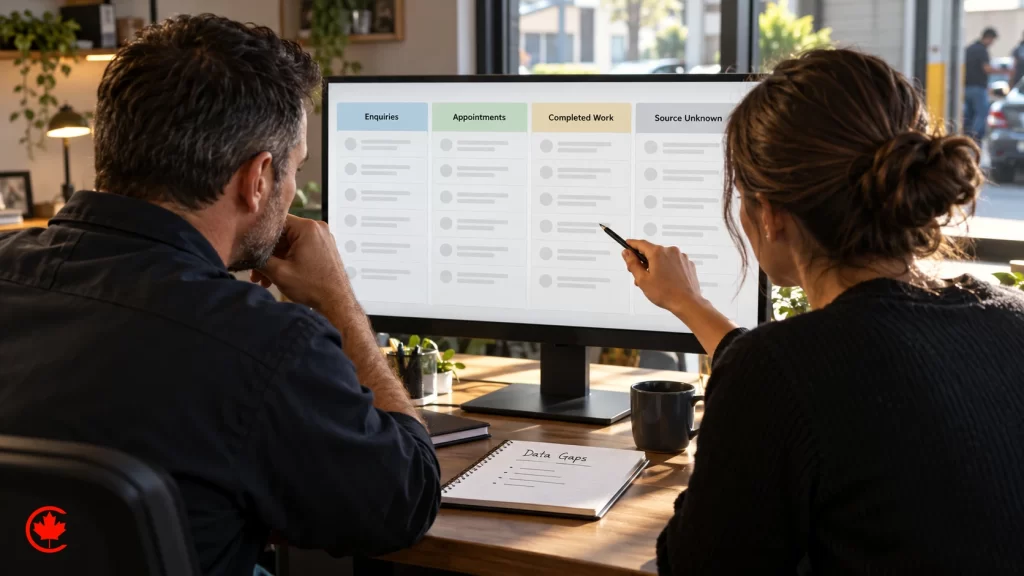
Plans for each type of automotive business
Independent repair shops compete on trust and location
Independent repair shops win with maps, reviews and job-specific pages. The plan leans on local search, a fast website and retention, with paid search used to fill gaps.
Collision and auto body shops depend on the claims conversation
Collision centres need pages that explain the claims process, estimates and what the customer can expect at each stage. Search campaigns target after-accident searches, and trust signals carry more weight because the customer is often stressed.
Tire and seasonal service shops plan around the calendar
Tire shops see peaks around spring and fall changeovers. Campaigns, reminders and storage offers start weeks before the first snow or the spring thaw so the schedule fills early.
Dealerships need inventory, finance and service marketing together
Franchised and independent dealers need inventory ads, finance and trade-in pages, and a service department campaign that keeps buyers coming back. We work within any manufacturer or co-op advertising rules you follow.
Specialty and mobile businesses need focus
Transmission, diesel, performance, EV and mobile mechanics serve narrower demand. Tight targeting and clear specialty pages outperform broad campaigns for these businesses.
Social media, video and guerrilla marketing for automotive brands
Short video shows the work
Short videos of diagnostics, before and after detailing, or walk-arounds of new inventory give people a reason to trust you before they call. Phone footage filmed in the shop often feels more credible than polished ads because it looks real.
Social media keeps past customers close
Social profiles are strongest for staying in touch: seasonal reminders, team introductions and community events. For most repair shops, social media supports search rather than replacing it.
Guerrilla marketing works when it is local and memorable
Guerrilla marketing for automotive businesses means low-cost local ideas that get attention, such as a free winter safety check day, a partnership with a local driving school or a sponsored community team. It works when it ties back to an offer you can track.
Creator partnerships need clear disclosure
Paid partnerships with local creators must be clearly disclosed under Canadian advertising standards. We plan them with disclosure built in from the start.
Services for car care and dealerships
Each page below focuses on one part of the automotive business. For search work focused on vehicle inventory and dealership departments, see car dealership SEO in Toronto.
How to compare automotive marketing agencies in Toronto
The best automotive ad agency for you is the one that can show how its work turns into booked jobs and vehicle sales in your market. Ask these questions before you sign.
Ownership of accounts and data should stay with you
Your business keeps control of its customer data, domain and business accounts, with accounts established in your name where the platform permits. Third-party software and licensed materials retain their existing terms.
Reports should measure bookings, not impressions
Reports should show calls, bookings and cost per booked job, not only impressions and clicks. Ask any agency for a sample report before you commit.
Experience with your business type and province matters
Advertising rules, seasons and customer behaviour differ by province and by business type. Canada Create brings 18+ years of experience across Canada, is a BBB Accredited Business with an A+ rating. Call (416) 273-9030, Monday to Friday, 9 am to 6 pm, and Saturday, 10 am to 2 pm. After hours, our 24/7 AI agent answers the toll-free line, +1 (800) 808-9235, and we’ll follow up the next business morning.
Guides for automotive businesses
Related work is explained on its own pages: marketing a dealership rental fleet.
Mechanic advertising: ads that fill your repair bays
Mechanic advertising is paid promotion that puts your auto repair shop in front of drivers at the moment something goes wrong or comes due: a grinding noise when braking, a check engine light on the dash, winter tires waiting in the garage, a safety certificate needed before a sale. Mechanic advertising is for independent mechanics, auto repair shops, tire and alignment shops, mobile mechanics and small service centres that want their ads tied to bay capacity and booked jobs rather than clicks. Canada Create is a Toronto digital agency at 126 Willowdale Avenue, serving repair shops and garages across Canada since 2008. We plan and manage search ads by repair job, call ads, map ads, local video and service specials, in accounts held in your shop’s name.
What drivers search and how they pick a shop
Drivers rarely search for a garage by name unless they already have one. They type the job or the symptom: mechanic near me, auto repair near me, brake repair, oil change, check engine light, transmission repair, tire change, wheel alignment, car AC repair or safety inspection. Many add the neighbourhood or simply rely on their phone’s location, which is why most repair searches feel local even without a place name.
How a driver chooses between three shops
The decision usually happens in a minute or two on a phone. Drivers look at review stars and recent comments, distance from home or work, whether the shop is open now, and any sign of price clarity, such as a posted oil change price or a clear diagnostic fee. Underneath all of it sits one worry: will this shop upsell me? Ads and landing pages that answer that worry, with plain pricing where you can give it and a promise to call before any extra work, win the call.
Urgent jobs versus planned maintenance
A driver with a dead battery on a January morning wants the nearest open shop and a quick answer. A driver booking a seasonal tire swap will compare price and convenience and happily book for next Tuesday. These are two different ad strategies: urgent jobs need call ads and tight radius targeting during open hours, and planned jobs suit online booking and service specials.
Search ads by repair job
One campaign for auto repair hides what each job really costs to win. We build Google Ads campaigns around the work you want in your bays: brakes, oil changes and maintenance, check engine diagnostics, tires and alignment, transmission, exhaust and muffler, air conditioning, batteries and electrical, and safety inspections. Each group gets its own ads, budget and landing page.
Matching the ad to the job
A brake repair ad should talk about brake inspections, pads and rotors, and how quickly you can look at the car. An AC ad in June should mention recharge and leak checks. A check engine ad should explain your diagnostic process and what the fee covers. Specific ads attract drivers with that exact problem, and they make your shop look like it knows the job before the car arrives.
Keeping out searches that never book
Repair searches attract plenty of clicks that never become a work order: people looking for mechanic jobs or apprenticeships, parts buyers, do-it-yourself videos, car makes you do not service, and dealer-only warranty work. Negative keywords keep those out. For mobile mechanics, we also exclude areas beyond the distance you will drive with your van.
Landing pages for each repair job
A brake ad that lands on a generic home page makes the driver hunt for the answer. Each repair campaign should land on a page about that job: what the inspection includes, a clear diagnostic or starting price where you can honestly give one, how you call before doing extra work, your hours, a tap-to-call button and a short booking form asking for the year, make, model and the symptom. Photos of your own bays and techs, not stock images, make the page feel like a real shop around the corner.
The makes you service
If your shop specializes in certain makes, ads can say so, naming the vehicles you service. They must never suggest that you are a dealer or authorized by a manufacturer unless you are.
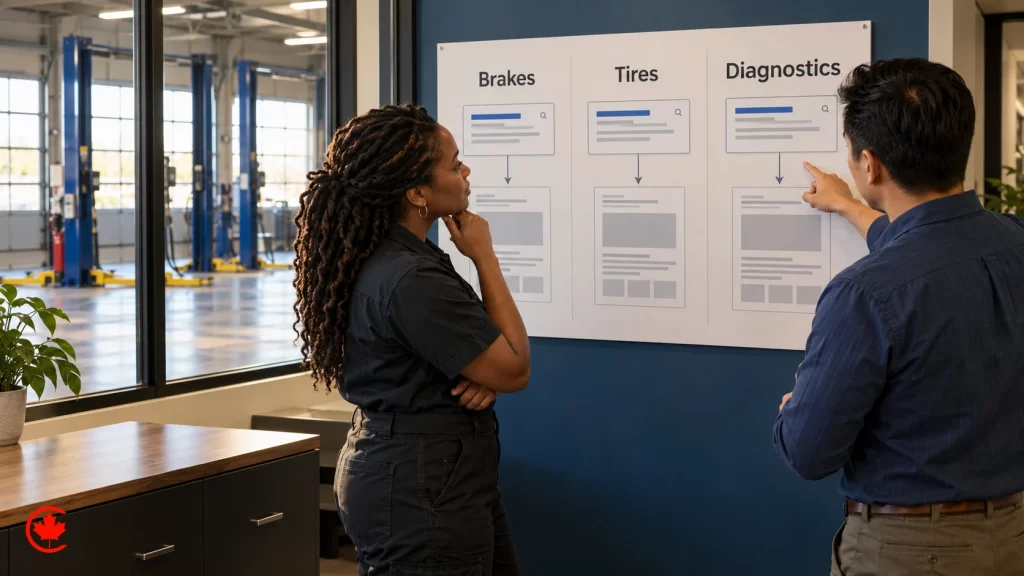
Calls, ad schedules and bay capacity
For a repair shop, the phone call is the conversion. Many drivers with a problem want to describe it to a person and hear when they can bring the car in.
Call ads and call tracking
We add call extensions to every search ad and run call-only ads for urgent jobs on mobile. Tracking numbers on ads let you see which campaigns ring the front counter, how long calls last and which ones were missed. Missed calls during a busy morning are one of the most expensive leaks in repair shop advertising, and the report makes them visible.
Ad schedules that follow your hours
Call ads that run while the shop is closed waste money and frustrate drivers. We schedule ads to your opening hours, reduce bids near closing, and switch to online booking messages after hours. Saturday hours, holiday closures and early drop-off windows are set in both the ads and your Google Business Profile so they match.
Turning spend up and down with bay space
When every bay is booked through Thursday, paying for more brake calls makes little sense. When a tech is free tomorrow, it does. We agree a simple signal with your service writer, such as a short message when the schedule is full or open, and adjust budgets and ad text, for example same day diagnostics available, to match. Ads tied to bay capacity spend money when you can take the work.

Map ads and your Google Business Profile
When a driver searches mechanic near me, the map pack often matters more than the regular results. Paid map placements and pay-per-call local service listings both draw on your Google Business Profile, so the profile is effectively the landing page for many repair shop ads.
What the profile needs before ads run
The right primary category, accurate hours, a list of services that matches your ad groups, photos of the shop front, bays and team at work, and steady review replies all improve how the ad looks and how often it is clicked. Our Google Business Profile management for local shops keeps those details current, and our management of Google local ads and listings covers setup, job types and call screening.
Local service listings for repair work
Where the platform offers them for auto repair in your area, these listings charge per call rather than per click and show review stars prominently. Choosing only the job types you want, keeping hours current and reviewing calls that were not real repair requests keeps them worth the money.
Local video and social ads for a repair shop
Search catches drivers with a problem today. Facebook, Instagram and YouTube ads build the familiarity that makes a driver think of your shop first when the problem arrives, and they suit planned work like tire changeovers and pre-trip inspections.
Video that builds trust
Short clips do this well: a technician showing a worn brake pad next to a new one, a walk through the shop explaining how you call before any extra work, the owner introducing the team, or a quick tip on checking tire tread before winter. Real people in your real shop beat stock footage of a gleaming garage. Our video production for local service businesses can film a set of clips in one visit.
Targeting the neighbourhood
Social ads for a repair shop work well within a short drive of the bays. We target the surrounding neighbourhoods and nearby workplaces, use retargeting for people who visited your site or watched a video, and keep frequency low so the ads stay welcome. Our paid social advertising service manages audiences, creative and budgets.
Service specials that match how you write estimates
Specials are a natural fit for repair advertising: a seasonal tire changeover price, an oil change and inspection bundle, a battery test before winter, an AC check in late spring. They give a hesitant driver a small, low cost first visit and a reason to choose you over the shop down the street.
Specials drivers believe
A special works when the price is real and the conditions are clear: which vehicles it covers, what oil type is included, how long it runs, and what happens if the inspection finds something else. The last point matters most. Saying plainly that you will show the driver what you found and wait for approval before doing more turns the special into trust rather than suspicion.
Specials that fill quiet days
Many shops have predictable slow days or weeks. A midweek maintenance special, promoted only in the days before it runs, can fill bays that would otherwise sit empty. We set these up as separate campaigns with their own end dates so they stop when the offer ends.
Fleet and commercial accounts
Fleet work, such as delivery vans, trades trucks, small business vehicles and rideshare drivers, can give a repair shop steady weekday volume. These buyers search differently and decide differently: they want quick turnaround, clear invoicing, consistent pricing, records by vehicle and someone who answers the phone.
Reaching fleet managers
Fleet searches include fleet maintenance, commercial vehicle repair and van repair near me. A separate search campaign for these terms, a fleet page that explains invoicing and scheduling, and LinkedIn or Facebook ads aimed at local business owners and operations managers can open conversations. A short fleet enquiry form asks for the number of vehicles, types and current service arrangement.
What a fleet page should say
Fleet buyers skim for practical answers: how early vans can be dropped off, whether you offer pickup or a loaner, how invoices are sent and grouped, whether you can follow a maintenance schedule by vehicle, and who the single point of contact is. Answering those questions on one page, with a phone number that reaches the service writer directly, saves a fleet manager several calls.
Keeping fleet clients
Once a fleet account starts, the relationship matters more than any ad. Our B2B marketing for service companies covers account follow-up, and CS+ can track each vehicle’s service history and next due date so reminders go out on time.

The repair shop advertising calendar
Auto repair demand in Canada follows the weather closely, and ad budgets should too.
- Fall: winter tire changeover is the busiest stretch for many shops. Booking ads should start before the first cold snap, when drivers begin thinking about it, and continue until the rush fills your schedule.
- Early winter: cold-start battery failures, block heater checks, wiper and washer issues and heater problems. Urgent call ads for batteries and no-start problems earn their keep on cold mornings.
- Spring: the second changeover, plus pothole damage, alignment, suspension and brake work after a hard winter.
- Late spring and summer: AC repair, pre-road-trip inspections and cottage season checks. Ads for inspections before long drives perform well before long weekends.
We build these seasonal campaigns once and reuse them each year, adjusting dates, prices and text so each season starts ready.
After the ad: reviews, reminders and answering
Ads bring a car into the bay once. What happens next decides whether the driver comes back. The rest of this page covers the whole automotive plan; here is how ads connect to it.
- Reviews after pickup: a short text or email after the car is picked up asks for a review while the experience is fresh, with consent. Strong recent reviews make every map ad more convincing. Our online reputation management covers review replies.
- Service reminders: CS+ can send oil change, tire swap and inspection reminders by mileage or date, so the second visit does not need another paid click. Our automotive email marketing covers these flows.
- Answering when techs are under a car: an AI receptionist for busy service counters can answer, take the vehicle and the problem, and offer drop-off times, so a ringing phone during a busy morning still becomes a booking.
- Organic search: ranking for repair terms without paying per click is the work of our SEO for auto repair and service centres, which shares the same keyword plan.
Detailing shops have their own page, car detailing marketing and advertising, since their bookings work differently.
Advertising rules for repair shops
Repair advertising touches prices, estimates and vehicle brands, so a few rules shape what an ad can say.
Estimates and authorization
In Ontario, the Consumer Protection Act sets rules for motor vehicle repairs, including how estimates are given and how additional work is authorized. Ads for prices and specials should match how your shop actually gives estimates and asks for approval. Other provinces have their own consumer protection rules.
Prices and brand names
Under the Competition Act, an advertised price must be genuinely available as stated, with no bait pricing that lures drivers in for a deal that rarely applies. Manufacturer names may appear only as vehicles you service, never in a way that implies dealer status or manufacturer authorization.
Consent and privacy
The oil change reminder text and the review request after pickup are commercial messages under CASL. Ask the driver at the counter or on the work order whether they want reminders, name your shop in every message, and include a working way to opt out. Work orders hold names, phone numbers, plates and VINs, which PIPEDA expects you to protect in general terms, and none of that belongs in an ad audience or analytics tool. This is a marketing observation, not legal advice.
How we run ads for your shop
It starts with a free review of what your shop runs today: any Google Ads or social accounts, local listings, your Google Business Profile, landing pages, how calls are answered and which jobs bring the most profit to your bays. We also ask what you do not want, such as tire-only customers in fall or certain makes.
You get a custom proposal with our fees quoted in writing and a recommended ad budget per campaign, paid directly to the platforms. After your approval, we build campaigns, call tracking and landing pages in agreed milestones, and you approve every ad and special before it runs.
Each month you receive a plain report: spend by repair job, calls answered and missed, bookings, and changes planned for the next month and season. All ad accounts and tracking stay in your shop’s name.
What mechanic advertising costs
Our fees are quoted in writing after the review, and ad spend is paid directly to Google, Facebook, Instagram or YouTube, shown separately. When SEO is added, it is quoted in writing too.
What drives the price for a repair shop
- Number of repair job campaigns: brakes and oil changes alone are lighter than a full menu of tires, transmission, AC, diagnostics and inspections.
- Locations and radius: a single bay shop versus several locations, or a mobile mechanic covering a wider area.
- Seasonal campaigns: tire changeover, battery and AC campaigns each need their own build and timing.
- Fleet work: a fleet page and B2B campaigns add scope.
- Video and landing pages: filming in the shop and building job pages are quoted separately.
How to choose an ad partner for your garage
Questions worth asking any agency before they spend your shop’s money:
- Who owns the accounts? The answer should be you. The ad accounts, call tracking numbers and Google Business Profile should be in your shop’s name.
- Will you split campaigns by repair job? Brakes, tires and diagnostics should not share one budget.
- How will you handle a full schedule? Ads should slow down when the bays are full.
- Will you report missed calls? A call the counter never answered is money spent for nothing.
- How do you write specials? Prices should be real, with conditions stated and no bait offers.
Book a review of your shop's mechanic advertising and call handling
Ask for a free review of your shop’s ads, profile and phone handling.
Request an automotive marketing proposal for your shop or dealership
Tell us about your shop or dealership, your locations and the work you want more of. We review your profile, website, ads and reviews, then send a custom proposal with costs split into setup, monthly management and ad spend. Request your custom proposal. Call (416) 273-9030, Monday to Friday, 9 am to 6 pm, and Saturday, 10 am to 2 pm. After hours, our 24/7 AI agent answers the toll-free line, +1 (800) 808-9235, and we’ll follow up the next business morning.
Talk to a strategist
Ready when you are?
Request a custom proposal
Tell us your goals, budget and timeline. You get a custom proposal and a named strategist, so your next stage of growth starts now.
How we build your automotive marketing plan
A clear sequence that fixes the foundation first, then adds reach where the numbers support it. The indicative schedule is confirmed around access, content and approvals.
- Audit Week 1
We review your Google Business Profile, website, ads, reviews, tracking and competitors in your area.
- Custom proposal Week 1 to 2
You get a custom proposal with priorities, channels and costs split into setup, monthly management and ad spend.
- Foundation Weeks 2 to 6
We repair your profile, set up call and conversion tracking, and fix or rebuild key website pages.
- Launch Weeks 4 to 8
Search campaigns, service pages, review requests and reminders go live in a planned order.
- Improve Monthly
We report calls, bookings and cost per booked job, then adjust budgets, pages and offers.
Why shops and dealers choose Canada Create
18+ years of experience
We have helped local businesses across Canada grow since 2008.
BBB Accredited, A+ rating
A BBB Accredited Business with an A+ rating.
Quoted in writing
Every fee is confirmed in writing before work starts. Request your custom proposal.
You own your accounts
Your business controls its customer data and accounts; platform access and custom website ownership are documented in the agreement.
Sales and support hours
Call (416) 273-9030, Monday to Friday, 9 am to 6 pm, and Saturday, 10 am to 2 pm. After hours, our 24/7 AI agent answers the toll-free line, +1 (800) 808-9235, and we'll follow up the next business morning.
One team for every channel
SEO, Google Ads, websites, reviews and CRM follow-up run from one plan. Our team reviews content, including AI-assisted work, before client approval.
Automotive marketing Toronto: questions shops and dealers ask
What does automotive marketing mean for a repair shop or dealership?
It is the mix of local search visibility, paid ads, a fast website, honest reviews and follow-up that fills service bays and showroom appointments. For a shop, the product being sold is really trust. For a dealer, it is a large purchase that often starts online weeks before anyone visits.
Which automotive marketing trends matter for Canadian shops?
Most repair searches now start on a phone, so map visibility, accurate hours and reviews decide who gets the call. Reply speed matters more for dealers too, because a lead left until the next morning may have booked elsewhere. Follow-up with past customers is gaining attention as acquisition costs rise.
What should an auto repair shop stop doing in its marketing?
Stop judging campaigns by clicks alone and look at calls, bookings and cost per booked job instead. Running ads to a website that cannot book work wastes money, and so does ignoring past customers who will need maintenance, tires and seasonal changeovers. Unanswered reviews are another common gap.
How has automotive advertising changed for dealerships?
Shoppers now choose the vehicle before the store, comparing price transparency, stock, trade-in offers and reviews online. Inventory pages, trade-in and finance forms and fast follow-up move them toward a test drive. Advertised prices also have to meet provincial rules, such as all-in pricing in Ontario.
How does car dealership marketing differ from auto repair marketing?
Repair marketing is local and urgent, reaching drivers near your bays when a warning light comes on. Dealer marketing supports a researched purchase across many websites, videos and reviews. Both depend on a findable website, an accurate Business Profile, real reviews and steady follow-up.
How is automotive marketing priced for shops and dealers?
Pricing reflects which channels a shop or dealer uses, how many locations it has and whether a new website is part of the work. Media budgets go to Google or Meta from your own account, and tools such as call tracking or inventory feeds are billed separately. Fees are quoted in writing after discovery.
How can email and reminders bring auto customers back?
Service reminders for oil changes, tire swaps and inspections bring past customers back without paying for new clicks. CASL requires consent before sending commercial email or texts, so consent records are built into the CS+ follow-up. Reminders also keep your shop in mind when the next vehicle purchase comes up.
How should I choose an automotive advertising agency?
Ask whether it reports booked jobs and sales rather than only clicks, and whether its ad copy follows provincial dealer advertising rules. Look up the agency's street address and its reviews on Google, and confirm your ad and analytics accounts belong to you. On the agency side, Canada Create started out in 2008, and its Better Business Bureau accreditation carries an A+ grade.
How do I promote my mechanic shop with paid ads?
Split Google Ads by repair job, such as brakes, oil changes, check engine diagnostics, tires, transmission, AC, batteries and safety inspections, and send each to a page about that job. Add call extensions and call-only ads for urgent jobs on mobile, and keep the Business Profile current because map ads draw on it. Measure booked jobs and missed calls, not clicks.
Does a garage gain from paying an agency to run its ads?
A garage gets value when the agency ties spend to bay capacity, turning ads up when a tech is free tomorrow and down when bays are booked through Thursday. It should also report which campaigns ring the front counter and which calls were missed. Ask whether the ad accounts will be held in your shop's name.
What will an ad agency charge an auto repair shop?
A repair shop's fee depends on how many repair jobs get their own campaigns, whether map and pay-per-call listings are set up, and whether seasonal, video or fleet campaigns are added. Ad spend goes to the platform directly and is shown separately. Book a free review of your ads and call handling, and the mechanic advertising fee follows on paper from Canada Create.
Do catchy slogans help a mechanic's ads?
Drivers choosing between three shops are mostly worried about being upsold, so a promise to call before any extra work does more than a clever line. Plain pricing where you can give it, such as a posted oil change price or a clear diagnostic fee, also earns the call. Keep slogans for the sign and let ads name the job.
Do Facebook ads pay off for a neighbourhood auto repair shop?
They suit planned work more than emergencies: tire changeovers, AC season and quiet day specials reach drivers before they search. Short videos of your own bays and techs feel like a real shop around the corner. For a dead battery or a grinding brake, search and call ads during open hours usually win the job.
How should a mobile mechanic advertise?
Run search and call ads for the jobs you do at the driver's location, and exclude areas beyond the distance you will drive the van. Schedule ads to the hours you can answer and switch to booking messages after hours. A Business Profile with an accurate service area and steady review replies supports the map results.
What auto repair Facebook post ideas bring in bookings?
Show the work: a tech explaining a worn brake pad next to a new one, a quick AC leak check in June, or a reminder before the winter tire rush. Posts with a clear next step, like booking a changeover slot or calling about a check engine light, turn interest into appointments. Use photos of your own shop and team rather than stock images.
What is a good mechanic advertising strategy for busy and quiet weeks?
Agree on a simple signal with your service writer when the schedule is full or open, and adjust budgets and ad text to match, for example offering same day diagnostics when a bay is free. Urgent jobs need call ads and a tight radius during open hours, while planned maintenance suits online booking and service specials. Ads that follow bay space spend money only when you can take the work.
How do I choose the best mechanic advertising partner in Toronto?
Ask whether campaigns will be built by repair job, how missed calls will be reported, and how they keep out searches for mechanic jobs, parts buyers and makes you do not service. Ads may name the makes you work on but must never suggest dealer status. Canada Create handles garage advertising from Willowdale Avenue in Toronto and holds every ad account in the shop's own name.


Turn more enquiries into booked work
We strengthen how drivers find and assess your shop, then connect enquiry capture with follow-up and a clear staff handoff.