
Toronto · Law firm marketing agency
Law Firm Marketing in Toronto
Your firm needs a clear connection between the matters it wants, the people it reaches and the way enquiries are handled. We bring your website, practice-area SEO, Google Business Profile, advertising and intake reporting into one plan. Your lawyers review legal copy; our team implements the marketing and reviews the results with you.
Law firm internet marketing for Toronto and GTA firms, from North York to downtown: websites, SEO, local search and Google Ads built to support consultations and retained matters, with your lawyers approving content before publication.
- BBB A+ accredited
- 18 years in business
- Mon to Fri 9 to 6, Sat 10 to 2
Get a custom proposal for your law firm marketing
Tell us your practice areas, locations and current marketing concerns. We reply within one business day.
Please do not share passwords or other sensitive details here. We never sell your contact information and we comply with Canadian privacy law
(privacy policy).
What your firm needs from marketing
Enquiries suited to your practice
Present the matters and locations your firm genuinely serves.
A credible first impression
Clear service information, lawyer profiles and consultation options.
A connected enquiry experience
Website and intake support aligned with your team’s availability.
Useful partner reporting
Review the agreed work and available enquiry, consultation and retained-matter records.
What our law firm marketing services include
Choose a focused service or a coordinated engagement. Your proposal identifies what is included.
- Law firm SEOContent and website support for the legal services and locations you want to grow.
- Local presenceEligible profile management, accurate office information and approved review communications.
- Google Ads managementAdvertising for the practice areas you approve, with budget oversight and reporting.
- Website designA credible presentation of the firm with clear consultation routes; accessibility deliverables are agreed in writing.
- Enquiry landing pagesService information and consultation options that match the offer your firm approves.
- Legal marketing contentPages, articles and other agreed content prepared for your lawyers to review.
- Enquiry reportingCalls and forms connected with the source and intake records available.
- Intake and CRM supportConsultation booking, approved follow-up and reporting, with compatibility assessed before scoping.
How law firm marketing is priced
We separate setup, monthly management and third-party spend so quotes are easy to compare.
Law firm SEO
Custom-scoped engagements; proposal after discovery
Firms growing organic and map visibility for one or more practice areas
- Technical SEO
- Practice-area and location pages
- Google Business Profile
- Monthly reporting
Google Ads management
By proposal
Firms considering paid advertising for selected services and locations
- Campaign management
- Lawyer-approved ads
- Agreed landing-page work
- Enquiry reporting
Coordinated law firm marketing
By proposal
Multi-office or multi-practice firms that want one team on site, SEO and ads
- Website work
- SEO and local SEO
- Google Ads
- Intake and CRM review
The written proposal confirms fees and responsibilities. Advertising spend is paid separately to the platform; website projects and third-party costs are identified in the scope.
Services for your practice
Law firm marketing built around the work you want
Law firm marketing in Toronto is everything that helps the right people find your firm, trust it and get in touch for the matters you want. That means a website prospective clients can assess on a phone, search visibility for each practice area, an accurate Google Business Profile for each office, advertising judged by consultations, careful handling of reviews and referrals, and an intake process that answers quickly and records where each enquiry came from. Canada Create has served businesses since 2008 from 126 Willowdale Ave. in Toronto and is a BBB Accredited Business with an A+ rating. We plan and run marketing for law firms as one coordinated program, with your lawyers approving every piece of legal copy before it is published.
We have done this work for law firms already. For Ghasemi Law we designed the website and ran Google Ads and social media advertising; for Azimi Law we designed the website and ran a YouTube advertising campaign.
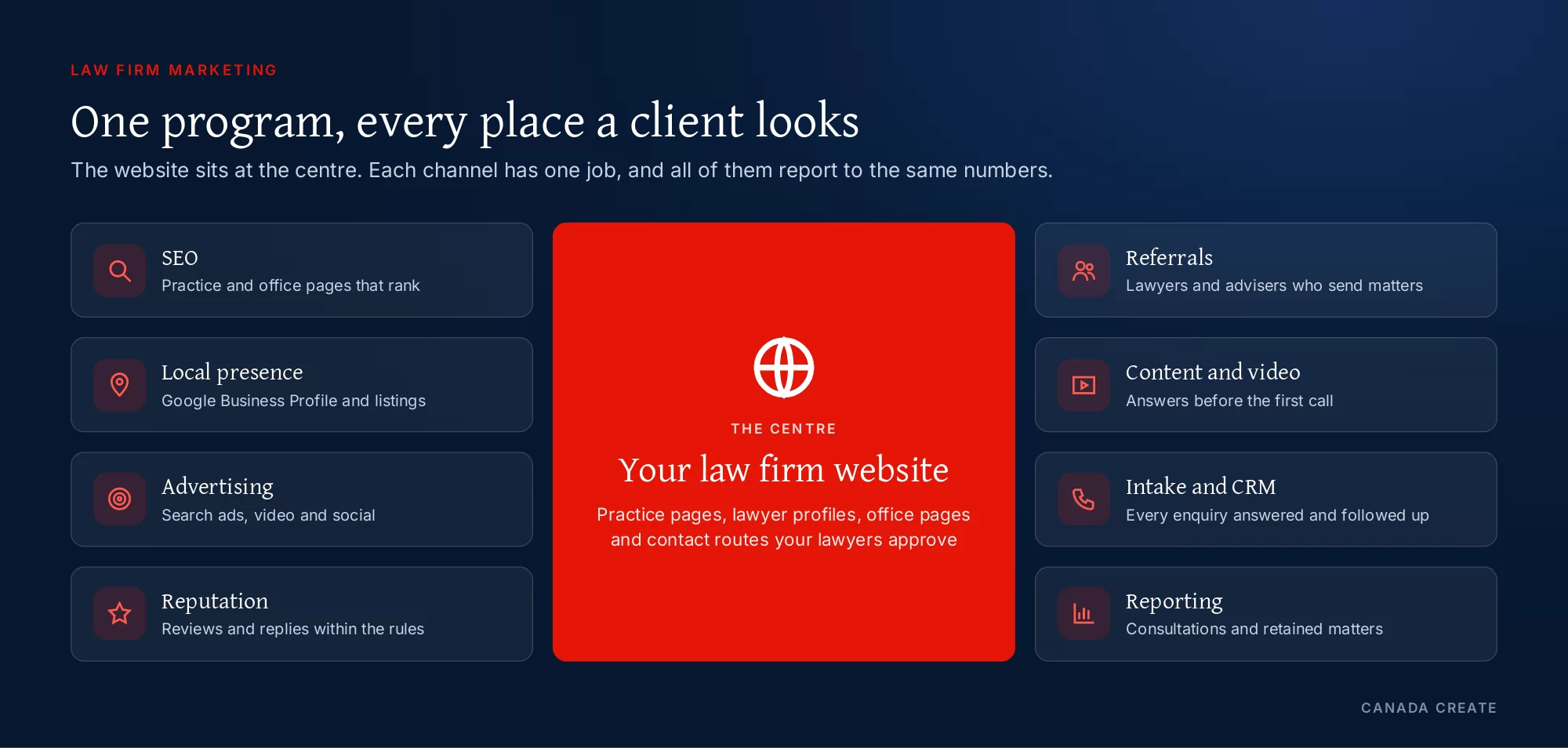
Our law firm marketing covers eight areas, and your custom proposal names the ones your firm needs:
- Website: practice area pages, lawyer profiles, office pages and contact routes that work on a phone.
- SEO: search visibility for the matters you want, in the places you serve.
- Local presence: Google Business Profile, Apple and Bing listings and legal directories for each real office.
- Advertising: Google Ads, YouTube and social, judged by suitable consultations.
- Reputation: review requests, replies and testimonials handled within the Law Society of Ontario’s rules.
- Content and video: guides, FAQs and short videos that answer what clients ask before they call.
- Intake and CRM: how calls, forms and chats are answered, followed up and recorded.
- Reporting: enquiries, consultations and retained matters by channel and practice area, where your records allow.
If search is the only channel you need, see our SEO for lawyers and law firms in Toronto.
What a law firm marketing agency does
A law firm marketing agency turns the firm’s goals into a set of channels that work together. A general agency can run ads or build a website; a legal marketing agency also understands that the firm’s marketing is regulated, that confidentiality limits what can be said, that conflict checks mean not every enquiry can be accepted, and that the person searching is often stressed, urgent or both.
The work starts with the practice you want to grow, not the channels. A firm that wants more employment matters for employees needs different marketing from one that wants corporate clients, and a criminal defence practice that takes urgent calls needs a different intake from a wills practice booking planned appointments. Once the goals are clear, each channel has a job: the website explains, search and ads bring people in, reviews and referrals build trust, and intake converts.
We coordinate those jobs so your lawyers deal with one team instead of separate website, SEO, advertising and CRM suppliers who each report a different number.
How prospective clients choose a law firm
Most people do not choose a lawyer from one search. They ask someone they trust, search the firm’s name, read reviews, look at the lawyer’s profile, compare two or three firms, and only then call. Some start with a search like “family lawyer near me” and shortlist from the map. Others ask an AI assistant to explain their situation and suggest firms. Referrals still check the website before they pick up the phone.
That journey is why law firm marketing works as a system. A strong referral can be lost to a weak website. A good website can be invisible without local search. Paid ads can bring calls nobody answers. The firms that grow steadily usually get the basics right everywhere a prospective client looks:
- Recognition: the client can tell quickly that the firm handles their kind of matter, where it practises and who would help.
- Trust: real lawyers, real offices, genuine reviews, accurate credentials and plain explanations.
- Ease: a phone number that works, honest hours, a short form and a clear description of what happens next.
What prospective clients look for before they call
When people describe how they chose a lawyer, the same few things come up. They looked for proof that the firm handles matters like theirs, a lawyer they could picture speaking with, signs the firm is established and nearby, and some idea of what would happen and what it might cost. Marketing that answers those questions early wins more calls than marketing that talks about the firm’s values in general terms.
On the website, that means practice pages that name the situations the firm helps with, lawyer profiles with photos and plain descriptions of experience, office pages with directions and parking, and an explanation of the first consultation: how long it takes, whether there is a charge, what to bring and what the lawyer will be able to tell them. On the Google Business Profile, it means real photos, accurate hours and recent reviews with calm replies. In ads, it means a message that matches the search and a landing page that continues the same conversation.
People also look for signs of care. A firm that explains things in plain language, uses Ontario terms correctly, keeps its pages current and makes contact easy on a phone signals the kind of attention a client hopes to receive on their matter.
Associations, community and the wider legal network
Some of the most valuable marketing for a law firm happens away from search engines. Membership and active involvement in bar associations, practice groups, community organizations, chambers of commerce and cultural associations build relationships that lead to referrals, and they usually produce genuine mentions and links that also help search visibility.
Speaking at continuing professional development events, writing for professional publications, teaching or mentoring at law schools and volunteering with legal clinics all raise a lawyer’s profile among the people most likely to refer work. Sponsorships of community events and organizations can make sense for business reasons; where a sponsorship includes a link, it should carry the sponsored attribute so it stays within Google’s guidelines.
We help firms make the most of that activity online: event pages and lawyer profiles that list talks and publications, news posts the firm approves, and consistent listings on association directories, so the work lawyers already do reaches the people searching for them.
Confidentiality and privacy in law firm marketing
A law firm’s marketing has to protect the same information its lawyers protect. That shapes several everyday decisions.
- Client stories: case examples and testimonials need the client’s informed permission, and many matters cannot be described at all. Anonymized examples can still identify someone in a small community, so lawyers review every example before use.
- Photos and video: clients, staff and visitors appear only with written consent, and office photos should not show files, screens or whiteboards.
- Forms: contact forms ask only what the firm needs to call back and run a conflict check, and they say plainly not to send confidential details before the firm has agreed to act.
- Analytics and advertising: tracking records which channel and page led to an enquiry, never the details of a legal problem, and remarketing is not built on sensitive topics.
- Reviews: replies never confirm that a reviewer was a client or discuss a matter.
Canada’s private sector privacy law and the Law Society’s rules both point the same way: collect only what is needed, protect it and be clear about how it is used. A privacy policy that matches what the website actually does is part of every law firm site we build.
A website that presents the practice accurately
The website is where every other channel ends up, so it carries the most weight. A law firm website needs a page for each practice area you want, a profile for each lawyer, a page for each office, and contact routes that suit how your clients reach you. It needs to load quickly on a phone, meet accessibility standards and protect any information entered in forms.
Our law firm website design in Toronto service covers new builds and redesigns, including content migration and redirects so a redesign does not throw away years of search history. For a broader project, our web design in Toronto team handles custom builds of every size. Hosting and maintenance are separate services unless included in your agreement.
SEO for the legal work you want
Search is where many prospective clients start, and organic visibility keeps producing enquiries after the work is done. SEO for law firms covers practice area pages, local search for each office, lawyer profiles, technical fixes, structured data and link building through real professional activity. SEO for lawyers and law firms in Toronto explains the work in depth, and our practice area pages go further for specific matters:
- Personal injury lawyer SEO in Toronto
- Criminal lawyer SEO in Toronto
- Immigration lawyer SEO in Toronto
- SEO for employment lawyers in Toronto
- Real estate lawyer SEO in Toronto
- Estate lawyer SEO in Toronto
Local presence for each office
For searches such as “lawyer near me”, Google shows a map with three firms, and those firms take a large share of the calls. Local visibility depends on relevance, distance and prominence: the right categories and services, an accurate address for a real office, and reviews, links and mentions that show the firm is established.
For each real office we manage the Google Business Profile, matching office page, Apple Maps and Bing listings, and consistent details across legal and local directories. Virtual offices and mail drops break Google’s guidelines, so we build local presence only where your lawyers actually meet clients. Our local SEO services in Toronto and Google Business Profile management in Toronto pages describe this work for every kind of business.
Advertising for law firms
Paid advertising puts a firm in front of people searching now, which suits urgent matters, new offices and practice areas the firm wants to grow quickly. It also costs money for every click, and legal clicks in Toronto are expensive, so waste shows up fast.
Law firm advertising we run includes:
- Google search ads: campaigns organized by matter and location, with negative keywords that filter out job seekers, free advice requests and matters you do not accept.
- Local Services Ads: pay-per-lead ads shown above some local searches; Google’s Canadian category list currently covers home services rather than legal services, so we check eligibility before planning them.
- YouTube and video: short videos that introduce the lawyers and explain common questions, building recognition before someone needs a lawyer.
- Social media ads: awareness and community campaigns on Meta and LinkedIn, with care around platform rules for sensitive topics.
- Remarketing: reminders for people who visited the website, never built on sensitive information about a legal matter.
Every ad is marketing under the Law Society’s rules, so ad copy and landing pages are reviewed by your lawyers before they go live. Lawyer advertising in Toronto covers paid campaigns for law firms in detail, and personal injury lawyer advertising in Toronto covers the most competitive practice area on its own.
Reviews, referrals and reputation
Reputation is what turns a search into a call. For law firms it is shaped by Google reviews, directory profiles, referral relationships, community involvement and what other lawyers say about the firm.
Reviews need particular care. The Law Society of Ontario’s commentary to Rule 4.2-1 lists testimonials or endorsements that contain emotional appeals among marketing that may contravene the rule, and replies to reviews must never confirm that the reviewer was a client or discuss a matter. We prepare review request wording, monitor new reviews and draft calm replies for your approval through our review management service. We never write or buy reviews.
Referrals deserve a plan too. Other lawyers, accountants, financial advisers, real estate agents, settlement agencies and past clients send many of the best matters a firm receives. Marketing can support those relationships with a clear website the referrer is comfortable sharing, lawyer profiles that explain what each lawyer does, newsletters to contacts who have agreed to receive them, and events or education that keep the firm in mind. Referral fees between licensees are governed by the Law Society’s rules, and commentary [3] to Rule 4.2-1 says marketing that fails to clearly and prominently disclose a practice of referring clients to other licensees for a fee contravenes the rule. Your firm decides how its referral arrangements work; marketing describes them accurately.
Content, video and email for law firms
Content is how a firm answers questions before the first call. Practice area FAQs, plain-language guides, short videos and newsletters help prospective clients understand their situation and recognize the firm as one that explains things well.
Good legal content is accurate, current and clearly general information. It says who it is for, gives the plain answer, explains what the answer depends on and suggests speaking with a lawyer about a specific situation. It is written in Canadian wording and Ontario terminology and reviewed by your lawyers before publication.
Video works well for law firms because people want to see who they will be talking to. Short clips on YouTube and the website can introduce a lawyer, explain what a first meeting involves or answer a common question. Our video production team can film in your office.
Email keeps the firm in touch with past clients and referral sources. Under Canada’s Anti-Spam Legislation, commercial email needs consent, identification of the sender and a working unsubscribe link, and purchased lists are not consent. We set up newsletters and updates that respect those rules and your clients’ privacy.
Intake, call handling and CRM
Marketing brings enquiries in; intake decides how many become clients. We often find that a firm’s marketing problem is partly an intake problem: calls going to voicemail at lunchtime, forms answered a day later, no route for urgent matters after hours, or enquiries nobody follows up.
Intake improvements we can make:
- Call handling: tracked phone numbers, honest hours on every page, and an AI receptionist that takes messages and books callbacks outside office hours.
- Forms: short forms that ask only what the firm needs to call back and run a conflict check, without inviting confidential details.
- CRM: a CRM for law firms so every enquiry has an owner, a status and a follow-up date, and the firm can see which channels bring matters it accepts.
- AI tools: practical legal AI for lawyers and law firms that helps with intake and routine work, scoped with confidentiality in mind.
Marketing for each practice area
Each practice area has its own clients, urgency and sensitivities, so marketing is planned per practice.
Personal injury
Injury clients search soon after a collision, a fall or a denied claim, often on a phone and sometimes through a family member. Marketing needs clear case type pages, an honest explanation of how fees work, fast intake and careful advertising, because injury clicks are among the most expensive a firm can buy. Any mention of amounts recovered needs the past results statement the Law Society’s commentary describes. See personal injury lawyer SEO in Toronto and personal injury lawyer advertising in Toronto.
Family and divorce
Family law clients need calm, private and practical information. Content should use Divorce Act terminology, such as parenting time and decision-making responsibility, and sensitive pages can include a quick exit option. Advertising avoids remarketing on sensitive topics. See family lawyer marketing in Toronto.
Criminal defence
The person calling may be the accused, a parent or a relative. Charge-specific pages, an accurate Google Business Profile and honest availability matter most, and the marketing never suggests a particular outcome. Commentary [2] to Rule 4.2-1 lists suggesting or implying the lawyer is aggressive among marketing that may contravene the rule, which shapes how criminal defence ads are written. See criminal lawyer SEO in Toronto.
Employment
Employment marketing should say whether the firm acts for employees, employers or both, because those audiences search differently. See marketing for employment lawyers in Toronto and SEO for employment lawyers in Toronto.
Immigration
Immigration marketing is multilingual and program driven. It must stay current, avoid any suggestion of promised approvals, and make clear whether services are provided by lawyers, licensed paralegals or licensed consultants. See immigration lawyer SEO in Toronto.
Real estate
Real estate clients compare price and responsiveness. If you advertise a price for a residential transaction, Rule 4.2-2.1 requires an all-inclusive price except HST and the permitted disbursements the rule lists. See real estate lawyer SEO in Toronto.
Wills, estates and notary work
Estate planning clients book ahead; estate litigation clients often come through referrals. Notary services draw quick, local searches. See estate lawyer SEO in Toronto and notary public advertising in Toronto.
Corporate and business law
Business clients usually come through referrals and reputation. Clear lawyer profiles, thought leadership the lawyers are comfortable publishing, LinkedIn presence and well-organized practice pages support those referrals.
A law firm brand clients remember
Most prospective clients compare two or three firms. The one they remember is usually the one whose practice they understood fastest. A clear brand for a law firm is less about a logo and more about a consistent answer to three questions: what kind of matters the firm handles, for whom, and how working with it feels.
That answer should show up everywhere the firm appears: the website’s opening lines, the Google Business Profile description, lawyer profiles, directory listings, ads, email signatures and the way the phone is answered. A family practice that describes itself as calm and practical on its website but runs aggressive ads sends a mixed message. A business law firm that says it is responsive but takes two days to return a web enquiry undoes its own positioning.
The firm’s name, trade name, logo and taglines are marketing too. Rule 4.2-0 of the Law Society of Ontario’s Rules of Professional Conduct includes firm names (including trade names), letterhead, business cards and logos in its definition of marketing, so a tagline needs to be as accurate and verifiable as any ad. Taglines that promise outcomes, claim superiority or imply aggression create risk; taglines that describe focus, approach or the communities served do not.
Marketing a new law firm or a new office
A new firm or office starts without reviews, links or search history, so the first months focus on the foundations that take longest to build.
Before opening, the firm needs its domain, a website with practice, lawyer and office pages, a Google Business Profile ready to verify at the real address, consistent listings in the main directories, tracked phone numbers and a simple intake process. Announcements to referral sources and past clients who have agreed to hear from the lawyers often bring the first matters.
In the first months, paid search can produce enquiries while organic visibility grows, and steady review requests build the map presence. Content starts with the matters the firm most wants, not with a blog calendar. Lawyers joining from another firm should update their own professional listings and profiles promptly, because people searching their names are often the warmest prospects a new office has.
Opening a second office follows the same pattern on a smaller scale: a real location with its own profile and page, local listings, local reviews and content that reflects the matters and clients of that area, rather than a copy of the main office page.
Competitor research for law firms
Knowing who you compete with online is different from knowing who you compete with in court. A firm’s real online competitors are the firms, directories and lead generation sites that take the search positions, map results and ad slots for the matters it wants.
Competitor research for a law firm looks at which firms appear for the practice and location searches you care about, what their practice pages cover that yours do not, how many reviews they have and how recent those are, which directories rank, what ads run for your terms and what the landing pages promise. It also looks at what AI assistants say when asked to recommend a firm for your practice areas in your city.
The goal is not to copy competitors. It is to find where your firm can be clearer, more useful or more accessible than the firms already visible, and to avoid spending on terms where the competition makes a return unlikely.
Planning a year of law firm marketing
A marketing plan for a law firm works best when it is built around a year, reviewed every month and adjusted every quarter. A typical first year looks like this, with the order changed to suit the firm’s starting point.
First quarter: foundations
Discovery, an audit of the website, search presence, profiles and reviews, tracking for calls and forms, intake improvements and fixes to anything that blocks results: wrong listings, broken forms, slow pages, missing practice pages. If enquiries are needed quickly, a focused paid search campaign can run in parallel.
Second quarter: practice pages and local presence
New and rewritten pages for the priority matters, lawyer profiles, office pages and a steady review request process. Google Business Profiles get regular updates. Ads are refined using the first months of enquiry data.
Third quarter: authority and reach
Guides and videos on the questions clients ask, involvement in associations and community activities that earn genuine mentions, email updates to consenting contacts and a check of what AI assistants say about the firm.
Fourth quarter: review and expand
A full review of enquiries, consultations and retained matters by channel and practice area. The plan for the next year keeps what works, drops what does not and adds practice areas or offices where the data supports it.
How law firms set a marketing budget
Firms set marketing budgets in different ways: a share of revenue, a target number of new matters, the cost of a lawyer’s unused capacity, or simply what was spent last year. Whatever the method, a useful budget answers two questions: what the firm wants to achieve, and what each channel needs to have a fair chance of achieving it.
Some channels have a minimum that makes sense. Paid search in competitive practice areas needs enough budget to gather meaningful data; a campaign that runs out of budget by mid-morning tells the firm very little. SEO needs enough content and authority work to compete for the chosen terms. A website rebuild is a one-time investment that affects every other channel for years.
The most reliable way to judge the budget is by retained matters and fees over time, using the firm’s own numbers. We include that view in reporting so partners can decide where to invest more and where to stop.
Marketing for growing and multi-office firms
As a firm grows, marketing needs structure. Several practice groups, offices and lawyers create more pages, profiles and approvals, and without governance the website drifts into duplicate pages, outdated profiles and inconsistent messages.
A multi-office firm benefits from one brand standard, one content approval route, one owner for each practice group’s pages, regular profile updates when lawyers join or leave, and reporting broken down by office and practice. Each office keeps its own Google Business Profile and local presence, and practice pages make clear which lawyers and offices handle each kind of matter.
Mergers and rebrands need particular care. Old firm names, domains and listings carry years of search history and reviews. Every old URL needs a redirect to its new home, directories need updating and Google Business Profiles need to be merged or renamed according to Google’s rules, so the firm keeps the visibility it has earned.
Common law firm marketing mistakes
These are the issues we see most often when we review law firm marketing in Toronto:
- Marketing every practice area equally instead of focusing on the matters the firm most wants.
- A website that describes the firm instead of the client’s problem.
- Ads that send everyone to the home page rather than a page for the matter they searched.
- Calls from ads going unanswered at lunchtime or after hours.
- Testimonials, “best lawyer” badges or results used without checking the Law Society rules.
- No tracking, so nobody knows which channel brings retained matters.
- Separate suppliers for the website, SEO and ads, each reporting a different number.
- Referral sources who cannot find a clear page to send people to.
- Old firm names and addresses left in directories after a move or merger.
Law firm marketing across Toronto and the GTA
Toronto is many markets at once. A firm near Yonge and Sheppard competes in a different map pack from one on Bay Street, and both compete with firms in Mississauga, Vaughan, Markham and Richmond Hill for clients willing to travel. Courthouses, land registry offices, tribunals and community networks differ across the region, and so do the languages clients speak.
We plan local marketing around the places your firm genuinely serves: real offices first, then the neighbourhoods and cities your clients come from, reflected in practice pages, Google Business Profile service areas, reviews and community involvement. Copied city pages with the name swapped are left out, because they help neither clients nor search visibility. For firms with clients across Ontario or Canada, content follows the rules and procedures of each province where the firm practises.
Law Society rules for law firm marketing
Every channel on this page is marketing under the Law Society of Ontario’s Rules of Professional Conduct, which define marketing broadly to include advertisements, firm names, letterhead, business cards and logos. Rule 4.2-1 requires marketing to be demonstrably true, accurate and verifiable, not misleading, confusing or deceptive, and in the best interests of the public.
In practice that means no superlatives such as “best” or “#1” unless they are bona fide, verifiable rankings; no suggestion of superiority over other lawyers; no implied aggression; past results only with the required statement; a clear statement that services are provided by licensed lawyers; no marketing of second opinion services; fee advertising only on the terms of Rule 4.2-2; and “specialist” only for lawyers certified by the Law Society. Our guide to lawyer advertising rules in Canada covers each rule with checklists, and the full text is on the Law Society of Ontario’s Chapter 4 page. This is general information, not legal advice: your firm remains responsible for what it publishes, and we prepare content for your lawyers to approve.
Privacy rules apply as well. We do not send legal matter details to analytics or advertising platforms, and we do not target or remarket to people by legal problem or other sensitive topics.
Measuring law firm marketing by retained matters
The number that matters to a partner is retained matters and the fees they produce, by practice area and channel. Reporting works up to that number in stages, because each stage tells you something different:
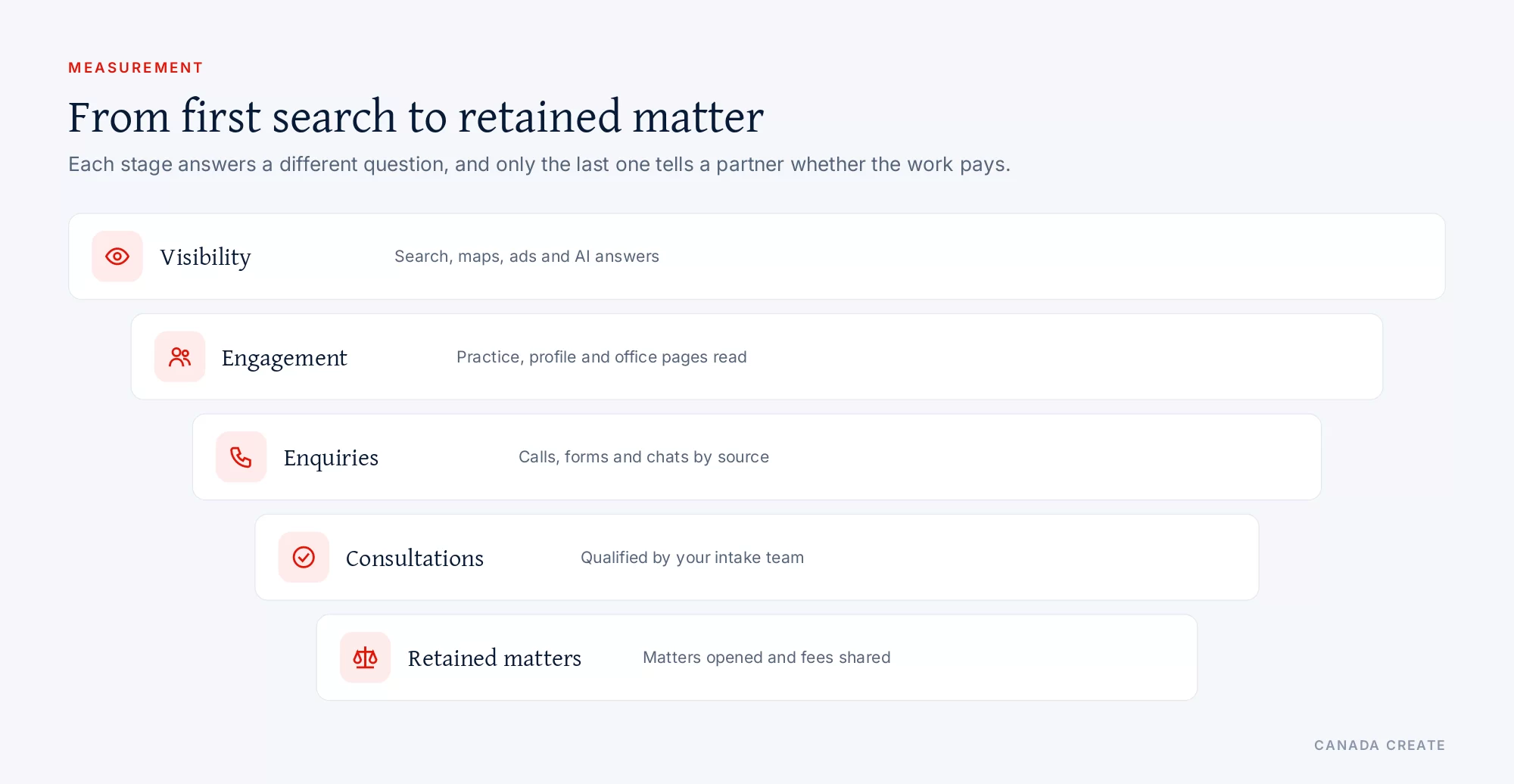
| Stage | What we measure | What it tells you |
|---|---|---|
| Visibility | Search positions, map results, ad impressions, AI answer checks | Whether prospective clients can find the firm |
| Engagement | Visits to practice, profile and office pages | Whether people find what they need |
| Enquiries | Calls, forms, chats and booking requests by source and page | Whether marketing produces contact |
| Consultations | Qualified consultations recorded by intake | Whether enquiries fit your practice |
| Retained matters | Matters opened and fees, where the firm shares them | Whether the investment pays |
Attribution has limits. A client who heard about the firm from a friend, searched its name and then clicked an ad touched three channels. We report each channel’s role honestly and use your own fee information rather than an industry average to judge return.
What law firm marketing costs, and what changes the fee
Law firm marketing with Canada Create is custom-scoped after discovery, and fees are quoted in writing after a free consultation. The things that change the scope are the number of practice areas and offices, the channels included, whether the website needs a rebuild, the competition in your practice areas and neighbourhoods, the languages involved, and how much of the intake and CRM work is included.
Advertising spend is separate from management fees and is paid to the platforms. A focused program for one practice area and one office can be a sensible start; a multi-office firm may need several channels from the beginning. The proposal separates one-time work, ongoing management and third-party costs, so the total is clear before you decide.
How to compare law firm marketing agencies in Toronto
Questions worth asking any agency, including us:
- What have you delivered for law firms, and can we see examples?
- How do our lawyers review content and ads before they go live?
- How do you handle the Law Society of Ontario’s marketing rules, reviews and testimonials?
- How will you report from enquiries to consultations and retained matters?
- Do you work on intake, or only on bringing enquiries in?
- Who does the website, SEO, ads and CRM work, and are any parts outsourced?
- Who owns the accounts, the website and the content?
Be cautious with any agency that promises a number of cases, sells “best lawyer” awards, offers to write reviews or resells the same leads to several firms. Those practices create professional risk for the firm and its lawyers.
Law firm marketing glossary
- Pay-per-click (PPC): advertising where the firm pays each time someone clicks an ad.
- Local Services Ads: Google’s pay-per-lead ads shown above some local searches.
- Lead: a prospective client who has made contact, before the firm has assessed the matter.
- Qualified consultation: a consultation with someone whose matter fits the firm’s practice, jurisdiction and capacity.
- Retained matter: a matter the firm has accepted under a retainer.
- Conversion rate: the share of visitors or enquiries that take the next step.
- Landing page: the page an ad or campaign sends people to.
- Call to action: the next step a page asks the reader to take, such as calling the office.
- Remarketing: showing ads to people who visited the website before.
- CRM: software that records every enquiry and client relationship and its follow-up.
- Intake: the process of answering, screening and booking new enquiries.
- Attribution: connecting a retained matter to the channels that produced it.
How we work with law firms
The first conversation covers the matters you want more of, the work you do not accept, your offices, your intake and what your current marketing produces. We review the website, search presence, profiles, reviews and any advertising accounts, then recommend the channels that fit your goals and budget in a custom proposal with scope, fees and responsibilities in writing.
During the engagement you deal with one team. Drafts come to your lawyers for approval, changes are logged, and monthly reports cover what was done, what it produced and what comes next. Analytics, advertising accounts, Google Business Profiles, domains and social accounts are set up in your firm’s name where the platform allows and remain yours.
Related guides: how law firms get clients in Canada, how paralegals and notaries get more clients and how wills, corporate, tax and IP lawyers get more clients.
Talk to a strategist
Ready when you are?
Request a custom proposal
Tell us your goals, budget and timeline. You get a custom proposal and a named strategist, so your next stage of growth starts now.
From discovery to reporting: how your law firm marketing runs
A clear scope and approval process, with the schedule confirmed for your engagement.
- Discuss your practice Discovery
Confirm the matters you accept, locations, capacity and current marketing concerns.
- Review the proposal Before work starts
Assess the recommended services, fees and responsibilities.
- Agree reporting At the start
Confirm which enquiry and outcome records your firm can appropriately share.
- Review the work Before publication
Your lawyers approve the service information, legal statements and claims.
- Assess progress As agreed
Review delivered work, enquiry quality and recommendations through the agreed reporting.
Law firm work from our portfolio
Websites and advertising we delivered for law firms.


Why Toronto law firms choose Canada Create
Established in 2008
A Toronto agency providing website, search and advertising services.
BBB Accredited A+
An accredited business with an A+ rating.
One accountable team
Website, SEO, ads and lead follow-up run together.
Your approval first
Nothing published without your review.
Quoted in writing
Every fee is confirmed in writing before work starts.
Free consultation
Start with a free consultation and a custom proposal.
Lawyer-reviewed content
Marketing copy is prepared for your lawyers to approve. Your firm retains responsibility for legal accuracy and professional compliance.
Sales and support hours
Call (416) 273-9030, Monday to Friday, 9 am to 6 pm, and Saturday, 10 am to 2 pm. After hours, our 24/7 AI agent answers the toll-free line, +1 (800) 808-9235, and we'll follow up the next business morning.
Law firm marketing in Toronto: questions firms ask
The basics
What is law firm marketing?
Law firm marketing is the work of helping prospective clients find a firm, trust it and get in touch for the matters it wants. It covers the website, SEO, local listings, advertising, reviews, referral relationships, content, intake and reporting, all within the Law Society's marketing rules and the firm's confidentiality obligations.
What does marketing do for a Toronto law firm?
Good marketing brings a steady flow of enquiries for the matters the firm wants, from people in the places it serves, and makes it easy for them to choose the firm. It also filters out work the firm does not take, supports referral relationships and gives partners clear numbers on which channels lead to retained matters.
What does a law firm marketing agency do that a general agency does not?
A legal marketing agency understands the Law Society rules, client confidentiality, conflict checks, the sensitivity of many legal matters and the gap between an enquiry and a retained file. It writes in Canadian legal wording, plans content for lawyer approval and reports on consultations and retained matters rather than clicks alone.
Is law firm internet marketing different from law firm marketing?
Internet marketing is the online part: the website, SEO, Google Business Profile, ads, reviews, social media, email and online directories. Law firm marketing also includes referrals, community involvement, events and print. Today most firms find that the online channels carry most of the work, and that referrals check the website too.
How do law firms get clients in Canada?
Mainly through referrals from past clients and other professionals, organic search and the map pack, paid search, legal directories, reviews and reputation, and increasingly AI assistants. The mix varies by practice area: criminal and injury firms lean on search and ads, while corporate practices lean on referrals and reputation.
Can a small or solo law practice compete online with large Toronto firms?
Yes, in focused areas. A solo lawyer who concentrates on one or two practice areas and one neighbourhood can rank well in the map pack, publish better practice pages than large firms that cover everything, and answer enquiries faster. Large firms win broad terms; small practices win specific matters in specific places.
Channels and strategy
How should a law firm market its services?
Start with the matters you want more of and where those clients are. Make sure the website explains each practice clearly, the Google Business Profile is accurate, reviews are steady and intake answers quickly. Then add the channels that fit: SEO for lasting visibility, ads for urgent matters, content and video for trust and email for referral sources.
For a Toronto law firm, which comes first, SEO or Google Ads?
If you need enquiries quickly, ads can start within days while SEO builds. If the budget is limited and the practice is less urgent, SEO and local search usually give more lasting value. Many firms run both: ads to learn which searches bring good matters, SEO to win those searches organically over time.
What are some effective marketing ideas for a law firm?
Publish one strong page for each matter you want, keep the Google Business Profile complete with real photos, ask satisfied clients for honest reviews, answer common questions in short videos, send a useful update to referral contacts who have agreed to receive it, and make sure every call is answered or returned promptly. Small improvements in each channel add up.
Does social media help law firms get clients?
It helps more with recognition and referrals than with direct enquiries. LinkedIn suits business and employment practices; Instagram, Facebook and YouTube suit practices serving individuals. Posts should be accurate and professional, avoid discussing client matters and follow the same Law Society rules as any other marketing.
Should a law firm use video marketing?
Video lets people see and hear the lawyer before they call, which builds trust for personal matters. Short clips explaining common questions or what a first meeting involves work well on YouTube and on practice pages. Scripts follow the marketing rules: no outcome promises, no implied aggression and no superlatives the firm cannot verify.
Can email marketing work for a law firm?
Yes, for past clients, referral sources and people who have asked for updates. Canada's Anti-Spam Legislation requires consent, sender identification and a working unsubscribe link, and purchased lists are not consent. Useful topics include changes in the law, practical checklists and firm news, written as general information.
How should a new law firm start its marketing?
Before opening, set up the domain, a website with practice, lawyer and office pages, a Google Business Profile at the real address, consistent directory listings, tracked phone numbers and a simple intake process. Then tell referral sources and past clients who have agreed to hear from you, and consider paid search while organic visibility builds.
Websites and search
Does a Toronto law firm need a new website before marketing?
Not always. If the current site is fast, accurate, mobile-friendly and has a page for each practice area, marketing can start with content and local search. If it is slow, outdated or missing practice and lawyer pages, fixing or rebuilding it first usually makes every other channel more effective.
What should a law firm website include?
A page for each practice area and sub-matter you want, a profile for each lawyer, a page for each office, clear contact routes with honest hours, a short enquiry form, plain explanations of how consultations and fees work, a privacy policy and a statement that services are provided by licensed lawyers. It should load quickly and meet accessibility standards.
Why does local SEO matter for a Toronto law office?
Many people search for a lawyer near me, and Google answers with a map showing three firms. Those firms take a large share of the calls. Local SEO, meaning an accurate Google Business Profile, a page for each office, consistent listings and genuine reviews, decides whether your firm is one of them.
How can a real estate lawyer appear in near me searches in Toronto?
List real estate law as a category and service on the Google Business Profile, publish an office page that explains closings and title insurance for your area, keep hours and phone numbers accurate and ask satisfied clients for honest reviews. Prompt replies matter, because people searching near me are often ready to book.
How do AI assistants decide which law firms to mention?
They draw on indexed web pages, consistent business details, directory listings, reviews and mentions in other sources. Clear practice pages that answer questions directly, accurate profiles and listings and genuine coverage of the firm make an accurate mention more likely. No agency can promise one.
Are legal directories still worth it for law firms?
Many are, because they rank for legal searches and confirm the firm's details to search engines and AI tools. Keep free listings accurate everywhere your clients look. Judge paid placements by the enquiries they bring over a few months, and be wary of directories that mainly sell badges or awards.
Advertising
What kinds of advertising work for law firms?
Google search ads for matters people search when they need a lawyer now, YouTube for recognition, social media ads for awareness and community, and remarketing for people who visited the website, built without sensitive information. The right mix depends on the practice area and budget.
Can law firms in Canada use Google Local Services Ads?
Not in most cases today. Google offers Local Services Ads for legal services in some countries, but its Canadian category list currently covers home services rather than legal services. Check Google's current eligibility for your category and location before budgeting. Search ads and a strong Google Business Profile reach the same searchers in the meantime.
Can a law firm use remarketing ads?
Yes, with care. Remarketing to people who visited the website is common, but lists should not be built from sensitive legal topics, such as people who read a criminal charge or family violence page, and ad platforms restrict sensitive categories. Simple remarketing to general visitors is usually the safe approach.
How should a law firm judge its advertising?
By qualified consultations and retained matters, not clicks or calls alone. Track calls and forms by campaign, ask intake to record whether each enquiry fits the practice and compare cost per retained matter between channels. A campaign with fewer, better enquiries can be worth far more than one with many unsuitable calls.
What is the main advertising legislation in Canada?
The Competition Act prohibits false or misleading representations in advertising across Canada, and Canada's Anti-Spam Legislation governs commercial email and texts. Lawyers also follow their law society's rules, which in Ontario are in Chapter 4 of the Rules of Professional Conduct. This is general information, not legal advice.
Reviews, referrals and rules
Do law firm marketing rules differ across Canada?
Yes. Each province's law society sets its own rules, many based on the Federation of Law Societies' Model Code. Ontario's are in Chapter 4 of the Law Society of Ontario's Rules of Professional Conduct. A firm practising in several provinces should check each one, and its lawyers decide what the firm publishes.
Can a law firm say it is the best in Toronto?
Avoid it. The Law Society's commentary treats superlatives such as best, super and number one as awards or rankings that must be bona fide and not misleading, and suggesting superiority over other lawyers may contravene Rule 4.2-1. Describe experience, focus and approach in terms the firm can verify.
Can a law firm use client testimonials in its marketing?
The firm can choose to, with the client's permission and with confidentiality protected, but the Law Society's commentary lists testimonials with emotional appeals among marketing that may contravene Rule 4.2-1. Each testimonial should be reviewed by a lawyer at the firm before use, and many firms rely on independent Google reviews instead.
How should a law firm handle referral relationships in its marketing?
Describe them accurately. Referral fees between licensees are governed by the Law Society's rules, and marketing that fails to clearly and prominently disclose a practice of referring clients to other licensees for a fee contravenes Rule 4.2-1. Supporting referrers with a clear website and useful updates is simple and effective.
Can a law firm advertise free consultations?
Many firms do. The offer must be accurate and honoured for everyone who responds, because commentary to Rule 4.2-1 treats bait and switch marketing as a contravention. A firm should also not market second opinion services, which Rule 4.2-1.2 prohibits. Your lawyers decide what the firm offers.
What are red flags in law firm marketing?
Promises of results, superlatives the firm cannot verify, testimonials with emotional appeals, implied aggression, second opinion offers, fees advertised without the details the rules require, specialist claims without certification, and agencies that offer fake reviews or resell leads. Each creates professional and reputational risk.
How can law firms get more Google reviews without breaking the rules?
Ask satisfied clients at a natural point, such as when a matter closes, with a short message and a direct link. Do not offer anything in exchange, do not ask only clients you expect to be positive and never write reviews yourself. Reply politely without confirming that the person was a client.
Can a law firm share client success stories online?
Only with the client's informed permission and with confidentiality protected, and many matters cannot be described at all. Any mention of amounts recovered or past success needs the statement that past results are not necessarily indicative of future results and that outcomes vary with the facts. A lawyer at the firm should review every story before it is used.
Are law firm taglines and logos covered by the marketing rules?
Yes. Rule 4.2-0 includes firm names, trade names, letterhead, business cards and logos in the definition of marketing, so a tagline must be as accurate and verifiable as an ad. Taglines that describe focus, approach or communities served are safer than ones that promise outcomes or claim superiority.
Intake and measurement
Why does intake matter so much in law firm marketing?
Because marketing only creates the chance of a new client. If calls go to voicemail, forms wait a day or urgent matters have no route after hours, the enquiry goes to the next firm. Fast, consistent intake often improves results more than extra spending on ads or content.
Should a law firm use an answering service or an AI receptionist?
Either can help when the office cannot answer every call. An AI receptionist can take messages, answer simple questions and book callbacks outside office hours, while a person handles screening and conflict checks. The key is that every caller gets a prompt, accurate response and nothing confidential is collected unnecessarily.
What CRM should a law firm use for marketing?
One that records every enquiry with its source, owner, status and follow-up date, and connects to your website forms and phone tracking. Some firms use a legal practice management tool for matters and a separate CRM for prospects. The right choice depends on firm size, existing software and who will use it daily.
How do law firms measure marketing return?
Track enquiries by source, ask intake to record which become qualified consultations and retained matters, and compare the fees from those matters with the marketing cost by channel. Use your own fee information rather than industry averages, and remember that many clients touch several channels before calling.
What should a monthly law firm marketing report show?
Work completed, visibility in search and maps, enquiries by channel and page, intake feedback on enquiry quality, consultations and retained matters where the firm shares them, ad spend and results, and priorities for next month. A useful report explains what changed and what the firm should decide.
How long does law firm marketing take to show results?
Ads can bring enquiries within days of launch. Google Business Profile and website fixes can help within weeks. SEO, content and reputation build over months, and the most competitive practice areas take longest. A realistic program reviews progress monthly and judges each channel over a period that suits it.
Practice areas
How should a personal injury firm approach marketing?
With fast intake, clear case type pages, honest explanations of how fees work, careful advertising budgets and the past results statement next to any mention of amounts recovered. Injury searches are competitive and expensive, so tracking from click to signed file matters more here than in most practices.
How should a family law firm market itself?
Calmly and privately. Use Divorce Act terms such as parenting time and decision-making responsibility, explain what a first meeting involves, add a quick exit option on sensitive pages, avoid remarketing on sensitive topics and keep ads factual. Avoid aggressive wording, which the Law Society's commentary flags.
How do criminal defence lawyers get clients?
Mostly through search at the moment of need, often by a family member, and through referrals. Charge-specific pages, an accurate Google Business Profile, honest availability and fast callbacks matter most. Marketing should never suggest an outcome or imply aggression, both of which the Law Society's commentary flags.
How should an immigration law firm market its services?
In the languages its lawyers work in, with pages for each program that are kept current, plain explanations of documents and timelines, and no suggestion of promised approvals or a special government relationship. The firm should make clear whether services come from lawyers, licensed paralegals or licensed consultants.
How do employment lawyers get more clients?
By being clear about who they act for, employees, employers or both, and publishing pages for the problems those clients search, such as wrongful dismissal, severance review or workplace investigations. Employee-side practices lean on search and reviews; employer-side practices lean on referrals and LinkedIn.
Can a real estate lawyer advertise a flat fee for closings?
Yes, within Rule 4.2-2.1. An advertised price for a residential transaction must include all fees and disbursements except HST and the permitted disbursements the rule lists, the ad must say those are not included and the price must be honoured. Many firms explain what affects the fee instead.
How do wills and estates lawyers market their practice?
Estate planning clients plan ahead, so search, clear service pages and referrals from financial advisers and accountants work well. Estate litigation clients often arrive through other lawyers. Calm, practical guides on wills, powers of attorney and estate administration build trust before the first meeting.
Can paralegals use the same marketing as law firms?
Paralegals follow the Law Society's Paralegal Rules of Conduct, and their marketing must make clear that services come from licensed paralegals. They should not describe themselves as a law firm or use lawyer titles. The channels are similar: local search, reviews, clear service pages for small claims and tribunal work, and fast intake.
Cost and choosing an agency
How much does law firm marketing cost in Toronto?
Canada Create quotes law firm marketing in writing after a free consultation, because cost depends on the channels, practice areas, offices, competition, the condition of the website and how much intake and CRM work is involved. Advertising spend is separate and paid to the platforms. The proposal separates one-time and ongoing costs.
How should a Toronto firm choose a law firm marketing company?
Look for law firm experience, lawyer review of content, a clear approach to the Law Society rules, reporting on consultations and retained matters, intake support and transparency about who does each part of the work. Ask who owns the accounts, and be cautious with promised results, paid awards, fake reviews and shared leads.
Should a law firm hire a marketing person or an agency?
An in-house marketer knows the firm well and can coordinate events and referrals, but one person rarely covers web development, SEO, advertising, video and CRM. An agency brings those skills as a team. Many firms combine the two: an internal coordinator working with an agency for specialized channels.
Do legal marketing agencies resell leads to several firms?
Some lead generation services do, which is why it is worth asking. When an agency builds marketing in your firm's own name, on your website and accounts, the enquiries are yours alone. Canada Create builds marketing for your firm; we do not sell shared legal leads.
Who owns the website and accounts when an agency markets a law firm?
Your firm should. With Canada Create, analytics, advertising accounts, Google Business Profiles, domains and social media accounts are set up in your firm's name where the platform allows and remain yours, and the content we write for your firm is published under your name.
What size counts as a large law firm, and does size change the marketing?
Definitions vary, but firm size changes the marketing more than the label does. A solo or small firm needs focus and fast intake. A mid-size firm needs consistent branding across practice groups and offices. A large firm needs approval routes, governance and reporting across many lawyers and locations.
Can Canada Create market law firms outside Toronto?
Yes. Our office is in Toronto and most of our law firm work is in Toronto and the GTA, but we also market firms elsewhere in Ontario and across Canada. Local presence is built around each firm's real offices, and content follows the rules of the provinces where the firm practises.
How do we start law firm marketing with Canada Create in Toronto?
Request a custom proposal or call (416) 273-9030. We start by discussing the matters you want, your offices, your intake and what your marketing produces today, then review your website and online presence. You receive a written proposal with scope, fees and responsibilities before work begins.
How should a law firm set its marketing budget?
Start from what the firm wants to achieve, such as more matters in one practice area, then check what each channel needs to have a fair chance of delivering it. Paid search needs enough budget to gather useful data, and SEO needs enough content and authority work to compete. Judge the budget over time by retained matters and fees.


Discuss the practice you want to grow
Tell us your website, practice areas and current concerns. We reply within one business day. After discovery, you receive a written proposal with scope and fees before work starts.