
Toronto · AI app development
AI app development in Toronto
AI app development in Toronto for SaaS products and business operations: we connect models and your systems, test representative cases and plan how the application runs after launch.
An AI development company for Toronto and GTA product and operations teams, from North York to downtown: AI apps built around a defined task and tested before release.
- BBB A+ accredited
- 18 years in business
- Mon to Fri 9 to 6, Sat 10 to 2
Get a custom proposal for your AI application
Tell us who will use the application, what task it should support and which systems it needs. Start with high-level context or synthetic examples.
Please do not share passwords or other sensitive details here. We never sell your contact information and we comply with Canadian privacy law
(privacy policy).
The foundations of an AI application you can evaluate
A testable product scope
Users, workflow boundaries and acceptance criteria define the first release.
Connected data and actions
The application reads approved sources and uses explicitly permitted business-system operations.
Visible quality evidence
Representative tests expose useful results, failure cases and remaining limitations.
An operating plan
Ownership, monitoring, change review and handover are planned alongside the build.
What our AI app development services in Toronto include
Components are selected for the application, data and release requirements established in discovery.
- Product and workflow discoveryDefine users, the current process, data availability and success measures.
- Prototype and feasibilityTest the riskiest assumptions on approved representative examples.
- Model and architecture selectionCompare task quality, latency, deployment constraints and expected usage cost.
- Data and retrieval pipelinesPrepare sources, permissions, freshness and references where needed.
- Application interfaceDesign input, output, review, correction and exception states, with accessibility requirements and any conformance testing specified in the agreement.
- Controlled integrationsAssess supported interfaces and authorized access; implement the agreed reads and writes with validation, human approval for consequential actions and failure handling.
- Evaluation and security reviewTest output quality, access boundaries, tool actions and misuse scenarios. Our team reviews AI-assisted development work using technical expertise and presents deliverables for client acceptance.
- Deployment and handoverOngoing operation is separately scoped.
How AI application development is scoped
Every AI application is quoted in writing after discovery.
Discovery and prototype
Quoted in writing
Resolve feasibility and define the first release
- Workflow and data review
- Representative test cases
- Prototype findings
- Implementation recommendation
Application build
Quoted in writing
Deliver the agreed interface, data paths and integrations
- Architecture and implementation
- Review and exception flows
- Evaluation and security checks
- Pilot and release evidence
Operation and evolution
Quoted in writing
Maintain and extend an agreed production application
- Quality and cost monitoring
- Change and regression review
- Support responsibilities
- Planned improvements
Data preparation, integrations, review requirements and deployment influence scope. Model usage, hosting and other third-party costs are identified separately.
From test cases to user workflows
Build the application around the evidence needed to release it
Move from an AI idea to an application people can use
An AI application earns its place when it does one job for real users, with evidence that it does it well. AI app development in Toronto is the design and build of software that combines models, your business data, an interface and controlled actions: a new SaaS product, an AI feature inside a platform you already run, or an internal tool for a complex workflow. Canada Create has built websites, apps and software from its office at 126 Willowdale Ave., Suite #3, in Toronto since 2008, and is a BBB Accredited Business with an A+ rating.
Our AI development company work covers five areas, and your custom proposal names the ones your project needs:
- Product and workflow discovery: the users, the task, the data available and what a good result means.
- Models and retrieval: model selection for the actual task, and retrieval of approved documents where answers need them.
- Integrations and permissions: what the app may read, which fields it may change and which actions need a person’s approval.
- Evaluation and security: representative test cases, failure cases, data separation and review before release.
- Interface, release and operation: web, mobile or in-product interfaces, a controlled pilot and a plan for who runs the application after launch.
Canada Create serves organizations across Canada from Toronto. For a funded product team, the important questions are what users will do, what evidence supports a release and how the feature will be operated. Institutional buyers also need clarity on access, data handling, procurement review and responsibility when an output is wrong. We resolve those questions alongside the software architecture.
Types of AI applications we build, chosen around the task
Generative AI can help draft, summarize, classify and answer questions. Other machine learning approaches support recommendations, forecasting, anomaly detection and image-based workflows. A project may combine these approaches with ordinary business rules. Discovery determines where a model is useful and where a deterministic calculation or existing software feature is the better component.
Candidate applications include knowledge assistants, document-processing workbenches, product recommendations, reporting tools and workflow applications with review queues. For conversational deployments, our AI chatbot and AI receptionist pages cover their distinct service scopes. AI workflow automation addresses connected processes; our AI app development service covers the custom application and user experience around the work.
Define what a good result means before building
We begin with representative examples, the current process and the cost of an incorrect result. A document task needs field-level accuracy and an exception path. A knowledge assistant needs supported answers, appropriate source access and a useful response when evidence is missing. A recommendation system needs a relevant baseline and a way to evaluate whether the suggestions help users.
The discovery output identifies users, workflow boundaries, available data, acceptance criteria and dependencies. A prototype tests the riskiest assumptions before a wider implementation. The decision to proceed uses the test findings, expected operating cost and the work needed to close gaps.
Connect models, retrieval and business systems
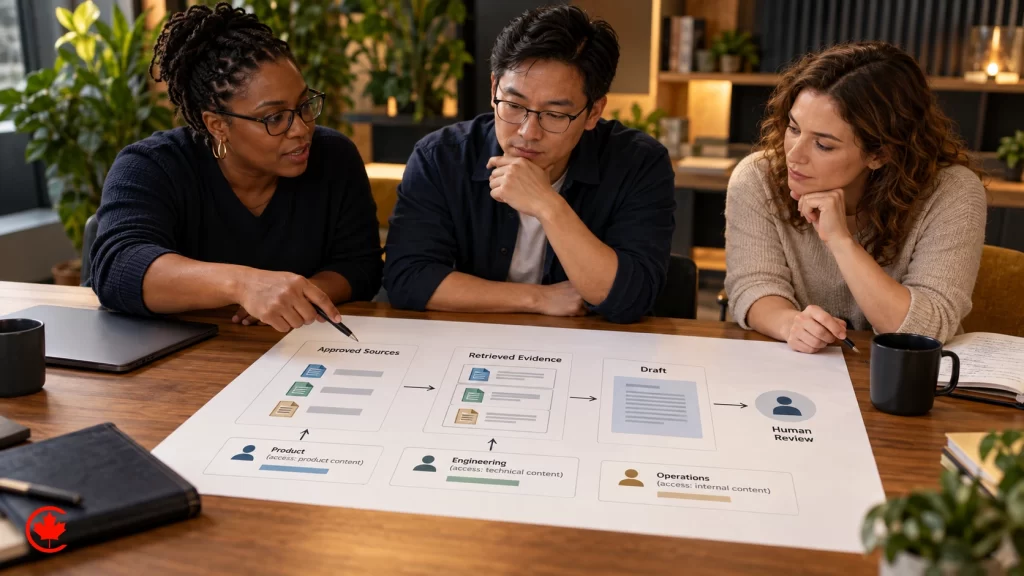
Model selection compares quality, response time, supported deployment options and expected usage cost for the actual task. Retrieval-augmented generation can bring approved documents into a response, with source references where useful. Document freshness, access permissions and the quality of the passages the system finds are tested separately from the generated answer. Retrieval does not eliminate incorrect output.
Integration scope depends on available interfaces, vendor permissions, service limits and access to a suitable test environment. We specify what the app may read, which fields it may change, how identity is checked and which actions need approval. Consequential business actions require approval from an authorized person. Failed writes, duplicate events and unavailable upstream services have explicit handling. The application can be delivered as a web interface, a mobile experience or a feature within an existing product, with custom software development and web app development supporting the wider build.
Evaluation is a release tool
A useful evaluation set includes ordinary requests, difficult examples and cases where the system should ask for clarification or stop. We define how outputs are scored, who reviews disagreements and what constitutes a release-blocking failure. Tests cover the whole workflow: retrieval, generated output, permissions, tool calls and user-visible results.
For applications handling multiple customers or departments, tests must check separation of their data. Security review also considers malicious instructions hidden inside the documents the system looks up, unauthorized actions and sensitive information in logs. Human review is designed around the consequence of the action, with a clear interface for accepting, correcting or rejecting the output. The NIST Generative AI Profile is a voluntary reference for considering trustworthiness throughout the AI lifecycle.
Make data and provider decisions visible
We map the information moving through the application, model providers, storage, search indexes and logs. Your requirements shape access controls, retention, deletion, processing regions and provider selection. Training-use settings, contractual terms and deployment constraints are reviewed for the selected services; a generic promise of Canadian hosting does not describe the whole data path. The client confirms the right to use each source for the agreed purpose. Access to a document alone does not authorize model training or a new use of personal information.
For health, legal, insurance and other sensitive workflows, your appropriate owners identify the obligations and approvals the application must support. Development and testing use synthetic, de-identified or expressly authorized data as appropriate. The application records the operational evidence required by its agreed scope without presenting software delivery as certification or legal approval.
Build, pilot and operate with clear release decisions
Design makes the review and exception states usable before implementation expands. The written scope identifies accessibility requirements for input, review and error states, including keyboard and assistive-technology use. Any conformance target and its testing coverage are written into the project scope. Build cycles deliver testable functionality with versioned prompts, configuration and evaluation results. A controlled pilot checks the application in its intended setting, including access, load, support routes and rollback. Your designated owners review the agreed acceptance evidence before production release.
After launch, operating work can cover quality trends, cost, failures, model or provider changes and new source material. Changes run through regression tests before rollout. The handover identifies who owns alerts, configuration, user support and release approvals. AI consulting can support the initial roadmap, while managed AI services can provide a separately scoped operating arrangement.

What AI app development costs and what changes the fee
Every project is quoted in writing after discovery. Cost depends on data preparation, workflow complexity, integrations, interface design, security requirements, evaluation depth and deployment. Model usage, hosting, search infrastructure and other third-party services are identified separately. The proposal can divide discovery, prototype, production build and operation into decision stages.
Timelines follow the requirements and dependencies, including data access, procurement, integration readiness and client review. Discovery produces a delivery plan with acceptance points rather than an assumed launch date. A smaller first release should still include the controls needed for its intended users and data.
Handover and future change
The handover lists the custom code, prompts, evaluation assets, data pipelines and configurations, and the accounts they live in. Pre-existing tools and third-party or open-source components retain their own rights and licences. Account administration, deployment instructions and ongoing responsibilities are recorded. Where portability matters, we assess the work required to change model providers instead of promising a cost-free switch.
How to compare AI app development companies in Toronto
Toronto has many firms offering AI development, from product studios to large consultancies. Five questions show quickly how a team works:
- Who does the work? Ask who designs the interface, who writes the integration code and who builds the evaluation set, and whether those people are on the team you meet.
- What is delivered at each stage? A discovery summary, a prototype with test findings and a release plan are concrete; “an AI strategy” is not.
- How is quality reported? Look for results on representative cases, including failures, rather than a polished demo.
- Who owns the accounts and code? Model provider accounts, cloud hosting, repositories and data should sit with your organization where the platform allows.
- What do real clients say? Read the firm’s current Google reviews and ask to see software it has shipped.
Be wary of promises that a model will never make mistakes or that a full product can be generated in days. Our checklist on how to compare app development companies in Toronto lists more questions to ask before version one is built. If your project is a conversational agent rather than an application, see our AI agent development in Toronto page.
What to bring to the first conversation
Bring a short description of the user, the task, the current workflow and the systems involved. Aggregate examples and synthetic samples are enough to begin; arrange an approved secure route before sharing sensitive records. We will use that context to define the next technical and commercial decision. Call (416) 273-9030, Monday to Friday, 9 am to 6 pm, and Saturday, 10 am to 2 pm. After hours, our 24/7 AI agent answers the toll-free line, +1 (800) 808-9235, and we’ll follow up the next business morning. A specialist replies within one business day.
Related guide: Vibe coding platforms compared.
Make the release decision explicit
Agree the evidence before expanding the build.
Plan a prototype, test cases and the integration checks that resolve the important unknowns. Custom-scoped engagements; proposal after discovery.
From application hypothesis to release evidence
The delivery plan follows the data, dependencies and acceptance decisions in your project.
- Define the user task Discovery
Map the workflow, baseline and consequences of an incorrect result.
- Test the assumptions Prototype decision
Compare approaches on representative examples and identify remaining engineering work.
- Design and implement Build cycles
Develop the interface, data paths and integrations with reviewable increments.
- Evaluate the release Pilot acceptance
Check quality, permissions, operational behaviour and readiness against the agreed criteria.
- Launch and hand over Release approval
Deploy with monitoring, rollback arrangements and named operational owners.
Engineering decisions that remain visible after the demo
Task-specific evaluation
A document field, recommendation and generated answer need different quality tests.
Reviewable outputs
People can inspect, correct and reject outputs at the right point in the workflow.
Permission-aware retrieval
Source access follows the application’s user and tenant boundaries.
Controlled business actions
Validate requested changes and handle failed or duplicate operations.
AI app development Toronto: questions buyers ask
Is there an AI that can build a business app on its own?
AI app builders and coding assistants can produce screens, code and quick prototypes, which is useful for testing an idea. A production AI application needs more than generated code: defined users, acceptance criteria, permitted data access, tested failure cases and a plan for who operates it. Our team reviews AI-assisted development work using technical expertise and presents each deliverable for your acceptance.
What drives the cost of AI app development?
Scope is shaped by data preparation, the number and difficulty of integrations, review requirements and how the application will be deployed. Model usage, hosting and other third-party costs are identified separately from development fees. Most projects begin with discovery and a prototype that tests the riskiest assumptions, and once discovery is done, the build fee arrives in writing as a custom proposal.
How should we choose an AI app development company?
Ask how the team defines a good result before building, and whether it tests on representative examples that include failure cases. Ask what the app may read, which fields it may change and which actions need human approval. It is fair to ask where the firm's office is, to read its current Google reviews, and to learn who will run the app once it is released. Canada Create builds AI applications from Toronto for organizations across Canada and treats evaluation as part of the release.
Where does AI fit inside an app, and where is ordinary code better?
Generative AI is good at drafting, summarizing, classifying and answering questions. Other machine learning methods handle recommendations, forecasting, anomaly detection and image-based tasks. Discovery decides where a model actually helps and where a fixed calculation or an existing software feature is the better component, and many AI apps combine models with plain business rules.
Can an AI application be delivered as a mobile app?
Yes, an AI application can ship as a mobile experience, a web interface or a new feature inside a product you already run. The interface is designed for input, output, review, correction and exception states. Accessibility requirements and any conformance testing are specified in the project scope.
What do AI app development services include?
Work usually covers product and workflow discovery, a feasibility prototype, model and architecture selection, and data and retrieval pipelines. The application interface, controlled integrations with your business systems, and an evaluation and security review follow. Deployment comes last, and ongoing operation is scoped separately.
How are models and tools chosen for AI app development?
Candidate models are compared on task quality, response time, supported deployment options and expected usage cost for your actual task. Retrieval-augmented generation can bring approved documents into a response with source references, though it does not eliminate incorrect output. Document freshness, access permissions and retrieval quality are tested separately from the generated answer.
What kinds of AI applications can a business build?
Common candidates include knowledge assistants, document-processing workbenches, product recommendations, reporting tools and workflow applications with review queues. The scope might be a new SaaS product, an AI feature in an existing platform or an internal application for a complex operational workflow. Conversational projects such as chatbots and receptionists have their own service pages.


Which user task should your application improve?
Bring the current workflow and the decision a prototype needs to answer. Custom-scoped engagements; proposal after discovery.