
AI SEO Vs. Traditional SEO: Which Strategy Wins?
If SEO feels harder than it used to, you’re not imagining it. A few years ago, publishing a solid blog post and earning a handful of links could move the needle. Today, the internet is saturated with “good enough” content, and search results are shaped by stronger competition, shifting user behaviour, and faster content cycles. That’s why the debate around AI SEO vs. traditional SEO has become so intense: everyone wants the approach that wins, not just the one that sounds modern.
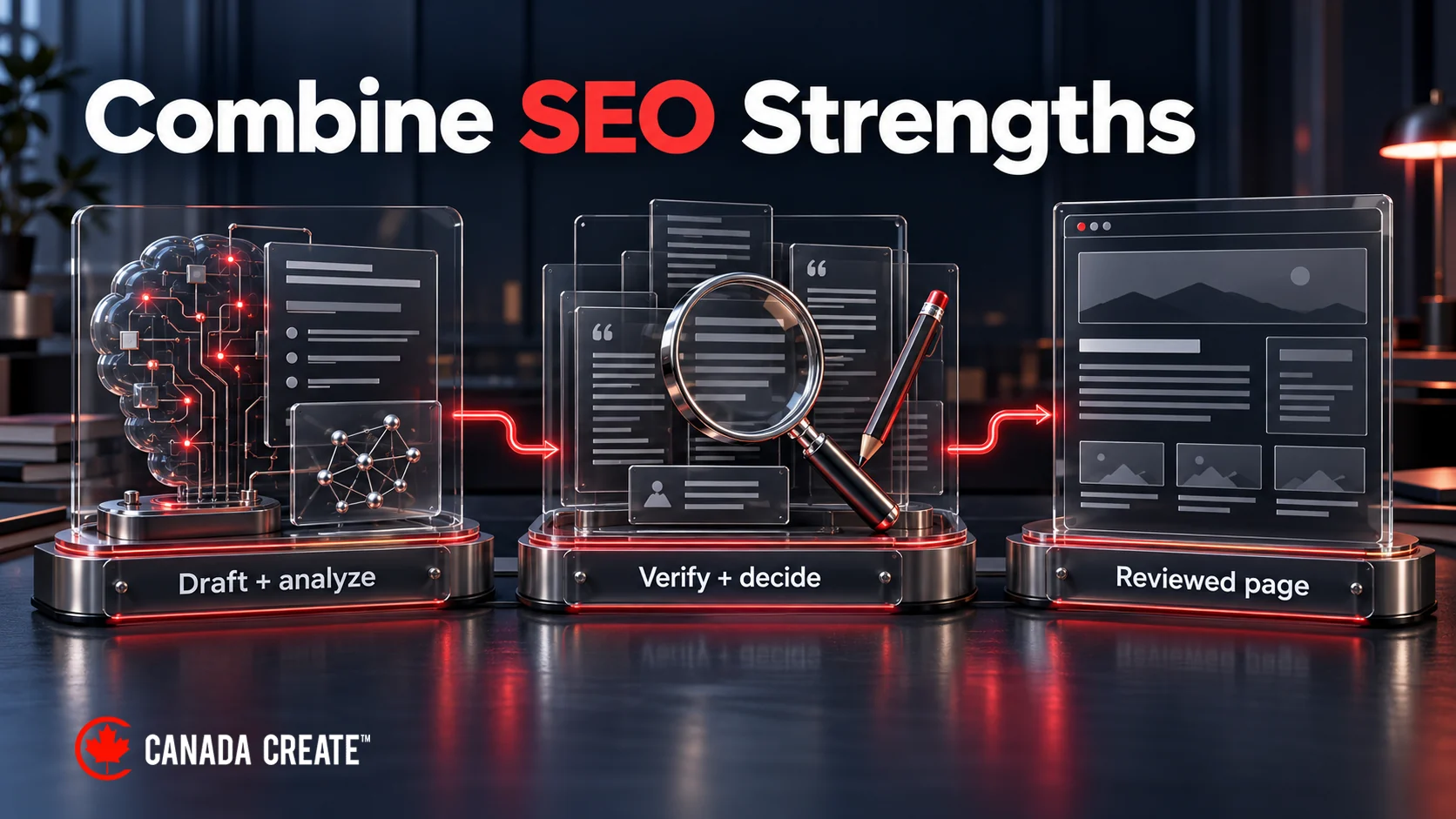
AI can help produce drafts, compare datasets and accelerate routine SEO tasks. People still need to decide what the business should publish, verify claims and bring first-hand knowledge to the work. Choosing the right mix is a practical question about your goals, resources and the consequences of mistakes.
This article will break down AI SEO vs. traditional SEO in practical terms: what each one does well, where each one fails, how to choose the right model, and how to build a strategy that ranks and converts without sacrificing quality. Keep reading to learn how to make the smartest decision, and how to avoid the common mistakes that waste months of effort.

What “AI SEO” Really Means (and what it doesn’t)
AI SEO is the use of artificial intelligence to support SEO activities such as keyword research, content planning, on-page optimization, internal linking, technical analysis, and reporting. It often includes tools that generate outlines and drafts, cluster keywords by intent, or identify patterns in search data and site performance.
AI SEO is not a magic switch that turns content into rankings. It doesn’t automatically create authority, and it doesn’t replace strategic thinking. What it does exceptionally well is speed up repeatable work and help teams operate with more consistency at scale.
At its best, AI SEO acts like a multiplier for skilled marketers. At its worst, it becomes a publishing machine that produces generic pages and dilutes brand trust. The difference is not the tool. The difference is the system around it.
What “Traditional SEO” Actually Covers
In this comparison, “traditional SEO” means an analyst-led workflow for research, technical improvements, content and promotion. Those same activities can use AI assistance. The label does not identify a different Google ranking system.
Helpful information, original expertise and clear explanations matter whether a team uses AI or works without it. AI-assisted research and drafting can support those goals when people check the facts and shape the final material. The distinction is the quality of the work and review, rather than a ranking advantage attached to the production method.
When comparing the two approaches, look at the task. Automation can speed up clustering or draft variants; people contribute business context, first-hand knowledge and editorial judgement. Both belong in a well-run SEO process.
Why This Debate Matters Now
SEO is no longer just about “ranking a page.” It’s about building a system that earns attention, trust, and conversions in an environment where content is everywhere.
Many teams are experiencing one of these problems:
They publish more, but rankings plateau.
They get traffic, but leads don’t improve.
They optimize pages, but competitors still win with stronger authority.
They scale content, but quality drops and brand tone becomes inconsistent.
These are not “AI problems” or “traditional problems.” They’re strategy problems. And the right answer is often a structured hybrid approach that respects both efficiency and credibility.
AI SEO vs. Traditional SEO: A Clear Comparison
Below is a practical comparison to help you see the trade-offs. This is where AI SEO vs. traditional SEO becomes real, not theoretical.
| Task | Useful AI assistance | Work for the responsible team |
|---|---|---|
| Research | Group supplied queries and summarize source material | Check source quality, dates, market and search intent |
| Content | Develop outlines, drafts and variations | Add original experience, verify claims and edit for the reader |
| Technical analysis | Identify patterns in crawl and reporting data | Reproduce faults, set priorities and validate implementation |
| Reporting | Organize results and highlight changes | Check definitions, explain uncertainty and connect findings to business decisions |
| Cost | Can reduce time on repeatable tasks | Account for tools, review and correction before claiming savings |
We help businesses show up in Google AI Overviews, ChatGPT and other answer engines.
If you read that table and feel torn, that’s normal. The “winner” depends on what you need most: speed, scale, trust, or competitive edge. In many industries, the best answer to AI SEO vs. traditional SEO is not choosing one, it’s combining them correctly.

The Biggest Myth: “More Content Automatically Means More Rankings”
AI has made it easy to publish frequently. But frequency doesn’t guarantee performance. Search engines and users reward usefulness, clarity, and credibility. If your site publishes dozens of similar posts targeting slightly different keywords, you may create overlap, dilution, and confusion rather than authority.
This is where many AI-first SEO strategies fail. They focus on output instead of outcomes. The result is a library of pages that look optimized but don’t earn clicks, links, or conversions.
The winning approach treats content as an asset. An asset needs purpose, differentiation, and a measurable role in the funnel.
When AI SEO Wins (and why it wins)
AI SEO wins when the challenge is scale, speed, and consistency. If your team is trying to do too much with limited resources, AI can reduce friction and free up time for higher-impact work.
AI SEO tends to win in scenarios like these:
You’re building foundational content for a new site and need structured coverage quickly.
You manage many pages, such as multi-location service sites or large ecommerce catalogues.
You need to refresh and optimize existing content efficiently across dozens of URLs.
You want faster keyword research, clustering, and content briefing workflows.
You need consistent metadata, internal linking suggestions, and structured outlines.
AI SEO is also strong for analysis tasks that humans find time-consuming:
Spotting patterns in performance data.
Summarizing competitor coverage and topic gaps.
Identifying internal link opportunities across large sites.
Creating structured content templates that reduce inconsistency.
In short, AI SEO wins when the problem is operational. It helps you do more with less.

When Traditional SEO Wins (and why it keeps winning)
Human expertise is especially important when the work depends on first-hand experience, accurate professional information or a distinctive position. AI can assist the process, but it cannot supply experience the business does not have.
Give expert review particular attention when mistakes could affect health, legal or financial decisions; when the offer needs careful explanation; or when original experience is the strongest reason to choose your business. Match the reviewer to the subject.
Traditional SEO also wins when your best advantage is something AI cannot fabricate:
Proprietary experience.
Case studies with real numbers.
Original research or first-party data.
Real examples drawn from campaigns, audits, or customer outcomes.
Human voice that persuades skeptical readers.
In short, traditional SEO wins when the problem is competitive and reputational. It helps you become the obvious choice.
The Real Winner for Most Brands: A Structured Hybrid Strategy
For most companies, the best answer to AI SEO vs. traditional SEO is a hybrid system: use AI to accelerate repeatable work, then use human expertise to deliver differentiation, accuracy, and brand credibility.
A hybrid approach prevents two common failures:
Traditional-only teams often move too slowly and miss opportunities.
AI-only teams often publish too much that sounds the same and fails to earn trust.
A hybrid approach aims for speed without sacrificing quality, and scale without sacrificing strategy.
A Practical Decision Framework: Which Strategy Should You Choose?
If you’re deciding between AI SEO vs. traditional SEO, don’t start with the tool. Start with your situation. These questions will guide you.
How competitive is your SERP?
If competitors are established brands with strong authority, you’ll need traditional SEO strengths: credibility, differentiation, and link acquisition.
If the SERP is fragmented and content is thin, AI SEO can help you cover topics quickly and win gaps.
How sensitive is your niche?
If mistakes create legal, medical, or financial risk, traditional SEO and expert review must lead.
If your niche is lower risk, AI SEO can support faster publishing, still with quality controls.
What is your resource reality?
If your team is small and your backlog is large, AI SEO can reduce workload and speed up progress.
If you have strong writers and subject-matter experts, traditional SEO can produce assets that outperform competitors.
What does “winning” mean for your business?
If winning means publishing at scale, AI SEO helps.
If winning means converting high-value leads and building trust, traditional SEO leads.
If winning means both, you need a hybrid system.
How to Combine AI Assistance and SEO Expertise
This is the most important section if you want outcomes. A hybrid system makes AI SEO vs. traditional SEO a partnership instead of a rivalry.
Step 1: Build a keyword strategy based on intent, not volume
Start by organizing topics into intent categories. This prevents content overlap and improves conversion alignment.
Common intent buckets:
Informational intent: educational guides, explanations, definitions, processes.
Comparative intent: “vs,” “best,” “alternatives,” “reviews,” “cost comparisons.”
Transactional intent: “services,” “pricing,” “hire,” “near me,” “consultation.”
Problem-solving intent: “fix,” “why,” “how to recover,” “troubleshoot.”
AI can help cluster keywords quickly, but humans should validate the intent and decide priorities based on business value.
Step 2: Use AI for research and drafts, then verify and edit
AI is excellent at building structure. Use it to generate:
A clean outline with logical headings.
A list of questions users ask about the topic.
Key subtopics that top-ranking pages tend to cover.
Suggested examples, checklists, and supporting sections.
Then add human direction:
What specific angle will make this page better than competitors?
What examples can you include that are real, not generic?
What practical steps can you provide that are specific to your audience?
This is where you turn a draft into an asset.
Step 3: Add differentiation signals that AI cannot fake
If you want to win the AI SEO vs. traditional SEO decision long-term, you need differentiation. Search engines and users gravitate toward content that feels grounded and credible.
Differentiation signals to include:
Mini case studies: what you did, what changed, what results followed.
Specific examples: sample templates, messaging variations, process walkthroughs.
Proof elements: screenshots (if appropriate), real scenarios, checklists from practice.
Unique frameworks: a simple model that makes decisions easier.
Even one strong original section can separate your content from ten similar articles.
Step 4: Write for clarity and conversion, not just ranking
SEO is not only about being found. It’s about being chosen. Traditional SEO strength comes from persuasion: helping the reader make a decision.
Conversion-focused writing includes:
Clear explanations without unnecessary jargon.
Short paragraphs that keep momentum.
Confident but responsible language.
Practical steps the reader can apply immediately.
Soft CTAs that match the reader’s stage, not aggressive sales pitches.
AI can draft, but humans must shape the message.
Step 5: Use AI to improve on-page optimization efficiently
On-page SEO is a perfect use case for AI SEO because it involves repeatable pattern work.
Use AI SEO to support:
Title and meta description variants.
FAQ question generation based on real intent.
Internal linking suggestions between related pages.
Semantic coverage checks so you don’t miss important subtopics.
Then apply human review to keep everything natural and aligned with tone.
Step 6: Combine AI pattern detection with human technical judgment
Technical SEO benefits from both approaches. AI can help detect issues at scale, while humans decide what changes are safe and valuable.
AI can surface patterns like:
Sudden indexation drops across page groups.
Duplicate metadata patterns.
Orphan pages without internal links.
Pages that take too long to load or fail core experience checks.
Overlapping content that competes with itself.
Humans then decide:
Which fixes matter most for business outcomes.
What changes reduce risk and improve crawl efficiency.
How to update architecture without harming conversions.
This combination is one of the strongest advantages of hybrid SEO.
Actionable Tips to Make AI SEO Content Feel Human (and Rank Better)
A common complaint about AI SEO content is that it feels generic. That’s not a technical problem. It’s a writing and editorial problem. Use these tactics to improve human quality while staying professional.
Add a strong opening that proves understanding
Instead of starting with a definition, start with a real-world tension:
What is the reader frustrated about?
What decision are they trying to make?
What is at stake if they choose wrong?
Use “specific over general” language
Generic content says: “SEO is important for visibility.”
Specific content says: “A page with many impressions but few clicks needs a closer look at the queries, search appearance and promise in its title.”
Include examples that mirror the reader’s reality
For example:
A local service business deciding between fast content production and reputation.
A SaaS company needing scalable programmatic pages without sacrificing trust.
An ecommerce brand trying to optimize category pages and internal linking.
Limit fluff and increase density of useful advice
AI drafts often include broad statements. Replace them with:
Step-by-step instructions.
Common pitfalls and fixes.
Decision checklists.
Templates and frameworks.
Use bold sparingly for key phrases
Examples of useful bolding:
hybrid SEO strategy
AI SEO vs. traditional SEO
search intent
quality control
conversion-focused content
Avoid bolding entire sentences. Highlight only what you want scanned readers to remember.

Cost, Speed, and ROI: What You Should Expect Realistically
Many teams choose AI SEO because it seems cheaper. That can be true in production cost. But ROI depends on the system you run.
AI SEO can reduce costs when:
You use standardized templates for certain page types.
You have a consistent editorial process.
You update and optimize existing content regularly.
You avoid publishing redundant pages.
Traditional SEO may cost more upfront, but it often produces stronger assets when:
Expertise is central to conversion.
Competition is high.
Brand trust is a key differentiator.
Links and mentions matter more than content volume.
Measure the time saved on a task and the quality of the finished work. A faster draft can still need substantial checking; a slower process is not automatically more persuasive.
The businesses that win treat AI as acceleration, not substitution.

The Risks of AI SEO (and how to prevent them)
To make the best choice in AI SEO vs. traditional SEO, you need to understand risks clearly.
Risk 1: Inaccuracies and confident errors
AI can produce statements that sound plausible but are wrong or outdated. This is especially risky for legal, medical, or financial content.
Prevention:
Use subject-matter review for sensitive topics.
Verify statistics before publishing.
Avoid definitive claims without evidence.
Use “may,” “often,” and “depends” where appropriate.
Risk 2: Publishing overlapping pages without distinct value
Pages that repeat the same answer make a site harder to navigate. Review whether each page serves a useful task before adding more. Google’s generative AI guidance also warns against producing pages at scale without adding value.
Prevention:
Create a topic map with one clear primary page per intent.
Use internal linking to clarify hierarchy.
Merge or consolidate overlapping pages.
Risk 3: Thin differentiation and weak authority signals
If your content resembles other pages, it will struggle to earn links, mentions, and strong engagement.
Prevention:
Add original examples and frameworks.
Include real-world perspective.
Improve author credibility and editorial quality.
Risk 4: Brand voice dilution
AI content can feel inconsistent, reducing trust.
Prevention:
Use a style guide: tone, preferred phrasing, formatting rules.
Edit intros and conclusions manually.
Standardize key messages and positioning.
If you control these risks, AI becomes a powerful advantage rather than a liability.

How to Measure Success: Metrics That Matter in AI SEO vs. Traditional SEO
In the AI era, it’s easy to measure output. What matters is performance.
Measure the right outcomes:
Ranking distribution: how many pages reach top 3 and top 10.
Organic conversions: leads, calls, purchases from organic traffic.
Conversion rate by page type: service pages, blogs, category pages.
Engagement quality: scroll depth, time on page, bounce signals (as directional indicators).
Content efficiency: updates that improve rankings vs new posts that don’t.
If a page attracts relevant visitors but few enquiries, review the offer, content and enquiry journey. If it has little search visibility, investigate access, indexing, relevance and competition before assuming more content is the answer.
Conclusion
The useful choice is a workflow that combines speed with reliable decisions. Use AI where it helps research, draft or analyze; use relevant human expertise to check facts, contribute original insight and approve the finished work. Judge the combination by the quality of the pages and the business outcomes you actually measure.
If you want SEO results that last, don’t ask whether you should choose AI or humans. Ask where AI creates leverage and where human judgment creates advantage. The businesses that win treat AI SEO as an engine, and traditional SEO as the steering wheel.
Now is the time to build an SEO process that is fast enough to compete and strong enough to earn trust. If you apply the frameworks in this guide, you can turn AI SEO vs. traditional SEO into a competitive advantage rather than a confusing choice.
Frequently asked questions
Is AI SEO a real discipline, and what does it cover?
AI SEO means using artificial intelligence to support SEO tasks such as keyword research, content planning, on-page work, internal linking, technical analysis and reporting. In practice that includes tools that draft outlines, cluster keywords by intent or spot patterns in performance data. It speeds up repeatable work, but it does not create authority or replace strategic thinking.
Does traditional, analyst-led SEO still matter when AI can speed up the work?
Yes, because the parts that win competitive searches still depend on people. Traditional SEO here means an analyst-led workflow for research, technical fixes, content and promotion, and those same steps can use AI help. Choosing what the business should publish, checking claims and adding first-hand knowledge remain human jobs.
Does using AI to write content hurt a site's SEO?
Not by itself, since the production method carries no ranking advantage or penalty of its own. Helpful information, original expertise and clear explanations matter whether or not AI helped. Problems start when a site publishes dozens of similar, unreviewed posts on slightly different keywords, which creates overlap and dilutes trust instead of building authority.
Will AI make SEO obsolete?
AI changes how SEO work gets done, though it cannot supply experience a business does not have. It handles drafts, clustering and data patterns quickly, while people set priorities, verify facts and bring proprietary knowledge such as real case examples and first-party data. Those human inputs are what separate a page from the flood of good-enough content.
How can a business use AI for SEO without hurting quality?
Use AI to cluster keywords by intent, build outlines and produce first drafts, then have people validate the intent and set priorities by business value. Add real examples, practical steps for your audience and checked facts before anything is published. Match the reviewer to the subject, especially where errors could affect health, legal or financial decisions.
Is AI SEO cheaper than traditional SEO?
AI can cut the time spent on repeatable tasks, but the savings are only real after you count tool costs, review and correction. Content that goes out unchecked can cost more later if it has to be fixed or removed. Compare the full workflow, including editing and fact-checking, rather than the drafting time alone.
When does AI-assisted SEO work well?
It is most useful when the challenge is scale, speed and consistency. Typical cases include building foundational content for a new site, managing multi-location service pages or large ecommerce catalogues, and refreshing existing content across many URLs. It also helps with analysis such as finding internal link opportunities and summarizing topic gaps in competitor coverage.
How reliable is AI SEO for health, legal or financial businesses?
In those fields, expert review has to lead, because a mistake can affect someone's health, legal position or money. AI can still help with research and structure, but a qualified person should check every claim before it goes live. Lower-risk niches can publish faster with AI support, as long as quality controls stay in place.
Should a business choose AI SEO or regular SEO?
For most companies the answer is a structured mix: AI for repeatable work, and people for accuracy, differentiation and credibility. Decide the balance by asking how competitive your search results are, how sensitive your niche is, what resources your team has and what winning means for the business. Teams relying on AI alone tend to publish pages that sound alike, while purely manual teams can move too slowly.