
Toronto · Perplexity SEO
Perplexity SEO in Toronto
Become one of the numbered sources Perplexity cites, with PerplexityBot access through your firewall, pages that state facts clearly and research-grade content.
Perplexity search optimization for Toronto and GTA businesses, from North York to downtown.
- BBB A+ accredited
- 18 years in business
- Mon to Fri 9 to 6, Sat 10 to 2
Get your custom Perplexity SEO proposal
Tell us the questions your Toronto buyers research, and we reply with a custom proposal.
Please do not share passwords or other sensitive details here. We never sell your contact information and we comply with Canadian privacy law
(privacy policy).
What Perplexity SEO gives you
Reachable by PerplexityBot
robots.txt, CDN and firewall rules that let the real crawler in.
Pages worth citing
Specific, dated, answer-first pages that support the sentences Perplexity writes.
A clear view of competitors
Citation lists show who Perplexity trusts for your buyers' questions.
Honest reporting
Citations, accuracy, referral visits and enquiries counted separately.
What is included in Perplexity SEO
Each engagement is scoped to your business and confirmed in a written custom proposal.
- Citation auditWho Perplexity cites for your key questions today, and why.
- PerplexityBot accessrobots.txt rules and published IP ranges checked.
- Firewall and CDN rulesCloudflare, AWS WAF or plugin settings adjusted to Perplexity's guidance.
- Answer-first rewritesService pages that state facts clearly under question headings.
- Research-grade pagesComparisons, requirements and decision pages for Deep Research.
- Accuracy fixesWrong facts traced through Perplexity's citations and corrected.
- Listings and mentionsDirectories, associations and coverage that describe you accurately.
- Monthly Perplexity reportTracked questions, citations, referrals and enquiries.
Perplexity SEO pricing in Toronto
Perplexity work usually sits inside a wider SEO and AI search scope, because the groundwork is shared.
Perplexity within your AI search program
Quoted in writing after a free consultation
Businesses whose buyers research before they call
- Citation audit
- PerplexityBot and firewall review
- Answer-first pages
- Monthly citation tracking
B2B and research-heavy categories
Quoted in writing after a free consultation
B2B, professional services and high-value purchases
- Everything in the core scope
- Comparison and requirement pages
- Deep Research question tracking
- Wider mention work
One-time setup work, monthly management and any third-party costs are listed separately in your custom proposal.
Perplexity search optimization
Be one of the numbered sources behind Perplexity's answer
Perplexity SEO is the work of getting your pages chosen as numbered sources when people ask Perplexity a question about your service, your industry or your area. Perplexity is an answer engine: it searches the web in real time, writes a short answer and lists the sites it used beside every claim. For a Toronto business, that format is both an opportunity and a test. A cited page gets a visible, clickable credit in front of a researcher who is already deep into a decision, and a business that is not cited can see exactly who was.
This page covers Perplexity on its own terms: how it builds answers, its two crawlers and the firewall settings that block them, the content it tends to cite, and how we measure it. For the program across Google AI Overviews, ChatGPT, Gemini, Copilot, Claude and Grok, see AI search optimization in Toronto.
How Perplexity builds an answer
Perplexity’s own help centre article, How does Perplexity work?, describes three steps: it interprets the question, searches the internet in real time and gathers information from sources such as articles, websites and journals, then compiles the most relevant points into a concise, conversational answer. The article says it uses large language models, naming GPT-5 and Claude among them, to understand the context of a question.
Two search modes change how much of the web it reads:
- Pro Search, applied automatically on plans that include it, runs a more thorough search across more sources for a detailed answer.
- Research (Deep Research) runs dozens of searches, reads hundreds of sources and reasons through them to produce a full report in two to four minutes.
That second mode matters for business visibility. A buyer who asks Perplexity to research “commercial roofing contractors in the GTA with green roof experience” gets a report built from a large slice of the web, and the businesses that appear are the ones with pages that clearly cover the details the report needs.
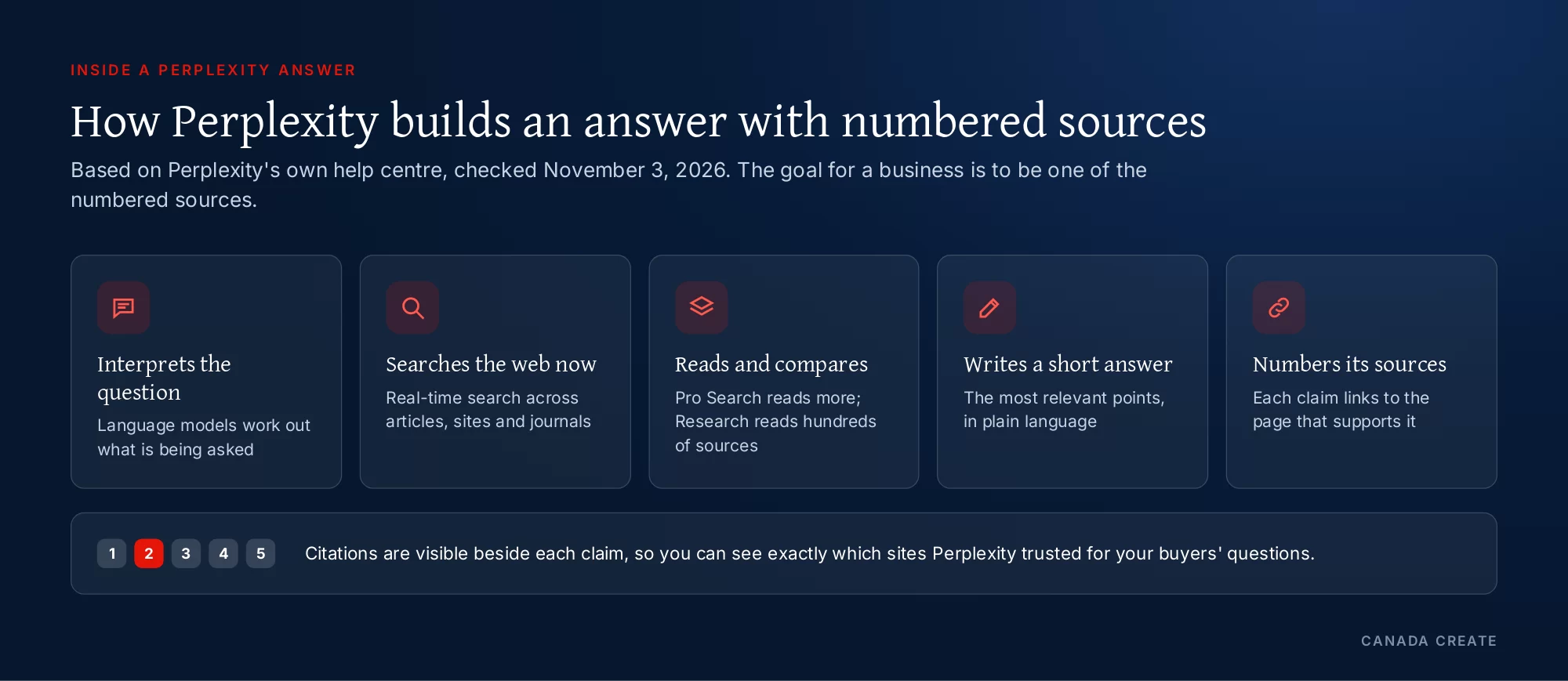
Numbered citations make Perplexity the easiest assistant to audit
According to Perplexity, each answer includes numbered citations linking to the original sources. That design is useful to a business in three ways.
- You can see the competition. Ask the questions your buyers ask and the citation list shows which sites Perplexity trusted for them: competitors, directories, review sites, news articles, forums or government pages.
- You can see what was used. Each numbered citation sits next to the claim it supports, so you can tell whether a competitor was cited for pricing, for credentials or for a how-to explanation.
- You can find the gaps. If every cited source for “best time to replace windows in Toronto” is a manufacturer’s page from outside Canada, a local installer with a clear, honest page on Toronto timing has an opening.
We use Perplexity’s citations as a research tool for the whole AI search program, not only for Perplexity, because they show which kinds of pages answer engines treat as trustworthy for your topic. A CC Zone article on whether Canadian B2B buyers use Google AI Overviews or Perplexity covers how the two compare.
PerplexityBot and Perplexity-User
Perplexity documents its crawlers on its Perplexity Crawlers page. As of November 3, 2026, it lists two user agents, and they behave differently.
| User agent | What Perplexity says it does | robots.txt and training |
|---|---|---|
| PerplexityBot | Surfaces and links websites in Perplexity search results | Follows robots.txt; Perplexity recommends allowing it and its published IP ranges; not used to crawl content for AI foundation models |
| Perplexity-User | Visits a page when a user asks a question, and may link the page in the answer | Generally ignores robots.txt because a user requested the fetch; not used for web crawling or training |
Three points stand out for site owners:
- PerplexityBot is the one to allow. Perplexity says it is designed to surface and link websites in its search results, recommends allowing it in robots.txt and permitting its published IP ranges, and says it is not used to crawl content for AI foundation models.
- Perplexity-User generally ignores robots.txt. Because a user requested the fetch, Perplexity says this fetcher generally ignores robots.txt rules. It visits a page to answer a person’s question and may include a link in the answer. Any public page can be read this way.
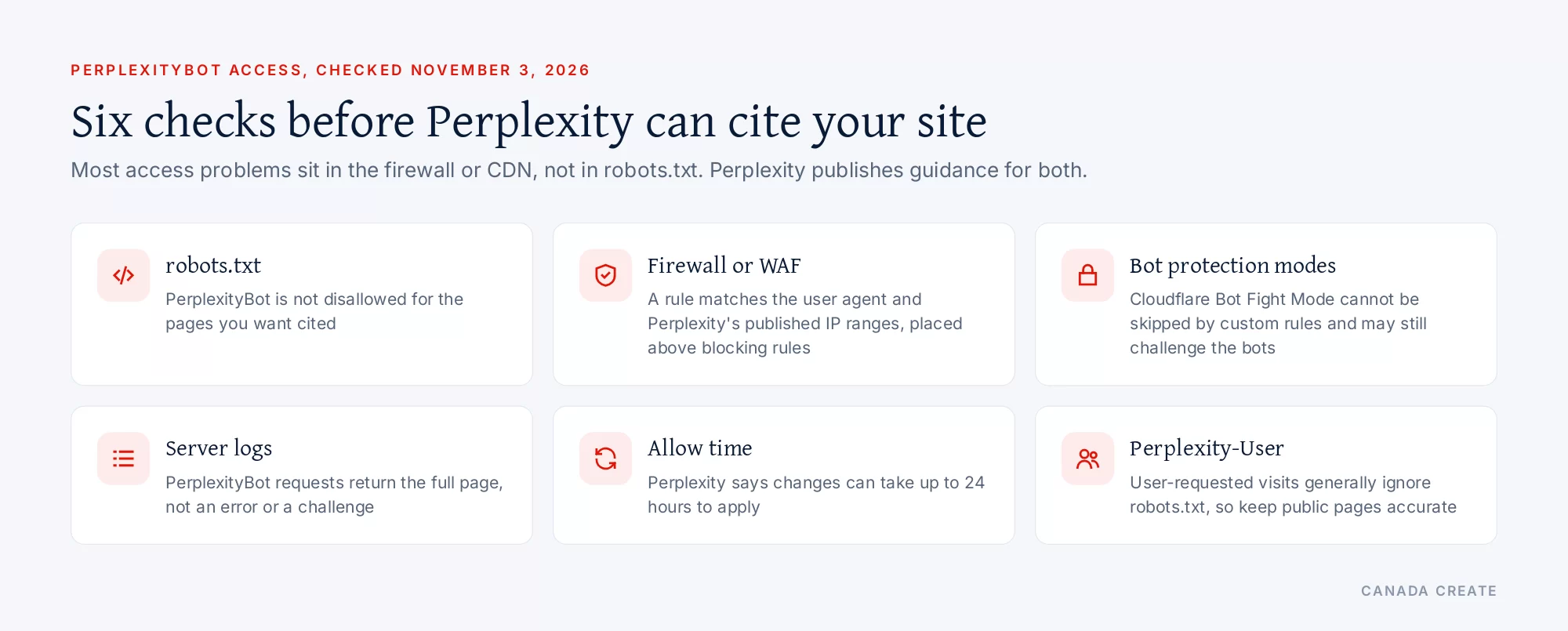
- Changes take up to 24 hours. Perplexity says each setting works independently and its systems may take up to 24 hours to reflect a change.
Firewalls that block Perplexity without anyone noticing
Perplexity’s documentation includes specific guidance for web application firewalls. For Cloudflare, it recommends a custom rule that matches each Perplexity user agent together with that bot’s own published IP ranges and sets the action to Skip, placed above any rule that blocks or challenges requests. It also warns that Cloudflare’s Bot Fight Mode cannot be skipped with custom rules, so with Bot Fight Mode on, Perplexity’s bots can still be challenged. For AWS WAF, it describes IP sets combined with a user agent match.
If your site sits behind a CDN or a security plugin with bot protection turned on, it is worth checking whether PerplexityBot actually gets through. We test it from outside, read your server or CDN logs for PerplexityBot requests, compare their IPs with Perplexity’s published list and adjust the rules so the real crawler is allowed and impostors are not.
What Perplexity needs from your pages
Perplexity writes short answers backed by specific citations, so it favours pages that make specific, checkable statements. These habits make a page easier for it to use.
Put the facts in text, near the top of each section
Perplexity has to read your page quickly and pull out the part that answers the question. Service details, areas, hours, prices or price factors and credentials should be in the HTML text, under clear headings, stated in the first lines of the relevant section.
Be the clearest page on one question
Perplexity cites the page that best supports a particular sentence in its answer. A page that tries to answer everything vaguely is rarely the best support for any one sentence. A page that answers “how long does a basement waterproofing job take in Toronto, and what affects it” directly is.
Date your information and keep it current
Research answers often involve rules, prices and programs that change. Show when a page was last reviewed, name the year when a figure applies, and update pages when the facts change. Stale pages lose to current ones.
Explain, compare and show your reasoning
Deep Research reports compare options. Pages that lay out trade-offs fairly (“when a heat pump makes sense and when it does not”), show criteria and explain how a decision is made are useful raw material. One-sided sales copy is not.
Back claims with something checkable
Link to the official rule, regulator or standard you rely on, name the qualified person behind the advice, and use figures your records support. Perplexity’s answers sit next to their sources, and readers click through to check.
Perplexity for research-heavy and B2B buyers
Perplexity is built around research: its Pro Search and Research modes exist to read many sources and compare them. That suits buyers who are comparing vendors, understanding a regulation, checking a technical point or preparing a recommendation for someone else, which makes it especially relevant for:
- B2B services and software, where buyers build shortlists and comparison tables.
- Professional services such as law, accounting and engineering, where clients research a question before calling.
- High-value home projects, where homeowners compare methods, materials and contractors.
- Healthcare and wellness, where patients research treatments and providers, within the limits of each regulator’s rules.
For these buyers, pages that answer the second and third questions (requirements, timelines, risks, alternatives, what to ask a provider) matter as much as the main service page. For companies selling to other companies, B2B SEO services and Perplexity work share most of the same pages.
Local questions on Perplexity
For a local request, Perplexity can only name businesses that the sources it finds place in that area. Perplexity does not publish a list of local data sources, so we make sure every likely source agrees: your own location pages, your Google Business Profile, your Bing Places and Apple Maps listings (our Apple Business Connect guide explains the Apple side), Yelp, the BBB and the directories for your trade. Reviews that describe the service and the neighbourhood in your customers’ own words help too. It is the same groundwork that drives local SEO in Toronto.
Why Perplexity cites other sites instead of yours
When we look at the citations for a client’s key questions, the reasons a business is missing usually fall into a few groups:
- PerplexityBot is blocked or challenged by a firewall or bot protection setting.
- The answer lives on a page Perplexity cannot use, such as a PDF without text, an image or a page that loads its content with scripts.
- No page answers the exact question, so a directory or a national article is the best available source.
- Competitors publish more specific information, such as typical timelines, cost factors or eligibility criteria.
- Independent sources describe competitors and not you: trade association listings, local news, review sites and forums.
- Your facts conflict across sources, so Perplexity prefers a source that seems more reliable.
Each cause has a different fix, and the citation list tells us which one applies.
Reading a Perplexity citation list for your market
The citation list beside each Perplexity answer is free market research, if you read it systematically. Ask the five to ten questions your buyers ask most, in their words, and for each answer note three things.
- What kind of source each citation is: a competitor’s service page, a directory, a review site, a news article, a forum thread, a government page or a manufacturer. If directories dominate, being listed in them matters. If government pages dominate, your page needs to explain the official rule in plain language and link to it.
- Which claim each source supports: the price range, the timeline, the licence requirement, the comparison. That tells you which specific facts your own page is missing.
- Where the sources are from: a Toronto or Ontario page, a national Canadian page or a page from another country. Answers to local questions that cite sources from outside Canada are often the easiest to win with a clear local page.
Repeat the same questions a month later. New sources, lost sources and changes in what each one supports show whether your work is moving the answer.
A Perplexity checklist for Toronto owners
These checks take an afternoon and cover the Perplexity-specific basics.
- Open your robots.txt and confirm PerplexityBot is not disallowed.
- Ask whoever manages your hosting or CDN whether bot protection is on, and whether it has a rule allowing Perplexity’s published IP ranges. On Cloudflare, ask specifically about Bot Fight Mode.
- Look in your server or CDN logs for PerplexityBot requests, and check they return a normal page.
- Ask Perplexity five questions your buyers ask and save the citation lists.
- For each question, find the page on your site that should have been cited. If there is none, that is your first content task.
- Check that each of those pages states the key facts in the first lines of the relevant section, in text, with a last reviewed date.
- Compare your name, address, phone and hours across your website and listings, and fix every difference.
Perplexity and your Google rankings
Work done for Perplexity rarely conflicts with Google. Clear answers under question headings, current dates, fair comparisons and checkable claims are what Google’s own guidance asks for as well. The one Perplexity-specific item is access: Google’s crawler is almost never blocked, while PerplexityBot often is, because bot protection products treat it as an unfamiliar visitor. Fixing that costs nothing in Google and opens the door to Perplexity.
How we measure Perplexity visibility
Perplexity does not offer site owners a citation report like Bing’s AI Performance report, so we measure it directly:
- Tracked questions. A fixed set of buyer questions, run on a schedule in standard search and, where relevant, Pro Search and Research modes, with the date and settings recorded.
- Citation lists. For each answer, which of your pages are cited, which competitors and which independent sites, and what claim each citation supports.
- Accuracy. Whether the facts Perplexity states about you are right.
- Referral visits. Visits from perplexity.ai in your analytics, where the browser passes that information, connected to calls, bookings and forms where tracking allows.
Because answers can vary from one run to the next, the trend across repeated checks counts for more than any single answer.
What our Perplexity SEO service includes
Every engagement is set out in a written custom proposal after a free consultation. A typical Perplexity scope:
- Citation audit: your key buyer questions, who Perplexity cites today and why, and every inaccurate fact about your business.
- Crawler and firewall review: robots.txt rules for PerplexityBot, CDN and WAF settings checked against Perplexity’s published IP ranges, and server log checks.
- Citable pages: the pages that deserve citations rewritten to lead with the answer, plus new pages for the specific questions your competitors are cited for.
- Research-grade content: comparison, requirement and decision pages that hold up in Deep Research reports.
- Listings and mentions: directories, associations and local coverage that describe you accurately.
- Monthly reporting: tracked questions, citations, accuracy, referral visits and enquiries.
How Perplexity fits with the other assistants
Perplexity’s numbered citations make it the clearest window into how answer engines pick sources, and the lessons carry over. The same groundwork helps you in ChatGPT, in Claude, which also shows citations when it searches the web, and in Google’s AI Overviews and AI Mode. Every one of them depends on the basics covered by our SEO services in Toronto; the AI SEO program in Toronto is where we run the engine-specific pieces side by side.
Before you start: questions owners ask
Is Perplexity worth the effort for a Toronto business?
It depends on your buyers. Perplexity is designed for research tasks, so it matters most for B2B, professional services and high-value purchases. Because its citations are public, it is also a fast, low-cost way to see how answer engines treat your topic, which helps every other channel.
Can anyone promise a citation in Perplexity?
No. Perplexity chooses its sources for each question, and the same question can produce different citations on different days. What can be done is to remove access problems, publish the clearest page on each question your buyers ask and earn independent mentions, then report what changes.
How quickly can things change?
Perplexity says crawler setting changes may take up to 24 hours to take effect. Because Perplexity searches in real time, a new or improved page can start appearing once it is found and judged useful; mentions on other sites take longer to build. There is no fixed timeline, so we track the same questions monthly and report the trend.
Call (416) 273-9030, Monday to Friday, 9 am to 6 pm, and Saturday, 10 am to 2 pm. After hours, our 24/7 AI agent answers the toll-free line, +1 (800) 808-9235, and we’ll follow up the next business morning.
Talk to a strategist
Ready when you are?
Request a custom proposal
Tell us your goals, budget and timeline. You get a custom proposal and a named strategist, so your next stage of growth starts now.
How Perplexity SEO runs
Access first, then the pages and mentions Perplexity cites, tracked through its own citation lists.
- Citation baseline Week 1 to 2
Run your buyer questions and record every cited source.
- Access fixes Week 2 to 3
robots.txt, WAF and CDN rules for PerplexityBot.
- Citable content Month 1 to 3
Answer-first rewrites and new pages for uncovered questions.
- Mentions and listings Ongoing
Independent sources that describe your business correctly.
- Track and adjust Monthly
Repeat the questions and act on the citation pattern.
Why Canada Create for Perplexity SEO
18+ years in search
We have helped businesses get found online since 2008.
BBB Accredited, A+
An A+ rating with the Better Business Bureau.
Perplexity within your wider SEO
Perplexity work is coordinated with your Google SEO and the other AI assistants in one scope.
Quoted in writing
Every fee is confirmed in writing before work starts. Request your custom proposal.
Site, search and ads under one roof
Web development, local SEO and Google Ads without vendor hand-offs.
Sales and support hours
Call (416) 273-9030, Monday to Friday, 9 am to 6 pm, and Saturday, 10 am to 2 pm. After hours, our 24/7 AI agent answers the toll-free line, +1 (800) 808-9235, and we'll follow up the next business morning.
Perplexity SEO in Toronto: questions buyers ask
How Perplexity works
What is Perplexity SEO?
Perplexity SEO is the work of getting your pages cited as numbered sources in Perplexity's answers. It covers access for PerplexityBot, including firewall rules, pages that state specific facts clearly, research-grade content for Pro Search and Research reports, consistent listings, and tracking which sites Perplexity cites for your buyers' questions.
What is Perplexity AI, from a business owner's point of view?
Perplexity is an answer engine. Instead of a list of links, it searches the web in real time, writes a short answer and shows numbered citations to the sites it used. For a business, that means being one of the cited sources is the goal, and the citation list shows who you are competing with.
How does Perplexity work?
Perplexity's help centre describes three steps: it interprets your question with large language models, searches the internet in real time for relevant sources, then summarizes the most relevant information into a conversational answer with numbered citations. Pro Search and Research modes read more sources for deeper answers.
What AI models does Perplexity use?
Perplexity's help centre says it uses large language models such as GPT-5 and Claude to understand questions, and lets subscribers pick a specific model or leave it on Best. For site owners, the model matters less than the search step, because the cited sources come from the web pages Perplexity finds.
Does Perplexity use ChatGPT or Claude?
Perplexity says it uses models including GPT-5 and Claude, but it runs its own search and citation process and its own crawler, PerplexityBot. Being visible in ChatGPT or Claude does not automatically make you visible in Perplexity, so each needs its own access check.
What is Perplexity Pro Search?
Pro Search is Perplexity's more thorough search mode, which researches across more sources for detailed answers. Perplexity says it is applied automatically when you use Search on a plan that includes it. For businesses, it means more of the web is considered, so clear, specific pages have more chances to be cited.
What is Perplexity Research or Deep Research?
Research is Perplexity's mode that runs dozens of searches, reads hundreds of sources and produces a detailed report in two to four minutes, according to its help centre. Buyers use it to compare vendors and options. Comparison, requirement and decision pages are the kind of content these reports draw on.
Is Perplexity better than ChatGPT for finding businesses?
They work differently rather than one being better. Perplexity always shows numbered citations and is built around research; ChatGPT is a broader assistant with a search feature. Your buyers may use either, so the practical approach is shared groundwork plus each engine's own crawler settings.
Crawlers and access
What is PerplexityBot?
PerplexityBot is Perplexity's crawler. Perplexity says it is designed to surface and link websites in Perplexity search results and is not used to crawl content for AI foundation models. Perplexity recommends allowing it in robots.txt and permitting requests from its published IP ranges.
What is Perplexity-User?
Perplexity-User is the agent Perplexity uses when a person asks a question and Perplexity visits a page to answer it, possibly linking the page in its reply. Perplexity says it is not used for web crawling or for collecting content to train AI models.
Does Perplexity respect robots.txt?
PerplexityBot follows robots.txt, and Perplexity documents how to manage it there. Perplexity-User is different: because a user requested the fetch, Perplexity says it generally ignores robots.txt rules. If you want to appear in Perplexity's results, allow PerplexityBot.
Does Perplexity train AI models on my content?
Perplexity says PerplexityBot is not used to crawl content for AI foundation models, and that Perplexity-User is not used for training either. That is different from some other AI companies, which use separate crawlers for training. Check Perplexity's crawler page for any changes.
How do I allow PerplexityBot on my website?
Make sure robots.txt does not disallow PerplexityBot, then check that your firewall, CDN or security plugin lets its requests through. Perplexity publishes PerplexityBot's IP addresses in a JSON file, so you can allow the genuine crawler while still blocking anything that only copies its name.
How do I allow Perplexity through Cloudflare?
Perplexity recommends a Cloudflare custom rule that matches each Perplexity user agent with that bot's own published IP ranges and uses the Skip action, placed above any rules that block or challenge requests. It warns that Bot Fight Mode cannot be skipped by custom rules and can still challenge its bots.
How do I allow Perplexity through AWS WAF?
Perplexity describes creating an IP set for PerplexityBot and one for Perplexity-User from its official IP lists, then rules that combine each IP set with a user agent match. Keep the IP sets updated when Perplexity changes its published ranges.
How long does Perplexity take to notice robots.txt changes?
Perplexity says each setting works independently and it may take up to 24 hours for its systems to reflect changes. After that, pages still need to be found and judged useful before they are cited, so give it time before rechecking.
Can I block Perplexity from reading my site?
You can disallow PerplexityBot in robots.txt to stay out of its search results, but Perplexity says Perplexity-User generally ignores robots.txt for user-requested fetches. Most businesses that want customers should allow PerplexityBot, since being cited is the point.
What is the difference between PerplexityBot and Perplexity-User?
PerplexityBot crawls the web to surface and link sites in Perplexity's search results, and it follows robots.txt. Perplexity-User only visits a page when a person's question needs it, and Perplexity says it generally ignores robots.txt for those user-requested fetches. Neither is used for training, according to Perplexity.
How do I tell real PerplexityBot traffic from impostors?
Match the user agent with Perplexity's published IP ranges. Anyone can copy a user agent string, but requests from outside Perplexity's listed ranges are not Perplexity. That is why its firewall guidance always pairs the user agent with the IP list.
Getting cited
How do I get cited by Perplexity?
Allow PerplexityBot, publish the clearest page on each specific question your buyers ask, state facts in text near the top of each section, date your information, and earn mentions on independent sites. Then check the citation lists for your key questions to see what changed.
Why does Perplexity cite my competitors and not me?
Usually one of these: PerplexityBot is blocked by a firewall, your answer sits in a PDF or image, no page answers the exact question, competitors publish more specific details, or independent sites describe them and not you. The citation list for each question shows which applies.
How do I show up in Perplexity search results?
There is no submission form. Perplexity finds pages through PerplexityBot and its real-time search, so pages need to be reachable, indexable and clearly useful for the question asked. Being well indexed on the major search engines and listed accurately in directories also helps.
Does Perplexity prefer certain types of websites?
Perplexity says it gathers information from authoritative sources such as articles, websites and journals. In practice, cited pages tend to be specific and checkable. A clear, current page from a qualified local business can be cited alongside large publishers when it answers the question best.
Do reviews and directories help with Perplexity?
They can, because Perplexity reads independent sources when it compares businesses, and review sites and directories often appear in its citations. Keep your listings accurate and consistent, ask satisfied customers for reviews within each platform's rules, and never buy reviews.
Can I pay to be cited in Perplexity answers?
Citations in Perplexity's answers are not for sale. They come from the sources Perplexity finds and judges useful for each question. The work is to make your pages and your independent coverage the most useful sources available.
How do I find which sources Perplexity cites for my industry?
Ask Perplexity the questions your buyers ask, in their own words, and save the numbered citations for each answer. Group them by type, such as competitors, directories, news and government pages, and note what each one supports. Repeat monthly with the same questions.
Do backlinks help with Perplexity?
Perplexity does not publish ranking factors. What clearly helps is being described accurately on independent sites that Perplexity reads, such as associations, directories, local news and review platforms, because those pages often appear among its citations. Earn those mentions on merit.
Content Perplexity cites
What content does Perplexity cite most?
Pages that support a specific sentence in the answer: clear facts, direct answers under question headings, comparisons, requirements and dated figures. Vague marketing copy is rarely the best support for any single claim, so it is rarely cited.
Should I write differently for Perplexity than for Google?
Not differently, just more precisely. Put the answer first in each section, keep one topic per section, show dates and qualifications, and link to the official rules you rely on. Those habits help in Google too, and they make your sentences easier for Perplexity to cite.
Do comparison pages help with Perplexity?
Yes, when they are fair. Research reports in Perplexity often compare options, so pages that explain trade-offs honestly, such as when one method suits a project and when another does, are useful sources. One-sided pages that dismiss every alternative are less likely to be trusted.
Does Perplexity read PDFs and images?
Text in HTML is the safest format. Facts that exist only inside images, scanned PDFs or content that only appears after scripts run may not be read or quoted reliably. Put key information on the page in text, and use images to support it.
How often should I update pages for Perplexity?
Whenever the facts change, and at least once a year for any page with prices, rules or programs. Show a last reviewed date. Perplexity searches in real time, so a current page can replace an outdated one in its answers once it is found.
Does Perplexity use my site's structured data?
Perplexity does not document how it uses structured data. Keep accurate schema that matches the visible page, because it helps search engines and removes ambiguity, but treat clear text as what Perplexity actually reads and cites.
Does Perplexity prefer recent content?
Perplexity does not document a freshness rule, but it searches in real time and many research questions involve facts that change. A page that shows a last reviewed date and current figures is easier for both Perplexity and the reader to trust than one that looks abandoned.
Local and B2B
Does Perplexity work for local businesses in Toronto?
Yes, especially for researched local purchases such as renovations, clinics and professional services. Perplexity does not publish its local data sources, so keep your location pages, Google Business Profile, Bing Places, Apple Business and directories identical, and collect reviews that mention the service and area.
Is Perplexity useful for B2B companies?
Often more than for consumer businesses, because Perplexity is built around research and its Research mode compares many sources. B2B buyers use it to build vendor shortlists, so pages on requirements, integrations, security, timelines and comparisons are worth the effort.
How do professional firms in Ontario get cited in Perplexity?
Publish clear, factual pages on the questions clients research, within your regulator's advertising rules: what a process involves, typical requirements, timelines and what to prepare. Name the qualified people behind the advice and link to official sources. Superiority or outcome claims your regulator restricts stay out.
What if Perplexity gets facts about my business wrong?
Find the source it cited for the wrong fact, which Perplexity shows beside the claim. Correct your own page or listing, or ask the third-party site to fix it, then rerun the question after a few days. The visible citations make Perplexity errors easier to trace than most.
Measuring results
How do I track my visibility in Perplexity?
Run a fixed set of buyer questions on a schedule, record the date and mode, and log which of your pages are cited, which competitors appear and what each citation supports. Pair that with referral visits from perplexity.ai and the enquiries they lead to.
Does Perplexity have a report for site owners?
Perplexity does not document a site-owner citation report like Bing's AI Performance report. Measurement relies on tracked questions, the visible citation lists and your own analytics, which is why we record the conditions of every check.
Can I see Perplexity traffic in Google Analytics?
Usually. Clicks from perplexity.ai show up as referral sessions when the browser sends the referrer, and the rest land in direct traffic, so treat the referral figure as a floor. In our reports, Perplexity sessions sit in their own row next to the calls and forms they led to.
Why do Perplexity's citations change from day to day?
Perplexity searches the web in real time, and the wording of the question, the search mode and new content all change which sources it picks. That is why one check proves little. The pattern across repeated checks shows whether your position is improving.
Is a Perplexity citation the same as a lead?
No. Being cited means Perplexity used your page as a source; a click is a visit; a call, booking or form is the lead. They are reported as three different numbers, since a citation on a research question may only turn into an enquiry weeks later, through another channel.
Does Perplexity send traffic to the sites it cites?
Each citation is a link, and some readers click through to check the source or learn more. How many do depends on the question: research questions with high stakes tend to send more visits than quick facts. Track perplexity.ai referrals to see what happens on your site.
Working with us
What does a Perplexity SEO service include?
At Canada Create it covers a citation audit of your key questions, a PerplexityBot and firewall review against Perplexity's IP lists, pages rewritten to lead with clear facts, comparison and requirement pages for research reports, listing and mention work, and a monthly report on citations, accuracy, referrals and enquiries.
How much does Perplexity SEO cost in Toronto?
The fee depends on the number of questions and services in scope, the fixes your site needs and how crowded the topic is. We put it in writing in a custom proposal after a free consultation; any third-party costs sit on a separate line.
How long does Perplexity SEO take?
Perplexity says crawler setting changes can apply within about 24 hours. A new page can be cited once Perplexity finds it and judges it useful, while independent mentions build over months. There is no fixed timeline; the monthly citation check shows the direction.
Is Perplexity SEO different from regular SEO?
It shares the same foundation and adds Perplexity-specific work: PerplexityBot access through firewalls, writing that supports specific cited sentences, research-grade pages and citation tracking. Most improvements also help your rankings and other AI assistants.
Can I do Perplexity SEO myself?
Partly. Check robots.txt and your CDN settings for PerplexityBot, ask Perplexity your buyers' questions monthly, study the cited sources and improve the pages that should be cited. Firewall rules, larger content work and tracking at scale are where outside help pays off.
Do I need Perplexity SEO if I already do ChatGPT SEO?
The groundwork overlaps, but each engine has its own crawler and access rules. A site can allow OpenAI's OAI-SearchBot and still block PerplexityBot in a firewall. We check each engine's access and track each one separately, inside one AI search scope.


Who does Perplexity cite when your buyers ask?
Every Perplexity answer lists its sources. Run the questions your buyers ask and the list shows which sites you are competing with, and where you are missing.