
Toronto · Law firm SEO
SEO for Lawyers and Law Firms in Toronto
SEO for lawyers in Toronto helps your firm appear in Google, the map pack and AI answers for the matters you want to accept. We combine practice area writing, technical website work, local visibility and enquiry reporting in one engagement, and your lawyers approve legal statements before publication.
Law firm SEO for Toronto and GTA lawyers, from North York to downtown: practice area pages, local search and AI answers, focused on the matters you want and enquiries your team can assess.
- BBB A+ accredited
- 18 years in business
- Mon to Fri 9 to 6, Sat 10 to 2
Get a custom proposal for your law firm SEO
Tell us your practice areas and locations. We reply with a custom proposal.
Please do not share passwords or other sensitive details here. We never sell your contact information and we comply with Canadian privacy law
(privacy policy).
Goals of law firm SEO: local visibility, client confidence, reporting
A clearer introduction to your practice
Help prospective clients understand the matters you handle and the jurisdictions you serve.
Relevant local visibility
Present accurate office and service information to people looking for legal help in your area.
Confidence before contact
Make verified lawyer experience and the next step easier for prospective clients to understand.
Useful commercial reporting
Review recorded enquiries and intake feedback, with consultations and retained matters where your records permit.
What is included in our law firm SEO services
Your proposal confirms the work included, the deliverables and the responsibilities of each team.
- Law firm SEO assessmentA review of the current website and search presence, with recommendations for your agreed scope.
- Practice-area contentPages that explain the legal services you offer, prepared around your firm’s information and approval.
- Local SEO for lawyersGoogle Business Profile management and public business information within the agreed markets.
- Legal content writingPages and supporting guides drafted for your lawyers to review before publication.
- Technical SEOAgreed improvements to search accessibility, mobile usability and page performance.
- Online presence and reputationSupport for a credible public presentation of the firm, with claims and materials approved by your team.
- Review communication supportReview-request wording and draft replies for your firm’s approval and confidentiality checks.
- Enquiry reportingMonthly reporting on available search and enquiry information, with intake outcomes where your records support them.
Law firm SEO pricing
Scope and fees reflect your practice areas, locations, website and content requirements. Initial work, management and third-party costs are identified separately.
Law firm SEO
Custom-scoped engagements; proposal after discovery
Firms focused on a defined set of practice areas and markets
- Website and search assessment
- Agreed practice-area and supporting content
- Local and technical SEO within the scope
- Content presented for lawyer approval
- Monthly search and enquiry reporting
Competitive and multi-office
By proposal
Firms with broader practice coverage, several offices or additional market requirements
- Scope agreed for each practice and location
- Content and review arrangements across your team
- Coordination with other agreed marketing services
- Reporting suited to the firm’s available intake information
Advertising spend is paid separately to the platforms. Applicable taxes are additional.
Choosing law firm SEO
Scope, fit and expectations for your law firm
SEO for lawyers in Toronto is how a law firm gets found by the people who need the work it wants to do. It is the work that puts your practice in Google’s organic results, the map pack and AI answers when someone searches for a family lawyer in North York, a wrongful dismissal lawyer downtown or a real estate lawyer in Vaughan, and then gives that person enough clear, accurate information to call your firm instead of the next one. Canada Create has worked with Canadian businesses since 2008 from our office at 126 Willowdale Ave. in Toronto, and we are a BBB Accredited Business with an A+ rating. Our law firm SEO brings practice area content, technical website work, Google Business Profile, reviews within your professional obligations and intake reporting together in one engagement.
Law firms already trust us with their online presence. We designed the website and ran Google Ads and social media advertising for Ghasemi Law, and designed the website and ran YouTube advertising for Azimi Law. That work sits beside the search engine optimization covered on this page: your SEO program can use the same team for the website, the ads and the reporting, or stand on its own.
A law firm SEO engagement with Canada Create covers eight areas, and your custom proposal names the ones your firm needs:
- Search and practice review: what people in your market search for, which firms appear for the matters you want, and where your website loses enquiries today.
- Practice area pages: a page for each matter you want more of, written for the person with the problem and approved by your lawyers.
- Local SEO: Google Business Profile for each real office, consistent listings, and the location signals that decide the map pack in Toronto and the GTA.
- Reviews and reputation: review requests and replies that respect confidentiality and the Law Society of Ontario rules.
- Lawyer profiles: call year, practice focus, languages and credentials presented accurately, which helps both clients and search engines judge experience.
- Technical SEO: indexing, speed, mobile use, structured data, site structure and redirects.
- AI search visibility: making sure AI Overviews, AI Mode and assistants describe your firm, offices and practice areas correctly.
- Reporting from search to retained matters: calls, forms and consultations by practice area, reviewed with your intake team.
If you want SEO, Google Ads, the website and intake handled as one program, see our law firm marketing in Toronto.
What SEO for lawyers covers in 2026
Law firm SEO is the ongoing work of making your website and your wider online presence the clearest, most useful answer for the legal searches you want to win. It has three parts that depend on each other. The website has to be technically sound, so search engines can crawl, render and index every page that matters. The content has to answer what a prospective client is actually asking, in plain language, for each practice area and each place you serve. And the firm has to be recognized beyond its own website, through Google Business Profile, legal directories, reviews, bar and community involvement and mentions that search engines and AI tools treat as evidence that the firm is real, local and experienced.
SEO is also what it is not. It is not buying a position, stuffing “Toronto lawyer” into every paragraph, publishing hundreds of thin city pages, or buying links from sites nobody reads. Those shortcuts break Google’s spam policies, and for a law firm they also sit badly with Rule 4.2-1 of the Law Society of Ontario’s Rules of Professional Conduct, which requires marketing to be demonstrably true, accurate and verifiable and not misleading. Good legal SEO looks a lot like good client communication: accurate, specific, written for the reader and easy to act on.
The search results themselves have changed. A legal search in Toronto today can show paid ads, a map pack with three firms, an AI Overview, “People also ask” questions, directory listings and only then the organic results. Each of those surfaces draws on slightly different signals, so a modern law firm SEO program plans for all of them instead of chasing one ranking.
Why SEO for law firms is different from SEO for other businesses
Legal topics are what Google calls “your money or your life” topics: a wrong answer can cost someone their job, their home, their family arrangements or their liberty. Google’s quality guidelines hold these pages to a higher standard of experience, expertise, authoritativeness and trust. In practice that means named lawyers, accurate credentials, a real office, careful legal information and content that is reviewed by someone qualified to review it.
Law firms also carry obligations that most businesses do not. Your marketing is regulated by the Law Society. Client confidentiality limits what you can say in reviews and case examples. Conflict checks mean not every enquiry can be accepted. Many matters are emotional, urgent or both, and the person searching may be reading on a phone in a hospital waiting room or a courthouse hallway. An SEO program for lawyers has to respect all of that while still making the firm easy to find.
SEO marketing for lawyers alongside ads, referrals and AI answers
SEO marketing for lawyers works best as one channel in a plan, not the whole plan. Referrals from past clients and other professionals still matter for most practices. Google Ads can put a firm in front of urgent searches quickly while SEO builds. AI assistants increasingly shape which firms a prospective client shortlists before they ever click a link.
Organic search has two advantages over paid channels for a law firm. The traffic keeps arriving after the work is done, without a cost per click, and the same pages that rank in Google also feed the map pack, AI answers and the referrals who check your website before they call. The disadvantage is time: SEO compounds over months, so the earlier it starts, the more useful it becomes. Our Google Ads for lawyers and SEO teams share reporting, so you can see which channel brings the matters you want.
Is SEO a suitable investment for your firm?
SEO can support a law firm’s visibility and enquiries over time, but it is not the right first step for every practice. Suitability depends on the existing website, the competition in your practice areas and neighbourhoods, your budget, your intake capacity and the time your lawyers can give to reviewing content. Rankings, consultations and retained matters also depend on competitors, search engine changes and how quickly enquiries are answered, none of which any agency controls.
SEO tends to suit a firm that:
- Wants more of a specific kind of work, such as more employment matters for employees or more estate litigation, rather than “more calls” in general.
- Has lawyers willing to review practice content and answer a few questions about how they handle matters.
- Can answer new enquiries quickly, including the phone, because a ranking that leads to a missed call is wasted.
- Plans to keep its office locations and practice areas stable for at least the next year.
A firm with few relevant enquiries needs a different conversation from one receiving plenty of calls about matters it does not handle. We review those concerns alongside the website and the search data available before recommending a scope. If your need is immediate, we can discuss paid search alongside the ongoing search program, with its own scope and budget.
Keyword research for law firms: how people search for legal help
People rarely search the way law firms describe themselves. A firm calls it “employment and labour law”; the person searching types “fired without cause what am I owed Ontario” or “wrongful dismissal lawyer near me”. Keyword research for lawyers starts from the matters you want, then maps how people describe those matters at each stage of their decision.
We group legal searches into four kinds of intent, because each needs a different page and a different next step:
- Urgent hire searches: “criminal lawyer Toronto”, “car accident lawyer near me”, “immigration lawyer open Saturday”. The person wants to call someone now. These belong on practice area pages and the Google Business Profile, with the phone number and hours easy to find.
- Comparison searches: “best family lawyer North York”, “reviews divorce lawyer Scarborough”, “real estate lawyer fees Ontario”. The person is shortlisting. Lawyer profiles, reviews, clear fee explanations where you choose to publish them and plain descriptions of how a first consultation works help here.
- Research searches: “how long does probate take in Ontario”, “what is severance pay vs termination pay”, “can I change my child’s school without consent”. The person is trying to understand their situation. Guides and FAQs written or approved by your lawyers answer these and introduce the firm early.
- Navigational searches: your firm name, a lawyer’s name, “firm name reviews”. These are the easiest to win and the most damaging to lose to a directory or a competitor’s ad.
Canadian wording matters in legal keyword research. Canadians search for a lawyer or a law firm, and Google groups the American wording with the Canadian terms anyway, so your pages should use the words your clients use. Practice area wording should match Ontario terms too: “parenting time” and “decision-making responsibility” under the Divorce Act, “accident benefits” for motor vehicle claims, “wrongful dismissal” and “constructive dismissal” for employment matters.
Good keyword research also tells you what not to target. Some phrases bring people looking for free legal advice, legal aid or a different province’s process. Some bring job seekers. A law firm that knows which searches lead to retained matters spends its content budget there.
Practice area pages that earn rankings and consultations
The practice area page is the most important page type on a law firm website. It is where most legal searches land, where Google decides whether your firm is relevant to a matter, and where a prospective client decides whether to call. A single “Services” page listing twelve areas of law rarely ranks for any of them.
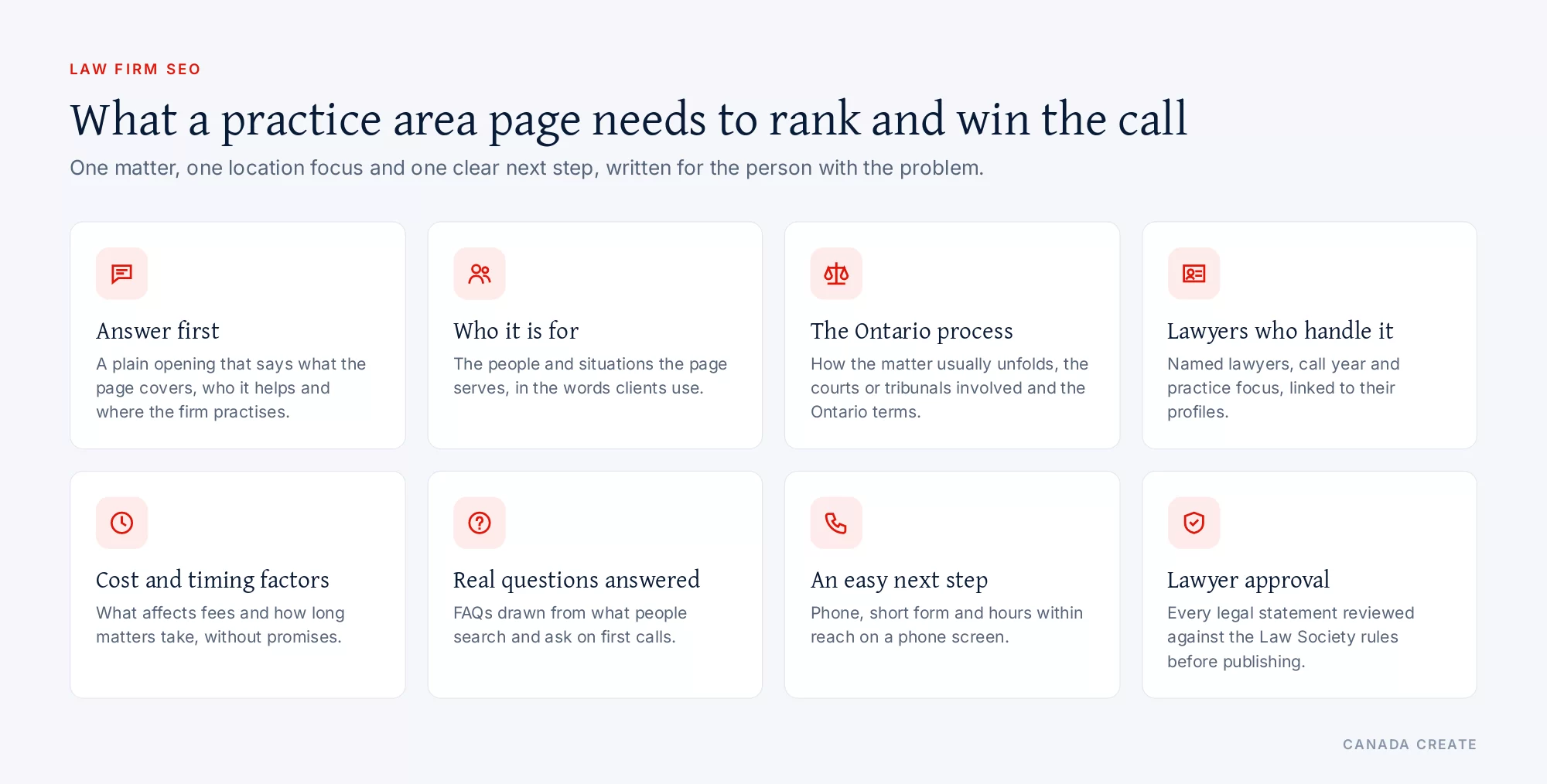
A strong practice area page has one main matter, one location focus and one clear next step. It explains who the page is for, what the firm does for that kind of matter, how the process usually unfolds in Ontario, what affects cost and timing, what to bring to a first consultation and how to get in touch. It names the lawyers who handle the work, links to their profiles and answers the questions people actually ask about the matter.
For a larger practice, one page per sub-matter often works better than one long page. An employment practice may need separate pages for wrongful dismissal, constructive dismissal, workplace harassment, severance review and employment contracts for employers, because each draws a different searcher with a different question. A real estate practice may separate purchases, sales, refinancing, title insurance questions and commercial leases. We plan that structure with you so the website mirrors the work you actually want, and we avoid pages for matters you do not accept.
What makes practice area content work for lawyers:
- Answer first. Open with a plain statement of what the page covers and who it helps, then explain. People and AI tools both quote clear opening passages.
- Ontario specific. Mention the Ontario process, the courts or tribunals involved and the Ontario terminology, and say plainly when something depends on the facts.
- Lawyer reviewed. Every legal statement is reviewed and approved by your lawyers before it goes live. We write; you decide what the firm says.
- No promises. No outcome claims, no “we always win”, no amounts recovered without the statement the Law Society requires. More on that below.
- Easy contact. The phone number, a short form and office hours appear where a reader on a phone can reach them without scrolling through the whole page.
Local SEO for lawyers in Toronto and the GTA
Most people want a lawyer they can reach. Google knows that, so legal searches with local intent show a map pack of three firms above the organic results, and those three firms often take most of the calls. Our local SEO services in Toronto apply directly to law firms.
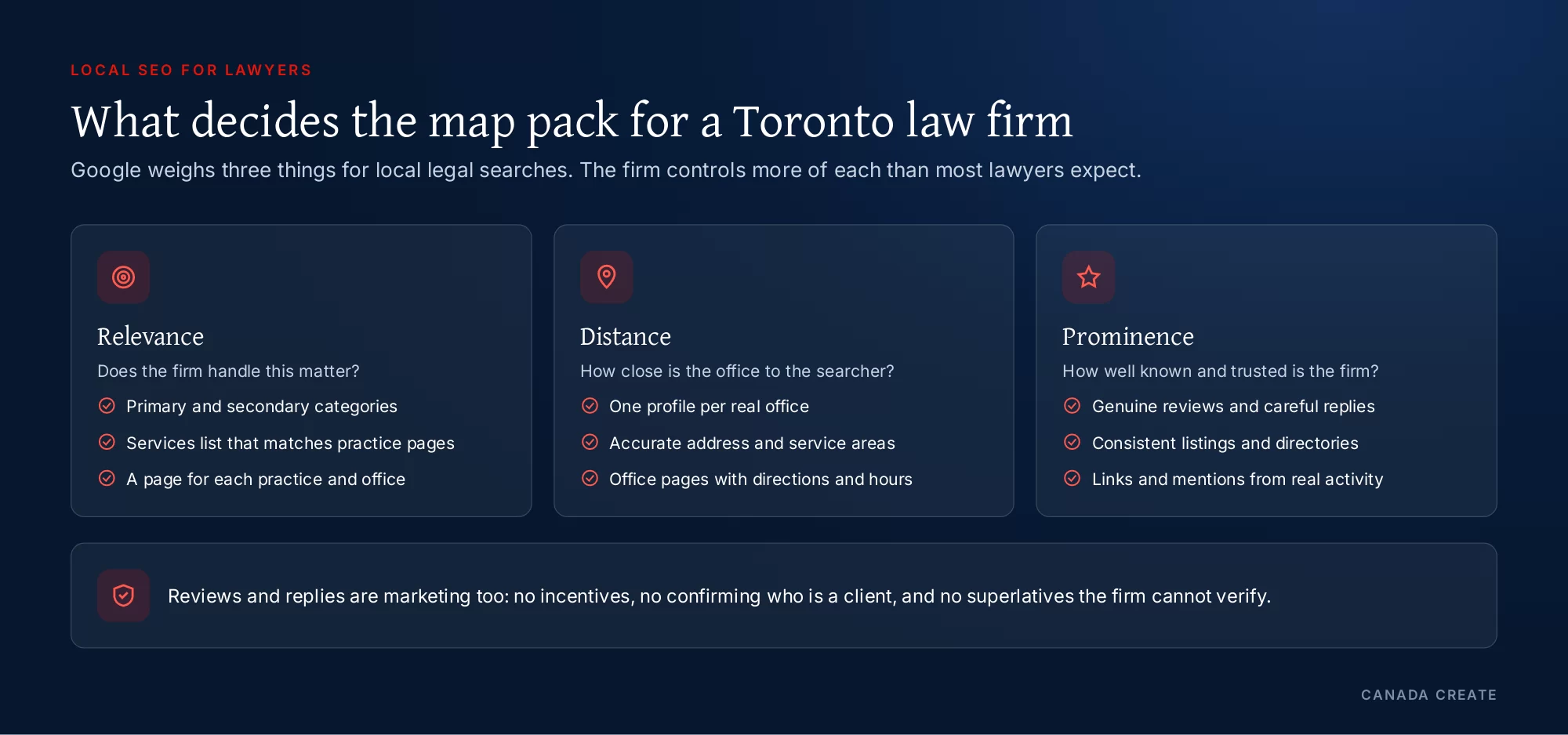
Google ranks the map pack on relevance, distance and prominence. Relevance comes from your Google Business Profile categories, services and website content. Distance is measured from the searcher, which is why a family law firm in North York can appear for searches made nearby and fall back for the same search made near Bay Street. Prominence comes from reviews, links, mentions and how well known the firm is online.
What that means in practice for a Toronto law firm:
- One profile per real office. Google Business Profile allows a profile only where the firm actually meets clients or has staff during stated hours. Virtual offices and mail drops break Google’s guidelines and can get a profile suspended.
- The right categories. Primary category matched to your main practice, such as the family law or employment law category, secondary categories for other real practice areas, and a services list that matches your practice pages.
- Consistent details. The firm name, address and phone number match across your website, Google, Bing, Apple Maps, the Law Society’s public directory listing and the legal and local directories you appear in.
- A page per office. Each office has its own page with directions, parking, transit, hours and the lawyers who work there, linked from the profile.
- Lawyer profiles on Google. Individual lawyers can sometimes have their own practitioner profiles. Whether that helps or splits your reviews depends on the firm’s structure, so we decide it with you.
For firms serving the wider GTA, we build location relevance where the firm genuinely serves people: Mississauga, Brampton, Vaughan, Markham, Richmond Hill, Scarborough, Etobicoke and downtown Toronto. That is done with real office pages, service area settings and content that mentions the courthouses, tribunals and land registry offices your clients will deal with, not with copied pages that swap the city name.
Google Business Profile for law firms
The Google Business Profile is often the first thing a prospective client sees, before your website. A complete profile for a law firm includes the correct categories, services, hours (including any genuine evening or weekend availability), accessibility details, a description that names the practice areas, real photos of the office and the team, and regular posts about firm news or legal updates your lawyers approve. Questions from the public should be answered carefully, without giving legal advice in a public forum. We manage profiles as part of Google Business Profile management in Toronto when it is in your scope.
Legal directories and citations
Directories still matter for lawyers, partly because they rank for legal searches themselves and partly because they confirm your firm’s details to search engines and AI tools. Useful listings include the Law Society of Ontario’s public directory (kept current by the lawyer), local chambers of commerce, bar associations and practice groups you belong to, and the established legal directories where your clients look. Paid directory placements may be worth it for some practice areas; we judge them on the enquiries they bring, not on the promise of a link.
Reviews for law firms within the Law Society rules
Reviews influence both the map pack and the decision to call. For lawyers, reviews also come with obligations that other businesses do not face.
The Law Society of Ontario’s commentary to Rule 4.2-1 lists testimonials or endorsements that contain emotional appeals among the kinds of marketing that may contravene the rule. Commentary [5] also treats awards, rankings and third party endorsements broadly, including superlatives such as “best”, “super” and “#1”, and says they must not be misleading. That shapes how a law firm should handle reviews online:
- Ask fairly. Asking satisfied clients to leave an honest review is common practice. Offering anything in exchange for a review, or asking only clients who you know will be positive, creates problems with Google’s policies and with the accuracy rules.
- Protect confidentiality in replies. A reply to a review should never confirm that the reviewer was a client, mention their matter or discuss details. A short, polite reply that thanks the person or invites them to contact the firm works for both positive and negative reviews.
- Be careful reusing reviews. Copying reviews onto your website as testimonials turns them into your marketing. Your firm decides whether a review is suitable to repeat, with the rules in mind.
- Never write or buy reviews. Fake reviews are deceptive under the Competition Act and against Google’s policies. We do not write or buy reviews for any client.
Our review management work for law firms covers request wording, timing, monitoring and draft replies for your approval.
Lawyer profiles, credentials and trust
Prospective clients want to know who will handle their matter, and search engines look for the same signals. A good lawyer profile is one of the strongest pages a firm can publish.
A complete profile includes the lawyer’s name and photo, year of call and jurisdictions, practice focus, education, languages spoken, professional memberships, speaking or writing the lawyer has done, and the matters they handle. It links to the practice area pages they work on, and those pages link back. Rule 4.2-1.1 requires a lawyer marketing legal services to identify in all marketing materials that they are licensed as a lawyer, and commentary [3] lists failing to state expressly whether services will be provided by licensed lawyers, licensed paralegals or both among the practices that contravene the rule. Profiles and practice pages are a natural place to make that clear.
Two credential points need extra care. Rule 4.3-1 says a lawyer shall not advertise that they are a specialist in a field unless the Law Society has certified them, so “specialist” belongs only on the profile of a lawyer who holds the Certified Specialist designation. And awards and rankings can be mentioned only if they are bona fide and not misleading; one conferred partly because of a fee, or not the result of a reasonable evaluative process, contravenes the rule. Commentary [5] notes that genuine honours for professional or civic service do not contravene the rule.
We structure profile pages with Person markup and link them to the firm’s organization data so search engines and AI tools connect each lawyer to the firm, the office and the practice areas.
Technical SEO for law firm websites
Technical SEO makes sure the content your lawyers approved can be found, read and trusted. Most law firm websites we review have at least a few of the same issues: duplicate practice pages from an old redesign, slow mobile pages, contact forms that do not record properly, missing redirects from old URLs, and structured data that describes the firm incorrectly.
The technical work for a law firm website usually covers:
- Crawling and indexing: every practice, office and lawyer page indexed; thin, duplicate and outdated pages consolidated or removed with redirects.
- Site structure: a clear hierarchy from home to practice areas to sub-matters, with internal links that match how people move through a legal decision.
- Speed and mobile use: fast pages on phones, readable text, tap-friendly phone links and forms that work on small screens.
- Structured data: organization, LegalService, LocalBusiness, Person, BreadcrumbList and FAQPage markup where it matches visible content.
- Security and privacy: HTTPS everywhere, secure forms, a current privacy policy and care with what analytics and advertising tags collect on sensitive pages.
- Accessibility: content built to WCAG, which Ontario’s AODA expects of many organizations and which also helps search engines read your pages.
- Redirects and migrations: when a firm renames, merges or rebuilds, every old URL gets a one-hop redirect to its new owner so years of search signals are kept.
- Multilingual pages: where your lawyers serve clients in other languages, properly marked up language versions rather than machine-translated copies.
If the website itself needs rebuilding, our law firm website design in Toronto team builds sites with this structure from the start. Hosting and maintenance are separate services unless included in your agreement.
Content beyond practice pages: guides, FAQs and video
Practice pages win hire-intent searches. Guides win the research searches that come earlier, and they give a firm the chance to be helpful before a competitor is even considered. For a law firm, good guide topics come from the questions your lawyers answer on every first call: what to do after a car accident, how separation affects the matrimonial home, what happens at a bail hearing, how severance is calculated, what a will needs to be valid in Ontario.
Guides work when they are accurate, current and clearly general information. Each one should say who it is for, give the plain answer, explain the main factors, note when the answer depends on the facts and suggest speaking with a lawyer for advice on a specific situation. They link to the related practice page, and the practice page links back.
FAQs do the same job in a compact form. Well-chosen FAQs on practice pages answer objections (“Will I have to go to court?”, “How are fees calculated?”), help prospective clients prepare for a consultation and are a frequent source of AI answer citations.
Video helps people see the lawyer they may hire. Short explanations of common questions, an introduction to the office, or a lawyer explaining what a first meeting involves can be posted on YouTube and embedded on the relevant page. Video for lawyers follows the same accuracy rules as text, and commentary [2] to Rule 4.2-1 lists suggesting or implying the lawyer is aggressive among marketing that may contravene the rule, which is worth remembering when scripting.
Link building and digital PR for law firms
Links from other websites are still one of the ways Google judges prominence. For law firms, the useful links are the ones a real practice earns through real activity, and they are rarely the ones offered in cold emails.
Links that suit a law firm:
- Professional and community involvement: bar association and practice group pages, law school clinics and mentoring programs, community organizations and charities the firm supports. Sponsored links should carry rel=”sponsored”, which keeps them within Google’s guidelines.
- Expert commentary: lawyers quoted in local news, trade publications or legal media on topics in their practice. This needs a lawyer willing to comment and a firm willing to approve it.
- Useful resources: genuinely helpful guides, checklists and explainers that other sites want to reference, such as a plain-language guide to a new rule or a court process.
- Speaking and education: continuing professional development sessions, webinars and community talks that are listed online.
- Directory and association listings: accurate entries where your clients and referral sources look.
Links to avoid: paid links that pass ranking signals without the sponsored attribute, private blog networks, link exchanges, mass guest posts on unrelated sites and “award” badges that are mainly a way to sell a link. That last point has a professional dimension too. Commentary [5] to Rule 4.2-1 says awards and rankings conferred in part because of a fee rather than a legitimate evaluation contravene the rule, so a paid badge can be a problem twice over.
AI search and AI Overviews for legal questions
AI Overviews, Google’s AI Mode and assistants such as ChatGPT, Gemini, Perplexity and Copilot now answer many legal questions before a person reaches a website. For a law firm, two things matter: that the firm is described correctly when someone asks about it, and that the firm is named or linked when someone asks for help with a matter in its area.
AI answers draw on the same foundations as search: indexed pages, clear passages that answer a question, consistent business information and evidence from other websites. So the work overlaps heavily with good SEO. We check what the main assistants say about your firm for the questions your clients ask, correct wrong details at the source, structure practice pages so their key answers are quotable and make sure the firm’s name, offices and lawyers are consistent everywhere AI tools read about you. Our AI SEO and AI search optimization in Toronto page explains the wider service.
One caution for lawyers: an AI tool may summarize your content in its own words. Keep legal information accurate, dated and clearly general, so a summary of it stays accurate too.
The LSO rules and law firm SEO content
Every page, profile, review reply and ad your firm publishes is marketing under the Law Society of Ontario’s Rules of Professional Conduct. Rule 4.2-0 defines marketing to include advertisements and similar communications in various media as well as firm names, letterhead, business cards and logos. SEO content therefore has to meet the same standard as a print ad. This is a summary for planning content, not legal advice; your lawyers approve what the firm publishes, and the rule text is on the Law Society of Ontario’s Chapter 4 page.
| Rule or commentary | What it says | What it means for SEO content |
|---|---|---|
| Rule 4.2-1 | Marketing must be demonstrably true, accurate and verifiable; not misleading, confusing or deceptive; and in the best interests of the public | Every claim on a practice page, profile or meta description has to be one you could prove |
| Commentary 2 | Amounts recovered or success in past cases may contravene the rule unless accompanied by a statement that past results are not necessarily indicative of future results and outcomes vary with the facts | Case results pages and settlement mentions need that statement beside them |
| Commentary 2 to (f) | Suggesting superiority to other lawyers, raising expectations, implying aggression, disparaging others or emotional testimonials may contravene the rule | Avoid “the toughest”, “we never lose”, “unlike other firms” and dramatic testimonials |
| Commentary [3] and [5] | Awards, rankings and third party endorsements that are not bona fide, or that are misleading, contravene the rule; superlatives such as “best”, “super” and “#1” count as rankings | Keep “best lawyer” phrasing out of titles, headings and alt text unless it is a genuine, verifiable designation |
| Rule 4.2-1.1 | A lawyer must identify in all marketing materials that they are licensed as a lawyer | Make it clear on profiles and pages that services are provided by licensed lawyers |
| Rule 4.2-1.2 | Marketing second opinion services is prohibited | No “free second opinion” pages or ads |
| Rule 4.2-2 and 4.2-2.2 | Advertised fees must be reasonably precise, state extra charges and be honoured; contingency fee marketing must comply with Rule 3.6-2.2 | Any fee page or “no win, no fee” wording is reviewed against these rules first |
| Rule 4.3-1 | No “specialist” unless certified by the Law Society | “Specialist” appears only for Certified Specialists |
Our guide to lawyer advertising rules in Canada covers these rules in more depth, with checklists for websites, reviews and ads.
SEO for each practice area
Every practice area has its own search patterns, urgency and sensitivities. These are the practice areas we work with most often in Toronto, each with its own page if you want more detail.
Personal injury
Injury searches are often made soon after an accident, frequently on a phone and sometimes by a family member. Pages need to explain the kinds of claims the firm handles, how accident benefits and tort claims differ in Ontario, what the first conversation involves and how fees work if you advertise contingency arrangements. Any mention of amounts recovered carries the past results statement. See personal injury lawyer SEO in Toronto.
Family and divorce
Family law searches range from “how to file for divorce in Ontario” to “child support calculator” to “family lawyer near me”. Content should be calm, use Divorce Act terminology such as parenting time and decision-making responsibility, and respect the reader’s privacy, including a quick exit option on sensitive pages. See family lawyer marketing in Toronto.
Criminal defence
Criminal searches are urgent and often made late at night by a family member. The website must state honestly when the firm can be reached and how, and it should never suggest availability the firm does not have. Pages for specific charges, bail and impaired driving tend to carry the most intent. See criminal lawyer SEO in Toronto.
Immigration
Immigration searches are multilingual, document heavy and full of program names. Content has to stay current as programs change, avoid any suggestion of promised approvals or a special relationship with the government, and make clear whether services come from lawyers or licensed consultants. See immigration lawyer SEO in Toronto.
Employment
Employment searches split between employees (“wrongful dismissal lawyer”, “severance review”) and employers (“workplace investigation”, “employment contract review”). A firm that serves one side should say so plainly. See SEO for employment lawyers in Toronto.
Real estate
Real estate law searches are transactional and price sensitive. If you advertise a price for a residential transaction, Rule 4.2-2.1 requires an all-inclusive price except for HST and the permitted disbursements listed in the rule, and the advertisement must say those are not included. See real estate lawyer SEO in Toronto.
Wills and estates
Estate searches come from people planning ahead and from families dealing with a death or a dispute. Pages for wills, powers of attorney, estate administration and estate litigation draw different readers and need different tones. See estate lawyer SEO in Toronto.
Corporate and business law
Business clients search for incorporation, shareholder agreements, contracts and disputes, often comparing firms on responsiveness and fit. Content that shows the lawyers’ commercial experience and explains engagement options clearly works well here, and it supports the referral relationships most business practices depend on.
Law firm SEO for Mississauga and GTA practices
Many of the searches that reach our law firm SEO work come from outside the old city of Toronto, and Mississauga is the largest of them. Firms in Mississauga, Brampton, Vaughan, Markham and Richmond Hill compete in their own map packs, with their own courthouses, land registry offices and community networks, and they also compete with downtown firms for clients willing to travel.
A GTA practice usually needs three things to rank well where it actually works. First, an office page and Google Business Profile for each real location, with directions, parking and the lawyers who meet clients there. Second, practice pages that reflect local reality: the Peel or York Region courthouse a family matter will go to, the employers and industries an employment practice serves, the new home developments a real estate practice closes in. Third, local prominence: genuine reviews from clients in that city, membership of local business and legal associations and involvement in the community that other sites mention.
What does not work is a set of copied pages for every city in the GTA with the name swapped. Google treats those as doorway pages, and they say nothing useful to a prospective client. A Toronto firm that genuinely serves clients in Mississauga can still build relevance there through real content and service area settings, while a firm with an office there should put that office front and centre.
What a law firm SEO audit checks
Every engagement starts with an audit, because the right first step depends on what is holding the firm back. A law firm SEO audit looks at:
- Indexing and duplicates: which practice, office and lawyer pages Google has indexed, and which old or duplicate pages compete with them.
- Practice coverage: whether each matter the firm wants has its own page, and whether those pages answer what people search.
- Search visibility: where the firm appears today for practice and location searches, the map pack from several points in the city, and branded searches.
- Competitors: which firms and directories take the positions you want, and what their pages offer that yours do not.
- Google Business Profiles: categories, services, hours, photos, reviews and policy issues for each office.
- Listings and consistency: the firm’s name, address and phone number across directories, especially after moves, mergers or name changes.
- Links and mentions: the sites that link to the firm, risky links that need attention and real opportunities the firm has not used.
- Page experience: mobile speed, readability, forms, phone links and accessibility.
- Rules review flags: wording that may need your lawyers’ attention under the Law Society’s marketing rules, such as superlatives, specialist claims or results without the required statement.
- Tracking: whether calls, forms and bookings are recorded by page, and whether any sensitive information reaches analytics.
The audit ends with priorities in plain language, ordered by the effect they are likely to have on the matters you want, so your firm can see why the first months of work focus where they do.
Intake: where law firm SEO is won or lost
SEO brings a prospective client to the website, but intake decides whether that person becomes a client. We often find that a firm’s search problem is partly an intake problem: calls going to voicemail at lunchtime, forms answered the next day, or no clear route for urgent matters.
Simple changes help both rankings and results. A phone number that is tapped, not copied. Hours that match when the phone is really answered. A short form that asks only what the firm needs to call back and run a conflict check, without inviting confidential details. A clear explanation of what happens after someone gets in touch. For firms that cannot answer every call, an AI receptionist can take messages and book callbacks outside office hours, and a CRM for law firms can make sure no enquiry is forgotten.
Search engines also notice. Pages that people use and act on, and a firm that answers reviews and questions promptly, send the kind of signals that support visibility over time.
Measuring law firm SEO from search to retained matters
More website visits can be useful, but a law firm needs to know whether search brings the right matters. Reporting relates search activity to the information available from your enquiry and intake systems, and it is honest about the limits of attribution.
| Question for your firm | Useful reporting | What it can tell you |
|---|---|---|
| Are prospective clients finding us? | Search visibility for practice and location terms, map pack positions from several points in the city, AI answer checks | Whether the firm appears where people look |
| Are those visits producing contact? | Recorded calls, forms, chat and booking requests by page and practice area | Whether people take the next step |
| Are the enquiries a fit? | Intake feedback: qualified consultations, conflicts, wrong practice area, outside jurisdiction | Whether the interest matches your practice and capacity |
| Is the work commercially useful? | Retained matters and fee information your firm chooses to share | How the program relates to the work accepted |
An enquiry, a consultation and a retained matter are different outcomes, and legal matters can take months to resolve, so we review them separately by practice area. Intake feedback also helps tell a search problem apart from unanswered calls, limited availability or matters outside your scope. Call tracking and form tracking are set up so that no confidential matter details are sent to analytics or advertising platforms. Your firm remains responsible for screening, conflict checks, legal advice and the decision to accept a client.
How long law firm SEO takes, and what changes the fee
Technical fixes and Google Business Profile improvements can show their effect within weeks. New practice pages usually need to be indexed, tested and supported by internal links and reviews before they rank well, which often takes several months in competitive Toronto practice areas. Competitive terms such as personal injury or criminal defence downtown take longer than a niche practice in a specific neighbourhood. We do not promise a ranking position or a date by which your firm will receive new files.
Canada Create law firm SEO engagements are custom-scoped after discovery, and fees are quoted in writing after a free consultation. The things that change the scope are:
| What affects the scope | Why it matters |
|---|---|
| Practice areas and sub-matters | Each needs its own research, pages, links and reporting |
| Offices and service areas | Each real office needs a profile, a page and local signals |
| Starting point of the website | A sound site needs content and links; a weak one needs technical work or a rebuild first |
| Competition | Some practice areas in some neighbourhoods need much more content and authority work |
| Languages | Each language version needs proper markup and lawyer review |
| Your team’s review time | Faster reviews mean faster publishing |
Compare an in-house hire, a freelancer and an agency by the work each will actually cover: writing, technical work, local SEO, reviews, reporting and lawyer review management. Ask which of those are priced separately so the total is clear before work begins.
Common law firm SEO mistakes
These are the problems we see most often when we review law firm websites in Toronto:
- One page listing every practice area, so no single matter has a page that can rank.
- Practice pages written about the firm instead of the client’s problem.
- City pages copied with the city name swapped, which Google treats as thin, duplicate content.
- A Google Business Profile at an address where nobody actually works.
- Inconsistent firm names, addresses or phone numbers across directories after a move or a merger.
- Testimonials and “best lawyer” badges used without checking the Law Society rules.
- Old URLs left without redirects after a redesign, losing years of search signals.
- Contact forms that are not tracked, so nobody knows which pages produce enquiries.
- Content nobody has reviewed for years, still describing old rules or processes.
- Bought links or link schemes that put the domain at risk.
How a law firm SEO engagement runs with Canada Create
Before work begins, you receive a custom proposal covering scope, fees, schedule and responsibilities. We confirm the access and information needed from your team and who will review content and share intake feedback.
The first weeks focus on discovery: the matters you want more of, the work you do not accept, your offices, your intake process and your competitors. We audit the website, the Google Business Profiles and the firm’s wider presence, then agree priorities with you. A firm with technical problems starts there; a sound site with thin content starts with practice pages; a firm invisible in the map pack starts with local work.
During the engagement, your firm receives drafts for approval and regular updates. Monthly reports cover search visibility, enquiries, completed work and the priorities for the next month, reviewed with someone who knows your intake. For a solo practice, review time has to fit around client work; for a larger firm, we agree one point of contact and a clear approval route across lawyers and offices.
Ownership of accounts and content
Analytics properties, Google Business Profiles, domains, advertising accounts and social media accounts are set up in your firm’s name where the platform allows and remain yours. Your firm grants us the access needed to do the work.
How to compare law firm SEO companies in Toronto
Choosing an SEO company for a law firm is partly a marketing decision and partly a professional risk decision, because the agency writes under your name. Questions worth asking any agency, including us:
- Which law firms have you worked with, and what did you deliver for them?
- Who writes the practice content, and how do our lawyers review it before publication?
- How do you handle the Law Society of Ontario’s marketing rules in content, reviews and ads?
- How will you report from search to consultations and retained matters, not only traffic?
- What will you change on the website itself, and who does that work?
- How do you build links, and can you show examples?
- Who owns the accounts, the content and the website?
- What do you need from our team each month?
Be cautious with any agency that promises a ranking position, promises a number of cases, offers “best lawyer” awards, suggests fake reviews or proposes dozens of copied city pages. Those shortcuts create risk for the firm and its lawyers.
Law firm SEO glossary
- Map pack: the block of three local results with a map that appears for many legal searches.
- Google Business Profile: the free listing that controls how your firm appears in Google Maps and the map pack.
- Practice area page: a page about one kind of legal matter, the main ranking page for hire-intent searches.
- Search intent: what a person is trying to do with a search: hire, compare, research or find a specific firm.
- E-E-A-T: experience, expertise, authoritativeness and trust, the qualities Google’s raters look for, held to a higher bar on legal topics.
- Structured data: code that describes the firm, lawyers, offices and FAQs to search engines.
- Citation: a listing of the firm’s name, address and phone number on another site.
- Backlink: a link from another website to yours.
- Indexing: whether Google has stored a page and can show it in results.
- AI Overview: the AI-written summary that appears above many Google results.
- Attribution: connecting an enquiry or retained matter to the channel and page that produced it.
- Conversion: an action you count, such as a call, form or booking request.
Related guides: how law firms get clients in Canada, what prospective clients look for on a law firm website and Google Ads cost per click for lawyers in Canada.
Talk to a strategist
Ready when you are?
Request a custom proposal
Tell us your goals, budget and timeline. You get a custom proposal and a named strategist, so your next stage of growth starts now.
Law firm SEO stages from first discussion to monthly progress reviews
A clear scope, a practical review arrangement and progress discussed in the context of your firm.
- Discuss your practice Discovery
Tell us which matters you handle, where you practise and what you want to improve about enquiries.
- Review the proposal Before work starts
Your written proposal sets out the agreed scope, fees, schedule and responsibilities.
- Confirm your team’s inputs At the start
We confirm the access, firm information and review contacts needed for the agreed work.
- Approve your content Before publication
Your firm reviews drafts and approves legal statements, credentials, testimonials and other claims.
- Discuss progress Monthly
Review completed work, available search and enquiry information, and feedback from your intake team.
- Agree changes When needed
Changes to practice areas, offices or deliverables are discussed against the scope, fees and schedule.
Law firm work from our portfolio
Websites and advertising we delivered for law firms.


Why law firms consider Canada Create for lawyer SEO
Established in 2008
A Toronto agency providing SEO, website and digital marketing services.
BBB Accredited, A+
An accredited business with an A+ rating.
Canada
We work with firms on both sides of the border.
Quoted in writing
Every fee is confirmed in writing before work starts. Request your custom proposal.
SEO for lawyers in Toronto: questions law firms ask
The basics
What is SEO for lawyers?
SEO for lawyers is the work of helping a law firm appear in Google's organic results, the map pack and AI answers when people search for the legal matters it handles. It combines practice area content, local SEO, lawyer profiles, technical website work and reviews handled within the Law Society rules, measured by the consultations and retained matters it brings.
Does SEO work for law firms in Toronto?
It can, when the firm has a sound website, content for the matters it wants, accurate local listings and an intake team that answers enquiries quickly. Toronto is competitive in personal injury, family, criminal and employment law, so results build over months rather than weeks, and no agency can promise a position or a number of new files.
Is SEO for lawyers dead in 2026, or has it changed?
It has changed rather than disappeared. Legal searches now show ads, map results, AI Overviews and People also ask questions before the organic links, and assistants answer many questions directly. Firms that publish accurate, lawyer-reviewed content and keep their business details consistent still win visibility across all of those surfaces.
What is the difference between law firm SEO and legal SEO?
They describe the same work. Legal SEO is the broader phrase people use for search engine optimization in the legal sector, including law firms, sole practitioners and paralegal practices. Law firm SEO usually means a program for one firm's website, offices and practice areas. The methods and the Law Society rules apply either way.
What does SEO marketing for lawyers include?
SEO marketing for lawyers usually includes keyword research by practice area, practice and location pages, Google Business Profile management, directory listings, review requests, lawyer profiles, technical fixes, structured data, link building through real professional activity and reporting from search to consultations. Your custom proposal names the parts your firm needs.
Do Canadians search for lawyers using American legal terms?
Canadians mostly search for a lawyer or a law firm, and Google groups the American wording with the Canadian terms in its search data. Pages written in Canadian wording reach both groups of searchers, and they read naturally to the Ontario clients a Toronto firm wants to serve.
Cost and value
How much does law firm SEO cost in Toronto?
Canada Create quotes law firm SEO in writing after a free consultation, because the scope depends on your practice areas, offices, competition, the condition of the website and how much content is needed. A proposal separates setup work from ongoing management and lists any third-party costs, so your firm can see the full picture before deciding.
What drives the price of SEO for a law firm with several offices?
Each real office needs its own Google Business Profile, office page, local listings and review activity, and each practice area needs its own research and pages. More offices and practice areas mean more work, as do competitive neighbourhoods, multilingual content and a website that needs technical repair before new content can perform.
Is SEO worth it for a small or solo law practice?
Often it is, because a solo lawyer can focus on one or two practice areas and one neighbourhood, where competition is lower than across the whole city. A small practice benefits most from a strong Google Business Profile, a handful of excellent practice pages and steady genuine reviews. The work has to fit the time the lawyer can spend reviewing content.
Should a law firm do SEO itself or hire an agency?
A firm can handle basics itself, such as keeping its Google Business Profile current and asking clients for reviews. Practice content, technical SEO, structured data, link building and reporting take time and skill, so most firms bring in help. Compare options by who does the writing, technical work, local SEO and reporting, and how much lawyer time each needs.
How does a law firm judge the return on SEO?
Look at retained matters and the fees they produce by practice area, alongside the cost of the program and the intake time involved. Traffic and rankings are early signals, consultations are better ones, and retained matters are the real test. Your own fee and delivery cost information gives a truer picture than an industry average.
Is SEO cheaper than Google Ads for lawyers?
They cost money in different ways. Google Ads charges for every click and stops when spending stops, which suits urgent matters and quick tests. SEO costs work up front and over time, but the visibility it builds keeps producing enquiries without a cost per click. Many firms use both and compare the quality of enquiries from each.
Timing and results
How long does SEO take for a law firm in Toronto?
Technical fixes and Google Business Profile changes can show an effect within weeks. New practice pages usually take several months to rank well, longer for competitive practice areas downtown. A realistic plan judges progress by visibility and enquiries over six to twelve months, with priorities reviewed each month.
Can an SEO company promise a first page ranking for my firm?
No honest agency can. Rankings depend on competitors, Google's systems, your website and your reputation, which nobody fully controls. Be cautious with any promise of a position or a number of cases. A good agency explains what it will do, how progress will be measured and what your firm needs to contribute.
Why do our old URLs still get more impressions than our new law firm SEO page?
Google takes time to move ranking signals from an old URL to its replacement after a redirect, especially when the old page was linked from other websites for years. One-hop redirects, updated internal links, a refreshed sitemap and a request to recrawl the new page help Google consolidate the signals sooner.
What should a law firm see in the first three months of SEO?
Typically a fixed technical base, corrected listings, a complete Google Business Profile, the first practice pages published and tracking that records calls and forms by page. Rankings for less competitive terms and branded searches often improve first. The competitive head terms usually take longer, which is why reports cover more than rankings.
Why does our firm appear in the map pack in North York but not downtown?
Google ranks local results partly by distance from the person searching. A firm whose office is in North York will usually rank better for searches made nearby than for the same search made near Bay Street. Strong relevance and prominence can widen that reach, but a firm cannot rank everywhere in the city from one address.
Local SEO and Google Business Profile
What is local SEO for lawyers in Toronto?
Local SEO for lawyers is the work that helps a firm appear in Google Maps and the map pack for searches near its offices. It covers the Google Business Profile, office pages on the website, consistent firm details across directories, genuine reviews and local links. For Toronto firms it often decides who gets the call for searches that include near me.
How should a law firm set up its Google Business Profile?
Use the firm's real name, the address where clients are actually met, accurate hours, the right primary category for your main practice and secondary categories for other real practice areas. Add services, a clear description, real office and team photos and links to the matching office page. Keep it updated when lawyers, hours or offices change.
Can a law firm use a virtual office for its Google Business Profile?
Google's guidelines allow a profile only where the business has a real location that serves clients during stated hours. Virtual offices, mail drops and shared addresses where nobody from the firm works can lead to suspension. If you meet clients at a location by appointment, it may qualify; ask before creating a profile for it.
Should each lawyer at our firm have a Google Business Profile?
It depends on the firm. Individual practitioner profiles can help a well-known lawyer appear for name searches, but they can also split reviews and compete with the firm's own profile. We look at how clients search for your lawyers and how the firm is structured before recommending practitioner profiles.
How can a Toronto law firm rank in Mississauga, Vaughan or other GTA cities?
The strongest route is a real office there, with its own profile and page. Without one, a firm can still be relevant through content about matters handled for clients in that city, local courthouse or tribunal information and genuine reviews from clients there. Copying the same page for every city is treated as thin content and rarely works.
Which directories matter most for law firm SEO in Ontario?
Start with accurate listings on Google, Bing and Apple Maps, the Law Society's public directory information kept current by each lawyer, the bar associations and practice groups you belong to, local chambers of commerce and the legal directories your clients actually use. Consistency of the firm's name, address and phone number matters more than the number of listings.
How can a real estate lawyer appear in near me searches in Toronto?
Make sure the Google Business Profile lists real estate law as a category and service, the office page explains closings, title insurance and lender requirements for that area, and clients leave genuine reviews. Office hours that suit buyers and sellers, a clear phone number and fast replies also help, because near me searches often come from people ready to book.
Is SEO for lawyers in Mississauga different from Toronto?
The method is the same, but the competition, courthouses, land registry offices and map packs are local. A Mississauga practice ranks best with a real office profile and page there, content that reflects Peel Region matters and genuine reviews from local clients. A Toronto firm serving Mississauga clients can build relevance with real content, not copied city pages.
Reviews and the LSO rules
Can a law firm ask clients for Google reviews in Ontario?
Asking satisfied clients to leave an honest review is common, as long as the firm respects confidentiality and the Law Society's marketing rules. Do not offer anything in exchange, do not ask only clients you expect to be positive, and do not write reviews for anyone. Your firm decides when and how to ask; we can prepare the request wording.
How should a lawyer reply to a negative Google review?
Calmly, briefly and without confirming that the reviewer was a client or discussing any matter. Thank the person for the feedback and invite them to contact the firm directly. A reply is public marketing, so it should meet the same accuracy and professionalism standard as the rest of the firm's content.
Can we use client reviews as testimonials on our website?
Your firm can choose to, but once a review appears on your website it becomes your marketing. The Law Society's commentary lists testimonials or endorsements with emotional appeals among the things that may contravene Rule 4.2-1, so each one should be reviewed before use, with the client's permission and with confidentiality in mind.
Can our law firm website say we are the best lawyers in Toronto?
Avoid it. The Law Society's commentary treats superlatives such as best, super and number one as awards or rankings, which must be bona fide and not misleading, and suggesting superiority to other lawyers may contravene the rule. Describe experience, practice focus and approach in verifiable terms instead.
Can a law firm mention case results and settlements on its website?
Under the commentary to Rule 4.2-1, stating amounts recovered or past success may contravene the rule unless it comes with a statement that past results are not necessarily indicative of future results and that outcomes vary with the facts of each case. Client permission and confidentiality also apply. Your lawyers decide what is appropriate to publish.
When can a lawyer use the word specialist in SEO content?
Only when the Law Society has certified the lawyer as a specialist in that field, under Rule 4.3-1. Other lawyers can describe their practice areas, experience and proficiency, as long as the description is accurate. We keep the word out of titles, headings and metadata unless the certification exists.
Do the Law Society marketing rules apply to SEO titles and meta descriptions?
Yes. Rule 4.2-0 defines marketing broadly, and a page title or description shown in Google is a public statement about the firm. The same accuracy standard applies to headings, image alt text, Google Business Profile descriptions and directory listings. Short text deserves extra care because there is no room for context.
Content and practice pages
Which keywords should a Toronto law firm target in SEO?
Start with the matters you want more of and the places you serve, then map how people actually describe those matters: urgent hire searches, comparison searches, research questions and searches for your firm's name. Prioritize terms that bring retained matters you want, and skip phrases that mostly bring requests for free advice or work you do not accept.
How many practice area pages does a law firm website need?
One for each matter you want to be found for, plus sub-pages where a practice area covers distinct problems. An employment practice may need separate pages for wrongful dismissal, harassment and employer advice, for example. More pages are not better on their own; each page should answer a real search and lead to a clear next step.
Who writes the content for law firm SEO?
We write drafts from your input and our research, and your lawyers review and approve every legal statement before it is published. That keeps the content accurate, consistent with your professional obligations and true to how the firm actually handles matters. Lawyers who prefer to write can send drafts for us to edit and optimize.
Should a law firm publish a blog for SEO?
A blog helps when its posts answer real questions your clients ask and link to the related practice pages. Short news posts with little substance rarely help. A few accurate, well-maintained guides on common questions often do more than frequent posting, and they are a common source of AI answer citations.
Can AI write content for a law firm website?
AI tools can help with research and first drafts, but legal content needs a qualified person to check every statement, because a confident error can mislead a reader and create professional risk. Google judges content by its usefulness and accuracy, not how it was produced. Our drafts are edited by people and approved by your lawyers before publication.
How often should law firm website content be updated?
Review practice pages at least once a year and whenever the law, a process or the firm's team changes. Update guides when rules or court procedures change, and note the date. Outdated legal information can mislead readers and weakens trust signals, so a simple review calendar is part of good law firm SEO.
Do lawyer profiles help law firm SEO?
Yes. Profiles that show the lawyer's call year, practice focus, education, languages and memberships help clients choose and help search engines connect experienced people to the firm. Linking each profile to the practice pages the lawyer handles, and back, strengthens both pages. Profiles should also make clear that services come from licensed lawyers.
Should a law firm website publish its fees?
That is the firm's choice. If it does, Rule 4.2-2 requires the advertising to be reasonably precise about the services for each fee, to state whether disbursements, third-party charges and taxes are extra, and the fee must be honoured. Many firms instead explain what affects the cost of a matter and how fees are discussed at the first consultation.
Technical, AI search and links
What technical SEO does a law firm website need?
Clean indexing of practice, office and lawyer pages, fast mobile pages, secure HTTPS forms, a clear site structure, one-hop redirects for old URLs, structured data that matches the visible content and accessibility built to WCAG. These fixes help the content your lawyers approved get found and read.
What structured data should a law firm use?
Organization and LegalService or LocalBusiness markup for the firm and each office, Person markup for lawyers, BreadcrumbList for site structure and FAQPage for visible FAQs. The markup must describe what is actually on the page. Self-serving review stars on your own website are not shown by Google, so they are not worth adding.
How do law firms appear in Google AI Overviews and ChatGPT answers?
AI answers draw on indexed pages, clear passages that answer a question, consistent business details and mentions on other websites. Practice pages that answer common questions directly, accurate profiles and listings, and genuine coverage of the firm all help. Nobody can promise a mention, but these steps make an accurate one more likely.
How do law firms get backlinks without breaking Google's rules?
Through real activity: bar association and community involvement, lawyers quoted in the media, useful guides that others reference, speaking and education, and accurate directory listings. Sponsored links should carry the sponsored attribute. Avoid paid links, private blog networks and paid award badges, which create search and professional risks.
Does a multilingual law firm need separate pages for each language?
Yes, if your lawyers serve clients in those languages. Each language version should be a properly translated and reviewed page with language markup, rather than an automatic translation widget. Search engines can then show the right version to the right searcher, and clients see that the firm genuinely works in their language.
Will a new law firm website hurt our current rankings?
It can if old URLs are not redirected, content is removed or the new site is slower. A careful migration maps every old page to its new owner with a one-hop redirect, keeps or improves the content that ranks, checks speed and tracking before launch and monitors search data closely in the weeks after.
How does website speed affect law firm SEO?
Speed is part of page experience, and many legal searches happen on phones, sometimes in stressful moments. A slow page loses readers before they see your phone number. Faster pages usually come from lighter images, fewer scripts and good hosting, and they help both rankings and the number of people who get in touch.
What does a law firm SEO audit include?
An audit checks indexing and duplicate pages, practice area coverage, current visibility and map pack positions, competitors, Google Business Profiles, listing consistency, links, page speed and accessibility, tracking of calls and forms, and wording your lawyers may want to review under the Law Society rules. It ends with priorities ordered by likely effect.
Choosing an agency and working with us
How should a law firm pick an SEO company?
Ask about the agency's law firm experience, who writes and how your lawyers review content, how they handle the Law Society rules, how they report from search to retained matters, what they change on the website, how they build links and who owns the accounts. Be cautious with promised rankings, paid awards and copied city pages.
Which SEO company suits a Toronto law firm?
One that understands the legal market, writes accurately in Canadian wording, respects the Law Society marketing rules, reports on consultations and retained matters rather than traffic alone, and can work on the website, local listings and reviews as well as content. Ask to see work it has delivered for other professional firms.
What should an SEO report for a law firm include?
Visibility for practice and location terms, map pack positions from several points in your market, calls and forms by page and practice area, intake feedback on enquiry quality, retained matters where your firm shares them, work completed and priorities for the next month. A good report explains what changed and why it matters.
Who owns the website content and accounts in a law firm SEO engagement?
Your firm does. Analytics, Google Business Profiles, domains, advertising and social accounts are set up in the firm's name where the platform allows, and the firm grants access for the work. Content written for your firm is published under your name on your website.
How much time will our lawyers need to spend on SEO?
Mostly review time: reading drafts of practice pages and guides, answering questions about how matters are handled and confirming profile details. A short monthly call with the person who sees intake helps too. We plan publishing around the time your lawyers realistically have, because unreviewed drafts do not help anyone.
Do you work with law firms outside Toronto?
Yes. Our office is in Toronto and most of our law firm work is for Toronto and GTA practices, but we also work with firms elsewhere in Ontario and across Canada. Local SEO is planned around wherever the firm's real offices and clients are, and content follows the rules of the provinces where the firm practises.
Can Canada Create handle our Google Ads and website as well as SEO?
Yes, if that suits your firm. We run Google Ads for lawyers, design and build law firm websites and manage intake tools, and we can combine them with SEO in one program with shared reporting. Each part is scoped separately in your custom proposal, so you can choose what you need.
What is the first step toward law firm SEO with Canada Create?
Request a custom proposal or call (416) 273-9030. We start with a conversation about the matters you want more of, your offices and your intake, then review your website and search presence. You receive a written proposal with the scope, fees and responsibilities before any work begins.
Why do some law firms rank well but still get few new clients?
Usually the gap is after the click: slow replies to forms, calls going to voicemail, pages that attract matters the firm does not take, or no clear next step on a phone. Reviewing intake alongside search data often finds quick improvements, such as accurate hours, a shorter form and an after-hours message service.


What would better-fit enquiries mean for your firm?
Tell us about the matters you want to accept and the challenges in your current enquiries. We will discuss whether a scoped SEO program is suitable.