
How law firms get clients in Canada: a playbook by practice area

Marketing a law firm is not simply a contest to receive the most calls. A useful enquiry must concern work your firm accepts, come from someone you can appropriately serve and reach a team with capacity to respond. A firm opening a new office faces a different buying decision from an established practice already turning away work. Even two firms in the same practice area can need different support.
This guide helps Canadian law-firm owners and practice leaders compare those choices. It explains what website, search, advertising and intake services contribute; how the decision changes by practice area; and how to interpret budgets and reported results. The search figures are estimates. The financial examples are explicitly hypothetical, not client results or recommended spending levels. Professional obligations remain with the firm, and a marketing engagement does not guarantee consultations, retained matters or revenue.
Define the growth your firm can accept
Start with the work you want the firm to be considered for, not the platform you have been offered. “More employment enquiries” is ambiguous if you advise employers but most callers are employees. “More family clients” can mean divorce representation, agreements, mediation or another service your firm may not provide. An engagement needs a clear description of accepted work before its enquiry count becomes meaningful.
Capacity also changes the choice. Before increasing advertising, check whether the firm can respond to new enquiries and whether its lawyers can take on more appropriate work. If the firm already receives more suitable enquiries than its lawyers can accept, more advertising may add pressure without creating capacity. If callers misunderstand the services offered or suitable enquiries go unanswered, clearer service information or better enquiry handling may help; those are separate problems to investigate, not conclusions that follow from limited lawyer capacity alone. Another firm with available lawyers, a functioning consultation process and little local awareness may have a stronger reason to compare additional search visibility and advertising.

Location, jurisdiction and language support need the same precision. A website in several languages is helpful only if the next conversation and actual service can support the expectations it creates. A page describing a city should not imply an office or service availability the firm does not have. The owner supplies these facts; an agency cannot establish them from a logo, a practice-area label or the size of a marketing budget.

Separate the stages you will evaluate. An enquiry is a request for contact. A relevant enquiry fits the agreed service and geographic boundaries. A consultation can be requested, booked or actually held. A retained matter requires the firm’s own acceptance and engagement process. Treating these as interchangeable makes an inexpensive enquiry look more valuable than it is and conceals where the firm’s own decisions affect the outcome.

Start with how clients search for your practice
A prospective client may look for a problem or service rather than a broad firm description: “family lawyer near me,” “wrongful dismissal lawyer” or “real estate lawyer for closing.” The table below shows estimated monthly searches across Canada for selected terms. Search volumes are approximate monthly averages, not counts of unique people. Click costs are estimates and are compared in plain terms only; they are not invoices, current bids or a quote for your firm.
| Search | Monthly searches in Canada | Estimated click cost, compared within this table | What to discuss before engaging an agency |
|---|---|---|---|
| family lawyer | 18,100 | Moderate | The family matters you accept and the consultation experience you offer |
| paralegal | 14,800 | Lower | Your permitted services, jurisdiction and client eligibility |
| personal injury lawyer | 9,900 | Among the highest | The injury matters you accept and how qualified consultations will be reported |
| employment lawyer | 9,900 | Moderate | Whether you represent employees, employers or both |
| divorce lawyer | 9,900 | Moderate | The distinction between divorce enquiries and your other family services |
| immigration lawyer | 8,100 | Lower | The immigration matters and languages your team can support |
| real estate lawyer | 6,600 | Moderate | The transactions you handle and the fee information you can substantiate |
| criminal lawyer | 5,400 | High | Your actual response availability for urgent enquiries |
| corporate lawyer | 2,400 | Moderate | The business clients and legal matters your firm is equipped to serve |
| ltd lawyer (exact search) | 110 | Among the highest | The disability claims your firm accepts and the limits of a single small search term |
We plan and run law firm marketing across SEO, Google Ads and websites, within Law Society advertising rules.
The table gives useful context, but it cannot answer whether your firm should buy a particular channel. The estimated click cost for “personal injury lawyer” is several times higher than for “family lawyer”. That difference does not establish which practice is more profitable, which enquiries will be suitable or what either firm’s eventual client acquisition will cost. A national term also combines situations that can differ substantially from one city, service area or firm to another.
The exact words matter. The final row measures “ltd lawyer”; it is not a measurement of every search for long-term disability representation. Likewise, family and divorce searches should not be added together and described as a pool of distinct prospective clients. One person can search repeatedly, compare several firms or change the wording of a question before contacting anyone.
Google defines actual average CPC as click cost divided by clicks. Its average cost-per-click explanation concerns a click measure, not the price of a consultation or a retained matter. A proposal that moves directly from a national CPC estimate to a promised number of clients is skipping important uncertainties about relevance, response, attendance and the firm’s acceptance decisions.
For a sound comparison, the proposal should make its geography, spending currency and outcome definitions explicit. Historical estimates can frame a discussion about affordability; actual campaign and firm records are needed to evaluate what happened. The search table should never be presented as your firm’s invoice or as proof that an apparently inexpensive search will produce inexpensive clients.
Marketing services to consider for your firm
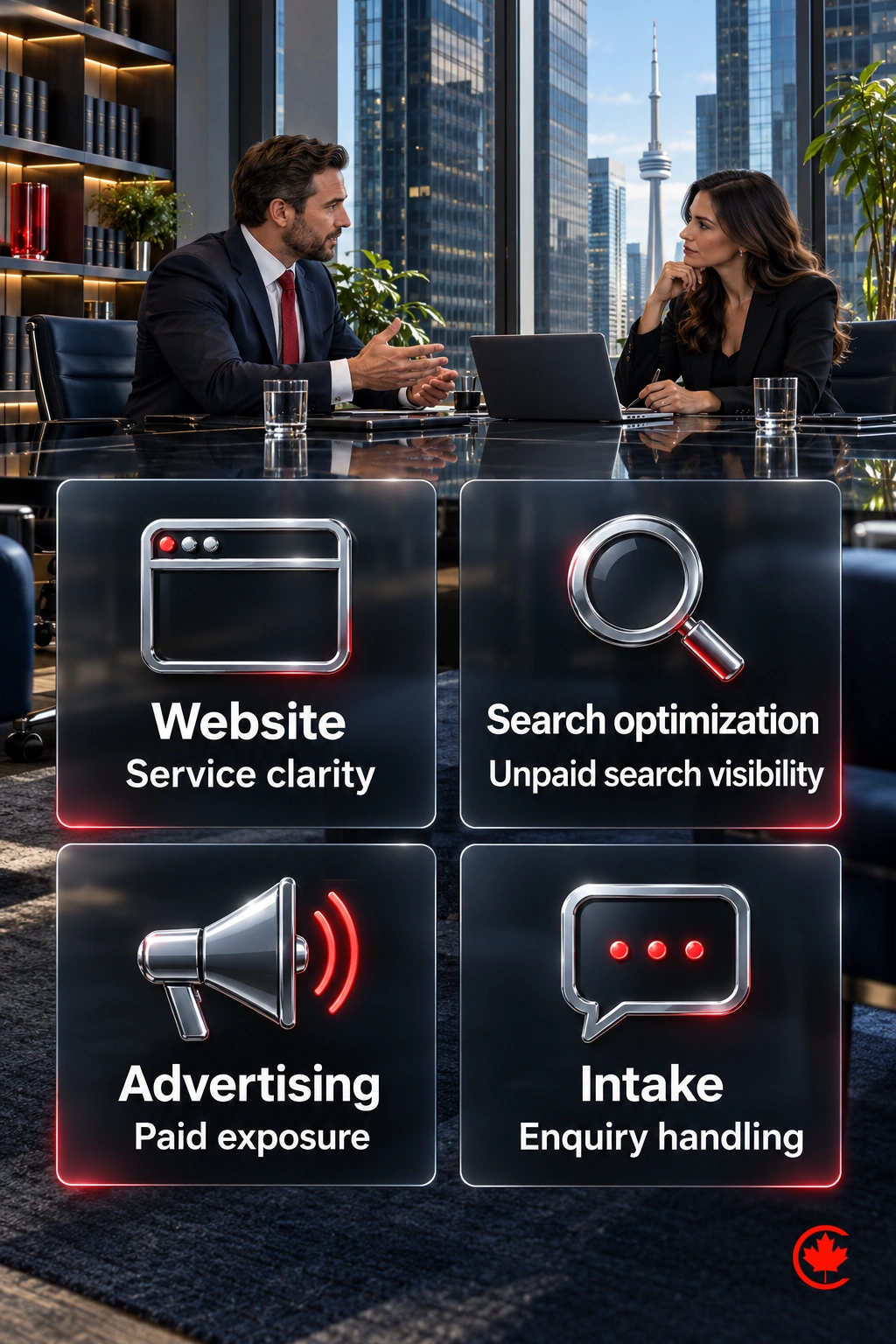
Different services address different obstacles. Website work improves the information and experience you own. Search engine optimization (SEO) is work to improve unpaid search visibility so people can discover and assess relevant services. Advertising buys opportunities for exposure while a budget is available. Intake support helps the firm handle enquiries. They can complement one another, but a proposal should explain the job of each service rather than imply that every firm needs the same bundle.
Local SEO and Google Business Profile
Local visibility matters when someone needs to confirm where the firm operates, which services are available and whether contacting that office makes sense. It is especially relevant to an office whose public information is incomplete or inconsistent with its real availability. This is different from promising a particular map position. The scope should identify the locations covered and responsibility for approving changing office information. Our local citations guide provides related context for business-listing support.
SEO for practice area pages
Practice-area content should help a visitor understand the work the firm accepts, the consultation experience and the information available about fees or the process. A firm with missing service information may need a different engagement from one with an established, accurate website requiring ongoing support. Neither a page count nor a promised ranking is an adequate buying criterion. Our SEO for lawyers service is a place to discuss that scope, including the legal content your firm must review.
Google Ads
Paid search merits consideration when the firm can accept additional relevant enquiries and fund the exposure without assuming immediate retained matters. It is not a substitute for clear services or an available intake team. Media spending and management are different costs, and website or content work may be separate again. Compare the intended matter types, covered locations and reporting outcomes. See Google Ads for lawyers and Google Ads for lawyers: cost per click by practice area for related buying context.
Google Local Services Ads
Local Services Ads are a distinct, eligibility-dependent product, not another name for ordinary Google Ads. Google’s Canadian Local Services Ads page currently lists eligible home-service categories rather than legal services. A Canadian firm should therefore verify its actual country, category and location eligibility before budgeting, rather than assume legal services are included. The Google Verified badge is not a promise of retained clients. Our how Google Local Services Ads work in Canada guide provides additional context.
Your website
A website project helps people assess the firm and take an appropriate next step. It does not automatically purchase an audience. A complete rebuild may be justified by broad usability or content problems; a limited project may be enough when the existing site works but important services or consultation information are unclear. Compare the scope against the actual visitor experience. Read what clients look for on a law firm website and our law firm website design service.
Intake and follow up
When suitable people cannot reach the firm or do not understand what happens next, additional exposure may not be the immediate missing service. A CRM for law firms (software for organizing enquiries and follow-up), answering support or an AI receptionist can be evaluated for defined enquiry-handling needs. The comparison should cover availability, human handover and permitted information, not imply that software gives legal advice, resolves conflicts or independently accepts clients.
Referrals and reputation
A referred prospect still needs to verify that the firm fits their situation. Accurate biographies, relevant service information and a clear consultation route can support that decision without replacing the relationship that produced the referral. Professional content or social presence may be relevant to the firm’s existing audience, but neither guarantees introductions. Any referral arrangement, testimonial or public claim needs the firm’s approval under the applicable professional requirements.
What to discuss for your practice area
Practice area changes the questions a prospective client needs answered. It does not produce a universal channel ranking. The comparisons below describe conditions that can make one type of support more useful than another. The firm’s current information, capacity and accepted matters remain decisive. Use the linked guides for additional sector context, while retaining responsibility for the actual services and claims your own firm approves.
| Practice area | Services to compare | Condition that changes the choice | Full guide |
|---|---|---|---|
| Personal injury | Paid or local discovery; service information | When suitable new matters can be accepted; improve clarity/intake first if existing enquiries are unsuitable | Personal injury |
| Family and divorce | Local/search visibility; consultation and service content | When the firm needs discovery versus when visitors need clearer family-service and consultation information | Family law |
| Immigration | Supported-language content; local or paid discovery | Only where real service and consultation language support match the public promise | Immigration |
| Criminal defence | Response/answering support; paid or local discovery | Actual availability determines whether additional urgent enquiries can be handled | Criminal defence |
| Employment | Audience/service clarity; search or paid visibility | Distinguish employee and employer work before increasing unsuitable enquiries | Employment |
| Real estate | Referral-support website information; local or paid discovery | Choose according to transaction capacity and whether the missing need is clarity or discovery | Real estate |
| Wills, corporate, tax, IP | Service-specific content and referral support; relevant discovery | Distinguish planning and business engagements rather than treating all solicitor work alike | Solicitor practices |
| Disability and insurance claims | Accepted-claim information and consultation support; search visibility | A single small search term cannot decide suitability or the value of a matter | Disability claims |
| Paralegal and notary | Appointment/service clarity; local or paid visibility | Use the actual professional role, jurisdiction and permitted service scope | Paralegal and notary |
Personal injury
A personal injury firm accepting additional relevant matters can compare paid search with local visibility and service-information support. The critical distinction is whether it lacks suitable enquiries or receives enquiries it cannot accept. In the latter situation, buying more exposure may enlarge the mismatch. Clear accepted-matter information and reliable intake can deserve priority. The choice should reflect real capacity and the firm’s definition of a suitable consultation, not an assumed settlement value or the high click cost of one search term.
Family and divorce
For family work, a prospective client may need a clear explanation of the firm’s services and consultation experience before deciding to make contact. A referred visitor and someone discovering the firm through search can both benefit from that information. Compare a service-content or website engagement with additional local or paid visibility according to which need is unresolved. Reassuring language should describe a real experience, not promise an outcome, invent confidentiality protections or suggest that every family matter is an urgent advertising opportunity.
Immigration
An immigration firm offering a defined range of services in particular languages should compare public discovery with the completeness of the service journey. A translated page has limited value if the following consultation cannot be supported in that language. Website/content work may therefore address a different problem from paid promotion. Community relationships can support awareness where they genuinely exist, but marketing should not invent partnerships, application-success rates or the idea that all newcomers need the same legal service.

A translated page should match the language support available for the consultation and legal service. Check the full journey before making that public promise.
Criminal defence
For a criminal defence practice, the promised response experience deserves close scrutiny. If the firm cannot provide immediate after-hours assistance, increased visibility should not be sold with that promise. Answering or intake support may be more useful than additional exposure when existing enquiries are not reaching an appropriate person. Paid and local search remain options to compare, but real availability is the condition that makes the message credible. A convenient contact route is not a guarantee of representation or a particular result.
Employment
An employment practice needs to make its audience clear. A firm advising businesses may be poorly served by a growing number of enquiries from individuals it does not represent. A service-clarity project can address that mismatch before additional discovery spending. If the correct audience already understands the offer and capacity is available, paid or organic visibility becomes a different conversation. Professional presence may support employer relationships, but a particular social platform should not be prescribed merely because the work is business-related.

Real estate
A real estate practice may need to support referred prospects, explain transaction scope or attract enquiries beyond its current relationships. These are different reasons to buy marketing. Accurate fee and engagement information can help someone understand a closing service; additional paid exposure can be evaluated when transaction capacity exists. A proposal should not assume all transactions are interchangeable or advertise a fee as covering disbursements and extra work unless the firm has verified that representation.
Wills, corporate, tax and IP
These practices share a directory here, not an identical buying journey. A local person seeking estate-planning advice and a company considering ongoing corporate support may need different information about fit and engagement. Website/content work and referral-support presence may address those differences; paid discovery is an option only where the firm’s service and capacity make it relevant. A broad “business law” message should not imply credentials or experience across tax and intellectual property that the firm cannot substantiate.
Disability and insurance claims
A disability or insurance-claim practice should distinguish useful enquiries from general interest in benefits or coverage. Clear service descriptions and consultation information can help a visitor understand whether approaching the firm is appropriate. Additional search exposure is a separate purchase decision. The small “ltd lawyer” search figure cannot establish the value of a case or dictate the channel mix. Firm-approved claims, jurisdiction and response capacity matter more than an unsupported assertion that one expensive keyword guarantees valuable work.
Paralegal and notary
Appointment clarity and accurate service descriptions can be especially important when a visitor is unsure which professional they need. Local visibility and paid exposure can both be considered, but neither justifies describing notarial services and paralegal representation as interchangeable. The actual provider’s authority, location and service scope must be clear. A straightforward appointment experience can support a defined service; a generic promise to handle every legal issue creates a different and potentially misleading expectation.
What a website engagement should cover
The important website decision is not whether a design looks expensive. It is whether a prospective client can understand the relevant service, verify the people behind it and make an appropriate contact request. A strong proposal identifies which of those needs the work addresses. A visual redesign that leaves unclear practice descriptions and contradictory consultation information unchanged may not resolve the reason the firm commissioned the project.
Consider an illustrative referred visitor. They have a lawyer’s name but are unsure whether the firm handles their type of employment issue. They need to find the relevant lawyer, distinguish employee from employer services, understand whether a consultation is offered and learn how to request it. Each answer comes from firm-approved information. The agency can help present it, but cannot supply missing professional experience, invent a consultation policy or determine the person’s legal rights.
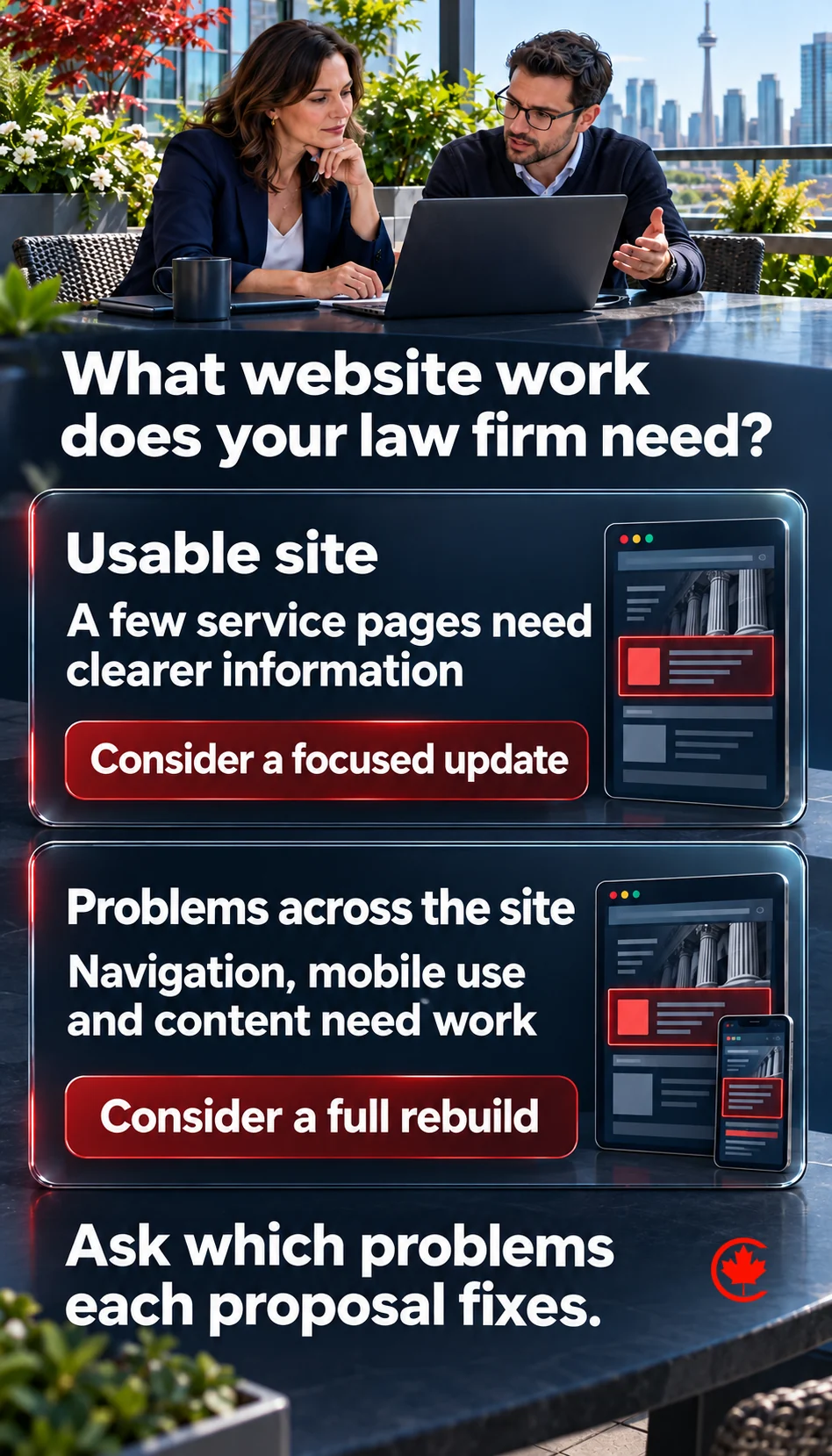
A full rebuild is easier to justify when the problem extends across the site: important services are absent, navigation is confusing, mobile contact is difficult and existing content is materially outdated. A narrower project may fit when the site is usable but a few service or consultation pages need improvement. Comparing those alternatives prevents an owner from treating “new website” as the only possible purchase or assuming a small content revision can cure every structural problem.
The proposal also needs clear boundaries. Hosting, ongoing maintenance, translations, new photography, third-party booking tools and accessibility assessment can be separate work. An attractive site is not proof of accessibility conformance, and a website project does not necessarily include ongoing updates after launch.
The firm should supply and approve biographies, credentials, service scope, contact details, consultation instructions, substantiated fee statements and rights to supplied materials. That approval is substantive, not a final spelling check. An owner who approves the design while leaving another person to verify legal claims needs that responsibility assigned explicitly, particularly when several practice leaders contribute content.
There is also a difference between being able to contact the firm and being able to choose the right next step. In an illustrative multi-office practice, a visitor may reach a general form without knowing which office handles the service or whether the requested lawyer is available there. A project that makes those distinctions understandable can have value even without changing the visual brand. By contrast, publishing extra office pages without confirming actual service availability can create more ambiguity. The useful acceptance question is whether a prospective client can understand the real options, not how many new pages appear on an invoice.
Enquiries, confidentiality and response capacity
Marketing and legal intake have different responsibilities. A marketing provider can help present an enquiry route and support agreed handling, but the firm determines legal fit, conflicts, advice and acceptance. A proposal that measures every submitted form as a “new client” blurs that boundary. Before paying for more exposure, the owner needs to understand who receives enquiries and what experience a person can actually expect.
There are practical alternatives. Staffed internal intake gives the firm direct control but depends on available people. An answering service may extend contact coverage without providing legal advice. Assisted receptionist or CRM services can support agreed information handling and handover, but the scope must say where human judgment resumes. The right purchase depends on the missing capability, not on whether an offer contains more automation features.
Imagine a prospective client leaving a message at 8 p.m. A truthful acknowledgement that a message has been received is different from immediate access to a lawyer. If the website promises round-the-clock legal help while the actual arrangement is next-business-period review, the problem is not simply response speed. The public promise and the firm’s delivery are inconsistent. Correcting that expectation can be more important than expanding the hours during which the firm attracts attention.

Information handling should be proportionate to the purpose. An initial contact route need not invite an unrestricted upload of sensitive case material. The firm should decide which details are necessary, where documents belong and who may access or retain records. A proposal involving call recording, third-party answering or transferred enquiry records needs a clear account of those uses and appropriate professional/privacy review, rather than an assumption that a standard software feature is suitable.
The same distinction applies to reporting. It may be possible to evaluate enquiry categories and consultation outcomes with aggregate information, without sending full matter files to a marketing provider. The firm should not accept a blanket “track everything” promise as proof of responsible measurement. Useful reporting and unnecessary disclosure are not the same thing, and neither an intake tool nor an agency can replace the firm’s own confidentiality decisions.
An illustrative law-firm marketing budget
The following example is hypothetical arithmetic only. It is not Canada Create pricing, a typical law-firm budget, a forecast or an actual client’s results. Every amount in this example is in Canadian dollars before tax. Keep these figures separate from the click-cost comparisons above; there is no performance prediction connecting the two.
Suppose an illustrative monthly scope contains CAD 3,500 of platform media, CAD 1,500 of management and CAD 1,000 of agreed website/content support. The recurring total is CAD 6,000. If a separate one-time launch project costs an assumed CAD 2,000, the initial cash requirement becomes CAD 8,000 before tax. These amounts demonstrate distinct cost categories. They are not a recommended allocation or a package Canada Create is offering.
Now follow one hypothetical group of 40 enquiries attributed to that month’s marketing. Assume 24 meet the agreed relevance definition and, by the chosen review date, twelve consultations have been held and four matters retained. Those counts are invented solely to show how the denominator changes the conclusion. Media-only cost per enquiry is CAD 3,500 divided by 40, or CAD 87.50. All-recurring-cost per relevant enquiry is CAD 6,000 divided by 24, or CAD 250.
The same recurring total divided by twelve held consultations gives CAD 500 per consultation. Dividing it by four retained matters gives CAD 1,500 per retained matter. None is the single universally correct “cost per lead.” Each describes a different outcome and cost boundary. Comparing an agency’s media-only enquiry figure with another proposal’s all-in retained-matter figure would be misleading even if both calculations were accurate.
The launch period matters too. Including the assumed one-time project gives CAD 8,000 divided by four retained matters, or CAD 2,000 per retained matter for that same group. A later month without that cost should not automatically be described as an improvement in marketing performance. The spending basis changed. Conversely, excluding every launch cost from a discussion of affordability can hide the amount the firm must actually fund.
Sensitivity is more useful than a confident forecast. If the same CAD 6,000 recurring expense produces only two retained matters, the cost becomes CAD 3,000 each. If no matters are retained within the observation period, there is no meaningful finite cost-per-retained-matter result to celebrate. Some consultations may lead to engagements later, so the firm must also distinguish a genuine shortfall from a reporting period that ends before decisions are known.
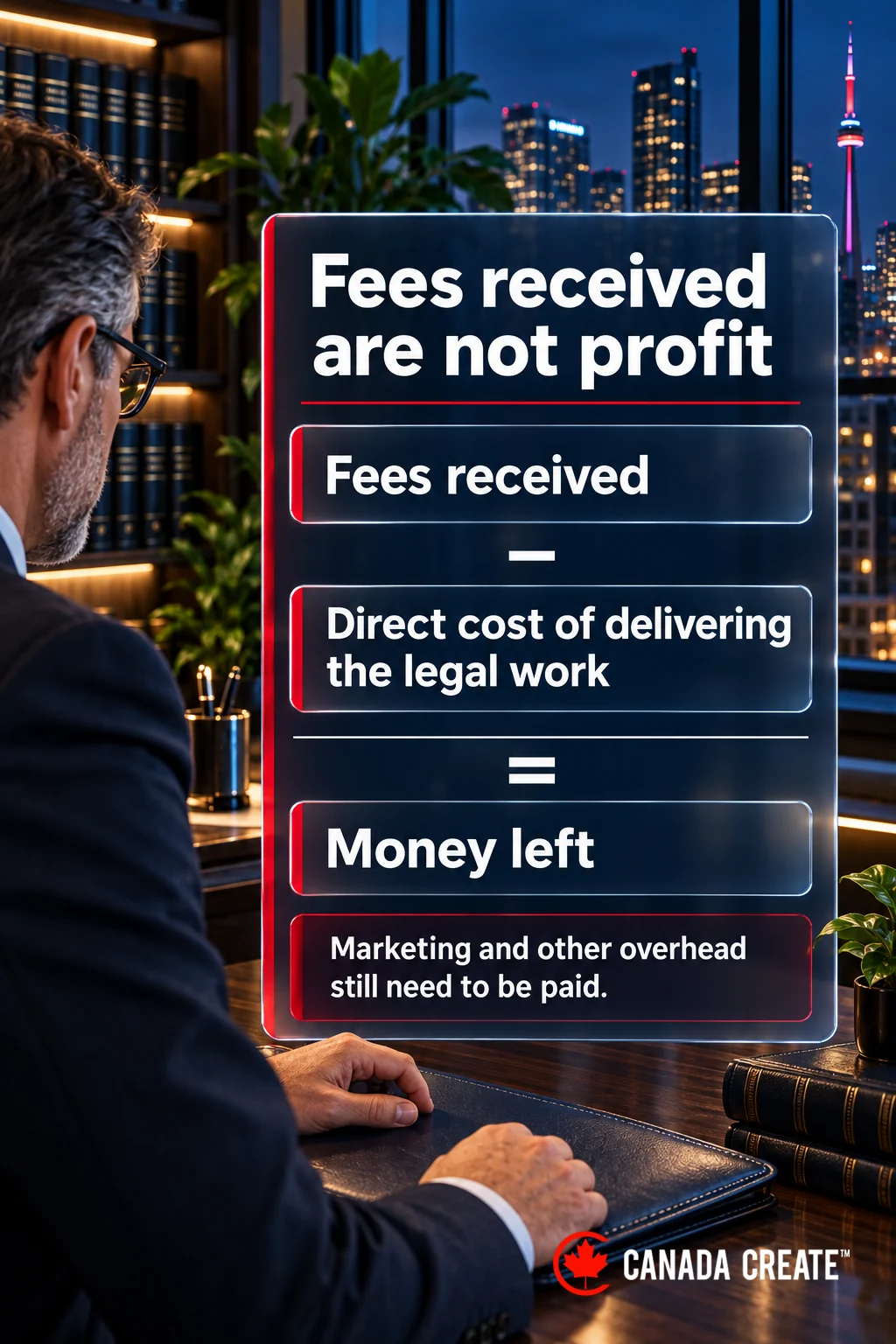
These figures are not profit or return on investment. Collected fees, lawyer and staff time, disbursements, overhead, matter duration and payment timing remain unknown. An owner needs the firm’s own private financial criteria to judge affordability. The useful output from this example is not “spend CAD 6,000”; it is the ability to recognize which costs, outcomes and timing assumptions a proposal or report has included, omitted or confused.
For one further hypothetical check, assume each of the four retained matters eventually produces CAD 4,500 in collected fees and CAD 3,000 in direct delivery costs. The assumed contribution is CAD 1,500 per matter, or CAD 6,000 across four matters. That amount is left before marketing, other overhead and the one-time launch cost; it is not profit. This eventual contribution is not monthly cash flow. It cannot establish affordability without checking collection timing and comparing costs for the same group of matters and period, including amounts still to be paid. Different real fees, delivery costs and payment delays could change the conclusion substantially. These invented figures are not a claim about any practice area’s economics, and the agency should not infer them from a keyword. The firm evaluates its own financial information privately and decides what spending it can sustain without depending on optimistic assumptions about future cases.
Reporting that helps you make a decision
A delivery report and a business-outcome report answer different questions. The first can show whether agreed work was completed and approved. The second helps the firm understand relevant enquiries, consultations and retained matters. Seeing completed pages does not prove client acquisition, while a quiet month does not by itself establish that contracted work was not delivered. A useful review keeps both questions visible.

Review whether the agreed work was completed and whether the firm has evidence of relevant enquiries, consultations and retained matters. Completed pages do not prove acquisition, and a quiet month alone does not prove the work was undelivered.
Definitions should remain consistent. A repeated contact from the same person should not silently become several new opportunities. A consultation booked is different from one held. A matter outside the agreed location or practice is different from a relevant enquiry the firm declines for another reason. The purpose is not to create an elaborate scoring system for the reader; it is to prevent incomparable numbers from driving a spending decision.
Consider another hypothetical comparison: one period has 40 enquiries and four retained matters; another has 20 enquiries and six retained matters. The first is not automatically better because its enquiry count is larger. Neither is the second necessarily more profitable without comparable costs, matter mix and collection information. The example illustrates why a simple traffic or call total can be an incomplete account of commercial usefulness.
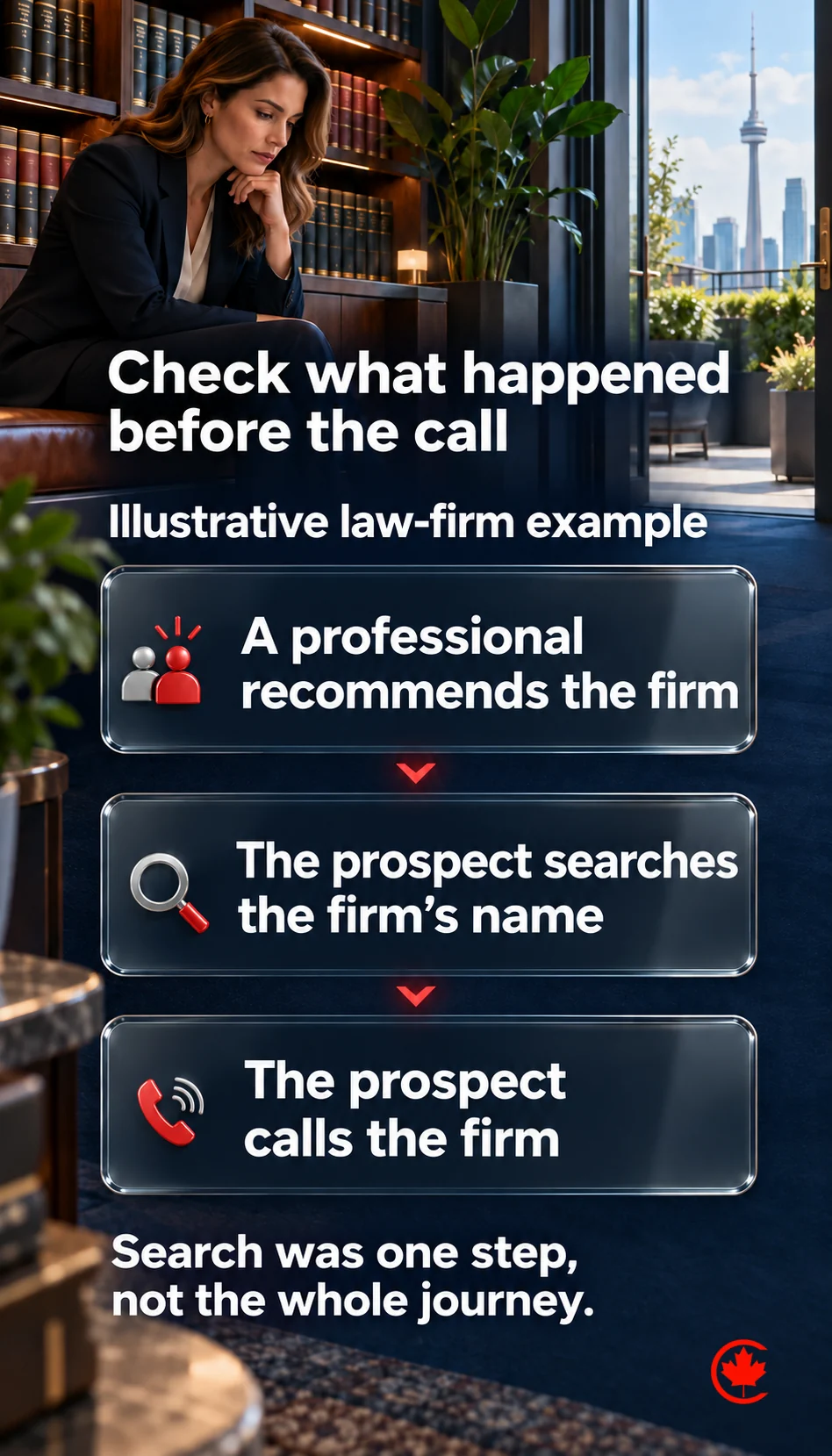
Attribution also has limits. A person may hear about the firm through a professional referral, search its name and then call. A report assigning that whole relationship to the final contact route can overstate what one channel accomplished. The firm should be able to see the reporting method and material unknowns in understandable language, without needing a technical implementation lesson.
Agree review points that examine the actual question being tested: whether information is clearer, relevant enquiries are reaching the team, or the firm has enough evidence to consider a different scope.
Early review and later outcome review should not be confused. When a website project is first presented, the firm can check its service facts, contact experience and agreed deliverables. It cannot yet know how many matters will ultimately follow. During an ongoing engagement, the owner can evaluate whether reporting is complete and whether relevant people are reaching intake. Retained-matter and financial interpretation may need a longer observation period, depending on the practice. These are different evidence questions, not a promise that every engagement follows the same timetable or that waiting automatically improves results.
A report should make a genuine limitation visible rather than replace it with a confident chart. For example, if the firm has not supplied permitted aggregate outcomes after consultations, the provider may be able to report enquiries but not retained files. That is a reporting boundary to resolve, not permission to estimate clients from a website button click. Equally, a firm that records retained matters without knowing how people first discovered it should not be told attribution is complete. Deciding what can responsibly be measured is part of evaluating the service’s usefulness.
Stay inside the Law Society rules
Your firm’s regulator determines the professional requirements that apply to its marketing. Ontario provides a specific example, not a complete Canadian rulebook. Section 4.2 of the Law Society of Ontario’s Chapter 4 requires marketing to be accurate, verifiable and not misleading. Section 4.3 restricts advertising as a specialist to lawyers certified by the Law Society. A firm serving other jurisdictions must check their current requirements rather than assume Ontario’s wording applies everywhere.
The practical approval task extends beyond the obvious advertisement. A biography, fee description, award badge, testimonial, past-result reference or statement comparing the firm with another provider can all shape the prospective client’s understanding. The firm needs evidence for what it approves and a responsible reviewer who understands the relevant context. A true statement can still be presented in a way that gives a misleading impression.
A testimonial is not a shortcut around that review. Authenticity, permission, confidentiality and professional advertising requirements are separate questions. The fact that someone voluntarily posted a public comment does not automatically settle whether the firm should reproduce it elsewhere or reveal details in a response. Marketing support should not be purchased on the assumption that every favourable statement can become promotional material.
The same care is useful when describing availability and fees. A visitor needs to know what a consultation involves, whether a quoted amount has conditions and which services the firm actually provides. Marketing should make those distinctions understandable, not use broad language that creates a commitment the firm did not intend. Referral-related arrangements and claims similarly require the firm’s appropriate approval rather than a generic promise of professional introductions.
Read our lawyer advertising rules in Canada guide for related context, and consult the current source for the firm’s own regulator. Canada Create’s marketing work is not legal or professional regulatory advice. The owner remains responsible for approving claims, materials and communications; an agency’s editorial review is not evidence that a law society or independent lawyer has approved them.
What to agree before committing your budget
With a limited budget, choose between problems rather than between fashionable channels. If suitable prospects already reach the firm but cannot obtain clear consultation information, more exposure may not be the best immediate purchase. If information and intake work well but the firm lacks relevant discovery, visibility services deserve a different evaluation. If there is no capacity for additional matters, the engagement should not be justified by a promise of more enquiries alone.
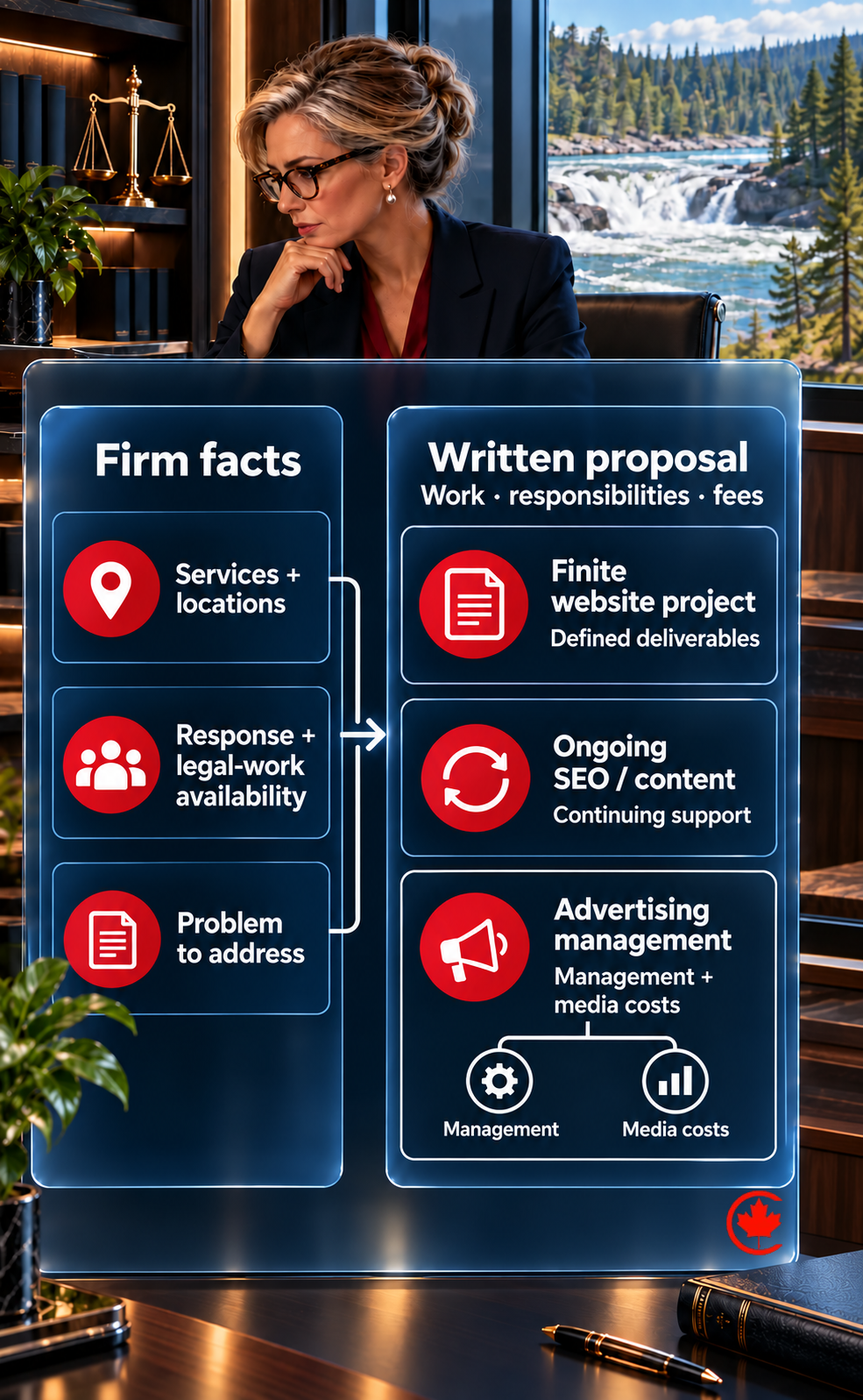
Compare proposals on the work included. A finite website project, ongoing SEO/content support and advertising management are not interchangeable even if their headline fees happen to match. The written agreement should identify services and locations, deliverables, exclusions, approval responsibilities, reporting, third-party charges, schedule and term. Media is paid directly to advertising platforms and is separate from Canada Create’s management fee; routine website maintenance is not automatically included.
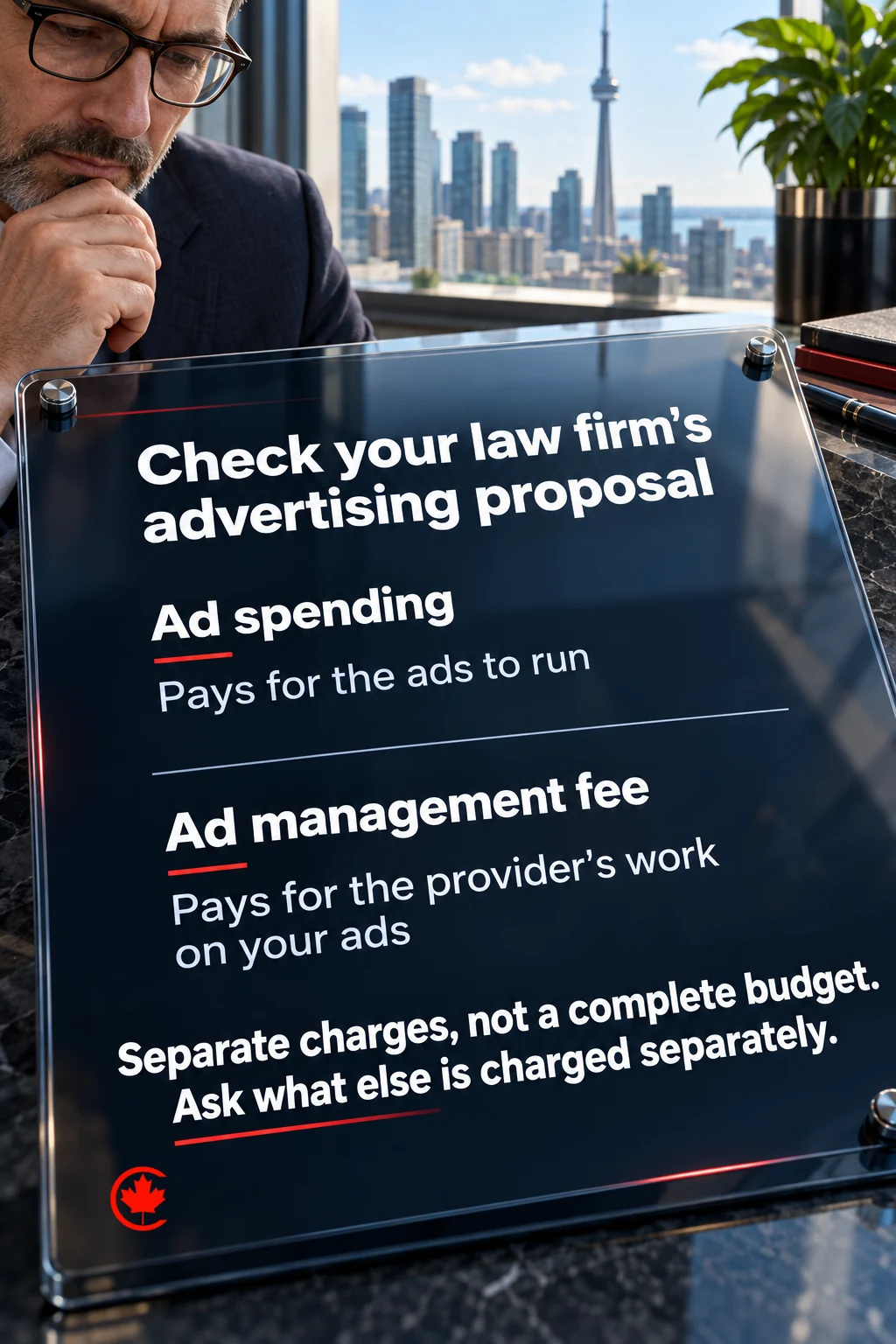
Contract terms deserve the same attention as creative work. Do not read an agreed media-spend review as a stop-anytime service arrangement. Ownership and access, permitted revisions, additional scope and renewal provisions should also be understood before comparing the apparent price of two offers.
Prepare the information only the firm can supply: correct contact and office details, accepted matters and jurisdictions, verified credentials, capacity, consultation policies, approved assets and the person responsible for review. Relevant evidence of a provider’s work can help evaluate fit, but generic screenshots or unsupported performance promises are not substitutes for a clear scope. A useful proposal makes the decision understandable without asking you to become a marketing technician.
Compare two proposals that solve different problems
Imagine two hypothetical offers for a firm whose website accurately describes its lawyers but leaves a new practice area almost unexplained. One offer covers a broad redesign, while another covers approved service information, consultation clarity and an agreed period of visibility support. Neither is automatically better. If visitors can already navigate the site and contact the correct team, the narrower offer may be more closely aligned with the missing information. If the whole site is difficult to use and responsibility for updates is unclear, a limited content project may leave material problems untouched. The comparison depends on the stated need and what each offer actually remedies.
Now consider a different hypothetical firm with a complete site and an available intake team, but limited awareness in a newly served location. A proposal focused entirely on design could improve presentation without addressing discovery. An offer for additional visibility may be closer to the objective, provided the location and accepted services are genuine and the firm understands the ongoing spending commitment. This is why a portfolio can help assess a provider’s craft without answering whether the proposed work is the right purchase. An impressive design is evidence of a design, not of what your particular firm needs next.
Finally, consider a firm already paying for advertising but unable to distinguish suitable consultations from unrelated calls. Buying more media before clarifying the outcome can make the next invoice larger without making the decision better informed. The owner can compare an agreed enquiry/reporting improvement with a larger acquisition scope, while checking what the current agreement already includes. This is not a recommendation to cancel a contract or stop platform spending unilaterally. It is a reason to understand the present service, the missing evidence and the cost of any proposed change before authorizing an expansion.
Decide what stays with the firm
An external engagement does not have to mean handing every marketing responsibility to one supplier. A firm may already have someone who maintains biographies and coordinates approvals but need outside website or advertising support. Another may have no available coordinator. These situations change the practical scope and the owner’s workload. A proposal should identify what the provider supplies and what depends on the firm’s people, rather than assume that “managed” means no internal time is required.
Consider an illustrative firm where three partners must approve material for their own practice areas. An ambitious content programme can stall if none has time to review it. The better buying decision may be a narrower, properly supported scope rather than a larger commitment based on approvals the firm cannot supply. The issue is not whether content matters; it is whether the engagement is workable with the firm’s real capacity. The owner should understand that dependency before agreeing deliverables and dates.

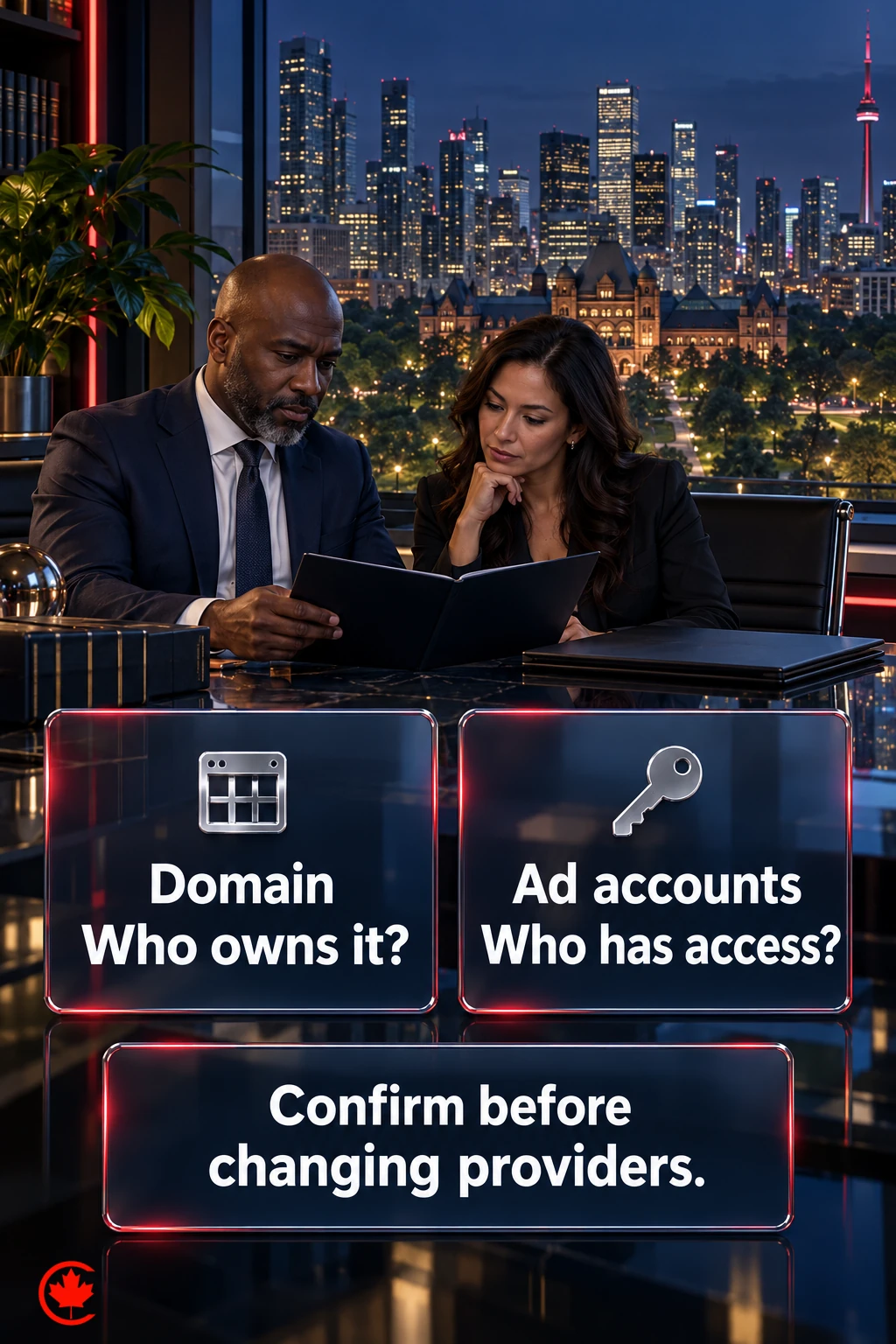
Ownership and continuing access matter beyond launch. The firm needs to understand whose name holds its domain and eligible advertising accounts, what access it receives, which third-party licences remain separate and what support or migration work is outside the agreement. Reviewing those boundaries avoids mistaking the purchase of a website or campaign service for ownership of every underlying product or unlimited future support. This is particularly important when the firm is replacing an existing provider and continuity of its public information and enquiry routes matters.
Choose support that matches your firm
The strongest next step is the one that addresses your firm’s actual constraint. A new office may need help becoming discoverable. An established practice may need to explain its services more clearly. A busy firm may need better enquiry handling rather than additional demand. Those choices can involve different services, budgets and responsibilities even within the same practice area.
Canada Create can discuss your accepted matters, service area, response capacity and desired outcomes, then define proposed scope and fees in writing. See our law firm marketing services or the industries we serve. Firms considering ways to put AI to work should evaluate the specific service, oversight and information boundaries rather than assume automation replaces professional judgment. The objective is an informed purchasing decision and a clear working relationship, not a promise that any channel can guarantee the next retained matter.
Frequently asked questions
Which marketing services fit our law firm?
The useful choice depends on the problem: insufficient discovery, unclear service information, unsuitable enquiries or inadequate response capacity. Compare the work each service performs against your accepted matters, locations and available lawyers. A website project, ongoing search support and advertising management are different purchases, not interchangeable packages.
What should a law-firm marketing budget include?
Separate platform media, management, agreed content or website work, one-time costs and any third-party charges. Understand taxes and the currency used. The worked figures in this guide are hypothetical, not Canada Create prices or a suggested budget. The firm must judge affordability using its own capacity, finances and accepted scope.
Do national CPC estimates predict the cost of a retained client?
No. National click estimates describe exact searched phrases only. A retained matter depends on several further stages and the firm’s own acceptance decisions. Relevant enquiries, held consultations and retained matters need separate definitions and cost calculations, with reporting periods and missing information made clear.
How should a family-law firm choose its marketing approach?
Compare the information prospective clients need with the firm’s present visibility and capacity. If referred visitors cannot understand the services or consultation experience, website or content support may address the immediate issue. If those elements work but relevant discovery is limited, compare additional search or paid visibility. There is no universal channel ranking.
What if we already receive plenty of enquiries?
More exposure may not solve the problem. Examine whether enquiries concern accepted work, reach the right people and lead to appropriate consultations. A scoped service-clarity or enquiry-handling engagement can address a different need from buying more traffic. Any change to the existing service or media budget remains subject to the agreement and required approval.
Can Canadian law firms use Local Services Ads?
Do not assume that legal categories are available in Canada. Google’s Canadian page currently lists eligible home-service categories rather than legal services. Confirm the actual country, category and location eligibility before budgeting. Local Services Ads are distinct from ordinary Google Ads, and a lead is not a guarantee of a retained client.
Can our firm advertise as a specialist?
In Ontario, Section 4.3 of the Law Society’s Rules of Professional Conduct restricts specialist advertising to lawyers certified by the Law Society. Check the current regulator requirements for each jurisdiction the firm serves. Credentials, testimonials, awards and past-result claims need their own review; one approved title does not clear every other marketing statement.
How much client information does a marketing provider need?
That depends on the agreed purpose and the firm’s professional and privacy obligations. Aggregate enquiry and consultation outcomes may answer reporting questions without transferring full case files. The firm should approve necessary information, access and handling. A promise to collect or track everything is not evidence that every proposed use is appropriate.
What should we compare before hiring a law-firm agency?
Compare the actual deliverables, exclusions, evidence, approval roles, reporting definitions, account access, third-party costs and agreement terms. Clarify what remains with the firm and what the supplier provides. A lower headline fee can cover a different job, while an attractive portfolio does not establish that its proposed scope addresses your firm’s present need.
When should we expect retained matters?
There is no fixed outcome timetable. A deliverable can be reviewed before enough enquiries or consultation decisions exist to evaluate acquisition. Agree meaningful review points and distinguish pending outcomes from confirmed results.