
How to get immigration clients: a practical guide for Canadian immigration lawyers and consultants

Getting immigration clients starts with a more useful question than how to generate more enquiries: which people or employers can your practice serve well, at a fee and pace that support good work? A busy inbox can conceal the wrong service mix, missed consultations or commitments your team cannot meet. Growth should mean more suitable retained matters, not simply more requests for free advice.
This guide is for Canadian immigration lawyers, regulated immigration consultants and the owners who make their marketing decisions. It compares services, budgets, supplier choices and the client experience without promising immigration approvals or marketing results. The financial examples are hypothetical, in Canadian dollars, and are not agency quotations or industry benchmarks. Professional requirements differ by regulator, licence and province; this is business information, not individual immigration, legal or regulatory advice.
Choose the clients you want to serve
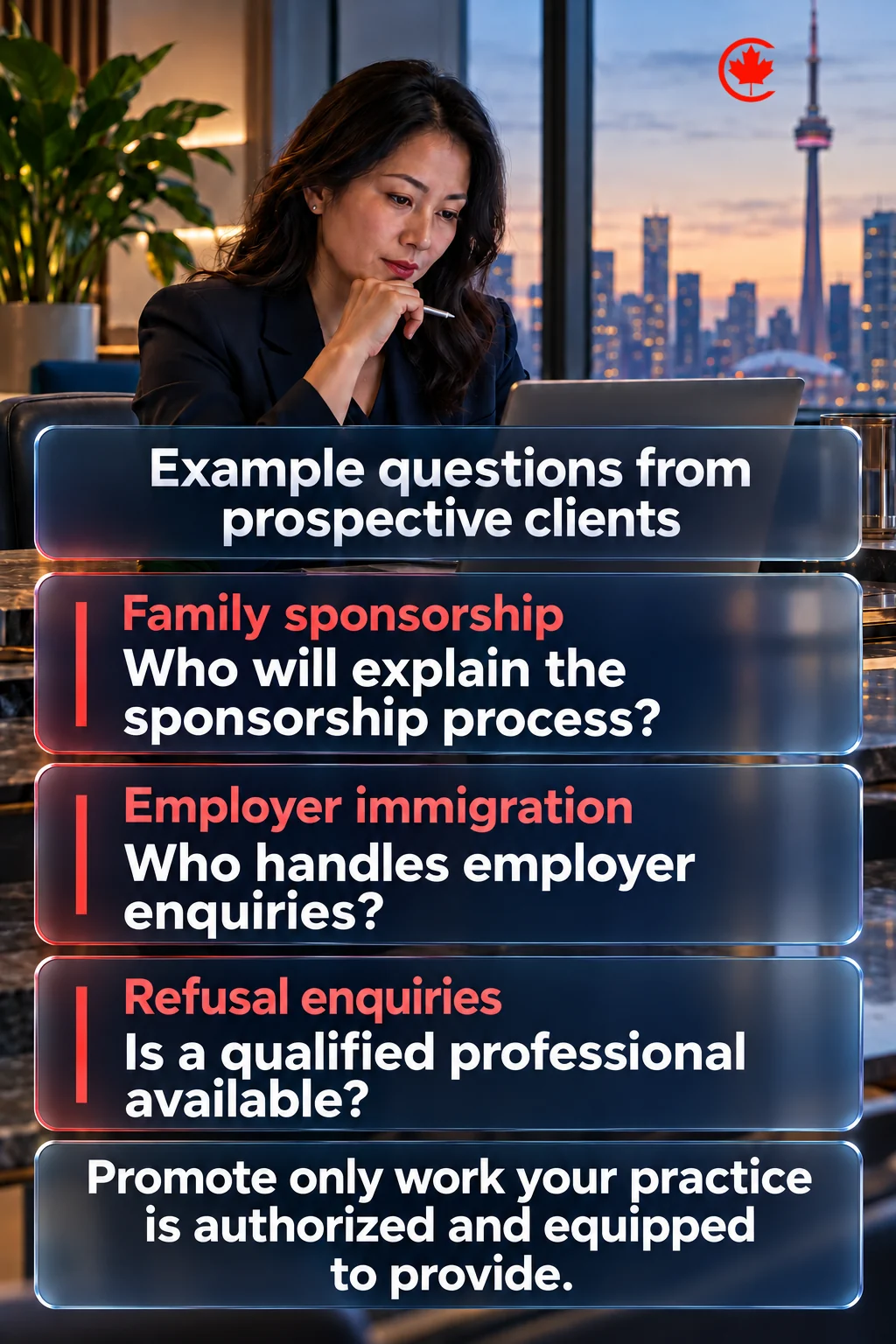
A family sponsorship practice, an employer-focused immigration team and a practice handling refusals do not need identical marketing. Their prospective clients have different questions, buying processes and expectations. A family may want to understand who will explain the work and communicate across time zones. An employer may need a named contact who understands the business assignment. Someone facing a refusal may first need to know whether a qualified professional is available to assess the situation promptly.
Choose a service focus from the work you are actually authorised and equipped to provide. Your licence, competence, available supervision and capacity matter more than the apparent popularity of a program. If you do not handle hearings, court proceedings or a particular category of case, the public offer should not suggest otherwise. A visitor should understand what you can consider without reading a catalogue of every possible Canadian immigration pathway.
Capacity is not just the number of empty consultation appointments. Consider the professional time needed after a person retains you, document coordination, interpretation, quality review and ongoing communication. In a hypothetical family-sponsorship practice, additional urgent consultation requests could create a service problem if the team cannot respond appropriately or the professionals cannot deliver the new work they accept. Another practice with an experienced employer team and few introductions may reasonably put more emphasis on reaching relevant businesses.
Also distinguish a commercial focus from a decision about an individual. Marketing can explain the services, fees, locations and languages your practice offers; it should not substitute for professional assessment. Agree internally who decides whether a matter is suitable and how an enquiry outside scope receives a clear answer. This gives a marketing supplier a truthful description of the business to present, while keeping acceptance and professional judgement with your practice.

An employer-focused offer deserves particular precision about who the service is for. A business paying for assistance and an individual affected by the work may have different interests and expectations. Your professional engagement determines the client relationship; an advertisement cannot resolve it. Before buying employer marketing, be ready to explain the business services available, who can request a conversation and how the professional will establish the appropriate relationship. This is different from advertising jobs or promising someone employment, permanent residence or a particular decision.

Know the rules before you advertise
Do not treat all immigration professionals as one regulated category. Lawyers follow the rules applicable to their law society and practice. College of Immigration and Citizenship Consultants licensees follow their own Code and licence conditions. Marketing that is suitable for one profession is not automatically suitable for the other. Identify the responsible professional and applicable jurisdiction before approving claims, credentials, fee language or referrals.

For example, Ontario lawyers’ marketing must be truthful, verifiable and not misleading. Ontario also restricts advertising as a specialist to lawyers certified by the Law Society. Advertised legal fees must describe the covered services with reasonable precision and disclose whether taxes and disbursements are extra. These are Ontario examples, not a substitute for checking another province’s requirements. The governing source is the Law Society of Ontario’s marketing and advertising rules.
For CICC licensees, Code section 44 requires the registered name prominently at or near an advertisement’s beginning, in its language, and the public-register Internet address in written advertising. It prohibits false or misleading claims, success guarantees and implied government relationships. Section 45 requires genuine, accurate endorsements approved for public use in writing. See the CICC Code.
Make these responsibilities part of the buying conversation, not an afterthought at launch. A supplier can help present approved information; that does not make it your regulator or legal adviser. Ask who submits copy for your review, who can authorise publication and how corrections are handled. Avoid an offer that treats an agency’s approval as permission to make professional claims or suggests that paying for marketing transfers your regulatory responsibilities.
Build a website that proves you are licensed and real
A prospective client needs to recognise the professional they would actually engage. Show accurate names, roles, credentials, service availability and contact details. Make verification straightforward rather than relying on a reassuring badge with no explanation. IRCC’s guidance about representatives distinguishes authorised paid representatives from other helpers. A marketing website should support that distinction, not blur a consultant, lawyer, recruiter and administrative assistant into an undefined team.
Evaluate website work from a visitor’s point of view. Can someone tell whether you handle their general type of matter, whether consultations are remote or in person, which languages are available and what happens after requesting contact? A polished homepage is not enough if the fee explanation contradicts the booking page or a consultation button leads to an unavailable calendar. These are concrete acceptance questions to discuss when buying website services.
Proof does not have to mean a dramatic case story. Accurate professional biographies, genuine office and team information, a clear description of the engagement and a consistent client experience can answer important trust questions. An image should not imply that an unfamiliar person is one of your lawyers or consultants. A statement about years of experience should identify whose experience it describes rather than combining unrelated careers into an unexplained total.

Choose between improving the existing site and replacing it based on the actual problem. If visitors can use the site comfortably but cannot understand your services, content and booking clarity may deserve attention before a rebuild. If the site cannot reliably support enquiries, account access or approved updates, broader work may be justified. Ask what will remain, what will change and what ongoing support is included. A redesign alone is not evidence that more suitable clients will follow.

If visitors can use the site but cannot understand your services, consider a focused content update. If the site cannot reliably support enquiries or approved changes, broader work may be justified. Ask what stays, what changes and what support is included; a redesign does not guarantee more suitable clients.
Accessibility and practical usability belong in this discussion too. Someone contacting you from a phone, a slow connection or an unfamiliar country should not have to decipher an elaborate presentation to find consultation information. Ask to review the actual proposed booking experience, including fee visibility, readable text and any accessibility deliverables included in the agreement. Do not assume that attractive design proves accessibility conformance. If a specific standard or assessment matters to your practice, name it in the scope and establish how it will be evaluated.
Reach clients in their own language
A multilingual offer is a service commitment, not merely a translation purchase. A person who reads a page in Persian, Punjabi, Mandarin, French or another language may reasonably expect a useful conversation in that language. Before commissioning pages, decide who will answer, what they can discuss, when they are available and whether the professional consultation needs an interpreter. Distinguish a team member’s conversational ability from the language support required for complex instructions.
Consider a hypothetical practice where one bilingual professional is already fully booked. Adding several translated service pages without another service arrangement could create enquiries the practice cannot support. A narrower, accurately described language offer may be more useful than a large menu. Conversely, a practice with established language support but unclear public information may benefit from making that existing capability easier for people to evaluate.

A translated page may lead someone to expect a conversation and professional service in that language. Confirm who can respond, what they can discuss and whether a consultation needs an interpreter. Agree who reviews meaning and updates each language when the offer changes.
Ask a content supplier to define translation, editorial review and ongoing updates separately. A price for initial pages may not include revising every language when consultation fees or accepted services change. Your reviewer should be able to judge meaning, not just spelling. In particular, reassurance in one language must not become an approval promise in another. Where Quebec or other language requirements may apply, obtain advice for your actual business and communications rather than relying on a translated website as proof of compliance.
Be visible in local and national search
Search visibility is worth considering when people are looking for the kind of professional help you provide but struggle to discover or evaluate your practice. The geographical decision should follow your service model. An office relying on in-person consultations has a different need from a team serving employers across Canada. International reach adds questions about time zones, language support, payment arrangements and the jurisdictions in which your services can be offered.

In Canada, “immigration lawyer” and “immigration consultant” each draw an estimated 8,100 searches a month. These are search estimates, not unique people, city-level demand or prospective clients available to one practice. Do not add the figures together as distinct buyers or assume the two professional labels are interchangeable.
The useful implication is modest: both professional identities deserve clear, accurate presentation. The figures do not determine which matters you should accept, whether you need a particular marketing package or how many clients a campaign will produce. A refusal enquiry, an employer enquiry and a general request for government information may all have very different value to your practice. Demand estimates should start a discussion about fit, not replace it.
When comparing proposals, ask which services and genuine locations the work covers, what information you will need to supply and how progress will be related to relevant enquiries. Be wary of a report that substitutes general traffic growth for suitable consultations. Our immigration lawyer SEO page explains the service offering. The appropriate scope depends on your starting point and objectives; no ranking or enquiry volume should be treated as guaranteed.
Build referral relationships
Referral relationships can be valuable because another professional or organisation already understands a person’s broad need. A family lawyer may encounter a sponsorship issue; an employment adviser may hear from a business planning to hire internationally. For the practice owner, the decision is which relationships fit the work you actually handle, not how many names can be collected. A referral that falls outside your authority or capacity is not automatically a useful new file.
For CICC licensees, section 13 of the Code generally prohibits referral inducements, with a limited exception for an agent soliciting clients whose name the licensee registers with the College in advance. It is not general permission to buy referrals. Lawyers must assess arrangements under their own regulator’s rules.
Do not confuse an introduction with authority to advise. An introducer’s role, any payment arrangement and permission to share information need careful consideration before the relationship begins. If a recruiter or education intermediary is also involved, have the responsible professional assess the full arrangement rather than treating it as ordinary advertising. IRCC’s representative guidance remains relevant: compensation for immigration advice or representation does not become acceptable simply because someone calls themselves a marketing partner.
Commercially, decide what a good introduction looks like and what the referring organisation can truthfully say about you. A clear description of your services and availability is more useful than an open-ended promise to solve every immigration problem. Protect the person’s choice of representative and avoid suggesting that an introduction obliges them to retain you. Updates to the referring party should follow the client’s authorisation and your obligations, not the partner’s curiosity about the outcome.
Teach in your community
Community information sessions are a different purchase from paid advertising. They require professional preparation, a suitable host, accessible communication and time for conversations that may never become retained work. They can make sense when a practice wants people or employers to understand its role and available services. They are less suitable as a supposed shortcut to an immediate, guaranteed number of clients.
Choose the commitment by audience and purpose. An employer association may want a general discussion of working with an immigration representative. A community organisation may want to help members recognise authorised professionals and understand consultation expectations. Neither requires attendees to disclose personal immigration histories in a public room. The host’s needs and your professional boundaries should shape the session, not a sales target that pressures participants to reveal sensitive information.
For a hypothetical event costing CAD $900 in venue, interpretation and preparation expenses, the sensible evaluation is broader than dividing attendance by cost. Consider whether attendees understood the service, whether appropriate private enquiries followed and whether the time displaced billable or existing-client work. Treat relationship value as a judgement rather than inventing a financial return. A small, relevant event can be worth considering, but the fee, preparation and follow-up responsibilities should be explicit before you commit.
Use video and social media carefully
Video can help a prospective client understand the person behind the practice and what a consultation will feel like. It is not necessary for every firm, and a large audience is not proof of local or service-specific demand. Compare the cost of production with the questions it will answer for your intended clients. A calm explanation of consultation scope may be more useful to that decision than a stream of loosely related news reactions.
The owner should know who reviews statements, whether the person shown actually works with the practice and how dated information will be handled. A short clip can circulate without the surrounding webpage, so essential qualifications should not depend on material a viewer may never see. Separate general educational discussion from an individual’s situation. Staff should not make acceptance decisions or solicit case details through public comments merely because a video has attracted attention.
Testimonials and reviews require similar restraint. Public praise is not permission to republish a person’s entire immigration story across channels. Discuss valid permissions and professional rules before using identifiable material. In review responses, a cautious practice avoids confirming representation or discussing a file. Ask a supplier to show how proposed content helps a prospective client choose responsibly, rather than relying on emotional before-and-after stories, unsupported success percentages or the assumption that engagement numbers equal retained matters.
Run Google Ads with discipline
Paid advertising may be worth considering when your practice can accept additional work, respond to enquiries and fund a defined period of evaluation. It buys exposure, not a guaranteed consultation or retainer. If your current enquiries are routinely unanswered or the available appointment is weeks away, increasing paid exposure may worsen the mismatch. Before choosing a supplier, agree which services you want considered and what counts as an enquiry your practice can actually handle.
There is an important platform boundary. Google’s sensitive-interest policy for marginalised groups specifically includes immigrant services and refugee legal services. It restricts advertiser-curated audiences, including Customer Match and your data segments, for these categories. This is not a blanket ban on immigration advertising. A proposal should account for the applicable restrictions rather than casually promising to follow past visitors or upload a client list for targeting.
Compare the complete financial commitment. In a hypothetical monthly plan, CAD $3,000 for media, $1,200 for management, $500 for agreed website or content work and $300 for additional intake support total $5,000 before applicable tax. A separate $1,500 setup charge makes the first month’s total $6,500 before tax. These invented figures illustrate cost categories only. They are not Canada Create prices, recommended budgets or evidence of what an immigration enquiry costs.
Now test affordability against your practice’s economics. Continue the hypothetical Canadian-dollar example before applicable tax. Suppose each additional completed matter produces $4,000 in collected professional fees and uses $2,200 in direct professional and support costs. That leaves $1,800 before marketing and fixed overhead. For this comparison, assume $5,000 is the total recurring marketing cost assigned to that same group of completed matters. Three such matters contribute $5,400 before that cost, leaving $400 toward fixed overhead and profit; four leave $2,200. These remainders exclude the separate $1,500 setup charge and are not monthly cash-flow results. If acquiring those matters requires additional months of marketing spending, include those costs too. Check when fees are collected and the relevant costs must be paid before judging affordability. The arithmetic does not predict that either number of completed matters will occur.
We help immigration firms rank in English and in the languages their clients search in.
Collection timing can make even an apparently affordable plan uncomfortable. If those matters begin now but earned fees are collected over later months, the media and supplier bills may fall due first. Base spending on money the business can properly use, not the face value of newly signed files. Include a downside in which fewer suitable matters arrive or collection takes longer. Agree when you will review the evidence and what spending decisions require your approval; that review date is not a cancellation right.
Turn enquiries into consultations and retainers
A useful intake experience reduces uncertainty without pretending to provide an assessment before a professional has reviewed the situation. A prospective client should understand how to request a consultation, what it costs, who will attend and what the consultation does and does not include. An acknowledgement can confirm receipt and explain availability, but it should not imply that representation has been accepted or that an urgent deadline is being protected.
Decide which information is needed at the first contact and which belongs in your professional intake process. A public marketing form is not the place to invite a detailed account of persecution, health conditions, family conflict or an entire document file. Ask your practice’s privacy and professional advisers to approve the information flow. The marketing supplier needs an agreed boundary between basic contact handling and confidential work, not unrestricted access to every prospective client’s history.
For a hypothetical cross-border enquiry, a person may be available only after your Canadian office closes and may share a telephone with relatives. A booking process that ignores the time zone or uses an unsafe callback method can fail even when the advertisement was relevant. Confirm preferred contact arrangements and available language support without promising round-the-clock professional service. These decisions affect the client experience more directly than a larger number of form submissions.

Separate administrative availability from professional availability when comparing an answering service or booking supplier. A receptionist may be able to confirm office hours and arrange contact without being qualified to interpret a refusal or advise on a deadline. Ask what happens when a caller describes an urgent situation, when an interpreter is unavailable or when the practice is full. The answer should reflect your approved service boundaries. An impressive response-time claim is not useful if it leaves the person believing a professional has reviewed a matter when no such review occurred.
Commercial follow-up should also respect its purpose. The CRTC’s CASL guidance explains consent, identification and unsubscribe requirements for commercial electronic messages. Do not assume every enquirer has agreed to an ongoing promotional newsletter. Distinguish responding to a requested consultation from later marketing, and have the applicable basis checked. Buying a communication service does not remove the practice’s responsibility for the audience and content it approves.
For CICC licensees, section 23 generally requires a written consultation agreement before an initial consultation; the Code contains specific exceptions. Build the booking experience around the agreement requirements that apply to your practice. For either profession, make cancellation, missed-appointment and rescheduling information easy to understand before payment, and ensure the displayed terms match the actual professional engagement rather than an unrelated supplier’s default wording.
Measure where your files come from
Judge marketing through stages that mean different things. An enquiry asks for contact; a relevant enquiry fits your accepted services and availability; a booked consultation may or may not take place; a retained matter has passed your professional acceptance process. A marketing report should not call every form submission a client or count an existing client’s routine message as newly acquired business. Agree the definitions before comparing suppliers or periods.
Consider a hypothetical group of 40 enquiries received in one month. Of those, 18 are relevant, 12 lead to booked consultations, nine lead to attended consultations and four lead to retained matters by the review date. If CAD $5,000 is the complete marketing cost assigned to acquiring that same group, it represents $125 per enquiry and $1,250 per retained matter as of that review date. Neither number by itself establishes profitability. The professional fees, delivery costs, collection timing and suitability of those four matters still determine whether the commercial result is acceptable.
Timing also matters when reading that example. A matter retained this month may have begun with an enquiry several months earlier. Someone may hear about you through a community contact and later find your website before booking. Treat source labels as practical evidence with limitations, not proof that one touchpoint caused the entire decision. Ask for a clear distinction between newly received enquiries, later outcomes from earlier enquiries and unresolved opportunities.
Protect confidentiality in the reporting arrangement. The owner needs enough information to assess relevance and commercial value, but a supplier does not necessarily need names, passports, application histories or consultation recordings. Prefer an agreed summary that answers the business question without exposing case material. If additional access is proposed, assess its necessity, permissions and safeguards before granting it. A detailed dashboard is not automatically better if it collects information that should remain within the practice.
Explain your fees clearly
Clients comparing professional help need to understand what they are buying, not just the smallest number on a page. Describe the consultation separately from later representation and explain whether its fee is credited toward another service. If the price depends on the scope or complexity of the work, say that the appropriate fee is established after assessment. Do not use an entry-level price in a way that suggests it covers matters your practice would ordinarily quote differently.
For a hypothetical consultation advertised at CAD $250 plus applicable tax, specify the intended length, the professional involved and the agreed output. If document review beyond a stated amount is separate, make that boundary clear before booking. For a later hypothetical $4,000 professional engagement, distinguish professional fees from government charges, translations and other disbursements. These examples are communication illustrations, not recommended immigration fees or statements about what any particular file requires.
Be equally careful when using anticipated fees to justify marketing. A signed agreement for $4,000 is not the same as $4,000 earned, collected and available for business expenses. For CICC licensees, sections 32 and 33 govern advance funds, trust handling and invoicing after services or disbursements. Lawyers must follow their applicable trust and billing rules. Have your own professional and accounting advisers establish the cash assumptions rather than treating client advances as a marketing budget.
A paid consultation may suit a practice offering substantial professional assessment. A clearly limited introductory conversation may serve a different purpose. Compare the professional time, preparation, attendance and client understanding associated with each option rather than assuming free always attracts more useful work or paid always filters better. Whatever you choose, consistency matters: the website, receptionist, booking confirmation and actual professional experience should describe the same offer.
International clients may also need clarity about currency and payment costs. A CAD quotation should not be left looking like a price in another currency, and a payment provider’s exchange charge should not be silently described as part of your professional fee. Decide how the practice will explain available payment methods, receipts and any applicable third-party charges before commissioning a new booking experience. Do not promise that every foreign card or transfer will work. Clear expectations reduce avoidable confusion without committing your practice to a payment arrangement it has not approved.
Use directories and referral services
A directory can serve different functions: helping someone verify a professional, introducing a practice or selling advertising space. Those functions should not be confused. A paid listing is not the same as independent professional endorsement, and a decorative award is not a substitute for licence verification. Evaluate the particular service, audience and commercial arrangement rather than assuming all legal directories provide comparable value.
Before buying a placement, ask what the price includes, whether the listing is clearly identified, which professional categories it accepts and how enquiries reach your practice. Find out whether a person may contact several listed providers and how duplicates or enquiries outside your agreed scope are treated. Do not buy on an implication that the prospective client belongs to you or cannot consider another professional. Their choice remains their own.
In a hypothetical directory offer costing CAD $1,200 annually, two retained matters may look attractive until you examine the services involved and the effort required to respond to all enquiries. Another placement may produce no retained work but be useful for an established professional association relationship. Separate those objectives honestly. Review value before renewal, but read the notice and payment terms first; deciding not to use a listing does not necessarily end the contractual commitment.
Plan around policy changes and seasons
Immigration-related information needs ongoing professional attention. A practice may change the matters it accepts when a program, eligibility rule or operating circumstance changes. Your marketing supplier should know who can confirm the effect on the practice’s public offer. The agency should not infer legal eligibility from a headline or independently decide that a particular person now qualifies. A dated article is useful only if the underlying information is still appropriate for its purpose.
Ask what ongoing content support actually includes. A contract for initial pages may not cover later professional review, translated revisions or urgent changes to booking information. If these are important to the practice, describe the deliverables and responsibilities in writing. Distinguish a supplier acknowledging your request from finishing an approved update. Neither a routine maintenance package nor a general marketing retainer should be assumed to include unlimited immediate changes.
Seasonal planning should follow your own evidence rather than a universal immigration calendar. A practice serving employers may see enquiries tied to its clients’ hiring plans; a practice with student clients may have different patterns. Those are reasons to inspect your history, not grounds to promise a recurring surge. Keep enough flexibility to respond to verified changes without spending ahead of work you cannot accept or allowing a short-lived announcement to define the entire year’s plan.
Avoid the most common immigration marketing mistakes
The first mistake is buying a larger package before identifying the actual obstacle. If people enquire but misunderstand what you offer, clarity and intake may need attention. If relevant prospects can assess the practice but rarely discover it, visibility may deserve investment. If suitable consultations take place but few become retained matters, the reason may involve fees, service fit or professional acceptance rather than inadequate advertising.
The second is choosing on a headline price while ignoring scope. One proposal may include agreed website improvements and reporting; another may quote advertising management only. Media, taxes, setup, translation, photography, software and intake time may be separate. Compare like with like and ask which work depends on material your team must provide. A low monthly fee is not automatically the lower total commitment if important requirements are excluded.
The third is accepting proof that cannot answer your question. A large traffic increase for an unrelated business does not establish immigration experience or the cost of suitable retained matters. Ask for evidence the supplier is authorised to share, with the service, period, starting point and outcome explained. Respect confidentiality where details cannot be disclosed, but do not fill the gap with assumptions. A demonstration can show an approach to presentation; it is not a client result.
The fourth is leaving approval and ownership unclear. Know who holds the domain, advertising account and relevant business profiles, who can access them and what happens at the end of the engagement. Know which deliverables are yours, which rely on third-party licences and which services continue only while a contract remains active. Resolve these issues while comparing proposals, not after a disagreement or an approaching renewal date.
A useful supplier conversation includes a disagreement as well as a sales presentation. Ask what happens if your professional reviewer rejects a proposed claim, a translation changes its meaning or a service must be withdrawn from your public offer. You need a clear review route, realistic dependencies and an explanation of any additional fees, not a promise that revisions are unlimited. Likewise, ask which decisions the supplier can make independently and which require your approval. Good boundaries let you assess the work without having to become a marketing operator.
Getting help
The right division of work depends on your practice. You may prefer to manage professional relationships and community involvement while a supplier supports website content, search visibility or advertising. A larger practice may need one coordinated engagement; a smaller practice may need a well-defined improvement rather than an extensive package. Choose the support that addresses a demonstrated need and that your team can meaningfully review.
Compare a fixed website project with ongoing advertising management as different commitments. In a hypothetical project proposal, acceptance might concern specified service pages and a working consultation-booking experience. In an ongoing proposal, accountability might concern agreed management, reporting and review responsibilities throughout the term. The first should not imply indefinite maintenance; the second should not be judged solely by whether new pages appear every month. Ask how each deliverable addresses your practice’s actual problem, what counts as completion and which continuing responsibilities remain with your team.
When discussing marketing for immigration lawyers with Canada Create, bring a description of the matters you accept, the clients or employers you want to serve, your genuine language support and available capacity. You do not need to send confidential client files to explain those goals. For firms with several practice areas, our law firm internet marketing page provides broader service context.
Ask for the proposed deliverables, responsibilities, fees and term in writing. Canada’s immigration professionals need a clear distinction between marketing support and professional review: Canada Create does not provide legal or regulatory advice, and its work is not a compliance review. Your practice remains responsible for the professional content and claims it approves. No engagement guarantees rankings, advertising approval, consultations, retained files or revenue.
Renewal and notice requirements depend on the agreement. Pausing advertising is not the same as ending that commitment. Media spend is separate from management fees, and website maintenance requires a separately agreed package rather than being automatically included in ongoing marketing.
Clarify ownership, access, third-party licences, approval duties and any agreement-specific changes before work starts. A general guide cannot determine how an agreement applies to your circumstances or whether a clause is enforceable. Obtain independent advice where needed. The practical next step is a scoped conversation about the work and commercial commitment, not a promise that one channel will solve every growth problem.
Frequently asked questions
How should an immigration practice choose a marketing agency?
Compare the services covered, review responsibilities, full cost, term, account access and evidence of relevant work. Ask how the proposed support addresses your accepted matters and actual capacity. Marketing does not replace professional review or guarantee retained clients. See our marketing for immigration lawyers service.
Can immigration lawyers advertise success rates?
Requirements depend on the regulator and the claim. Ontario requires verifiable, non-misleading marketing; its commentary cautions about past-result claims without appropriate context. Do not present a percentage as a guarantee. Obtain advice on the particular statement under your own regulator's current rules.
Can I call myself an immigration specialist?
In Ontario, lawyers may advertise as specialists only if certified by the Law Society. Do not apply that answer automatically to another province or to consultants; check the rules governing your own professional designation.
How does marketing for immigration consultants differ from lawyer marketing?
Some channels overlap, but professional identity, permitted work and advertising obligations differ. CICC licensees and lawyers have different regulators; one profession's marketing rules are not automatically the other's. Choose support that reflects your actual services, language support and consultation availability.
Should I create pages in other languages?
Consider them when your practice can support the resulting conversations and professional service. Agree who reviews meaning and who updates each language when the offer changes. More languages do not, by themselves, establish better enquiries or more clients.
Can I pay for immigration referrals?
CICC's limited pre-registered soliciting-agent exception is not blanket permission to pay for referrals. Lawyers have separate regulator requirements. Have the particular arrangement assessed before making a commitment, including the introducer's role and any information sharing.
Do Google Ads work for immigration practices?
They may be worth evaluating when your practice can accept suitable work and fund the full cost. Results are not guaranteed. Google's sensitive-interest restrictions apply to immigrant and refugee services; a proposal should not assume unrestricted use of client lists or past-visitor audiences.
Should I charge for immigration consultations?
Compare the professional assessment offered, preparation time, attendance and client expectations. Explain the fee, scope, payment and rescheduling terms before booking, and use the professional agreements that apply to your practice. Neither a paid nor a free approach guarantees better retained work.
How do I keep my website accurate when IRCC policies change?
Identify the professional responsible for confirming changes to your accepted services and public statements. Agree what update support you are buying, including translated pages, and do not assume routine marketing includes unlimited urgent revisions. See immigration lawyer SEO.
How do I protect client confidentiality in marketing?
Establish which information belongs in initial contact, professional intake and business reporting. Avoid inviting case histories through public channels or sharing identifiable files simply to assess marketing. Have the proposed collection, access and reporting arrangements reviewed for your practice's obligations before use.