
Google Ads for lawyers: cost per click by practice area in Canada (2026 data)

A legal search click is not a consultation, a suitable client or a retained file. It is a paid opportunity for someone to consider your firm. The useful budget question is therefore not simply whether lawyers pay more per click than other businesses. It is whether the particular enquiries your firm can competently serve are likely to justify the full cost of acquiring them, within a spending limit you can afford.
This guide is for Canadian law-firm owners and managing partners comparing Google Ads proposals or reviewing an existing investment. The benchmark below helps put different searches in context. The sections that follow explain what those estimates cannot tell you, how to connect clicks to your own practice economics, and what to require from a provider without turning you into a campaign operator. All worked examples are hypothetical Canadian-dollar illustrations, not Canada Create client results, recommended budgets or legal-fee benchmarks.
Legal search CPC in Canada, by practice area
| Search | Monthly searches in Canada | Relative cost per click |
|---|---|---|
| motor vehicle accident lawyer | 210 | Among the highest |
| slip and fall lawyer | 590 | Among the highest |
| dui lawyer | 1,900 | Among the highest |
| personal injury lawyer | 9,900 | Among the highest |
| ltd lawyer | 110 | Among the highest |
| personal injury lawyer toronto | 2,400 | Among the highest |
| dog bite lawyer | 390 | High |
| criminal lawyer | 5,400 | High |
| criminal defence lawyer | 3,600 | High |
| intellectual property lawyer | 590 | High |
| family lawyer toronto | 5,400 | Moderate |
| litigation lawyer | 2,400 | Moderate |
| insurance claim lawyer | 480 | Moderate |
| employment lawyer toronto | 2,400 | Moderate |
| medical malpractice lawyer | 2,400 | Moderate |
| corporate lawyer | 2,400 | Moderate |
| divorce lawyer | 9,900 | Moderate |
| family lawyer | 18,100 | Moderate |
| employment lawyer | 9,900 | Moderate |
| tax lawyer | 1,600 | Moderate |
| traffic ticket lawyer | 1,300 | Moderate |
| real estate lawyer toronto | 1,900 | Moderate |
| real estate lawyer | 6,600 | Moderate |
| estate lawyer | 2,900 | Moderate |
| wrongful dismissal lawyer | 1,300 | Moderate |
| immigration lawyer | 8,100 | Lower |
| paralegal | 14,800 | Lower |
| will lawyer | 2,400 | Lower |
| immigration consultant | 8,100 | Lower |
| notary public | 14,800 | Lower |
| notary near me | 49,500 | Lower |
| car accident lawyers | No estimate | No estimate |
We run law firm Google Ads measured on calls, forms and booked consultations.
The rows are estimates for each search phrase across Canada, ordered from the most to the least expensive per click, with one phrase that has no estimate at the end. Motor vehicle accident, slip and fall, impaired driving and personal injury searches sit at the top of the table, while notary searches are the least expensive. These are estimates, not invoices, retained-client costs or a universal price for legal advertising.
Read each row as an estimate for that particular search phrase. A phrase containing Toronto is still measured across Canada; it is not a count of every potential client living in Toronto. A national figure also cannot tell you what your firm would pay in a specific neighbourhood, at a particular time, with a particular offer. Your actual account history is a separate source of evidence.
Do not add these search volumes together and call the result the size of the Canadian legal market. Related phrases can describe overlapping demand, and a search is not a unique person. Someone may investigate several firms, search more than once, need information rather than representation, or live outside the area your firm serves. These distinctions matter before a proposal turns a large search number into an apparently precise client forecast.

The table also includes searches associated with different professional roles, including paralegals, immigration consultants and notaries. Their presence is context, not a suggestion that they are interchangeable with a lawyer or that every Canadian professional can provide the same services. Licensing, permitted scope and the meaning of a service depend on the jurisdiction. Compare the rows that genuinely relate to your practice instead of using the cheapest professional-service query as a target for every file type.
What CPC measures, and why your invoice can differ
Google distinguishes the final amount charged for an individual click from an average calculated across clicks. An account’s average CPC is its click cost divided by its clicks. A keyword research estimate is neither of those account-specific measurements. It is a planning input. Ask any proposal using a CPC number to identify whether it is a historical account average, an external estimate, or a forecast based on stated assumptions. Those labels should not disappear once the number reaches a sales presentation. See Google’s definitions of actual CPC and average CPC.
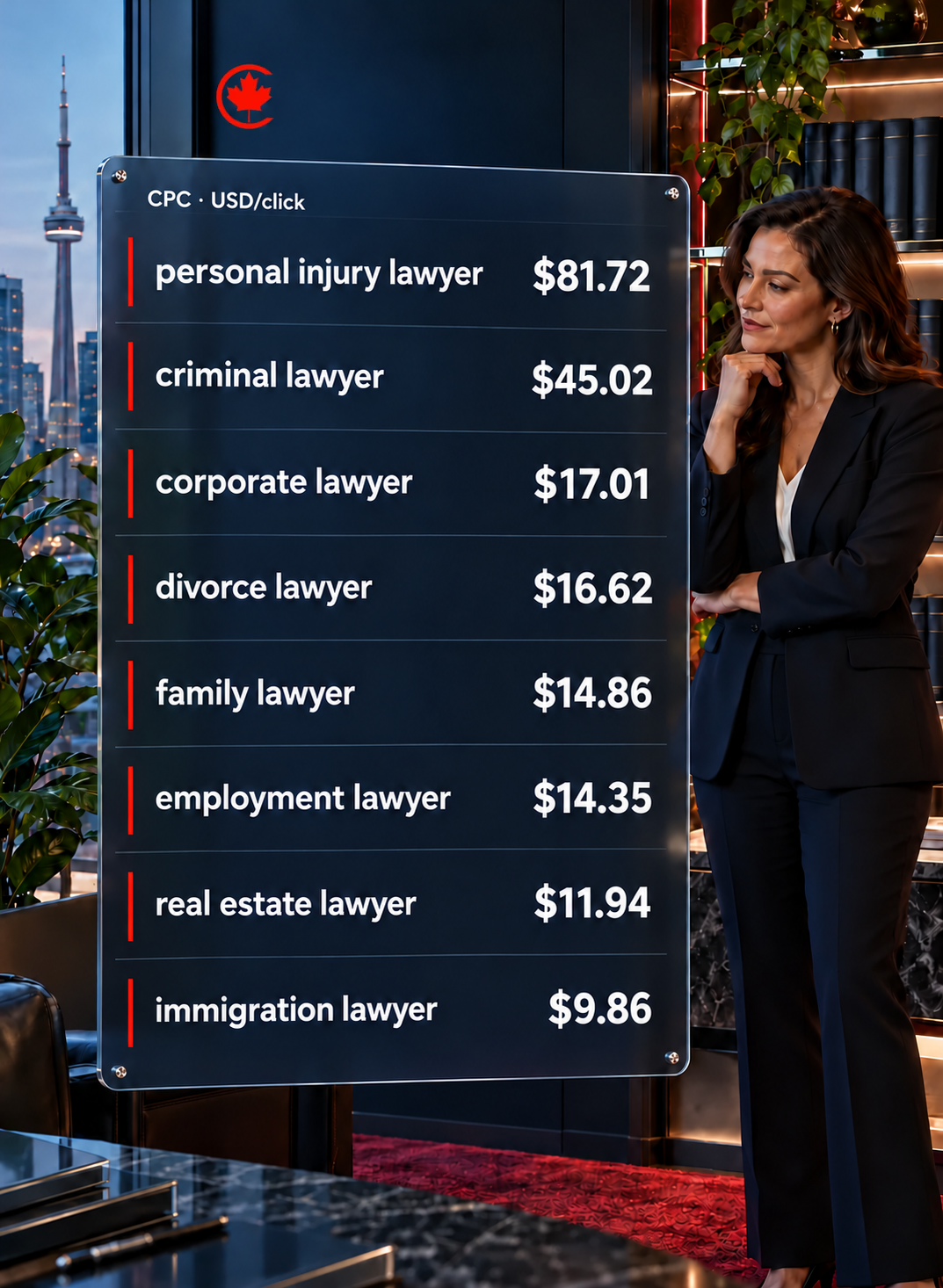
An average cost per click above the relevant benchmark does not, by itself, prove mismanagement. Equally, a lower average cost per click does not prove that the firm is attracting better clients. A campaign reaching broad information seekers can buy inexpensive attention without producing suitable consultations. A narrowly defined service with fewer potential enquiries may cost more per click yet fit the practice better. The provider should connect price to the intended work and resulting enquiries, rather than ask you to celebrate a cheap click in isolation.
Google’s auction considers factors including competition, relevance and the circumstances of a search. This provides a reasonable general explanation for why actual prices vary. It does not establish why a particular row in this table is expensive. The table cannot reveal another firm’s profit per file, bids, retained files or willingness to pay. Claims that a specific practice area costs more because every file is valuable, or that the first firm answering always wins, go beyond what these data demonstrate.
Currency is another source of misleading comparisons. A firm’s account, management agreement and collected fees may not all be quoted in the same currency. Keep a single currency throughout a worked budget. If a proposal converts a figure from another currency, ask for the exchange rate used, not a silently rounded conversion presented as current fact. The examples below use Canadian dollars from the start.
Start with the work your firm actually wants
Before choosing a spending amount, describe the work the investment is meant to support. A general wish for more clients is not enough to evaluate a campaign serving several practice groups. Identify the relevant service, permitted jurisdiction, language or accessibility requirements, existing capacity and the person responsible for accepting an enquiry. These are business and professional boundaries. They are not instructions about how to structure an advertising account.
For a family-law practice, a suitable enquiry might mean a person seeking a service the firm offers in its jurisdiction, with an available consultation slot and no disqualifying conflict identified through the firm’s process. It does not mean everyone who asks about divorce will become a retained client. Fee expectations, the urgency of the matter and the firm’s ability to act all affect the eventual decision. A proposal should make room for those normal exclusions instead of treating them as staff failure.
For a business-law practice, a promising conversation may concern an ongoing advisory relationship rather than a single immediate transaction. An owner researching incorporation today could be comparing options, already have counsel or require a service outside the proposed scope. Counting an email address as the same outcome as an accepted corporate mandate would obscure that difference. Agree what progress looks like without assuming the future value of every contact.
For criminal-defence or urgent civil matters, response coverage can be commercially important, but availability claims must match reality. If your firm does not provide after-hours intake, the advertised expectation should not imply otherwise. For a small practice, accepting more enquiries than it can assess promptly may create cost and frustration without adding useful work. The sensible initial constraint is the number and kind of matters the firm can responsibly consider, not the maximum number of clicks it can purchase.
Compare practice areas without inventing a universal legal average
A single average for all lawyers would hide the differences that make the benchmark useful. Routine transactional work, contested family matters, commercial advice and contingent-fee litigation can have very different collection patterns, delivery costs and capacity demands. Even within one category, a firm’s preferred matters may differ substantially from those described by a broad query. Your own accepted-file records are therefore more relevant to affordability than another practice’s headline CPC.
Consider a firm that provides a narrowly scoped real-estate service. Its owner may reasonably focus on the work required per completed transaction, the timing of collection and the team’s ability to absorb seasonal volume. An expensive enquiry that routinely falls outside the offered service is not attractive just because the overall property market is busy. A lower-priced click is also unhelpful if the person expects services excluded from the firm’s quoted scope.
A litigation practice faces a different question. The potential fee shown in a hypothetical successful outcome is not cash available to fund acquisition today. Outcomes, collection timing and delivery effort are uncertain. When a provider uses a large possible recovery to justify aggressive spending, ask how unsuccessful or unsuitable matters, time to collection and financing needs were considered. Marketing should not require the owner to pretend that uncertain future fees are already earned.
Use the table to prepare a conversation, not to assign every practice group the same return target. The right comparison is between plausible acquisition cost and a defensible allowance for the specific work. If your records cannot yet support that allowance, an initial bounded investigation may be more appropriate than a large commitment. There is no evidence-based reason to borrow another firm’s conversion rate merely to make a spreadsheet produce an attractive answer.
Work backwards from an affordable cost per retained file
A retained-file budget should begin with collected fees, not the total value of a claim, a signed retainer deposit or an optimistic pipeline estimate. Fees collected over a relevant period need to be considered alongside the work required to deliver the service. Taxes, disbursements and other amounts that do not belong to the firm as service revenue should not inflate the apparent acquisition allowance. Have the firm’s accountant confirm the accounting treatment for its own circumstances.
Next, decide what must remain after acquisition. The owner may need to cover delivery costs, fixed overhead, a reserve for uncertainty and a target return. There are also acquisition costs outside the advertising invoice, such as management, dedicated website work, approved measurement support and staff time handling enquiries. A media allowance is what remains for paid clicks after these other commitments have been considered. It is not automatically a fixed percentage that applies to every law firm.
Here is a deliberately simplified example. Suppose a group of similar retained files, followed long enough to assess their collections and delivery costs, averages CAD$2,000 in collected fees per file. Include files with no collection when calculating that average. Every per-file cost in this example refers to that same group. The firm estimates CAD$1,100 in delivery costs, sets aside CAD$400 for its remaining overhead and return requirement, and allows CAD$200 for non-media acquisition costs. That leaves CAD$300 per retained file for advertising media. These invented values are only an illustration of the decision, not an estimate of Canadian legal fees or a promise of profit.
The calculation exposes a useful question before advertising begins: is the remaining media allowance plausible for the firm’s enquiry and retention experience? If the answer requires ignoring staff time or assuming every consultation retains, the budget is not ready. If the calculation produces no remaining allowance, more advertising is not the first financial remedy. A different service scope, cost structure or acquisition approach may need consideration with the firm’s advisers.
Turn that allowance into an illustrative click ceiling
The connection between media allowance and CPC is a probability chain. Use a booked-consultation rate measured from clicks and a retained-file rate measured from those booked consultations, with compatible definitions and time periods. Include cancellations and no-shows consistently. If one report uses attended consultations while another uses all bookings, multiplying the two figures can produce a misleading result. A provider should be able to explain the denominators without exposing confidential matter details.
The useful formula is: target media CPC equals media allowance per retained file, multiplied by the share of clicks becoming booked consultations, multiplied by the share of booked consultations becoming retained files. Express the rates as decimals. An equivalent version uses average collected fees per retained file, multiplied by the share of those fees left for advertising media after the other costs and financial requirements above, then multiplied by those same two compatible rates. Neither formula establishes profitability unless the underlying allowance has already accounted for the other costs and financial requirements.
Using the hypothetical CAD$300 media allowance above, an 8% booked-consultation rate and a 25% retention rate from bookings produce an illustrative ceiling of CAD$6 per click: CAD$300 multiplied by 0.08 multiplied by 0.25. Across 1,000 clicks, those assumptions imply 80 bookings and 20 retained files. At CAD$6 per click, media spend would be CAD$6,000, or CAD$300 per retained file. These are modelled expectations, not a promise that a real campaign will deliver 20 clients.
Now change only the booking rate to 4%. The same 1,000 clicks imply 40 bookings and 10 retained files, and the affordable CPC falls to CAD$3. Keeping the original CAD$6 click cost would produce CAD$600 media cost per retained file under those assumptions. This is why an owner’s budget decision cannot rest on an external CPC benchmark alone. The relationship between purchased attention, suitable consultations and actual retained work matters just as much.
When the more expensive click is the better purchase
Imagine two different, purely hypothetical periods. In the first, the firm buys 200 clicks at CAD$15 each, spending CAD$3,000. Ten booked consultations eventually produce three retained files. Media cost is CAD$1,000 per retained file. In the second, it buys 100 clicks at CAD$40 each, spending CAD$4,000. Twenty booked consultations produce eight retained files. Media cost is CAD$500 per retained file, despite the much higher CPC.
This illustration does not mean the second approach is automatically preferable. The accepted work must be comparable, collection and delivery costs still matter, and the samples may be too small to support a confident forecast. A business could also improve its apparent retention rate by accepting work it should decline. The point is narrower: price per click cannot identify the better purchase without the subsequent outcomes and professional screening context.
An owner reviewing these two reports should ask whether the periods use the same definition of a booking and retained file, whether existing clients are separated from new enquiries, and whether any duplicates were removed. Ask whether the difference concerns practice areas, geographic fit, enquiry quality or simply the maturity of the data. A recent period with files still being assessed should not be compared with an older period whose outcomes have already settled.
The provider’s explanation should remain understandable at a management level. You do not need a lesson in account controls to ask which work the spending supported and what uncertainty remains. A credible report can acknowledge that CPC rose while useful economics improved, or that cheap traffic failed to produce suitable matters. It should not select whichever single metric makes the month look most successful.
Check the denominator before accepting a forecast
A proposal can use individually correct percentages and still produce the wrong forecast if the percentages describe different groups. Consider a hypothetical cohort of 400 clicks producing 24 booked consultations. Six bookings are cancelled and four people do not attend, leaving 14 attended consultations. Seven people eventually retain the firm. The retention rate is 50% of attended consultations but only about 29.2% of booked consultations. Both statements are mathematically valid; they answer different questions.
The click-to-booking rate in that example is 6%. Multiplying it by the 50% attended-consultation retention rate would incorrectly predict 12 retained files from 400 clicks. The actual chain is 400 clicks,24 bookings,14 attendances and seven retained files. Either include the attendance step explicitly or use seven divided by 24 as the retention rate from bookings. A buyer should ask for compatible definitions, not accept a larger forecast created by silently skipping cancellations and no-shows.
Suppose the media allowance is CAD$600 per retained file. The compatible booked-consultation calculation is CAD$600 multiplied by 0.06 multiplied by seven divided by 24, producing CAD$10.50 as the illustrative click ceiling. If media actually costs CAD$10 per click, spending is CAD$4,000 and media cost per retained file is about CAD$571.43. The CAD$571.43 figure covers media only. Add non-media acquisition costs separately when calculating total acquisition cost per retained file, even if those costs were considered when setting the media allowance. The arithmetic demonstrates a consistency check, not an expected performance level for a law firm.
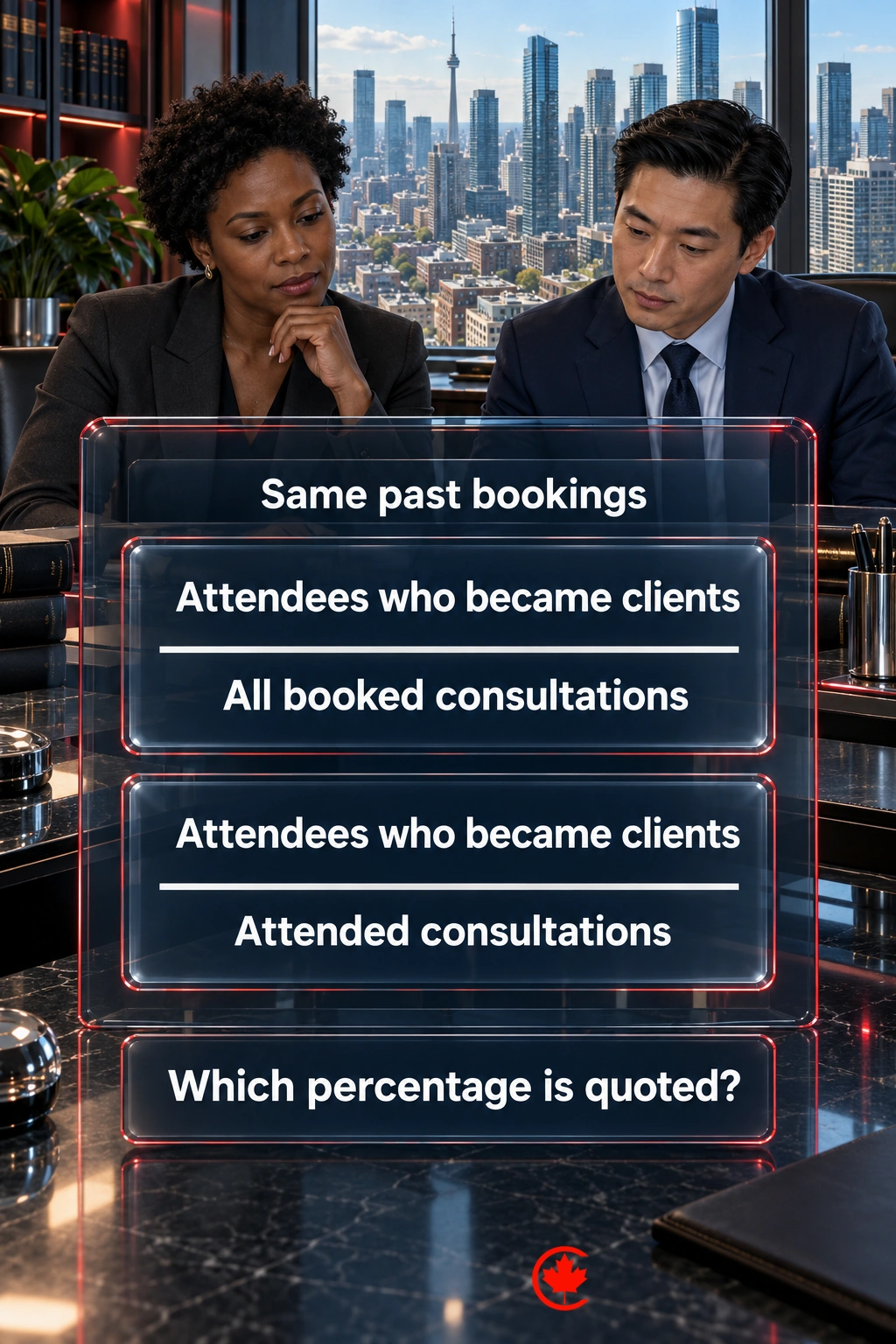
For the same set of past consultation bookings, percentages using all bookings and only attended consultations answer different questions. Keep cancellations and no-shows in the booking total, or include attendance as a separate step. Use compatible groups and reporting periods before combining rates in a forecast.
Small numbers also deserve restraint. One additional retained file can change a short-period average substantially, and a still-pending consultation may change it again. There is no universal number of clicks in this guide that makes an investment statistically proven. The firm should consider how much uncertainty the decision can tolerate, whether the work and circumstances are comparable, and whether the likely downside remains affordable. A request for more evidence is meaningful only when it identifies what is missing and how long the firm can reasonably wait.
The same discipline applies when the practice changes. A new lawyer, different service scope, altered consultation fee or reduced availability can make earlier rates less transferable. A provider should explain which assumptions still fit rather than recycle the strongest historic month as the default forecast. Your decision is about the business you can deliver now. Historic results are useful evidence, but they are not an entitlement to future files or a substitute for an explicit cash boundary.
Put a cash limit around the experiment
An affordable expected cost is not permission to spend without a limit. Agree an amount the firm can lose without impairing payroll, client service or other obligations if the initial assumptions prove wrong. Separate one-time work from recurring management and advertising media. State who can authorize a change and when spending will be reviewed. The firm’s consent should cover an actual commitment, not a vague promise to increase investment whenever the platform sees an opportunity.

For example, an illustrative proposal could contain CAD$3,000 in media, CAD$900 in management and CAD$600 in one-time landing-page work for a defined initial period. The cash commitment is CAD$4,500 before any applicable tax or additional agreed costs, not merely the CAD$3,000 media line. If it produces six retained files, those listed acquisition costs average CAD$750 per file. That figure still excludes any internal intake cost not included in the proposal and says nothing by itself about collected profit.
If only three files are retained, the same listed commitment becomes CAD$1,500 per file. This simple downside comparison is more useful than pretending a quoted lead forecast is certain. Ask what evidence would justify continuation, what would trigger a scope change and what would cause a hold. Those criteria can include insufficient suitable enquiries, capacity constraints, unresolved reporting definitions or a material professional-compliance concern, not just a numerical threshold.
Google’s average daily budget is not a promise of identical spending each day. Its documented spending limits can allow daily variation; for most campaigns, Google describes a daily limit of twice the average daily budget and a monthly limit based on 30.4 times that budget. Review the applicable campaign’s terms with the provider rather than treating a simple daily multiplication as a hard cash commitment. Google’s spending-limit explanation is the primary reference.
A very small daily amount is not automatically a useful or useless budget. First identify its currency, total permitted media spend and the other fees. For illustration, a total CAD$300 media allowance at an assumed CAD$20 per click buys an arithmetic expectation of 15 clicks, not 15 enquiries or clients. It may answer a narrow preliminary question but cannot support a confident retained-file forecast by itself. Ask what decision the proposed allowance can realistically inform, and what happens if it produces too little suitable evidence.
Do not confuse a payment threshold with a spending limit. Under Google’s automatic-payment arrangements, a charge can occur when accrued costs reach the account’s threshold or at the scheduled monthly billing point. A CAD$500 charge is therefore not enough information to identify an error or a campaign’s budget. The provider should reconcile the actual statement and account terms. Google’s payment-settings explanation describes the distinction.
Check dated surcharges as well as management fees. Google’s current guidance says ads served in Canada are no longer subject to the 2.5% Canada DST fee from July 1, 2025. An old article announcing that fee should not be copied into a new Canadian estimate. Other taxes or jurisdiction-specific charges may still matter to the actual account. Use Google’s current surcharge guidance and the relevant invoice rather than a historic headline.
Respect the delay between enquiry, retention and collection
Legal matters do not all move through the business at the same pace. An initial consultation can occur in one reporting period, a retainer in another and the collection of fees later still. A report that treats all three as the same event will misrepresent both commercial progress and cash availability. Agree which date attaches to each measure and keep a separate view of matters whose outcome is not yet known.
This is especially important where fees depend on later events. An expected fee can support a cautious planning scenario, but it should not be presented as collected revenue. A firm with a long collection cycle may face an unacceptable cash requirement even when a mature cohort eventually produces acceptable economics. The budget decision must consider the period during which advertising and delivery costs are funded, not only a possible eventual return.
Suppose a hypothetical firm spends CAD$6,000 in advertising media on a cohort that ultimately produces four suitable retained matters. Its media cost per retained matter is CAD$1,500. If the outcomes are not yet collected, the firm cannot truthfully report the hoped-for fees as cash generated by that spending. It can report the retained matters, the money spent and the uncertainty separately. This avoids both premature celebration and unfairly rejecting a channel solely because a recent cohort has not matured.

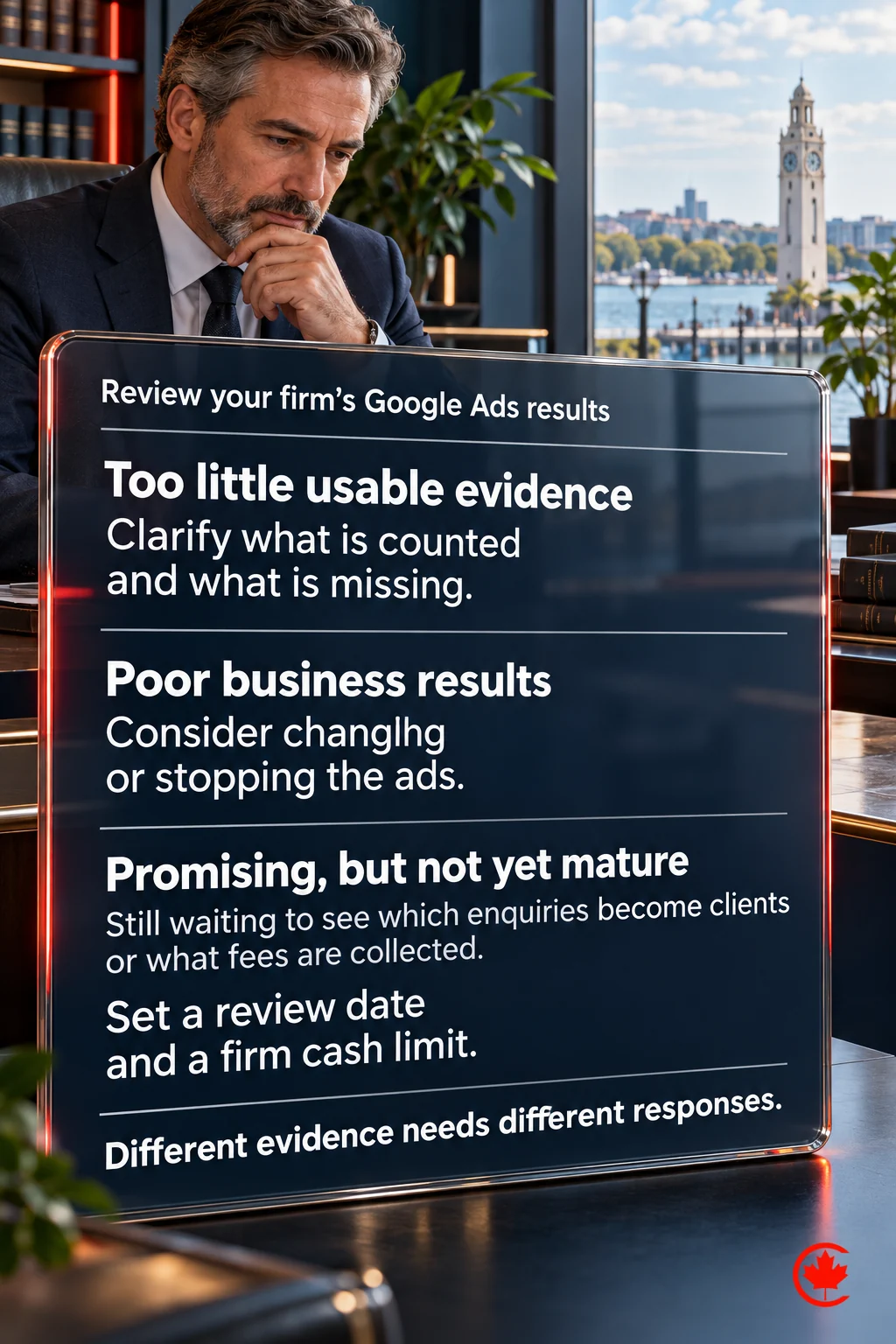
A useful owner review distinguishes three conditions: inadequate evidence, commercially poor results and results that are promising but not yet mature. They require different responses. Inadequate evidence may call for clearer definitions; poor results may require a change or a stop; immature results require a realistic review date and a firm cash limit. None of those decisions needs confidential descriptions of individual allegations or personal circumstances in a marketing dashboard.
What to ask when comparing Google Ads proposals
Ask each provider to describe the business problem it is being hired to address. Is the proposed work intended to increase suitable enquiries for one practice area, support an underused location or improve the accountability of an existing spend? A proposal that promises more traffic without connecting it to the firm’s accepted work is difficult to evaluate. The owner should be able to identify the intended audience and exclusions in ordinary business language.
Compare like-for-like scope. One proposal might charge CAD$800 per month for account management with reporting limited to advertising enquiries. Another might charge CAD$1,300 per month and include agreed website revisions, matching the firm’s enquiry records to the agreed outcome categories, and a monthly management review. These are hypothetical fees, not Canada Create prices or market averages. The second is not automatically better, and the first is not automatically cheaper in total. Compare the work you actually need, exclusions, ownership, separate charges and acceptance criteria.
Require a practical definition of each deliverable. A website revision should specify which information or decision it is intended to improve, not merely promise optimization. A report should identify its outcome definitions and explain limitations. An intake review should clarify who provides the relevant aggregated information and who retains control of confidential records. A meeting is not a substitute for an understandable recommendation about whether to continue, change or limit the investment.
Account access and exit arrangements deserve attention before a contract is signed. Clarify who owns the advertising account, website material and approved reporting records; what access the firm retains; what notice applies; and what happens when the engagement ends. This is buyer due diligence, not a reason to request shared passwords or unrestricted access to client files. The firm should obtain advice on contractual terms that affect its interests rather than rely on a general marketing article.
Choose paid search for the right problem, not every problem
Google Ads can make a firm’s approved message eligible to appear in relevant paid searches, but buying clicks does not create a professional fit or ensure a new matter. It is most sensible to assess paid search when there is a defined service, realistic capacity to respond and a budget that can tolerate uncertainty. If the firm cannot say what work it wants or who will handle enquiries, buying more attention may magnify an existing problem.
Organic search and local visibility are different investments. They can help potential clients find and assess a practice without purchasing every visit as a search-ad click, but they involve their own work, costs and uncertain outcomes. A firm should not buy them on a promise of a particular ranking or assume that a website change will immediately replace a paid channel. Compare the purpose, expected time horizon and evidence required for the decision rather than treating SEO as free advertising.
Referral relationships and established professional networks may also be appropriate sources of enquiries. Their suitability depends on the firm’s work and applicable professional obligations, and they should not be compared with paid clicks as though every contact were equivalent. A firm seeking a few highly specialized mandates may value carefully qualified introductions differently from a practice seeking more routine enquiries. The overall acquisition mix should reflect that distinction rather than an agency’s preferred product.
Do not assume that every Google advertising product is available to Canadian law firms. Google’s Canadian Local Services Ads eligibility list does not include legal services. An example from a law firm in another country therefore cannot establish Canadian eligibility or lead pricing. Confirm the actual country and category before approving such a proposal. Our Local Services Ads guide explains the separate product; Google’s Canada eligibility page is the authoritative starting point.
Agree what a useful enquiry and retained file mean
A report may call a telephone interaction, form submission or another defined action a conversion. That is not automatically a new client. Agree how the business report distinguishes an enquiry, a booked consultation, an attended consultation and a retained file. Keep existing-client contacts and duplicates identifiable at an appropriate aggregated level. Otherwise a higher conversion count can disguise a flat number of useful new opportunities.
The definition of suitability should respect professional judgment. Marketing staff should not decide the legal merits of a matter or promise representation. The firm determines conflicts, jurisdiction, competence, capacity and the appropriate next step. A provider can help make a report understandable without receiving the substance of a person’s legal problem. The owner needs enough information to evaluate the acquisition process, not a public-facing or broadly shared copy of the firm’s intake files.
A hypothetical example shows why definitions matter. A month produces 30 reported enquiries, classified once into mutually exclusive categories: six are repeat contacts, four concern existing files and five seek work the firm does not offer. That leaves 15 potentially relevant new enquiries before professional screening, not 30 new-client opportunities. If five of those eventually retain, saying the campaign acquired 30 clients would be false. The appropriate conclusion depends on the cost, capacity and suitability of the five, not merely the initial count.
Do not use those example exclusions as a universal rejection rule. A repeat contact can be part of a legitimate client journey, and an existing client’s additional matter may have business value. The purpose of separating categories is to avoid double-counting and make attribution honest. The firm can decide which outcomes it wants to evaluate, provided the definitions remain stable and the report does not quietly change them to improve an apparent result.
Protect confidentiality when measuring commercial outcomes
Measuring retained files does not require sending a person’s allegation, medical history or detailed legal circumstances to an advertising service. Start with the firm’s professional duties and the specific data use being proposed. Ask what information leaves approved systems, which recipient receives it, why it is necessary and who reviews the arrangement. A general statement that information is encrypted or hashed does not answer whether a particular disclosure is permitted.
Google’s customer-data policy places restrictions on sensitive-category conversions used in enhanced conversions and store-sales uploads, including health information and the commission or alleged commission of crimes. This is a feature-specific policy boundary, not a blanket statement that all legal advertising or all measurement is prohibited. The firm’s responsible advisers and provider must assess the actual feature, data and applicable duties before adopting a proposal. Refer to the current customer-data policy, not a generic assurance that every conversion upload is acceptable.
Keep the management question proportional: can the firm understand what it spent, what suitable work resulted and what uncertainty remains without unnecessary disclosure? Aggregated financial and operational reporting may answer much of that question. If a provider insists on unrestricted matter access as the only way to demonstrate value, ask for the purpose and alternatives before agreeing. Convenience for a marketing workflow is not, by itself, a justification for broader access.
Reporting limitations should be visible rather than concealed. Privacy boundaries, a long consideration period and incomplete records can make exact attribution difficult. A responsible report can separate directly observed events from inferred influence and unassigned outcomes. An owner should prefer an honest, bounded estimate to false precision created by treating every new file as advertising-generated or transferring information without a properly reviewed basis.
Keep claims, fees and competitive comparisons defensible
Advertising rules are jurisdiction-specific. A Canada-wide marketing guide cannot replace the rules of the law society that governs the firm. In Ontario, the Law Society’s marketing provisions require truthful, accurate and verifiable claims that are not misleading, confusing or deceptive. Fee advertising also has conditions concerning the service offered and additional charges. These are reasons for a firm’s designated professional to approve claims before publication, not for an agency to make legal-compliance decisions independently. Review LSO Chapter 4 and the applicable regulator elsewhere.
An owner reviewing an advertisement should be able to substantiate the stated service, location, availability and credentials. A promise of an outcome or an unsupported superiority claim creates a different risk from a clear description of work the firm actually undertakes. The same scrutiny applies to a landing page or a comparison presented as helpful information. For broader context, see our lawyer advertising rules in Canada, then obtain guidance on any specific proposed claim.
Google’s trademark policy is not a general legal clearance to use another firm’s identity. It distinguishes use as a keyword from uses in advertisements and describes restrictions concerning direct competitors and misleading use. Whether a particular proposal is suitable for your firm requires more than the observation that a platform might accept it. The buyer-level question is whether the proposal creates an unnecessary confusion, professional or legal risk, and who has reviewed it. See Google’s trademark policy.
Similarly, a comparison of CPCs should not become a claim about another firm’s competence, profitability or client outcomes. We do not know those things from the benchmark. Keep commercial decisions anchored in the firm’s own accepted work, financial limits and professional obligations. This allows a useful conversation about value without turning an external keyword estimate into a claim that a particular competitor, practice area or advertising approach must perform better.
Make the next decision from evidence, not a single attractive number
Before approving a proposal, the owner should be able to explain the intended work, the full initial cash commitment, the meaning of a useful outcome and the circumstances that would trigger a change. If those four points are unclear, additional charts will not solve the problem. Ask for the missing definitions and a bounded scope. A capable provider should make the decision easier to understand, not make the firm dependent on technical language.
At a review, separate what was purchased from what happened afterwards. Check media and other costs, the maturity of the enquiry cohort, suitable consultations, retained matters and collection status. Consider capacity and professional screening alongside the numbers. An improvement in one measure is relevant, but it should not erase a deterioration elsewhere. In particular, a lower CPC should never excuse misleading claims, unsuitable enquiries or an unaffordable total commitment.
There are reasonable circumstances in which the next decision is to hold rather than scale: the firm is at capacity, the outcome records are unreliable, collection remains too uncertain, or a material compliance question is unresolved. There are also circumstances where a limited continuation is defensible even without a dramatic headline result. State the question the next period is meant to answer and the financial boundary around it, instead of extending the engagement by habit.
The benchmark is most useful when it helps a firm ask better questions. It shows that different searches can carry very different estimated click prices, but it does not decide what your firm can afford. That decision belongs to a clear view of retained-file contribution, realistic enquiry outcomes, a controlled cash commitment and accountable professional judgment. Buy an understandable business case, not the promise of the cheapest legal click.
For broader budgeting context, read how much Google Ads costs and Google Ads cost per click by industry in Canada. To discuss a defined scope for your practice, see Google Ads for lawyers.
Frequently asked questions
How much does Google Ads cost for lawyers in Canada?
There is no single price for a law firm. Across 32 Canadian legal and related professional-service searches, estimated costs per click run from the least expensive notary searches to the most expensive motor vehicle accident and personal injury searches. It is not a lawyer-only price range. These are estimates for each search, not actual account prices or client-acquisition costs. Compare the relevant practice area with your own collected-fee economics and full acquisition costs.
Is $10 a day good for Google Ads?
Not automatically. Identify the currency, total media allowance and separate management or project fees. A small allowance may answer a narrow preliminary question, but it may produce too few suitable enquiries to support a retained-file forecast. Judge the proposed investment against your practice, capacity, affordable downside and the evidence it is meant to produce, rather than a universal daily minimum.
Why did Google Ads charge me $500?
The amount alone does not identify the reason. Under automatic payments, a charge can occur when accrued costs reach the account's payment threshold or at the scheduled monthly billing point. A payment threshold is not a campaign spending limit. Ask for a reconciliation of the actual statement, accrued costs and account terms; this guide cannot diagnose an individual charge.
How should a law firm decide what CPC it can afford?
Establish a media allowance per retained file after delivery costs, other acquisition costs and the firm's financial requirements. Multiply that allowance by compatible click-to-booked-consultation and booked-consultation-to-retained-file rates. Use consistently defined groups of clicks and resulting consultations and files, followed long enough to assess their outcomes. Include no-shows and consultations that did not go ahead in the appropriate booking totals, and retained files with no collection in the collected-fee average. This produces a planning threshold, not a promised result or proof of profit.
Does a lower CPC mean a lower cost per retained client?
No. A cheaper click can still produce unsuitable enquiries or few retained files. Compare full acquisition costs, the work accepted, mature outcomes and collected fees using consistent definitions. Do not treat every reported conversion as a new client or ignore professional screening to improve a headline rate.
What should a law firm's Google Ads proposal include?
Look for the intended service and audience, media and other fees, specific deliverables, outcome definitions, professional approval responsibilities, appropriate data boundaries, account ownership and review criteria.