
How disability, malpractice and insurance claim lawyers get clients

A disability, medical malpractice or insurance-dispute practice needs marketing that helps the right people understand whether to contact the firm, without turning distress into a sales opportunity. The commercial goal is suitable enquiries that the practice can assess and serve. A larger contact list is not useful if it overwhelms the lawyers, attracts matters outside their work or promises help the firm cannot provide.
These practice areas belong in the same conversation because prospective clients may face uncertainty about money, health and legal costs. They should not share an undifferentiated acquisition plan. A disability-benefits enquiry, a possible medical-negligence matter and a business insurance dispute can require different people, documents, funding and review time. The website, enquiry experience and marketing budget should reflect those differences before a supplier is asked to generate more demand.
This guide is for Canadian practice owners choosing marketing support. It explains the decisions that belong in a useful brief: which work to promote, what capacity to protect, how to compare channels, what an enquiry should accomplish and how to judge spending against collected legal fees. Examples are planning illustrations, not forecasts, legal advice or assessments of anyone’s entitlement to compensation.
Define the work and capacity you want to grow
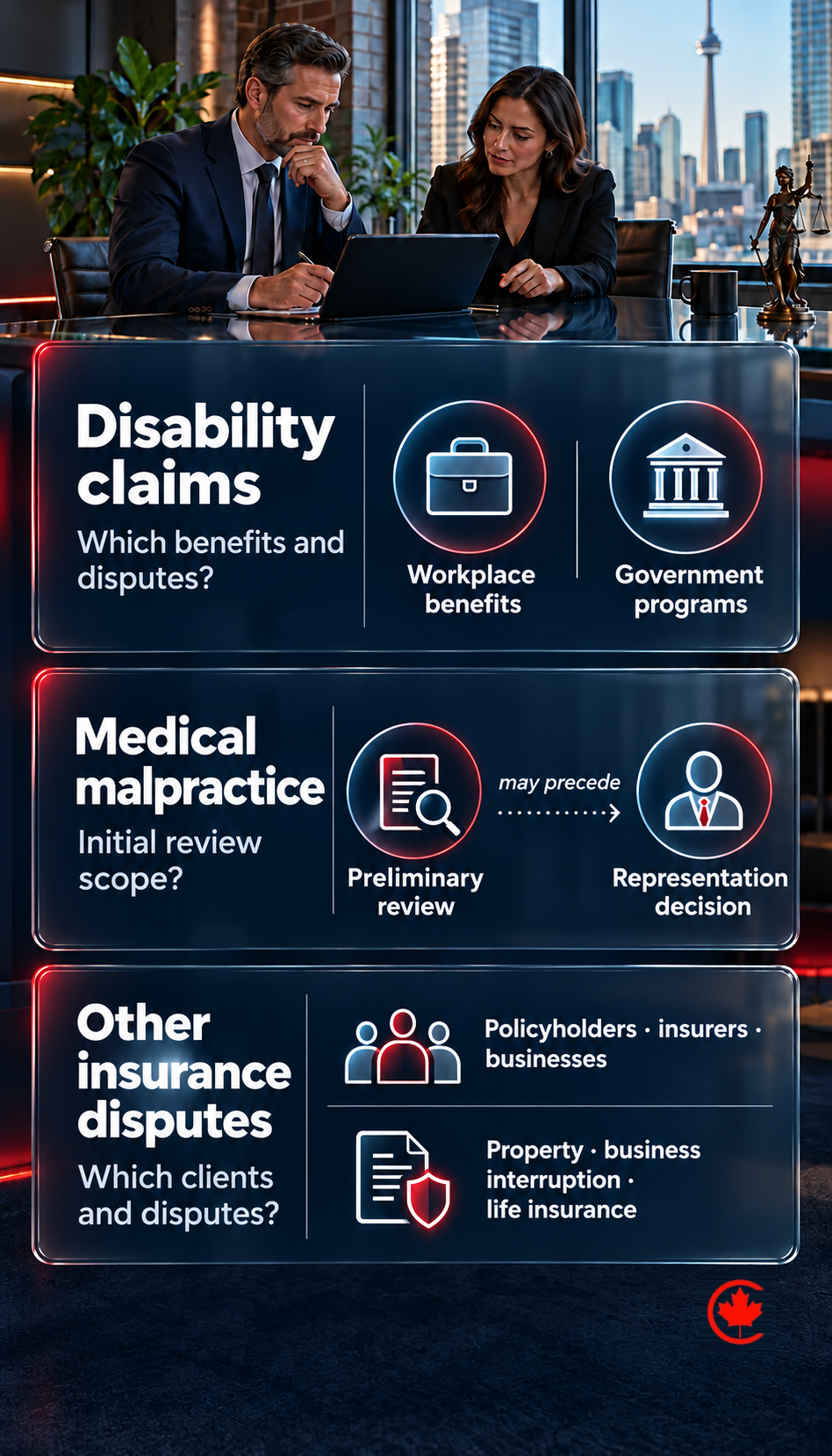
Start with the firm’s actual services rather than the broadest label a prospective client might search. For disability work, distinguish the types of benefits and disputes the firm accepts, the provinces it serves and the stage at which it is prepared to consider an enquiry. Someone seeking help with a workplace benefits denial may mean something different from someone asking about a government program. The marketing supplier needs that boundary in ordinary language, approved by the responsible lawyer.
Medical malpractice deserves its own service explanation and commercial assumptions. A practice may need substantial preliminary review before deciding whether it can offer representation. Marketing should explain what the first discussion covers and what remains unknown afterwards. A visitor should not be led to believe that describing a disappointing treatment outcome online establishes negligence or guarantees that a lawyer will take the matter. The firm, rather than an advertising form or marketing contractor, makes professional assessments.
Insurance-dispute work also needs a clear client-side distinction. A firm acting for policyholders should say so where relevant; a firm serving insurers or commercial organizations should not use consumer-denial messaging merely because it attracts more enquiries. Household property claims, business interruption disputes, life-insurance issues and disability claims are not interchangeable services. The owner’s question is which of these the practice genuinely wants and can serve, not how many topics can fit beneath an insurance heading.
Capacity has several dimensions. Available consultation appointments do not establish available litigation capacity. A partner may have time for initial calls while the team handling records, experts and continuing communication is already stretched. Conversely, a firm may have file capacity but insufficient administrative coverage to return enquiries reliably. Include both constraints in the marketing brief. Otherwise a supplier can meet a lead target while worsening the practice’s actual workload.

Consider a hypothetical practice with room for four additional disability files but only one additional malpractice review during the next planning period. A single target of twenty consultations hides the difference. The owner should ask for separate reporting on each service, a realistic allowance for screening and a way to stop promoting an area when its receiving team is full. The resulting plan may deliberately produce fewer total enquiries while giving the firm a better mix of work.
Also agree who can change the brief when circumstances change. An extended absence, a trial commitment or a new referral arrangement can alter capacity before a monthly marketing meeting. A named practice contact should be able to tell the supplier that a service is temporarily unavailable. Public availability should follow that decision promptly within the agreed scope, without suggesting that staff must accept a matter because the advertising generated it.

Read search demand and click costs in context
The figures below describe searches by prospective legal clients, not law firms looking for an agency. Monthly searches are estimated averages across Canada, and click costs are estimates too. They are not quotations for a future campaign, local market sizes, expected traffic or amounts paid by every advertiser.
| Client search | Average monthly searches, Canada | Estimated click cost |
|---|---|---|
| insurance claim lawyer | 480 | Moderate for legal searches, similar to the row below |
| medical malpractice lawyer | 2,400 | Moderate for legal searches |
We help personal injury firms rank for the accident and injury searches that lead to signed files.
These two examples demonstrate that there is measurable search activity around distinct services. They do not establish the full size of either market. People use many descriptions, repeat searches, look for specific firms and search from outside the area a practice serves. Neither row tells you how many individuals will be appropriate prospective clients, how many consultations the firm can handle or how much revenue an engagement will eventually produce.
A high click price alone cannot tell an owner that cases are valuable, that competitors are scarce or that content should replace advertising. It describes one part of an advertising market. The comparison that matters to your practice includes the service mix, the cost of screening, the probability of an engagement within your actual experience and the time until fees are collected. Those inputs come from the firm’s own records and an agreed measurement plan.
Missing figures deserve restraint. This table does not give a current verified estimate for every disability-related phrase. An unavailable estimate is not evidence of no demand, and a reported zero would not mean no one ever uses a term. Ask a supplier to distinguish an unknown figure from zero and to identify the period and geography behind any numbers used in a proposal. A Toronto phrase measured across Canada remains a national measurement.
Use demand information to frame a conversation, not to award a budget automatically. If the practice serves one province and has capacity for only a small number of matters, national volume can substantially overstate the opportunity it can responsibly pursue. A sensible proposal will explain what the available evidence supports, what remains uncertain and how the firm will decide whether the resulting enquiries are commercially and professionally suitable.
Choose content, paid search and referrals for different jobs
A useful website can explain service fit, introduce the lawyers and make first contact less confusing. Paid search can provide an additional route for people actively looking for help. Professional relationships can introduce people who already understand something about the firm. None of these channels should be declared universally superior from a CPC table. They solve different problems and carry different costs, dependencies and uncertainties.
Content work is a reasonable priority when the current website leaves basic hiring questions unanswered. A visitor may be unable to tell whether the firm handles their type of insurance issue, whether a consultation carries a fee or what happens after an enquiry. Buying additional traffic before addressing that uncertainty can increase the administrative burden without improving the experience. The value of the content project is clearer decision support, not an automatic promise of rankings or signed files.
Paid search deserves consideration when the practice has a defined service, an approved budget and the capacity to respond. It also requires enough financial room to learn from actual enquiries rather than treating the first few calls as a verdict. The owner should understand which costs continue regardless of whether a particular enquiry becomes a client. Media, management and intake labour belong in that discussion, alongside any separately agreed website or measurement work.
Referrals can be important where the prospective client benefits from a trusted introduction, but the business should not assume they arrive on demand. A relationship channel may take staff attention, and a single source can change its availability or priorities. Keep the value of those relationships visible without forecasting a fixed number of future files. The practice should remain able to explain its services clearly when a referred person visits the website independently.
Compare channel proposals against the current bottleneck. If enquiries are already plentiful but few fit the practice, an acquisition expansion is unlikely to be the first useful purchase. If suitable enquiries arrive but are not answered, coverage and process deserve attention. If the practice is largely unknown and the website explains its services well, a measured visibility investment may be appropriate. This diagnosis prevents the same package being recommended to every firm.
There is also a difference between reaching a prospective client and helping that person choose responsibly. A long article about an insurance issue may attract readers who want general information rather than representation. A short service page may help someone already referred to the firm. Ask the supplier to explain the intended role of each proposed deliverable and how its performance will be interpreted, rather than assigning every page a signed-client target.
Give each service a useful content brief
For disability work, a useful brief identifies the situations the practice wants a visitor to recognize without asking the visitor to diagnose their own legal position. The firm might want to distinguish an initial benefit denial from an interruption of benefits or a question about a different program it does not handle. The commercial benefit is a more appropriate conversation at intake. The supplier’s deliverable is the approved explanation, not a legal decision tree that tells a stranger whether to sue.
For malpractice work, focus the brief on the uncertainty before engagement. Prospective clients may want to know whether the firm considers the kind of concern they have, what the initial review involves and whether further assessment could carry costs. The owner should specify which answers can be published generally and which require a private discussion. The result should help people understand the firm’s process without suggesting that a lengthy narrative, a particular diagnosis or a serious outcome automatically makes a matter suitable.
For property-insurance disputes, the relevant service questions may have little to do with disability. A household and a commercial property owner may have different practical concerns, and a business enquiry may involve several decision-makers. Explain whom the practice acts for and whether its work includes the category being promoted. A page focused only on injured individuals can confuse a property owner, even if the firm is capable of handling the dispute. Clear scope is more valuable than a generic promise to fight insurers.
Funding information should also follow the service rather than the website template. An initial discussion offered without charge in one practice area does not establish the same offer elsewhere. A staged commercial engagement should not inherit a contingency-fee slogan from a disability page. Ask the supplier to identify these differences for approval, and ask the practice to confirm them against the actual offer. This is especially important when several lawyers or offices contribute material to the same website.

Decide how much content the practice can maintain responsibly. A smaller set of accurate service explanations may be a better purchase than a large collection of condition-specific articles that no one can keep current. Each proposed article should answer a meaningful prospective-client question, have an identified professional reviewer and have a reason to exist alongside the firm’s existing material. Volume alone is not evidence of usefulness, and repetition across closely related pages can make the experience harder to navigate.
Be careful with reassurance. A statement that the team will listen to an enquiry is different from saying the firm understands every condition or can remove every source of stress. Readers can be offered a clear next step without being promised recovery, rapid resolution or a particular emotional experience. The practice owner should favour descriptions of actual behaviour: who explains the next stage, how appointments are arranged and how a person can ask an administrative question.
Keep the contact request proportional to the page’s purpose. Someone reading a general explanation may not yet be ready to share documents, while someone referred by another lawyer may be ready to arrange a conversation. The website can support both without repeatedly interrupting the reading experience or pressuring everyone into the same form. Discuss these visitor needs when buying design and content work, rather than measuring success only by how often the page asks someone to contact the firm.
Finally, define acceptance around the complete experience. The owner should be able to review the service boundaries, funding description, named practitioners and next step together. A technically polished page can still be unsuitable if its headline promises one service and its form routes to another. The deliverable earns its place when a reasonable visitor can understand what the firm offers and what happens next, while the practice can support those expectations with its current people and resources.
Make the enquiry experience manageable
The first-contact experience should accommodate people who may be tired, anxious, using assistive technology or helping someone else. Avoid assuming that every visitor can complete a long form, stay on a call or read several screens at once. A clear service summary, readable text and a straightforward choice of contact methods can reduce unnecessary effort. These are practical usability goals; they do not, by themselves, establish conformance with an accessibility standard.
When buying website work, ask what will actually be checked. Reading the page on a phone is different from testing keyboard access, meaningful form labels, error messages or the ability to enlarge text. The proposal should identify the agreed review scope and who will resolve issues found. If formal accessibility conformance is a required deliverable, specify it expressly rather than assuming that a promise of an accessible design includes a complete assessment.
A contact form should have a limited initial purpose. For many practices, the first objective is to identify the broad service, confirm an appropriate way to respond and route the enquiry to the right person. Detailed medical histories, identification documents and entire claim files may be unnecessary at that stage. The lawyer should decide which information belongs in a later, appropriately controlled exchange instead of letting the marketing team collect everything that might someday be useful.

Callback preferences deserve similar care. A person may share a telephone, use an employer’s email address or prefer not to receive a detailed voicemail. Give the firm a practical way to learn how it may respond without inviting a long explanation in a public-facing form. Then ensure the receiving staff can see and respect the preference. A reassuring website statement has little value if the information disappears before the callback.
Family involvement requires a separate decision. A spouse or adult child may ask how to arrange contact, but receiving that enquiry does not automatically authorize the practice to disclose information about another person. The initial experience can welcome assistance while making clear that the firm will determine the appropriate communication arrangements. This is more useful than either promising relatives unrestricted access or excluding everyone who needs help making an enquiry.

Test the experience from the visitor’s point of view before expanding promotion. Does the person know that an enquiry was received? Can they tell whether an appointment is confirmed or merely requested? Is an unavailable service labelled accurately? Can they find another contact route if the form fails? These questions concern an understandable service experience, not a promise that every submitted enquiry will receive representation or a legal answer within a fixed period.
Separate marketing enquiries from professional assessment
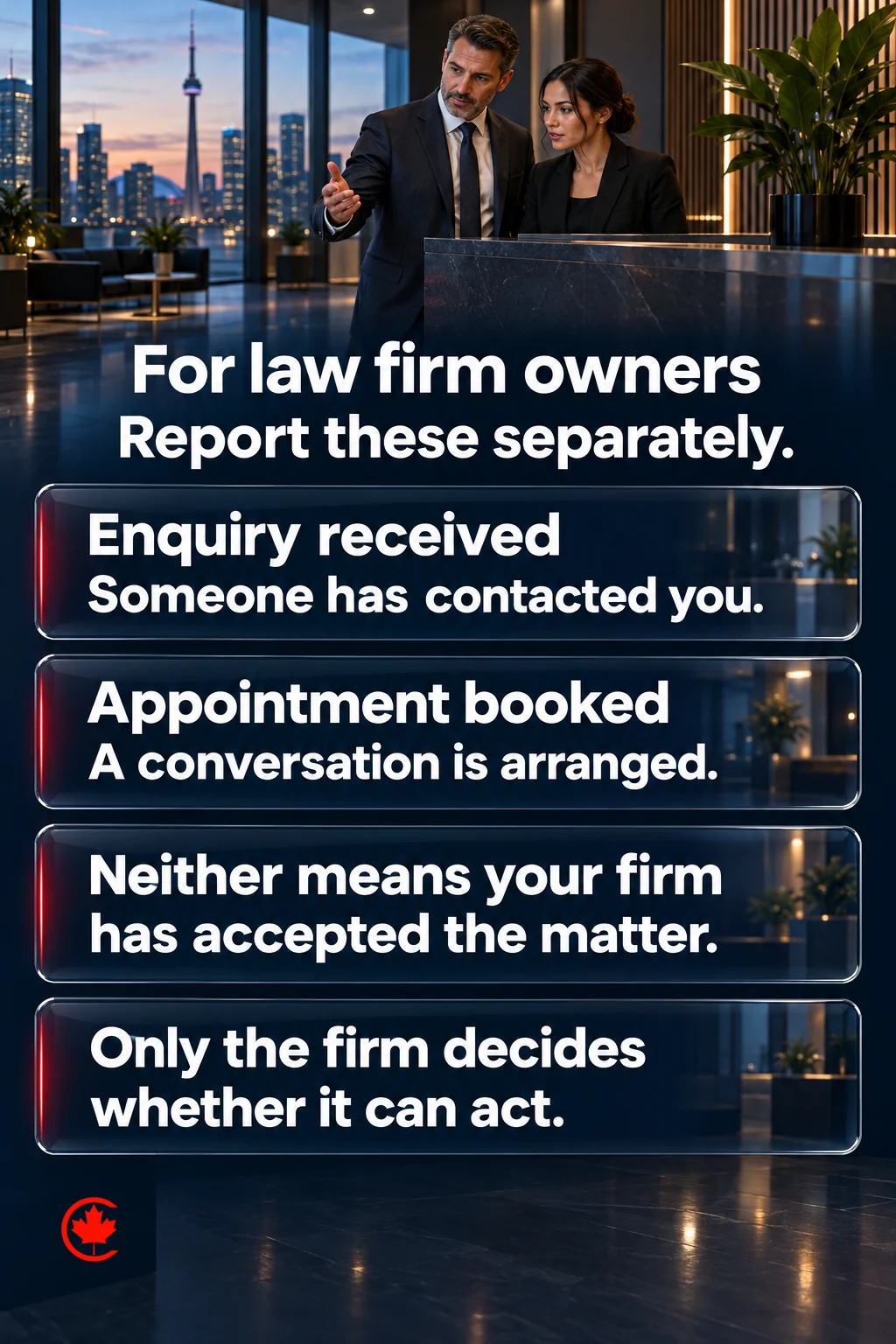
A useful intake journey has clear boundaries between receipt, administrative screening, professional review and engagement. The terminology in the marketing report should respect those stages. A submitted form is an enquiry. A booked call is an appointment. Neither means that the firm has accepted a case. Establishing these distinctions prevents a supplier’s optimistic report from creating pressure on the people responsible for deciding whether the practice can act.
Ask the receiving team where effort is being spent. Disability enquiries may require clarification of the benefit or insurer involved. A malpractice enquiry may require a different preliminary discussion and a longer internal review. Commercial insurance enquiries may come from a business representative whose authority and objectives need clarification. These are reasons to plan separate paths, not instructions for marketing staff to decide the legal merits of any matter.
Screening criteria in a marketing contract should remain administrative and practice-approved. Geography, advertised service and current availability may help explain whether the enquiry reached the intended team. A label such as qualified lead should not quietly mean a winning case, a minimum recovery or a person who can be pressured to sign. If the parties cannot agree on a clear definition, they will struggle to interpret campaign performance fairly.
For example, suppose twelve enquiries arrive during a hypothetical month, seven relate to services the practice handles, five attend an initial conversation and two become engagements after the firm’s review. Each number answers a different question. The difference between twelve and seven may suggest a service-clarity problem; the difference between seven and five may relate to scheduling or changing needs. The final decision belongs to the practice and should not be reduced to a marketing defect without context.
Unaccepted enquiries also require thoughtful handling. Agree who explains that the firm cannot assist, what the communication may say and whether any approved referral information is offered. Do not let a marketing contractor improvise legal recommendations or disclose the person’s details to another organization. The owner can improve the experience without promising that every visitor will be found another lawyer or that a referral settles any question about deadlines or eligibility.
Assess paid search without exposing sensitive information
Before approving advertising, ask how the supplier will evaluate the promoted service and its destination against the platform’s current rules. Disability and health-related legal enquiries deserve particular care because the information involved can be sensitive even when the advertiser is a law firm rather than a healthcare provider. Clear service descriptions help visitors, but changing the wording of an advertisement does not eliminate the nature of the underlying service.
Google’s health-related personalized advertising policy treats health and disability as sensitive interests, including disability content directed at carers, and restricts advertiser-curated audiences for sensitive promotions. That distinction matters when a proposal includes reaching people again because of their earlier interaction with the firm. It does not establish that all legal advertising is prohibited or that any particular proposed campaign will be approved.
Measurement is a separate question. Here, conversions are tracked outcomes used to evaluate advertising, such as enquiries or engagements. Google’s customer data policy restricts sensitive-category conversions in measurement features called enhanced conversions and store-sales uploads. A firm should not assume that consent, hashing personal identifiers into coded values or removal of a diagnosis makes a particular sensitive-service conversion eligible. Ask for a clear explanation of the proposed event, information shared and product used before approving data transfers. Platform permission and the firm’s own privacy obligations both need consideration.
The practice can still ask commercially meaningful questions without giving the marketing supplier unrestricted access to files. Aggregate counts of enquiries, attended consultations and engagements may provide useful management information when appropriately reviewed and handled. The reporting design should explain what detail the supplier actually needs and what stays inside the practice. Medical narratives, claim documents and financial hardship descriptions should not become routine material in marketing presentations.
Advertising proposals should also explain disruption risk. A platform may review, restrict or disapprove material, and the supplier cannot guarantee uninterrupted availability. The practice needs to know who will communicate a problem, what work is included in addressing it and how spending decisions will be handled while it is unresolved. A contingency discussion is more valuable than a promise that carefully written ads can never encounter a policy issue.
See Google Ads for lawyers and the full cost per click by practice area.
Budget against fee contribution and cash timing
A settlement or insurance recovery belongs to the client under the applicable arrangements; it is not the firm’s marketing revenue. For business planning, distinguish the firm’s collected fees from gross amounts associated with a matter. Then distinguish those fees from the costs of doing the work. A campaign that appears attractive when compared with a headline case value can look very different after professional time, outside costs, write-offs and delayed collection are considered.

Use a definition of contribution that your accountant and practice management team can apply consistently. For the illustrations here, contribution means collected legal fees less the direct delivery costs assigned to those matters, before marketing and general overhead. This is a management example, not an accounting standard. Treatment of disbursements, tax, work in progress and partner time must suit the firm’s actual records. Do not count reimbursed client expenses as additional margin by accident.
Consider a hypothetical disability practice spending CAD $6,000 on media, CAD $2,000 on management and CAD $1,000 on additional intake labour for one defined group of enquiries and the matters resulting from them (an acquisition cohort). Total acquisition spending is CAD $9,000. If that cohort produces thirty enquiries, twelve attended consultations and three engagements, the corresponding costs are CAD $300 per enquiry, CAD $750 per attended consultation and CAD $3,000 per engagement. These are arithmetic examples, not expected rates or a recommended budget.
Now suppose those three matters eventually produce CAD $45,000 in collected fees and CAD $27,000 in assigned direct delivery costs. The resulting contribution before acquisition spending is CAD $18,000. After the CAD $9,000 acquisition cost, CAD $9,000 remains before general overhead, financing and tax. The calculation would be wrong if the CAD $45,000 were instead the clients’ recoveries, if the delivery costs were incomplete or if the fees had not actually been collected.
Timing can still make that apparently positive cohort difficult to fund. Suppose acquisition spending and CAD $12,000 of the direct delivery costs are paid before any fees arrive. The illustrative funding requirement at that stage is CAD $21,000, before other business costs. A firm cannot pay today’s wages with a future contribution estimate. The owner should assess the available cash buffer and the range of possible collection dates with their financial advisers before increasing commitments.
Medical malpractice may require a different planning horizon and a different allowance for preliminary work. In a second hypothetical example, the firm spends CAD $4,000 attracting enquiries and CAD $3,000 on preliminary review activity but accepts no new matter during that period. The CAD $7,000 is still a real cost. It should not be hidden by assigning a speculative value to every reviewed enquiry or treating a later unrelated engagement as proof that the original cohort paid for itself.
For an insurance-dispute practice using staged billing, cash might arrive earlier on some matters, but invoices still differ from collections. A hypothetical cohort with CAD $20,000 billed, CAD $14,000 collected and CAD $8,000 in assigned delivery costs has CAD $6,000 of collected-fee contribution before acquisition spending at that point. The remaining CAD $6,000 receivable should be shown separately, not silently treated as available cash. Later receipts can change the assessment.

Compare cohorts at sensible ages. A recently opened file should not be judged against a mature file that has already concluded, nor should the firm wait indefinitely to recognize a poor-quality enquiry pattern. Early reviews can examine service fit, responsiveness and consultation attendance. Later reviews can examine engagements, delivery costs and collections. Ask for a report that identifies which conclusions are provisional and which are based on completed, collected work.
Finally, choose a spending limit based on downside as well as upside. Discuss what the practice can afford if fewer suitable enquiries arrive, review takes longer or collections are delayed. A useful limit protects service capacity and cash rather than representing the highest amount an optimistic forecast can justify. Increasing spend should follow a documented business decision, not a claim that one expensive click proves the next case will be profitable.
Show what a prospective client can reasonably expect
People choosing a firm need information about the relationship as well as the subject matter. Describe who receives the first enquiry, whether the first conversation is with a lawyer or another team member and what happens before the firm decides whether it can act. This makes the next step more understandable without promising a legal conclusion. Keep the explanation aligned with the actual experience rather than an ideal process the practice has not implemented.
Fee explanations should distinguish the initial conversation, any separately charged assessment and an eventual engagement. Where the firm offers a contingency arrangement, the responsible lawyer should approve the public description and its qualifications for the relevant jurisdiction and service. Avoid using a broad slogan that obscures possible costs or suggests every prospective client will be offered the same funding arrangement. The purpose is informed contact, not a substitute for the firm’s engagement documents.
Credentials and experience should help visitors understand who may do the work. Identify real practitioners and relevant, supportable experience without implying that an award, designation or past result predicts their outcome. If several services sit on the same website, make it clear which people handle each one. The existence of a firm-wide litigation practice does not establish that every lawyer offers every advertised claim service.
Communication promises must fit staffing. An after-hours message service is different from a lawyer being available to assess a matter immediately. A request for an appointment is different from a confirmed meeting. Describe these distinctions plainly. If the practice cannot reliably deliver a proposed response commitment, change the commitment before publication rather than treating missed expectations as an unavoidable consequence of growth.
Ask for proof in context when reviewing a supplier’s examples. An attractive page is evidence of presentation, not evidence of increased suitable engagements. A genuine past marketing result still needs a period, relevant scope and clear limitations. The practice should be able to distinguish design quality, service understanding and reported commercial performance, without being asked to infer all three from an impressive screenshot or an isolated percentage.

Build useful professional relationships with clear boundaries
Relationships with other legal professionals and relevant community organizations can help people learn that a suitable service exists. The firm’s offer should be easy to understand: the work it accepts, the regions it serves and the route for an initial enquiry. A concise explanation of service scope may be more useful to a referring professional than a broad claim that the firm can help anyone with an insurance problem.
Keep education separate from a promise of reciprocal business, payment or access to personal information. A clinician or community worker’s involvement does not give a marketing supplier permission to obtain a person’s health details. The firm should decide how an introduction can be made appropriately and what information, if any, is needed. A potential client can often be given the firm’s contact information without their entire situation being shared among organizations.
Referral-fee questions require review of the applicable professional rules and the particular participants. Do not assume there is one Canadian rule covering every lawyer, clinician, organization and arrangement. The marketing plan should not offer commissions or revenue shares simply because an introduction has commercial value. Ask the responsible professionals to resolve the arrangement before it appears in outreach, agreements or supplier compensation.
Evaluate relationship work without creating pressure to produce files. Useful signs may include a clearer understanding of the firm’s scope and fewer misdirected enquiries. A referral source should not be described as exclusive, and the prospective client remains free to consider other providers. The practice can invest in being helpful and understandable while avoiding forecasts that treat another professional’s contacts as a guaranteed stream of business.
Keep professional approval separate from marketing delivery
The practice should approve public service descriptions, fee statements, credentials and examples before they are used. The marketing supplier can help make information clear, but the responsible lawyer must determine whether it accurately represents the practice and meets applicable obligations. Approval should cover the complete message, including a prominent headline or brief FAQ answer that could imply more than a carefully qualified paragraph elsewhere.
Case stories and testimonials require particular care. Consider the authority to use the material, the possibility of identifying someone indirectly and the impression created about likely outcomes. A disclaimer cannot repair a misleading central promise. The practice should not publish a composite story as an actual client result or describe a hypothetical recovery as evidence of experience. Useful marketing can explain the service without manufacturing proof.
Jurisdiction-specific content needs a responsible owner and an update decision. A page discussing claims should not give a universal deadline or encourage a reader to wait on the basis of general information. Where legal detail is necessary, the firm should decide its scope and review requirements. This marketing guide does not establish the applicable rules for every Canadian province or certify any advertisement as compliant.
For broader buying context, see lawyer advertising rules in Canada. The practical expectation is a clear approval boundary: the agency supplies agreed marketing work, while the practice supplies accurate professional information and retains responsibility for the legal and regulatory assessment. Do not purchase a compliance guarantee that the supplier does not actually offer.
Choose a supplier and an accountable scope
Compare proposals by the problem they will solve and the work they include. A website clarification project, ongoing content support and paid advertising management are different purchases. Ask which services, locations, pages and reporting needs are covered, who provides professional review and how changes are handled. An apparently lower fee can be poor value if the practice later discovers that essential intake or website work was never included.
Keep platform spending distinct from management fees and other project costs. A proposed learning period should not be mistaken for a free trial or a right to exit a longer commitment.
Account access, deliverable rights and ongoing care are separate questions. Maintenance is not automatically included in an ongoing marketing agreement. Discuss the relevant scope expressly rather than relying on a general promise that the firm will own everything and receive continuing fixes.
Set a review rhythm that fits the practice. At the beginning, confirm services, capacity, enquiry handling and approved claims. During the initial operating period, examine actual fit and the receiving team’s experience. Once enough matters have matured, assess collected-fee economics alongside earlier indicators. These are business review stages, not guaranteed milestones or a promise that a profitable result will appear within ninety days.
A supplier should be able to say what remains uncertain. It may be too early to evaluate collections, the practice may need more capacity to respond to new enquiries or a platform issue may limit the available channel. Honest limitations make decisions easier. The best next purchase is the one that addresses the firm’s actual constraint with an understandable scope, not the largest package justified by a projected settlement value.
These practices sit close to personal injury, so read how to get personal injury clients too. For a plan built around your practice, see our personal injury lawyer SEO or the law firm marketing playbook.
Frequently asked questions
What marketing options should a disability or insurance-dispute practice compare?
Compare clear service content, paid search and professional relationships against your actual bottleneck. Consider service fit, receiving capacity, acquisition cost and collected fees. No channel is automatically best because a search term has a high CPC.
Should disability, malpractice and other insurance disputes share one marketing plan?
They can share a firm-wide brand, but should have distinct service descriptions, receiving arrangements and commercial assumptions. Different review needs, funding offers and collection timing make a single lead target too crude for many practices.
Does a high CPC mean each legal file is highly profitable?
No. CPC does not establish case value or profitability. Evaluate the firm’s collected fees, direct delivery costs, acquisition spending and cash timing. A client’s settlement or recovery is not the firm’s revenue.
What should a practice show before asking someone to enquire?
Explain the services and regions covered, the initial contact process, any initial fee and what remains subject to professional assessment. Identify real practitioners and make availability accurate. Do not imply that submitting a form establishes a legal entitlement or an engagement.
Can a family member make the first enquiry?
The practice can provide a route for someone assisting a prospective client. Receiving that enquiry does not automatically authorize disclosure about another person. The firm should determine appropriate communication and authorization arrangements.
Can health-related enquiry data be used in advertising audiences or enhanced conversions?
Do not assume it can. Keep audience targeting (who can see ads) separate from conversion measurement (which outcomes are reported). Google restricts audiences assembled by the advertiser for sensitive health-related promotions and separately restricts sensitive-category outcomes in specified measurement products, including enhanced conversions. The actual service, data and feature require review; consent or hashing personal identifiers into coded values does not automatically make them eligible.
How should we evaluate a campaign before files produce collected fees?
Review service fit, attended consultations, the firm's ability to respond to enquiries and accept suitable work, and acquisition spending first. Track later engagements, direct delivery costs and collections for the same group of enquiries. Label early conclusions as provisional rather than assigning speculative revenue to every enquiry.
Can we promise payment for referrals from clinicians or community organizations?
Do not build such a promise into marketing without the responsible professionals reviewing the specific arrangement and applicable rules. Keep introductions, payments and personal-information sharing separate; there is no single permission assumed here for every Canadian referral relationship.
Does marketing support include legal compliance approval or guaranteed results?
No such promise should be inferred. The practice is responsible for professional and regulatory assessment of its content, and the written agreement defines the marketing scope.