
How to get family law clients: marketing a family and divorce practice with trust

Getting more family law clients starts with a more precise question: which new matters can your firm serve well, at a cost and pace it can sustain? A practice seeking separation agreements needs a different proposition from one expanding complex divorce litigation. Both need a clear explanation of their services, credible reasons to make contact and a first conversation that respects the sensitivity of the situation.
This guide is for Canadian family and divorce law firm owners choosing marketing support. It connects local discovery, useful website content, paid search and referrals to practical decisions about capacity, consultations, privacy, spending and supplier accountability. The goal is suitable enquiries that can become appropriate engagements, not the largest possible lead count. Marketing cannot promise a legal outcome, remove conflicts or create lawyer availability where none exists.

What family law clients look for before they call
Start with the work you genuinely want to accept. Divorce representation, separation agreements, parenting disputes, support matters, property issues and mediation are not interchangeable purchases. A prospective client needs to recognize their concern, understand who can help and see the next step. Your marketing brief should distinguish the services you actively want to grow from those you handle selectively or refer elsewhere.
Matter mix also changes the resources behind growth. An apparently valuable file may demand substantial senior attention, while a narrower engagement may fit an associate’s availability better. Compare likely collected fees with the time and direct costs needed to deliver the service, rather than choosing solely by the largest quoted retainer. Include the impact on existing clients: new consultations should not crowd out work the firm has already committed to complete.
Consider a hypothetical two-lawyer practice. One partner has a full litigation calendar; the other can take additional agreement work and consultations. A generic promise to handle every urgent family dispute could attract enquiries the firm cannot accommodate. A more useful purchase would make the available services clear, explain the consultation process and support an appropriate flow of new appointments. This example describes a planning choice, not a reported client result.

When litigation capacity is full but the firm can accept agreement work, a focused agreement-service offer is more useful than promising every urgent dispute. Confirm actual availability and explain the appropriate consultation; this choice does not establish demand or guarantee an engagement.
Define capacity at two levels before discussing growth targets. First, how many initial conversations can staff and lawyers handle without rushed screening or unsafe callbacks? Second, how many new engagements can the legal team responsibly take on after those conversations? A full consultation diary is not success if suitable clients must wait beyond the firm’s actual availability or repeat sensitive information to several people.

Geography needs the same precision. Distinguish where the firm is licensed and able to practise, where it genuinely serves clients and where it has a physical office. A virtual consultation option should not imply nationwide legal coverage or a local office that does not exist. Have the responsible professional confirm every jurisdiction and service description before approving marketing aimed at a new market.
Professional titles and roles should be understandable too. A lawyer consultation, a conversation with intake staff and a meeting with another authorized provider are different experiences. If your team includes paralegals or other professionals, describe their actual role and permitted scope rather than letting a broad family-law label imply that every team member can provide every service. The firm, not the marketing supplier, must settle the professional boundaries.
Make room for genuine differences in client needs without promising services you do not provide. A firm might offer consultations in two languages but have document preparation available in only one, or offer remote meetings while requiring some attendance in person. Those distinctions affect suitability. Stating them clearly can save a prospective client an unhelpful appointment and save the firm time, without making assumptions about the person’s circumstances or excluding them through vague marketing language.

Your first-contact offer should answer practical questions: is the initial conversation free or paid, who conducts it, how long is it, and what does it include? A free intake call should not be presented as a free legal opinion. If a paid consultation is available, explain its price, applicable taxes, preparation requirements and any conditions accurately. Do not advertise same-day access, emergency coverage or a fixed response deadline unless the firm can support that specific promise.
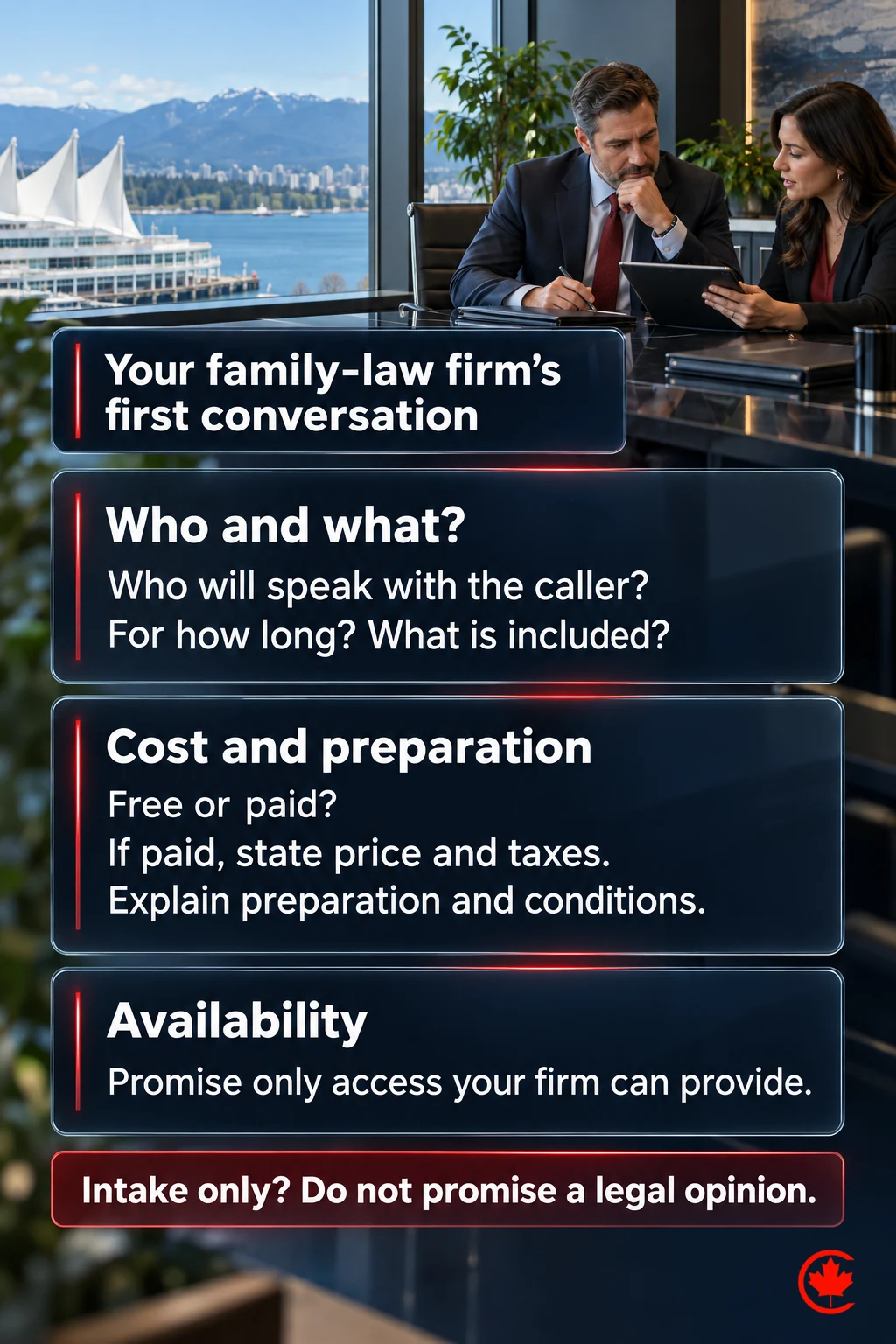
Choose a tone that matches this experience. Calm language can still be confident: it can describe the lawyer’s verified background, the services available and how the firm communicates. Aggressive promises about defeating the other party create expectations the legal team may not share. The strongest distinction is often a concrete service experience, such as clearly explained consultation options, rather than an unsupported claim to be the city’s best firm.

Search demand for family law in Canada
Search demand can establish that people look for legal help, but it cannot tell you how many suitable matters your firm will sign. One example is the search below. The figure covers all of Canada, even though Toronto appears in the wording. It is not a count of searches made only by Toronto residents, and it is not a forecast for your office.
| Prospective-client search | Average monthly searches, Canada | Estimated click cost |
|---|---|---|
| family lawyer toronto | 5,400 | Moderate for legal searches, well below personal injury terms |
We market family law firms with care and clarity for clients in difficult moments.
The search figure is an estimated monthly average. The click-cost estimate is not a current quote or an all-in acquisition cost. It excludes the cost of marketing management, website work and your firm’s time. Similar searches may overlap; adding headline volumes together does not produce a reliable number of unique prospective clients.

A query containing a city name may still have been measured across Canada. That national estimate does not count local suitable clients or forecast the enquiries your firm will receive. Check the market, measurement period and relevance to the services you accept before using it to support a commitment.
Ask what demand means for your actual services. Someone researching a general question may not be ready to hire. Someone looking for a lawyer may need a different jurisdiction, funding arrangement or type of representation. A useful proposal relates the opportunity to the matters you accept and the territory you serve, while acknowledging that individual suitability is established through the firm’s own intake and professional review.
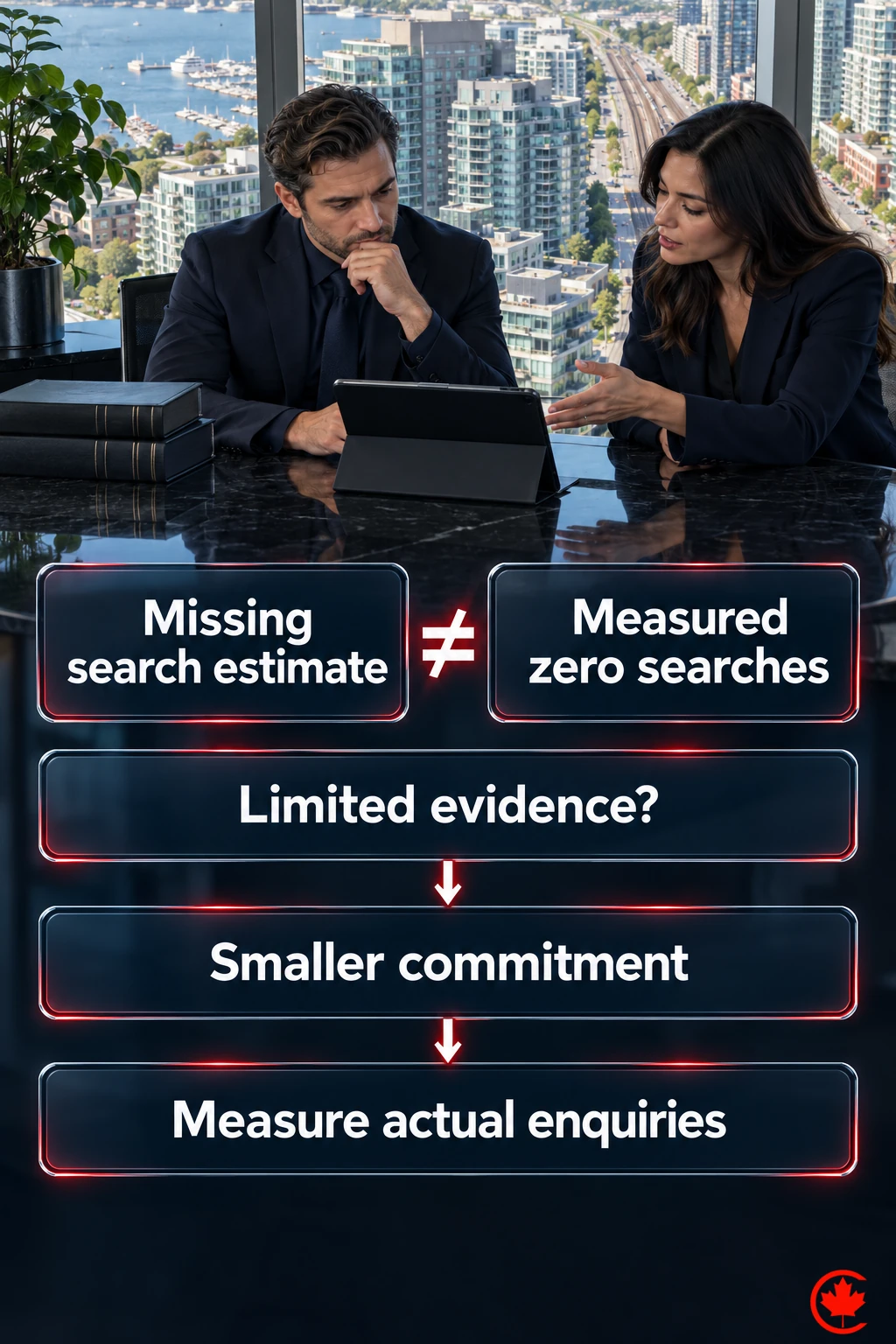
Do not mistake a missing estimate for proof of no demand, or a measured zero for a missing value. Equally, a large national estimate does not justify a large local commitment. Where evidence is limited, the commercial decision should be smaller and more conditional: improve a known weakness, agree what will be measured and preserve enough budget to learn from actual enquiries. Your own collected-fee and capacity information matters more than an impressive market headline.
Local discovery that helps suitable clients find you
Local visibility helps a person answer basic questions before contacting a firm: is this a real practice, does it serve my area, and can I reach it in a way that works for me? Local SEO support is a purchase intended to improve that discovery and the accuracy of the information people encounter. It is not a promise to occupy a particular map position or win a legal case.
For a single-office practice, the first business concern is often inconsistency. An old telephone number, unclear visiting arrangements or services the firm no longer accepts can create avoidable disappointment. For a genuinely multi-office practice, the question is whether each location has a clear purpose and an accurate client experience. Paying for a larger geographical footprint makes little sense if the underlying offices or service coverage cannot support it.
Ask a supplier to explain which public information it will maintain, what remains your responsibility and how changes reach the people doing the work. The useful result is accurate information across the places prospective clients use, not a long list of obscure listings. Our local citations guide provides further context for evaluating this part of a local visibility engagement.

Reviews deserve a different level of care in family law. A person may value your work and still prefer not to reveal any connection with a family-law practice. Treat declining to review as an entirely acceptable choice. Google’s review policies prohibit incentives and selectively requesting positive reviews. Invitations should seek genuine feedback without pressure or a requested rating, subject to the firm’s professional and privacy obligations.
Decide who can approve public responses and what information must never appear in them. A friendly reply can still reveal too much if it confirms representation, mentions a child or discusses the matter’s outcome. Have the firm approve a restrained response approach that does not debate the file in public. More review activity is not worth disclosing information that the person reasonably expected the firm to protect.
Judge this service using the connection between discovery and appropriate enquiries. A report should help you understand whether people can find accurate information and whether the enquiries fit the practice, not simply show a collection of rankings. If the office has recently moved or changed its contact arrangements, correcting that confusion may be more valuable than expanding into another area. Buy the work that addresses the actual barrier first.
Paid directory listings and purchased enquiries deserve a separate comparison. Ask what you are buying, where the prospective client believed their information was going, which services and locations the listing covers, and how an unsuitable or duplicate enquiry is handled. A low advertised enquiry price is not enough to establish value. The firm still needs to assess suitability, permissions, professional obligations and the total cost of staff time before deciding whether that purchase belongs in its marketing mix.
Content that helps a prospective client choose
A family-law website needs more than a long list of practice areas. Different pages answer different buying questions. A service page explains the help available; a lawyer biography establishes who may provide it; a fee explanation reduces uncertainty about payment; and a consultation page explains how the relationship begins. Educational articles can add context, but they should not substitute for clear information about the firm itself.
For example, an agreement-service page can help a reader decide whether to enquire without trying to resolve their legal situation online. It can describe the service in plain language, the jurisdiction served, which team members handle it and the next step for discussing suitability. It should distinguish an initial conversation from an accepted engagement and avoid suggesting that a short form guarantees the firm will take the matter.
Fee information can be useful without pretending every matter has the same price. Explain whether the firm offers a paid consultation, hourly work or any genuinely available fixed-fee service. Where a fixed price is advertised, the reader needs to understand what is included, what falls outside it and any relevant conditions. Ask the responsible lawyer to approve the wording, including how taxes, disbursements and later changes are described.
Biographies should make experience understandable rather than relying on decorative claims. Relevant, verifiable information could include a lawyer’s actual practice focus, languages in which they provide services and the types of work they undertake. Avoid making a team page appear to promise personal access to a senior lawyer when another professional normally handles initial consultations. The person shown and the service offered should match the experience a new client can expect.
Educational content is most useful when it helps readers prepare for a professional conversation. Topics might include what an initial consultation covers, the differences among services the firm offers or what information staff will request later. Jurisdiction-specific legal explanations need review by the appropriate professional. This marketing guide does not supply advice about divorce, parenting arrangements or support, and your firm’s general articles should not imply individual advice either.
When commissioning content, ask how proposed topics support the services you want to grow. A practice seeking agreement work does not automatically benefit from a large library centred on highly contested proceedings. Conversely, a firm equipped for complex disputes needs enough information about its relevant services to let a suitable reader recognize that fit. The content purchase should deepen useful coverage rather than repeat the same general introduction under different titles.
Include review capacity in the scope discussion. A promise of frequent publication has little value if the lawyer responsible for accuracy cannot review it. Decide who supplies factual information, who approves professional statements and who is responsible for later updates when services or law change. You are buying a usable body of information, not just a monthly word count, so the approval burden and update responsibility need to be realistic.
Video and social content can serve a similar purpose when they let a prospective client understand the firm’s manner and approach. They are not automatically the first purchase for every practice. If the website leaves fees and contact options unclear, polishing those fundamentals may be a better use of money than adding another channel. Choose the format that resolves a real unanswered client question, without exposing private stories to make the content more compelling.
Google Ads for family law
Paid search can put an eligible firm’s message in front of people actively looking for relevant services. Its commercial attraction is the ability to purchase attention rather than wait for someone to encounter the firm elsewhere. Its risk is equally straightforward: you can pay for attention that never becomes a suitable consultation. Assess paid search against your available appointments and all-in economics, not a claim that family-law clicks are universally affordable.
The scope should identify the services and geographical coverage being promoted, the approved consultation offer and the people responsible for responding. Ask what the supplier considers a useful enquiry and how that definition differs from a raw telephone call or completed form. A wrong-jurisdiction request, an existing client’s call and a suitable new prospective client should not be treated as commercially identical outcomes.
Privacy and platform eligibility need attention before you buy extra advertising features. Google’s relationship-hardship policy identifies divorce services as sensitive. Its restrictions include advertiser-curated audiences such as customer matching and your own audience segments. That is not a blanket prohibition on Search advertising, but it means a proposal to follow divorce visitors around the internet needs careful scrutiny rather than automatic approval.
Ask the supplier to explain which services are eligible, what information would be shared and what policy limits apply to the actual destination and proposed features. Do not assume that generic wording, hashing a contact list or obtaining a broad permission removes a platform restriction. The firm should retain control over decisions involving prospective-client information. A smaller, appropriate advertising scope is preferable to a package whose privacy assumptions no one can explain.
Our Google Ads for lawyers service is relevant when you are evaluating paid-search support. Google’s Canadian Local Services Ads category list does not currently include family lawyers. Check eligibility before budgeting for that product. Our Local Services Ads guide discusses the distinction; Google’s Canadian availability page is the primary reference.
Can the firm afford the acquisition commitment?
A useful budget separates media spend, management, initial website or content work, outside software charges and the firm’s own intake time. Ask which amounts recur, which are one-time and which are paid directly to a platform. Express the decision in Canadian dollars with applicable taxes identified. A click estimate is not a budget on its own, because it leaves out the other costs of acquiring work.
Consider this explicitly hypothetical monthly example, not a quote, forecast or client result. A firm budgets CAD $3,000 for media, $1,200 for management, $600 for incremental intake time and $200 for other attributable charges. The recurring total is $5,000 before tax. It also pays $2,400 for initial website work, making the first month’s cash commitment $7,400 before tax. All amounts are invented to demonstrate the buying calculation.
Suppose that spend produces 40 enquiries, of which 20 fit the firm’s initial service and jurisdiction criteria. Twelve attend a consultation and four become accepted engagements. The cost of that month’s recurring acquisition spending is $125 per enquiry, $250 per initially suitable enquiry, about $416.67 per attended consultation and $1,250 per engagement. Including the initial website payment makes the first month’s cost per engagement $1,850. Those are different measures, and a proposal should not label all of them simply as lead cost.
Now consider the work’s contribution rather than its headline fee. Assume each of those four engagements eventually produces $4,000 in collected professional fees, excluding tax and reimbursed disbursements, with $2,500 in directly attributable delivery costs. That leaves $1,500 per engagement before acquisition costs and general overhead. Across the full collection period, these four engagements contribute $6,000 on that basis. Comparing that group’s eventual contribution with the single month’s $5,000 acquisition spend attributed to it leaves $1,000 before general overhead, or negative $1,400 after also charging the separate $2,400 initial website payment to this group. These are eventual results for this group, not monthly profit or cash available in month one.
This example is deliberately less reassuring than a revenue-only calculation. It shows why $16,000 in collected fees does not mean $16,000 is available to pay for marketing. It also separates a recurring decision from an initial investment. The website may remain useful beyond the first month, but its bill still needs paying when due. Your accounting adviser can help distinguish profitability measures from the cash required to meet actual commitments.
Timing can change an otherwise plausible decision. In a second hypothetical cash schedule, assume only $6,000 of those earned professional fees is collected in month one, while $4,000 of delivery costs and the $7,400 launch commitment are paid that month. The resulting cash shortfall is $5,400 before tax and overhead. Later collections could change the picture, but they do not pay today’s invoices. Ask your accounting adviser which receipts are available to meet operating costs.
For a simple all-in cash illustration, suppose the actual supplier and platform invoices in that hypothetical launch also require $800 in taxes. That invented invoice amount is not a Canadian tax-rate estimate. The launch cash requirement becomes $8,200, and the first-month cash shortfall becomes $6,200 before general overhead. Whether any tax is recoverable, and when, needs the firm’s own accounting assessment. A proposal that quotes amounts before tax should therefore be paired with a payment calendar showing the amounts that will actually leave the bank.
Test a weaker outcome before approving the commitment. If only two engagements result from the same month’s $5,000 acquisition spending, and each eventually contributes $1,500, their eventual $3,000 combined contribution falls $2,000 short of that one month’s spend, before overhead or initial work. If six suitable prospective matters arrive but the team can responsibly accept only four, extra demand does not automatically improve the result either. The budget needs both an affordability boundary and a capacity boundary.
Agree when the commercial decision will be reviewed and what information will justify continuing, changing or reducing future discretionary spend. Review appointment suitability, accepted matters, actual collections and delivery pressure together. The firm should understand both levers before it signs, rather than discovering the distinction when results are disappointing.
A website that makes the first step easy
The first-contact experience is part of what the firm is selling. A person should be able to understand the service and request an appropriate next step without first submitting an intimate account of their relationship. Start by deciding what staff genuinely need to receive an enquiry, determine the next action and ask how the person can be contacted safely. More information is not automatically better at this early stage.
A contact preference should mean more than choosing telephone or email. Someone may be able to receive a call only at particular times, may not want a voicemail or may use a shared email account. Have the firm decide how those preferences are requested, recorded and respected. The website promise must match what staff, booking confirmations and other communications actually do; a discreet form followed by an unexpected revealing message defeats the purpose.
Imagine a hypothetical visitor considering separation who can read the site privately but cannot safely take a call at home. The useful outcome is not the fastest possible callback at any cost. It is a clear way to state a safe contact option, understand who will respond and choose an appropriate time if the firm offers that choice. This is a service-design scenario, not a claim about any identifiable client or a guarantee of personal safety.
Keep initial document requests proportionate to the stage. There is a meaningful difference between asking what broad service someone needs and asking them to upload financial records, identification, court material or information about children immediately. The firm’s lawyer should decide what is necessary, when it is needed and how it should be provided. A marketing supplier should not receive full matter files merely to explain which channel generated an enquiry.
Privacy explanations should help the person make a real choice. The Privacy Commissioner of Canada’s consent guidance emphasizes understandable information about collection, sharing, purposes and meaningful risks. Ask for the firm’s actual practices to be explained at the relevant point, with legal review for the obligations that apply. A generic privacy statement is not evidence that every connected service handles information appropriately.
Conflict screening and acceptance must remain clear. A visitor should not be left thinking that an enquiry form has retained the firm, protected a deadline or guaranteed representation. Have the responsible lawyer approve the explanation of when and how the firm can consider an engagement. Staff also need an appropriate route for urgent concerns, rather than a website invitation that promises immediate legal assistance regardless of availability.
A quick-exit feature can change the visible page rapidly, but it is not a privacy shield. The Safety Net Project explains that it does not clear browsing history or defeat monitoring of a device or internet activity. If you include one, describe that limit clearly. Do not sell it as making the visitor’s browsing safe, and do not let its presence substitute for careful handling of messages and contact preferences.
Booking convenience needs honest boundaries. State whether someone is requesting an appointment or reserving a confirmed slot, who they will meet and whether payment is required. Describe any rescheduling or cancellation conditions that actually apply. An attractive online calendar should not create a stronger promise than the firm can fulfil, especially where screening or a conflict check must happen before a lawyer consultation can be confirmed.
If an external answering or booking service is part of the proposal, understand its role before approving it. Who receives the initial information, which requests can that person answer, and when does responsibility return to the firm? A service that can receive a message outside office hours is not necessarily providing legal assistance at that time. The wording on the website should make the distinction clear, and the firm’s professional team should approve the limits of any outsourced conversation.
Ask to review the complete prospective-client experience, including acknowledgements and appointment reminders, rather than approving only the visible page. A short demonstration using invented details can reveal whether the promised contact preference carries through to the next communication. Keep real client information out of that demonstration. The purpose is to verify what the firm is buying, not to assume that a polished screen proves the whole experience is appropriate.
Accessibility and clarity belong in the purchase discussion rather than being assumed from a polished design. Ask whether the scope includes testing the contact journey on the devices and assistive technologies relevant to your users, and what standard is being promised, if any. Readable text, clear labels and workable forms are business requirements; a blanket claim of legal accessibility compliance needs an expressly defined scope and appropriate evidence.
Choose website work by the problem it resolves. If people cannot tell which services you offer, prioritize service clarity. If suitable visitors abandon a confusing contact process, prioritize that experience. If the site is fundamentally difficult to maintain, a broader rebuild may deserve consideration. Our law firm website design service and what clients look for on a law firm website explain the related buying questions.
Referrals still matter
A recommendation from another professional can introduce someone to a firm they would not otherwise have considered. The useful relationship is based on a clear understanding of the services you actually provide and the circumstances in which an introduction may be appropriate. Other lawyers, accountants or support professionals may encounter people who need legal help, but no relationship guarantees a steady stream of suitable matters.
Make the referral experience accurate and respectful. A professional should know which jurisdiction and services your firm handles and how a person can make contact without sharing unnecessary personal details through an intermediary. Ask whether the person wants the introduction before information changes hands. A relationship that produces fewer appropriate introductions may be more valuable than a large contact list that generates unsuitable or unexpected calls.
Do not equate keeping in touch with placing every past enquirer into a marketing list. A requested reply about an appointment and an ongoing promotional newsletter serve different purposes. Canada’s anti-spam guidance distinguishes consent requirements and explains identification and unsubscribe obligations for commercial messages. Have the firm determine the applicable basis for its communications, rather than treating an old enquiry as permission for unlimited follow-up.
Professional referral arrangements also need their own review. If money, reciprocal commitments or other benefits are involved, have the firm assess its regulator’s current requirements before agreeing to them. This guide does not establish that a particular arrangement is permitted. Marketing support can make the firm’s services easier to understand, but it cannot decide the professional obligations attached to a referral or replace the lawyer’s judgement about accepting a matter.
Compare referrals fairly with paid acquisition. Introductions may carry no media charge but still require professional time and relationship effort; paid enquiries may arrive sooner but require more initial screening. Review whether either source produces work the firm wants and can serve. A healthy mix does not require every channel to contribute equally. It should reduce dependence on any single source without creating more commitments than the practice can manage.
Compliance and supplier decisions for family law marketing
Truthful marketing should describe the firm’s actual people, services and offer without promising how a matter will end. Verify credentials, experience claims, awards and any use of a specialist designation before approving them. Stories and testimonials need particular care where details could identify a person or their family. Our lawyer advertising rules in Canada introduces the issues; the firm’s regulator and qualified advisers determine its obligations.
A Canadian agency should not offer a single nationwide assurance that every legal advertisement is compliant. Requirements and permitted professional scopes need attention in the relevant jurisdiction, and platform acceptance is a separate question from professional compliance. Make lawyer approval a real part of the engagement. A supplier’s confidence or an advertisement’s approval by a platform does not remove the firm’s responsibility for the content it publishes.
Choose the scope, responsibilities and terms
Compare proposals by the problem each will solve. Local visibility work addresses discovery and public information; content work addresses unanswered service questions; website work addresses the client experience; and paid search buys eligible exposure. One provider may coordinate several needs, but a broad package is not inherently more valuable than a focused engagement. Ask which deliverables are included now, which depend on earlier work and which would require a separate agreement.
Responsibility needs names, not vague references to collaboration. Know who on your side approves professional statements, supplies service and fee information, responds to enquiries and resolves questions about privacy. Know who at the supplier coordinates delivery and communicates scope changes. An agency can reduce the execution burden, but it cannot invent facts about your practice or make professional decisions that belong to your lawyers.
Compare outside help with realistic internal alternatives. An internal marketing employee may offer closer daily coordination, but the firm still needs to budget for the skills and support that person does not provide. A specialist supplier may suit a narrow need, while a coordinated agency engagement may reduce the burden of managing several providers. None of these choices removes the need for an accountable firm-side decision-maker or makes legal review somebody else’s responsibility.
A hypothetical practice manager with limited time might prefer one coordinated proposal covering website clarity and paid-search support, while a larger firm with an established marketing team might buy only a defined specialist service. Compare the full management burden, not just supplier fees. If a lower-priced option depends on several hours of partner coordination every week, that time belongs in the buying decision even when it does not appear on an agency invoice.
Account control and intellectual property are related but different questions. Ask whose name the advertising accounts and domain are in, what access the firm retains and how a future handover would work. Separately, ask what finalized deliverables you own after payment, what remains licensed and which third-party charges continue.
Read the complete commercial terms, not just the monthly price. Media spend is separate from management fees. Ownership of finalized custom deliverables is conditional, with third-party and pre-existing materials excluded and signature requirements applying. These points belong in the buying decision before approval, alongside the actual written scope and payment schedule.
Maintenance, support and compliance are not interchangeable services. Ask what support, updates and testing your proposed agreement actually includes. If accessibility conformance or another specific standard is required, it should be expressly scoped rather than inferred from a general website or marketing package.
Request useful reporting without asking for private matter details to be spread more widely. The firm should be able to distinguish raw enquiries, initially suitable contacts, attended consultations and accepted engagements while keeping case information appropriately restricted. Reporting should explain uncertainty and unclassified outcomes rather than quietly assigning them a success label. You need enough information to make a spending decision, not an unnecessarily detailed copy of the firm’s confidential files.
When evaluating evidence of a supplier’s work, look for a clearly described scope, measurement period and relevant business outcome. A traffic increase does not establish more profitable family-law matters, and another firm’s results do not predict yours. Ask what the evidence actually supports and what remains unknown. Credible discussion of limits is more useful than a promise of a fixed number of clients, guaranteed rankings or territory exclusivity.
Review the investment without losing sight of service
A first review period should establish whether the purchase is solving the agreed problem, not merely whether activity occurred. Before work starts, agree the starting position, the firm’s available capacity, the approved offer and the information needed for decisions. A 90-day review can be a useful commercial checkpoint, but it is not a promised results deadline or a right to end a longer contractual term.
At that checkpoint, separate different problems. Plenty of unsuitable enquiries may point to a mismatch between the advertised service and what the firm accepts. Suitable enquiries with few attended consultations may point to appointment availability, unclear fees or an inconvenient contact experience. New engagements with weak cash contribution raise a different question about spending and delivery economics. The response should fit the problem rather than automatically increasing advertising.
Decide what would justify the next commitment. That might mean maintaining a useful channel, improving an unclear service explanation or reducing future discretionary media spend while capacity catches up. Keep the firm’s professional responsibilities, contractual obligations and cash position in view. Growth is valuable when it produces appropriate work the team can deliver well, not when it creates a larger queue of people waiting for help the practice cannot provide.
For help comparing the options for your practice, explore our family lawyer marketing service or the broader law firm marketing playbook. Discuss your priorities, capacity and budget so the proposed scope can address the right problem.
Frequently asked questions
How do family lawyers get more clients?
Match marketing to the matters and jurisdictions the firm can serve. Make services and consultation options clear, support appropriate local discovery, and compare paid search, content and referrals against intake capacity and all-in acquisition costs. No channel guarantees new engagements.
How much search demand is there for family lawyers in Canada?
"Family lawyer toronto" draws about 5,400 searches a month across Canada. This is not a Toronto-only audience count or a forecast of suitable clients for a particular firm.
Should a family law firm publish its fees?
Explain the actual consultation price and fee arrangements offered. Where a fixed fee is available, clarify its scope, conditions, taxes and exclusions. Have the responsible lawyer approve the wording rather than suggesting every matter costs the same.
What tone should family law marketing use?
Use calm, clear and respectful language supported by verified facts about the firm. Explain services and next steps without aggression, pressure or promises about the outcome of a legal matter.
Are family lawyers eligible for Google Local Services Ads?
Google's Canadian category list does not currently include family lawyers. Check Google's current eligibility information before budgeting for the product.
What content should a family law blog cover?
Cover questions that help a prospective client understand the firm's services and prepare for a professional conversation. Consultation expectations, service options and fee explanations can be useful. Have the appropriate professional review jurisdiction-specific legal information and keep it distinct from advice about an individual's situation.
How do I ask family law clients for reviews?
Invite genuine feedback without pressure, incentives or selecting only people expected to be positive. Respect privacy and the person's choice not to review. Have the firm approve public responses that do not disclose representation or details about a matter.
Why add a quick exit button?
It can quickly change the visible page, but it does not erase browsing history or stop device or internet monitoring. Explain those limits and do not present the feature as a guarantee of visitor safety.
Do referrals still matter in family law?
Appropriate professional introductions can complement other channels. Make the firm's services and contact options clear, respect permission before sharing information and have the firm review any paid or reciprocal arrangement under its regulator's requirements.
Can we say we are the best family lawyer in the city?
Do not use an unsupported superlative. Have the responsible lawyer check the evidence and the rules governing the proposed wording. Specific, verifiable information about services and experience is more useful than a claim the firm cannot substantiate.
How should a firm choose a family law marketing agency?
Compare the proposed scope, responsibilities, relevant evidence, reporting, privacy arrangements and full commercial terms. Clarify account access, conditional deliverable ownership, support exclusions, fees and the contractual term. A lower monthly price does not necessarily mean a lower total commitment.
What should a family law marketing plan include?
It should connect the desired matter mix and available capacity to an accurate consultation offer, appropriate channels, safe first contact and a CAD budget. Include how the firm will assess suitable enquiries, accepted engagements, collections and delivery pressure before making further spending commitments.