
Lawyer advertising rules in Canada: what Law Societies allow in 2026

Every Canadian law society regulates how lawyers market their services, and the core test is the same across the country: marketing must be demonstrably true, accurate and verifiable, must not be misleading, confusing or deceptive, and must be in the best interests of the public. Ontario sets out its version in Section 4.2 of the Law Society of Ontario’s Rules of Professional Conduct, with commentary that gives concrete examples of what may and does contravene the rules. This guide walks through those rules as they apply to websites, Google Ads, reviews, social media, video, awards, fees and referrals, with Ontario as the main example and checklists you can use before anything is published.
The rules and their commentary change, so check the current text on the Law Society of Ontario’s Chapter 4 page or your own law society’s rules before relying on any point here.
Where the rules come from
Lawyer marketing in Canada is governed by several layers at once.
- Provincial law societies: each province and territory regulates its own lawyers. In Ontario, marketing is covered by Section 4.2 (marketing) and Section 4.3 (advertising nature of practice) of the Law Society of Ontario’s Rules of Professional Conduct, with related fee rules in Chapter 3.
- The Model Code: the Federation of Law Societies of Canada publishes a Model Code of Professional Conduct that most law societies have adopted in large part, so the core marketing test is very similar across provinces.
- Paralegals: in Ontario, licensed paralegals follow the Paralegal Rules of Conduct, which have their own marketing provisions, including a ban on marketing second opinion services.
- General law: the Competition Act prohibits false or misleading representations to the public, which includes fake reviews; Canada’s Anti-Spam Legislation governs commercial email and texts; and privacy law governs how personal information is collected through websites and ads.
- Platform policies: Google, Meta, LinkedIn and other platforms have their own advertising and review policies, which apply on top of the professional rules.
What counts as marketing
Rule 4.2-0 says that marketing “includes advertisements and other similar communications in various media as well as firm names (including trade names), letterhead, business cards and logos.” In practice, almost everything a firm publishes about itself is covered:
- The website, including headings, page titles, meta descriptions and image alt text.
- Google Business Profile descriptions, posts and replies to reviews.
- Search, display, video and social ads, including their extensions and landing pages.
- Directory listings and profiles on legal and local directories.
- Social media posts, videos and podcasts that promote the firm.
- Email newsletters, brochures, signage, vehicle wraps and sponsorship materials.
- The firm name, any trade name, taglines and the logo.
Because short formats leave no room for context, titles, ads and taglines deserve the most care.
The core test in Rule 4.2-1
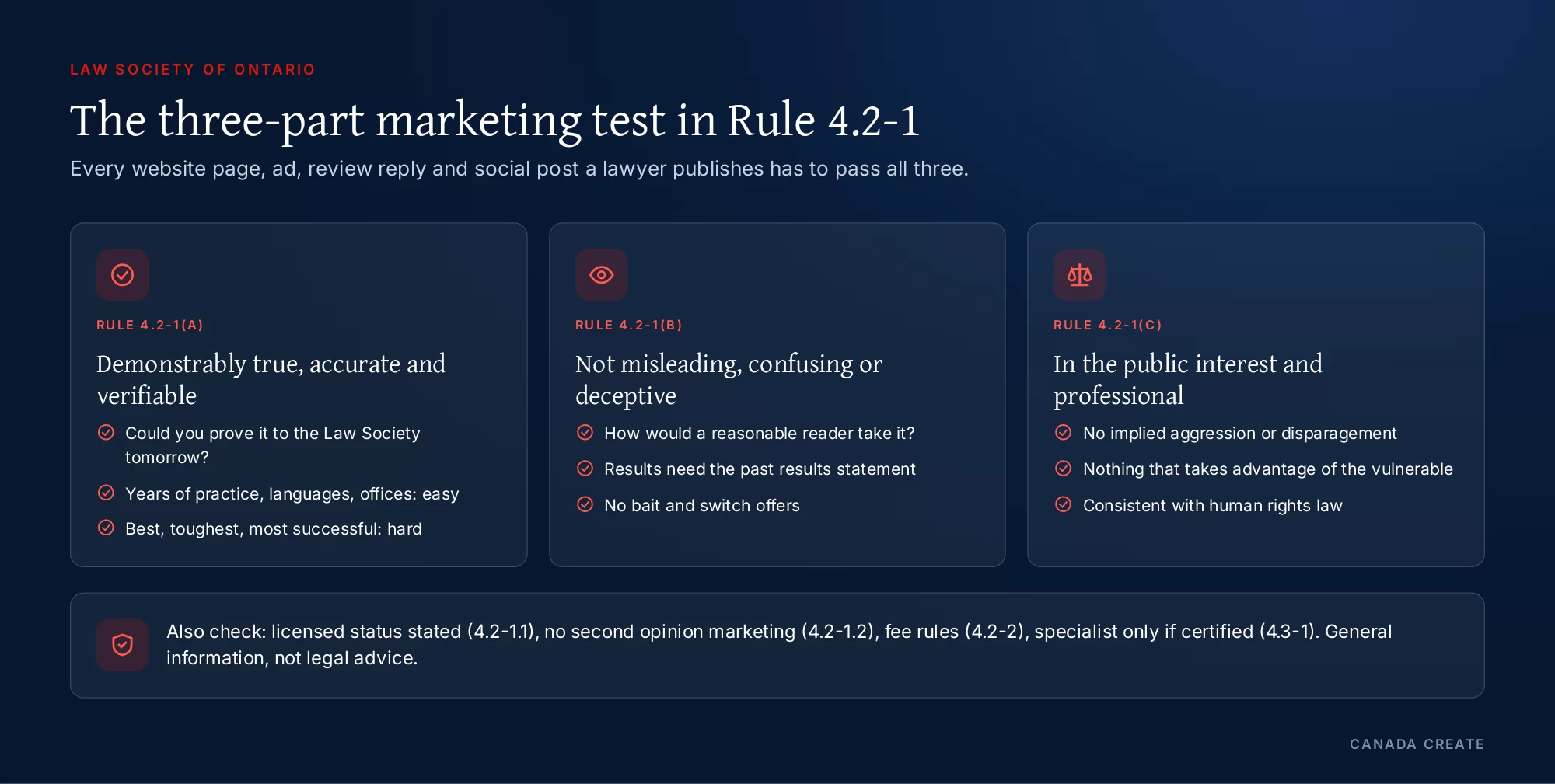
Rule 4.2-1 says a lawyer may market legal services only if the marketing:
- (a) is demonstrably true, accurate and verifiable;
- (b) is neither misleading, confusing, or deceptive, nor likely to mislead, confuse or deceive; and
- (c) is in the best interests of the public and is consistent with a high standard of professionalism.
A practical way to apply it: before publishing any claim, ask whether you could prove it to the Law Society tomorrow, and whether a reasonable reader could take it to mean something you could not prove. Commentary [1] confirms the rule covers claims about the size, location and nature of the practice and about awards, rankings and endorsements from third parties.
What may contravene the rule: commentary [2]
Commentary [2] to Rule 4.2-1 lists examples of marketing that may contravene the rule. These are not automatic breaches, but each needs care:
- Results and amounts recovered: stating an amount of money the lawyer has recovered for a client, or referring to the lawyer’s degree of success in past cases, unless accompanied by a further statement that past results are not necessarily indicative of future results and that the amount recovered and other litigation outcomes will vary according to the facts in individual cases.
- Superiority: suggesting qualitative superiority to other lawyers.
- Raising expectations: wording that leads readers to expect a particular outcome.
- Aggression: suggesting or implying the lawyer is aggressive.
- Disparagement: disparaging or demeaning other persons, groups, organizations or institutions.
- Emotional testimonials: using testimonials or endorsements which contain emotional appeals.
What does contravene the rule: commentary [3]
Commentary [3] lists examples that do contravene the rule:
- Marketing services the lawyer is not currently able to perform to the standard of a competent lawyer.
- Bait and switch marketing, where clients are attracted by offers of services, prices or terms different from those commonly provided to clients who respond.
- Marketing that fails to clearly and prominently disclose a practice of referring clients for a fee, or other consideration, to other licensees.
- Failing to expressly state that the marketed services will be provided by licensed lawyers, by licensed paralegals or both.
- Referring to awards, rankings and third party endorsements that are not bona fide or are likely to be misleading, confusing or deceptive.
Commentary [4] explains the purpose: marketing should make clear what services are actually available and who will provide them, with no bait and switch aspect.
Awards, rankings and superlatives
Commentary [5] says the terms awards and rankings “are intended to be interpreted broadly and to include superlative titles such as ‘best’, ‘super’, ‘#1’ and similar indications.” Awards, rankings and third party endorsements contravene the rule if they:
- do not genuinely reflect the performance of the lawyer and the quality of services but appear to do so;
- are not the result of a reasonable evaluative process;
- are conferred in part because of the payment of a fee or other consideration rather than a legitimate evaluation; or
- could not have been shown, at the time of reference, to comply with the rule.
The commentary adds that particular care is needed in mass advertising, such as newspaper, internet, television, billboard and transit advertising, where references must be “particularly clear and straightforward” because there is little opportunity to provide context. It also notes that genuine honours for professional or civic service, such as recognition from the Canadian or Ontario government, the Law Society or a professional organization, do not contravene the rule.
For marketing teams, the practical point is that “best lawyer”, “top law firm” and “#1” belong nowhere in headlines, titles or alt text unless they are the exact, verifiable name of a genuine designation, and paid “award” badges are a risk under both the professional rules and search engine guidelines.
Professionalism and human rights: commentary [6] and [7]
The rule also requires marketing to be consistent with a high standard of professionalism. Commentary [6] notes that marketing practices must conform to the requirements of human rights laws in force in Ontario. Commentary [7] gives examples of marketing that may be inconsistent with a high degree of professionalism: images, language or statements that are violent, racist or sexually offensive, that take advantage of a vulnerable person or group, or that refer negatively to other licensees, the legal profession or the administration of justice. This matters for creative campaigns, video and social content, where tone can drift.
Identifying licensed lawyers: Rule 4.2-1.1
Rule 4.2-1.1 says a lawyer marketing legal services “shall specifically identify in all marketing materials that they are licensed as a lawyer.” The commentary explains that the public should know that both lawyers and paralegals are licensed by the Law Society and whether a lawyer or a paralegal is offering the services. A firm that offers services from both should make that clear on its website and in ads.
Second opinions: Rule 4.2-1.2
Rule 4.2-1.2 prohibits the marketing of second opinion services. The commentary acknowledges that second opinions are valuable but says second opinion marketing is commonly undertaken to obtain the retainer rather than to provide a second opinion, a form of bait and switch, and that it is prohibited “whatever the intent of the marketing.” Ads, landing pages and website copy should not offer free or paid second opinions. The rule carries an amendment date of February 2017.
Advertising fees: Rules 4.2-2, 4.2-2.1 and 4.2-2.2
A lawyer may advertise fees under Rule 4.2-2 if:
- the advertising is reasonably precise as to the services offered for each fee quoted;
- it states whether other amounts, such as disbursements, third-party charges and taxes, will be charged in addition; and
- the lawyer strictly adheres to the advertised fee in every applicable case.
Residential real estate prices
Rule 4.2-2.1 sets a stricter standard for advertising a price to act on a residential real estate transaction. The price must be inclusive of all fees, disbursements and other amounts except HST and a listed set of permitted disbursements (land transfer tax, government registration fees, fees charged by government, Teranet fees, the cost of a condominium status certificate, payment for letters from creditors’ lawyers regarding similar name executions and any title insurance premium), and the advertisement must state that HST and those permitted disbursements are not included. A purchase price must include acting on the purchase and one mortgage; a sale price must include acting on the discharge of the first mortgage. The commentary says providing a price on a website counts as price advertising, whether prices are listed on a page or provided in response to a request made on a page, with an exception for a specific quotation based on an actual assessment of the transaction with full disclosure of the expected charges.
Contingency fees
Rule 4.2-2.2 says a lawyer must comply with Rule 3.6-2.2 if they market legal services on the basis that fees may be contingent on the successful disposition or completion of the matter. Rule 3.6-2.2 requires a lawyer who markets on that basis to publish a general maximum contingency fee percentage, on the lawyer’s website or, if there is no website, by providing it to potential clients when they first make contact, with some exceptions set out in the rule. The commentary says the published percentages should be easily accessible. For “no win, no fee” style messages, that means the website needs the published maximum before the ad runs.
Specialist claims: Rule 4.3-1
Rule 4.3-1 says a lawyer shall not advertise that they are a specialist in a specified field unless the Law Society has certified them as one. The commentary adds that a lawyer who is not a Certified Specialist may not use any designation from which a person might reasonably conclude that they are one, and that lawyers may advertise their areas of practice, a preferred or restricted practice, and their proficiency or experience in an area of law, as long as the representations are accurate and not misleading.
In practice, “practice focused on employment law” or “employment lawyer since 2012” describe a practice accurately; “employment law specialist” belongs only on a Certified Specialist’s materials.
Referral fees and marketing
Referral fees between licensees are governed by Rule 3.6-6.1, which allows them only under conditions that include a signed referral agreement in the Law Society’s form, a fee that is fair and reasonable and does not increase the client’s total fee, and a cap of fifteen percent of the fees paid for the first $50,000 of fees for the matter and five percent of any additional fees, to a maximum of $25,000. On the marketing side, commentary [3] to Rule 4.2-1 says marketing that fails to clearly and prominently disclose a practice of referring clients to other licensees for a fee contravenes the rule. A firm that advertises broadly and refers out much of the work it receives should say so plainly.
Reviews and testimonials
Reviews sit where professional rules, platform policies and consumer protection law meet.
- Asking for reviews: inviting satisfied clients to leave an honest review is common. Google’s policies prohibit offering incentives for reviews, even when any rating qualifies, and asking selectively can distort the picture the rules require to be accurate.
- Fake reviews: writing, buying or arranging fake reviews is deceptive under the Competition Act and against platform policies.
- Replying: replies should never confirm that the reviewer was a client or reveal anything about a matter. A short, courteous reply that invites the person to contact the firm works in most cases.
- Testimonials on the firm’s own materials: once a review or client comment appears on the website or in an ad, it is the firm’s marketing. Commentary [2] lists testimonials with emotional appeals among marketing that may contravene the rule, and client permission and confidentiality apply.
Our guide to what counts as a fake Google review covers the platform side in more detail.
Websites and search: a checklist
Before a law firm page goes live, check:
- Every factual claim can be documented.
- No headline, title, meta description or alt text uses best, top, #1 or similar wording unless it is a bona fide designation.
- “Specialist” appears only for Certified Specialists.
- Results or amounts recovered carry the past results statement, or are left out.
- Testimonials are permitted by the client, free of emotional appeals and reviewed by a lawyer.
- The page makes clear that services are provided by licensed lawyers, licensed paralegals or both.
- Fees, if shown, meet Rule 4.2-2, real estate prices meet Rule 4.2-2.1 and contingency fee marketing is supported by a published maximum percentage under Rule 3.6-2.2.
- There is no offer of second opinion services.
- Nothing reveals confidential client information.
- The privacy policy matches what the site’s forms, chat and analytics actually collect.
Google Ads and paid social: a checklist
Ads compress everything into a few words, so each element gets the same review:
- Headlines and descriptions describe services plainly, with no superiority, aggression, results or promises.
- Sitelinks, callouts and image text follow the same standard.
- Any offer in the ad, such as a free consultation, is what everyone who responds actually receives.
- The landing page supports every claim in the ad.
- Bidding on another firm’s name may be allowed by the platform, but using another firm’s name or trademark in ad text can mislead and may break platform trademark policies.
- Audiences and remarketing lists are not built from sensitive information such as criminal charges, family violence or health conditions.
- Mass formats, such as video, billboards and transit, keep any reference to rankings or endorsements particularly clear.
Our page on lawyer advertising in Toronto covers campaign planning, landing pages and measurement.
Social media, video and podcasts
Posts and videos that promote the firm are marketing. Educational content is valuable, but it should stay general and avoid advising an individual on their situation in public. Comments and messages that describe a person’s matter should move to a private, confidential channel. Video scripts follow the same rules as text: no outcome promises, no superlatives the firm cannot verify, no implied aggression and nothing that takes advantage of a vulnerable person. Paid influencer or partner content should be clearly identified as advertising.
Email, newsletters and CASL
Commercial email and texts need consent, identification of the sender and a working unsubscribe mechanism under Canada’s Anti-Spam Legislation, and unsubscribe requests must be given effect within ten business days. Purchased lists are not consent. Newsletters to past clients, referral sources and people who asked for updates are common in law firms; keep records of consent and honour unsubscribes promptly. Messages about an existing matter are different from promotional messages and should be kept separate.
Paralegals, notaries and immigration consultants
Ontario’s licensed paralegals follow the Paralegal Rules of Conduct, which also require marketing to be accurate and prohibit marketing second opinion services. Paralegal marketing should make clear that services are provided by licensed paralegals and should not use terms that suggest a law firm or a lawyer. Notary services are described differently from province to province, so marketing should use the correct local terms. Regulated immigration consultants are licensed by the College of Immigration and Citizenship Consultants, and marketing for any immigration service should never suggest promised approvals or a special relationship with the government.
Other provinces
Because most law societies have adopted the Model Code in large part, the core test in Rule 4.2-1 and the specialist rule in 4.3-1 look similar across Canada. The details differ: commentary, fee advertising rules, contingency fee requirements, referral rules and enforcement vary by province. A firm practising in more than one province should check each law society’s current rules, and national campaigns should follow the strictest applicable standard.
A pre-launch checklist for any lawyer marketing
- Can every claim be proven with documents today?
- Could a reasonable reader take any word to mean something you cannot prove?
- Does anything suggest superiority, aggression or a likely outcome?
- Do any awards, rankings or badges come from a genuine, evaluative process with no fee attached?
- Is it clear who provides the services, lawyers, paralegals or both?
- Are fees, prices and contingency arrangements stated as the rules require?
- Is there any offer of second opinion services?
- Does anything reveal confidential client information or identify a client without permission?
- Is the tone consistent with a high standard of professionalism?
- Have you checked your own law society’s current rules and commentary?
We build law firm marketing around these rules from the start. See law firm marketing in Toronto, SEO for lawyers and law firms in Toronto and our guide to how law firms get clients in Canada.
Frequently asked questions
What are the advertising rules for lawyers in Canada?
Each provincial law society sets its own rules, most based on the Federation of Law Societies' Model Code. The common test is that marketing must be demonstrably true, accurate and verifiable, not misleading, confusing or deceptive, and in the best interests of the public. Ontario's rules are in Sections 4.2 and 4.3 of the Law Society of Ontario's Rules of Professional Conduct.
Who regulates lawyer advertising in Ontario?
The Law Society of Ontario, through Chapter 4 of its Rules of Professional Conduct for lawyers and the Paralegal Rules of Conduct for licensed paralegals. The Competition Act, Canada's Anti-Spam Legislation, privacy law and advertising platform policies also apply to law firm marketing.
What counts as marketing under the LSO rules?
Rule 4.2-0 says marketing includes advertisements and similar communications in various media, as well as firm names including trade names, letterhead, business cards and logos. In practice that covers websites, ads, directory listings, social posts, Google Business Profiles, review replies, videos and newsletters.
What does demonstrably true, accurate and verifiable mean?
It means a claim must be correct and provable with evidence the firm could produce, not just believed. Statements such as years of practice, languages spoken, offices and memberships are easy to verify. Claims such as best, toughest or most successful usually cannot be verified, which is why the rules discourage them.
We plan and run law firm marketing across SEO, Google Ads and websites, within Law Society advertising rules.
What is the main advertising legislation in Canada?
The Competition Act prohibits false or misleading representations to the public across Canada, including fake reviews and misleading price claims. Canada's Anti-Spam Legislation governs commercial email and texts. Lawyers also follow their law society's professional rules, which add requirements specific to legal services.
Did Ontario change its lawyer advertising rules in 2017?
Yes. The Law Society of Ontario amended its marketing rules and commentary in 2017, including the prohibition on marketing second opinion services in Rule 4.2-1.2, which carries a February 2017 amendment date, and further fee advertising changes later that year. Referral fee rules were also tightened. Check the current text, as the rules continue to change.
Do the same rules apply to paralegals?
Licensed paralegals in Ontario follow the Paralegal Rules of Conduct, which have similar accuracy requirements and also prohibit marketing second opinion services. Paralegal marketing must make clear that services come from licensed paralegals and should not suggest a law firm or a lawyer.
Can a lawyer say they are the best lawyer in Toronto?
Avoid it. Commentary [5] to Rule 4.2-1 treats superlatives such as best, super and number one as awards or rankings, which must be bona fide and not misleading, and commentary [2] lists suggesting superiority to other lawyers among marketing that may contravene the rule.
Can a law firm ad say aggressive representation?
Commentary [2] to Rule 4.2-1 lists suggesting or implying the lawyer is aggressive among marketing that may contravene the rule. Words such as aggressive, ruthless or fighter are best avoided. Experience, focus and clear explanations convey confidence without that risk.
Can lawyers mention settlement amounts or case results?
Only with care. Commentary [2] says stating an amount recovered or referring to past success may contravene the rule unless accompanied by a statement that past results are not necessarily indicative of future results and that outcomes vary according to the facts. Client permission and confidentiality also apply.
What wording must accompany a past result in Ontario?
The commentary describes a statement that past results are not necessarily indicative of future results and that the amount recovered and other litigation outcomes will vary according to the facts in individual cases. It should sit with the result, not in a distant footnote, so readers see both together.
Can a lawyer call themselves a specialist?
Only if the Law Society has certified them as a specialist in that field, under Rule 4.3-1. Lawyers who are not Certified Specialists cannot use any designation that suggests they are. They can describe their practice areas, a restricted practice and their experience accurately.
Can a lawyer use the word expert?
The rules do not ban the word itself, but commentary to Rule 4.3-1 says a lawyer who is not a Certified Specialist may not use any designation from which a person might reasonably conclude they are one. Expert can create that impression in headlines and ads, so describing experience in concrete terms is safer.
What is bait and switch marketing for lawyers?
Commentary [3] describes it as attracting clients with offers of services, prices or terms different from those commonly provided to clients who respond. Advertising a service or price the firm does not actually provide to responders contravenes the rule.
Can a law firm advertise a free consultation?
Many do. The offer must be what everyone who responds actually receives, because bait and switch marketing contravenes the rule. The firm should also be careful that a free consultation is not presented as a second opinion service, which Rule 4.2-1.2 prohibits marketing.
Why is marketing second opinions prohibited in Ontario?
The commentary to Rule 4.2-1.2 says second opinion marketing is commonly undertaken to obtain the retainer rather than to provide a second opinion, a form of bait and switch. It is prohibited whatever the intent of the marketing, although giving a second opinion when asked remains a valuable service.
Must lawyers say they are licensed in their marketing?
Yes. Rule 4.2-1.1 requires a lawyer marketing legal services to specifically identify in all marketing materials that they are licensed as a lawyer, and commentary [3] says failing to state whether services will be provided by licensed lawyers, licensed paralegals or both contravenes Rule 4.2-1.
Can a law firm criticize other firms in its ads?
Commentary [2] lists disparaging or demeaning other persons, groups, organizations or institutions among marketing that may contravene the rule, and commentary [7] flags marketing that refers negatively to other licensees. Comparative claims about other firms are best avoided.
Can a lawyer mention awards and rankings?
Yes, if they are bona fide and not misleading. Commentary [5] says awards and rankings contravene the rule if they do not genuinely reflect the lawyer's performance, are not the result of a reasonable evaluative process, are conferred partly because of a fee or could not have been shown to comply at the time.
Are paid lawyer awards allowed?
Awards conferred in part as a result of the payment of a fee or other consideration, rather than a legitimate evaluation of the lawyer's performance and quality, contravene the rule under commentary [5]. Many badges sold to lawyers fall into that category, so check how any award is decided before using it.
Can a lawyer mention government or Law Society honours?
Yes. Commentary [5] says references to genuine honours for professional or civic service, such as recognition from the Canadian or Ontario government, the Law Society or a professional organization, do not contravene the rule, provided they reflect a genuine and responsible assessment.
Why do the rules single out mass advertising?
Commentary [5] says references to awards, rankings and endorsements in mass advertising, such as television, billboards, transit and internet ads, must be particularly clear and straightforward, because readers have little opportunity to reflect or see context. Short formats need the most care.
Can lawyers advertise their fees in Ontario?
Yes, under Rule 4.2-2, if the advertising is reasonably precise about the services offered for each fee, states whether disbursements, third-party charges and taxes are extra, and the lawyer strictly adheres to the advertised fee in every applicable case.
What are the rules for advertising a real estate closing fee?
Rule 4.2-2.1 requires an advertised price for a residential transaction to include all fees, disbursements and other amounts except HST and a listed set of permitted disbursements, and the ad must say those are not included. A purchase price includes one mortgage; a sale price includes discharging the first mortgage.
Is a price on a law firm website considered fee advertising?
The commentary to Rule 4.2-2.1 says providing a price by a website is price advertising, whether prices are listed on a page or only provided in response to a request made on a page. A specific quote based on an actual assessment of the transaction, with full disclosure of expected charges, is treated differently.
What must a lawyer publish to advertise contingency fees?
Rule 4.2-2.2 requires compliance with Rule 3.6-2.2, which says a lawyer who markets on the basis that fees may be contingent on success must publish a general maximum contingency fee percentage on their website, or provide it to potential clients at first contact if there is no website. Some exceptions apply.
Can a personal injury firm advertise no win, no fee?
Only if the marketing meets the contingency fee requirements, including a published maximum contingency fee percentage under Rule 3.6-2.2, and the wording is accurate about what the client may still pay, such as disbursements. The firm's lawyers should review the exact wording against the current rules.
What are the referral fee rules for Ontario lawyers?
Rule 3.6-6.1 allows referral fees only under listed conditions, including a signed referral agreement in the Law Society's form, a fee that is fair and reasonable and does not increase the client's total fee, and a cap of fifteen percent of fees for the first $50,000 and five percent of additional fees, to a maximum of $25,000.
Do law firms have to disclose that they refer work out?
Commentary [3] to Rule 4.2-1 says marketing that fails to clearly and prominently disclose a practice of referring clients to other licensees for a fee or other consideration contravenes the rule. Firms that advertise widely and refer out much of their work should say so plainly.
Can lawyers ask clients for Google reviews?
Asking satisfied clients to leave an honest review is common practice. Google prohibits incentives for reviews, even when any rating qualifies, and the firm must protect confidentiality. Ask neutrally, at a natural point such as the end of a matter, and never write reviews for anyone.
Can a law firm use testimonials on its website?
With care. Commentary [2] lists testimonials or endorsements containing emotional appeals among marketing that may contravene Rule 4.2-1. Testimonials should be genuine, used with the client's permission, free of emotional appeals and reviewed by a lawyer at the firm.
How should a lawyer respond to an online review?
Briefly and courteously, without confirming that the reviewer was a client or revealing anything about a matter. Thank the person or invite them to contact the firm directly. Replies are public marketing and should meet the same standard of accuracy and professionalism.
Are fake reviews illegal in Canada?
Fake reviews can be false or misleading representations under the Competition Act and break platform policies. For lawyers they also conflict with the professional rules on accurate marketing. Firms should never write, buy or arrange reviews, and agencies should never offer to.
Do the LSO rules apply to Google Ads?
Yes. Search, display and video ads are marketing under Rule 4.2-0, so headlines, descriptions, sitelinks, image text and the landing pages they lead to must meet Rule 4.2-1. Short ad text leaves little room for context, so it needs particular care.
Can a law firm bid on another firm's name in Google Ads?
Google's policies may allow bidding on another firm's name as a keyword, but using that name or trademark in the ad text can mislead and may break Google's trademark policy. Many firms avoid it entirely because of the risk of confusing searchers.
Can lawyers target ads to people with a specific legal problem?
Search ads naturally reach people searching for legal topics. Building audiences or remarketing lists from sensitive information, such as criminal charges, family violence or health conditions, raises privacy and platform policy problems. Keep targeting to searches, locations and general website visitors.
Do the rules apply to lawyer social media posts?
Posts that promote the firm or its services are marketing and follow the same rules. Educational posts should stay general and avoid advising an individual publicly. Paid partner or influencer content should be clearly identified, and comments about specific matters should move to a private channel.
Do the rules apply to law firm websites?
Yes. Every page, heading, title, meta description, image alt text and profile is marketing. Websites are where results pages, testimonials, fee information and specialist claims usually appear, so they need a full review before launch and after any major change.
Can lawyers use AI tools to write marketing content?
They can, but the lawyer remains responsible for the content. AI drafts can contain confident errors, superlatives or outcome language that breaches the rules, so every statement needs review by someone qualified before it is published, exactly as with human-written content.
Do lawyer newsletters need consent under CASL?
Commercial electronic messages need consent, sender identification and a working unsubscribe mechanism, and unsubscribe requests must be given effect within ten business days. Purchased lists are not consent. Messages about a client's existing matter are different from promotional newsletters.
What privacy rules apply to law firm marketing?
Collect only the information needed, protect it and say clearly how it is used. Contact forms should not invite confidential details before the firm agrees to act, analytics and ad tracking should not capture legal matter details, and identifiable people appear in photos or stories only with consent.
What rules apply to immigration consultants' advertising?
Regulated immigration consultants are licensed by the College of Immigration and Citizenship Consultants, which has its own code of conduct. Marketing for any immigration service should never suggest promised approvals or a special relationship with the government, and should make clear who provides the service.
Are lawyer advertising rules the same in every province?
The core accuracy test is similar because most law societies adopted the Model Code, but commentary, fee advertising, contingency fees, referral rules and enforcement differ. Firms practising in several provinces should check each law society's current rules and follow the strictest standard in national campaigns.
What is the Federation of Law Societies' Model Code?
It is a model set of professional conduct rules published by the Federation of Law Societies of Canada, which most provincial law societies have adopted in large part. Its marketing provisions are the basis for rules such as Ontario's Rule 4.2-1, although each province adapts them.
What happens if a lawyer breaks the marketing rules?
Complaints can be made to the law society, which can investigate and take regulatory action depending on the circumstances. Misleading advertising can also raise issues under the Competition Act. Firms reduce the risk by reviewing every piece of marketing before it is published.
How can a law firm check its marketing before publishing?
Use a checklist: every claim provable, no superlatives or superiority, results with the required statement, no specialist claims without certification, licensed status clear, fees and contingency fees stated as required, no second opinion offers, nothing confidential and a professional tone. A lawyer signs off before publication.
Who is responsible when an agency writes a law firm's marketing?
The lawyer and firm remain responsible for their marketing under the professional rules, whoever drafts it. A good agency builds the rules into its process and flags risky wording, but the firm's lawyers should approve every legal statement before it goes live.
Can a law firm's name or tagline breach the rules?
Yes. Rule 4.2-0 includes firm names, trade names, letterhead, business cards and logos in the definition of marketing. A trade name or tagline that implies superiority, specialization or a likely outcome can be as problematic as an ad, so it deserves the same review.
How often should a law firm review its website for compliance?
At least once a year and whenever the rules change, a lawyer joins or leaves, a fee structure changes or new content is added. Old pages with outdated results, badges or wording are a common source of problems, so include archived posts and directory profiles in the review.