
How employment lawyers get more clients in Canada

Employment-law marketing should help your firm attract work it is equipped to accept, not simply generate more enquiries. An employee-side practice may want more paid consultations or suitable dismissal files. An employer-side practice may want advisory relationships, investigation instructions or defined project work. A mixed practice needs both goals made clear without treating every incoming enquiry as commercially useful or professionally available.
The purchasing decision starts with the practice you want to build. What work fits your lawyers, capacity and geography? What does an initial conversation actually offer? How much can the firm invest before fees are collected? This guide helps Canadian employment-law firm owners compare marketing options, evaluate supplier proposals and judge results without relying on promised rankings, fixed hiring timelines or assumed case values.
Choose the employee-side and employer-side work you want
Begin with a description of acceptable new work rather than a target for total leads. An employee-side firm might welcome a defined document-review engagement but not have capacity for new litigation. An employer-side firm might prefer ongoing advice for established businesses rather than isolated investigations. Those are different commercial choices even when the same lawyer could technically provide both services. A marketing proposal should explain which choice it supports and which enquiries will fall outside its purpose.

For a mixed practice, the audience split also affects availability. Consider a hypothetical firm receiving ten promising employer enquiries after expanding its visibility. Four cannot proceed because the firm identifies conflicts. Of the six remaining enquiries, three need services outside its agreed practice scope. The marketing report has ten enquiries, but the owner has only three possible engagements. That is not an argument against growth. It is a reason to agree what counts as suitable work before comparing suppliers or approving a larger commitment.

Define your geographic and jurisdictional scope with the lawyers responsible for delivery. Location alone does not settle every employment-law question. The federal government’s jurisdiction overview distinguishes federally regulated workplaces from provincial and territorial employment standards. Your public service descriptions should reflect the work your firm actually handles, with legal claims approved for the relevant jurisdiction rather than copied across Canada.

| Owner decision | Employee-side practice | Employer-side practice |
|---|---|---|
| Work to attract | Specify the reviews, negotiations or disputes the firm can accept. | Specify advisory, project or dispute work and the businesses the firm can serve. |
| Initial service | Explain screening, consultation scope, fees and document requirements. | Explain who will assess the business need and what an initial discussion covers. |
| Timing | Individual circumstances and stated deadlines need professional assessment. | Urgent events and planned purchases can both occur; confirm the actual decision process. |
| Channel comparison | Evaluate search visibility, paid promotion, reputation and referrals against suitable enquiries. | Evaluate the same options alongside professional relationships and relevant business communications. |
| Meaningful result | Suitable consultations, accepted files and fees collected, with delivery costs shown separately. | Suitable business discussions, accepted projects and advisory fees collected, with delivery costs shown separately. |
We plan and run employment lawyer SEO for law firms in Toronto and across Canada, scoped in writing after a free review.
The table is a decision aid, not a claim that employees hire within days or businesses take weeks. Either audience can have an immediate need or defer a purchase. Ask prospective marketing partners to explain their assumptions about your particular audience, and compare those assumptions with your own aggregate enquiry history. Where you have little history, make that uncertainty part of the investment decision instead of accepting a confident forecast built on another firm’s experience.
Understand employee enquiries without confusing attention with fit
A person looking for an employment lawyer is not necessarily looking for the service your firm wants to sell. They may need a limited review, representation in a dispute, an explanation of an unfamiliar document or help outside your jurisdiction. For the owner, the useful distinction is between interest in an employment topic and a realistic opportunity for an appropriate engagement. A proposal centred on search traffic should explain how its recommended work relates to that distinction.
Evaluate whether a supplier understands the questions a prospective client must answer before contacting you: whether you act for employees, whether the relevant lawyer is accepting work, what the first appointment involves and whether it carries a fee. These are matters of service clarity, not permission to advise an unknown person about their dismissal. The marketing should explain access to your professional service without pretending that a short public article can decide an individual case.
Keep demand evidence in its proper place. A national estimate for a phrase containing a city name is not a count of prospective clients living in that city. A search estimate is also not a forecast of enquiries your firm will receive. Ask for the market, period and limitations behind any demand claim in a proposal. More importantly, ask why the apparent demand matches your actual service scope rather than a broad informational audience.

A national estimate for a phrase containing a city name is not a count of local prospective clients or a forecast for your firm. Ask what was measured, when, and why it relates to work your firm accepts.
One useful buying test is to compare two otherwise similar proposals. One promises more visitors interested in workplace problems; the other identifies the intended matter mix and explains what suitable initial enquiries would look like. The second gives you a clearer basis for evaluation, even before results exist. Neither deserves approval on its wording alone: the scope, evidence, cost and responsibilities still need examination.

A visitor-total promise and a proposal tied to suitable enquiries offer different ways to judge progress. Examine the scope, evidence, full costs and responsibilities of both; attractive wording alone does not justify approval.
Make the first review offer understandable
A severance-review service can be a clear starting point when it reflects what your firm actually offers. It is not automatically a better offer than a consultation, and its label does not establish profitability. Decide whether the initial service is screening, a paid legal consultation, a document review or a broader engagement. The prospective client should not discover after making contact that the advertised service is materially different from the one available.
Compare what the proposed website and advertising will say about the reviewer, scope, price and next step. Does the offer include a meeting with a lawyer? Is written advice included? What work falls outside the initial fee? Can the practice reasonably meet the response expectation being advertised? These details should come from the firm’s approved service, not from an agency’s preferred sales wording. Clear boundaries let a potential client make a more informed choice.
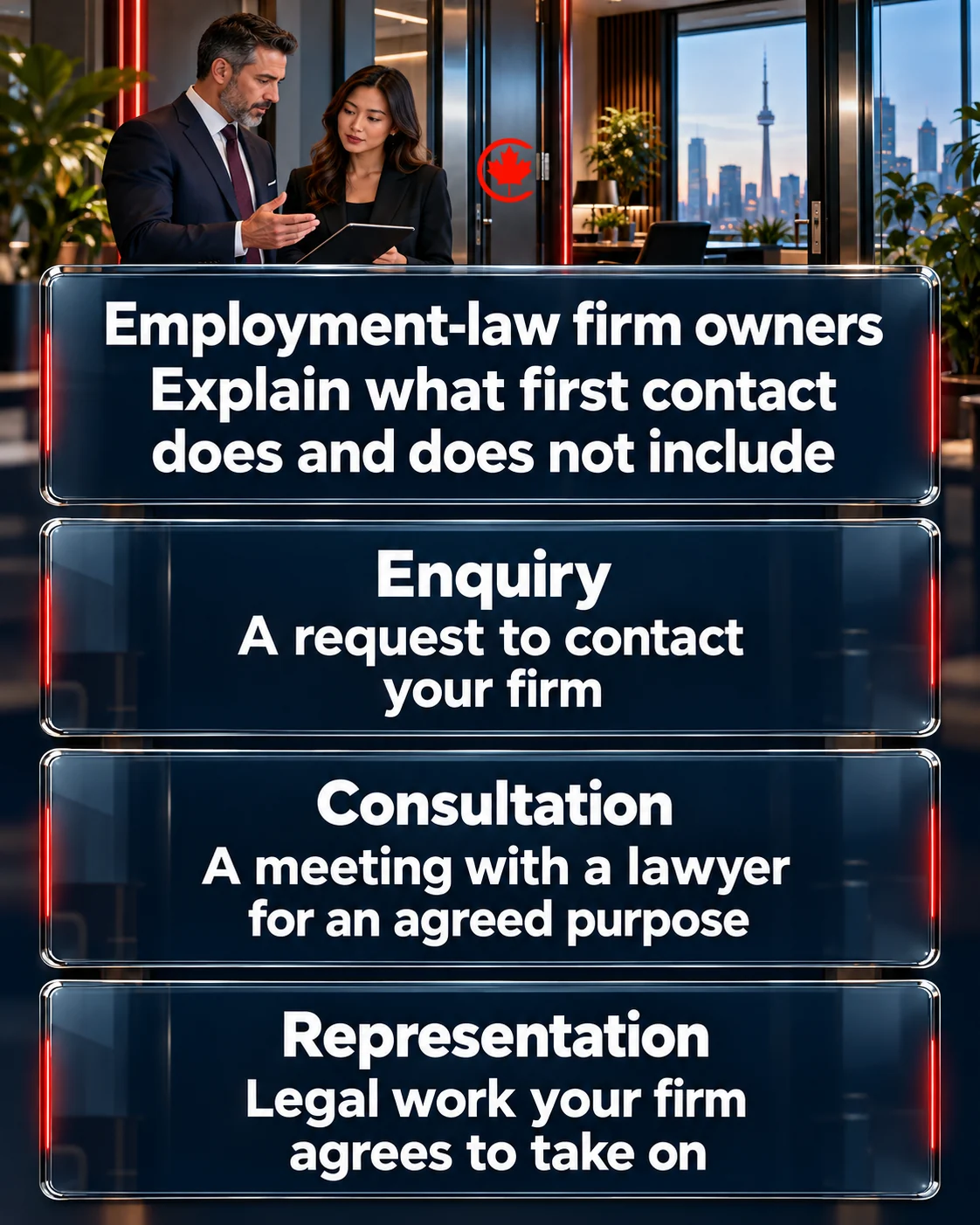
In a hypothetical comparison, Firm A advertises a free review but provides only a brief administrative screening call. Firm B advertises a paid consultation and explains what the lawyer will assess. A report might show more initial contacts for Firm A while Firm B uses less staff time on misunderstandings. Without consultation attendance, suitability and collection information, the owner cannot conclude that either offer is commercially stronger. The right comparison includes the whole initial-service experience.

If a free review means administrative screening while a paid consultation includes a lawyer’s assessment, the contact totals are not a like-for-like measure of commercial value. Compare consultation attendance, suitability, staff time and collections before judging either offer.
Assess calculators as a service and reputation decision
A calculator deserves a separate owner decision because a numerical output can look authoritative even when its assumptions are narrow. Before commissioning one, ask who is responsible for the legal basis, jurisdiction, updates and explanation of limitations. Compare that continuing responsibility with the simpler option of clearly describing a professional review. Do not approve a calculator because a supplier promises traffic, and do not present a calculation as an assessment of someone’s entitlement.

Before commissioning a calculator, identify who will review its legal basis, confirm its intended jurisdiction, maintain it and explain its limitations. Compare that responsibility with clearly describing a professional review. A numerical output must not be presented as an assessment of an individual’s entitlement.
Buy service clarity, not a larger collection of pages
A website proposal should make it easier for the right visitor to recognize the work your firm handles. That does not mean every possible employment issue needs its own new page. Ask which existing descriptions are unclear, which genuine services lack explanation and which proposed additions would duplicate what is already available. A long list of content deliverables is not, by itself, evidence that the investment will help a prospective client choose your practice.
Review proposed coverage against your actual lawyers and capacity. A firm may handle executive exits but not workplace investigations, or employer contracts but not union-related matters. These distinctions belong in the owner’s approval criteria. Buying broad coverage without resolving them can create a public service promise the practice did not intend. It can also increase the time spent explaining to unsuitable enquirers that the firm cannot assist.
Ask for examples of the decisions the finished content will help a visitor make. Useful answers include understanding who the firm acts for, the boundaries of a consultation, the lawyer’s relevant experience and how to request an appropriate appointment. Less useful answers focus only on page totals or vague claims about visibility. You are buying a clearer connection between your professional offering and a suitable prospective client, not an editorial inventory for its own sake.
Approval responsibility matters as much as coverage. Identify the lawyer who can review each topic, the time required and the person who will approve later changes. If that reviewer is unavailable, reduce the initial scope rather than treating unchecked legal content as a routine marketing asset. A smaller, accurate description of a service you can deliver is a sounder starting point than an ambitious promise with no qualified owner.
Evaluate local visibility and reputation responsibly
Local visibility is useful only when the information presented matches the practice. A prospective client may want to know whether an appointment is remote or in person, which office they can attend and which lawyers are available there. Ask a supplier what factual checks and approvals are included in its proposed work. Do not confuse a presence in search results with proof that your firm can provide every service throughout the area being described.
Reputation work should also fit the sensitivity of employment matters. A person may value the service but prefer not to discuss a workplace dispute publicly. For your buying decision, ask how the proposed service respects that choice, who approves public responses and what happens if a review includes confidential allegations. A promise to increase review totals is not an adequate substitute for boundaries around the people and matters involved.
Google’s Maps content policy prohibits incentives for reviews, discouraging negative reviews and selectively seeking positive reviews. An owner’s acceptance criteria should reject those practices rather than reward a supplier solely for a higher rating. Platform requirements are separate from the firm’s professional obligations, including the assessment of what may be disclosed in any response.
A reasonable proposal makes responsibilities visible: the firm approves sensitive wording, the supplier explains what reputation support is included, and neither treats a public review as permission to republish a detailed client story. Evaluate examples of how the supplier communicates, not just screenshots of star ratings. A restrained response and a clear private contact option may serve the practice better than a detailed public defence of a disputed interaction.
Compare paid search with other investments
Paid search, organic visibility, professional relationships and business communications address different opportunities. Paid promotion may be worth considering when the firm has an understandable offer, capacity for suitable enquiries and a budget it can sustain while results are evaluated. Organic work may address an unclear or incomplete online presence. Relationship-led activity may support an employer practice whose prospects need to understand its lawyers over several interactions. None is a universal winner.
Ask each supplier to state the problem its recommended investment is intended to solve. If people already enquire but cannot obtain an appropriate appointment, buying more reach may amplify the problem. If the firm has capacity but its public offering is unclear, service presentation may deserve attention before additional promotion. If suitable employer contacts know the firm but not its advisory scope, the decision may concern communication rather than a larger advertising commitment.
Separate media expenditure, management fees, website work, content, reporting and internal review time when comparing proposals. A lower monthly fee can exclude work another supplier includes, while a larger package can contain deliverables you do not need. Ask what is one-time, what recurs and what would require a change in scope. Compare the cost of the agreed outcome and responsibilities, not only the headline amount on the proposal.
Click prices do not tell you what a retained file will cost. The firm also needs to understand the share of enquiries it can accept, consultation attendance, engagement decisions and actual collections. A high-value matter that requires substantial lawyer time is not equivalent to a high-margin matter. Avoid treating a potential settlement amount as firm revenue, or a signed engagement as cash already available to pay marketing invoices.
For further buying context, compare Google Ads for lawyers, how to target buying committees with LinkedIn Ads and the cost per click by practice area. Evaluate each against your practice rather than treating a channel description or historical estimate as a forecast. A suitable proposal explains both why an option is relevant and what evidence would justify changing the investment.
Choose content that demonstrates the service accurately
For an employee-side practice, useful public content can clarify what happens in a consultation and which kinds of work the lawyers undertake. For an employer-side practice, it can explain the scope of an advisory relationship or how a proposed professional service fits a business need. The owner should be able to identify the buying question each piece answers. Content that merely repeats legal terminology may add volume without making the firm easier to evaluate.
Legal content needs a defined review owner and a maintenance decision. Ask whether the engagement includes later revisions when your services or the relevant law change, and what happens to material the firm can no longer stand behind. A publication date does not establish continuing accuracy. A supplier should not present an old article as current merely because its design looks fresh or it remains visible on the website.
Use scenarios to explain a professional service without making them look like client results. A hypothetical employer arranging advice before a planned business change can illustrate the questions a consultation will address. It should not imply that every employer faces the same duties or that the firm can guarantee a particular result. Similarly, an employee-facing example should show the review process without calculating a stranger’s entitlement or telling readers what action to take in their own case.
Decide which evidence the practice is comfortable making public. Verified qualifications, a clear practice focus and an accurate description of service can be more useful than a dramatic but poorly explained recovery figure. Ask suppliers to distinguish evidence they can substantiate from persuasive wording they would like to use. That distinction protects the firm’s credibility while leaving room for clear, confident explanations of genuine strengths.
Assess professional relationships and referral arrangements
Professional relationships are another route to suitable enquiries, but they are not costless or automatically appropriate. An introduction from an accountant, another lawyer or an HR contact may involve time, events or proposed commercial terms. Ask what a supplier is actually offering: public communications, event support, relationship development or a payment tied to referred work. Those are different purchases and should not be bundled behind the vague promise of more referrals.
Referral-payment rules require jurisdiction-specific review. For example, British Columbia’s Code, rules 3.6-6 to 3.6-8, sets conditions for lawyer-to-lawyer referral fees, restricts rewards to non-lawyers and contains a specific multidisciplinary-practice exception. That is not a nationwide permission or prohibition covering every arrangement. Have the responsible lawyer assess the actual proposed payment before making a commitment.
Separate the value of an introduction from permission to discuss the matter. An external contact may want an update, but the firm should decide what it may appropriately communicate. Your marketing partner does not need details of a workplace allegation to understand that a relationship generated an enquiry. For owner reporting, suitable aggregate categories can be more useful than distributing the identity and circumstances of every referred person.
Match intake promises to real capacity and confidentiality
A stated deadline deserves attention, but an initial message does not establish what the deadline means or whether the firm can act. Marketing should accurately distinguish receiving an enquiry, arranging a consultation and accepting instructions. An automated acknowledgement is not the same as a lawyer’s review. Before approving language about immediate help or same-day advice, confirm who will deliver it, when they are available and how the firm handles requests it cannot accept.
Consider a hypothetical employee contacting the firm late on a Friday with a document they say expires on Monday. A website promising instant legal help creates an expectation that a message-taking service cannot fulfil. The buying issue is not whether the form looks modern. It is whether the public promise matches the firm’s actual arrangements for assessing urgent enquiries. The lawyers, not the marketing supplier, should determine the professional meaning of the response.
Document handling deserves its own acceptance criteria. Ask which information is needed at initial contact, when more material is appropriate and who can see it. A termination letter can include information about other employees, health issues or internal business affairs. Requesting an entire case file simply to register marketing interest can expose much more than the commercial discussion requires. The firm should approve a suitable boundary between contact information and confidential professional material.
British Columbia’s confidentiality rule and commentary extend protection beyond a signed retainer to people seeking professional advice or assistance. This illustrates why a firm should not assume that unretained enquiries are freely usable marketing data. Obtain the applicable professional and privacy assessment for your own practice before approving access or disclosure.
For software purchasing context, see choosing a CRM for small business in Canada. Compare access, responsibility, retention and handover requirements rather than assuming that a new system will make follow-up reliable. The relevant service question is whether staff can use the agreed arrangement safely and consistently, including when the usual contact is away or the agency relationship ends.
Approve claims and data use for the actual jurisdiction
Professional rules are not a single national marketing checklist. British Columbia’s marketing rules prohibit false, inaccurate, unverifiable or misleading promotion and identify unjustified expectations of results as a concern. Its specialization rule restricts specialist titles unless authorized as specified in the rule. A description suitable for one jurisdiction should not be reused elsewhere without the responsible lawyer’s assessment.
Review recovery figures, testimonials and credentials in the context in which a prospective client will see them. What does the statement actually prove, whose consent is required and what might a reader wrongly infer? Do not assume that adding a general disclaimer makes any claim acceptable. In particular, a result from a different kind of matter should not be presented as a typical outcome for the service now being promoted.
Google’s negative-financial-status policy lists unemployment resources within a sensitive-interest category. Its personalized advertising rules restrict advertiser-curated audiences for sensitive-category promotions. These policies require assessment of the actual service and content; the word employment does not automatically make every legal-service advertisement an employment-opportunity advertisement. Ask what policy assumptions a proposal relies on without assuming all paid search is prohibited.
Measurement has separate limits. Google’s customer data policy prohibits sensitive-category conversions in enhanced conversions and store-sales uploads, including listed health, union and negative-financial information. General consent language or hashing does not establish eligibility for a prohibited use. Ask what information a supplier proposes to receive or share, and have the firm approve the actual use rather than accepting a broad promise of improved attribution.
Read lawyer advertising rules in Canada for related context. Your lawyers remain responsible for approving their own professional claims; a marketing engagement is not a substitute for that assessment.
Measure suitable work and collections, not only activity
Ask for reporting that distinguishes the stages a prospective client goes through when considering and paying for your firm’s legal services. An enquiry, an appropriate consultation, an accepted engagement, an invoice and collected fees answer different questions. Combining them into one conversion total can make a weak result look strong or hide worthwhile progress. The owner should know which event a reported number represents, which period it covers and whether the underlying records are complete enough to support a decision.
A mixed practice needs separate interpretations of employee and employer work. Ten completed employee consultations and two substantive employer discussions cannot be compared solely as twelve leads. They may have different delivery demands, collection timing and likelihood of further work. Ask for enough separation to judge each objective, without giving the agency confidential client narratives. Report commercial progress in terms that the partners and practice manager can recognize.
Look for explanations of unsuitable enquiries as well as successful engagements. A conflict, unavailable capacity, a service mismatch and a person who chooses not to proceed are different reasons. They can point to different owner decisions. An increase in contacts that the firm cannot accept does not necessarily justify more spending, even if the headline cost per enquiry falls. Equally, a quieter period is not proof of failure when the sample is very small.
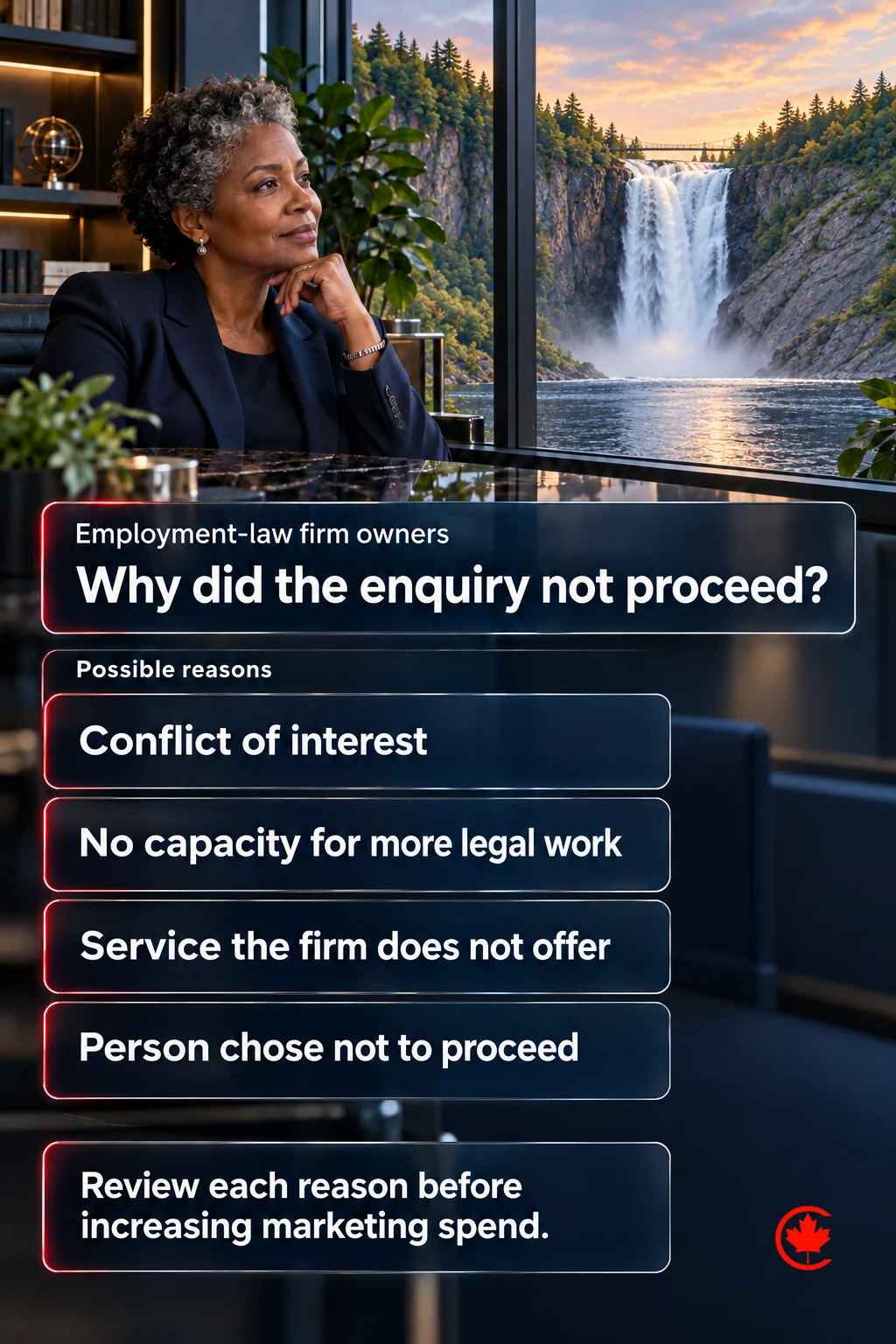
Be cautious about attribution. Someone may hear about the firm from a professional contact, read its website and later call after seeing an advertisement. A report may not identify every influence, and incomplete records should remain incomplete rather than being assigned convenient certainty. Agree how the supplier will explain known limits and reconcile its figures with the firm’s aggregate records. That makes the review useful even when measurement cannot tell a perfect story.
Evaluate employer relationships on their own terms
An employer-side proposal should identify who the practice wants to serve and what those businesses can genuinely buy. An owner-managed company seeking occasional advice is different from a larger HR team seeking outside counsel for defined projects. Neither automatically needs an ongoing retainer, and a single instruction does not prove a recurring relationship. Compare the supplier’s assumptions with the access, fees and availability your practice is prepared to offer.
Useful communication can help a business understand the firm’s approach, but the format should follow the buying need. A briefing may demonstrate how the lawyers explain a complex issue; an event may allow prospective clients to meet them; a service description may answer a procurement question. Ask why a proposed format matters to your intended audience and how much lawyer time it requires. Do not accept a claim that webinars or professional networking always outperform advertising.
The CRTC’s CASL guidance identifies consent, sender identification and an unsubscribe mechanism as core requirements for commercial electronic messages, with the applicable exceptions and forms of consent requiring assessment. A professional contact or event attendee should not simply be treated as an unrestricted marketing list. Have the firm approve the communication purpose and permission basis before including ongoing email or text activity in the engagement.
For a hypothetical employer-advisory practice, one useful outcome may be a qualified discussion with a business whose needs match an available partner. That is progress, not a retained relationship or a lifetime revenue figure. Ask reports to show what remains unresolved, such as scope, professional clearance or procurement. The owner can then judge whether continued investment is supported without either dismissing early interest or overstating its value.
Specify the website experience you are buying
Review the website as an intended client would. Can an employee tell whether the firm acts for individuals? Can an HR manager understand the employer offering without reading employee-focused material? Can either visitor find the relevant consultation information and a usable contact route? These are concrete acceptance questions for a website engagement. They are more useful than approving a redesign because a presentation looks polished.
Include practical usability in the scope. Readable text, understandable forms, mobile access and clear fee explanations affect whether the intended service is easy to assess. If accessibility conformance is required, agree the standard, testing and responsibilities expressly rather than assuming a visual refresh includes it. Distinguish a promise to improve usability from an unsupported certification or a guarantee that every person will complete an enquiry.
Ask what will actually be tested and what evidence the firm will receive. Seeing a form on screen does not demonstrate that a message reaches the appropriate recipient. Equally, a successful test does not prove permanent reliability. Agree the checks and responsibility for later problems, including changes the firm makes itself. The owner should understand which support is included, which maintenance is separate and where staff should report a failure.
Use credible people and evidence, not inflated positioning
A lawyer profile should help a prospective client identify relevant professional experience and service fit. Check the current role, practice focus, languages actually offered and credentials the lawyer is entitled to describe. If a firm serves both employees and employers, the profile should not leave the audience to guess which work that person handles. The owner is approving a representation of a real professional, not just a persuasive biography.
Video is a purchasing option, not a requirement for credibility. Compare the time, production cost and maintenance needs with the question it will answer. A short explanation of what an initial consultation involves may be useful; a polished presentation that makes unsupported claims about results is not improved by its production quality. If the lawyer’s availability or offering changes, decide who will review the video and whether replacement is included.
When evaluating an agency’s own proof, ask what was delivered, when and for what type of practice. A public result without a period, scope or clear outcome is difficult to interpret. Confidentiality can reasonably limit what a supplier shares, but it does not justify inventing certainty. Judge the explanation, relevance and evidence together, and do not treat another firm’s recovery amounts, growth or enquiry totals as a promise about your future practice.
Treat consultation economics as part of the purchase
A consultation can be a complete professional service, a step toward further work or both, depending on what the firm offers. Decide which role matters to your business before judging conversion rates. A valuable paid consultation that does not lead to litigation is not automatically a failed lead. Conversely, a high number of free appointments can consume substantial professional time without producing work the practice intends to accept.
Compare appointment bookings with attendance, suitability, time required and collections. For a hypothetical firm charging CAD $300 for a consultation, ten completed and paid consultations produce CAD $3,000 in fees before delivery costs and overhead. That does not mean CAD $3,000 is available for acquisition spending. Lawyer and staff time still have a cost, and any later file revenue must be assessed separately without counting the same fee twice.
Professional judgement must remain separate from sales pressure. A marketing report should not encourage lawyers to accept unsuitable work simply to improve a retention percentage. Ask how the review will distinguish a sound professional decision not to proceed from a preventable misunderstanding about the advertised service. That distinction supports better buying decisions while respecting the firm’s responsibility for its own clients, capacity and case acceptance.
A hypothetical CAD investment comparison
Consider a fictional employee-side firm evaluating a defined review period. It allocates CAD $4,000 to media, CAD $1,500 to marketing management and CAD $500 to additional intake administration, for CAD $6,000 in acquisition expenditure. These invented amounts illustrate a decision, not a market price or recommended budget. The example excludes taxes and assumes no separate website project; a real comparison would include the applicable tax treatment and every additional cost.
Suppose the firm receives 40 enquiries, of which 20 fit its initial screening criteria. Twelve people complete paid consultations at CAD $300, generating CAD $3,600 collected. Four subsequently retain the firm for additional work, and those files generate a further CAD $12,000 collected during the assessment period, excluding consultation fees. Total collected revenue is CAD $15,600. Acquisition expenditure is CAD $500 per completed consultation or CAD $1,500 per retained follow-on file.
Now assume direct delivery costs are CAD $1,800 for the consultations and CAD $6,000 for the subsequent work. That leaves CAD $7,800 before acquisition expenditure, and CAD $1,800 after the CAD $6,000 acquisition total. The remaining amount still has to contribute to general overhead and profit. The retained-file cost alone would not reveal this position. The owner needs the delivery and collection assumptions as well as the marketing figures.
If only CAD $6,000 of subsequent fees had been collected by the review date, total collections would instead be CAD $9,600. Holding the stated delivery costs unchanged leaves CAD $1,800 before acquisition and a CAD $4,200 shortfall after it. Some fees might arrive later, but that possibility does not pay today’s bills. Review timing therefore affects the conclusion, and the firm should separate cash collected from expected future income.
For a separate hypothetical employer-side example, suppose the firm spends CAD $2,000 acquiring a defined contract-review project, collects CAD $6,000 and incurs CAD $3,500 in direct delivery costs. It has CAD $500 remaining after those acquisition and delivery costs, before general overhead. The business also discusses ongoing advice at CAD $1,500 monthly but has not agreed to purchase it. That discussion adds nothing to current collections. If a later, separately agreed month produces CAD $1,500 collected and CAD $1,000 in direct delivery costs, it contributes another CAD $500 before other costs. Neither the first project nor that later month establishes years of retained revenue. These fictional figures are not recommended fees or performance targets.
An employer-side comparison may use a different observation period, but it should be equally disciplined. Do not assign years of advisory revenue to a business merely because it attended a meeting. Start with the accepted scope and collections that actually occur, then separately identify uncertain future work. Use the example to challenge assumptions in a proposal, not to adopt its fictional enquiry rates, fees or budget as targets.
Agree owner checkpoints, supplier scope and stopping criteria
Before engagement, settle the audience, suitable matter mix, capacity, initial service and affordable financial exposure. Then ask the supplier to state the deliverables, exclusions, approval responsibilities and evidence for its recommendations. This checkpoint should reveal disagreements before money or lawyer time is committed. A calendar labelled ninety days cannot resolve an unclear service or establish when a marketing investment will produce useful work.
Media spend is separate from management fees. Accounts remain the client’s where platforms permit. Read them in full before engaging. Marketing work is not a compliance review, and results are not guaranteed.
For any proposal, ask what you can continue using after the engagement and what depends on a separate licence, subscription or supplier relationship. Clarify access to accounts, ownership of commissioned materials, the format of handover and any remaining charges. If a website, reporting service and advertising service are bundled, identify what happens to each component separately. A vague statement that you own everything may overlook third-party rights or conditions in the agreement. Resolve those questions before signing.
During delivery, distinguish acceptance of contracted work from evidence of business results. Confirm whether the agreed service descriptions are accurate, whether the intended contact experience has been checked and whether staff understand the handover. If legal review or access is missing, acknowledge the dependency rather than approving unfinished work because a launch date is near. Your partner should explain the impact and any proposed scope change in writing.
At the commercial review, compare actual expenditure, suitable enquiries, consultation activity, collections and available capacity with the assumptions you approved. Decide in advance what would justify more investment and what would prompt reassessment, such as unaffordable acquisition costs, repeated unsuitable demand or an unresolved data-handling concern. Review the agreement before assuming that a campaign pause ends the engagement.
Avoid the purchases that create the wrong kind of growth
The most expensive mistake may be buying volume the practice cannot use. A busy phone does not compensate for conflicts, unclear service scope or unavailable lawyers. Another is buying an impressive collection of deliverables without deciding what a prospective client needs to understand. Bring the discussion back to the work you can accept, the experience you can deliver and the evidence that would make further investment sensible.
Prepare for a marketing discussion with a short description of your audience split, desired work, capacity, fee model and aggregate enquiry history. Include the questions you want a proposal to resolve and the internal time available for review. You do not need to provide confidential employment documents to explain a growth objective. A useful next step is a scoped commercial conversation that makes the responsibilities and trade-offs clearer.
Explore our employment lawyer SEO service and SEO for lawyers program, or read the law firm marketing playbook. Discuss a scope that fits the practice you want to grow, with your firm retaining responsibility for its legal services and professional approvals.
Frequently asked questions
Should employee-side and employer-side marketing be evaluated separately?
Yes, where the firm serves both. Agree the work each audience can buy, the practice capacity available and the outcomes that matter. Separate reporting helps you judge suitable consultations and employer discussions without assuming that either audience has a fixed hiring timeline.
Is a severance-review offer always better than a free consultation?
No universal advantage is established. Compare the actual scope, fee, professional time, suitability and collections for your practice. The public description should make clear whether the first contact is screening, a lawyer consultation or a defined document review.
What should an employment-law marketing proposal include?
Look for the intended audience and matter mix, evidence for the recommendation, deliverables and exclusions, costs, term, approval responsibilities, reporting and handover conditions. Compare the complete commitment, including media and internal review time, rather than only a monthly management fee.
Can Canada Create guarantee more retained employment-law files?
No. Evaluate the written scope, responsibilities and evidence for the recommendation, and distinguish an agreed deliverable from an uncertain commercial result.
How should the firm judge the cost of acquiring work?
Use actual expenditure, suitable enquiries, consultations, accepted engagements and collected fees. Include delivery costs and cash timing, and separate employee and employer work where their economics differ. The CAD figures in this guide are hypothetical examples, not recommended budgets or predicted results.
Should confidential employment documents be included in marketing reports?
Do not assume that detailed case material is needed for marketing evaluation. Ask what information a supplier proposes to receive, why it needs it and who will have access. Have the firm approve the applicable professional, privacy and platform boundaries before sharing.
What is a sensible first decision before hiring a marketing partner?
Agree which employee-side or employer-side work you want more of, whether the firm can accept it and how much financial exposure it can sustain. Bring aggregate enquiry and collection information to the discussion, then assess a written scope against those priorities.