
Google Ads cost per click by industry in Canada (2026 data)

A Google Ads click does not have one Canadian price. In a selected sample of 45 customer searches across Canada, keyword-level cost-per-click estimates ranged from very low for “pharmacy near me” to among the most expensive search terms in Canada for “personal injury lawyer”, more than two hundred times higher. That spread is useful context, but it is not an average for every business in either industry. Your decision is not simply whether a click looks expensive. It is whether the total cost of attracting a suitable customer can fit the work you sell, the money left after its direct delivery costs (contribution) and your capacity to deliver it.
This guide separates those decisions. First, it explains the Canadian search estimates and their limitations. Then it shows how to interpret the differences across legal, financial, home-service and health-related searches. Finally, it connects click costs to enquiries, completed customers, an affordable budget and a proposal you can evaluate. The worked examples use invented Canadian-dollar assumptions to make the arithmetic understandable. They are not client results, campaign forecasts or Canada Create prices.

How to read these figures
The tables contain selected customer-service searches across Canada. It is national context, not a measurement of Toronto, a neighbourhood or the area your business can actually serve.
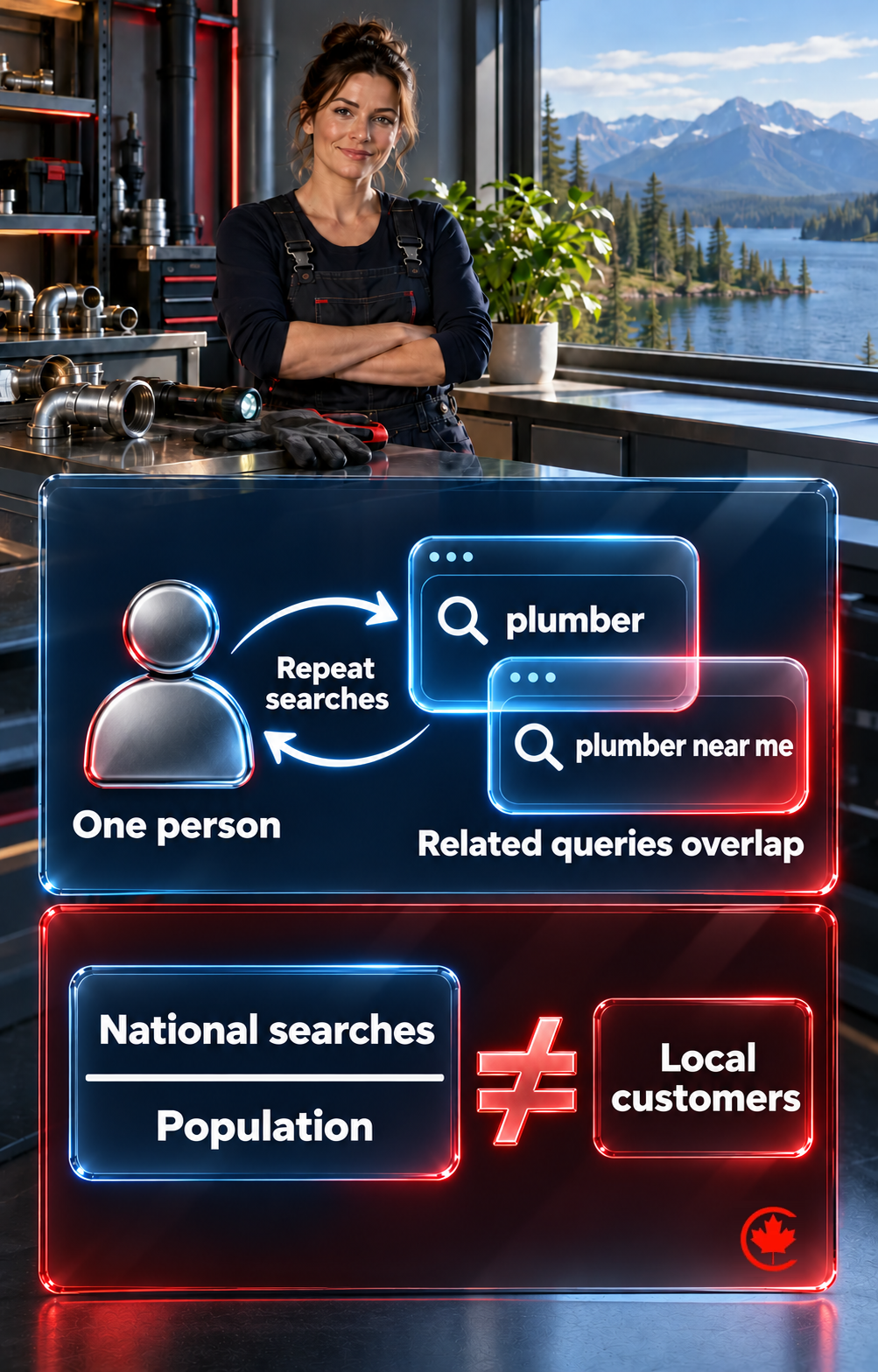
Monthly search volume is an approximate average, not a count of unique people, qualified prospects or available jobs. One person can search several times. Similar queries can share estimated demand. Adding every row together would therefore create a misleading impression of a pool of distinct customers. A local company should not divide a national total by population and treat the answer as a reliable local forecast, either. Service availability, geography and search behaviour do not distribute that neatly.
Click costs in the tables are shown in relative terms rather than as amounts: very high, high, moderate, lower or low, comparing the 45 searches in this sample with each other. Prices in a live account depend on the market, the account and the timing, so a relative comparison is the more durable way to read them. Keep currency and cost definitions visible in any proposal and in the report used to evaluate it.
There is also a distinction between an estimate and an account result. Google defines average CPC as the cost of clicks divided by their number. The keyword estimates below do not say what your account has paid or will pay. They are not a fixed price list, a quote for management services or a promise that spending a certain amount will produce customers.
These are search-keyword examples, not a combined benchmark for every Google advertising format. A video view, a display-ad interaction and a search click are different buying contexts. Comparing their headline prices without comparing the resulting business outcomes can favour whichever report uses the cheapest-looking unit. When a proposal combines channels, expect the purpose and results of each to remain understandable rather than disappear into one blended cost.
Finally, the sample was selected, not drawn to represent every search in an industry. Its highest and lowest rows are the extremes of these 45 examples, not the most and least expensive possible searches in Canada. That is why the article uses specific query names rather than presenting a single “legal industry CPC” or “healthcare CPC”. The narrower description is less dramatic, but it is more useful for a real spending decision.
Legal: relate the click to the matter you can accept
| Search | Monthly searches | Estimated CPC, relative |
|---|---|---|
| personal injury lawyer | 9,900 | Very high |
| criminal lawyer | 5,400 | Very high |
| corporate lawyer | 2,400 | High |
| family lawyer | 18,100 | Moderate |
| employment lawyer | 9,900 | Moderate |
| real estate lawyer | 6,600 | Moderate |
| immigration lawyer | 8,100 | Moderate |
| paralegal | 14,800 | Moderate |
| notary near me | 49,500 | Low |
We build and run Google Ads campaigns measured on calls, forms and booked jobs, not clicks.
Within these selected legal searches, “personal injury lawyer” has the highest CPC estimate, close to double “criminal lawyer” and more than five times “family lawyer”. Those are meaningful differences in the sample. They do not establish why each price occurs, how many firms compete for that search or which practice area is most profitable. Nor do they establish that an enquiry is a suitable file for a particular firm.
A firm’s first comparison should be between the advertised service and the matters it actually accepts. An employment practice representing employers has a different fit requirement from one representing employees. A family practice may offer services that differ from what a person searching about divorce needs. A general legal enquiry can require an initial suitability discussion before anyone can know whether the firm can act. Counting all those enquiries as equivalent “new clients” would hide the distinction that matters.
The commercial outcome also develops over time. A call may become a consultation, but not every consultation becomes a retained matter, and a retained matter does not necessarily generate collected fees in the same reporting period. An owner evaluating marketing needs a practical view of that journey without putting confidential client information into a marketing report. Agreed, appropriately aggregated outcome categories can be more informative than a list of call counts.
Consider a hypothetical firm that receives plenty of calls but has little capacity for the requested matters. Buying additional traffic before clarifying its service focus and response capacity could increase workload without improving the number of suitable retained files. Another firm may have capacity and a clear service offering, but few people discovering it. The two firms can reasonably buy different kinds of support even if their keyword CPC is identical. That is a business-fit decision, not a campaign-setting lesson.
For budget planning, use expected collected fees and realistic direct service costs rather than the largest possible value of a case. Keep the time between enquiry, engagement and collection visible. Marketing material also needs approval against the rules of the relevant jurisdiction; paying a high CPC does not justify unsupported claims. More selected legal data is in Google Ads for lawyers: cost per click by practice area. Check the scope of any separate table before combining it with this one.
Finance, insurance and real estate: a quote request is not a completed engagement
| Search | Monthly searches | Estimated CPC, relative |
|---|---|---|
| home insurance | 12,100 | Very high |
| car insurance | 40,500 | Very high |
| mortgage broker | 18,100 | Moderate |
| realtor near me | 5,400 | Lower |
| accountant near me | 9,900 | Lower |
The financial and property-related examples show another reason to avoid one national planning number. In this sample, “home insurance” costs roughly nine times as much per click as “accountant near me”. These searches describe different services and decisions. The table does not measure their commission, fee, approval rate, contribution or repeat business. A lower click price is not evidence that one business model has better marketing economics.
For an insurance broker, an enquiry may need to progress through suitability, a quotation and a policy decision. For a mortgage business, a conversation is distinct from an eligible application and a completed transaction. A real-estate enquiry can be far removed from a completed engagement. The point is not to impose the same reporting process on every profession. It is to agree which business outcome is being evaluated before dividing advertising spend by a count.
A hypothetical broker comparing two proposals might see one promise more quote requests and another focus on enquiries for the products and locations the brokerage actually serves. The first number is larger, but the owner cannot judge value until the meaning of a quote request and the proposed scope are clear. An enquiry outside the brokerage’s offering still consumes attention even when its advertising cost is low. A suitable enquiry can also take time to reach a decision.
Time matters to cash flow. The business may pay advertising and management costs before an eventual commission or professional fee is collected. A budget that looks attractive when calculated from potential revenue can still be uncomfortable if collection is delayed or outcomes fall through. Build the approval around what the business can safely commit, not around an assumption that every transaction will close promptly.
Repeat business and referrals can be valuable, but they should not become an invented multiplier that makes any acquisition cost appear affordable. If the business has dependable records of repeat contribution, it can consider them explicitly. If it does not, a conservative first-engagement view is clearer than an optimistic lifetime-value claim. The table supplies search-cost context; the business’s own evidence must supply the economics.
Home services and trades: separate urgent repairs from planned projects
| Search | Monthly searches | Estimated CPC, relative |
|---|---|---|
| emergency plumber | 6,600 | Very high |
| window replacement | 9,900 | Very high |
| basement renovation | 2,900 | High |
| air conditioner repair near me | 8,100 | High |
| garage door repair near me | 6,600 | High |
| plumber near me | 49,500 | High |
| furnace repair near me | 5,400 | High |
| painters near me | 6,600 | Moderate |
| movers near me | 14,800 | Moderate |
| hvac near me | 12,100 | Moderate |
| electrician near me | 27,100 | Moderate |
| roofer near me | 9,900 | Moderate |
| contractor near me | 9,900 | Lower |
| pest control near me | 14,800 | Lower |
| handyman near me | 5,400 | Lower |
| cleaning services near me | 8,100 | Lower |
| landscaping near me | 8,100 | Lower |
“Emergency plumber” has roughly double the estimated CPC of “plumber near me” in this sample. That is a comparison of estimates, not proof that urgency alone causes the difference or that the first caller always books. It is a prompt to distinguish the work being sought. An urgent repair, a planned installation and a maintenance visit can have different response requirements, delivery costs and contribution even when the same company provides them.
Imagine two hypothetical plumbing businesses. One has a team available for genuine emergency response; the other mainly books planned installations several days ahead. Advertising that produces urgent calls could be appropriate for the first and frustrating for the second. Both owners should understand the difference before committing spend. The comparison does not require them to learn campaign architecture. It requires a truthful description of the service they can fulfil and a provider whose proposed scope matches it.
Planned projects introduce another distinction. Window replacement, basement renovation and roofing can involve an enquiry, an inspection or consultation, an estimate, a decision and then completed work. A signed estimate is not the same as collected revenue, and a full calendar of estimates is not the same as a profitable workload. If estimates are plentiful but completion is weak, more advertising may not be the first missing piece.
Capacity can change the decision even when demand is strong. A company booked well ahead may want a different mix of work, better visibility for a later period or clearer enquiry handling rather than an immediate increase in leads. An owner should be able to explain how much additional work the business can absorb. Weather, staffing and project duration can change that answer; a national CPC table cannot resolve it.
The practical comparison is therefore cost per suitable completed job alongside the contribution that job leaves, not CPC alone. Keep emergency repairs, installations and recurring work distinguishable enough to see whether one category is carrying the results of another. That is also why a provider should explain a change in the mix of enquiries, rather than presenting a falling average click price as an automatic improvement.
Health, dental and personal care: demand must fit appropriate care
| Search | Monthly searches | Estimated CPC, relative |
|---|---|---|
| dentist near me | 246,000 | High |
| dentist | 110,000 | High |
| orthodontist | 27,100 | Moderate |
| therapist near me | 27,100 | Lower |
| eye exam near me | 33,100 | Lower |
| psychologist near me | 12,100 | Lower |
| chiropractor near me | 60,500 | Lower |
| vet near me | 90,500 | Lower |
| optometrist near me | 74,000 | Lower |
| hearing aids | 18,100 | Low |
| laser hair removal near me | 14,800 | Low |
| naturopath near me | 12,100 | Low |
| massage near me | 550,000 | Low |
| pharmacy near me | 550,000 | Low |
The health-related rows should not be read as a statement that all patient acquisition is inexpensive. “Dentist” and “dentist near me” are among the higher-cost searches in this selected sample, while several other queries are lower. The searches describe different needs, services and providers. A general query can also include people looking for information or an existing provider, rather than someone ready to book a new appointment at your clinic.
The large estimated volumes for “massage near me” and “pharmacy near me” do not represent unique available patients for one business. A clinic or practice still has a particular location, scope of care, provider availability and appointment schedule. National search demand is useful background, but it does not remove the need to understand whether enquiries match the services and access the organization can actually offer.
A useful distinction is between an enquiry, a booked first appointment and an attended appropriate appointment. Cancellation, scheduling conflicts, provider fit and payment questions can affect the journey. Reporting only bookings may conceal a different experience at the clinic. Reporting only revenue can also miss the professional responsibility to recommend care on clinical grounds, not on a marketing target or a desire to exhaust benefits.
Consider a hypothetical clinic with open appointments in one discipline but a waiting list in another. More general enquiries may add administration without helping the area that has capacity. The owner’s choice is not necessarily to spend more or less everywhere. It is to make the proposed service scope reflect the actual providers, services and availability, and to evaluate whether the resulting enquiries are appropriate for those circumstances.
This sample has no usable estimates for “physiotherapy” or “physiotherapy near me”. That is unavailable data, not zero demand. A clinic should not abandon a service or manufacture a budget forecast from that absence. Its own appointment and enquiry evidence can still inform the business decision, with appropriate privacy safeguards and without exposing patient details.
When assessing affordability, avoid assuming an arbitrary series of repeat visits from every new patient. Use appropriate, evidence-based business figures and keep treatment decisions independent. Payment coverage, direct billing and reimbursement are also different matters; marketing should describe the arrangements accurately rather than suggesting that an enquiry or an appointment establishes insurance eligibility.
What the differences mean for your business
The first useful pattern is variation within a sector. A practice-area name, repair type or treatment category can matter more to the business than a broad industry label. A proposal based on an “industry average” should identify the source, geography, dates and included services. Without that context, comparing it with these selected queries may be a comparison of different things rather than evidence that either number is wrong.
The second pattern is that volume and click price answer different questions. A query can have a high estimated search volume and a low CPC, or the reverse. Neither tells you how many suitable enquiries your business will receive. Volume helps describe a search market; CPC describes a cost unit. The connection to your own customers requires additional evidence that the table does not contain.
The third is that the cheaper click can be the more expensive customer. Suppose, purely for illustration, one source costs CAD4 per click and produces one completed customer per 100 clicks. Its media cost per customer is CAD400. Another costs CAD10 per click and produces one completed customer per 20 clicks, giving CAD200. Those invented outcomes are not expected conversion rates. They show why comparing the click prices alone would select the wrong option in that example.
The fourth is that a higher-value service does not automatically support any advertising cost. Revenue must cover delivery and other business costs. A large contract with a small contribution can leave less room for acquisition than a smaller engagement with a stronger contribution. Timing, cancellations and payment collection can change the picture again. Use the economics of the service you actually sell, not an impressive maximum transaction value.
The final pattern is a limit: these estimates describe differences, not their causes. They cannot tell you that a particular bidder, advertisement, economic event or season caused a price. They also cannot diagnose the quality of your existing campaign. For that, a fair review needs the actual account and business context, comparable periods and consistent outcome definitions. The appropriate response to an unexpected number is investigation, not an unsupported accusation or a promised instant fix.
Why your actual click price can differ or change
The table is historical context; an actual search click is priced in a live advertising environment. Google’s explanation of the factors behind ad placement and cost includes the competition in an auction, what advertisers are willing to pay, the usefulness and relevance of the advertisement and the page it leads to, and the circumstances of the search. Location, device and time are among those circumstances. A national historical estimate cannot hold all those conditions constant for your business.
Google also distinguishes the actual charge for a click from an advertiser’s maximum bid. The price is not simply a fixed tariff for an industry or always the amount the advertiser offered. This is enough for an owner to understand why a quoted research figure and an account result may differ; choosing bidding settings is a separate specialist task, not the purpose of this guide.
These influences do not let anyone diagnose a specific price change from a table alone. A higher CPC is not proof that your website is poor, that a named competitor increased spending or that an agency made a mistake. A business promoting a different mix of services or reaching a different mix of searches may also see its average change. The useful question is which explanation the actual evidence supports, and which remains a hypothesis.
Finally, separate a genuine click-price change from a comparison error. A research estimate is not directly comparable with your own account average. A media-only CPC is not the same measure as an invoice total that includes management. A larger bill can reflect more clicks rather than a higher price per click. Before approving a change in strategy, ask for comparable periods, the same currency and cost definition, and the resulting suitable business outcomes.
From a paid click to a completed customer
Start with the outcome closest to the business decision, then work back through the stages you can actually observe. A paid click indicates an interaction with an advertisement. An enquiry indicates someone has contacted the business. A suitable enquiry meets the agreed service and location criteria. A booking or consultation is a further step, and completed paid work is another. Depending on the business, there may be meaningful stages between them.
Those distinctions should remain visible when a report uses the word “conversion”. Google’s conversion-action definition includes actions such as a purchase or a phone call. A report counting calls is not automatically counting sales. The owner does not need a lesson in installing tracking to understand this. They need the report to say what was counted and why that action is relevant.
A paid click records an interaction with an advertisement. An enquiry records contact with the business. Completed, paid work means the service has been delivered and payment has been received. These are different events, not interchangeable counts. A contact can be repeated, unsuitable or from an existing customer, and a booking is not necessarily completed work. Compare a clearly defined enquiry group over a suitable observation period; do not assume that work and payment occurred in the month of the click or that advertising caused every outcome.
There are several useful cost measures, provided their names are accurate. Media cost per enquiry divides advertising spend by enquiries. Media cost per completed customer divides it by completed customers. An all-in acquisition calculation includes the agreed additional acquisition costs as well. Google also defines average CPA (cost per action) around the conversions being measured. None of these labels should silently change halfway through a comparison.
For example, a report showing 40 contacts might include repeat contact from the same person, existing customers or enquiries for services the business does not provide. It would be misleading to call all 40 newly acquired customers. Equally, dismissing every enquiry that did not buy immediately could undervalue a service with a longer decision period. Agree practical definitions that suit the business and explain their limitations rather than pretending every outcome is perfectly attributable.
Match the time window to the journey. Advertising paid for in one month may lead to a consultation that month and a completed transaction later. Dividing this month’s spend by every customer who happened to pay this month can mix unrelated groups. A helpful review explains which enquiry group is being followed, what is complete and what remains undecided. It should not turn incomplete outcomes into success or failure simply to improve a presentation.
There is a responsibility on both sides. The marketing provider can report the evidence within its scope, while the business often knows whether an enquiry was suitable and whether work was completed. The agreement should make that handoff practical without requesting unnecessary personal, health or confidential legal information. Clear aggregate feedback can support a better spending decision without exposing the details of an individual customer or matter.
A worked affordability and break-even example
The useful owner-level calculation is not “What is everyone else paying?” It is “What contribution can this business reasonably make available for acquiring one more suitable customer?” Begin with the amount collected for the work, subtract the relevant direct delivery costs, and consider the other costs that still need to be covered. Gross revenue is not the amount available to spend on marketing.
The following example is entirely hypothetical and uses Canadian dollars. Assume a completed customer leaves CAD600 after the direct costs of delivering the service. The owner wants to retain CAD200 per customer to contribute toward overhead, taxes and the business’s desired return. They also expect to allocate CAD100 per customer to other acquisition costs. That leaves CAD300 per customer available for media in this planning model.
If the assumed click-to-completed-customer rate is 2%, the corresponding planning CPC is CAD300 multiplied by 0.02, or CAD6. In plain language, if 100 clicks produce two completed customers, those customers make CAD600 available for media under the stated assumptions. Dividing CAD600 by 100 clicks gives CAD6. This is a way to test affordability, not an instruction to set a bid and not a promise that the assumed completion rate will occur.
It is important to name the calculation correctly. Spending every dollar of contribution on acquisition would leave nothing for the overhead or return excluded from the example. A simple acquisition break-even calculation is therefore not the same as whole-business profitability. The lower CAD6 planning figure deliberately retains a contribution for other needs. BDC’s explanation of break-even and sensitivity analysis is useful background on why changes in costs and sales assumptions matter.
Now make the hypothetical month concrete. CAD3,000 of media at an assumed average CPC of CAD6 produces 500 clicks. Assume those clicks lead to 50 enquiries, 30 suitable opportunities and ten completed customers. The media cost per enquiry is CAD60, the media cost per suitable opportunity CAD100 and the media cost per completed customer CAD300. All three numbers describe the same spending, but they answer different questions.
Add an invented CAD1,000 allowance for other acquisition costs. This is not a Canada Create quote. Total marketing cost becomes CAD4,000, or CAD400 per completed customer. Ten customers at CAD600 contribution produce CAD6,000 before marketing. Subtracting CAD4,000 leaves CAD2,000 to contribute toward the overhead, taxes and return not included in the direct-delivery assumption. Calling the full CAD6,000 “profit” would be wrong.
Then test a weaker outcome. If the same spending produces only five completed customers, all-in acquisition cost rises to CAD800 each. Their combined contribution is CAD3,000, less than the CAD4,000 marketing cost, before the other business costs are considered. The click price did not change. The result changed because fewer suitable opportunities became completed customers. That is the risk a CPC-only conversation can miss.
This example also exposes an assumption in the initial CAD100 allocation for other acquisition costs: CAD1,000 divided by ten customers is CAD100, but divided by five it is CAD200. Costs that are committed for a period do not necessarily fall when outcomes disappoint. When evaluating a real proposal, test how the calculation changes under a lower completion rate, delayed collection or a different service mix. Use your own qualified financial advice where needed; the illustration is not a forecast for your business.
What a small daily budget can and cannot establish
“Is CAD20 a day enough?” is understandable, but incomplete. Enough for what service, in what market, over what period, and for what decision? A daily amount can limit the cash committed to media. It cannot establish the number of suitable enquiries, the reliability of a test or whether a customer can be acquired affordably. A small scope may be sensible when it matches a small, clearly defined business objective.
Use the click-cost arithmetic to make the limitation tangible. If an entirely hypothetical campaign averaged CAD10 per click, CAD600 of media would buy about 60 clicks. If it averaged CAD3, the same amount would buy about 200. Neither calculation predicts customers. It simply shows why the same budget can create very different amounts of observation. A provider should explain what can realistically be learned at the proposed scope rather than offer a universal minimum as though it applied to every business.
Budget terminology also matters. Google’s budget overview distinguishes an average daily budget from daily and monthly spending limits. For most campaigns, its stated daily limit is twice the average daily budget and its monthly limit is based on 30.4 times that average. An owner approving spend should understand the applicable arrangement, not assume the average is a fixed charge on every day. Changes and campaign-specific rules should be explained for the actual account.
Media is only part of the commitment. Management, agreed website work, creative, measurement support and other services may be separate. Some are recurring and some may be one-time. Comparing “CAD600 of advertising” with “CAD600 including every service” would conceal a different scope. A clear proposal lists those components and identifies what already exists, what needs work and what is excluded.
A small budget should also not be stretched across so many goals that none receives a meaningful evaluation. An owner can choose a narrower business priority, improve readiness before advertising or postpone an engagement until the commitment is affordable. Those are valid decisions. They are different from accepting a large promise and hoping a small spend will somehow achieve it.
How to use these benchmarks when choosing a channel
Paid search is one way to reach people expressing a relevant need. It is not the answer to every acquisition problem. A business that needs more suitable discovery may evaluate it differently from a business whose main problem is unanswered enquiries. Before buying more traffic, distinguish the shortage you are trying to solve. Otherwise, the spending can amplify the same unresolved problem.
Organic search and local visibility can help people find and assess a business, but they should not be sold as free customers or promised rankings. Their costs and time horizons differ from paying for clicks. A business considering those services should understand the proposed work, the evidence used to evaluate progress and the limitations. A higher paid-search CPC alone does not prove that organic acquisition will be cheaper for that business.
Eligible how Google Local Services Ads work in Canada use a different cost unit. Google’s Canadian Local Services Ads information describes paying when prospective customers get in touch rather than paying for clicks, with eligibility depending on the service and location. That can be worth comparing, but a charged lead is not a promised completed job. Compare suitable outcomes and total costs, not just the apparent advantage of one billing label.
Existing customer relationships and referrals can address a different need again. A business with a strong base may need clearer communication about appropriate repeat services, while a new business may have no such base to draw on. Permission, professional rules and the actual service remain relevant. Neither route should be presented as a universal substitute for paid acquisition.
For a practical decision, consider three hypothetical situations. A contractor with spare capacity and a clear urgent service may want to assess immediate enquiry opportunities. A specialist with a long consideration cycle may need stronger service information and a longer evaluation horizon. A clinic receiving enough enquiries but struggling to offer suitable appointment times should first establish whether the limit is available clinician time or a confusing booking process. Clearer service and booking information may help with confusion; it should not be presented as a solution to a shortage of clinician time. The right priority follows the business constraint; it cannot be selected from CPC rank alone.
Compare proposals on the same basis
Begin with the total commitment and the business objective, not the most attractive performance number. One proposal may include only advertising management, while another includes a website project or other support. One may report all contacts, while another separates suitable opportunities. A comparison is useful only when the differences are visible. The more detailed proposal is not automatically better, but a vague scope makes value harder to judge.
Here is a hypothetical comparison. Proposal A estimates 60 enquiries and Proposal B estimates 30 suitable enquiries. Neither estimate is a promise. The first question is not which number is larger; it is what the terms mean, how the assumptions were formed and whether the business can serve those people. Then compare media, fees, included services, responsibilities and the period over which outcomes will be reviewed. Do not convert either number into customers without an explicit, defensible assumption.
Ask how a provider will explain mixed results. A report might show a higher CPC but more completed suitable work. Another might show cheaper clicks but fewer useful enquiries. Good reporting makes those differences understandable and identifies uncertainty. It does not rely on whichever metric looks best that month, nor does it claim every business outcome was caused by advertising when the evidence cannot establish that.
Look for clear ownership of the decisions you must make. The business supplies accurate service information, capacity, approvals and appropriate outcome feedback. The provider’s responsibilities should be defined in the agreement. Account access, reporting, additional work and what happens when priorities change should be understandable before work begins. An owner’s approval of spend is not the same thing as a provider promising the result.
For Canada Create engagements, the written agreement defines scope, deliverables, fees, schedule and term. Advertising platforms bill media separately from management fees, and website maintenance is not automatically included in a marketing engagement. This distinction matters when planning how much flexibility the business actually has.
Review the evidence before increasing the commitment
Separate a reliable pattern from an early fluctuation. One additional customer can dramatically change an average when there are only a few completed outcomes. Conversely, a long decision cycle can make early results look weaker than the eventual cohort. A useful review states the size and maturity of the evidence rather than presenting a small percentage movement as certainty. Where information is incomplete, the next decision can be to resolve that uncertainty rather than immediately expand.
A hypothetical comparison shows why the review date belongs beside the result. Suppose two enquiry groups each cost CAD3,000 in media. The older group has ten completed customers; the newer group has five completed and five still deciding. The observed media costs per completed customer are CAD300 and CAD600 respectively. It would be wrong to report the undecided five as wins and claim that the newer group already matches the older one. It would also be premature to conclude that the newer group has permanently performed twice as badly.
The owner can ask for both the current result and the unresolved exposure: how many decisions remain open, how long comparable decisions usually take according to the business’s records, and whether any further service cost is committed. That does not require a more flattering forecast. It requires the same definition and a fair observation window. If the newer group eventually produces only six completed customers, its media cost is CAD500 each; if it produces ten, it is CAD300. Neither eventual outcome should be assumed before it occurs.
Also check whether the work mix has changed. If a business starts receiving more low-contribution jobs, a higher number of customers may not improve the commercial result. If it wins fewer but more suitable projects, the opposite may be true. The purpose is not to optimize a spreadsheet at the expense of customers or professional obligations. It is to understand whether the services being promoted fit the business and the people it can responsibly serve.
Useful warning signs include an unexplained currency mismatch, national estimates presented as a local quote, enquiries labelled as customers, revenue called profit, or a promised return supported only by a generic industry average. Another is a proposal that teaches a technical mechanism without explaining the outcome the owner is buying. You should be able to understand the commercial logic even when the provider handles the specialist work.
The strongest next step is a decision based on your service, capacity, affordability and evidence. That may be a defined advertising engagement, a different service priority or a decision not to commit yet. The tables are a starting point for that judgement. They are not a substitute for it.
For budgets and how Google Ads pricing works, read how much Google Ads costs. Industry guides: law firms, clinics and how home service companies get more calls in Canada. Want a custom proposal for your advertising? See our Google Ads management and the industries we serve.
More industry and business guides: insurance brokers, mortgage brokers, accounting firms, auto repair and dealerships, how to target buying committees with LinkedIn Ads and choosing a CRM.
Channel guides: How YouTube ads work for Canadian businesses, what works in TikTok ads in Canada, Google Ad Grants for charities and the Google Business Profile guide.
Frequently asked questions
How much do Google Ads charge per click?
There is no single Canadian price. In the selected 45-search sample in this guide, the most expensive search costs more than two hundred times as much per click as the cheapest. These are keyword estimates, not a price quote or a national industry average.
Why do the tables show relative click costs instead of amounts?
Click prices change with the market, the account and the timing, so the tables compare the searches with each other. The worked business examples use invented Canadian-dollar figures; check your account's actual billing before comparing anything with a budget.
Why is there no physiotherapy figure?
This sample has no usable estimates for physiotherapy or physiotherapy near me. Missing data is not zero demand.
Does a lower CPC mean a lower customer-acquisition cost?
Not necessarily. Enquiry suitability, completion rates and other acquisition costs also matter. A cheaper click can produce a more expensive customer if fewer clicks lead to completed suitable work.
Is $20 a day good for Google Ads?
There is no universal answer. First specify the currency, service, market and objective. A small media budget can support a narrower commitment, but cannot ensure enough observations, suitable enquiries or customers to justify an expansion.
Do these CPC figures include management fees?
No. The tables are keyword-level advertising estimates, not an agency proposal. Compare media, management and any agreed production, website or other costs separately, including which are recurring and which are one-time.
How can I judge whether a click cost is affordable?
Use your own contribution after direct service costs, allow for other acquisition costs and business needs, then test realistic completed-customer assumptions. The hypothetical calculation in this guide illustrates that reasoning; it is not a forecast or a bid recommendation.
Is an average daily budget a fixed daily bill?
No. Google distinguishes an average daily budget from spending limits. For most campaigns, its stated daily limit is twice the average daily budget and its monthly limit is based on 30.4 times that average. Confirm the applicable rules for your actual campaign.
What should I compare when choosing a marketing provider?
Compare the business objective, included services, total commitment, outcome definitions, responsibilities and review period. Treat proposed results as assumptions to evaluate, not promises, and check the written agreement before committing.