
How insurance brokers get more clients in Canada

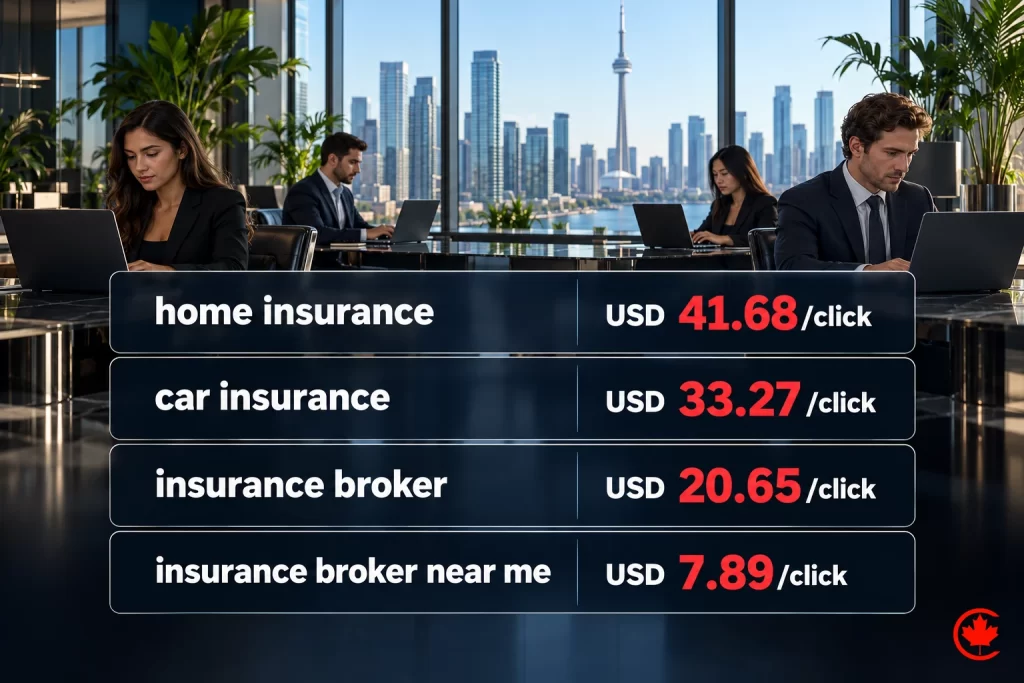
Among the four searches in the comparison below, “home insurance” has the highest estimated cost per click, followed by “car insurance”; both are among the more expensive search terms in Canada. “Insurance broker” draws about 14,800 searches a month at a lower, though still high, estimated click cost. Brokers compete with direct insurers, comparison sites and other brokerages for the same quote requests. The brokerages that grow combine strong local search, fast quoting, renewal retention and marketing that stays inside their regulator’s advertising rules.
These are Canada-wide estimates of average monthly searches and click costs. Actual campaign costs vary.
This guide covers how insurance brokers and agencies in Canada win more business: search demand and economics, the advertising rules, positioning against direct insurers, line of business pages, local search, paid search, speed to quote, lead sources, retention and cross-selling, content and measurement.
Search demand and economics
| Search | Estimated monthly searches in Canada | Estimated cost per click, relative |
|---|---|---|
| home insurance | 12,100 | Highest of the four |
| car insurance | 40,500 | Very high |
| insurance broker | 14,800 | High |
| insurance broker near me | 8,100 | Lowest of the four |
We plan and run insurance marketing for financial firms in Toronto and across Canada, scoped in writing after a free review.
Within these four selected queries, “insurance broker near me” has the lowest estimated cost per click. This is a Canada-wide estimate of that exact phrase, not a city-specific quote. A lower CPC does not establish cheaper bound policies or a profitable campaign; compare quote-request rates, bind rates, servicing costs and retention before choosing where to spend.
Know your numbers
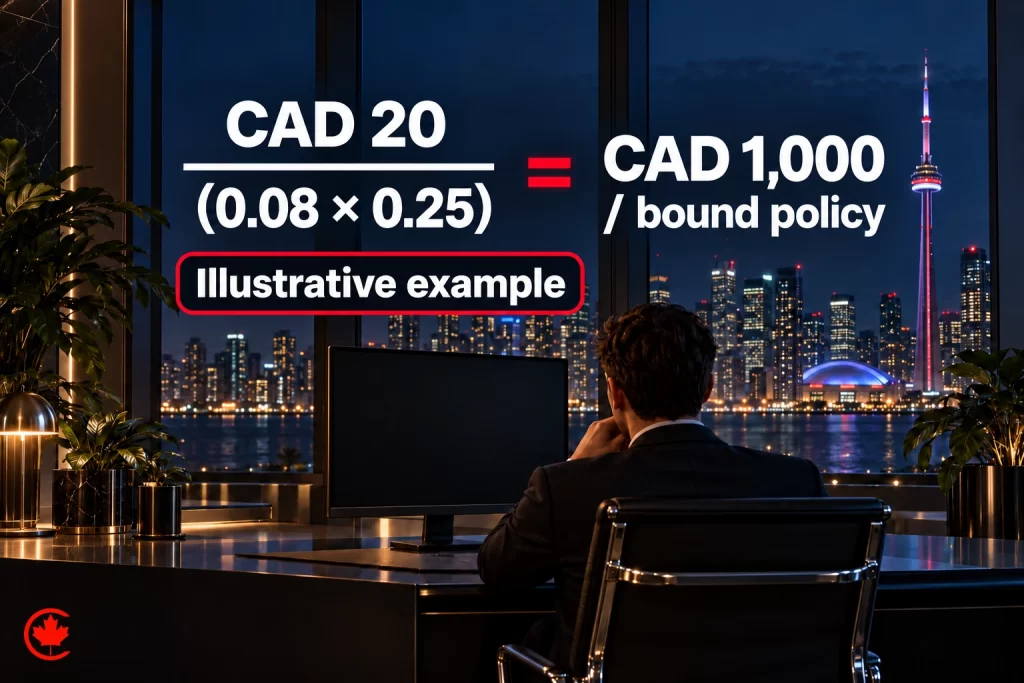
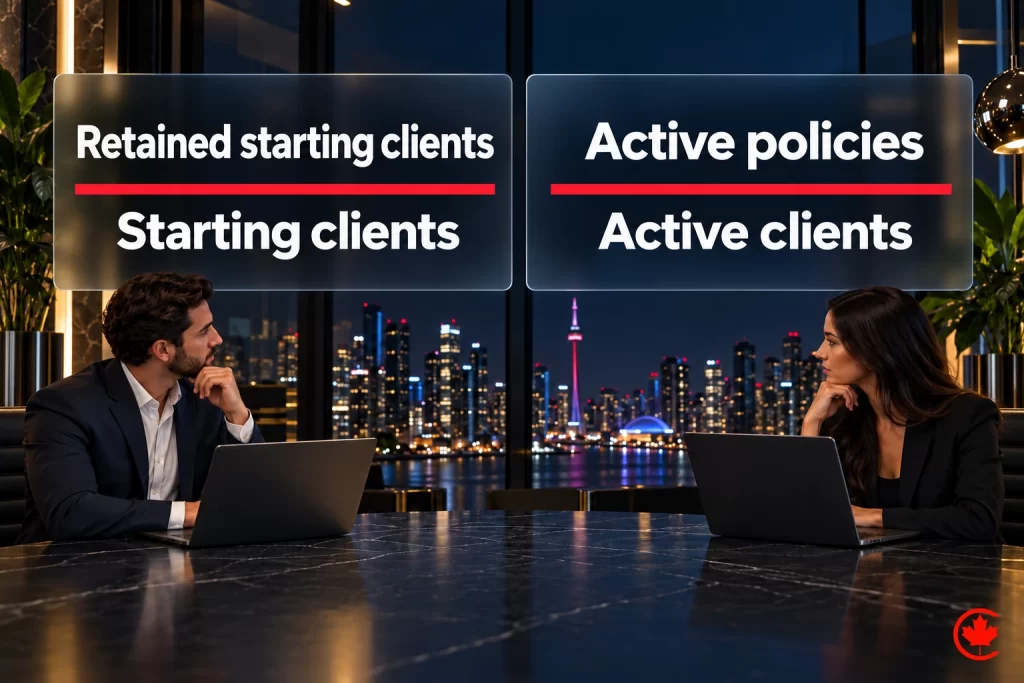
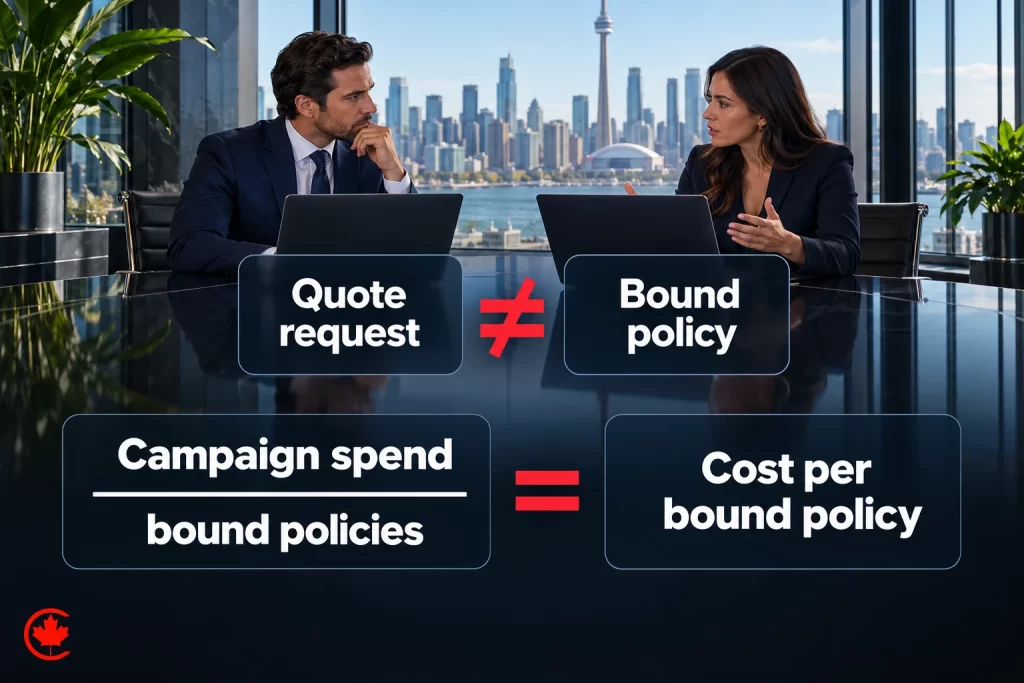
Before spending on ads, estimate a new policyholder’s lifetime contribution: expected commission across retained and cross-sold policies, less the costs of servicing those policies. Avoid counting the same policy twice. Then set a target cost per bound policy. A useful formula is cost per click divided by (quote request rate times bind rate). In an illustrative example, if clicks cost CAD 20, 8% of clicks request a quote and 25% of quotes bind, each bound policy costs about CAD 1,000 in clicks.
Advertising rules for brokers and agents
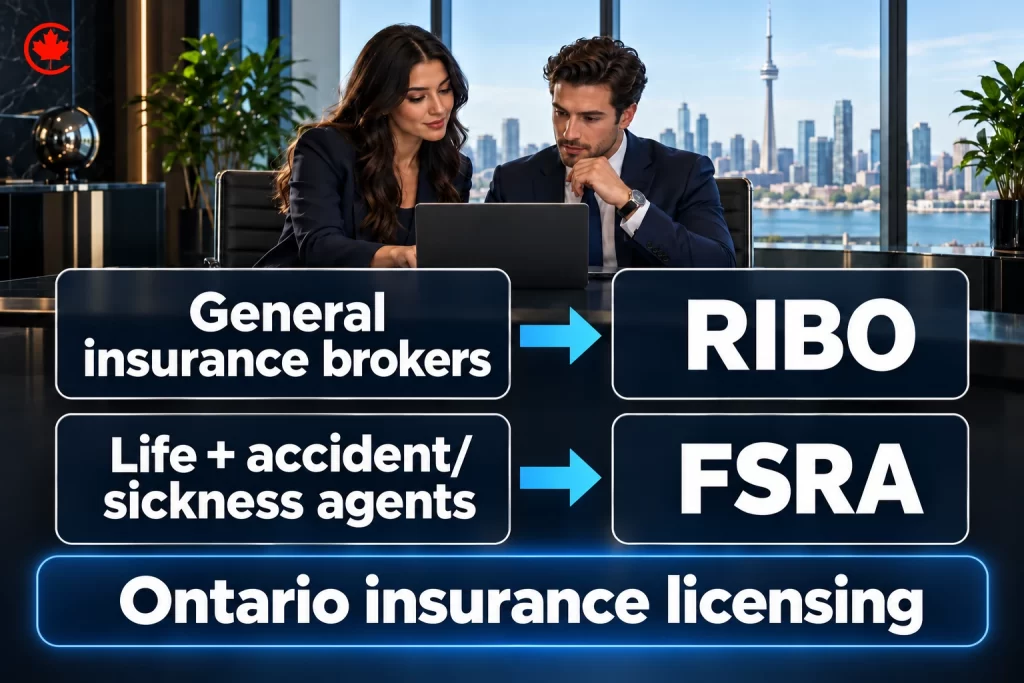
Insurance intermediaries are licensed provincially, and regulators set advertising expectations. In Ontario, general insurance brokers are regulated by the Registered Insurance Brokers of Ontario (RIBO), whose guidance addresses:
- False, misleading or incomplete statements about coverage or price.
- Implying affiliations that do not exist.
- Using insurer names or logos without authorization.
- Disparaging competitors.
- Scare tactics and bait and switch offers.
RIBO also encourages brokers to have marketing plans reviewed. Life and health agents in Ontario are licensed by the Financial Services Regulatory Authority of Ontario, and other provinces have their own regulators and rules. Commercial email and texts generally need a valid CASL consent basis, sender identification and an unsubscribe mechanism unless an applicable exception changes those requirements. Protect personal information under the privacy rules that apply to your brokerage.
Positioning against direct insurers
Brokers cannot outspend national insurers, so they win on what direct channels cannot offer:
- Choice: quotes from several insurers in one conversation.
- Advice: help with unusual risks, coverage gaps and limits.
- Claims support: a person to call when something goes wrong.
- Local knowledge: understanding of the community, its businesses and its risks.
- Specialty programs: coverage for niches such as contractors, hospitality, short term rentals or high-value homes.
Make these advantages concrete on your website with examples of the types of clients you help, without naming them or disclosing their details.
Line of business pages
Build a page for each line you write and want to grow:
- Personal lines: auto, home, condo, tenant, cottage, recreational vehicles.
- Commercial lines: general liability, property, contractors, professional liability, cyber, commercial auto.
- Life and benefits: life, critical illness, disability and group benefits, where licensed.
- Specialty programs: the niches where your brokerage has insurer relationships and experience.
Each page should explain who the coverage is for, what affects the premium, common coverage options, what information is needed for a quote and how to start. Link each page to a short quote form built for that line.
Local SEO
- Use your real brokerage name and accurate categories, with one profile for each office that meets Google’s eligibility and staffing requirements.
- List the lines you write as services and keep hours accurate.
- Add real photos of the office and team.
- Keep your details consistent across directories, insurer broker locators where available and local listings.
- Invite clients to leave an honest review at consistent points in the relationship, regardless of whether their experience was positive or negative, and never offer incentives.
Paid search without waste
- Focus on local and specialty searches rather than generic product terms.
- Separate campaigns by line, each with its own landing page and form.
- Exclude insurer customer service, claims phone numbers, jobs and licensing course searches.
- Schedule ads around when brokers can call back quickly.
- Track calls, quote requests and bound policies in your CRM to judge campaigns on results. Before importing conversion signals into an ad platform, check consent, the data fields and the platform’s customer-data rules; keep policy details, health information and other sensitive client information out of uploads.
Speed to quote
Many insurance shoppers request several quotes at once and buy from whoever responds first with a clear answer. A strong quote process:
- Acknowledges the request instantly by email or text, with consent.
- Routes it to the right broker based on line and location.
- Gets a broker on the phone within the hour during business hours.
- Follows up on unbound quotes a few days later and before the renewal date the client mentioned.
A CRM connected to your broker management system keeps this consistent. See choosing a CRM for small business in Canada.
Lead sources: owned versus rented
Shared leads sold to several brokers create a race to the bottom on price and speed. Leads generated in your own name, through your website, profile and campaigns, build a direct relationship with your brokerage. They are not resold by a lead vendor, but shoppers may still contact other brokers. Referral relationships with realtors, mortgage brokers, car dealerships, accountants and property managers also bring steady business. Keep referral arrangements within your regulator’s rules and the requirements of privacy law.
Retention and cross-selling
Retention is often the most profitable marketing a brokerage does. A client who stays for years, with several policies, is worth far more than a new single-policy client.
- Contact clients before renewal, especially if their premium is changing, to explain why and review options.
- Offer annual policy reviews for home, auto and business clients.
- Cross-sell naturally: home to auto clients, umbrella liability to homeowners, commercial coverage to clients starting a business.
- Send useful seasonal content, such as winter driving or spring flood reminders, to clients who have agreed to receive it.
Keep renewal notices and other transactional messages separate from promotional ones.
Content that earns trust
| Topic | Why it works |
|---|---|
| Why did my home insurance premium go up? | A common renewal question with high intent |
| Condo insurance versus the building policy | Confusing for many owners |
| How much liability coverage does a contractor need? | Reaches commercial clients |
| What to do after a car accident | Shows claims support |
| Insuring a short term rental | A growing niche with real coverage gaps |
Have a licensed broker review every article and keep content accurate and current.
Measuring results
| Measure | What it shows |
|---|---|
| Quote requests by line and source | Which channels bring shoppers |
| Quote to bind rate | Whether pricing and speed win |
| Cost per bound policy | Whether paid channels are profitable |
| Retention rate | Whether clients stay |
| Policies per client | Whether cross-selling works |
Commercial lines marketing
Commercial insurance clients choose differently from personal lines shoppers. Business owners want a broker who understands their industry, their contracts and their risks. Effective commercial marketing includes:
- Industry pages for the sectors you serve, such as contractors, restaurants, manufacturers, professional services and transportation, explaining typical coverages and the questions to ask.
- Certificate of insurance help, because many contractors need certificates quickly to start work.
- Risk management content, such as safety programs or cyber hygiene, that shows you care about preventing claims.
- Relationships with accountants, lawyers and business associations who advise business owners.
- LinkedIn presence for commercial brokers, sharing practical advice for business owners.
Commercial clients often stay for many years and buy several policies, so investing in their trust pays off.
Website essentials for brokerages
- A visible phone number and quote button on every page.
- Short quote forms for each line, with only the questions needed to start.
- Clear information about the insurers you work with, using names and logos only with authorization.
- A claims help page explaining what to do after a loss and how your brokerage supports clients.
- Broker profiles with licences, lines handled and languages spoken.
- Fast loading on mobile and secure forms.
Claims service as marketing
The moment a client makes a claim is the moment they decide whether they will stay. Clear claims guidance on your website, a quick call from the broker after a loss is reported and regular updates during the claim build loyalty and generate reviews and referrals. Ask for feedback after a claim is settled, and use what you learn to improve.
Content for life and benefits advisors
Life and benefits work relies on trust and education. Content explaining how much life insurance a family might consider, the difference between term and permanent coverage, how disability and critical illness coverage work and what group benefits small businesses can offer helps people understand their options. Keep the content general, avoid projections or promised returns, and follow the rules of your licensing regulator and the insurers you represent.
A worked example
Consider an independent brokerage with two offices that relies on renewals and walk-ins. Its website has one general quote form, and it buys shared leads that rarely bind. In the first month it reviews regulator guidance, completes both Google profiles, sets up line-specific quote forms and adds instant acknowledgements. In the second month it builds pages for auto, home, condo and contractor insurance and launches local search campaigns focused on broker near me and contractor insurance searches. In the third month it starts renewal outreach for clients facing premium increases and publishes articles on condo coverage and contractor liability. By the end of the quarter the brokerage can compare cost per bound policy across its own campaigns and the shared leads it used to buy, and decide where to invest. This is an illustrative sequence, not a client result; the brokerage would use its own bind rate and acquisition costs to decide what to keep.
A 90 day plan
- Days 1 to 30: review regulator guidance, tidy each office’s profile, set up quote tracking and an instant acknowledgement.
- Days 31 to 60: build pages for your top lines and specialty programs, launch local and specialty search campaigns and start review requests.
- Days 61 to 90: set up renewal outreach and policy reviews, publish two content pieces and review cost per bound policy by channel.
Want help growing your brokerage? See our insurance marketing and insurance CRM services, or read Google Ads cost per click by industry in Canada.
Frequently asked questions
How can an insurance broker compete with direct insurers for clients?
Brokers cannot outspend national insurers, so they win on what direct channels lack: quotes from several insurers in one conversation, advice on unusual risks and coverage gaps, and a person to call at claim time. Local knowledge and specialty programs for niches such as contractors or short term rentals add to that. Show these advantages with examples of the kinds of clients you help, without naming anyone.
How should an insurance brokerage work out what a new client is worth before buying ads?
Estimate the policyholder's lifetime contribution: expected commission across retained and cross-sold policies, less the cost of servicing them, without counting any policy twice. Then set a target cost per bound policy, which equals cost per click divided by quote request rate times bind rate. A lower click cost does not by itself mean cheaper bound policies.
How can an insurance brokerage appear in local results for broker near me searches?
Use your real brokerage name and accurate categories, with a Google profile for each office that meets Google's eligibility and staffing rules. List the lines you write as services, keep hours current and add real photos of the office and team. Keep details consistent across directories and insurer broker locators, and ask clients for honest reviews at consistent points, never with incentives.
Should a car insurance broker bid on broad car insurance searches?
Usually not as the main approach, since "car insurance" draws about 40,500 searches a month in Canada at a very high estimated click cost. Focus on local and specialty searches, give each line its own campaign, landing page and form, and exclude insurer customer service, claims numbers, jobs and licensing courses. Schedule ads for times brokers can call back quickly.
Why is retention such profitable marketing for insurance brokers?
A client who stays for years with several policies is worth far more than a new single-policy client. Contact clients before renewal, especially when the premium changes, and offer annual reviews for home, auto and business coverage. Cross-sell where it fits, such as umbrella liability to homeowners, and keep renewal notices separate from promotional messages.
How fast should an insurance broker respond to a quote request?
Quickly, because many shoppers request several quotes at once and buy from whoever answers first with a clear answer. Acknowledge each request instantly by email or text with consent, route it to the right broker by line and location, and aim to have a broker call within the hour during business hours. Follow up on unbound quotes a few days later and before the renewal date the client mentioned.
What advertising rules apply to insurance brokers in Ontario?
General insurance brokers in Ontario are regulated by RIBO, whose guidance covers misleading or incomplete statements about coverage or price, implied affiliations, unauthorized insurer names or logos, disparaging competitors, scare tactics and bait and switch offers. Life and health agents are licensed by FSRA, and other provinces have their own regulators. Commercial emails and texts generally need CASL consent, identification and an unsubscribe.
What content helps life insurance brokers earn trust?
Explain how much life insurance a family might consider, the difference between term and permanent coverage, and how disability and critical illness coverage work. Small business owners also look for plain information on group benefits. Keep the content general, avoid projections or promised returns, and follow your licensing regulator's rules and those of the insurers you represent.
Should insurance brokers buy shared leads to overcome tough competition?
Shared leads sold to several brokers create a race on price and speed that few brokerages win. Leads generated in your own name through your website, profile and campaigns build a direct relationship and are not resold, although shoppers may still contact others. Referrals from realtors, mortgage brokers, dealerships, accountants and property managers add steady business within your regulator's rules.
What do commercial insurance brokers do differently to win business owners?
Business owners want a broker who understands their industry, contracts and risks, so build industry pages for sectors such as contractors, restaurants and manufacturers. Quick help with certificates of insurance matters to contractors who need them to start work. Risk management content and relationships with accountants, lawyers and business associations show you care about preventing claims.