
How insurance billed clinics get more patients: direct billing, benefits and booked visits

For an insurance-billed clinic, attracting interest is only part of the job. A prospective patient needs to understand whether you offer the relevant service, whether an appropriate provider is available, what the visit may cost and how an appointment is arranged. Direct billing can simplify part of that experience, but it does not establish insurance coverage or ensure that an insurer will pay.
This guide is for Canadian allied-health clinic owners comparing marketing, website and enquiry-handling support. It connects service choices to actual appointment capacity, payment information and attended visits. The aim is not to persuade people to use unnecessary care or exhaust benefits. It is to help suitable patients make informed choices and help the clinic purchase support that matches what it can responsibly provide. Search estimates and illustrative financial examples are identified separately throughout.
Questions patients need answered before booking
The first question is fit: does the clinic offer the service this person needs, through an appropriate provider, at a location and time they can use? A broad list of disciplines is not always enough. Someone considering physiotherapy may need an assessment appointment rather than a follow-up slot. Someone seeking counselling may need to understand the provider’s designation, client population and actual in-person or virtual availability. These are distinct decisions, not interchangeable opportunities for a generic booking button.
The second question is payment. A patient can have benefits without knowing whether a particular service, provider or amount is eligible. They may also confuse the clinic’s ability to submit a claim with the insurer’s willingness to reimburse it. Clear information about fees, direct billing and possible upfront payment can prevent the website from creating an expectation the reception team later has to correct.
The third question is what happens next. An immediate online booking, an appointment request and a suitability conversation create different expectations. The clinic should identify which route applies to each service. A person who receives an acknowledgement of a request should not believe an appointment is confirmed when someone still needs to review it. The distinction matters even when the website looks polished and the form works correctly.
Capacity gives these decisions a practical boundary. A multi-disciplinary clinic may have available massage appointments and a physiotherapy waitlist. A promise to increase “clinic bookings” is too broad to evaluate. Additional physiotherapy enquiries may add frustration while the available massage service remains poorly understood. The clinic needs support that reflects the actual service and provider availability, not an undifferentiated increase in attention.
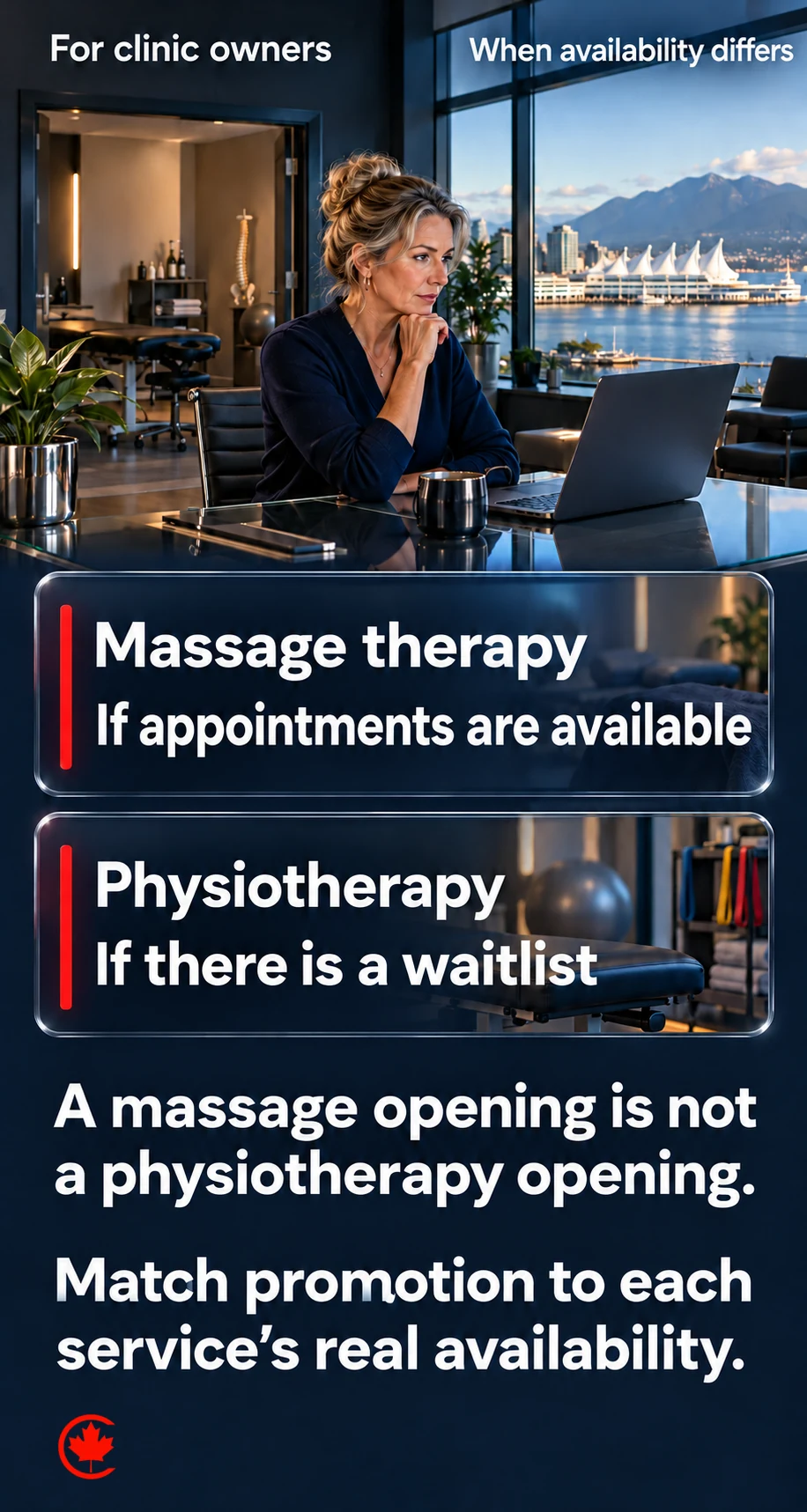
A new clinic and an established clinic therefore face different purchases. The new clinic may need discovery and a clear explanation of its services. The established clinic may already be known but have confusing payment information, uneven availability or an inconvenient booking experience. Before comparing packages, the owner should establish the problem that is worth solving and the appointments the team can appropriately offer.
Search demand for clinic services in Canada
The Canada-wide search estimates below are approximate monthly averages, not counts of unique prospective patients. Click costs are shown in relative terms. They are not a quote for your clinic, an advertising invoice or a cost per booked or attended appointment.
| Search | Monthly searches in Canada | Estimated cost per click, relative |
|---|---|---|
| massage near me | 550,000 | Lowest |
| optometrist near me | 74,000 | Moderate |
| chiropractor near me | 60,500 | Higher |
| RMT near me | 60,500 | Lower |
| acupuncture | 49,500 | Lower |
| therapist near me | 27,100 | Highest |
| naturopath near me | 12,100 | Lower |
| psychologist near me | 12,100 | Higher |
| chiropodist near me | 4,400 | Lower |
| kinesiologist near me | 1,600 | Lower |
We market clinics and practices within the advertising rules of each regulated health college.
The figures describe the exact phrases shown. “Massage near me” can include people looking for different services and provider types; it is not a count of patients eligible for your clinic’s insured massage appointments. “RMT near me” and “massage near me” should not be added together and described as separate people. One person can make both searches, compare several locations or decide not to book.

Physiotherapy estimates are unavailable for the two researched patient-service phrases in this sample. That does not establish zero demand or explain why the estimates are missing. It also does not mean that a different phrase about marketing a physiotherapy practice can stand in for patient demand. A clinic’s buying decision still depends on its actual services, location, appointment capacity and the scope of support under consideration.
Google’s average CPC definition concerns click cost divided by clicks. A click does not establish suitability, insurance eligibility or attendance. A proposal based on national estimates should therefore distinguish that background research from the costs and outcomes it expects to report for your engagement, without promising that one can be calculated reliably from the other.
National averages cannot establish demand within your clinic’s travel area or ensure that a particular provider’s appointments will fill. A low estimated click cost is not automatically a good investment if the resulting interest concerns unavailable services. Conversely, a higher click estimate does not by itself make a service unsuitable to promote. The useful comparison is the fit between the clinic’s real offer, its available capacity and the full cost of the proposed support.
Make coverage easy to understand
Direct billing, coverage and payment are related but different. Direct billing describes an arrangement through which a clinic can submit a claim and, where applicable, receive payment from a participating insurer. Coverage concerns the patient’s plan and the eligible service, provider and expense. Payment concerns who receives the money, when it is available and what the patient may still owe. A single insurer logo cannot answer all three questions.
For a website or content engagement, the clinic’s approved information should explain its actual arrangements. A statement that direct billing is available needs the relevant limitations: participating insurers, eligible services or providers where applicable, and circumstances in which the patient may need to pay. It should not imply that every appointment is covered because the clinic is registered with a billing service or employs a regulated professional.
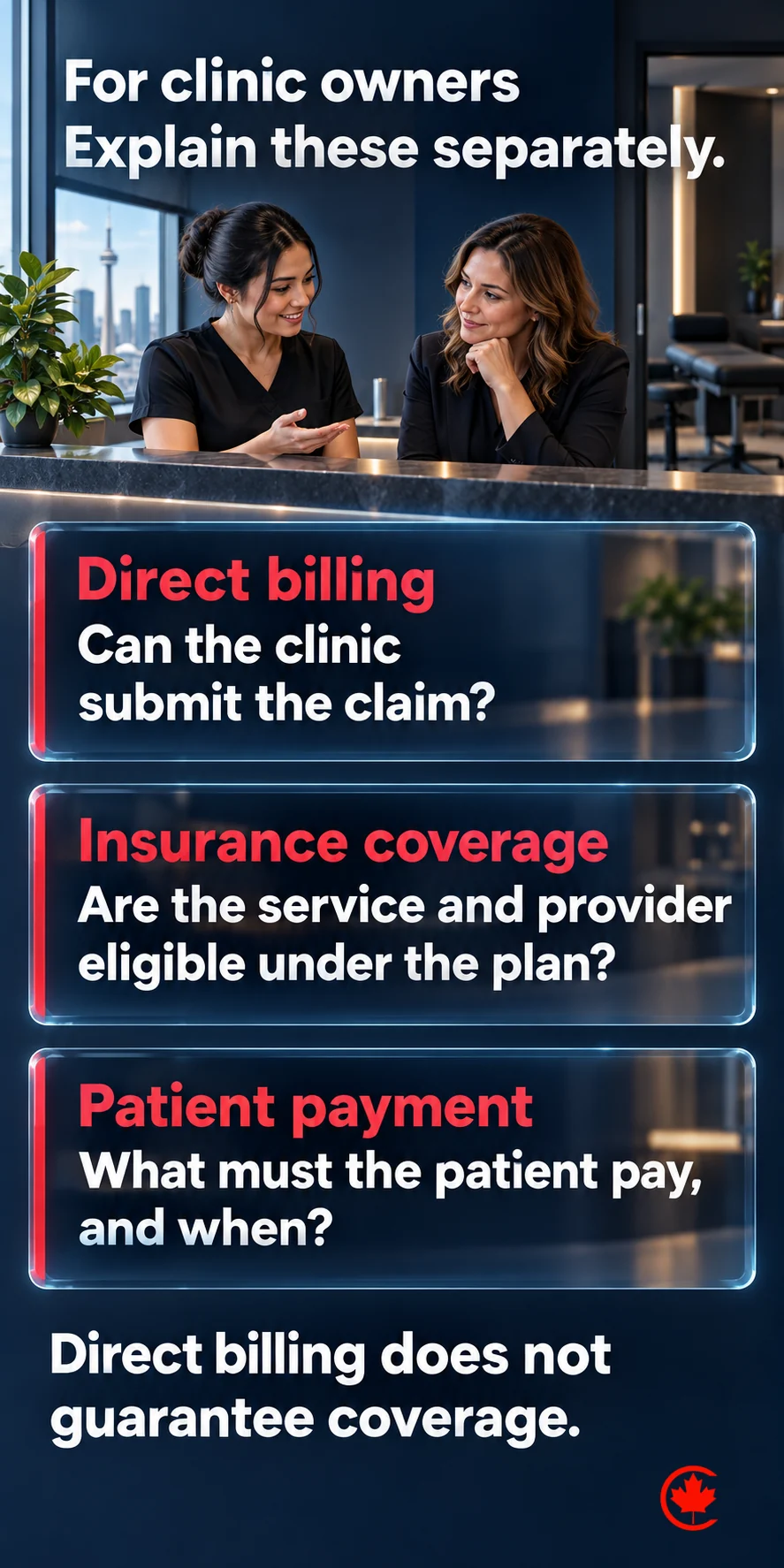
A clearly labelled example helps make the distinction concrete. Suppose a hypothetical visit costs CAD 140. Assume the patient’s plan confirms an eligible expense of CAD 100 and reimburses 80% of that eligible amount. The assumed reimbursement is CAD 80, leaving a CAD 60 patient balance. These invented numbers are not a standard fee, a typical plan or a reimbursement promise. They simply show why “80% covered” does not necessarily mean 80% of the clinic’s full fee.
The payment recipient changes the experience again. If the assumed CAD 80 is payable to the clinic and the claim is accepted, the patient may pay the remaining CAD 60. If it is payable to the patient, or the claim cannot be completed at the appointment, the patient may need to fund the full CAD 140 first. A website that promises “no upfront payment” without verifying the actual arrangement could mislead someone even when a benefit ultimately exists.
Real platforms illustrate the distinction without removing it. TELUS Health eClaims describes electronic claim submission and adjudication with participating insurers. Its existence does not mean every insurer, service, provider or individual claim is eligible. A clinic should describe what it genuinely supports rather than copy a platform’s broad capabilities into an unconditional promise about its own appointments.
Similarly, Jane’s Canadian insurance overview describes insurer integrations and distinguishes an insurer, a patient policy and a claim. It states that the described Canadian insurance features require its Insurance Plan. For a buyer, the relevant point is that existing software, plan level and actual billing arrangements can affect scope. A website project should not imply that an unverified integration, subscription or insurer relationship is included.
Coverage information also needs an owner. When a provider joins, a billing arrangement changes or a service is no longer offered, someone at the clinic must approve the public change. A beautifully designed page becomes unhelpful if its insurer list or payment expectations are outdated. The proposal should distinguish initial content preparation from ongoing responsibility for keeping these facts accurate.
Benefits reminders require a different judgment from a payment-information page. Plan dates vary, and a renewal date does not create a clinical need. Any agreed patient communication should have an appropriate purpose, lawful consent and accurate information. Pressure to use remaining benefits can undermine the patient-centred decision the clinic is trying to support. Marketing should clarify options, not prescribe treatment frequency or turn an insurance allowance into a sales target.
Know your payer streams
The clinic’s payer mix changes what prospective patients need to understand. It does not justify assuming that every clinic participates in the same programmes or that one type of coverage is its largest source of work. A useful proposal reflects the arrangements your clinic actually accepts and the distinctions your team can explain accurately.
| Payer | What it means for marketing |
|---|---|
| Extended health benefits | Coverage and payment arrangements vary by insurer, plan, service and provider |
| Auto insurance (motor vehicle accidents) | For accidents that occur in Ontario on or after July 1, 2026, auto insurance pays first for eligible medical and rehabilitation expenses, except medication costs. Confirm coverage with the insurer. Patients need clear information about the accident-related care your clinic offers and confirmation of their claim arrangements |
| Workplace injury (WSIB in Ontario, WorkSafeBC and others) | Clarify which workplace-injury programs your clinic actually accepts |
| Private pay | Clear fees and payment information for patients paying directly |
| Public coverage | Eligibility and covered services differ by province and program |
Extended health benefits require patient-specific confirmation. The service, provider designation, plan limits and payment arrangements can all matter. A clinic can explain the information patients should confirm without presenting its own estimate as the insurer’s decision. Private-pay patients need equally clear fees and appointment expectations; they should not have to navigate an insurance-focused message to discover how to arrange an ordinary self-funded visit.
Ontario’s motor-vehicle-accident change needs precise wording. For accidents occurring in Ontario on or after July 1, 2026, auto insurance pays first for eligible medical and rehabilitation expenses, except medication costs. FSRA’s 2026 OCF-23 form identifies the accident-date and Ontario boundary; the 2026 OCF-18 form also identifies the medication exception. This does not ensure acceptance of an individual claim, and it should not be described as a rule for every appointment after that date or every accident across Canada.
Workplace-injury and public programmes need their own confirmation. Naming WSIB, WorkSafeBC or a provincial programme on a page does not establish that all the clinic’s providers or services participate. A patient needs accurate information about the clinic’s actual role and any applicable appointment process. If a proposal simply groups every payer under “insurance accepted,” it may omit distinctions that change the patient’s experience.
The buying decision is therefore about useful clarity, not the largest possible list of insurer and programme names. A short, accurate explanation of supported arrangements is preferable to broad coverage language that the clinic cannot substantiate. The owner supplies and approves the facts; the marketing engagement can help make their meaning understandable to prospective patients.
What local visibility support should address
Local visibility support helps people identify a real nearby service and decide whether the location is practical. Accurate hours, service availability and provider information matter to that decision. It does not create appointment capacity or ensure a particular map position. A clinic with a full schedule may need clearer service-specific availability rather than an engagement justified only by increasing local enquiries.
Compare the location experience before comparing a package’s list of platforms. In an illustrative two-location clinic, a patient may find the brand but not know which location offers the service or has the relevant provider. If they reach the wrong office, the clinic can receive an enquiry without having created a useful appointment opportunity. The scope should address actual locations and services rather than imply that every provider works everywhere.
Our local citations guide and how to win near me searches offer related context. For the clinic owner, the important purchasing questions concern truthful representation, covered locations and responsibility for approving changes. A larger number of listing-related deliverables is not automatically a better fit than resolving the information patients actually need.
Decide what website, content and search support you need
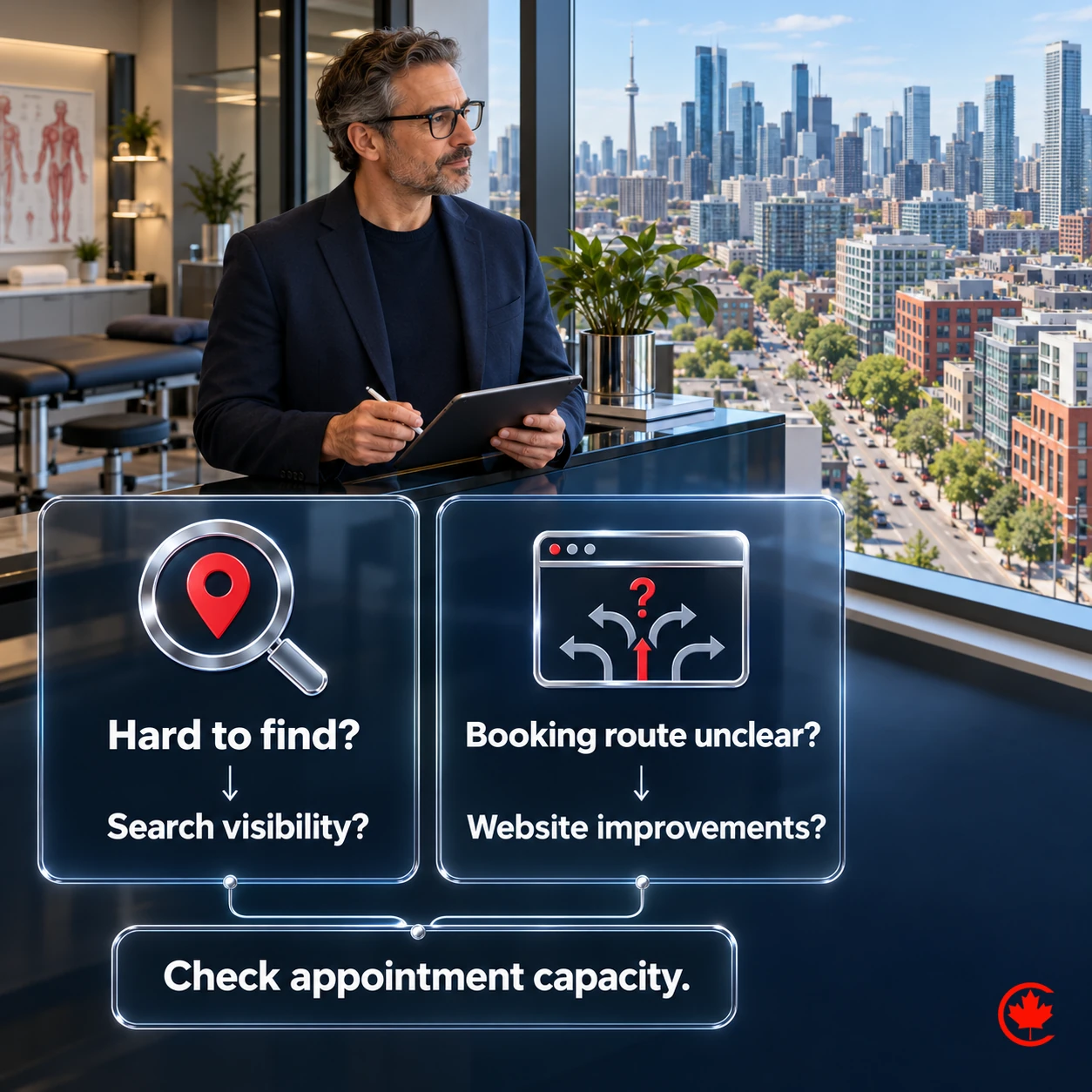
A website project addresses the experience of people who arrive. SEO and content support can address discovery and the information available about relevant services over time. These roles overlap, but they are not identical purchases. A clinic with a usable website and missing service explanations may need focused content work rather than a complete redesign. Another clinic with difficult mobile navigation and an unclear booking route may need a broader project before more exposure is useful.
The distinction is especially important when a proposal promises “more patients” without identifying the work. A new service page, a redesign and ongoing search support have different scope and dependencies. The owner should be able to explain what a prospective patient will understand or experience differently after the work. If the only answer is that the site will look more modern, the proposal has not yet connected presentation to the clinic’s actual problem.
Check appointment availability before buying advertising
Managed advertising can be considered when the clinic has an appropriate service and capacity for additional enquiries. It involves ongoing amounts paid to advertising platforms (media costs), separate campaign-management fees and potentially additional content or website work. It should not be sold as promised appointments or automatic healthcare advertising approval. Choose the service around the clinic’s actual problem, rather than assume every allied-health discipline needs the same advertising channel.
A hypothetical clinic with available assessment appointments but little awareness may reasonably compare paid visibility with ongoing search support. A clinic receiving many calls that cannot be accommodated needs a different explanation for increasing spend. Marketing cannot make an unavailable clinician available, and a cheaper enquiry is not a better outcome if it repeatedly leads to disappointment. Capacity and patient suitability remain limits on what demand is useful.
Compare referrals, social presence and communication support
A referred patient still needs to confirm service fit, location and payment expectations. Clear referral-facing information can support a real relationship without promising a stream of referrals. Social presence may help explain actual services and practical updates, but follower totals are not attended appointments. An agency should not imply that physician partnerships or professional endorsements exist when the clinic has not established them.
Patient communication and reminder support address another need. They can be evaluated for an agreed purpose and appropriate handling of information; they are not permission to promote services to every person in a patient database. Likewise, review activity must reflect the rules for the profession involved. The right comparison includes what the clinic is allowed to approve, not merely which platform offers the most convenient marketing feature.
Content support that answers patient questions
Useful clinic content helps a person make a decision that belongs before an appointment. Service information explains what the clinic offers. Provider information identifies the professional and their actual role. First-visit information describes practical expectations. Payment information explains the clinic’s arrangements without promising reimbursement. A proposal should distinguish these jobs instead of treating a set number of articles as proof that patients’ important questions will be answered.
Clinical information requires a different review from general website copy. A page about a condition should remain within the providers’ professional scope and should not diagnose a visitor or promise a treatment result. The clinic’s appropriate reviewer needs to approve substantive health statements, not just the spelling of service names. When reliable support for a claim is missing, adding confident language or a disclaimer does not supply that evidence.
Consider a hypothetical person choosing between two appointment options. One page provides a broad promise to “feel better,” while another accurately explains the service offered, the provider, what the first appointment involves and how payment questions are handled. The second gives the person more usable information without claiming a superior clinical outcome. That is a meaningful content objective an owner can evaluate before accepting a deliverable.
Language and accessibility needs also affect scope. A translated page should not imply consultation support the clinic cannot provide. Important practical information should not exist only inside an image or an inaccessible document. The agreement should identify the actual languages and accessibility work included rather than treat a bilingual label or attractive mobile layout as proof that every patient’s needs have been addressed.
Booking features to discuss before a website project
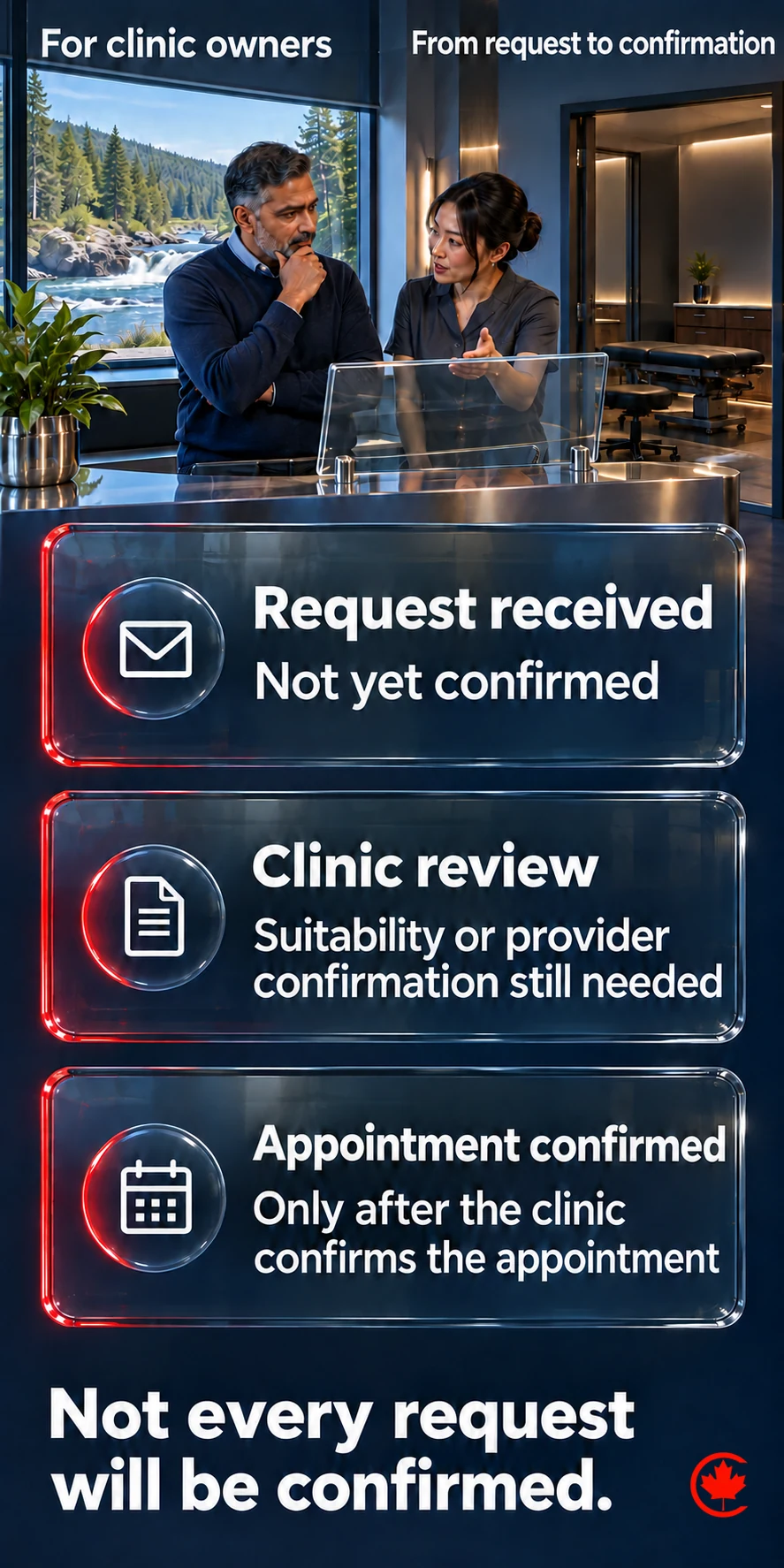
A prominent booking option is useful only when its meaning is clear. Some services can offer a confirmed appointment from available choices; others may need a request followed by a clinic conversation. A patient should be able to tell which is happening. If a suitability check or provider confirmation is still required, a generic success message should not imply that a specific appointment has been secured.
The whole experience matters. A patient may find a service on a phone, check the fee, choose a location and then encounter appointment names that do not match the website. Another may choose a provider without knowing that the displayed availability is for follow-up visits rather than a first assessment. These are concrete purchasing issues because a booking project should make the actual choices understandable, not simply add another button.
Existing software can affect the scope. Before buying replacement software or a new CRM, the clinic should understand what its current system supports and which part of the experience is actually missing. A new website does not automatically include a new software subscription, insurer integration or migration of records. Compatibility and access need verification rather than an assumption that two products will work together because both are widely used.

Payment and cancellation information should be available at the appropriate point, with confidential health or insurance details handled through the clinic’s approved process. A general marketing contact form should not be treated as an unrestricted clinical intake channel. Reminder options also need an agreed purpose and consent arrangements; neither an automated message nor a booking integration ensures attendance. See online booking for clinics for related buying considerations.
An illustrative clinic marketing budget
This example uses invented figures solely to explain cost and capacity. It is not Canada Create pricing, a typical clinic budget, a client case study or a forecast. All amounts are Canadian dollars before tax. They are separate from the click estimates earlier in the guide, and no assumed conversion or attendance rate is an industry benchmark.
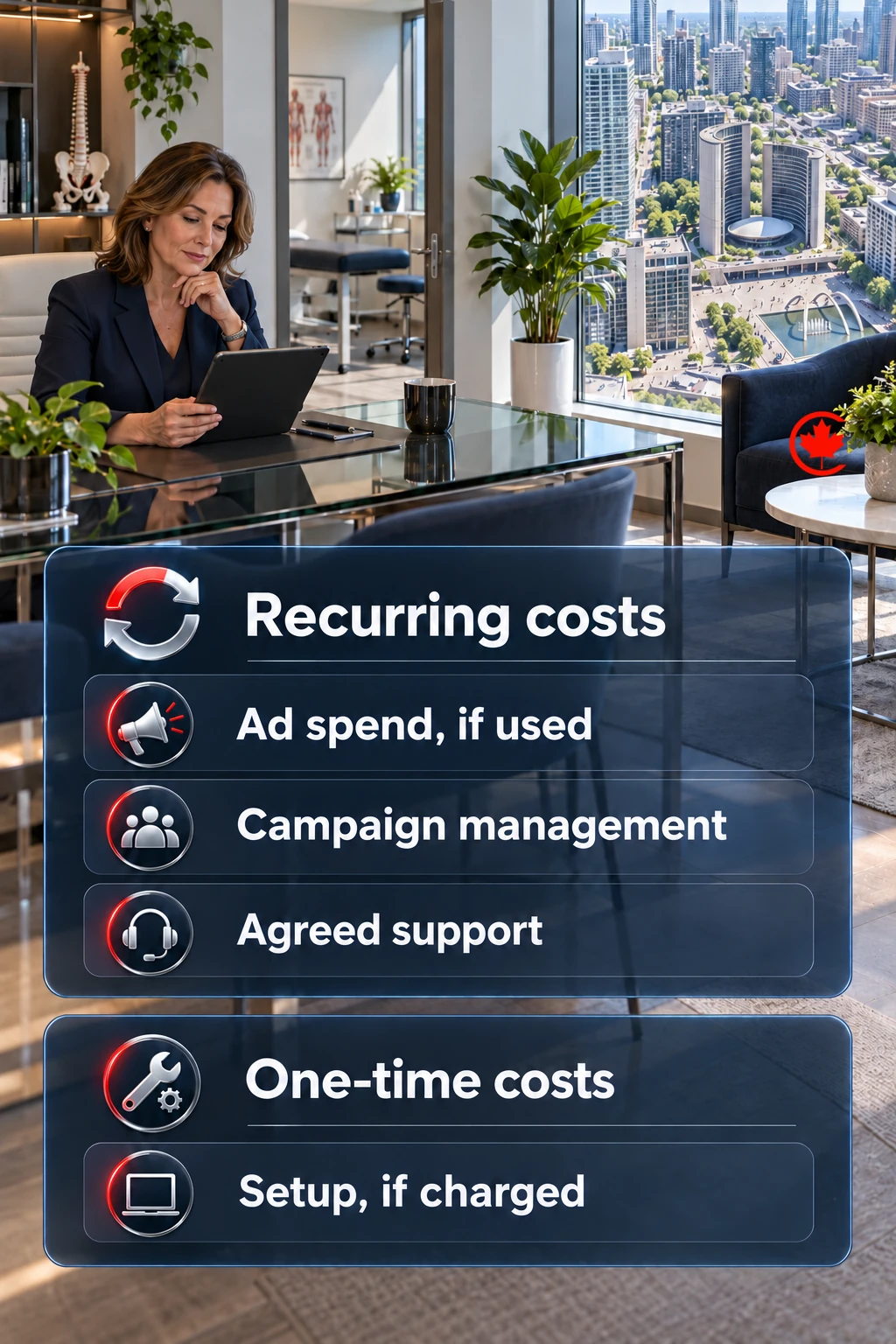
Suppose an illustrative monthly engagement contains CAD 2,200 of platform media, CAD 1,000 of management and CAD 800 of agreed website/content support. The recurring total is CAD 4,000. If a one-time setup project costs an assumed CAD 1,200, the initial month requires CAD 5,200 before tax. The example separates categories an owner needs to understand; it is not a recommended allocation or a package offer.
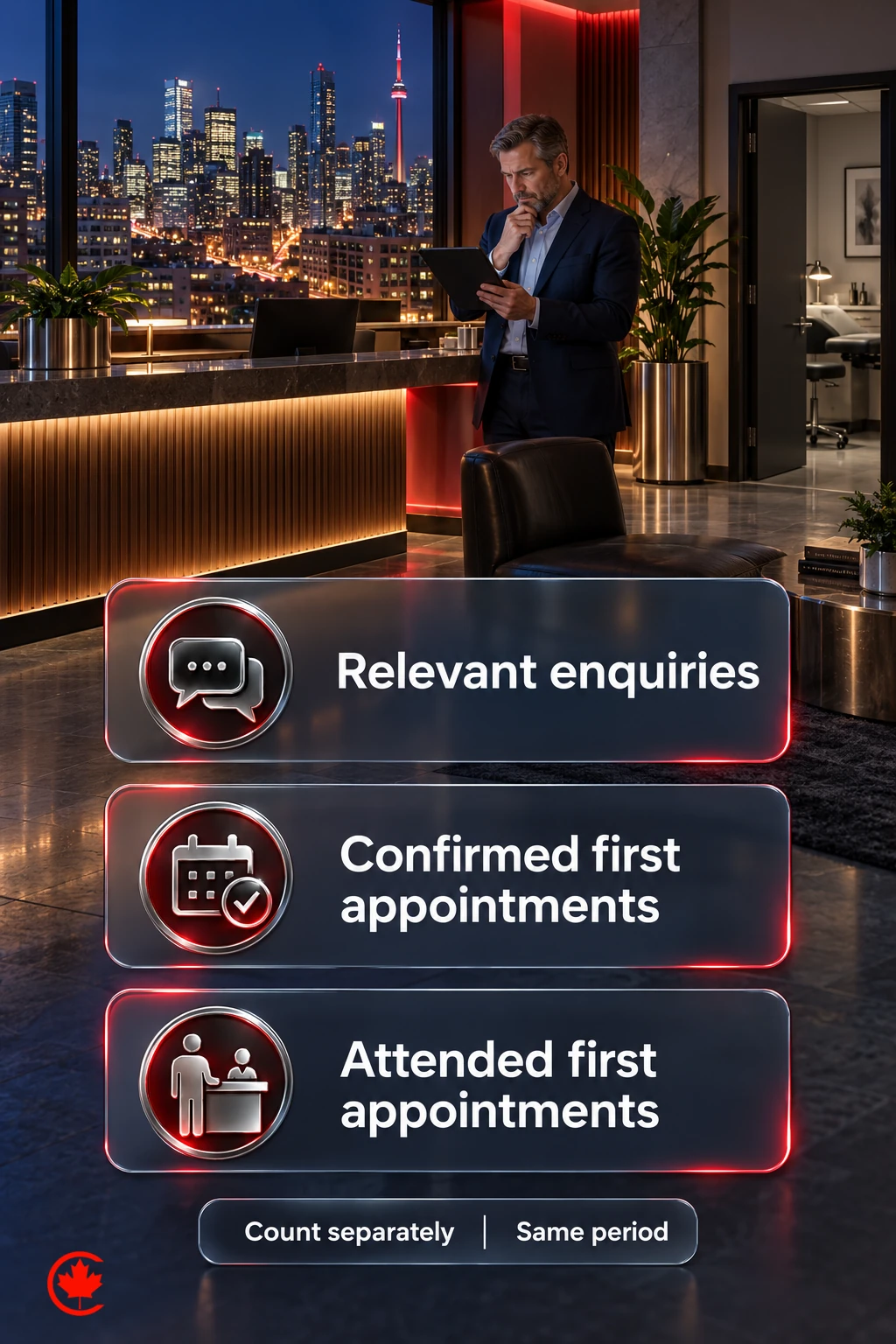
For this one-month example, assume there are 50 unique relevant enquiries. Of those people, 30 book a first appointment and 24 attend it within the same month. Count each person once at each stage. Recurring cost per relevant enquiry is CAD 4,000 divided by 50, or CAD 80. Cost per booked first appointment is CAD 4,000 divided by 30, or approximately CAD 133.33. Cost per attended first appointment is CAD 4,000 divided by 24, or approximately CAD 166.67.
The cost boundary changes the result. Media alone divided by the 24 attended appointments is approximately CAD 91.67. Including the hypothetical setup in the initial period gives CAD 5,200 divided by 24, or approximately CAD 216.67. These figures are not contradictory. They answer different questions. A proposal comparison becomes unreliable if one figure includes management and setup while another includes only platform spend.
Capacity provides another check. Eight available new-assessment slots per week over a four-week period give 32 slots. Thirty bookings fit that illustrative availability; a goal of 45 in the same period does not, unless real capacity changes. Appointment duration, provider mix and existing follow-up commitments may impose further limits. The arithmetic is useful precisely because it does not assume an unlimited schedule or prescribe more clinical visits.
The result is also sensitive to attendance. If only twelve first appointments are attended at the same CAD 4,000 recurring cost, the cost is approximately CAD 333.33 per attended appointment. More enquiries do not automatically fix that difference. The clinic needs to understand the actual reasons within its permitted records, rather than label every cancellation a marketing failure or assume reminders can prevent all non-attendance.
Acquisition cost is not profit. Collected fees, clinician time, overhead, payment delays and other costs remain outside the calculation. Future appointments should not be assumed simply to make the first-visit arithmetic attractive. Clinical need, patient choice and the provider’s judgment determine ongoing care. The decision is whether the clinic understands the full investment and its actual outcomes, not whether an invented lifetime-value figure can justify any spending level.
Assess results beyond enquiry volume
A useful report distinguishes work delivered from patient-related outcomes. Approved service information, completed website work and agreed updates show what the engagement supplied. Relevant enquiries, confirmed appointments and attendance describe different subsequent events. A report should not call every form submission a patient or every booking an attended visit. Those distinctions become especially important when several disciplines or locations share one brand.
New patients, repeat appointments and total visits should also remain separate. A rising total can reflect more visits by existing patients rather than improved discovery. That is not inherently good or bad, but it answers a different question. Marketing should not determine how frequently a patient returns or imply that more appointments are always the desired clinical outcome.
Comparisons need context. An apparent change can coincide with a new provider, changed hours, a location opening, a waitlist or a different payer arrangement. A before-and-after total alone does not show what caused the difference. The clinic should see the period covered and the material changes that affect interpretation, rather than receive a confident attribution claim unsupported by the available information.
There can be useful reporting without exposing clinical details. Aggregate counts and agreed service categories may answer the marketing question without transferring diagnoses, treatment notes or insurance identifiers. The clinic determines lawful access and disclosure boundaries. If the permitted data supports reporting enquiries but not attendance, that limit should be visible rather than concealed by an estimated patient count.
Review criteria should relate to the problem the engagement was meant to address. Are people enquiring about services actually offered? Does payment information match the clinic’s arrangements? Can suitable appointments be accommodated? Has the agreed work been delivered? These questions lead to a more informative decision than a generic promise to increase traffic or a fixed deadline by which every clinic must see a particular result.
The evidence available at a project review is also different from the evidence available later. Before launch, the clinic can verify the actual provider information, payment explanations, booking choices and agreed deliverables. It cannot yet know how many appropriate appointments will follow. During an ongoing engagement, enquiry and attendance information may become available at different times. A booked appointment several weeks away should not be counted as an attended visit, and a reporting period should not be quietly extended until it looks favourable. Consistent definitions allow an owner to identify what is known, what remains pending and which part of the service needs attention.
Stay inside college advertising rules
A multi-disciplinary clinic cannot assume one advertising rule applies to every provider. A useful concrete example is Ontario’s treatment of testimonials. The College of Physiotherapists of Ontario’s guidance allows genuine, accurate and verifiable patient testimonials, with informed consent for names, photographs or personal health information. By contrast, the CMTO advertising standard prohibits testimonials in RMT advertising. A clinic-wide promotional component cannot simply assume the physiotherapy position applies to massage therapy.
The buying consequence is specific: review-related services, patient imagery and promotional content need profession-appropriate approval before being included in a shared website or campaign. A software feature that can display reviews does not establish permission to use it. Neither does the fact that a patient sincerely likes the clinic. The clinic’s responsible reviewers need to identify which rules govern the particular material and provider.
Other important claims include professional titles, registrations, treatment descriptions, comparative language, fees, coverage statements and offers. The clinic should be able to substantiate what it approves and identify who keeps it accurate. An agency should not supply invented clinical credentials or turn a general service description into a promise that a treatment will work for every patient. Read our healthcare advertising rules in Canada guide for related context, then check the actual regulator for each profession and jurisdiction.
Privacy requires an equally clear boundary. Ontario’s Information and Privacy Commissioner explains that, except where PHIPA permits otherwise, express consent is required for using personal health information for marketing or market research. An existing care relationship is not blanket permission for every promotional use. A clinic should not assume that a patient list, condition history or treatment record can be transferred to an advertising service simply because it would make a campaign convenient.
Booking communications and promotional outreach may serve different purposes. The agreed service should identify the purpose, permitted information, consent responsibilities and who may access records. Canada Create’s marketing support is not professional regulatory advice or a certification that every clinic data flow complies with every applicable law. The clinic retains its professional and privacy responsibilities; appropriate review should resolve specific questions rather than rely on a generic “healthcare compliant” label.
Guides by discipline
The clinic’s disciplines should remain distinct in the proposal and in the patient experience. A broad healthcare package can miss practical differences even when its design is consistent. The following guides provide related context; the decisions described here concern the clinic’s actual services and buying needs, not treatment recommendations or a claim that all these professions are regulated identically across Canada.
For Physiotherapy, the clinic should distinguish assessment availability, the services its providers offer and the payer arrangements it actually accepts. Missing national keyword estimates do not decide whether support is worthwhile. A proposal focused on more enquiries needs to explain its relevance when the clinic has a waitlist or only certain appointment types are available.
For Chiropractic, service and provider information should support an informed first-visit decision without unsubstantiated clinical results. The clinic’s payment arrangements and professional review matter as much as the presentation. A generic treatment promise or copied testimonial policy from another discipline is not a substitute for the responsible provider’s approval.
For Massage therapy, distinguish the actual provider and service from broad interest in massage. Registration, availability and payment arrangements should be accurate. A high national search estimate does not establish that everyone using that phrase is seeking an insured appointment at your clinic or that every patient can be reimbursed for the visit.
For Psychotherapy and counselling, clear provider designation, service scope and appointment arrangements help prospective patients assess fit. In-person and virtual availability should reflect what is genuinely offered. Sensitive enquiries require careful information handling; a general website or receptionist service should not be described as clinical crisis care or as a substitute for a qualified professional.
For Optometry and hearing clinics, distinguish an assessment or appointment from a product purchase. Someone seeking an examination needs different information from someone comparing devices. The clinic should approve its actual services, fees and coverage wording rather than allow a general marketing package to blur those different decisions.
For Naturopathy and acupuncture, keep the professions, providers and services clear. Do not assume identical titles, coverage or professional rules throughout Canada. A prospective patient benefits from accurate practical information and properly reviewed health statements, not a broad promise that every plan supports every appointment.
For Occupational therapy, speech therapy, kinesiology, osteopathy and chiropody, a shared directory should not erase individual service differences. The proposal needs the actual provider, client population, appointment process and professional status. A clinic may offer several of these services, but that does not make their assessment pathways, payment arrangements or regulatory requirements interchangeable.
Compare proposals and prepare your clinic
A useful proposal connects each service to the clinic’s identified problem. A finite website or booking project, ongoing content/local visibility support and managed advertising are different purchases. Compare what the patient will understand or experience differently, which locations and disciplines are covered and what the clinic must approve. A larger bundle is not necessarily more useful if it neglects the payment or booking confusion that prompted the enquiry.
The written scope should identify included work, clinical approval, software compatibility assumptions, reporting, third-party charges, maintenance and responsibility for updates. Media is paid directly to advertising platforms and is separate from management.
The clinic supplies facts an agency cannot responsibly invent: its service and provider roster, actual availability, registrations, supported payment arrangements, fees, cancellation information, permitted assets and responsible reviewers. Appropriate aggregate capacity information can help define the engagement without exporting patient files. A software or reporting proposal should identify the necessary information and authority rather than presume access to everything the clinic holds.
Consider two hypothetical proposals for an established clinic receiving frequent enquiries about insurance. One proposes more advertising and social content; the other proposes a scoped service/payment-information project and improvements to the appointment experience. If the clinic already receives relevant interest but people cannot understand payment expectations, the second may address the immediate problem more directly. If the clinic’s information and booking experience are already clear but appropriate appointment capacity remains unused because few people know the service exists, additional discovery support may deserve more attention. Neither conclusion follows from the package name alone.
A second illustrative situation is a clinic adding a provider while keeping its existing software. An offer that requires a full system replacement should explain why that change is necessary for the identified need, what it includes and which additional costs and data responsibilities it creates. A narrower engagement may be suitable if accurate provider information, real availability and the existing appointment route can support the service. The owner should compare the actual missing capability, not assume that more software means better care or that a website agency’s familiar product is automatically the right clinical system.
Choose support the clinic can actually use
Staff adoption is a genuine purchasing issue, not something to leave until a new website or booking service is finished. A proposal may look complete while depending on reception staff who have no time to maintain changing provider availability or answer a new type of request. The clinic should understand which responsibilities remain with its team and which are included in the service. A larger feature set can create more work if those responsibilities are unclear.
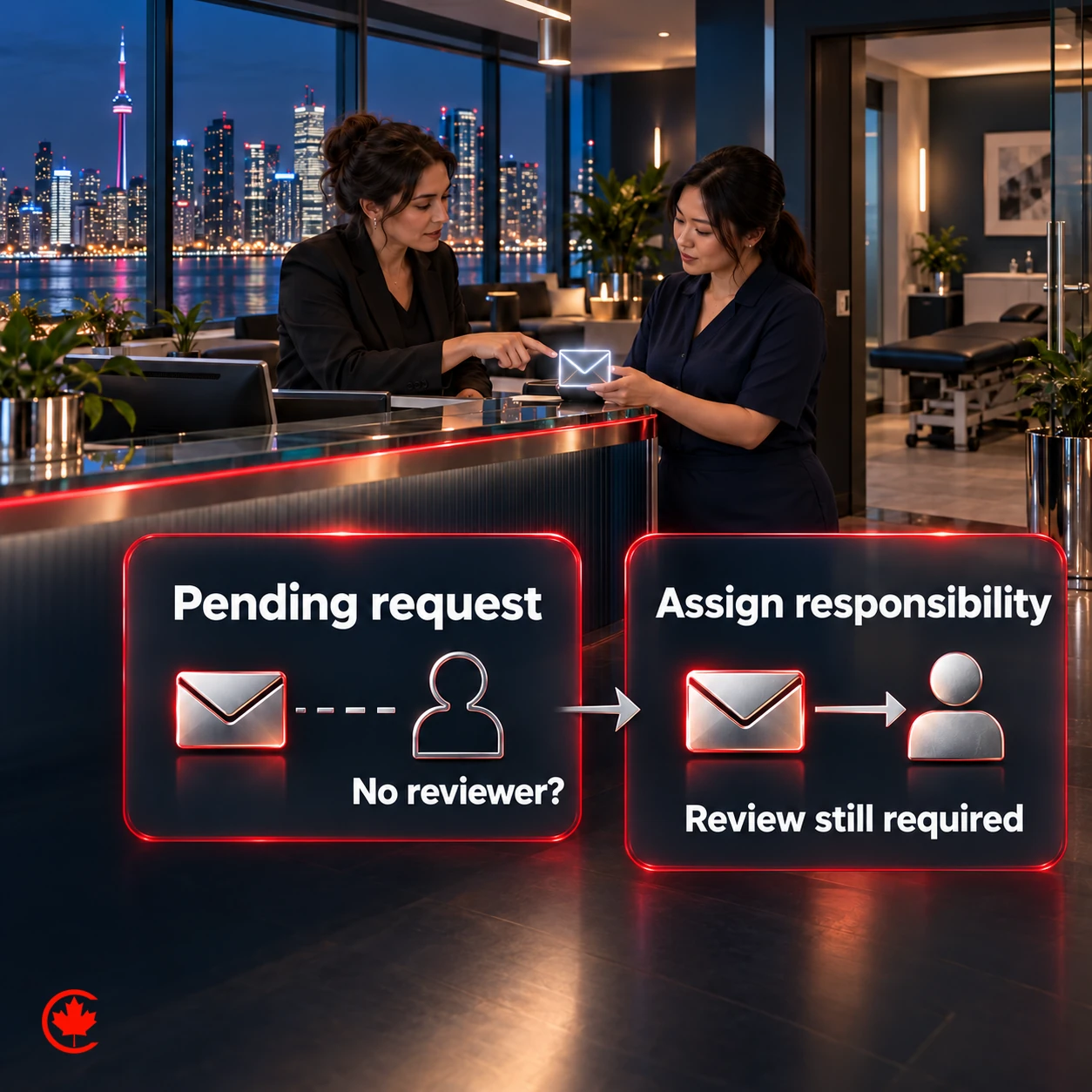
For example, imagine a clinic introducing an appointment-request route for a service that requires confirmation. Patients understand that a request is pending, but the clinic has not assigned anyone to review it. The problem is not solved by adding more advertising or another reminder. The purchasing decision needs a workable division of responsibility and a truthful response expectation. This example concerns the patient experience and the clinic’s staffing, not instructions for building the underlying software or an assumption that the agency supplies clinical screening.
The owner should also distinguish an enquiry-management tool from a clinical record system. A marketing project may need to show that a request reached the appropriate team without giving the provider access to treatment notes. If a proposed product requires broader access, that requirement deserves a specific explanation and the clinic’s appropriate review. Convenience alone does not establish that transferring records is necessary, lawful or included in the agreed project.
Continuity matters when changing suppliers. The clinic needs to know what happens to its domain, public information, eligible accounts, software subscriptions and agreed access at the end of a project or term. Ownership of finalized deliverables does not imply ownership of every third-party licence or unlimited migration support. Any additional handover or ongoing maintenance needs should be stated in the agreement. A proposal that is clear about continuing responsibilities is easier to evaluate than one that promises everything will be handled without identifying what that means.
For a new clinic, the next conversation may concern discovery and clear service information. For an established clinic, payment clarity, uneven availability or appointment handling may be more important. Canada Create’s healthcare marketing, SEO for healthcare, medical website design and CRM for healthcare services can be discussed against those specific needs, with scope and fees agreed in writing rather than a promise of a fixed number of patients.
Related sectors have their own buying considerations: how to get more dental patients, how veterinary clinics get more clients in Canada, how fertility clinics reach patients within the rules, how cosmetic surgery clinics attract patients within the rules and how pharmacies grow locally within Ontario OCP rules. The common principle is to purchase support that matches the real service, patient decision and available capacity, without treating every appointment as interchangeable or every marketing channel as appropriate for every clinic.
Frequently asked questions
What are some effective marketing ideas for a clinic?
Choose support for the actual obstacle: discovery, unclear service or payment information, booking difficulty or uneven appointment availability. A clinic with spare appropriate appointments faces a different decision from one with a waitlist. Compare local visibility, website/content, advertising and enquiry-handling services by their role and limits, rather than buy a universal channel checklist.
Is direct billing the same as insurance coverage?
No. The clinic’s ability to submit a claim is different from the patient’s benefit eligibility and the insurer’s decision about a particular service or expense. Provider, plan and payment arrangements can matter. Direct billing should not be described as a promise that every visit is covered or that the patient owes nothing.
Can patients still need to pay upfront?
Yes, depending on the actual plan, claim and payment arrangements. Reimbursement may be payable to the patient rather than the clinic, or a claim may not be completed at the appointment. The clinic should publish accurate payment expectations and confirm the relevant details rather than promise no upfront payment universally.
What should we publish about accepted insurers?
Publish the arrangements your clinic has verified, with relevant service or provider limitations and possible patient payment responsibilities. A platform’s list of participating insurers is not automatically your clinic’s list. Someone at the clinic should approve updates when providers, services or billing arrangements change; a professional designation alone does not establish reimbursement.
What changed for Ontario accident-related expenses in July 2026?
For accidents occurring in Ontario on or after July 1, 2026, auto insurance pays first for eligible medical and rehabilitation expenses, excluding medication costs. The FSRA forms linked in the guide identify these boundaries. This does not ensure an individual claim or apply simply because an appointment occurs after that date; confirm the claim arrangements.
Should a clinic with a waitlist buy more advertising?
Not simply to increase the overall enquiry count. Determine whether the waitlist concerns every service or only particular providers, while other appropriate appointments remain available. Additional demand cannot create clinical capacity. The relevant purchase may instead concern accurate service availability, payment information or the appointment experience, depending on the actual problem.
Can every discipline use the same patient-review marketing?
No. Rules differ by profession and jurisdiction. The Ontario examples in this guide illustrate the issue: physiotherapy guidance permits qualifying genuine testimonials, while CMTO prohibits testimonials in RMT advertising. A shared clinic component needs appropriate review for the providers and material involved; a software feature is not permission to use it.
Are benefits reminders appropriate for every patient?
There is no universal date or message. Plan dates vary, communications need an appropriate purpose and lawful consent, and remaining benefits do not create a clinical need. A clinic should not assume that consent associated with care permits every promotional use of patient information or encourage appointments merely to exhaust an allowance.
Which marketing measures matter after an enquiry?
Distinguish relevant enquiries, booking requests, confirmed first appointments and attendance. Keep new patients, repeat appointments and total visits separate. Review cost boundaries, capacity changes and reporting periods. Useful aggregate reporting may be possible without transferring clinical notes or insurance identifiers; limitations should be visible rather than replaced by estimated patient totals.
Do we need a new CRM or booking system?
Not necessarily. Identify what the current system supports and which capability is actually missing. A website or marketing engagement does not automatically include software subscriptions, integrations, record migration or clinical screening. Compare verified compatibility, staff responsibilities, necessary data access and ongoing costs before treating a system replacement as the solution.