
How to get more physiotherapy patients: benefits, MVA and workplace injury referrals

Getting more physiotherapy patients starts with deciding which appointments your clinic can responsibly offer, then making those appointments easier to find, understand and book. More enquiries are useful only when the service, practitioner, location, funding arrangements and patient’s needs fit. A busy phone line is not the same as a sustainable schedule, and additional visits are not a success measure when further treatment is unnecessary.
This guide is for owners and managers of Canadian private physiotherapy clinics. It uses four common payment routes to organise the decisions: extended health benefits, motor vehicle accident claims, workplace injury programs and private pay. These are not the only ways Canadians access physiotherapy. Publicly funded services have their own eligibility and referral requirements. Ontario examples are identified as Ontario examples; another province’s insurance system or professional standards must be checked separately.
The practical goal is to connect suitable patients with available care while reducing avoidable uncertainty about access, fees and next steps. That requires both marketing and a functioning patient journey. Start by identifying the constraint in your clinic before buying more advertising, another website or a larger package of monthly content.
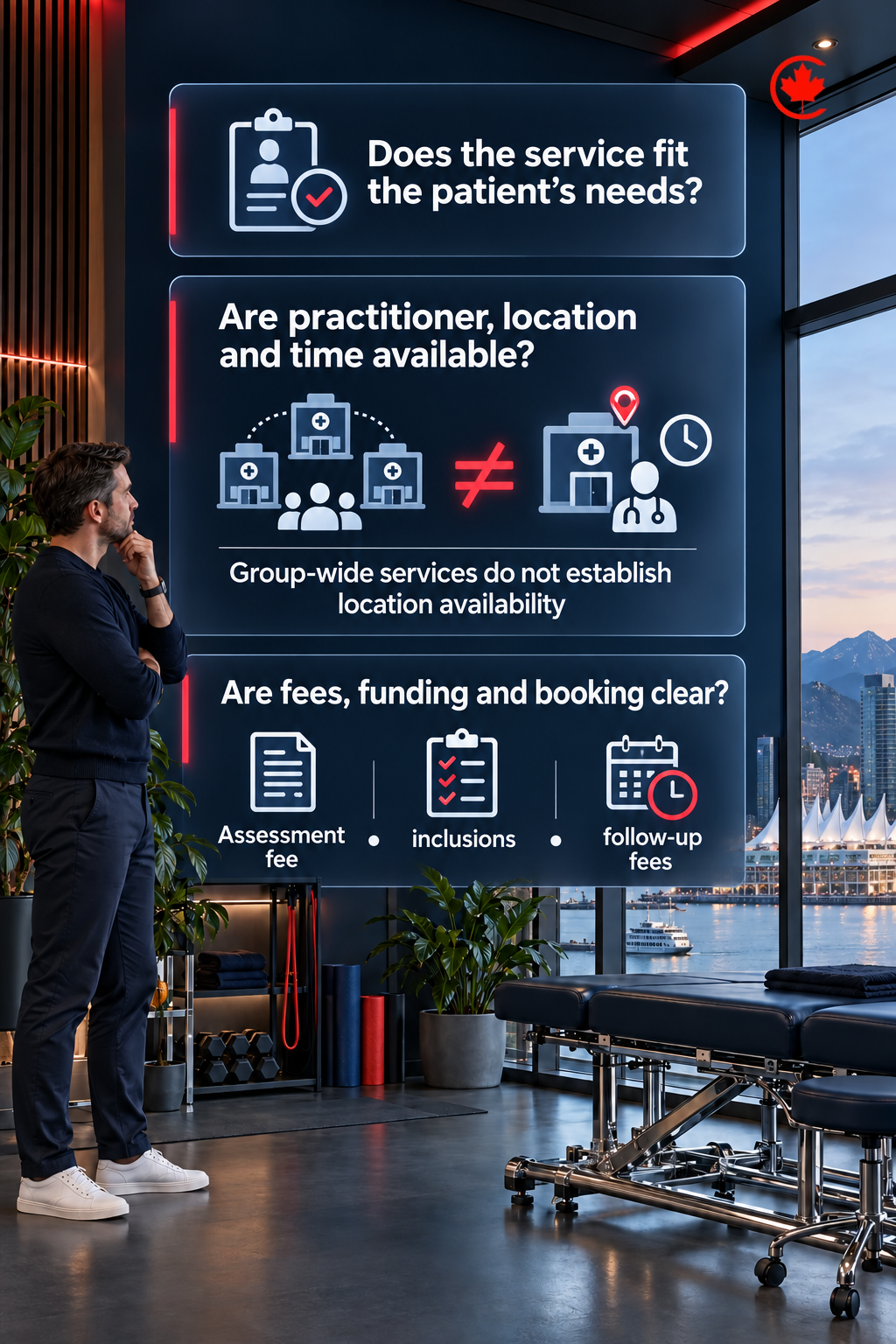
Start with capacity and the right growth problem
Define the service you want to grow more precisely than “physiotherapy.” A clinic may have general assessment availability on weekday mornings but no evening appointments. Another may have a practitioner with a genuine focus on vestibular rehabilitation who is accepting patients, while its sports-injury appointments are full. Advertising the whole clinic without those distinctions can produce enquiries the team cannot accommodate.
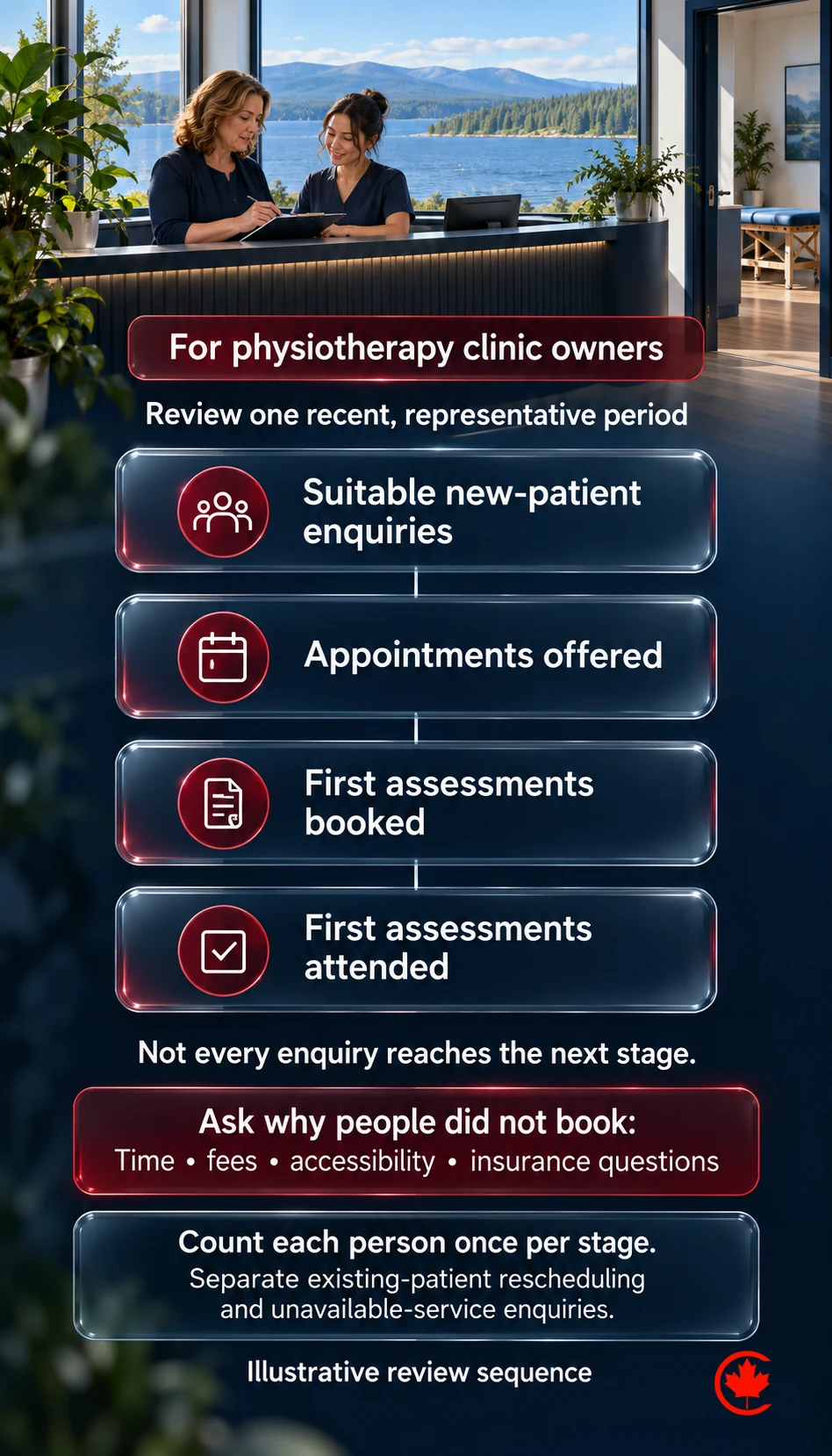
Use a recent, representative period to examine suitable enquiries, appointments offered, bookings and attended first assessments. Separate new patients from existing patients changing an appointment, duplicate contacts and enquiries for services you do not provide. Then look at the reason suitable people did not book. An unavailable time, unexpected fee, inaccessible entrance or uncertainty about insurance points to a different problem from very few local people finding the clinic.
Consider two hypothetical clinics. The first receives enough enquiries to fill its available assessment slots, but callers mainly need evenings and the openings are in the middle of the day. Increasing the advertising budget may intensify that mismatch. The second has appropriate evening availability, clear fees and reliable booking, but few people in its service area know it exists. Improving local visibility or testing focused paid search is more relevant there.

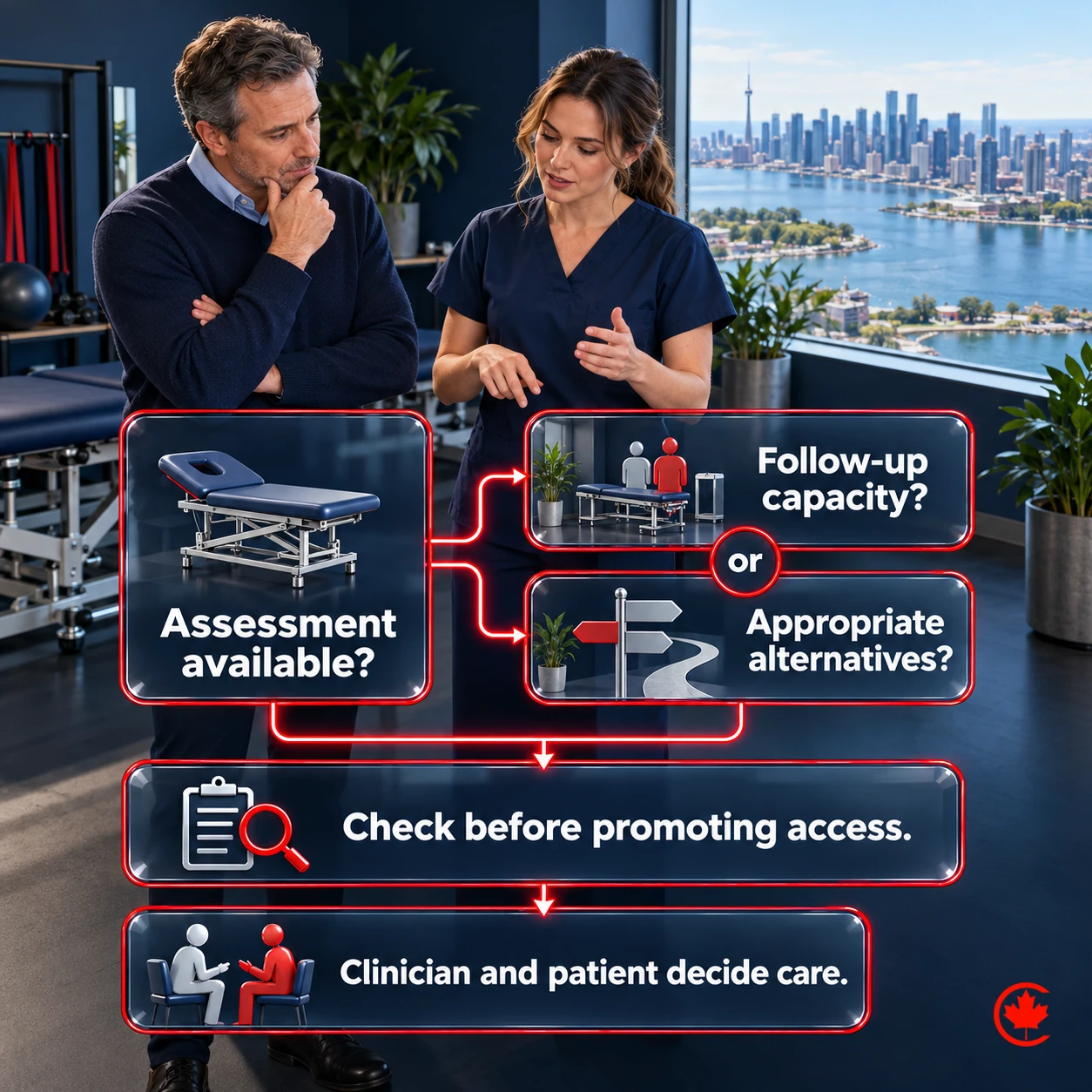
Capacity also includes what follows an assessment. A clinic should not promote immediate access if it cannot provide the follow-up that its clinicians reasonably anticipate or arrange appropriate alternatives. Conversely, maintaining appointment capacity does not justify promising a fixed treatment course before assessment. The clinician and patient determine care, not the marketing target.
Agree on a practical objective with the team, such as increasing suitable attended assessments for one available service at one location. Establish who checks availability, who updates public information and who can reduce promotion when capacity changes. This turns “more patients” into a manageable business decision without making a promise about patient outcomes.
A note on search data
Use search research to test a growth opportunity, not to overrule what your clinic actually provides. A national estimate for a broad phrase does not tell you how many suitable people need an appointment near your location. A missing estimate does not establish that demand is absent. Compare relevant local search evidence with your website’s search enquiries, Business Profile activity and the questions your reception team receives. Ask a marketing supplier to explain what those signals support, what remains uncertain and why the proposed service deserves priority.

Stream 1: extended health benefits patients
For an extended-benefits patient, “Do you take my insurance?” may conceal several different questions. Can the clinic submit a claim electronically? Does the patient’s plan cover the service and practitioner? Is a referral required for reimbursement? How much remains available, and will the patient need to pay anything at the appointment? A clear answer separates these issues rather than treating direct billing as a coverage guarantee.

The Ontario Physiotherapy Association’s access and payment guidance distinguishes direct access to physiotherapy from an insurer’s requirements. Patients can generally access a physiotherapist directly, while some plans require a physician or nurse practitioner referral for payment. Per-visit limits, annual limits and benefit pools shared with other services can also affect reimbursement. Publicly funded pathways have separate requirements. Keep those distinctions visible on the clinic’s payment page and in conversations with prospective patients.
A useful payment page explains which direct-billing arrangements the clinic currently supports, what patients should confirm with their insurer and what happens if a claim cannot be processed immediately. Avoid collecting policy numbers or detailed medical histories through a general marketing form. Give patients an appropriate secure route for information the billing team needs, after explaining the purpose.

Here is a hypothetical example, not a typical fee or insurance entitlement. Suppose an assessment costs CAD120 and a particular plan pays 80% of the eligible expense, subject to a CAD90 per-visit payment maximum and enough remaining annual coverage. Assume the full CAD120 assessment fee is an eligible expense. Eighty per cent of CAD120 would be CAD96, but the assumed payment maximum reduces the insurer’s contribution to CAD90, leaving CAD30 for the patient. A different plan could produce a different result. The point is to explain the patient’s likely responsibility before the visit rather than advertise “covered” care without qualification.
Give reception staff a clear boundary: they can explain the clinic’s billing process and help identify questions, but they should not promise an insurer’s decision. If a claim is delayed or declined, patients should understand the agreed payment arrangements and whom to contact. For the owner, repeated confusion at this point is a service-information problem worth resolving before increasing traffic.
Benefits-renewal messages also need restraint. Not every plan resets in January, and unused coverage is not a clinical reason to receive treatment. Where a patient has agreed to receive appropriate promotional communication, a reminder can encourage them to check their plan and discuss a genuine care need. Avoid pressure to “use it or lose it” or book unnecessary visits. The useful business advantage is clarity, not artificially increasing consumption.
Stream 2: motor vehicle accident patients
Motor vehicle accident enquiries need a different explanation from ordinary benefits enquiries. A prospective patient may be uncertain about starting a claim, arranging an assessment, approval of proposed care and payment. A clinic considering this service should first confirm its clinical capability, administrative arrangements and ability to manage the relevant documentation. A well-promoted page cannot compensate for an intake process that repeatedly sends patients between the clinic and insurer without a clear next step.
Ontario’s 2026 accident-benefit changes require precise wording. For policies entered into or renewed on or after July 1, 2026, medical, rehabilitation and attendant care benefits remain mandatory, while other accident benefits are optional. Renewal transition rules can preserve previously held benefits as optional coverage unless the parties agree to changes, so the clinic should not tell a patient that other benefits simply disappeared at renewal. That policy-design change is separate from payment priority. FSRA’s 2026 forms describe auto-insurer first payment for eligible medical and rehabilitation expenses, excluding medication, for accidents occurring in Ontario on or after July 1, 2026. Do not apply that summary indiscriminately to older accidents or every out-of-province situation. See FSRA’s coverage explanation and Treatment and Assessment Plan.
The current Ontario regulation retains a CAD3,500 medical and rehabilitation limit for predominantly minor injuries, plus applicable HST under its stated terms and subject to exceptions. That is not a promise that every person has that amount available for treatment at your clinic, nor does a short description of an injury settle the applicable claim category. Clinical evidence, the relevant benefit rules and the individual claim matter. Ask the responsible practitioner and billing lead to approve any explanation of eligibility, limits or authorization before it becomes public marketing copy.
A useful MVA page answers the practical first-contact questions: whether the location accepts these enquiries, how to arrange an assessment, what claim information the team will request securely and who explains payment arrangements. Distinguish submitting a treatment plan from receiving approval. The HCAI treatment-plan guidance describes the electronic submission process and the distinction between relevant forms; it is not a guarantee that an insurer will approve the proposed services.

Also distinguish participation in HCAI from direct-payment licensing. HCAI’s provider guidance explains that a facility needs a valid FSRA service-provider licence at the relevant treatment and invoice stages to receive direct insurer payment. If your clinic does not have the arrangement a patient expects, explain that before creating an impression of effortless direct billing.
For the owner, assess this stream on more than the number of enquiries. Consider assessment availability, reporting time, coordination responsibilities, claim-processing delays and the experience of patients whose funding remains uncertain. Start with the services your team can reliably deliver. A narrow, accurate MVA page is better than a broad promise to handle every accident claim.
Stream 3: workplace injury patients
Workplace-injury marketing should identify the actual provincial program and the clinic’s role in it. “We treat workplace injuries” does not necessarily mean a particular practitioner and location are registered for the program the worker needs, that all proposed treatment is approved or that every fee will be paid. Explain what the clinic can confirm and what remains with the board or insurer.
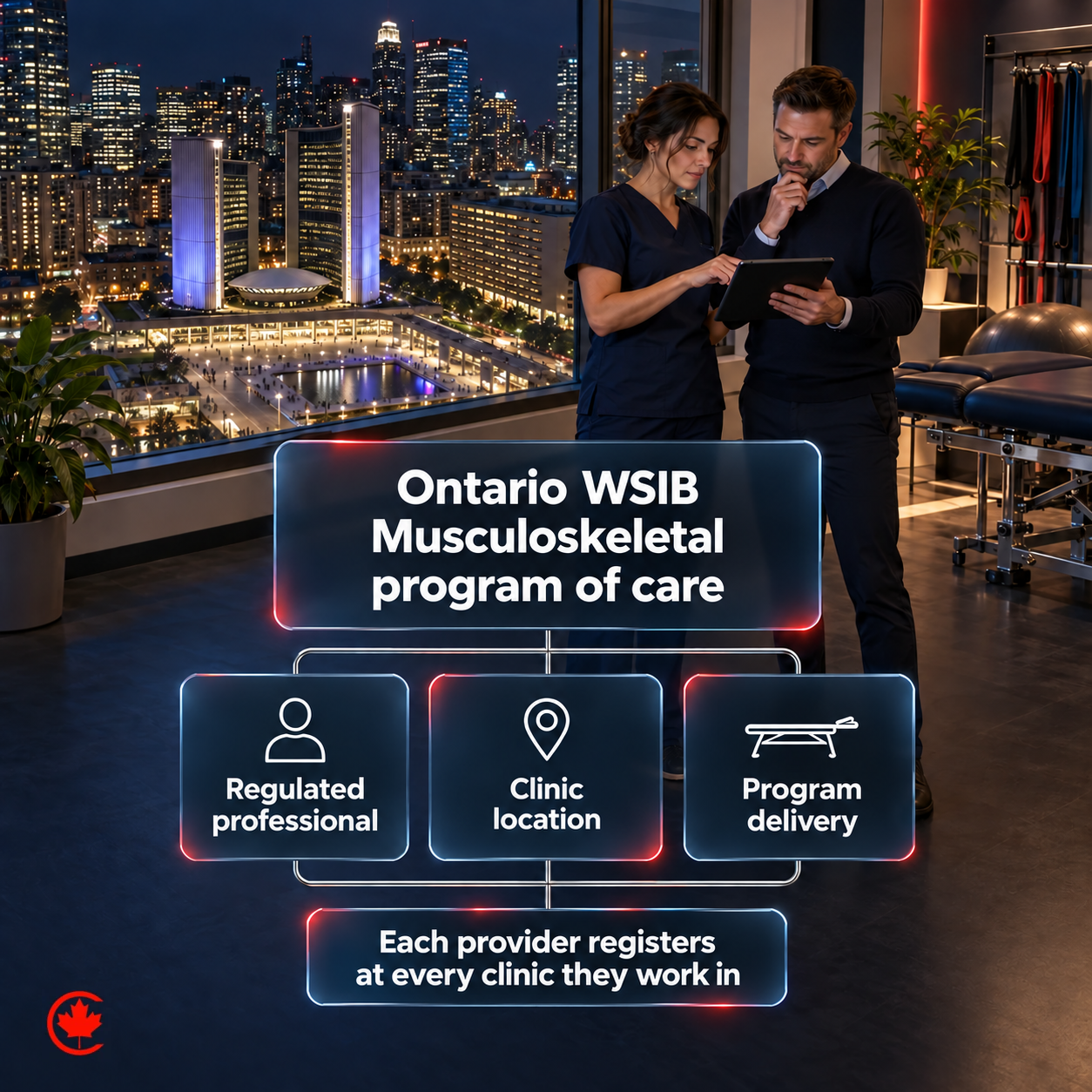
In Ontario, WSIB’s musculoskeletal program of care has admission, provider-registration and reporting requirements. Its guidance requires each regulated professional delivering the program to register, including each location where they work. Before marketing this offering, check that the provider, location and public directory information agree. A general clinic brand statement is not a substitute for those details.
British Columbia is different. WorkSafeBC’s patient guidance distinguishes contracted physiotherapists from non-contracted providers. A contracted provider can deliver an initial assessment before claim acceptance under its stated arrangements; choosing a non-contracted provider can involve upfront payment and reimbursement limits. Do not copy Ontario wording into a British Columbia location page simply by changing the board’s name.
Build the page around access rather than legal or clinical advice. Tell workers how to contact the clinic, how the team checks the relevant arrangements and which information should be supplied through the appropriate intake process. For employers and case managers, clarify the clinic’s services, location and reliable contact route without promising a return-to-work date or access to confidential information.
This stream can require substantial coordination. A clinic with spare treatment appointments but no capacity for timely reports may not be ready to promote it heavily. Compare the administrative commitment with the team’s available time, and identify who handles changes in claim status. If those fundamentals are not in place, resolve them before paying to attract more workplace-injury enquiries.

Stream 4: private pay
A private-pay patient needs enough information to make an informed decision without having to become an expert in physiotherapy. Publish the assessment fee, what that appointment includes, its expected duration and any different follow-up fees. If prices vary by practitioner or service, explain the difference clearly. A low headline price that applies only to an appointment the patient does not need creates frustration rather than trust.
Describe the first assessment as an opportunity to understand the patient’s needs and discuss suitable next steps, not as a guaranteed route to a predetermined package. Explain practical details such as preparation, clothing, accessibility and cancellation arrangements where relevant. The objective is to make the first visit understandable, not to promise that every person needs the same number of sessions or will recover within a fixed time.
Packages need particular care. The College of Physiotherapists of Ontario’s advertising guidance says bundled-service advertising must disclose the included services, the option to purchase individually and refunds for unused services. Treatment must remain appropriate to the patient’s needs. A package is a payment arrangement, not a clinical prescription or a reason to continue after discharge is appropriate.
For a hypothetical comparison, one clinic might offer a longer initial assessment at a higher fee than another clinic’s shorter appointment. A buyer cannot evaluate that difference from price alone. Clear information about who provides the care, how the appointment is structured and what is included allows a fairer comparison. Do not invent a superiority claim to justify the price, and do not imply that paying more guarantees a better outcome.
Affordability questions should receive a respectful response. Where the clinic genuinely offers reduced-fee options or knows appropriate publicly funded alternatives, staff can explain the available route without making unsupported eligibility promises. Turning away an unsuitable enquiry with useful information may be better for the patient and the clinic than pressuring someone into care they cannot afford.
Local SEO for physiotherapy clinics
Local search should help a person establish that the clinic is real, nearby and suitable for their needs. A local-search proposal should make someone accountable for accurate practice details, services and booking destinations. Ask how the supplier will verify that public listings describe the actual clinic rather than a broader range of treatments chosen to attract more searches. The owner should approve the factual description and know who maintains it when services or hours change.
Location-page work should deliver answers to location-specific questions: which practitioners work there, what appointments are available, how to reach the premises and which payment arrangements apply. Ask to see those patient decisions represented in the proposed scope. A person with limited mobility may need to know about entrance steps, an elevator or accessible washrooms before booking. The clinic should verify the stated features rather than approve an unqualified “fully accessible” label.
A proposal for numerous neighbourhood pages deserves scrutiny. Does each page help a reader make a distinct decision, or does it simply repeat the same clinic description with another suburb name? A service area is not a physical office. Owners should reject work that implies locations the practice does not have, and ask what useful patient information justifies each proposed page. Page count alone is not a measure of value.
For a hypothetical two-location practice, imagine that pelvic-health appointments are available at the north location only. The south location’s page should not imply those appointments are available there simply because the service belongs to the group. A clear route to the correct location prevents the front desk from repeatedly correcting expectations after a booking request.
Evaluate local work by whether appropriate people find and contact the correct clinic, not solely by a ranking screenshot. Search visibility varies by query and location, and no supplier can promise a permanent map position. Ask for an explanation of the actual local opportunity and the patient information being improved. Our guide to how to win near me searches provides broader local-search context.
Content that brings patients
Useful physiotherapy content connects a real question with a sensible next step. A service page can explain what the clinic offers, who provides it and how to arrange an assessment. A first-visit page can reduce uncertainty about timing, fees and preparation. A payment page can distinguish the clinic’s billing arrangements from an insurer’s coverage decision. These pages serve different purposes and should not all repeat the same booking message.
The following framework helps an owner evaluate the purpose of proposed patient information. The right choice depends on the clinic’s actual services and the questions prospective patients need answered before deciding whether to contact it.
| Content | Buyer purpose to evaluate |
|---|---|
| Condition pages (low back pain, sciatica, rotator cuff, ACL rehab) | Explain an offered service and whether an assessment may be appropriate |
| “Physio after a car accident in Ontario” | Clarify applicable Ontario claim arrangements and the clinic’s intake role |
| “Is physiotherapy covered by my benefits?” | Distinguish direct billing from the patient’s actual plan coverage |
| First visit guide | Explain appointment expectations, preparation, fees and booking status |
| Exercise videos for common recovery stages | Provide clinician-reviewed education with clear audience and safety limits |
We help physiotherapy clinics rank locally and turn searches into booked assessments.
Ask a content supplier which patient decision each proposed page will support. If reception repeatedly explains referral requirements for reimbursement, a payment explanation may deserve priority over another general article. If people cannot tell whether a service is available at their location, the proposal should address that uncertainty. This lets the owner assess the value of the work without adopting a publishing quota or managing a search-content production process.
Condition pages need clinical review. They should describe the clinic’s relevant assessment and care approach without diagnosing the reader, exaggerating what physiotherapy can achieve or promising a recovery timeline. Do not market a practice focus that is not a significant part of the practitioner’s work. A list of popular conditions is not permission to advertise every treatment associated with them.
Exercise videos deserve a separate decision. General educational material can show the clinic’s communication style, but it should not present one exercise sequence as suitable for every person with a symptom. Have a qualified clinician decide the purpose, limits and review arrangements. If the clinic cannot maintain that standard, a carefully reviewed first-visit explanation may be more useful than an expanding library of generic recovery advice.
Finally, follow the journey after the page. Does the booking button open the right location and appointment type? Is an online submission a confirmed booking or only a request? Can someone ask a practical question without sending sensitive health details through a general contact form? A clear page loses much of its value if the next step contradicts it.
Referral sources
Referral relationships work best when another person understands which patients your clinic can appropriately assess and how to reach you. A family physician, sports organisation or occupational-health team may need concise information about actual services, location, availability and the contact route. An owner should be able to explain those facts without making a promise of preferential treatment or guaranteed outcomes.
The College of Physiotherapists of Ontario’s Conflict of Interest Standard prohibits arrangements such as paying or providing benefits in exchange for referrals and receiving benefits for sending referrals elsewhere. It also addresses incentives linked to treatment-session counts. A generic “reward people who send patients” marketing tactic is therefore not an appropriate default for an Ontario physiotherapy clinic.
Consider a hypothetical relationship with a local running club. An educational session on what an assessment involves may help people understand the service, provided the information is accurate and within the presenter’s competence. A payment to the club for each member who becomes a patient is a different arrangement with a different professional-risk profile. Assess the actual proposal, not just the friendly label “community partnership.”
Relationships with personal-injury lawyers or employers need the same discipline. Make clinical independence, patient choice and appropriate information-sharing arrangements clear. A referral is not blanket permission to send reports or health details to the referring person. Keep the communication connected to an authorised purpose and the applicable privacy and professional requirements.
Review referral sources for fit and access, not merely volume. If many referred people need a service you do not offer, clarify your scope. If suitable referrals cannot obtain appointments, resolve the capacity issue before inviting more. A dependable explanation of what you can and cannot provide builds a more useful relationship than an ambitious promise the team cannot keep.
Keep patients through their plan of care
Continuity means helping patients follow an appropriate, agreed plan and making it easier to discuss problems with that plan. It does not mean maximising visits regardless of need. A patient who has achieved their goals and is appropriately discharged is not a marketing failure. Neither is a patient who makes an informed decision to choose another option.
When someone misses an appointment or does not rebook, avoid assuming the cause. The appointment may no longer be needed, the cost may be difficult, work hours may have changed or the patient may have questions about progress. A respectful follow-up can offer a way to contact the clinic without pressuring the person to attend or revealing treatment information in a message someone else could see.
Separate administrative support from clinical decisions. Reception can explain scheduling and agreed fees; the responsible clinician should handle changes to the care plan, reassessment and discharge questions. Appointment reminders should use the patient’s agreed contact arrangements. Promotional messages are a different purpose and should not be quietly added to a clinical reminder sequence.
Software can support this coordination, but it does not replace the underlying responsibilities. A CRM for healthcare should be evaluated for the precise administrative problem it solves, the information it needs and how it works with the clinic’s practice systems. More automated messages are not automatically a better patient experience. Our guide to online booking for clinics covers the booking side of that decision.
For reporting, distinguish missed appointments, clinically appropriate discharge, patient-directed discontinuation and an unresolved communication problem. Those situations call for different responses. Do not pay staff or suppliers to drive a blanket visit-count target that could interfere with professional judgement or patient interests.
The College’s advertising standard
The College of Physiotherapists of Ontario’s Advertising and Marketing Standard, effective May 1, 2025, requires accurate, verifiable and non-misleading promotion. It addresses competence, practice-focus and specialist representations, outcome guarantees, superiority claims, unnecessary services, bundles and free offers. Practitioners must review advertising placed on their behalf and take reasonable steps to correct problems. Hiring an agency does not remove that responsibility.
Ontario physiotherapy and dentistry do not have identical testimonial rules. Current CPO guidance allows genuine, accurate and verifiable patient testimonials, with informed consent when a name, image or personal health information is included. That is not permission to invent a review, pay for one or turn a patient’s statement into an unsupported treatment promise.
Google imposes its own review-content rules, including prohibitions on incentives and selectively soliciting positive reviews. A professionally acceptable testimonial and a permitted Google review request are separate questions. Replies should avoid confirming a person’s patient status or discussing their care in public, even when the person has already posted details.
Build a manageable approval process around the material that can cause harm: provider titles, service claims, images, offers, prices, insurance explanations and patient stories. Identify the reviewer, keep the approved version and revisit information when the service or rules change. This is more useful than relying on a broad assurance that all marketing will be “compliant.”
Other provinces have their own regulators and requirements. A national group needs a location-aware review rather than one undifferentiated approval. Use our overview of healthcare advertising rules in Canada as a starting point, then check the current rules for the actual profession and province. This guide is general business information, not advice about a particular regulatory or legal situation.
Choose paid search and other channels deliberately
Paid search can be a reasonable test when the clinic has suitable availability and wants to reach people actively looking for an offered service. It is less compelling when the booking journey is broken, the service is unavailable or the clinic cannot afford to learn from an uncertain initial result. Buying clicks does not solve those underlying problems.
Ask the supplier to explain the intended service, location and patient action in ordinary language. An assessment enquiry for an available service is different from a person researching exercises, a job or professional training. You do not need to manage the campaign yourself, but you should understand how its purpose matches the clinic’s capacity and how unsuitable enquiries will be identified.
Health-related promotion also has targeting restrictions. Google’s personalized-advertising policy limits advertiser-curated audiences for sensitive-interest services. Do not assume that a patient list, a condition-page visitor list or a record of treatment enquiries is an acceptable audience simply because it is technically possible to upload it. The landing page, advertising content, targeting method and data use require separate review.
Compare paid search with other options instead of treating it as mandatory. Local information and service pages help people assess the clinic over time. Suitable community relationships can improve understanding and access but take staff effort. Educational social content may introduce the practice to people who are not ready to book. Each channel has a different purpose, time horizon and level of uncertainty.
A focused initial choice is often easier to evaluate than changing every channel at once. For example, a clinic might first improve the service and booking information for an available assessment type, then test paid discovery for that same service. If results are weak, the team can examine where the journey failed without trying to untangle a simultaneous website replacement, pricing change and multi-channel launch.
Set a budget and measure attended assessments
Budget for the whole activity, not only the advertising account. Money paid to advertising platforms (media spend), campaign-management fees, content, website work, booking tools and staff time may be separate costs. Distinguish an initial project from an ongoing monthly commitment, and confirm whether taxes and third-party charges are included. A proposal with a smaller headline fee can cost more if essential work is excluded.
Consider a hypothetical monthly example, not a market benchmark or Canada Create quote. A clinic spends CAD1,200 on media, CAD600 on management and CAD200 on incremental booking and administrative support, for CAD2,000 before any applicable tax. It records 30 unique suitable enquiries, 20 first-assessment bookings and 16 attended first assessments attributed to the activity. Media cost per suitable enquiry is CAD40. Total activity cost per attributed attended assessment is CAD125. Those figures answer different questions.
The CAD40 figure omits management and support costs. It also does not show how many enquiries became bookings or how many booked patients attended. If the clinic reports every call as a new patient, it may include existing-patient administration and duplicates. Agree on the definitions before judging the supplier. The clinic should be able to reconcile a simple summary with its own booking records without sending identifiable health information to an advertising platform.
Even the CAD125 figure does not prove that all 16 people were additional patients caused by advertising. Some may already have known the clinic or would have booked another way. Attribution identifies an observed connection; incrementality asks what would have happened without the activity. Small clinics may not have enough data for a confident causal conclusion, so describe the result honestly and look for consistent evidence over a suitable period.
Assess affordability using the clinic’s actual economics and available capacity. Collected fees are not profit: practitioner compensation, facility costs and administration still matter. Do not manufacture a favourable lifetime-value calculation by assuming every new patient buys an arbitrary course of treatment. Future appointments depend on clinical need, patient choice and appropriate reassessment.
Include cash flow in the decision. A campaign invoice may be due before insurance payments arrive. Decide how much the clinic can commit to learning, what result would justify continuing and what operational problem would require a pause. A poor first month may warrant diagnosis rather than immediate expansion or a confident declaration that the channel never works.
Protect information and choose the right help
Marketing reporting should not require unrestricted access to patient records. Identify the minimum information needed to understand enquiries and appointments, and separate administrative measurement from clinical documentation. Ontario’s privacy commissioner explains that marketing uses of personal health information have specific consent requirements. A general permission to receive care is not a blanket marketing authorisation, and consent does not remove an advertising platform’s own restrictions.
Promotional email and text also require a separate review. The CRTC describes CASL’s core requirements as consent, sender identification and an unsubscribe mechanism for commercial electronic messages. Do not assume that every past patient can be added indefinitely to a promotional list. Have someone responsible for privacy and communications review the intended purpose, consent basis and message content.
When choosing external help, start with the problem you need solved. A functioning website with weak fee and booking information may need focused improvements rather than a rebuild. A clinic whose team cannot manage advertising may need ongoing management. A practice opening a genuine new location may need coordinated local information, patient pages and staff preparation. These are different scopes, not interchangeable packages.
Ask each supplier what will be delivered, what requires clinical approval, what the clinic must provide and how outcomes will be reported. Clarify ownership of the domain, website content, advertising accounts and profile access. Identify who can maintain the work if the relationship ends, and what exports, handover or third-party licences are included. A visually impressive proposal is incomplete if those responsibilities remain unclear.
Compare the full agreement, not a verbal promise. Understand the initial term, notice period, renewal, cancellation charges, media commitments and whether maintenance or additional pages cost extra. Ask who handles booking-system changes and who checks that the patient journey still works afterward. Avoid contracts or incentives that reward unsuitable referrals or unnecessary treatment volume.
For example, suppose two proposals both promise to improve new-patient bookings. One offers a complete website replacement; the other proposes changes to three existing service pages and the booking journey. Ask each supplier to show the problem that makes its scope necessary. If the existing website works well on phones, accurately describes the clinic and can support the required improvements, a full replacement needs a stronger justification than a new visual style. If patients cannot reliably reach the booking system or the platform cannot support essential information, a more substantial project may be reasonable.
Then compare responsibility for the same outcome. Does either proposal include updating payment information after the billing team reviews it? Who verifies that the correct practitioner and location appear in booking? Who corrects an error after launch, and is that covered by the agreement? A clinic should not discover after signing that both its website supplier and booking supplier consider the broken handoff to be someone else’s responsibility.
Do not confuse account access with clinical access. A marketing supplier may need access to manage the clinic’s advertising account but not to read individual treatment notes. Define each role around the work actually being done. When a staff member or supplier leaves, the clinic needs a practical handover and an accountable person to review their access, rather than finding that the only person who can update essential patient information is no longer available.
A good supplier can explain both the opportunity and the limits. They should not guarantee rankings, patient numbers, clinical outcomes or universal regulatory compliance. They should be willing to show how the work fits the clinic’s services, capacity, province and information safeguards, and to distinguish measured results from assumptions.
A 90-day plan with clear decisions
Use a 90-day discussion with your team or supplier to define review checkpoints, not to accept a guaranteed growth timetable. At the first checkpoint, the owner should have a credible account of the constraint: unsuitable enquiries, insufficient discovery, unclear payment information, limited availability or booking friction. Ask what evidence supports that diagnosis and which dependencies must be resolved before further spending makes sense.
The next checkpoint is readiness. Has the agreed patient-information or booking work been delivered? Has the responsible clinician approved service and funding claims? Can reception explain the same arrangements that prospective patients see online? If a proposed campaign depends on appointment capacity or a direct-billing arrangement that is not ready, the owner needs a revised scope or start date, not a launch that ignores the gap.
A later review should compare suitable enquiries, bookings, attended assessments and total costs against the agreed objective. Ask the supplier to explain changes in staffing, hours, fees and seasonal demand that might affect interpretation. A small number of enquiries may leave the result inconclusive. Ninety days is a useful management checkpoint, not a guarantee that organic visibility or acquisition economics will have stabilised.
The decision is whether to continue, adjust or stop a defined activity. A promising service may justify more support within capacity; a booking bottleneck may justify operational help rather than additional advertising. If the clinic is already full, clearer information and appropriate continuity may be more valuable than more enquiries. Sustainable growth connects suitable patients with appropriate care, clear expectations and a business model the practice can support.
For help aligning discovery, patient information and booking, explore our physiotherapy marketing service or the broader clinic marketing guide.
Frequently asked questions
How do physiotherapy clinics get more patients?
Start with available services and appropriate patient needs, make fees and payment routes clear, improve local discovery and booking, and compare channels by suitable attended assessments rather than raw enquiries. Continuity should support clinically appropriate care, not unnecessary visits.
Do patients need a referral to see a physiotherapist in Ontario?
For private physiotherapy outside a hospital, the College does not generally require a referral to assess or treat. Some insurers require one for reimbursement, and hospital or publicly funded programs have separate requirements. Confirm the patient's actual route.
Who pays for physio after a car accident in Ontario?
For accidents occurring in Ontario on or after July 1, 2026, the revised rules require auto-insurer payment for eligible medical and rehabilitation expenses otherwise payable by supplementary health insurance, except medication expenses. Individual entitlement, approval and limits still matter; do not apply this summary to every older or out-of-province claim.
Is the Minor Injury Guideline limit still $3,500?
Ontario's current regulation retains a $3,500 medical and rehabilitation limit for predominantly minor injuries, plus applicable HST under its stated terms and subject to exceptions. This is not a guaranteed amount available at one clinic; clinical evidence, prior payments and the applicable claim rules matter.
Can physiotherapists offer free assessments?
Ontario permits free-service advertising only within its standard's stated conditions. The offer must disclose applicable limits, fit its education, awareness or pro-bono provisions and not promote unnecessary care. Check the complete proposal.
Can a physiotherapist call themselves a specialist?
In Ontario, the College must authorize use of a specialist title or wording implying specialization. Advertised practice interests must represent a significant practice focus.
What content works for physio clinics?
Prioritise clear, clinician-reviewed information about offered services, the first visit, fees, coverage questions and booking. Condition pages or educational videos need an appropriate purpose and limits; no content format guarantees appointments or treatment outcomes.
How should a physiotherapy clinic judge its marketing budget?
Include payments to advertising platforms, campaign-management fees, content, website or booking work and staff costs. Compare total activity cost with suitable attended assessments, distinguish attributed from genuinely additional patients and avoid assuming every person needs a fixed number of future visits.
How do physio clinics reduce drop off?
Make scheduling and fees clear, use agreed reminder arrangements and offer a respectful way to discuss missed visits or barriers. Keep clinical reassessment and discharge with the practitioner and patient. Appropriate discharge or an informed patient choice is not a retention failure.
Should physio clinics publish prices?
Clear assessment and follow-up fees help patients make informed choices. Explain what is included and any relevant differences. In Ontario, bundled-service advertisements must disclose included services, individual purchase options and refunds for unused services.