
Toronto · Brand guidelines
Brand guidelines in Toronto
Brand guidelines in Toronto, done well, are a brand book your staff and suppliers actually open, with the rules, templates and files they need to apply your brand correctly.
Brand guidelines design for Toronto and GTA businesses, from North York to downtown: brand books and style guides with logo rules, colour values, typography, templates and voice.
- BBB A+ accredited
- 18 years in business
- Mon to Fri 9 to 6, Sat 10 to 2
Get a custom proposal for your brand guidelines
Send us the logo files and materials you use today and where the brand looks inconsistent. We reply with a custom proposal.
Please do not share passwords or other sensitive details here. We never sell your contact information and we comply with Canadian privacy law
(privacy policy).
What your brand guide gives you
One correct set of files
Every logo version, colour value and font settled and stored in one place.
Rules people can follow
Short, visual guidance with misuse examples instead of long paragraphs.
Templates that do the work
Documents, slides, social posts and signatures with the brand built in.
Easy supplier handoff
A supplier pack so printers, sign makers and designers start from the right files.
What brand guidelines include
Each guide is scoped in a written proposal; these are the usual sections.
- Logo rulesVersions, clear space, minimum size and a page of misuse examples.
- Colour paletteHex, RGB, CMYK and spot references, with approved combinations.
- TypographyTypefaces, hierarchy, fallback fonts and licence notes.
- ImageryPhotography style, illustration rules and an icon set.
- TemplatesDocuments, proposals, presentations, social posts and email signatures.
- Voice and toneTraits, tone by situation, before and after rewrites and a word list.
- Accessibility and bilingual rulesContrast pairs, minimum sizes and French and English usage.
- Supplier packApplied examples for signs and vehicles, plus files in one folder.
How brand guidelines are priced
Brand guidelines fees are quoted in writing after a free review. Font licences and stock images are bought in your name and shown separately.
Starter guide
Quoted in writing
Small teams that need the basics settled
- Logo rules
- Colour values
- Typography
- Supplier pack
Full brand book
Quoted in writing
Organizations with staff and many suppliers
- All visual sections
- Voice and tone
- Accessibility rules
- Applied examples
Templates package
Quoted in writing
Teams producing documents and posts daily
- Document templates
- Presentation template
- Social templates
- Email signatures
Bilingual or multi brand guide
Quoted in writing
French and English use or several sub brands
- French usage rules
- Bilingual layouts
- Sub brand sections
- Online brand page
Ad spend and software licences are paid to the platform directly and shown separately from our fees.
Brand guidelines guide
What a usable brand guide includes and how to keep it current
A brand stays consistent only when everyone has the same rules and files. Brand guidelines in Toronto, also called a brand book or brand style guide, are the written rules and ready to use files that let anyone apply your brand correctly: staff making a slide deck, a printer producing a sign, a freelancer designing a social post or a new marketing coordinator writing an email. Useful brand guidelines cover logo use, colour values for print and screen, typography, photography style, templates, voice and tone, accessibility and French and English usage, and they make it easy for suppliers to get the right files. They are for owners and marketing coordinators who are tired of seeing five versions of the same logo. Canada Create has worked with Canadian businesses since 2008, is BBB Accredited with an A+ rating and works from 126 Willowdale Ave. in Toronto.
Our brand guidelines work covers six areas:
- Logo rules: versions, clear space, minimum sizes and misuse examples.
- Colour and typography: print and screen values, font licences and type hierarchy.
- Imagery: photography, illustration and icon style.
- Templates: slide decks, documents, social posts and signage files ready to use.
- Voice and tone: how the brand writes, with examples in English and French where needed.
- Supplier pack: organized files and a short brief for printers, sign shops and freelancers.
- What brand guidelines are for
- What should brand guidelines include?
- How many pages should brand guidelines be?
- Logo use rules
- Colour palette for print and screen
- Typography and font licences
- Photography, illustration and icons
- Templates over rules
- Voice and tone with examples
- Accessibility and bilingual use
- Supplier handoff, formats and updates
- Trademarks, licences and claims
- Brand guidelines examples worth studying
- Common brand guidelines mistakes
- How we build brand guidelines
- What brand guidelines cost in Toronto and what changes the fee
- How to compare brand guidelines designers in Toronto
- Request a brand guidelines proposal for your logo, colours and voice
What brand guidelines are for
A brand drifts the moment more than one person touches it. The office manager stretches the logo to fit a flyer, a sign shop matches the colour by eye, a new hire picks a different font for proposals, and within a year the business looks like several different companies. Brand guidelines stop that drift by answering the questions people would otherwise guess at.
Who reads them
- Staff who make documents, presentations and social posts.
- Outside designers, printers, sign makers, vehicle wrap shops and web developers.
- Franchisees, partners and resellers who show your logo.
- New marketing hires who need to learn the brand quickly.
- Event organizers and sponsors who ask for your logo with a short deadline.
Usable beats beautiful
Many brand books are designed to impress at the launch meeting and then never opened again. A usable guide is short where it can be, shows examples rather than lecturing, and links straight to the files people need. If a coordinator cannot find the right logo file in under a minute, the guide has failed, however handsome it is. The guide sits on top of your brand identity; it documents a brand that exists, rather than inventing one.
What should brand guidelines include?
Brand guidelines should include logo rules, colour values for print and screen, typography, imagery style, voice and tone, templates and a supplier pack with the files. Those seven parts answer almost every question staff and suppliers ask. Larger or bilingual organizations add accessibility rules, French and English usage, co-branding rules and the name of the person who approves exceptions.
- Brand foundation: a short statement of positioning, audience and personality, so the rules make sense.
- Logo: every version, clear space, minimum size, backgrounds and misuse examples.
- Colour: primary, secondary and neutral colours with HEX, RGB, CMYK and spot values, plus approved combinations.
- Typography: typefaces, hierarchy, fallback fonts and licence notes.
- Imagery: photography, illustration and icon style with do and do not examples.
- Voice and tone: how the brand writes, with before and after examples.
- Templates and files: documents, slides, social posts and signage, linked from the guide.
How many pages should brand guidelines be?
Most small and mid-sized businesses need 15 to 40 pages, and many need fewer. A starter guide with logo, colour, type and a supplier pack can fit on a handful of pages, while a full brand book for a multi-location or bilingual organization runs longer because it adds voice, templates and applied examples. Length is a poor measure of quality: a guide that answers the common questions on short pages and links straight to the files gets used, while a long book designed to impress tends to sit unopened.
Logo use rules
The logo section is the one people open most, so it needs to be clear and complete.
Versions
Most brands need a primary logo, a horizontal and a stacked version, a symbol on its own for small spaces such as social avatars and favicons, and one colour versions in dark and reversed white. Each version should state where it is used, so a sign shop knows which one goes on a narrow fascia and which goes on a square window decal.
Clear space and minimum size
Clear space is the empty area around the logo that nothing else may enter, usually measured using a part of the logo itself so it scales. Minimum size is the smallest the logo can appear in print and on screen before details blur. Both prevent the cramped, unreadable logo on the bottom of a sponsor banner.
Misuse examples
A page of what not to do is often the most useful page in the guide: no stretching, no recolouring, no drop shadows, no outlines, no placing on busy photos, no rearranging the symbol and wordmark. Showing the mistakes visually works better than describing them. If the logo itself needs work before the rules are written, our logo design service handles that first.
Colour palette for print and screen
Colour is where brands drift fastest, because every medium reproduces it differently.
Values for every medium
Each brand colour is listed with its values for screens (hex and RGB), for process printing (CMYK), and where it matters for a specific ink match (a spot colour reference). Sign and vehicle colours may also need a vinyl or paint match chosen with the supplier. Without these values, every supplier makes their own guess.
Primary, secondary and neutral colours
The guide shows which colours lead and how much each is used, often as a simple visual of proportion: mostly white or a neutral, the primary colour for emphasis, an accent used sparingly. It also defines tints for backgrounds and the colours for text, links and buttons on the website.
Approved combinations
Not every pairing in a palette works. The guide shows which text colours may sit on which backgrounds, which ties directly to contrast and accessibility, covered below.
Typography and font licences
The type system
The guide names the typefaces and the weights in use, then sets a hierarchy: headings, subheadings, body text, captions, buttons. Each level gets a size range for print and screen and a line spacing, so a proposal and a web page feel like the same brand.
Fallback fonts
Brand fonts are not always installed on every computer. The guide names a fallback for everyday documents, presentations and email so staff are not left choosing whatever is in the menu. It also notes which web fonts the website loads.
Licences
Fonts are software with licences. A desktop licence may not cover the website, an app or a vehicle wrap, and some licences limit how many computers may install the font. The guide records which licences the business holds, in whose name, and where each font may be used, so a supplier never installs an unlicensed copy.

Photography, illustration and icons
Photography style
The photography section describes and shows the look: natural light or studio, people at work or products alone, candid or posed, colour treatment, what to avoid. A few strong examples and a few rejected ones teach faster than paragraphs. If your library is thin, our photography team can shoot images that match the guide, which then becomes the brief for every later shoot.
Image library and file naming
An approved image library saves staff from pulling random photos off the website or a phone. The guide explains where the library lives, how folders are organized (by location, service or season, for example), how files are named so the right one can be found by search, and which images are retired. It also notes who took each photo and whether people shown have agreed to its use, which matters when a staff member leaves.
Illustration
If the brand uses illustration, the guide sets the style: line weight, colour use, level of detail, and where illustration replaces photography. It also states who may create new illustrations so the style stays consistent.
Icons
An icon set needs a consistent stroke, corner style and size grid. The guide includes the set as files and explains how to request a new icon rather than downloading a mismatched one.
Templates over rules
The fastest way to keep a brand consistent is to give people a finished starting point. Rules tell people what to do; templates do most of it for them.
Templates worth including
- Letterhead, memo and report documents in everyday word processing formats.
- Proposal and quote templates with cover, section and pricing page styles.
- Presentation templates with title, section, content, chart and closing slides.
- Social post templates for announcements, quotes, events and hiring.
- Email signatures with the correct logo size, colours and contact layout.
- Business cards, name badges and simple flyers.
Locking the right things
Good templates fix the logo, colours and type while leaving text and images editable. Staff then change what they should and cannot easily change what they should not. Our graphic design team builds the templates alongside the guide, and our social media management team works from the same social templates when it posts for you.
Voice and tone with examples
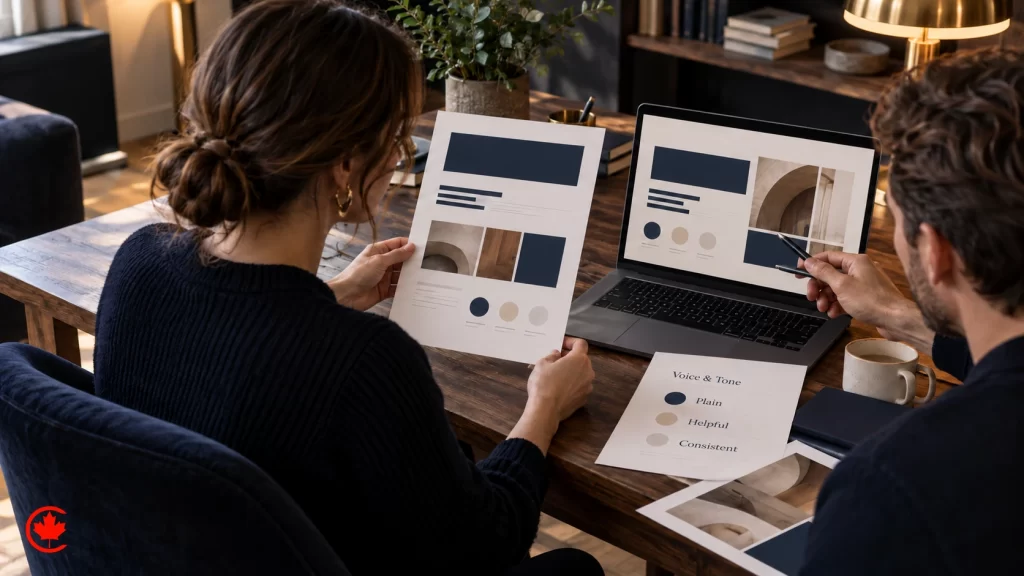
A visual guide without a voice section leaves half the brand unguided. Customers meet your words in emails, quotes, voicemails and website pages far more often than they meet your logo.
Voice traits
Voice is described as a few traits with limits, such as “plain, not simplistic” or “confident, not boastful”. Each trait comes with a short explanation of what it means for the business.
Tone by situation
Tone shifts with the moment while the voice stays the same. The guide shows the difference between a welcome email, a reply to a complaint, a past due invoice reminder, a job posting and a social post. Before and after rewrites of real sentences are the most useful examples.
Writing for different channels
The same voice reads differently on a vehicle, in a text message and in a long proposal. The guide gives short rules per channel: how long a social caption runs, how formal a quote cover letter should be, how the business answers the phone, and what an out of office reply says. These small, concrete rules settle most of the daily questions staff ask a marketing coordinator.
Word list
A short list of preferred and avoided words settles everyday questions: the exact business name, how to write service names, whether to say clients or customers, spelling conventions (Canadian spelling, for example), and words that should never appear. Our content writing service can draft the voice section and rewrite core pages to match it.
Accessibility and bilingual use
Contrast and readability
The guide marks which colour pairs pass contrast for normal text, which pass only for large text, and which must never be used for text at all. It sets minimum type sizes for print and screen, asks for real text rather than text inside images, and reminds people not to carry meaning by colour alone. Building these into the guide prevents inaccessible materials from being made in the first place.
French and English
Businesses serving French and English customers need rules for both. The guide covers whether the logo has a French version or stays the same, how bilingual signs and documents are laid out (side by side, top and bottom, or separate pieces), which language comes first in which context, and French typography conventions such as spacing before certain punctuation and the use of guillemets. French text usually runs longer, so templates leave room for it.
Supplier handoff, formats and updates
Most brand mistakes happen at the supplier, not in the office. The guide should make a supplier’s job simple.
Applied examples
Show the brand on real items: the main sign, a window decal, a vehicle side and rear, a uniform, a trade show banner, packaging. Applied examples answer questions about scale and placement that rules cannot. Our signs and large format team can produce mockups for these pages and the final items.
The supplier pack
A supplier pack bundles what an outside party needs: logo files in vector and image formats, colour values, font names with licence notes, key templates and a one page quick reference. It should be one link or one folder, not a scatter of email attachments.
Co-branding and partner use
Partners, sponsors and event organizers will ask for your logo. The guide sets how it appears next to another brand: equal size or secondary, which version on dark backgrounds, the clear space between the two marks, and what partners may not do, such as recolouring your logo to match theirs.
Who approves exceptions
No guide covers everything. The guide names who approves an exception, such as a co-branded sponsor banner or an unusual sign shape, and how to ask. Without a named approver, exceptions slowly become the rule.
PDF and online page
A PDF guide is easy to send to a printer and keep on file. An online brand page, often a private page on your website, is easier to keep current and can host the download links directly. Many businesses use both: a PDF for suppliers and an online page for staff. Our website design team can build the online version.
Keeping it current
Guides go stale when a new service, location or campaign arrives and nobody updates them. Set a person responsible, date each version, keep a short change log at the front and review the guide whenever the brand changes in a visible way. Outdated files should be removed from shared drives so nobody uses them by accident.
Ownership
The guide, the source files and the asset library belong to your business and should live in a shared drive or account in your business name, not in a designer’s personal storage.

Trademarks, licences and claims
The guide is also where the business records how its marks and assets may be used. This is a marketing observation, not legal advice.
Trademarks
The guide should reflect the legal status of your marks. Whether a logo clashes with someone else’s registration, and whether to file your own with the Canadian Intellectual Property Office, are questions for a trademark agent or lawyer. Once they answer, the guide can show the registered symbol where your counsel asks for it.
Licences
Fonts, stock images and illustrations carry licences that set where they may be used. The guide lists each licence and its limits so staff and suppliers stay within them.
Claims and accessibility
Writers following the voice section should also know the claims rule: under the Competition Act, statements like made in Canada or eco friendly have to be accurate and provable. The contrast pairs set earlier in the guide support AODA expectations in Ontario, with WCAG as the reference for type and colour.
Brand guidelines examples worth studying
The best way to see what good brand guidelines look like is to study public ones. The organizations below publish their brand guidelines, brand books or style guides online. We describe what each does well in our own words; follow the links to see the guides themselves on each organization’s site. None of these is Canada Create work.
- Toronto Metropolitan University: A university brand site that sets out logo use, colour, typography and photography for many faculties and departments. It is a useful model for any organization where dozens of teams produce their own material, because the rules are written for people who are not designers.
- University of Toronto: A brand portal that brings rules and downloadable assets together in one place. The lesson for a business is the portal itself: suppliers get the current files from one link instead of an old email attachment.
- University of British Columbia: A brand site organized by where the brand appears: visual identity, writing, photography, web, social media, audio and video, signage and stationery. Organizing a guide by use rather than by element helps people find the page they need.
- McGill University: A visual identity guide for an institution that works in English and French, covering the name, symbols and logo use. Bilingual Canadian businesses can borrow the idea of treating both languages as first-class in the rules.
- Mailchimp Content Style Guide: A writing guide rather than a visual one, covering voice and tone, grammar, accessibility, writing for social media and email. It shows how much of a brand lives in words and how to give writers clear examples.
- Atlassian Design foundations: A design system that documents colour, typography, iconography, illustration, logos and motion for digital products. Software and SaaS companies can see how brand rules become components that developers reuse.
- LinkedIn brand guidelines: A short guide focused on how partners and the public may use the logo. It is a good example of a public-facing section that answers one question well: how to show our logo correctly.
- Wise Design: A brand and design site for a company that operates across many countries and currencies, with its visual direction explained alongside the system. It shows how a brand can stay recognizable while adapting to many markets.
- Mozilla brand portal: A portal that covers a parent brand and several product brands in one place. Businesses with sub brands, locations or product lines can use it as a model for brand architecture inside the guidelines.
- GOV.UK Design System: A public sector system built around accessibility and plain language for every page and form. It is a reminder that brand guidelines for websites should set contrast, readability and form patterns, not only colours.
What these brand guide examples share is more useful than any single one: they are organized around the questions people ask, they show examples instead of only rules, they link to current files and they are kept up to date. A business guide does not need their scale. It needs the same habits applied to your logo, colours, voice and suppliers.
Common brand guidelines mistakes
- Rules without files. A guide that describes the logo but does not link to the correct versions sends people back to an old email.
- Colour values for one medium only. Screen colours without CMYK or spot values lead to mismatched signs and print.
- No misuse examples. People follow pictures faster than paragraphs; show stretched, recoloured and crowded logos.
- Fonts nobody is licensed to use. Name fallback fonts for email and shared documents, and note who holds each licence.
- Voice described in adjectives only. “Friendly and professional” means little without before and after sentences.
- No owner and no date. Without a person who approves exceptions and a version date, the guide goes out of date quietly.
- Designed for the launch meeting. A long, beautiful book that is hard to search is used once; short pages with clear headings are used every week.
How we build brand guidelines
Free review
We look at your current logo files, materials and any existing guide, and ask where the brand drifts most.
Written proposal
The sections, templates, formats and languages, with fees quoted in writing.
Audit and gathering
Collecting every logo file, colour, font and template in use, and settling which are correct.
Drafting and templates
The guide written and designed, templates built, and drafts reviewed with the people who will use them.
Handover
The PDF, the online page if included, the supplier pack and a short walkthrough for staff.
Every file is handed over in your business’s name, ready for the next person who needs it.
What brand guidelines cost in Toronto and what changes the fee
Brand guidelines fees are quoted in writing after a free review. The size of the guide matters less than what has to be decided and built.
What changes the fee
- Whether the logo, palette and type are settled or need decisions first.
- How many templates are built, and in which formats.
- Whether a voice and tone section is written.
- Whether the guide is in English only or in French and English.
- How many applied examples, such as signs and vehicles, are mocked up.
- Whether an online brand page is built as well as the PDF.
- How many sub brands or locations need their own rules.
Starting small
A short starter guide with logo rules, colours, type and a supplier pack can come first, with templates and voice added later. Font licences and stock images are bought in your name and shown separately.
How to compare brand guidelines designers in Toronto
- Who does the work? Ask whether the designer you meet is the one who builds the files and templates.
- Will the guide be short enough for staff to use, and can I see a sample page?
- Do you build templates, or only write rules?
- How will you handle colour values for signs, vehicles and print?
- Will you include voice and tone, and French and English usage?
- Who owns the accounts? The answer should be you. The asset library, font licences and source files should be in your business name.
- How do we keep the guide up to date after handover?
- Are the reviews real? Read Google reviews from businesses the studio has worked with, not only portfolio captions.
A good sign is a designer who asks how your staff actually make documents today, because that is where the guide will be tested.
Related guide: Canva alternatives for small teams.
Request a brand guidelines proposal for your logo, colours and voice
Gather the logo files and materials you have, including the ones you suspect are wrong, and send them with a note on where the brand looks inconsistent. We will review them for free and send a written proposal for a guide your team will open. Call (416) 273-9030, Monday to Friday, 9 am to 6 pm, and Saturday, 10 am to 2 pm. After hours, our 24/7 AI agent answers the toll-free line, +1 (800) 808-9235, and we’ll follow up the next business morning. We reply within one business day. Canada Create is at 126 Willowdale Avenue, Suite 3, Toronto, and you can also share your brand files with us ahead of the review.
Talk to a strategist
Ready when you are?
Request a custom proposal
Tell us your goals, budget and timeline. You get a custom proposal and a named strategist, so your next stage of growth starts now.
How a brand guide project runs
Each step is written down, and the guide, templates and files stay in your business's name.
- Free review First call
Your current files, materials and where the brand drifts most.
- Written proposal Written proposal
Sections, templates, formats, languages and fees quoted in writing.
- Audit, drafting and templates Agreed milestones
Files gathered and settled, the guide drafted and templates built.
- Handover Handover
PDF, online page if included, supplier pack and a staff walkthrough.
Why business owners choose Canada Create for brand guidelines
Since 2008
More than 18 years of websites, search and advertising work for businesses across Canada.
BBB Accredited A+
A BBB Accredited Business with an A+ rating and zero complaints.
Toronto office
126 Willowdale Avenue, Suite 3, Toronto, serving businesses across Canada.
English and French
Our team works in English and French.
Brand guidelines in Toronto: questions owners ask
Basics
What do brand guidelines do for a business with several suppliers?
Brand guidelines stop a brand from drifting once more than one person touches it. Without them, the office manager stretches the logo to fit a flyer, the sign shop matches colours by eye and a new hire picks a different font for proposals. A written guide answers those questions before anyone has to guess, so printers, designers and staff all start from the same files.
How do brand guidelines relate to a brand identity project?
Brand guidelines document an identity so it can be used consistently. When the identity itself needs work, our branding agency in Toronto team builds the identity and the guidelines together.
Contents
What affects the cost of a brand guidelines project?
Scope sets the cost: a starter guide with logo rules, colour values and a supplier pack is a smaller job than a full brand book with voice, accessibility rules and applied examples. Templates for documents, slides and social posts, or a bilingual guide covering several sub brands, add work. Font licences and stock images are bought in your name and listed separately. Send us the logo files you use today for a free review, and the fee follows in writing.
Should brand guidelines be a PDF or a page on our website?
Either can work, and many brands use both. A PDF is easy to send to a printer or a sign shop. An online brand page can link straight to the logo and template files and be updated in one place, so nobody works from an old copy.
Which logo rules should brand guidelines spell out?
Start with the versions: primary, horizontal, stacked, a symbol for small spaces such as favicons, and one colour versions in dark and reversed white. Add clear space measured from part of the logo itself and a minimum size for print and screen. A page of misuse examples, showing stretching, recolouring, drop shadows or busy photo backgrounds, prevents more mistakes than paragraphs of text.
What should brand guidelines include?
At minimum: logo versions and rules, colour values for print and screen, typography, imagery style, voice and tone, templates and a supplier pack. Bilingual or multi-location brands add French and English rules, accessibility, co-branding and an approvals contact.
Examples
What belongs on the typography page of brand guidelines?
The typography page names each typeface and shows the hierarchy for headings, body text and captions. It also lists fallback fonts for places where the brand font is not installed, such as email or shared documents. Licence notes explain who may use each font, since many fonts are licensed per user or per project.
What do useful brand guidelines examples share?
The guides people keep opening are short where they can be, show examples instead of lecturing and link straight to the files. A coordinator should be able to find the right logo file in under a minute. Guides designed mainly to impress at a launch meeting tend to go unread afterwards.
Where can I find good brand guidelines examples?
Universities, public bodies and software companies often publish theirs: Toronto Metropolitan University, UBC, McGill, the Mailchimp Content Style Guide and the GOV.UK Design System are useful to study. See the examples section on this page for what each does well.
Format
Can we fill in a free brand guidelines template ourselves?
A template gives you section headings, but it cannot settle your actual hex, RGB, CMYK and spot colour values, your clear space rules or which logo version goes on a narrow fascia. Those decisions are the hard part, and they need the original files behind them. For a two- or three-person business, a free template filled in carefully by someone with design training may be all you need.
How many pages should brand guidelines be?
Most small and mid-sized businesses need 15 to 40 pages, and a starter guide can be much shorter. What matters is that each common question has a clear page and that the files are linked.
How often should brand guidelines be updated?
Review the guide whenever the brand adds a service, location, sub brand or template, and at least once a year. Put a version date and an owner on the cover so people know they have the current copy.
Building a guide
How are brand guidelines created for a brand that already exists?
The guide documents the brand you have rather than inventing a new one. We gather every logo file, colour and font in use, settle the correct versions and write short visual rules with misuse examples. If the logo itself needs work first, our logo design service handles that before the rules are written.
How do I create a brand style guide?
Start by gathering every logo file, colour, font and template in use and settle which versions are correct. Then write short rules for logo use, colour values, typography, imagery and voice, with an example for each, and link the files. Test the draft by asking a supplier and a new staff member to use it, and fix whatever they had to ask about.
Does a small business need brand guidelines?
Yes, once more than one person or supplier makes materials. A short starter guide with logo rules, colour values, fonts and a supplier pack prevents most drift. It can grow into a full brand book later.
Cost and scope
Is a brand style guide the same thing as brand guidelines?
In everyday use the terms overlap: a brand book, a brand style guide and brand guidelines usually mean the same set of rules and files. What matters is what the document covers, from logo use and colour values to typography, imagery, templates, voice and tone. Some teams keep a separate editorial style guide for writing, which can sit inside the brand guide as the voice section.


Stop the five versions of your logo
When every supplier guesses at your colours and fonts, the brand drifts with every order. A short review shows what your guide needs and which files to settle first. Book a free brand guide review.