By Amir Vincent, Chief Executive Officer at Canada Create™ Published 2026-07-15. Last updated 2026-07-15.
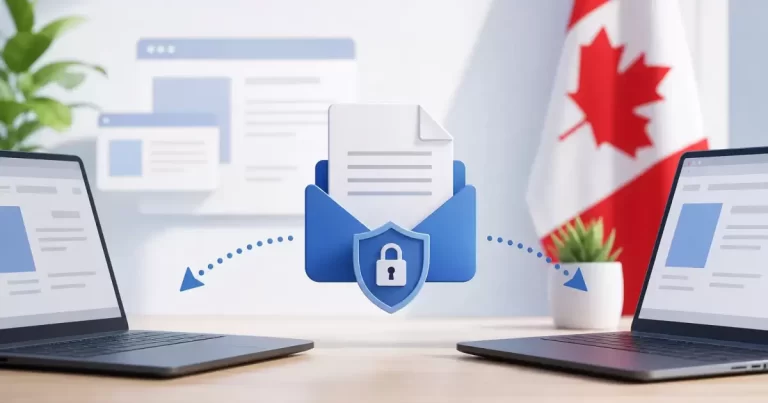
I am Amir Vincent, Chief Executive Officer at Canada Create™, and here is what our compliance reviews for professional service clients actually show. PIPEDA does not mandate a specific technology like fax or email for transmitting client documents. It requires that whatever method you use protects personal information with safeguards appropriate to its sensitivity, and that you can demonstrate reasonable care was taken. The technology matters less than whether you can show the safeguards around it.
That answer surprises a lot of office managers who assume there is a specific approved list of tools. There is not. If you are heading toward the bigger question of what your firm’s overall secure document workflow should look like, understanding what PIPEDA actually demands first prevents you from over-engineering, or under-protecting, your current process.
Why This Question Comes Up Before a Bigger Decision
Office managers at law and medical clinics usually ask this question after a specific trigger: a client asked why documents are still being faxed, a new hire questioned the process, or a privacy audit flagged an outdated policy. Before deciding whether to switch systems entirely, the honest first step is understanding what the law itself requires, since that shapes whether the fix is a policy update, a technology upgrade, or both.
Getting this sequence backwards, switching technology before understanding the actual legal requirement, is how firms end up either overspending on unnecessary compliance features or, more dangerously, assuming a new tool is automatically compliant just because it is newer than a fax machine.
The Signals That Tell You It Is Time to Act
A few concrete signals tell you your current document transmission practice needs a formal review:
- Nobody at your firm can point to a written policy describing how client documents are transmitted and secured. The Office of the Privacy Commissioner of Canada expects organizations to have accountability measures, not just good intentions.
- Staff routinely email sensitive documents as unencrypted attachments because it is faster than the approved process. A typical cause is a secure process that is slower than email, for example a fax line that is often busy, so staff work around it.
- You have never documented what happens if a transmission fails or is misdirected. PIPEDA requires breach response readiness, and misdirected faxes or emails are one of the most common real-world breach scenarios in professional services.
- Your current system has no audit trail showing what was sent, when, and to whom. Accountability under PIPEDA depends partly on being able to demonstrate this after the fact, not just in the moment.
What Most Canadian Businesses Get Wrong Here
The most common mistake we see is assuming that because fax has been used for decades, it is automatically PIPEDA compliant, or conversely, that because fax feels outdated, switching to email automatically improves compliance. Neither assumption holds up. A traditional analog fax line, when dialed correctly and paired with a confirmation process, can meet PIPEDA’s safeguard requirements. An unencrypted email sent to the wrong address can violate them just as easily as a misdialed fax number.
Free website review
Get a free 10-minute website teardown.
We will review your site’s conversion path, search visibility, and technical friction, then send a focused video with practical next steps. No obligation and no pressure.
Prefer to talk first? 416-273-9030
The second mistake is treating this as purely a technology decision when it is actually a policy and training decision first. The Canadian Medical Protective Association’s guidance on privacy consistently notes that most privacy incidents in clinical settings stem from process failures, not technology failures. A firm can have the most secure tool available and still create a breach through a training gap or a rushed staff member skipping a verification step.
A Practical Framework or Checklist
| Step | What you do | Why it matters under PIPEDA |
|---|---|---|
| 1. Document your current transmission method | Write down exactly how documents move today, fax, email, or otherwise | Accountability requires a documented process, not just informal habit |
| 2. Assess sensitivity, not just volume | Sort document types by how sensitive the personal information is | Safeguards should scale with sensitivity, per PIPEDA’s proportionality principle |
| 3. Add a confirmation step | Require a call-ahead or read receipt before transmitting sensitive documents | Reduces the single most common real-world failure point, wrong recipient |
| 4. Train staff on the actual policy, not just the tool | Confirm staff understand why the process exists, not just the steps | Prevents the workaround behaviour that causes most real incidents |
| 5. Build a breach response plan before you need one | Know who to notify and how, in advance | PIPEDA requires timely breach reporting once a real incident occurs |
Canada Create™ builds and optimizes WordPress sites for Toronto businesses. Tell us your goals and we will recommend the right setup.
When You Are Ready for the Full Decision
Once you understand what PIPEDA actually requires, the next question is which specific tools and workflow changes bring your firm into full compliance without disrupting day-to-day operations. That fuller breakdown, including specific platform comparisons, lives in Secure Document Workflows for Canadian Legal, Medical & Financial Firms. If your firm is specifically weighing whether to move off a physical fax machine, our companion piece comparing SRFax against traditional fax machines walks through that exact decision.
Frequently Asked
Does PIPEDA specifically ban fax machines for client documents? No. PIPEDA is technology neutral. A fax machine paired with proper safeguards and verification steps can meet the requirement, though it is worth noting many firms find newer systems easier to document and audit.
What counts as a reasonable safeguard under PIPEDA? The safeguard needs to be proportionate to the sensitivity of the information, per the Office of the Privacy Commissioner’s guidance. Highly sensitive medical or financial records generally warrant stronger protection than routine correspondence.
Does using a cloud fax service like SRFax automatically make a firm PIPEDA compliant? Not automatically. The service needs to be configured correctly, paired with staff training, and backed by a documented policy. The tool alone does not create compliance.
Ready to go further?
Not sure whether your current document process actually meets PIPEDA’s requirements? Canada Create™ has advised Canadian legal, medical, and financial firms on secure document workflows since 2008. Book a 30-minute compliance review with our team and we will tell you honestly where the gaps are. No pitch deck. No pressure.
Written by Amir Vincent, Chief Executive Officer at Canada Create™.
Since 2008, our team has helped Canadian SMEs and professional service firms generate leads and grow revenue through SEO, content, paid media, and AI-enabled marketing. Reach the team at info@canadacreate.com or 416-273-9030.
Connect on LinkedIn.

About the author
Written by the author, Chief Executive Officer at Canada Create™. Since 2008, Canada Create™ has helped Canadian SMEs and professional service firms generate leads and grow revenue through SEO, content, paid media, and AI-enabled marketing.