
AI Overviews in 2026: What 400 Local Searches in Toronto and New York Show
On November 4, 2026, Canada Create ran the same 200 local service searches on Google in Toronto and in New York City and recorded everything on page one. An AI Overview appeared on 53.5% of the Toronto searches and 50.5% of the New York ones. The local pack (the map with three businesses) appeared on 77% in both cities, People Also Ask on more than 80%, and not one of the 400 pages showed a featured snippet. We also asked ChatGPT, with web search on, 30 questions about local services in each city and logged every website it cited.
This article sets out what we found, how Toronto compares with New York, and what it means for a business that wants to be found, chosen and called.
The findings at a glance
- AI Overviews showed on about half of local service searches: 107 of 200 in Toronto (53.5%) and 101 of 200 in New York (50.5%). The two cities agreed on 164 of the 200 searches.
- Questions almost always got one. 26 of 27 question searches in Toronto (“how much does a root canal cost”) showed an AI Overview, and all 27 did in New York.
- “Near me” searches stayed local. 25 of 26 “near me” searches in Toronto showed a local pack, and only 6 of 26 showed an AI Overview.
- The local pack did not shrink. It appeared on 77% of searches in both cities, and 31% of Toronto searches showed a local pack and an AI Overview on the same page.
- Featured snippets were absent: 0 of 400 pages.
- Toronto AI Overviews cite Canadian sites. 88 of the 98 Toronto AI Overviews with links cited at least one .ca website. YouTube was cited in 48% of them, Reddit in 12%.
- ChatGPT leaned on rankings and regulators. For “who is the best” questions about Toronto, 8 of 10 answers cited a ranking, directory or marketplace site, and only 3 of 10 cited a local business’s own website.
How we ran the analysis
We built one list of 200 searches across 10 industries a local business owner would recognize: dental, legal, home services, auto repair, health and physio, beauty and med spa, real estate, restaurants and food, finance and insurance, and fitness. Each industry had 20 searches: service names (“emergency plumber”), “near me” searches and plain questions (“how long does botox last”). No search included a city name, so the same words could run in both places.
Every search ran in English on desktop Google results set to Toronto, Ontario, and to New York City, on November 4, 2026. We recorded each page one feature: AI Overview, local pack, People Also Ask, video, images, discussions and forums, ads and featured snippets, plus the websites each AI Overview linked to. For AI answers, we asked ChatGPT, with web search on, the same 30 questions for each city (three per industry: a “best” question, a cost question and a “how do I choose” question) and recorded the websites cited in each answer.
These are snapshots from one day, one device and one location setting per city. Google results change by the hour and by searcher, so treat the numbers as a fair picture of early November 2026, not a permanent rate.
How often do AI Overviews appear on local searches in 2026?
About half the time. In Toronto, 53.5% of the 200 local service searches showed an AI Overview. In New York, 50.5% did. The gap is small: both cities showed one on the same 86 searches, neither showed one on 78, and the remaining 36 split 21 to Toronto and 15 to New York.
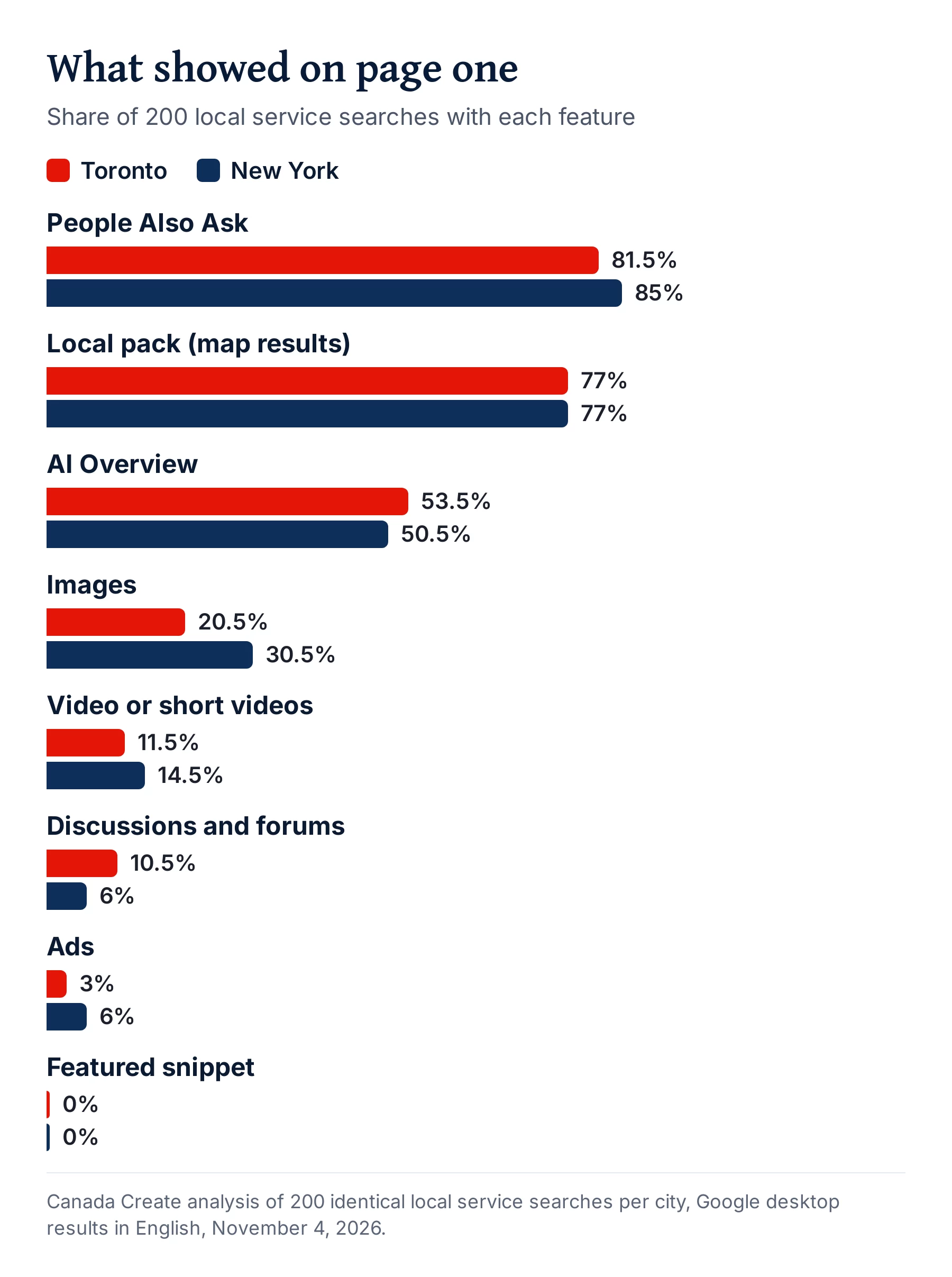
The type of search mattered far more than the city. Plain questions triggered AI Overviews almost every time (26 of 27 in Toronto, 27 of 27 in New York). Searches that were not questions triggered them on 46.8% of Toronto searches. “Near me” searches triggered them on only 6 of 26 in each city.
Google says AI Overviews appear when its systems decide generative AI adds something to the classic results, so many searches never get one. Its guide to AI features and your website also says there are no extra requirements or special optimizations to appear in them: a page must be indexed and eligible to show a snippet.
Which industries see the most AI Overviews?
Finance, insurance and real estate in Toronto, health and real estate in New York. In Toronto, 17 of 20 finance and insurance searches and 17 of 20 real estate searches showed an AI Overview. Restaurants and food sat at the other end, with 2 of 20.
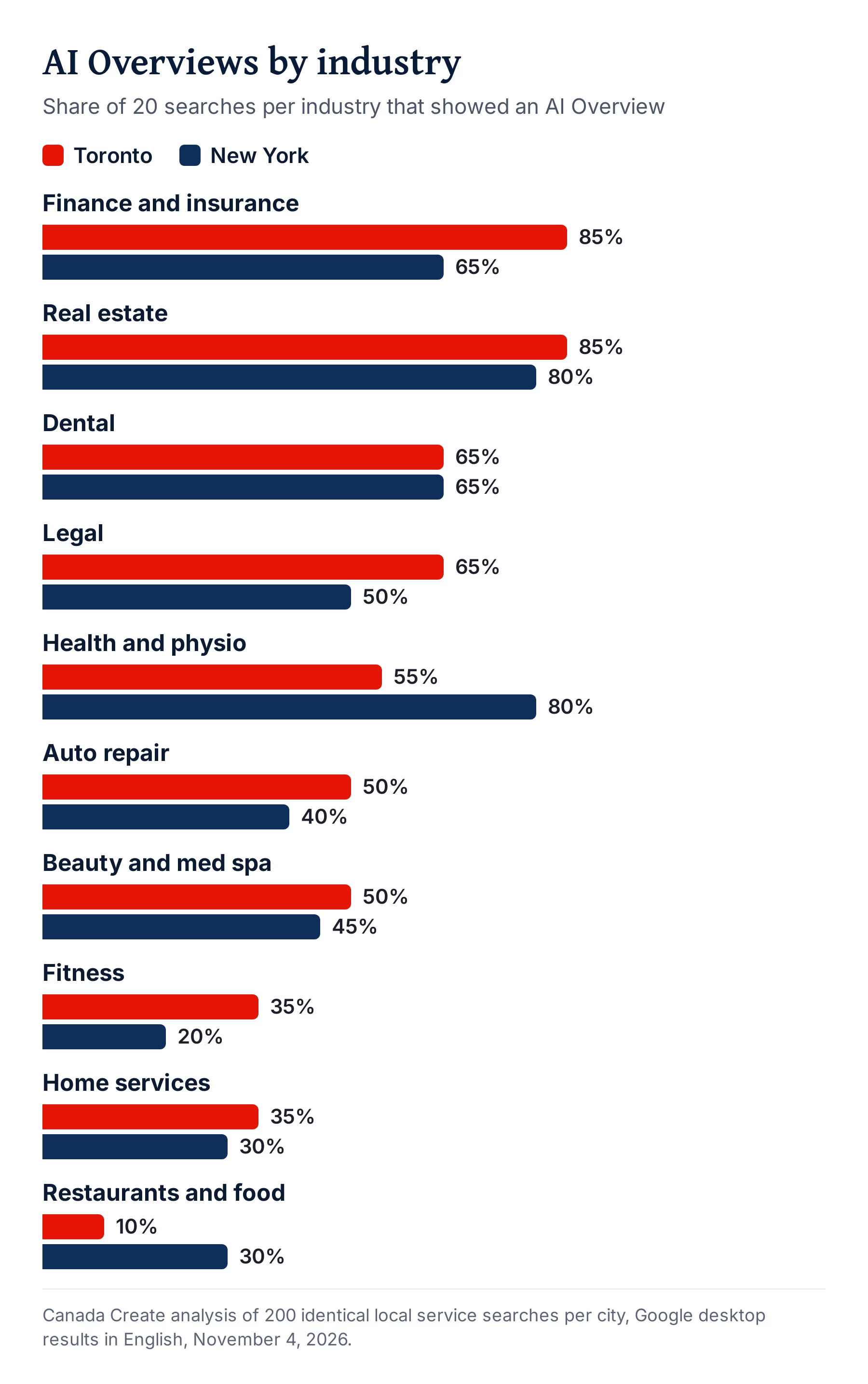
The pattern follows how people search in each trade. Finance, insurance, real estate, legal and dental searches are full of cost and process questions (“how much do realtors charge”, “how long does probate take”), and those draw AI Overviews. Restaurant, fitness and home service searches are mostly “find me one now” searches, which Google answers with a map.
With 20 searches per industry, one search moves an industry’s figure by five points. The order of industries is more reliable than the exact gap between two cities in one industry.
Do AI Overviews replace the local pack?
No. In this sample they sit beside it. The local pack showed on 154 of 200 searches in each city (77%). For “near me” searches it showed on 25 of 26 in Toronto and 26 of 26 in New York. In Toronto, 62 searches showed both an AI Overview and a local pack on the same page.
For a local business, this means two separate front doors on many searches: the map listing, which comes from your Google Business Profile, and the AI Overview, which draws on web pages, videos and posts. A strong profile does not put you in the AI answer, and a page cited in the AI answer does not put you in the map. The local SEO work that wins the map still matters on most of these searches.
What do AI Overviews cite for local service searches?
Canadian websites, YouTube and health reference sites, in that order of reach. Of the 98 Toronto AI Overviews that showed links, 88 cited at least one .ca website, and .ca sites made up 38.5% of the websites cited. In New York, .ca sites were almost absent (1 of 91). Each AI Overview linked to about seven websites on average.
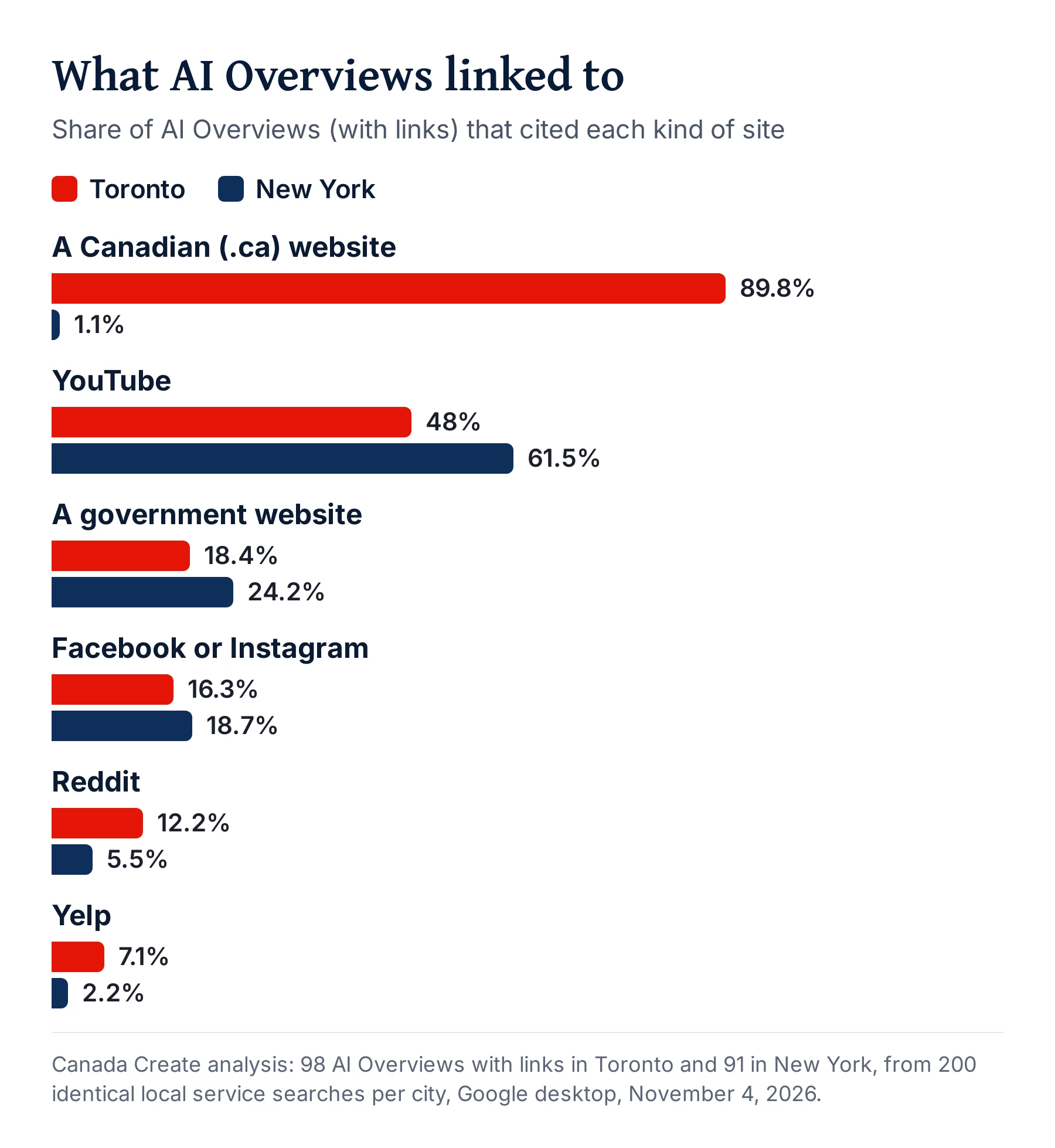
- YouTube was the most cited single domain in both cities: in 47 of 98 Toronto AI Overviews and 56 of 91 in New York.
- Facebook and Instagram appeared in 16 Toronto and 17 New York AI Overviews.
- Reddit appeared in 12 Toronto AI Overviews against 5 in New York.
- US health reference sites still reached Toronto answers: Cleveland Clinic, Mayo Clinic, WebMD, Healthline, Johns Hopkins Medicine and Harvard Health made up 31 of the Toronto links.
- Canadian sources such as Canada.ca, Ontario.ca, realtor.ca, Zolo, Ratehub and Canadian bank insurers appeared in Toronto answers on finance, real estate, legal and dental questions.
The local signal is the useful part for Canadian businesses. Google is not filling Toronto answers with US pages by default. When a Canadian page answers the question, it gets cited.
What does ChatGPT cite when people ask about local businesses?
Mostly third parties: regulators, ranking sites, directories and guides. ChatGPT cited at least one website in 29 of 30 answers in each city, about two websites per answer. In Toronto, a local business’s own website made up 24.2% of the citations. Government bodies, regulators and associations made up 33.9%, and ranking, directory and marketplace sites 25.8%.
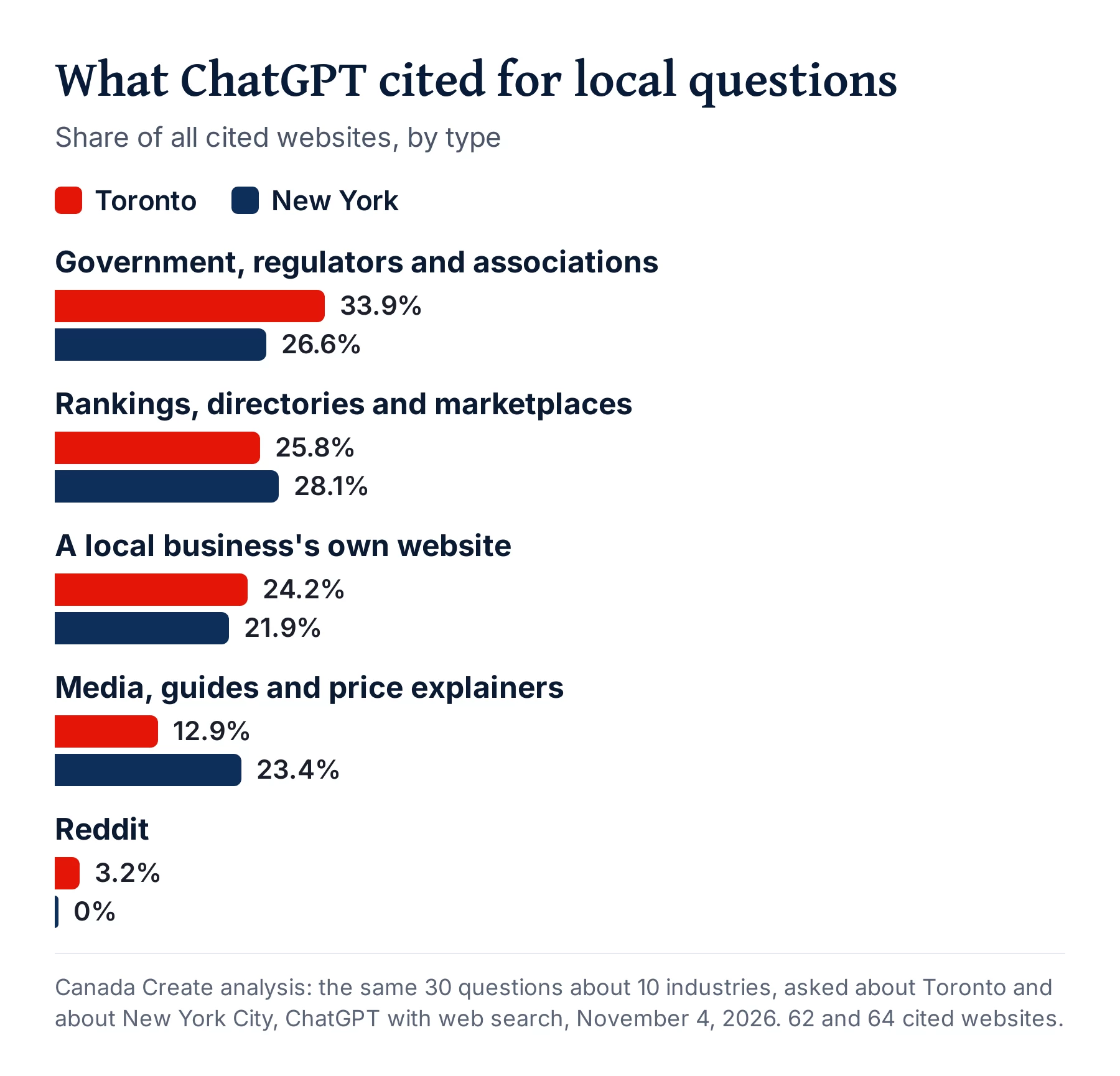
Each kind of question drew a different kind of site:
- “Who is the best” questions in Toronto cited a ranking, directory or marketplace site in 8 of 10 answers (5 of 10 in New York). Only 3 of 10 cited a business’s own website in either city.
- “How do I choose” questions cited a government body, regulator or professional association in 7 of 9 answers in each city: the Law Society of Ontario, the Ontario Dental Association, the Ontario Chiropractic Association and Ontario.ca in Toronto.
- Cost questions drew on clinic and business pages that publish real price ranges, and from price guide sites.
Being named in an AI answer and being linked from it are different results. A business can be the name ChatGPT recommends because a ranking site lists it, without its own website ever being cited. That is why the places that write about you matter as much as your own pages.
Are featured snippets gone in 2026?
Not officially, but they were absent from this sample. None of the 400 result pages showed a featured snippet. Google’s own featured snippets documentation still describes the feature and the controls that limit it. The practical shift is that the answer-first writing that once won a snippet now feeds AI Overviews and People Also Ask, which showed on 81.5% of Toronto pages.
Is SEO dead in 2026?
No. The parts of page one that send local customers were all still there. Every one of the 400 pages had organic results. The local pack showed on 77%, People Also Ask on more than 80%, and the pages AI Overviews cited were ordinary web pages, videos and posts that someone had written and that Google had indexed. Google states that AI features use the same indexing and snippet rules as classic search.
What changed is how many places a business needs to appear. A ranking on its own covers less of page one than it did, and the AI answer, the map and the third-party sites around them each need their own work. The SEO work in Toronto that holds up is the work that covers all of them.
We help businesses show up in Google AI Overviews, ChatGPT and other answer engines.
What this means for Canadian businesses
These steps follow from what showed on page one in Toronto. None of them needs a special file or markup; Google says AI features run on standard indexing.
Treat the local pack as its own channel
On “near me” searches the map showed almost every time and AI Overviews rarely did. Keep your Google Business Profile complete and current: categories, services, hours, photos, posts and owner replies to reviews. This is where most of the calls from local searches start.
Answer the questions customers ask, in full sentences
Question searches drew AI Overviews 26 times out of 27. Put each real question on the page that owns the topic as a heading, and answer it in the first two sentences under it: the price range, the time it takes, the steps, the rule that applies in Ontario. Then give the detail. Pages written this way serve People Also Ask, AI Overviews and the reader at the same time.
Publish real numbers and local facts
Cost questions in both Google and ChatGPT drew on pages that state a price range or a timeline. If you can publish a range for your service, with what changes it, you give AI answers something specific to cite. Regulated professions should check their college’s advertising rules first.
Make video part of the plan
YouTube was the most cited single website in Toronto AI Overviews, in 48% of those with links. A short, plain video that answers one customer question (“how long does a root canal take”) and is embedded on the matching page gives you two ways into the answer.
Be present where people discuss your trade
Reddit appeared in 12% of Toronto AI Overviews, more often than in New York. Useful answers from a named person at your business, within each community’s rules, are the only kind worth posting. Facebook and Instagram pages were cited too, so keep your own profiles accurate and active.
Earn mentions on the sites AI answers trust
ChatGPT’s “best” answers in Toronto relied on ranking and directory sites, and its “how do I choose” answers relied on regulators and associations. Keep your listing correct on your regulator’s public register and on the directories that matter in your trade, and make your name, address and phone number match everywhere. Coverage from local media and trade associations is the earned version of the same signal.
Measure more than rankings
Track three things side by side: where your pages rank, whether AI Overviews and ChatGPT cite or name you for your main questions, and the calls, forms and direction requests your profile and site produce. Google reports AI feature traffic inside the Search Console Performance report under the Web search type, so it sits in the same numbers as your other organic clicks. Our AI search optimization work tracks the citation side for clients.
For more on the page side, see how to improve your website for Google AI Overviews and how local businesses get cited in AI search.
Frequently asked questions
How do AI Overviews work?
An AI Overview is a short answer Google writes with generative AI at the top of some results, with links to the pages it drew on. Google says it may run several related searches across subtopics to build the answer, which is why one AI Overview can link to many sites. In our November 4, 2026 sample, each AI Overview linked to about seven websites.
What triggers a Google AI Overview?
Google shows one when its systems decide a generated answer adds something to the classic results. In Canada Create's sample of 200 local service searches in Toronto, questions triggered one 26 times out of 27, other searches 46.8% of the time, and "near me" searches only 6 times out of 26.
How often do AI Overviews appear in Canada?
In Canada Create's analysis of 200 local service searches on desktop Google in Toronto on November 4, 2026, 53.5% showed an AI Overview. The same searches in New York City showed one 50.5% of the time.
Do AI Overviews show up for "near me" searches?
Rarely, in our sample. Only 6 of 26 "near me" searches showed an AI Overview in Toronto, while 25 of 26 showed a local pack with three businesses on a map. For those searches, your Google Business Profile still does most of the work.
Is there a way to turn off AI Overviews on Google?
Google says AI Overviews cannot be turned off. After you search, you can choose the Web filter, which shows only text links without features such as AI Overviews.
Is AI Overview the same as ChatGPT?
No. AI Overviews are a feature of Google Search, built from Google's own index and shown on its results page. ChatGPT is a separate assistant from another company. In our checks the two cited different kinds of sites: AI Overviews leaned on YouTube and local websites, ChatGPT on regulators, ranking sites and directories.
How do I get my business into an AI Overview?
Google says there are no extra requirements or special optimizations: a page must be indexed and eligible to show a snippet. In practice, answer each customer question clearly on the page that owns the topic, publish real facts such as price ranges and timelines, add short videos, and keep your business details consistent across the web. Our Google AI Overviews optimization page covers this work.
How do I get my business cited by ChatGPT?
In our checks, ChatGPT's answers about local services cited government bodies, regulators, associations, ranking sites and directories more often than business websites. Keep your listings correct on your regulator's register and the directories in your trade, earn coverage from local media and associations, and publish clear pages with real prices and process details. See our ChatGPT SEO page.
Which websites do AI Overviews cite most?
In Canada Create's Toronto sample, YouTube was the most cited single website, appearing in 48% of AI Overviews with links. Facebook or Instagram appeared in 16% and Reddit in 12%. 88 of 98 Toronto AI Overviews with links cited at least one Canadian .ca website.
Do AI Overviews replace the local pack?
Not in our sample. The local pack appeared on 77% of the 200 searches in both Toronto and New York, and 31% of Toronto searches showed a local pack and an AI Overview on the same page.
Are featured snippets still shown in 2026?
Google still documents the feature, but none of the 400 result pages in our November 4, 2026 sample showed one. People Also Ask, which appeared on 81.5% of Toronto pages, now carries most of the short answers.
Is SEO dead in 2026?
No. All 400 pages in our sample had organic results, most had a local pack and People Also Ask, and AI Overviews cited ordinary indexed pages, videos and posts. What changed is that a business now needs to appear in several places on page one, not only in the ranked list. Our SEO services in Toronto cover each of them.
Will SEO be replaced by AI?
AI changes where answers appear, but Google says its AI features use the same indexing and snippet rules as the rest of Search, so pages still have to be found, crawled and judged useful. The work now also covers citations, video and reviews.
Can I see AI Overview traffic in Search Console?
Yes. Google includes clicks and impressions from AI features in the Search Console Performance report under the Web search type, together with your other organic results. It does not split them out, so pair Search Console with your own checks of which questions cite you.
Which industries get the most AI Overviews?
In Canada Create's Toronto sample, finance and insurance and real estate searches showed an AI Overview 85% of the time, dental and legal 65%, and restaurants and food only 10%. Industries with many cost and process questions see the most AI answers.