
Toronto · Body shop ads
Body shop advertising in Toronto
Ads that reach drivers in the hour after a dent, a scrape or a collision, and turn that search into a photo estimate and a repair order.
Paid search, map and social ads for auto body shops and collision centres in Toronto and the GTA and across Canada: damage type campaigns, photo estimate pages, claim messaging and storm bursts.
- BBB A+ accredited
- 18 years in business
- Mon to Fri 9 to 6, Sat 10 to 2
Get a custom proposal for your collision ads
Tell us your locations, the repairs you want more of and how estimates reach you now. We reply within one business day.
Please do not share passwords or other sensitive details here. We never sell your contact information and we comply with Canadian privacy law
(privacy policy).
What your shop gets from its ads
Spend split by damage type
Collision, bumper, dent, scratch and structural work each get their own budget and reporting.
Photo estimates around the clock
Landing pages that collect vehicle details and damage photos even when the counter is closed.
Claim customers who know their choice
Ads and pages that explain the claim process and the driver's right to choose a shop.
Repair orders traced to campaigns
A monthly view of estimates and repair orders by campaign, not just clicks.
What body shop advertising includes
The exact mix is set out in your written proposal after a free review; ad spend is paid to the platform separately.
- Damage type search campaignsCollision, bumper, dent and paintless dent, scratch and paint matching, frame and glass where offered.
- Map ads per locationPlacements tied to each shop's Business Profile with its own radius and bids.
- Photo estimate landing pagesForms for vehicle, damage area, photos, claim number and drivability.
- Claim explainer pageThe steps of a claim at your shop, written for search ads on insurance repair terms.
- Before-and-after social adsFacebook and Instagram photos and video from your bays, with owner permission.
- Storm and winter campaignsHail, freezing rain and first snowfall plans ready to switch on.
- Retargeting and fleet adsReminders for unfinished estimates and ads aimed at fleet and dealer contacts.
- Call and repair order trackingCalls, forms, estimates and repair orders tied back to each campaign.
How body shop ads are priced
Fees are quoted in writing after a free review. Ad spend is paid directly to the ad platforms and shown separately from our fees.
Search and map ads
Quoted in writing
A single shop that wants more estimate calls
- Damage type campaigns
- Map ads tied to the profile
- Call tracking
- Monthly report
Photo estimate pages
Quoted in writing
Shops without a working estimate form
- Photo upload form
- Claim explainer page
- Pages per damage type
- Form to inbox and CS+ routing
Social and storm campaigns
Quoted in writing
Shops ready to show their work and react to weather
- Before-and-after creative
- Hail and winter campaigns
- Retargeting with caps
- Owner permission records
Multi location and fleet
Quoted in writing
Groups and shops selling to fleets and dealers
- Budgets per location
- Fleet manager campaigns
- Dealer partner page
- Repair order reporting by shop
Ad spend and software licences are paid to the platform directly and shown separately from our fees.
Collision ads guide
How collision shops turn ad clicks into repair orders
Body shop advertising is paid search, map and social advertising for auto body shops and collision centres: ads that put your shop in front of a driver who has just backed into a pole, found a dent in a parking lot or been rear ended on the 401, and that turn that moment into an estimate request with photos. This page covers the campaigns, landing pages and tracking a collision repair shop needs, from damage type search ads to before-and-after creative and weather event bursts. Canada Create is a Toronto agency at 126 Willowdale Avenue, Suite 3, serving auto body and collision businesses across Canada.
- How drivers look for a collision shop after damage
- Search campaigns built around damage types
- Map ads and the near me moment
- Insurance claim messaging in your ads
- Estimate request forms that collect photos
- Before-and-after ads on Facebook and Instagram
- Weather events, seasons and ad schedules
- Retargeting, dealers and fleet accounts
- Measuring repair orders and linking the rest
- Advertising rules and privacy for collision shops
- How we run your ads and what drives the fee
- How to choose an agency for collision ads
- Request a body shop advertising audit before the next storm season
How drivers look for a collision shop after damage
Nobody plans to need a body shop. The search starts in a parking lot, at the side of the road or at home looking at a crumpled quarter panel, and it is usually done on a phone. That changes everything about how collision ads should be written and where they should send people.
The words drivers type
The searches are short and specific: body shop near me, auto body repair Toronto, collision repair, bumper repair cost, dent removal, scratch repair, paintless dent repair, car paint shop, and, after a claim has been opened, insurance approved body shop. Some drivers search by the part that is broken (rear bumper cover, side mirror, fender) and some by the event (hail damage, hit a deer, keyed car). Each of those phrases deserves an ad that repeats the driver’s own words, because a stressed driver scans for proof that you fix exactly their problem.
What decides the call
Drivers pick a collision shop on trust before price. They look at reviews and photos of finished work, whether the shop deals with their insurer, whether there is a written warranty on the repair (only the warranty your shop actually gives), how close the shop is to home or work, whether a rental car or towing can be arranged, and whether someone answers the phone. A good body shop ad answers three of those questions before the click, and the landing page answers the rest.
Two kinds of jobs, two kinds of ads
Insurance claims and customer pay jobs behave differently. A claim customer often has an adjuster suggesting a shop and needs to hear that the choice is theirs to make. A customer pay customer with a scraped bumper or a door ding wants a price range and a fast appointment. Splitting campaigns along that line lets each ad speak to the right worry, and lets you see which kind of repair order your budget is producing.
Search campaigns built around damage types
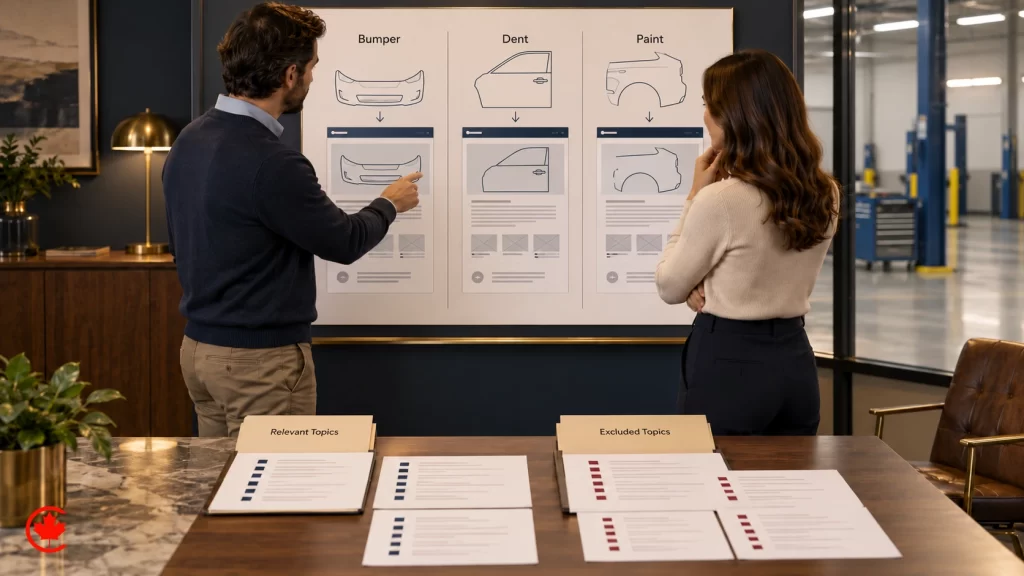
One campaign called “body shop” with every keyword inside it is the most common reason collision ads waste money. The driver searching paintless dent repair and the driver searching frame straightening are different jobs, different ticket sizes and often different technicians. Structure the account by damage type so spend follows the work you want more of.
Ad groups that mirror your estimate sheet
- Collision repair: broad accident work, insurance claims, multiple panel damage, airbag deployment repairs.
- Bumper repair: bumper cover replacement, crack repair, parking sensor reinstall where you do it.
- Dent repair and paintless dent repair: door dings, crease dents, hail dents, the quick customer pay jobs.
- Scratch repair and paint matching: key scratches, clear coat failure, spot repairs, full panel refinish.
- Frame straightening and structural work: unibody measuring and pulling, for shops with the equipment.
- Auto glass: windshield repair and replacement only if you do it in house or through a partner you name honestly.
Keywords to keep out
Collision searches attract plenty of clicks you never want: people looking for body shop jobs, body shop paint suppliers, DIY dent pullers, used bumpers from a scrapyard, and the cosmetics retailer with a similar name. A tidy negative keyword list, reviewed every month against the actual search terms report, protects the budget for drivers with damaged vehicles.
Ad copy that sounds like a shop
Write ads the way your estimator talks: “Rear bumper cracked? Send three photos for an estimate,” “Hail damage repair with paintless dent removal,” “We work with your insurer; the choice of shop is yours.” Use the extensions for your hours, your call button, Saturday estimates if you offer them and the location of each shop.
Map ads and the near me moment
When a driver types body shop near me, the map results often get the first look. Map placements in Google Ads draw on your Business Profile, so the ad can only be as good as the listing behind it: correct category, accurate hours, real photos of your bays and finished cars, and enough recent reviews to look alive.
The listing that sits behind the ad
Before spending on map ads, check that the profile lists collision repair and auto body services accurately, that holiday hours are set before long weekends, and that photos show the shop as it really is. If you run more than one location, each one needs its own profile and its own address, and the ads should point to the location nearest the driver. Our team handles Business Profile management in Toronto where the listing needs work before ads go live.
Radius and drive time
Collision customers rarely cross the city for a bumper, but they will drive further for a shop their insurer or a friend recommended. Start with a tight radius around each shop, then widen it for higher value work such as structural repair or specialty refinish. Our Google local ads service sets the radius and bids per location rather than one setting for the whole account.
Calls are the conversion
Many collision customers call rather than fill in a form, especially right after an accident. Track calls from ads as conversions, record whether the call became an estimate booking, and look at the hours when calls go to voicemail. If the front counter is swamped on Monday mornings, an answering option such as an AI receptionist that takes estimate bookings can catch the overflow so the ad spend is not wasted.
Insurance claim messaging in your ads
Most of a collision shop’s larger repair orders arrive through an insurance claim, and the claim is where many drivers feel least in control. Ads and landing pages that explain the claim process plainly can win the job before the driver accepts whichever shop is suggested on the phone.
The right to choose, stated carefully
In Ontario, insured drivers generally have the right to choose where their vehicle is repaired. An ad can say that in plain words: “Your claim, your choice of shop.” What an ad must not do is imply an insurer endorses your shop when it does not. If you are part of an insurer’s direct repair program, you may say so in the terms that program allows; if you are not, say you work with all insurers and help with the claim paperwork.
A claim explainer landing page
Send claim searches to a page built for them, not to the home page. It should walk through the steps as your shop handles them: report the claim, choose your shop, bring the vehicle or arrange a tow, inspection and estimate, supplement if hidden damage turns up, repair, final inspection and pickup. Add what the driver should bring (claim number, adjuster contact, photos) and a short form to start. Drivers who understand the next step are more likely to name your shop to their adjuster.
Towing and rental cars as your shop provides them
If you can arrange a tow from the scene or the driveway, or set up a rental car through the claim, say so in the ad and on the page, because convenience is a deciding factor. Describe only what your shop or its partners actually provide. A shop that promises a rental car and then has none available on a Friday afternoon earns a bad review that costs more than the click.
Estimate request forms that collect photos
The photo estimate form is the most useful landing page a body shop can have. It lets a driver start the process from the parking lot, it gives your estimator what they need to triage the job, and it captures a lead even when the shop is closed.
What the form should ask
- Name, phone number and preferred contact method.
- Year, make and model, and the VIN if the driver has it handy.
- Where the damage is, chosen from simple options: front, rear, driver side, passenger side, roof or hood.
- Three to six photos: one wide shot of the whole vehicle, one of the damaged area, one close up, and one at an angle that shows panel alignment.
- Whether there is an insurance claim, and the claim number if one exists.
- Whether the vehicle is drivable, which tells you if towing is needed.
Set the right expectation
A photo estimate is a starting point, and the page should say so. Hidden damage behind a bumper cover or a cracked absorber only shows up at teardown. Wording such as “We will review your photos and call you to book an in person inspection” is honest and keeps your front office out of arguments later.
One page per campaign
A hail damage ad should land on a hail page with the photo form; a scratch repair ad should land on a spot repair page with the same form. The form can be identical while the headline, the example photos and the explanation change. This match between ad and page is what turns a click into an estimate request.

Before-and-after ads on Facebook and Instagram
Search catches drivers who already have damage. Social ads keep your shop in the minds of local drivers before they need you, and remind people with a dent they have been ignoring for months that the repair is quicker than they think.
Creative that works for collision repair
Before-and-after photos and short videos are the strongest format: a crushed front end on the frame machine and the same car leaving the paint booth, a paintless dent repair technician working a door ding out in thirty seconds, a colour match being sprayed and blended. Real shop footage beats stock images every time. When the owner of the vehicle is recognizable, or the plate is visible, get written permission or blur it out.
Who sees the ads
Target by location around each shop, and build audiences from people who visited your estimate pages or watched your repair videos. Customer lists can be uploaded for retargeting only where you have consent to use them that way. Avoid targeting anyone based on accident history or any sensitive personal detail; local drivers and engaged viewers are enough. Our social media ads team builds these audiences and refreshes the creative so the same crumpled bumper does not run for six months.
Offers that are real
Seasonal offers such as a free headlight restoration with any collision repair, or a booking slot for minor dent repairs before winter, can lift response. Run only offers the shop will honour, at the price stated, with no extra fees added at the counter.
Weather events, seasons and ad schedules
Collision work in Canada follows the weather more closely than almost any other trade. A sensible ad plan has a steady base budget and room to surge when the weather turns.
Hail and storm campaigns
A summer hailstorm can dent hundreds of cars across a few neighbourhoods in an afternoon. Prepare a hail campaign in advance (ads, a hail landing page, a photo form, a way to book paintless dent repair assessments) and switch it on the day of the storm, focused on the areas that were hit. If you bring in extra dent technicians for storm work, say so; if you do not, set the budget at what your bays can actually take.
Winter and freezing rain
The first icy mornings of the season bring fender benders, slides into curbs and parking lot scrapes. Raise budgets and extend ad schedules around the first snowfall and after freezing rain warnings, and push messages about towing and rental coordination. In spring, pothole damage, salt related paint problems and hidden winter damage give you a second wave, mostly customer pay work.
When ads should run
Look at when calls and estimate forms actually arrive and when your front office can answer. Many shops reduce bids overnight but keep the photo form ads running, because a driver who submits photos at ten at night still wants a call at eight the next morning. Deer and wildlife collisions on rural roads in the fall are worth a separate ad group for shops outside the core of the city.
Retargeting, dealers and fleet accounts
Not every collision job is decided in one search. A driver waiting for the adjuster, a fleet manager comparing shops, or someone saving for a cosmetic repair may come back days later. Paid ads can stay in front of them without becoming a nuisance.
Retargeting with limits
Show visitors who started but did not finish the estimate form a reminder ad with the photo form, and visitors to the claim explainer an ad about choosing their own shop. Cap how often each person sees an ad, and stop retargeting once someone has booked. Retargeting windows for collision work should be short, because the repair happens within days or weeks of the damage.
Fleet managers and commercial vehicles
Companies running delivery vans, service trucks and company cars need a reliable shop with quick turnaround and clear invoicing. Search ads on fleet collision repair and commercial vehicle body repair, plus LinkedIn ads to fleet and operations managers in your area, can open these accounts. The landing page should cover what a fleet manager cares about: pickup and drop off, how estimates are approved, how invoices are organized, and the vehicle sizes your bays can take.
Dealers without their own body shop
Dealerships that sell and service vehicles but send collision work out are a referral source worth courting. Paid ads are a small part of that relationship, mainly keeping your name visible to managers in your area, but a landing page for dealer partners, describing OEM repair procedures your shop actually follows, gives your sales calls something to point to.
Measuring repair orders and linking the rest
Clicks and impressions are not what keep a body shop open. What matters is how many estimates the ads produce, how many become repair orders, and what those repair orders are worth by damage type and by campaign.
What to track
- Calls from ads that last long enough to be a real conversation, and calls missed.
- Photo estimate forms submitted, by landing page.
- Estimates written, with the source recorded at the front counter.
- Repair orders opened, and whether each one was a claim or customer pay job.
- Repair order value by campaign, so a cheap dent lead and a structural collision lead are not counted as equal.
Closing the loop with your shop system
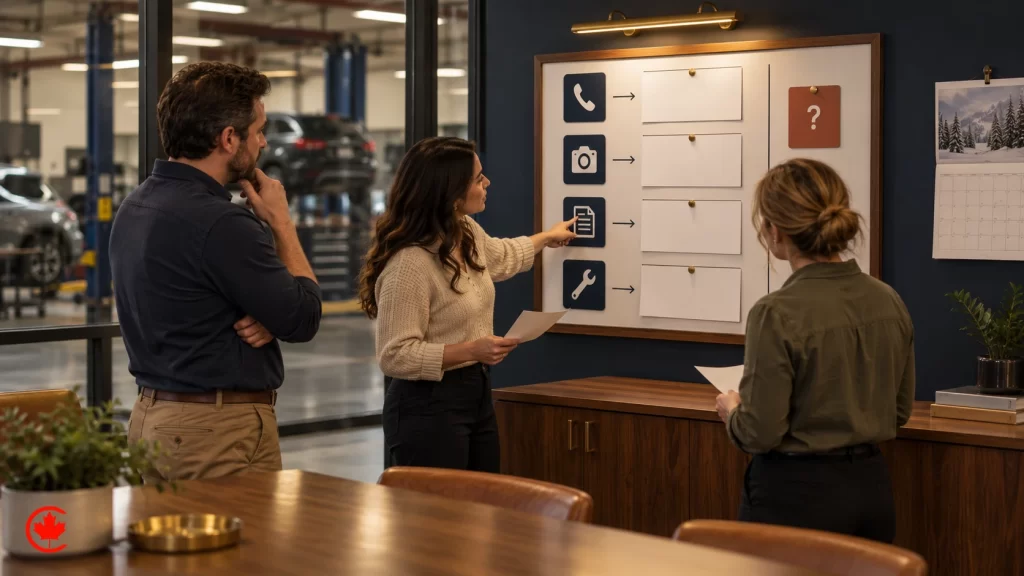
Your shop management system knows which repair orders were written; your ad accounts know which clicks happened. The link between them is usually a simple habit: record the lead source on every estimate. Leads can also flow into CS+, our CRM, which keeps each estimate request, call and follow up together so the monthly report shows repair orders by campaign rather than guesses.
Where ads meet the rest of the shop
Ads work best when the rest of the shop’s presence is in order. The full plan for a collision business, from referral relationships to customer updates during a repair, belongs on our body shop marketing plan page; this page stays on paid ads. A few connections matter directly to ad performance.
Your reviews sit next to your map ads, so a steady flow of new reviews from finished jobs makes every ad look more trustworthy; online reputation management helps when a single bad review is dragging the rating. Organic rankings give your shop a second place on the same searches without a cost per click, which is the work of SEO for automotive repair and service businesses. After the repair, reminders by email keep you in mind for the next fender bender, covered on our automotive email marketing page. If you also run a mechanical service department, ads for brakes, diagnostics and maintenance are set up differently and are covered by advertising for mechanics and repair shops, and detailing add-ons have their own home under car detailing advertising. The broader view of every automotive service is on our automotive marketing hub.
Advertising rules and privacy for collision shops
Collision ads touch insurance, towing, pricing and personal data, so a few rules shape what can be said. This is a marketing observation, not legal advice.
Insurance and endorsements
Ontario drivers generally choose where their vehicle is repaired. Ads can say that, but must never suggest an insurer recommends or approves your shop unless that is true and you are allowed to say it.
Towing and storage
Towing and vehicle storage are regulated provincially in Ontario. If your ads mention towing, describe only what your shop or its towing partner may lawfully offer, and keep any towing claims accurate.
Estimates and prices
Ontario’s Consumer Protection Act includes rules about repair estimates, so the way an ad describes estimates should match how your shop actually writes and authorizes them. Under the federal Competition Act, an advertised price must be the price the customer pays: mandatory shop supplies or environmental fees cannot be added later in a way that makes the ad price misleading, and “sale” or “regular price” comparisons must be genuine.
Consent and personal information
Commercial emails and texts, including estimate follow ups and seasonal offers, fall under CASL: you need consent, clear sender identification and a working unsubscribe. Personal information collected through estimate forms should be handled in line with PIPEDA in general terms. Keep accident details, injuries and claim data out of analytics and out of ad targeting.
How we run your ads and what drives the fee
Our work for a collision shop follows a plain sequence, written for how body shops actually operate.
From review to launch
- A free review. We look at your current ads, Business Profile, estimate forms and call handling, and ask which jobs you want more of and how much bay and paint booth capacity you have.
- A custom proposal. Campaigns by damage type, landing pages, weather plans, tracking and fees quoted in writing.
- Build and launch. Photo estimate pages and call tracking first, then search and map ads, then social creative and retargeting.
- Monthly reporting. Estimates, repair orders and spend by campaign, with what we will change next month.
Every ad account, landing page and tracking setup is in your shop’s name.
What changes the cost
Our fees are quoted in writing after the review. What drives them for a body shop is the number of locations, how many damage types you want separate campaigns for, whether photo estimate pages need to be built, how much before-and-after creative and video is needed, whether you want storm campaigns ready to switch on, fleet and dealer campaigns, and how tightly ads must be tied to repair orders. Ad spend is paid directly to the ad platforms and shown separately from our fees. If you later want organic search work as well, SEO is quoted in writing too.
How to choose an agency for collision ads
Ask any agency these questions before handing over a collision shop’s ad budget:
- Who owns the accounts? The answer should be you. The Google Ads account, the Facebook and Instagram ad account, landing pages and call tracking numbers should sit in your shop’s name.
- How will you split campaigns? Look for campaigns by damage type and by claim versus customer pay, not one big bucket.
- How do you handle insurer wording? The answer should show care about endorsements and the driver’s right to choose.
- What happens when a hailstorm hits? A good answer includes a prepared campaign and a budget cap tied to your capacity.
- What will the monthly report show? Estimates and repair orders by campaign, not just clicks.
- Who writes and approves the creative? You should approve every before-and-after photo, with owner permission recorded.
Canada Create answers each of these in the written proposal before any spend starts.
Request a body shop advertising audit before the next storm season
Before the next hailstorm or the first icy week, let us audit your collision campaigns for free: the search terms your budget is buying, the bumper and dent pages behind them, the map listing beside them and the calls that rang out unanswered last month. You get a short written summary of what to keep, what to cut and what to build first. Call (416) 273-9030, Monday to Friday, 9 am to 6 pm, and Saturday, 10 am to 2 pm. After hours, our 24/7 AI agent answers the toll-free line, +1 (800) 808-9235, and we’ll follow up the next business morning. We reply within one business day. You can also reach us through our contact page. You are welcome at 126 Willowdale Avenue, Suite 3, Toronto, and Canada Create works with collision shops in every province.
Talk to a strategist
Ready when you are?
Request a custom proposal
Tell us your goals, budget and timeline. You get a custom proposal and a named strategist, so your next stage of growth starts now.
How we start your collision ads
Each step is agreed in writing, and every ad account stays in your shop's name.
- Free review First call
We review your ads, profile, estimate forms, calls and bay capacity.
- Custom proposal Written proposal
Campaigns by damage type, pages, storm plans, tracking and fees quoted in writing.
- Build and launch Agreed milestones
Estimate pages and tracking first, then search, map and social ads.
- Report and adjust Every month
Estimates and repair orders by campaign and the changes planned next.
Why collision shop owners choose Canada Create
Since 2008
More than 18 years of websites, search and advertising work for businesses across Canada.
BBB Accredited A+
A BBB Accredited Business with an A+ rating and zero complaints.
Toronto office
126 Willowdale Avenue, Suite 3, Toronto, serving businesses across Canada.
English and French
Our team works in English and French.
Body shop advertising questions
How do I get more customers into my auto body shop with ads?
Build search campaigns around damage types, such as bumper repair, dent and paintless dent repair, scratch and paint matching, and frame work, and repeat the driver's own words in each ad. Send every click to a phone-friendly estimate form that takes photos, and track calls as conversions since many drivers phone right after an accident. Map ads backed by a current Business Profile catch the near me searches.
How do drivers find a good body shop, and what should ads show them?
Drivers pick a collision shop on trust before price: reviews, photos of finished work, whether the shop deals with their insurer, a written warranty if the shop gives one, distance, rental or towing help, and whether someone answers the phone. A strong ad answers three of those before the click. The landing page should answer the rest with real photos from your bays.
What is the difference between a body shop and a repair shop in advertising terms?
A body shop repairs collision damage, dents, scratches, paint and structural parts of a vehicle, while a general repair shop works on mechanical systems such as brakes, engines and suspension. In ads, the two attract different searches, so body shop campaigns should stick to damage terms and exclude mechanical ones. Saying plainly which work your shop does saves wasted clicks.
Should body shop ads promote paintless dent repair on its own?
Yes, paintless dent repair is a different job and ticket size from frame straightening, so it deserves its own ad group and landing page. Door dings, crease dents and hail dents are quick customer pay jobs, and those drivers want a price range and a fast appointment. Avoid promising that every dent can be fixed without paint, because some need filler and refinish.
What other names for a body shop should collision ads target?
Drivers type collision repair, auto body repair, car paint shop, dent removal and, once a claim is open, insurance approved body shop. Some search by the broken part, such as a rear bumper cover or side mirror, and others by the event, like hail damage, hitting a deer or a keyed car. Each phrase deserves an ad that repeats it.
What is the most cost-effective way to advertise a body shop?
Stop paying for clicks that never become repair orders. A single campaign called body shop with every keyword inside wastes the most, so split the account by damage type and keep out searches for body shop jobs, paint suppliers, DIY dent pullers and the cosmetics retailer with a similar name. Then compare repair orders per campaign, not clicks.
What does a body shop advertising campaign cost?
Our fee moves with the number of locations, whether photo estimate pages and a claim explainer must be built, and whether social, storm or fleet campaigns are added to search and map ads. Ad spend is paid by the shop to Google or Meta and listed apart from the fee. Canada Create quotes collision ad work in writing following a free audit of your current setup.
What is a smart body shop advertising strategy for insurance claims?
Split claim and customer pay campaigns, since each worries about something different. A claim customer often has an adjuster suggesting a shop, and in Ontario insured drivers generally have the right to choose where the vehicle is repaired, so an ad can say the choice is theirs. Never claim a relationship with an insurer the shop does not have, and confirm the latest regulator guidance before an ad names any program.
How do I spot the best body shop advertising agency?
Ask how the account will be split by damage type, who builds the negative keyword list, and whether the report counts repair orders by shop instead of clicks. The ad accounts and Business Profile should be in the shop's name. Canada Create runs collision ads from its Toronto office for shops across Canada and keeps written owner permission on file before any before-and-after photo runs.


A dent search lasts minutes
A driver looking at a crushed bumper calls the first shop that looks trustworthy and answers. Ads matched to the damage, with a photo estimate one tap away, put your shop in that position. Book a free collision ads review.