
How to Compare Marketing Agency Proposals
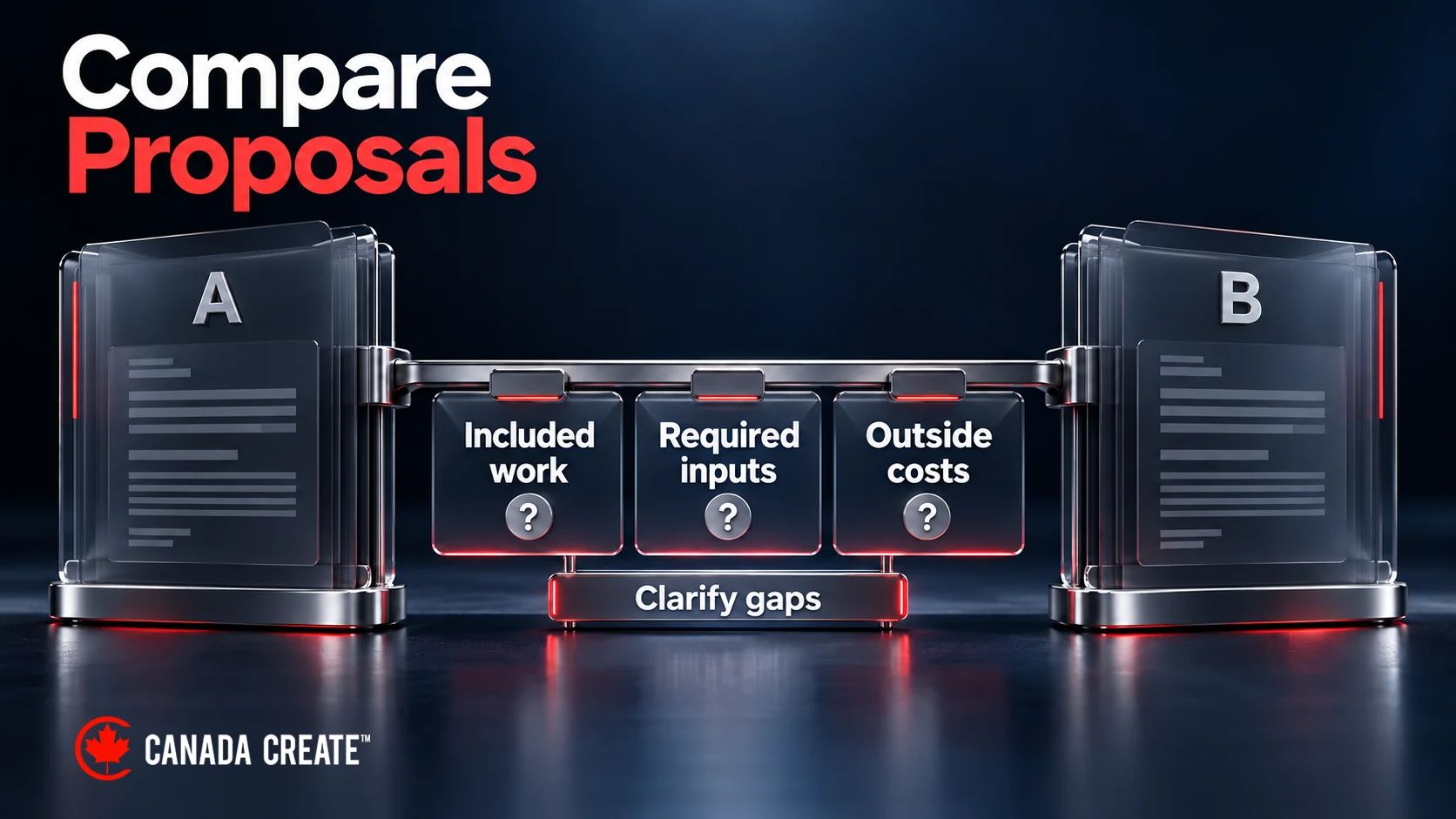
Two marketing proposals can look alike while covering very different work. Before comparing the total fee, put the proposed activities, assumptions and responsibilities side by side. This guide shows what to line up and which questions to ask before you choose.

Read the diagram description
Two fictional proposals show the same headline fee but different included tasks. A comparison bracket highlights that fee equality cannot establish equivalent scope. Agency proposal prices become comparable only after the included work and required inputs are clear.
Self-check: Can price alone identify the better proposal?
No. First establish what each proposal includes and requires.
Compare the same scope
List the business priorities each proposal addresses. Ask what will actually be delivered, who supplies the inputs and what counts as finished. A content plan, written copy, design and publishing are separate pieces of work, so check which ones are included.

Read the diagram description
Content plan, written copy, design and publication appear as four separately owned outputs. An included-plan checkbox does not automatically tick the other three. A content proposal must identify the included planning, writing, design and publication outputs and their owners.
Self-check: What should content included mean in the proposal?
The exact deliverables and stages that are included, with responsibilities.
- Which pages, campaigns or channels are covered?
- Which tasks are monthly and which are one time projects?
- How many review rounds are included, and who approves the work?
- Which connections or existing assets are assumed to be ready?
- How are extra requests estimated and approved?

Read the diagram description
A fictional website project and monthly campaign program sit in separate rows. Channel coverage, quantities and completion criteria are compared row by row, with unknown quantities left open. One-time projects and recurring agency work have different outputs, timing and ongoing obligations.
Self-check: Why separate a project from recurring work?
Their outputs, timing and ongoing obligations differ.

Read the diagram description
Supplied copy, ready analytics access and an existing integration are marked assumptions. Missing inputs lead to an explicit estimate question rather than quietly expanding the agreed work. A missing assumed integration requires clarification of the additional work and approval before that work is treated as included.
Self-check: What should happen when an assumed integration is absent?
Clarify the additional work and approval before treating it as included.
Separate fees from other spending
Ask for agency fees, advertising spend, production costs and software subscriptions to be listed separately. Check whether outside costs are included in the estimate or billed to you directly. Ask how a change in scope affects the estimate and who can approve extra spending.

Read the diagram description
Agency fee, media spend, production and software occupy distinct blank columns. Each has a payer and billing route, so money sent to an ad platform is not confused with agency compensation. An agency proposal must state whether media spending is included and who pays each outside cost.
Self-check: Does an agency fee necessarily include ad-platform spending?
No. The proposal must state whether and how that spending is included.
Compare the full arrangement rather than assuming the lowest headline fee covers the same work. Where a cost is unclear, write it down as a question instead of guessing a number.

Read the diagram description
A hypothetical additional video request gets defined scope, estimate and named approval before work begins. An unanswered cost is shown as open, not zero. Additional agency work should begin only after the relevant scope and spending approval are obtained.
Self-check: When should the extra work begin?
After the relevant scope and spending approval are obtained.
Check account ownership and access
Ask which business accounts will be used and who will manage them. Your business should own its website, advertising, analytics and social accounts, with the agency given the access it needs. Never put passwords in a proposal or a shared planning document.

Read the diagram description
Business-controlled website, ads and analytics accounts grant limited role access to an agency. A password field is absent, and the exit route revokes agency access without transferring business ownership. A business should retain ownership and access to its accounts and records when an agency relationship ends.
Self-check: What should survive the agency relationship ending?
Business ownership and access to its own accounts and records.
We plan and run B2B marketing across search, ads, content and email for Canadian companies.
Make reporting definitions clear
Ask what each reported conversion means. A form submission, a phone click, a qualified enquiry and a completed sale are different events. Find out which results can be checked against your own records and how the agency will explain any gaps.

Read the diagram description
Phone click, submitted form, qualified enquiry and completed sale are separate event cards with their own evidence source. No equality sign connects them. A verified completed-sale record is different from a click or form submission.
Self-check: Which event proves a completed sale?
The business’s verified sale record, not a click or form submission alone.
A useful report explains the work completed, the results observed and the next decisions. Ask how the starting point will be set and how changes to offers, budgets or tracking will be recorded.

Read the diagram description
A starting period and review period are separated by marked changes in offer, budget and tracking. The report distinguishes work performed, observed outcomes and explanations still uncertain. A rise in reported conversions may reflect changed definitions or tracking rather than improved performance alone.
Self-check: Why note a tracking change beside a rise in conversions?
The definition or measurement may have changed, not just performance.
See how the team will work with you
Find out who handles everyday decisions and who approves content, creative and spending. Ask how feedback is collected and how delays in supplying information affect timelines. Check which parts of the work depend on your own staff or another supplier.

Read the diagram description
Everyday questions go to an operational contact, while creative, claims and spending each route to a designated approver. Multiple reviewers feed one consolidated response instead of contradictory instructions. Added media expense needs approval from the person with spending authority; creative-review authority is a separate role.
Self-check: Who approves an added media expense?
The person authorized for spending, not whoever gives creative feedback.

Read the diagram description
A fictional campaign cannot reach approval until product information and imagery arrive. The schedule shows a dependency arrow and a review date, not a fixed guarantee independent of missing inputs. Agency timelines must show client-input dependencies and how missing inputs affect delivery.
Self-check: Can an agency timeline ignore late client inputs?
No. Dependencies and their timing effects need to be explicit.
Keep a simple comparison table
For each agency, record the scope, exclusions, fees, outside costs, approval process, reporting definitions and account arrangements. Add a final column for open questions, and get those answered before you decide. Our guide to what to look for in a digital marketing agency covers the qualities to weigh alongside the numbers, and a clear marketing brief makes proposals far easier to compare.
Explore our marketing services, then ask Canada Create for a proposal with your priorities and the questions it should answer.

Read the diagram description
Proposal A includes copy but excludes launch; proposal B includes launch but assumes supplied copy. A common requirement list reveals both gaps before either is marked equivalent. A proposal that omits required work needs clarification or an authorized scope adjustment before it is treated as complete.
Self-check: Which proposal is complete if both omit required work?
Neither without clarification or an authorized scope adjustment.

Read the diagram description
Scope, outside cost, reporting definition and account ownership each have known or open status. An attractive total cannot move the decision through while a material condition remains unanswered. Material unknowns about work, cost, reporting or account control must be resolved before selecting an agency proposal.
Self-check: Which unanswered question should be ignored to choose faster?
None that could materially change the work, cost or control.
Frequently asked questions
How do I compare marketing agency proposals fairly?
Line up the same scope across every proposal, then compare deliverables, inputs, review rounds, fees and reporting definitions side by side.
Why do agency proposals vary so much in price?
They often cover different work. One may include writing, design and publishing while another covers only planning.
Should agency fees and ad spend be listed separately?
Yes. Agency fees, advertising spend, production and software costs should each be shown so you know where your money goes.
Who should own the marketing accounts?
Your business. The agency should be given the access it needs to do the work.
What is a conversion in a marketing report?
It depends on the agency. Ask whether it means a form submission, a phone click, a qualified enquiry or a sale.
Is the cheapest proposal the best value?
Not always. Check what is excluded and what you are expected to supply before comparing totals.
How many review rounds should a proposal include?
It varies by project. The important thing is that the number is stated and you know how extra rounds are handled.
What questions should I ask before choosing an agency?
Ask about scope, exclusions, outside costs, who approves work, how results are reported and who your main contact will be.
Should I share passwords with agencies during the proposal stage?
No. Access is set up securely once you have chosen an agency.
Can Canada Create send a proposal I can compare?
Yes. Share your goals and priorities. After discovery, you receive a written proposal that lists scope, fees and outside costs separately before work starts.