
Best freelance websites in 2026: where to find work and where to hire talent

Freelance websites connect independent professionals with clients who need work done, from logo design and writing to software development, bookkeeping and video editing. They are a fast way to find a first client or fill a skill gap, but they differ widely in fees, competition, vetting and the kind of work on offer. This guide compares the main freelance platforms for 2026 from both sides: freelancers looking for work and businesses looking to hire. It also covers fees, how to stand out, how to hire well and the Canadian tax basics every freelancer should know. Platform fees and rules change, so check each site’s current pricing before you sign up.
Quick picks by situation
| Situation | Where to start | Why |
|---|---|---|
| Freelancer starting out in almost any field | Upwork or Fiverr | The largest marketplaces with steady demand across categories |
| Experienced developer, designer or finance expert | Toptal | Screened network for specialist client engagements |
| Freelancer comparing commission structures and portfolio features | Contra | Commission free model for freelancers |
| Designers and creatives | Dribbble, Behance and 99designs | Portfolio driven discovery and design projects |
| Writers | Content marketplaces, job boards and LinkedIn | Ongoing writing work and direct client relationships |
| Remote freelance and part time roles | We Work Remotely, FlexJobs, LinkedIn | Longer engagements rather than one off gigs |
| Business hiring for a quick, defined task | Fiverr | Fixed price packages with clear deliverables |
| Business hiring for ongoing or complex work | Upwork or Toptal | Proposals, interviews and longer engagements |
We plan and run search, ads, websites and lead tracking for small businesses in Toronto and across Canada, scoped in writing after a free review.

The main freelance websites compared
| Platform | How it works | Best for | Watch for |
|---|---|---|---|
| Upwork | Clients post jobs; freelancers send proposals using paid credits | Most skills, from short tasks to long engagements | Service fees, proposal costs and heavy competition |
| Fiverr | Freelancers sell packaged services (“gigs”) at set prices | Clearly defined deliverables | Price competition and platform fees on each order |
| Toptal | Screened network matched to clients | Senior developers, designers, finance and product experts | Rigorous screening to join |
| Freelancer.com | Job postings and contests | Wide range of projects | Many low budget postings |
| Contra | Portfolio and services with commission free work for freelancers | Independent professionals building a brand | Smaller client base than the giants |
| Profile, network, posts and job listings | B2B services and direct client relationships | Requires active networking | |
| 99designs | Design contests and direct projects | Logo, branding and packaging design | Contests can mean unpaid work for non winners |
| Dribbble and Behance | Design portfolios with hiring features | Visual designers and illustrators | Portfolio quality decides everything |
| Guru and PeoplePerHour | Job postings and hourly or fixed price work | General freelance services | Smaller marketplaces |
| We Work Remotely and FlexJobs | Remote job boards | Remote freelance and part time roles | Some charge job seekers for access |
Understanding platform fees
Marketplaces earn money by charging freelancers, clients or both: a percentage of each payment, a fee per proposal or connect, a client service fee, payment processing and currency conversion. Before you set rates, work out what you keep:
Take home per project = project price − platform fee − proposal costs − payment and conversion fees − taxes
Price your services so the take home amount covers your time, tools, taxes and unbilled hours such as proposals and admin.

How freelancers win work on platforms
- Niche down. “Shopify speed optimization for apparel brands” beats “web developer”.
- Build a strong profile: a clear headline, specific outcomes you deliver, a professional photo and portfolio samples.
- Write short, specific proposals that show you read the job: restate the problem, outline your approach and ask one smart question.
- Start with smaller projects to earn reviews, then raise your rates.
- Respond quickly; early proposals are read more often.
- Deliver on time and communicate clearly; repeat clients are where income stabilizes.
- Build an off platform presence with a website and LinkedIn, so you are not dependent on one marketplace.
How businesses hire freelancers well
- Write a clear brief: the goal, deliverables, deadline, budget range and how you will judge success.
- Check portfolios and reviews for similar work, not just ratings.
- Interview the shortlist and ask how they would approach your project.
- Start with a small paid test task before a large project.
- Agree on scope, milestones, ownership of the work and payment in writing, and use the platform’s payment protection.
- Protect access: give limited accounts rather than your main passwords, and remove access when work ends.
- Get rights to the work transferred to your business, especially for logos, code and content.
Freelancer, agency or in house?
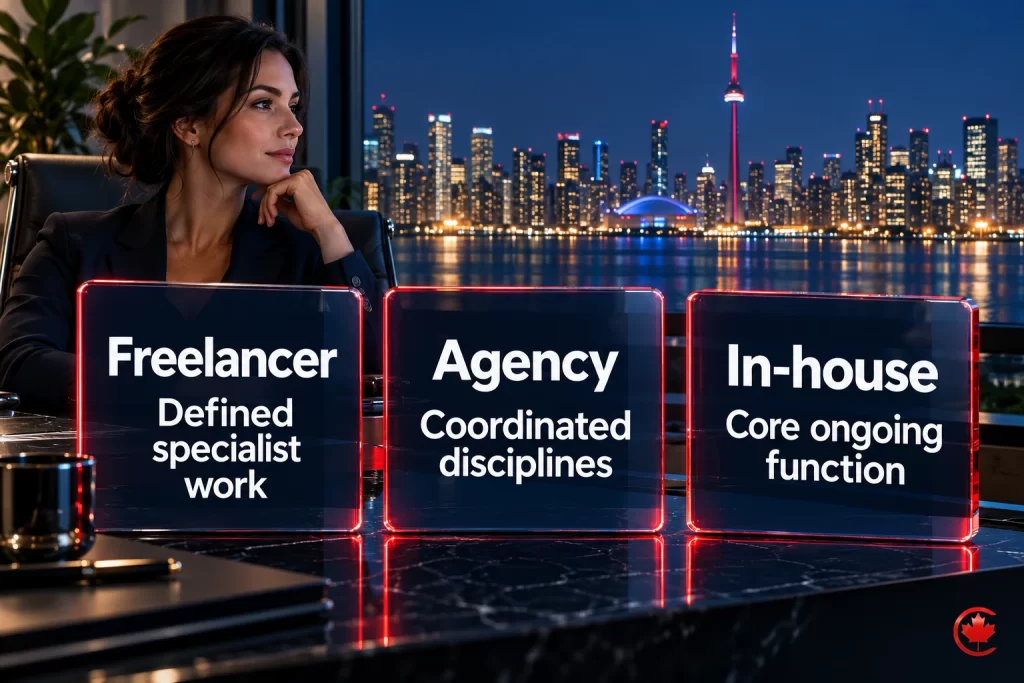
Freelancers are excellent for defined projects and specific skills. For ongoing work that needs strategy, several skills working together and accountability for results, a team or agency is often more effective, and for core functions, an in house hire may make sense. Our comparison of agency retainers vs in house hires walks through the costs, and our services page shows where Canada Create fits.
Canadian freelancers: tax basics
- Self employment income is reported on your personal tax return, and you can deduct reasonable business expenses.
- CPP or QPP contributions: self-employed people generally pay both portions of the applicable pension-plan contribution. Quebec has the QPP; contribution rules depend on your earnings and circumstances.
- GST/HST: for most businesses, the $30,000 small-supplier test uses worldwide taxable revenue before expenses, including zero-rated supplies and relevant associated businesses. If you exceed it in one calendar quarter, GST/HST applies to the taxable supply that takes you over. If you exceed it over four or fewer consecutive quarters, but not in one quarter, small-supplier status ends after the following month. Registration and charging dates differ between these cases. Check the CRA registration rules; supplies to clients outside Canada need separate review.
- Instalments: once you owe enough tax, the CRA may require quarterly instalments.
- Records: generally keep invoices, receipts and platform statements for at least six years from the end of the last tax year they relate to. Some records must be kept longer.
Avoiding scams
- Never pay to receive a job or for “training” from a client.
- Follow the platform’s communication and payment rules even after you trust the client. Off-platform payments may be prohibited or require an approved conversion process, and platform protection may no longer apply.
- Be wary of overpayments followed by requests to return part of the payment.
- Do not share personal banking or ID details outside the platform’s verification process.
Common mistakes to avoid
- Competing on the lowest price instead of a clear specialty.
- Sending the same generic proposal to every job.
- Ignoring platform fees when setting rates.
- Hiring without a written brief or a small test.
- Relying on one platform for all income or all hiring.
Freelance categories with steady demand
| Category | Examples of work |
|---|---|
| Development | Websites, apps, integrations, automation and AI tools |
| Design | Logos, branding, web and app design, presentations, packaging |
| Marketing | SEO, paid ads, email, social media, analytics |
| Writing | Website copy, articles, technical writing, editing |
| Video and audio | Editing, motion graphics, podcast production, voiceover |
| Business support | Bookkeeping, virtual assistance, customer support, data entry |
Building a freelance business beyond platforms
- Your own website with services, portfolio, testimonials you have permission to use and a contact form.
- A clear specialty that makes you easy to recommend.
- Referrals: ask happy clients to introduce you to others.
- Content: share useful advice on LinkedIn or a blog to show expertise.
- Partnerships with agencies and complementary freelancers who need overflow help.
Direct clients avoid platform fees and usually value the relationship more, but platforms remain useful for steady demand and payment protection.
Setting rates
Work backwards from the income you need. Add yearly business costs, taxes and time off, then divide by realistic billable hours, which are usually far fewer than working hours once you include admin, proposals and learning. Project based pricing often beats hourly rates once you understand your scope, because clients pay for outcomes and you benefit from working efficiently.
The bottom line
For freelancers, start on Upwork or Fiverr to build reviews, move to Toptal or Contra as your experience and portfolio grow, use Dribbble, Behance or 99designs for design work, and build your own website and LinkedIn presence to reduce platform dependence. For businesses, use Fiverr for well defined tasks, Upwork or Toptal for ongoing or complex work, and always start with a clear brief and a small paid test.
Frequently asked questions
Should I use Fiverr or Upwork?
It depends on the work. Fiverr sells packaged services at set prices, which suits a quick task with clear deliverables, though price competition and per order fees are common. On Upwork, clients post jobs and freelancers send proposals using paid credits, which fits anything from short tasks to longer or more complex engagements.
Are there good alternatives to Upwork for experienced freelancers?
Toptal is a screened network that matches senior developers, designers and finance experts with clients, though joining means rigorous screening. Contra uses a commission free model for freelancers, LinkedIn supports direct B2B relationships, and Dribbble and Behance help visual designers get found through their portfolios. We Work Remotely and FlexJobs list longer remote roles, although some job boards charge job seekers for access.
Which freelance websites suit beginners?
Upwork and Fiverr are the usual starting points because they are the largest marketplaces with steady demand across categories. Pick a narrow niche, take smaller projects first to earn reviews, then raise your rates. Short, specific proposals that restate the client's problem and suggest an approach get read more often, especially when sent early.
Is Upwork still worth it in 2026 once fees are counted?
Only if your take home pay still covers your time. Work it out as the project price minus the platform fee, proposal costs, payment and conversion fees, and taxes. Then price your services so that amount pays for your time, tools and unbilled hours spent on proposals and admin.
What are freelance websites, and how do they differ?
Freelance websites connect independent professionals with clients who need work done, from logo design and writing to software, bookkeeping and video editing. They are a quick way to land a first client or fill a skill gap. The platforms differ widely in fees, competition, vetting and the kind of work on offer, so check each site's current pricing before you sign up.
How should a business in Canada hire someone through a freelance website?
Write a clear brief with the goal, deliverables, deadline, budget range and how you will judge success, then check portfolios for similar work and interview a shortlist. Start with a small paid test task, and agree on scope, milestones, ownership and payment in writing while using the platform's payment protection. Give limited accounts instead of your main passwords, and get rights to logos, code and content transferred to your business.
What tax basics apply to Canadians who freelance through these websites?
Self-employment income goes on your personal tax return, and you can deduct reasonable business expenses. Self-employed people generally pay both portions of CPP or, in Quebec, QPP contributions. Once taxable revenue passes the $30,000 small-supplier threshold, GST/HST registration usually applies, so check the CRA's current rules for your situation.
What freelance platforms work best for designers and creatives?
Dribbble and Behance give visual designers portfolio driven discovery and hiring features, where the quality of your portfolio decides most outcomes. 99designs runs design contests and direct projects for logos, branding and packaging, though contests can mean unpaid work for those who do not win. LinkedIn helps creatives build direct client relationships through networking.