
SEO Statistics 2026: Search Share, AI Overviews and On-Page Data

SEO statistics are most useful when they come from the people who run the search engines or measure the web directly. This 2026 edition gathers search engine optimization figures from those publishers: search engine share in Canada, how many people now see AI answers in Google, how those answers change clicking, how many websites get the on-page basics right and what page speed targets Google publishes. Each figure names its publisher and the year it describes, and the full list of publishers sits at the end of the page.
Key SEO statistics at a glance
| Statistic | Figure | Published by |
|---|---|---|
| Google’s share of search in Canada, October 2026 | 85.03% (Bing 10.46%) | Statcounter Global Stats |
| Monthly users of Google AI Overviews | Over 2 billion, in more than 200 countries and territories | Alphabet, Q2 2025 earnings remarks |
| Monthly active users of Google AI Mode in the US and India | Over 100 million | Alphabet, Q2 2025 earnings remarks |
| Length of AI Mode queries compared with traditional searches | About three times longer | Alphabet, Q3 2026 earnings remarks |
| Visual searches on Google each month | Over 50 billion | Alphabet, Q3 2026 earnings remarks |
| Visits where users clicked a regular result when an AI summary appeared | 8%, compared with 15% without a summary | Pew Research Center, 2025 |
| Visits where users clicked a link inside the AI summary | 1% | Pew Research Center, 2025 |
| Pages with a meta description | 67.7% of desktop pages | HTTP Archive Web Almanac 2025 |
| Pages served over HTTPS | 91.7% of desktop pages | HTTP Archive Web Almanac 2025 |
| Pages passing all Core Web Vitals, June 2025 | 56% on desktop, 48% on mobile | HTTP Archive Web Almanac 2025 |
| Sites with an llms.txt file | 2.13% of desktop sites | HTTP Archive Web Almanac 2025 |
Our SEO team plans, fixes and reports on the work in this guide every month for Canadian businesses.
Search engine market share in Canada
Statcounter Global Stats put Google’s share of search in Canada at 85.03% in October 2026. Bing followed with 10.46%, then Yahoo at 2.49%, DuckDuckGo at 1.5%, Yandex at 0.23% and Ecosia at 0.19%.
Two practical points follow. Google is still where most Canadian searches happen, so Google’s guidelines remain the reference for SEO work in Canada. And Bing’s share of roughly one search in ten is large enough to matter: Bing’s index also feeds other search and AI products, so a site that Bing can crawl and understand reaches further than the Bing share alone suggests.
Desktop and mobile search in Canada
Statcounter’s October 2026 measure of all Canadian web traffic was 50.7% desktop, 46.28% mobile and 3.02% tablet. Canada is more desktop heavy than many countries, but nearly half of visits still arrive on a phone. Google indexes the mobile version of a page first, so the mobile page is the one that has to carry the content, headings and structured data.
AI Overviews and AI Mode statistics
The biggest change in search since the last edition of this page is the spread of AI answers inside Google itself.
- In March 2025, Google said AI Overviews were used by more than a billion people.
- In its Q2 2025 earnings remarks (July 2025), Alphabet said AI Overviews had over 2 billion monthly users across more than 200 countries and territories and 40 languages, and that AI Mode had over 100 million monthly active users in the US and India while it was still rolling out.
- In its Q3 2026 earnings remarks on October 28, 2026, Alphabet said Google’s year over year query growth rate was the highest it had been in five years, that queries in AI Mode are on average three times longer than traditional searches, and that one in five AI Mode searches globally use voice, images or documents.
- The same Q3 2026 remarks reported more than 50 billion visual searches a month.
Longer, more specific questions favour pages that answer specific questions clearly. A service page that explains who the service suits, what it includes and how it works in your city gives AI answers something concrete to draw on. Our AI search optimization page covers how businesses earn citations in AI Overviews, AI Mode and other AI answers.
For local service searches, Canada Create checked 200 searches in Toronto on November 4, 2026: 53.5% showed an AI Overview and 77% a local pack. The comparison with New York is in AI Overviews in 2026: what 400 local searches in Toronto and New York show.
How AI summaries change clicking
Pew Research Center analyzed the browsing of 900 US adults who agreed to share their activity, covering 68,879 Google searches made in March 2025. Some 18% of those searches produced an AI summary. Its findings, published on July 22, 2025:
- users who saw an AI summary clicked a traditional search result in 8% of visits, against 15% for users who did not see one
- users clicked a link inside the AI summary itself in just 1% of visits to pages with a summary
- users ended their browsing session on 26% of pages with an AI summary, compared with 16% of pages with only traditional results
- about 58% of the people in the study ran at least one search in March 2025 that produced an AI summary
- Wikipedia, YouTube and Reddit were the sources cited most often in both AI summaries and standard results
Fewer clicks per search means each click is worth more, and being named inside the answer matters even when the visitor does not click at once. Nonprofit websites in the M+R Benchmarks 2026 study show the trend in their own numbers: organic search still delivered 39% of their visits in 2025, but that share declined over the year.
Which searches trigger AI summaries
Pew’s data also shows which searches are most likely to produce an AI summary, and what those summaries cite:
- just 8% of one or two word searches produced an AI summary, rising to 53% for searches of 10 words or more
- 60% of searches that began with a question word such as who, what, when or why produced a summary
- 36% of searches written as full sentences, with both a noun and a verb, produced one
- 88% of summaries cited three or more sources, and only 1% cited a single source
- the median summary was 67 words long
- government websites made up 6% of the sources linked in AI summaries, against 2% in standard results; news sites were 5% in both
- Wikipedia, YouTube and Reddit together made up 15% of sources in AI summaries and 17% in standard results
- around two-thirds of all searches ended with the user browsing elsewhere on Google or leaving without clicking a result
Short head terms such as “plumber Toronto” still mostly show classic results and the local pack. Questions and long, specific searches are where AI summaries appear, and where a page needs a clear, quotable answer near the top. Because most summaries cite several sources, a business does not need to be the single best page on the web to be included; it needs to be one of the clearest.
What Google’s own numbers say about search demand
Concerns that AI chat tools would empty out search have not shown up in Google’s reported results so far. In its Q2 2025 results, released on July 23, 2025, Alphabet said Google Search and other revenue grew by double digits and that Google Services revenue rose 12% to US$82.5 billion. In its October 28, 2026 remarks, it said overall query growth, including commercial queries, was at its fastest rate in five years. More searching, with more of it answered on the results page, is the setting every SEO plan in 2026 has to work in: visibility inside the answer and on the map counts alongside the click.
On-page SEO statistics: how many sites get the basics right
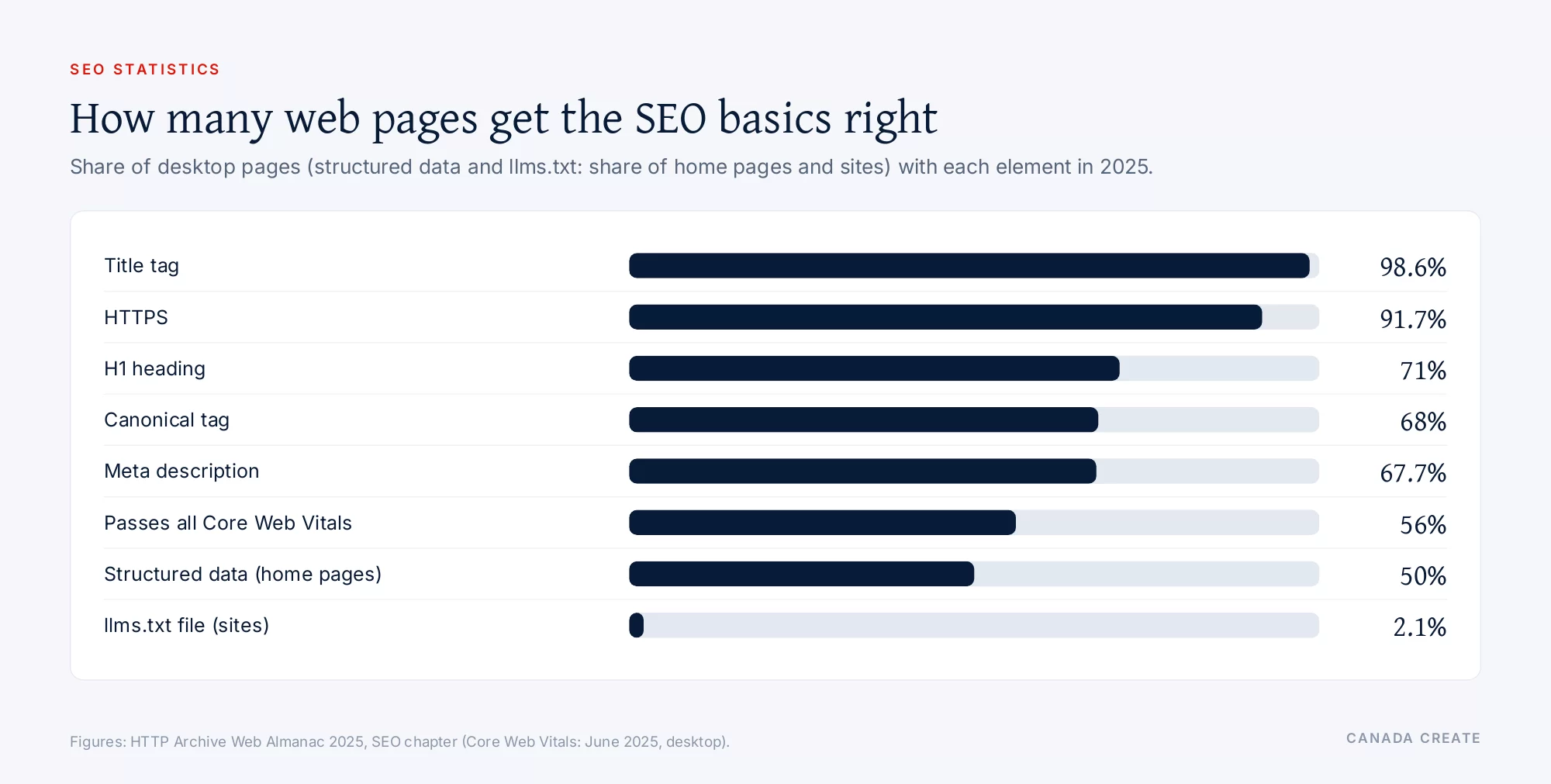
The HTTP Archive Web Almanac crawls a large sample of public websites every year and reports what it finds. Its 2025 SEO chapter shows that many sites still miss basic elements that search engines and AI systems rely on.
- Title tags: present on 98.6% of desktop pages and 98.5% of mobile pages.
- Meta descriptions: present on only 67.7% of desktop pages and 67.2% of mobile pages.
- H1 headings: present on 71% of desktop pages and 70% of mobile pages; non-empty on 66%.
- Canonical tags: used on 68% of desktop and 67% of mobile pages, up from 65% in 2024.
- HTTPS: 91.7% of desktop pages and 91.5% of mobile pages, up from about 89% in 2024.
- Image alt text: at the median, 60% of images on mobile pages had alt attributes, up from 58% in 2024.
- Viewport tag: on 93.1% of desktop pages and 95.2% of mobile pages.
- Descriptive link text: found on 92.42% of desktop inner pages.
Structured data statistics
Structured data helps search engines understand what a page is about. The Web Almanac found that structured data use grew to 50% of home pages in 2025, from 48% to 49% in 2024. JSON-LD is the most common format, on 43% of home pages and 39% of desktop inner pages. The most common types on home pages were WebSite (37% of desktop home pages), SearchAction (28%), Organization (about 27%), WebPage (25%) and BreadcrumbList (21%). Only about 2% of sites add structured data with JavaScript; the rest put it in the raw HTML.
Technical SEO statistics: crawling, robots and llms.txt
- robots.txt: in 2025, 85% of requests for robots.txt files returned a valid 200 status code, up from 84% in 2024; 13% returned a 404.
- Robots directives: meta robots tags appear on 47.0% of desktop pages and 47.9% of mobile pages; the X-Robots-Tag header appears on under 1%.
- noindex: used on 3.5% of desktop pages and 2.4% of mobile pages.
- AI crawler rules: GPTBot is named in 4.5% of desktop robots.txt files, up from 2.9% in 2024, and Google-Extended in 3.4%.
- llms.txt: found on 2.13% of desktop sites and 2.10% of mobile sites, with 324,184 valid files across the mobile sites analyzed.
The llms.txt figure is a useful reality check. The file is a proposal for helping AI systems read a site, not a Google ranking requirement, and adoption is still low. A clean robots.txt, consistent canonical tags and pages Google can render matter more today.
Page speed and Core Web Vitals statistics
Google publishes three Core Web Vitals targets for a good page experience: Largest Contentful Paint within 2.5 seconds, Interaction to Next Paint under 200 milliseconds and Cumulative Layout Shift under 0.1.
The Web Almanac’s June 2025 data from real Chrome users shows how far the web still has to go:
- Desktop: 74% of pages had good LCP, 72% good CLS, 97% good INP, and 56% passed all three.
- Mobile: 62% had good LCP, 81% good CLS, 77% good INP, and 48% passed all three.
Loading speed (LCP) on mobile is the weakest of the measures. Speed matters for revenue as well as rankings: the Milliseconds Make Millions study, commissioned by Google and run by 55 and Deloitte on 37 brand sites, found that a 0.1 second improvement in four speed measures lifted lead generation sites’ progression to the form submission page by 21.6% and retail spending by 9.2%.
How to use these SEO statistics
- Fix the basics first. One page in three still has no meta description and three in ten have no H1. Check your own templates before buying advanced tactics.
- Write for longer questions. With AI Mode queries three times longer than classic searches, pages should answer the follow-up questions buyers ask, in plain sentences.
- Measure more than clicks. With fewer clicks per AI summary, track impressions, branded searches, calls and form leads alongside sessions.
- Do not ignore Bing. One search in ten in Canada is a meaningful audience, and Bing Webmaster Tools is free.
- Test speed on a phone. Mobile LCP is where most sites fail Core Web Vitals.
- Use structured data that matches the page. Organization, BreadcrumbList and the type that fits your content are a sensible starting set.
If you want this done for your business, our SEO services in Toronto cover technical fixes, content and local search, and the local SEO service focuses on Google Maps and the local pack. For a deeper technical check, see the guide to technical SEO audit tools.
Common mistakes when reading SEO statistics
- Repeating figures nobody can trace. Many SEO statistics pages recycle numbers from studies a decade old. Look for the year and the original publisher.
- Treating US click studies as Canadian. Pew’s study covers US adults. The direction applies in Canada; the exact percentages may differ.
- Reading adoption as importance. A low llms.txt adoption rate does not make it useless, and a high title tag rate does not make titles easy to write well.
- Confusing visits with buyers. Organic traffic can fall while enquiries hold steady if AI answers filter out casual visitors.
What these numbers mean for Canadian businesses
Google still handles about 85% of Canadian searches, and its AI Overviews reach more than two billion people a month. People ask longer questions, click less when an AI summary appears and still rely on pages that answer clearly. At the same time, a third of pages lack a meta description and half of mobile pages fail Core Web Vitals, which leaves plenty of room for businesses that get the fundamentals right.
References
- Statcounter Global Stats, search engine market share in Canada (October 2026): gs.statcounter.com
- Statcounter Global Stats, desktop vs mobile vs tablet market share in Canada (October 2026): gs.statcounter.com
- Google, “Expanding AI Overviews and introducing AI Mode” (March 5, 2025): blog.google
- Alphabet, Q2 2025 earnings call: remarks from the CEO (July 2025): blog.google
- Alphabet, Q3 2026 earnings call: remarks from the CEO (October 28, 2026): blog.google
- Alphabet, “Alphabet Announces Second Quarter 2025 Results” (July 23, 2025), filed with the US Securities and Exchange Commission: sec.gov
- Pew Research Center, “Google users are less likely to click on links when an AI summary appears in the results” (July 22, 2025): pewresearch.org
- HTTP Archive, Web Almanac 2025, SEO chapter: almanac.httparchive.org
- Google Search Central, “Understanding Core Web Vitals and Google search results”: developers.google.com
- Google, web.dev case study “Milliseconds Make Millions”: web.dev
- M+R Benchmarks 2026, website performance chapter: mrbenchmarks.com
Frequently asked questions
What share of searches in Canada happen on Google?
Statcounter Global Stats put Google's share of search in Canada at 85.03% in October 2026. Bing followed at 10.46%, then Yahoo at 2.49% and DuckDuckGo at 1.5%. Google remains the main reference for SEO in Canada, but Bing's share is large enough to deserve attention.
How many people use Google AI Overviews?
Alphabet said in its Q2 2025 earnings remarks that AI Overviews had over 2 billion monthly users across more than 200 countries and territories and 40 languages. In the same remarks, it said AI Mode had over 100 million monthly active users in the US and India.
Do AI Overviews reduce clicks to websites?
Pew Research Center's 2025 study of US adults found that users who saw an AI summary clicked a traditional result in 8% of visits, compared with 15% for users who did not see one. Clicks on links inside the summary happened in just 1% of visits, and sessions ended more often after an AI summary.
How are search queries changing in 2026?
Alphabet said on October 28, 2026, that Google's year over year query growth rate was the highest in five years, that AI Mode queries are on average three times longer than traditional searches and that one in five AI Mode searches use voice, images or documents. Visual searches passed 50 billion a month.
How many websites have a meta description?
The HTTP Archive Web Almanac 2025 found meta descriptions on 67.7% of desktop pages and 67.2% of mobile pages, so about one page in three has none. Title tags were present on 98.6% of desktop pages, and H1 headings on 71%.
How many websites use structured data?
The Web Almanac 2025 found structured data on 50% of home pages, up from 48% to 49% in 2024. JSON-LD was the most common format, used on 43% of home pages. WebSite, Organization, WebPage and BreadcrumbList were among the most common types.
What are the Core Web Vitals targets in 2026?
Google's guidance sets a Largest Contentful Paint within 2.5 seconds, an Interaction to Next Paint under 200 milliseconds and a Cumulative Layout Shift under 0.1. In June 2025, 56% of desktop pages and 48% of mobile pages passed all three, according to the Web Almanac.
How many websites have an llms.txt file?
The Web Almanac 2025 found llms.txt files on 2.13% of desktop sites and 2.10% of mobile sites, with 324,184 valid files across the mobile sites it analyzed. The file is a proposal for AI systems, not a Google ranking requirement, so the basics still come first.
Is mobile or desktop search more common in Canada?
Statcounter measured Canadian web traffic in October 2026 at 50.7% desktop, 46.28% mobile and 3.02% tablet. Canada leans more to desktop than many countries, but close to half of visits still come from phones, and Google indexes the mobile version of a page first.
Is SEO still worth it with AI answers in search?
Yes. Google still handles about 85% of Canadian searches, and AI answers draw on pages that rank and explain things clearly. The work now includes being cited inside answers, not only ranking. Our SEO services in Toronto cover technical, content, local and AI search work.