
Affiliate Marketing Statistics 2026: Spend, Returns and Canadian Data

Affiliate marketing statistics show how much brands spend on commission-based partners, what that spending returns and how the channel is changing as search, social media and AI answers reshape where people discover products. This 2026 edition collects the affiliate figures that come from the people who measure the industry directly: the Performance Marketing Association’s industry study and brand survey, and Canadian consumer research published with Ad Standards. Every figure names its publisher and the year it covers, and the full list of publishers is at the bottom of the page.
Key affiliate marketing statistics at a glance
| Statistic | Figure | Published by |
|---|---|---|
| US affiliate marketing spend, 2024 | US$13.62 billion, up 49.8% from US$9.1 billion in 2021 | Performance Marketing Association, Industry Study 2025 |
| Compound annual growth of US affiliate spend, 2021 to 2024 | 14.42%, about twice the pace of ecommerce | Performance Marketing Association, Industry Study 2025 |
| US ecommerce sales generated by affiliate marketing, 2024 | US$113 billion, 9.4% of all US ecommerce sales | Performance Marketing Association, Industry Study 2025 |
| Share of sales from affiliates at companies that use the channel | An estimated 15% to 20% | Performance Marketing Association, Industry Study 2025 |
| Return on ad spend reported for travel and retail | US$19 and US$11 for every dollar invested | Performance Marketing Association, Industry Study 2025 |
| Retail’s share of US affiliate spend | 63% in 2024, down from 76% in 2021 | Performance Marketing Association, Industry Study 2025 |
| Affiliate programs prioritizing content partners to influence AI search results | Around 60% | Performance Marketing Association, 2026 US Brand Survey |
| Programs still using last-click attribution | Almost 80% | Performance Marketing Association, 2026 US Brand Survey |
| Canadians who have bought something because of an influencer recommendation | About 73% to 75% | Caddle for Ad Standards, Attitudes Towards Influencer Marketing (2025 wave) |
| Influencer-driven purchases by Canadians that started on Instagram | 61% | Caddle for Ad Standards (2025 wave) |
We set up, recruit and manage affiliate programs with clear tracking and compliance.
How big is the affiliate marketing industry?
The most detailed measure of the market comes from the Performance Marketing Association (PMA), the affiliate industry’s trade association. Its Industry Study 2025, released on June 18, 2025, with London Research as the research partner, found that US affiliate marketing spending grew by 49.8%, from US$9.1 billion in 2021 to US$13.62 billion in 2024. That is a compound annual growth rate of 14.42%, which the PMA describes as twice the pace of the broader ecommerce market.
The spending produced results at scale. The study credits affiliate marketing with US$113 billion in ecommerce sales in 2024, equal to 9.4% of all US ecommerce sales. For companies that run affiliate programs, the PMA estimates the channel accounts for 15% to 20% of their sales.
There is no equivalent national spend study for Canada, so Canadian owners usually work from the US figures and adjust for a smaller market. Canadian consumers do shop through creator and affiliate links at high rates, as the Ad Standards research further down shows.
Affiliate marketing return on ad spend by sector
Because affiliates are paid on results, the channel is usually judged by return on ad spend (ROAS). The PMA study reported:
- Travel: US$19 in sales for every dollar invested
- Retail overall: US$11 for every dollar
- Department stores: US$21 for every dollar
- Office supplies: US$20 for every dollar
- Automotive parts: US$19 for every dollar
These are averages across the programs in the study. A new program with few partners, or one in a crowded category, should expect lower returns while it builds relationships. The value of the figures is in showing which sectors buyers already reach through partner content.
Affiliate marketing statistics by publisher type
Affiliate “publishers” are the partners who send traffic: cashback and loyalty sites, coupon sites, content sites and bloggers, creators on social platforms, comparison tools and technology partners such as checkout or browser integrations. The PMA’s 2026 Brand Survey found that cashback and loyalty platforms remain the dominant revenue drivers for programs and that technology solutions have grown significantly. At the same time, marketing spend is moving up the funnel, away from coupons and toward content, influencer and creator partnerships. Its earlier 2024 Brand Survey, based on responses from more than 300 US retailers, tracked the same questions on publisher types, program age and click and sale activity, which is what makes the 2026 shift visible.
For a Canadian brand building a new program, this mix suggests a practical order: a small group of content and creator partners who explain the product, supported by a loyalty or cashback partner that closes sales, with rules on coupon sites so they do not simply collect commission on buyers who were already at the checkout.
Where affiliate spending is moving
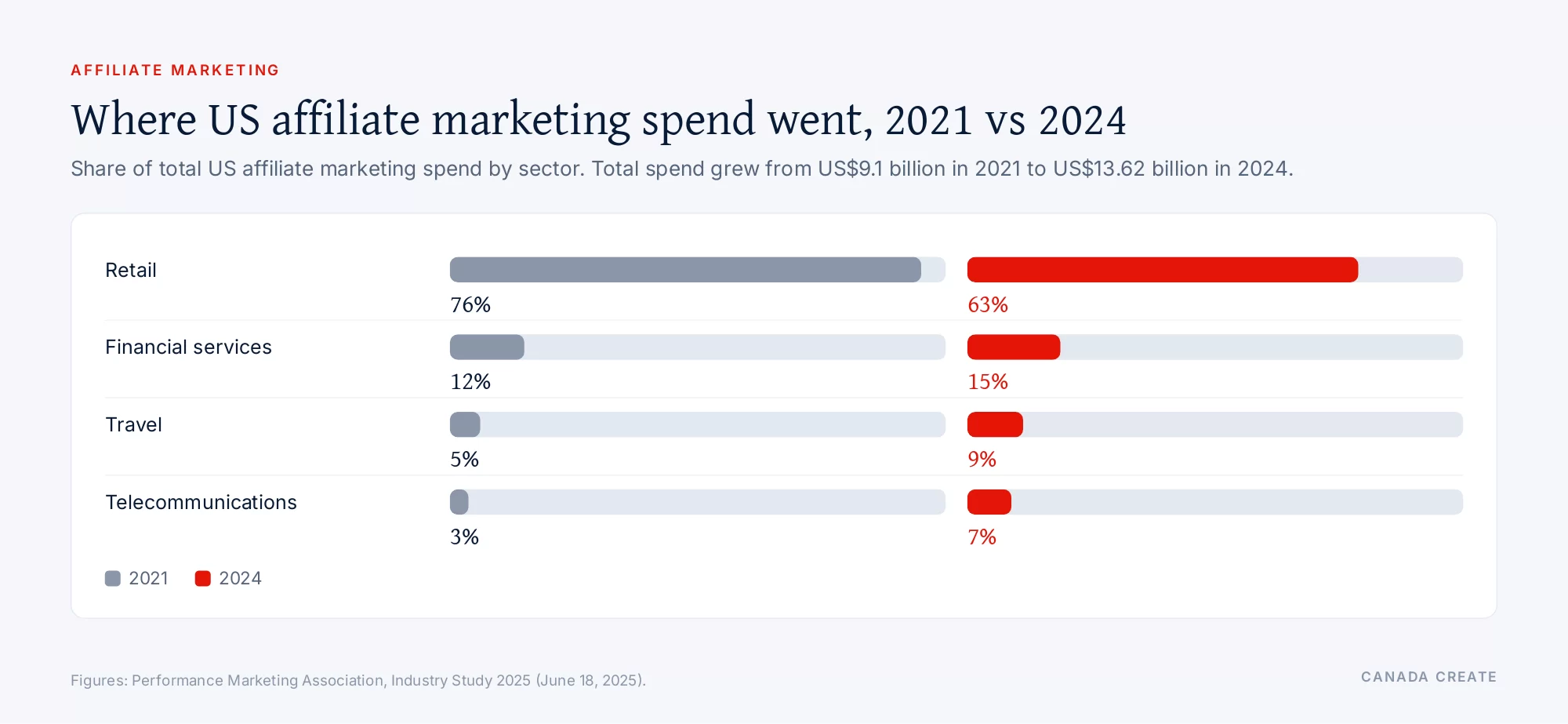
Retail still dominates affiliate spending, but its share is shrinking as other sectors invest. Between 2021 and 2024, the PMA found:
- retail fell from 76% to 63% of US affiliate spend
- financial services grew from 12% to 15%
- travel grew from 5% to 9%
- telecommunications more than doubled, from 3% to 7%
The study also found that content creators and bloggers gained a larger share of investment. The PMA’s 2026 US Brand Survey, conducted by its Measurements and Insights Council between April and June 2026 and released on July 14, 2026, adds detail on that shift: cashback and loyalty platforms remain the leading revenue drivers for programs, while spending is moving away from coupons and toward content, influencer and creator partnerships.
Affiliate marketing and AI search
AI answers in search are now a factor in affiliate planning on both sides of the relationship.
- In the PMA’s 2025 publisher survey, 69% of affiliate publishers said they were concerned that recent Google actions, including algorithm changes and AI Overviews, were reducing site traffic and affiliate revenue.
- In the same survey, 54% of publishers said they were confident or very confident in the future of their affiliate business, and 52% planned to experiment with new forms of promotion.
- In the 2026 Brand Survey, around 60% of brand respondents said they were already prioritizing content partnerships designed to influence AI-generated search results and large language models, though most measured this through basic brand mentions rather than dedicated tracking.
For a brand, the lesson is that partner content now does two jobs: it sends clicks, and it shapes what AI systems say about the brand. Reviews and comparison articles that are accurate and detailed serve both. Our AI search optimization page explains how businesses earn mentions in those answers.
How affiliate programs are run and measured
The 2026 Brand Survey shows programs becoming more selective about who they work with and slower to change how they measure success:
- the share of businesses using more than one affiliate platform more than doubled, from just under 9% to nearly 20%
- fewer programs allow toolbars, browser extensions and subnetworks than in 2024
- almost 80% of respondents still use last-click attribution, and most rely on their affiliate platform’s own reporting as the main record of results
Last-click attribution gives all the credit to the final link a buyer clicked. It tends to favour coupon and cashback sites at the end of the purchase and undervalue the review or video that started the buyer’s research. If you are moving budget toward content partners, check whether your reporting can see their influence before you judge them on last-click sales.
Canadian influencer and affiliate statistics
Much affiliate activity in Canada now runs through creators: a link in a video description, a discount code in a post or a “link in bio” storefront. Ad Standards, the national advertising self-regulator, published a tracking study by the Canadian consumer panel Caddle in February 2026. Its third wave surveyed 2,242 Canadians on October 29, 2025. Key results:
- 48% of Canadians are quite familiar with influencers, and about half follow at least one
- 53% say they trust influencer recommendations
- about 73% to 75% have purchased something because of an influencer recommendation, and roughly 34% buy that way at least monthly
- 73% learn about products from influencers weekly and 32% daily
- interest is softening: only 30% are interested in learning about products from influencers (down 5 points) and about 20% say they are likely to buy from an influencer in the future (down 6 points)
Which platforms drive purchases in Canada
Among Canadians who bought because of an influencer post, 61% saw that post on Instagram, followed by YouTube and Facebook at 35% each and TikTok at 31%. TikTok’s share has grown from 20% in the 2021 wave, while Facebook’s has fallen from 52%.
Who buys through creators
Younger Canadians are far more engaged. 71% of Gen Z and 64% of Millennials follow influencers, compared with 36% of Gen X and 22% of Boomers. Purchases follow the same pattern: 81% of Gen Z and 73% of Millennials have bought because of an influencer, against 56% of Boomers.
Smaller creators, stronger influence
65% of Canadians say they learn about products from micro influencers, compared with 48% for macro influencers, 44% for nano influencers and 38% for celebrities. 91% say follower count does not materially change whether they learn about a product. Content quality is the main reason people follow someone.
AI influencers and Canadian buyers
The same research asked about virtual influencers created with AI. 63% of Canadians were unaware of AI influencers, and only 24% felt confident they could tell an AI creator from a human one, while 42% were not confident. Most saw AI influencers as less relatable (65%) and less effective (58%) than people. 78% said AI influencers must clearly disclose what they are, and 57% said AI involvement makes them less likely to buy. For brands that pay partners on commission, the message is consistent with the rest of the study: buyers respond to people they trust, and they expect to be told when something is not what it seems.
Who knows the disclosure rules
Awareness of disclosure rules is uneven. Just over a third of Canadians (35%) say they are quite familiar with the requirement that influencers disclose a brand relationship, about the same as in 2023 (34%). Awareness is highest among Gen Z (53%) and Millennials (48%), and lower among Gen X (30%) and Boomers (19%). Comfort with disclosure requirements has risen 12 points since 2021. A partner whose audience is mostly over 50 should therefore make the relationship especially plain, because many of those readers will not recognize a hashtag on its own.
Disclosure rules for affiliate links in Canada
Ad Standards’ Influencer Marketing Disclosure Guidelines, updated in October 2025, state that affiliate marketing and refer-a-friend programs may trigger disclosure requirements whenever the person sharing a link receives a commission or another benefit. The guidelines recommend clear wording or hashtags such as #affiliate, #AffiliateLink or #CommissionEarned, or a plain sentence such as “Each time you make a purchase through a link that I provide, I receive a commission.” For affiliate content, they suggest identifying the relationship with the brand, for example #CompanyPartner or #CompanyAffiliate, rather than a generic #ad.
Canadians notice these labels more than before. In the Caddle research, 54% recognized “Paid Promotion” labels and 48% recognized #ad or #sponsored, yet 76% believe influencers are paid for their posts and 47% think most posts are paid. Clear disclosure keeps a program on the right side of the guidelines, and the numbers suggest it no longer surprises buyers.
How to use these statistics in your affiliate program
- Benchmark returns by sector, not by headline. Compare your ROAS with your own sector’s figure, and give a new program time to recruit and train partners.
- Recruit content partners, not only coupon sites. The spending shift toward creators and reviewers reflects where buyers research, and it is the content AI answers draw on.
- Look past last click. If you cannot see assisted conversions, test partners with unique codes or landing pages so their contribution is visible.
- Choose platforms by audience. For Canadian consumer brands, Instagram leads creator-driven purchases and TikTok is growing, especially with buyers under 40.
- Write disclosure into partner terms. Give partners approved wording that follows the Ad Standards guidelines, and check posts during the first months of a campaign.
Our affiliate marketing program management team recruits and manages partners for Canadian brands, and the influencer marketing service covers creator campaigns. For a wider look at creators, see the creator economy statistics for 2026.
Common mistakes when reading affiliate marketing statistics
- Treating US spend as Canadian spend. The PMA figures describe the US market. Use them for direction and ratios, not as Canadian totals.
- Mixing spend and sales. US$13.62 billion is what brands paid partners; US$113 billion is the ecommerce revenue credited to them. They are different measures.
- Reading ROAS as profit. A US$11 return on each dollar describes revenue, before product costs, shipping and returns.
- Quoting old surveys. Many statistics pages still repeat affiliate figures from 2016 and earlier. Check the year a number describes.
- Assuming all creators are equal. Canadians report learning more from micro influencers than from celebrities.
What this means for Canadian brands
Affiliate marketing is a growing, results-based channel: US spend rose by almost half in three years and returned double-digit revenue per dollar in many sectors. Spending is moving toward content creators, AI answers are changing how partner content earns attention, and most programs still measure with last click. In Canada, three in four consumers have bought because of an influencer, Instagram leads those purchases, and clear disclosure is expected.
References
- Performance Marketing Association, “PMA Study: Affiliate Marketing Industry Grows 49.8% to $13.63 B, Outpacing E-commerce Growth by 2X” (Industry Study 2025, June 18, 2025): thepma.org
- Performance Marketing Association, “Announcing the 2026 Performance Marketing U.S. Brand Survey Results” (July 14, 2026): thepma.org
- Ad Standards and Caddle, “Attitudes Towards Influencer Marketing” (February 25, 2026): adstandards.ca
- Ad Standards, Influencer Marketing Disclosure Guidelines (October 2025 update): adstandards.ca
- Ad Standards, influencer marketing guidance page: adstandards.ca
Frequently asked questions
How big is the affiliate marketing industry in 2026?
The newest full measure, the Performance Marketing Association's Industry Study 2025, found US affiliate marketing spend reached US$13.62 billion in 2024, up 49.8% from US$9.1 billion in 2021. That works out to compound annual growth of 14.42%, about twice the pace of US ecommerce.
How much in sales does affiliate marketing generate?
The PMA study credits affiliate marketing with US$113 billion in US ecommerce sales in 2024, or 9.4% of all US ecommerce sales. For companies that run affiliate programs, it estimates the channel produces 15% to 20% of their sales.
What return on ad spend does affiliate marketing deliver?
The PMA reported a return of US$19 for every dollar in travel and US$11 for every dollar in retail, with department stores at US$21, office supplies at US$20 and automotive parts at US$19. These are revenue figures before product, shipping and return costs, so judge them against your own unit economics.
Which industries spend the most on affiliate marketing?
Retail still leads but its share fell from 76% of US affiliate spend in 2021 to 63% in 2024. Financial services grew from 12% to 15%, travel from 5% to 9% and telecommunications from 3% to 7%, according to the PMA.
Is affiliate marketing affected by AI search?
Yes. In the PMA's 2025 publisher survey, 69% of affiliate publishers said Google changes, including AI Overviews, were reducing their traffic and revenue. In the 2026 Brand Survey, around 60% of brands said they were prioritizing content partnerships designed to influence AI search results.
How do most affiliate programs measure results?
Almost 80% of respondents to the PMA's 2026 Brand Survey still use last-click attribution, and most rely on their affiliate platform's own reporting. That method tends to reward coupon and cashback partners at the end of a purchase and undervalue the content partners who started the buyer's research.
How many Canadians buy through influencers or creators?
Research by Caddle for Ad Standards, based on 2,242 Canadians surveyed on October 29, 2025, found that about 73% to 75% have purchased something because of an influencer recommendation, and about 34% buy that way at least monthly. Interest is softening, with only about 20% saying they are likely to buy from an influencer in the future.
Which social platform drives the most influencer purchases in Canada?
Instagram. Among Canadians who bought because of an influencer post, 61% saw that post on Instagram, followed by YouTube and Facebook at 35% each and TikTok at 31%. TikTok has grown from 20% in 2021, while Facebook has fallen from 52%.
Do affiliate links need a disclosure in Canada?
Ad Standards' Influencer Marketing Disclosure Guidelines say affiliate and refer-a-friend programs may trigger disclosure requirements when the person sharing a link receives a commission or another benefit. The guidelines suggest clear wording such as #AffiliateLink, #CommissionEarned or a plain sentence explaining the commission.
How should a Canadian brand start an affiliate program?
Start with partners whose audience matches your buyers, set commission and tracking rules you can measure, give partners approved disclosure wording and review results by sector benchmarks rather than headline averages. Our affiliate marketing program management team sets up and runs programs for Canadian brands.