
Toronto · SEO for personal injury lawyers
Personal Injury Lawyer SEO and Marketing in Toronto
Canada Create coordinates case-type content, local visibility, relevant professional listings and technical website improvements for your injury practice. Help injured people and their families understand your services and request a consultation, with content approved by your lawyers.
Personal injury lawyer SEO for Toronto and GTA law firms, from North York to downtown: case type pages, local search and technical work.
- BBB A+ accredited
- 18 years in business
- Mon to Fri 9 to 6, Sat 10 to 2
Get a free personal injury SEO review
Tell us your case types, offices and the enquiries you want to improve. A strategist replies within one business day.
Please do not share passwords or other sensitive details here. We never sell your contact information and we comply with Canadian privacy law
(privacy policy).
What your injury practice needs from SEO
Accurate local information
Help people confirm genuine offices, services and appointment options.
Clear case-type information
Explain the injury and insurance matters your firm accepts.
Work you can review
Relevant professional placements and the other agreed work are identified in reports.
Reporting connected to signed files
Review consultations and the signed-file outcomes available from your records.
What our PI SEO service includes
The mix is set after a free review of your website, profiles and competitors. Every engagement is scoped in writing.
- PI SEO auditCurrent website, search presence and enquiry needs reviewed, with written recommendations.
- Practice-focused content planAn agreed plan for the case types, service areas and prospective-client needs the engagement covers.
- Case type pagesCollision, slip and fall, disability, brain injury and wrongful death pages written for searchers and approved by your lawyers.
- Local SEO for injury firmsBusiness Profiles, location pages, citations and a respectful review process.
- Link building for law firmsRelevant professional listing and public-mention work, reported for your review.
- Technical SEOWebsite performance and usability, with accessibility improvements and testing defined in your written scope.
- Content and AI answersApproved information for prospective clients, with observable AI-search references reported where included.
- Enquiry and signed-file reportingReview recorded calls, forms and consultations alongside the signed-file outcomes your team can share.
Personal injury SEO pricing
Custom-scoped engagements; proposal after discovery. Setup, ongoing SEO work and third-party costs are shown separately in your written proposal.
Personal injury lawyer SEO
Custom-scoped engagements; proposal after discovery
Firms targeting relevant case types and markets, with the scope adjusted for the number of offices, content needs and competition.
- Case type pages
- Google Business Profile
- Technical SEO
- Link building
- Monthly reporting
Website rebuild or SEO migration
Quoted in writing
Priced by the number of pages, case types, offices and languages, and by the content, URL mapping and technical checks needed for the migration.
- Fast, accessible design
- Case type and lawyer pages
- Secure intake forms
- Redirect and migration plan
Google Ads management
Quoted in writing
Setup and monthly management reflect your case types, service areas and campaigns. Ad spend is paid directly to Google. Local Services Ads are separately assessed only where Google confirms eligibility.
- Advertising for your injury services
- Ongoing campaign management
- Call and form tracking
- Monthly reporting
Fees are quoted in writing after a free consultation. Advertising spend is paid separately to the platforms. Applicable taxes are additional.
Injury-practice service fit
Services, fit and expectations for your personal injury firm
Personal injury lawyer SEO and marketing in Toronto is how an injury firm reaches people after a collision, a fall or a denied claim, and gives them a clear reason to call. It is the case type content, local search, technical website work, advertising, reviews and intake that help a personal injury law firm appear when someone searches for help, and then turn that search into a consultation and, for the right matters, a signed file. Canada Create has worked from its Toronto office at 126 Willowdale Ave., Suite #3, since 2008, and is a BBB Accredited Business with an A+ rating. Your lawyers approve every legal statement before it is published.
Our work for law firms includes the website, Google Ads and social media advertising for Ghasemi Law and the website and YouTube advertising for Azimi Law.
A personal injury program with Canada Create covers eight areas, and your custom proposal names the ones your firm needs:
- Case type pages: the motor vehicle, slip and fall, long term disability, serious injury and wrongful death matters your firm accepts.
- Lawyer profiles: credentials and experience your lawyers confirm, with no “specialist” title unless the lawyer is certified.
- Local SEO: Google Business Profiles and office pages for real offices, including home or hospital visits where you offer them.
- Technical SEO and accessibility: a fast, usable website for people in pain, with reduced mobility or reading on a phone.
- Advertising: Google Ads and video campaigns organized by case type, coordinated with SEO.
- Reviews and reputation: review requests and replies that respect confidentiality and the Law Society of Ontario’s rules.
- Intake and booking: calls, forms and callbacks answered quickly, with follow-up recorded in a CRM.
- Reporting: consultations and signed files by case type, where your records support it.
If you want every practice area handled together, see our law firm marketing in Toronto. For paid campaigns on their own, see personal injury lawyer advertising in Toronto.
How injured people search for a lawyer
Injury searches happen at difficult moments. Someone may be searching from a hospital bed the day after a collision, a spouse may be searching on their behalf, or a person may start looking months later when an insurer denies a claim or stops payments. The searches reflect that range:
- Urgent hire searches: “car accident lawyer near me”, “personal injury lawyer Toronto”, “slip and fall lawyer Scarborough”.
- Situation searches: “insurance denied my long term disability claim”, “hit by a car as a pedestrian what to do”, “fell on ice at a store”.
- Cost and process questions: “how do personal injury lawyers get paid”, “who pays legal fees if you win”, “how long does a personal injury claim take in Ontario”.
- Comparison searches: reviews, lawyer names and “best” searches, as people narrow down two or three firms.
Each kind of search needs a different page and a different next step. Urgent searches need a case type page and a Google Business Profile with the phone number one tap away. Situation and cost questions need plain-language guides that explain how things usually work in Ontario without advising on the reader’s own case. Comparison searches need profiles, reviews and clear information about how a first consultation works.
Case type pages people can assess
Case type pages carry most of the weight in personal injury SEO, because they match the searches with the strongest intent. A single “personal injury” page rarely ranks for the many specific matters people search for.
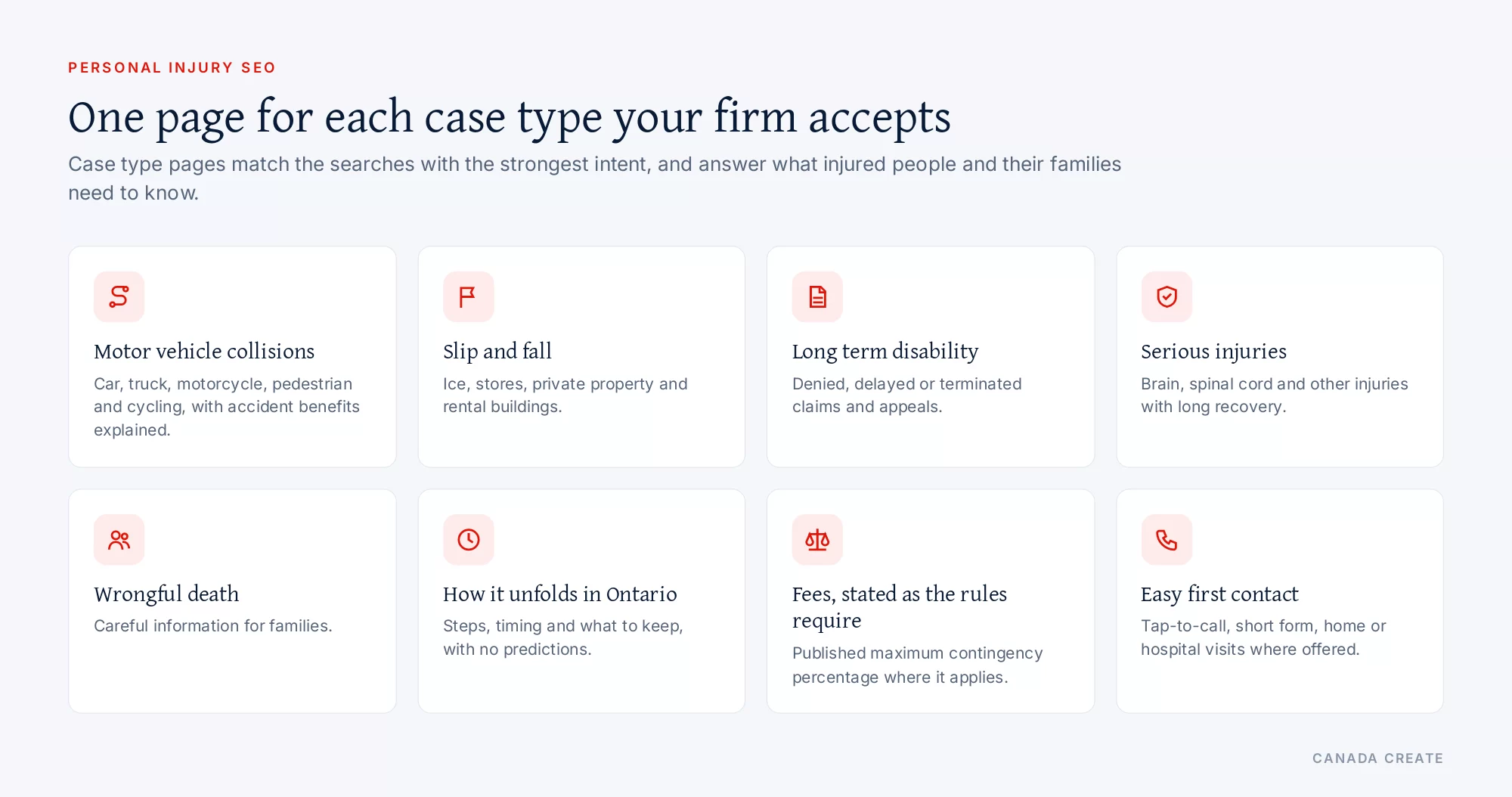
We build pages for the matters your firm accepts, such as:
- Motor vehicle collisions: car, truck, motorcycle, pedestrian and cycling collisions, and the accident benefits and tort claims that may follow.
- Slip and fall and premises claims: falls on ice, in stores, on private property and in rental buildings.
- Long term disability and insurance disputes: denied, delayed or terminated claims under group and individual policies.
- Serious injuries: brain injuries, spinal cord injuries, fractures and other injuries with long recovery.
- Wrongful death and fatal claims: careful information for families considering legal help.
- Other matters you choose: dog bites, medical negligence or product liability, only where your firm accepts them.
Each page explains who it is for, the kind of help the firm provides, how the matter usually unfolds in Ontario, what to do and what to keep, how a first consultation works and how fees are discussed, with your lawyers’ approval. Pages should never predict what a reader will recover. Content about accident benefits needs regular review: Ontario’s auto insurance changes that took effect on July 1, 2026 made several benefits optional, so older pages may now describe coverage incorrectly.
Fees, results and the Law Society rules for injury marketing
Personal injury marketing draws more regulatory attention than most practice areas, because the people reading it are often vulnerable and the advertising is often intense. The Law Society of Ontario’s Rules of Professional Conduct shape several common features of injury websites and ads. This is general information, not legal advice; your lawyers approve what the firm publishes.
- Contingency fees: Rule 4.2-2.2 says a lawyer who markets services on the basis that fees may be contingent on success must comply with Rule 3.6-2.2, which requires publishing a general maximum contingency fee percentage on the lawyer’s website, or providing it at first contact if there is no website. “No win, no fee” messages need that published maximum, and wording that is accurate about disbursements and other costs.
- Results and amounts recovered: commentary to Rule 4.2-1 says stating amounts recovered or referring to past success may contravene the rule unless accompanied by a statement that past results are not necessarily indicative of future results and that outcomes vary according to the facts.
- Superlatives and aggression: “best”, “super” and “#1” are treated as rankings that must be bona fide, and suggesting superiority or implying the lawyer is aggressive may contravene the rule.
- Specialist: Rule 4.3-1 limits “specialist” to lawyers certified by the Law Society.
- Second opinions: Rule 4.2-1.2 prohibits marketing second opinion services.
- Referral practices: marketing must clearly and prominently disclose a practice of referring clients to other licensees for a fee, and referral fees themselves are capped under Rule 3.6-6.1.
Our guide to lawyer advertising rules in Canada covers each rule with checklists.
Local SEO for personal injury firms
For “personal injury lawyer near me” and similar searches, the map pack decides who gets most of the calls. Google ranks it on relevance, distance and prominence, so the work focuses on real offices with complete Google Business Profiles, office pages with directions and accessibility details, consistent listings and genuine reviews.
Injury firms often serve clients far from the office, through home visits, hospital visits or video meetings. Where your firm offers those, the website and profile should say so plainly, and service area settings can reflect the communities you serve across Toronto and the GTA. Profiles must follow Google’s rules: one per real office where clients are met, never a virtual office. Our local SEO services in Toronto explain the wider service.
Reviews and reputation for injury firms
Reviews matter in injury cases, because people want to know a firm will treat them well during a long and stressful process. Ask satisfied clients for honest reviews at a natural point, without incentives and without asking only those you expect to be positive. Replies should never confirm that the reviewer was a client or discuss their matter. Testimonials reused on the website become the firm’s marketing, and commentary to Rule 4.2-1 lists testimonials with emotional appeals among marketing that may contravene the rule. We never write or buy reviews.
A website injured people and their families can use
A prospective client may be living with pain, reduced mobility, a concussion or difficulty reading a screen, and a family member may be researching for them. The website should be easy to use in those conditions: large, readable text, a tap-to-call number on every page, short forms, clear headings, accessible design built to WCAG and pages that load quickly on a phone.
Forms should ask only what the firm needs to call back and check for conflicts, with a note not to send medical records or other sensitive details before the firm agrees to act. Your firm decides when documents enter its intake system. A rebuild or migration is planned through our law firm website design in Toronto service.
Advertising alongside SEO
SEO builds visibility over months; injury firms often need enquiries sooner, and some case types are worth advertising for while organic rankings grow. Google search ads organized by case type, with tight location and schedule controls and strong negative keyword lists, can bring calls within days. Video ads on YouTube help people remember the firm before they need it.
Injury clicks are among the most expensive in legal advertising, so ads and SEO should share data: the searches that bring signed files in paid campaigns are the ones worth winning organically. Local Services Ads are offered for legal services in some countries, but Google’s Canadian category list currently covers home services rather than legal services, so they are considered only if Google adds legal categories in Canada. See personal injury lawyer advertising in Toronto for paid campaigns in detail.
Intake: from first call to signed file
Many injury firms lose good matters after the click. Calls go to voicemail at lunchtime, forms wait until the next day or a family member calling at night finds no route to a person. In a practice where people often contact several firms, speed and care at first contact decide who gets the file.
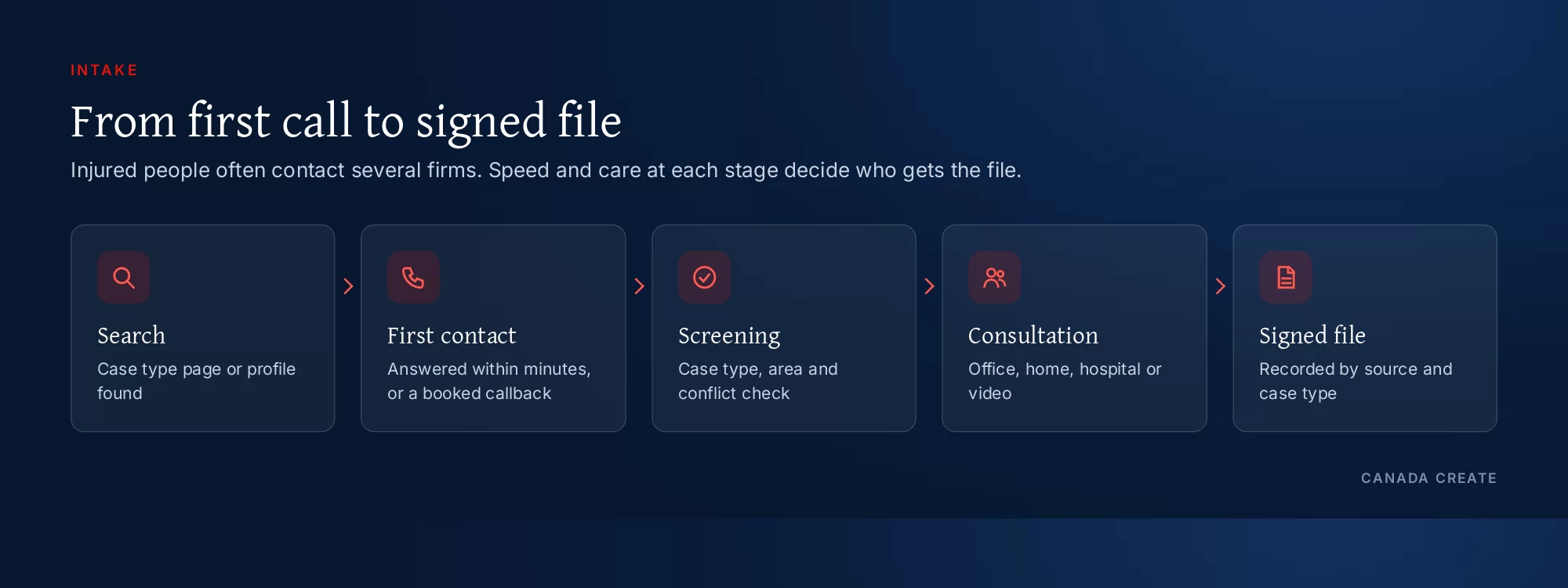
Intake improvements we can make:
- Answering: tracked numbers, honest hours on every page and an AI receptionist that takes messages and books callbacks outside office hours.
- Booking: consultation booking, including home, hospital or video meetings where the firm offers them, with reminders.
- Follow-up: a CRM for law firms so every enquiry has an owner, a status and a next step.
- Screening support: short questions that help your team see quickly whether a matter fits the case types and areas you accept.
Direct enquiries through your firm’s own channels
We build and manage marketing in your firm’s own name: your website, your Google Business Profiles and your advertising accounts, set up in the firm’s name where the platform permits. Canada Create does not sell shared leads or resell enquiries generated through your channels. That does not stop a prospective client from contacting another firm, and it is not a promise of exclusive prospects or signed files, but every enquiry your marketing produces is yours.
When a personal injury marketing review is useful
You may already have traffic and calls but be unsure whether the investment supports the practice you want. A review looks at search presence, the website, advertising and intake together. It is especially useful when:
- Enquiries regularly fall outside the case types or areas you accept.
- Your firm is opening capacity for a specific case type or office.
- Reports show activity but little connection to consultations or signed files.
- The website no longer represents your lawyers or services accurately.
- Several suppliers leave you coordinating the website, ads and intake yourself.
The review leads to a recommended scope. A larger advertising budget is only one possible answer; the website, content or intake may need attention first.
Measuring injury marketing: consultations and signed files
Injury files can take a long time to resolve, so current enquiry activity should not be confused with collected fees. Reporting tracks each stage separately:
| Stage | What we measure |
|---|---|
| Visibility | Search positions for case type and location terms, map pack positions from several points in the city |
| Enquiries | Calls, forms and bookings by page, campaign and case type |
| Consultations | Qualified consultations recorded by your intake team, with reasons for unsuitable enquiries |
| Signed files | Files opened by case type and source, where your records support it |
Attribution has limits and does not prove that SEO or advertising caused every file. Your intake team’s feedback helps separate suitable matters from enquiries outside the practice or jurisdiction. Tracking records the source of each enquiry, never the details of anyone’s injury. Your firm remains responsible for conflicts, screening, advice and decisions to accept a matter.
Content that answers what injured people ask
Beyond case type pages, guides and short videos answer the questions people ask before they call: what to do after a collision, how accident benefits differ from a lawsuit, what to keep after a fall, how disability claims are appealed, how long claims usually take and how fees work. Each guide stays general, explains what the answer depends on, suggests speaking with a lawyer about a specific situation and links to the relevant case type page. Our guide to how to get personal injury clients in Canada and how disability, malpractice and insurance claim lawyers get clients cover the wider picture.
Technical SEO for injury firm websites
Behind every strong case type page is a website search engines can crawl, render and trust. For injury firms the technical work usually covers indexing of every case type, lawyer and office page; consolidating old or duplicate pages left by past redesigns with one-hop redirects; fast mobile pages; structured data for the firm, each office, the lawyers and the visible FAQs; secure forms; and internal links that connect case type pages, lawyer profiles, guides and office pages so both readers and search engines can follow the path.
Results pages need particular care. If your firm publishes past results, each one should carry the statement the Law Society’s commentary describes, client permission should be on file and the page should be kept up to date. A results page with old, unexplained amounts can create more risk than value.
Personal injury SEO across Toronto and the GTA
Injury clients come from across the region, and the courthouses, hospitals and insurers they deal with vary from Toronto to Peel, York and Durham. Firms with offices outside the core city, such as in Mississauga, Brampton, Vaughan or Markham, should give each real office its own Google Business Profile and page. Firms that serve the wider region from one office can reflect that with service area settings, home and hospital visit options and content about the communities they actually serve.
What does not work is a set of copied pages that swap the city name. Search engines treat them as doorway pages and injured people find nothing useful in them. A smaller number of genuinely local pages, each with real information, does more.
Referral relationships for injury firms
Many injury files arrive through referrals from past clients, other lawyers and the professionals who meet injured people early. Marketing can support those relationships with a website a referrer is comfortable sharing, clear case type pages and lawyer profiles, and updates for contacts who have agreed to receive them.
Referral arrangements have rules of their own. Referral fees between licensees must follow Rule 3.6-6.1, including a signed referral agreement and a capped fee, and marketing must disclose a practice of referring clients out for a fee. Paying people who are not licensees for referrals raises separate professional issues. Your firm decides how its referral relationships work; marketing describes them accurately.
AI search and injury questions
People increasingly ask AI assistants what to do after an accident or how injury claims work in Ontario, and some ask them to suggest a lawyer. AI answers draw on pages that are indexed, clear and consistent with what other sources say. Case type pages that answer common questions directly, accurate lawyer profiles, consistent business details across directories and genuine reviews make an accurate mention of your firm more likely. Our AI SEO and AI search optimization in Toronto page explains the wider service.
Common personal injury marketing mistakes
The same problems appear in many injury firms’ marketing:
- One “personal injury” page for every kind of claim.
- Ads that send every click to the home page.
- Calls from evening ads going to voicemail.
- Settlement amounts shown without the past results statement.
- “No win, no fee” messages without a published maximum contingency percentage.
- Best, toughest or aggressive wording in ads and headlines.
- Accident benefits pages that still describe coverage before the July 2026 changes.
- Reports that count clicks and calls but never signed files.
Each is straightforward to fix once it is found, and fixing them usually lowers the cost of every useful enquiry.
What personal injury lawyer SEO and marketing cost in Toronto
Injury marketing is custom-scoped after discovery, and fees are quoted in writing after a free consultation. The scope depends on the case types targeted, the number of offices and areas served, competition, the condition of the website, the content needed, the channels included and how much intake work is involved. Advertising budgets are set by the firm and paid directly to the platforms. The proposal separates one-time work, ongoing management and any third-party costs.
How to compare personal injury marketing agencies in Toronto
Questions worth asking any agency, including us:
- What have you delivered for law firms, and can we see examples?
- Do you sell shared leads or resell enquiries to other firms?
- Who owns the website, profiles and advertising accounts?
- How do you handle the Law Society’s rules on fees, results, testimonials and specialist claims?
- How will you report consultations and signed files, not just clicks and calls?
- Who writes the case type pages, and how do our lawyers review them?
Be cautious with any agency that promises a number of cases, offers to write reviews or suggests wording about settlements and results without the statements the rules require.
Talk to a strategist
Ready when you are?
Request a custom proposal
Tell us your goals, budget and timeline. You get a custom proposal and a named strategist, so your next stage of growth starts now.
How a personal injury SEO engagement starts
A clear proposal, practical lawyer review and reporting tied to the enquiries your firm receives.
- Review your needs Discovery
Tell us about your personal injury services, capacity and current enquiries.
- Agree the scope Before work starts
Review the recommended services, fees and responsibilities before work starts.
- Confirm reporting At the start
Agree how available enquiry data will be used to report consultations and signed files.
- Review the content Before publication
Your lawyers check and approve the pages and claims prepared for your firm.
- Receive the agreed work As agreed
The team delivers the services and milestones in your approved scope.
- Review progress Monthly
Discuss consultations and signed files, the quality of enquiries and any proposed scope changes.
Law firm work from our portfolio
Websites and advertising we delivered for law firms.


One team, lawyer-approved copy: how we handle personal injury lawyer SEO
One accountable team
Strategy, content, technical and link work run from one plan.
Lawyer-reviewed copy
We prepare clear marketing copy, flag claims for review and obtain your lawyers’ approval before publication. Your firm retains responsibility for regulatory compliance.
Your approval first
Nothing published without your lawyers approving it.
Reporting tied to your practice
Review available consultation and signed-file records, with source-data limits explained.
Personal injury lawyer SEO and marketing in Toronto: questions firms ask
The basics
What is personal injury lawyer SEO?
It is the work of helping a personal injury law firm appear in Google's organic results, the map pack and AI answers when people search for help after an accident, a fall or a denied claim. It covers case type pages, local SEO, lawyer profiles, technical website work, reviews within the rules and reporting from search to signed files.
What does personal injury lawyer marketing include?
It usually combines SEO for the case types the firm accepts, Google Ads and video advertising, a website with clear lawyer profiles and consultation routes, review handling within the Law Society rules, and intake support through a CRM. Canada Create scopes these as one program or as single services, and your lawyers approve every legal statement.
Is doing local SEO worth it for personal injury lawyers?
Usually, yes. Many injury searches include near me or a neighbourhood, and the map pack shows only three firms, which take a large share of calls. A complete Google Business Profile for each real office, consistent listings, genuine reviews and office pages that mention home or hospital visits where offered all support local visibility.
Does SEO work for personal injury law firms in Toronto?
It can, but injury is one of the most competitive practice areas in the city, so results build over months. Firms that publish strong case type pages, keep their profiles accurate, earn genuine reviews and answer enquiries quickly tend to see steady gains. No agency can promise a ranking or a number of files.
How do personal injury lawyers get clients?
Through search and the map pack at the moment of need, paid search and video ads, referrals from past clients, other lawyers and health professionals, and reputation in their community. The firms that grow steadily combine those channels with fast, careful intake, because injured people often contact more than one firm.
Which marketing techniques suit a personal injury law firm?
Match marketing to the case types and areas the firm actually accepts, so pages and campaigns do not attract cases you would turn away. Publish clear case type pages, run tightly targeted search ads, ask for honest reviews and make the path from enquiry to consultation easy, with booking, reminders and follow-up suited to your team.
What is the hardest part of marketing a personal injury firm?
Usually competition and speed. Many well-funded firms compete for the same searches, clicks are expensive, and injured people contact several firms at once. Firms that focus on the case types they do best, keep their content accurate and answer quickly tend to do better than those that try to outspend everyone.
Case type content
How should case type pages explain what a personal injury lawyer does?
Each page introduces the matters the firm accepts, such as car, truck, motorcycle, pedestrian or cycling collisions, premises claims or denied disability benefits. It explains the help available, how the matter usually unfolds in Ontario and how to request a consultation, in plain, careful language that never predicts what a reader will recover.
Which case types should a personal injury website cover?
Only the ones your firm accepts and wants more of. Common pages include motor vehicle collisions, slip and fall, long term disability, serious injuries such as brain or spinal injuries, and wrongful death. Separate pages for distinct matters usually rank better than one long page covering everything.
Can a personal injury website answer questions such as who pays legal fees after a win?
Yes. Guides and short videos can answer general questions your lawyers are comfortable addressing in public, explaining how things usually work without advising on a reader's own case. Fee explanations must match the firm's actual agreements and the Law Society's rules, and your lawyers approve each piece before it goes live.
Should injury content mention Ontario accident benefits?
Yes, because many motor vehicle clients first need to understand accident benefits and how they differ from a lawsuit. Content must be kept current: Ontario's auto insurance changes that took effect on July 1, 2026 made several benefits optional, so older pages may now describe coverage incorrectly and need review.
How often should personal injury website content be updated?
At least once a year, and whenever insurance rules, limitation periods, court processes or the firm's team change. Injury law and insurance rules shift, and outdated pages can mislead readers. A simple review calendar, with your lawyers signing off changes, keeps the site accurate.
What blog topics work for a personal injury law firm?
Questions people ask before they call: what to do after a collision, what to keep after a fall, how accident benefits differ from a lawsuit, how disability claims are appealed, how long claims take and how fees work. Each guide stays general and links to the matching case type page.
Should a personal injury firm use video?
Video helps people see and hear the lawyer before they call, which builds trust in a long, stressful process. Short clips answering common questions or explaining a first meeting work well on YouTube and case type pages. Scripts follow the same rules as text, with no outcome promises or implied aggression.
Should a personal injury firm have pages in other languages?
If your lawyers or staff serve clients in other languages, yes. Translated and reviewed case type pages, a profile listing the languages spoken and ads in those languages help people find a firm they can talk to comfortably. Machine translation widgets are not a substitute.
Fees, results and rules
Should a personal injury firm explain contingency fees on its website?
Many do, because fees are one of the first things people want to understand. If the firm markets on the basis that fees are contingent on success, Rule 3.6-2.2 requires publishing a general maximum contingency fee percentage on the website. The explanation should match the firm's actual agreements and be approved by its lawyers.
Can a personal injury firm advertise no win, no fee?
Only if the marketing meets the contingency fee requirements, including the published maximum percentage under Rule 3.6-2.2, and the wording is accurate about what a client may still pay, such as disbursements. The firm's lawyers should review the exact wording against the current rules before it is used.
Can injury lawyers mention settlement amounts in their marketing?
Under the commentary to Rule 4.2-1, stating amounts recovered or past success may contravene the rule unless accompanied by a statement that past results are not necessarily indicative of future results and that outcomes vary according to the facts. Client permission and confidentiality also apply.
Which warning signs should injury lawyers keep out of their SEO pages?
Promised outcomes, predictions of what a reader will recover, settlement amounts without the required statement, best or number one claims, implied aggression, emotional testimonials, specialist claims without certification and any offer of second opinions. Pages that describe the cases you accept and how you work avoid those risks.
What advertising red flags should a personal injury firm avoid?
Promising outcomes or amounts, calling a lawyer a specialist unless certified, claims that cannot be verified, wording that suggests aggression, fee messages without the published contingency maximum and ads for second opinions. Public replies to reviews should never discuss anyone's matter.
Can a personal injury lawyer be called a specialist?
Only if the Law Society of Ontario has certified the lawyer as a specialist in that field, under Rule 4.3-1. Other lawyers can describe their focus on injury work and their experience accurately, for example a practice devoted to motor vehicle claims.
Do injury firms have to disclose that they refer files to other lawyers?
The commentary to Rule 4.2-1 says marketing that fails to clearly and prominently disclose a practice of referring clients to other licensees for a fee contravenes the rule. Referral fees themselves must follow Rule 3.6-6.1, including a signed referral agreement and a capped fee.
Local SEO and reviews
How should a personal injury firm set up its Google Business Profile?
Use the firm's real name and the address where clients are met, the personal injury category, accurate hours, services for each case type, real photos of the office and team and a link to the matching office page. Mention home, hospital or video meetings in the description where the firm offers them.
Can an injury firm rank across the GTA from one office?
Partly. Google weighs distance from the searcher, so one office ranks best nearby. Service area settings, content about communities the firm serves, genuine reviews from clients there and home or hospital visit options can widen reach. A real second office with its own profile does more than copied city pages.
Can personal injury firms ask clients for Google reviews?
Yes, if the request is honest and neutral: no incentives, no asking only clients you expect to be positive and no writing reviews for anyone. The end of a matter is a natural point to ask. Replies should never confirm that the reviewer was a client or discuss the claim.
How should an injury firm reply to a negative review?
Calmly and briefly, without confirming that the person was a client or mentioning any detail of a claim. Thank them for the feedback and invite them to contact the firm directly. The reply is public marketing, so it should be as professional as everything else the firm publishes.
Do legal directories help personal injury SEO?
Accurate listings on the main legal and local directories confirm the firm's details to search engines and AI tools, and some directories rank for injury searches themselves. Paid placements should be judged by the enquiries they bring over a few months, and paid award badges are best avoided under the Law Society rules.
Should personal injury lawyers have their own Google profiles?
Sometimes. A well-known lawyer may benefit from a practitioner profile for name searches, but separate profiles can split reviews and compete with the firm's main profile. We decide with you based on how clients search for your lawyers and how the firm is structured.
Advertising and intake
Should a personal injury firm run Google Ads or focus on SEO?
Many firms do both. Ads can bring calls within days for the case types the firm wants, while SEO builds visibility that keeps working without a cost per click. Ad data shows which searches lead to signed files, which helps decide where SEO effort will pay off.
Can personal injury lawyers in Canada use Google Local Services Ads?
Not in most cases today. Google offers Local Services Ads for legal services in some countries, but its Canadian category list currently covers home services rather than legal services. They are considered only if Google lists the firm's category and market as eligible; regular search ads can run alongside SEO in the meantime.
Why are personal injury clicks so expensive?
Many firms compete for a limited number of searches, and a single file can be worth a great deal, so bids are high. Tight location and schedule controls, strong negative keywords, case type landing pages and fast intake keep the cost per signed file under control.
How fast should a personal injury firm respond to enquiries?
As fast as possible, ideally within minutes during office hours, with a clear after-hours route. Injured people and their families often contact several firms, and the first to respond with care often gets the file. An AI receptionist or answering service can take messages and book callbacks when the office is closed.
What should a personal injury contact form ask?
Only what the firm needs to call back and check for conflicts, such as name, contact details, the type of incident, its date and the other party where known. Add a note not to send medical records or other sensitive details until the firm agrees to act.
Can a personal injury firm offer home or hospital consultations online?
Yes, if the firm actually offers them. Saying so clearly on the website and Google Business Profile helps people with injuries who cannot travel, and online booking can include those options. The marketing must match what the firm will really provide to everyone who asks.
Do legal marketing agencies resell personal injury leads to several firms?
Some lead sellers do. Canada Create does not sell shared leads or resell enquiries generated through your firm's channels: we build and manage your firm's own branded marketing, and advertising accounts are opened in the firm's name whenever a platform allows it.
Should personal injury ads run at night?
Only if someone can answer or a reliable after-hours route exists. Injury searches often happen in the evening, so many firms keep ads running with calls routed to an answering service or an AI receptionist that books callbacks, rather than to voicemail.
Measurement
How is personal injury SEO measured when files take a long time to resolve?
Reporting tracks search visibility, calls, forms and consultations, then signed files where your records support it. Current enquiry activity is not the same as collected fees, and attribution cannot prove that SEO produced every file. Intake feedback helps separate suitable matters from enquiries outside the practice.
What should a personal injury marketing report include?
Visibility for case type and location searches, map pack positions, calls and forms by page and campaign, qualified consultations, signed files by case type where the firm shares them, ad spend and results, work completed and priorities for the next month.
How do we know which case types our marketing brings?
Track enquiries by the page and campaign they came from, and have intake record the case type and whether it fits the firm's criteria. Over time that shows which case types each channel brings and which pages or campaigns deserve more investment.
How long does personal injury SEO take?
Technical fixes and Google Business Profile improvements can show an effect within weeks. New case type pages usually take several months to rank well in Toronto, longer for the most competitive terms. Judging progress over six to twelve months, with monthly reviews, is realistic.
When is a personal injury marketing review useful?
When enquiries often fall outside the case types or areas you accept, when the firm is adding capacity for a case type or office, when reports show activity but little connection to signed files, when the website is out of date or when several suppliers leave you coordinating everything yourself.
Can call tracking work for personal injury firms without privacy problems?
Yes. Tracking can record which page or campaign led to a call, its time and length, without recording the conversation or any injury details. If calls are recorded for quality, callers must be told, and recordings need careful handling because they may contain sensitive information.
Cost and choosing an agency
What will a personal injury law firm pay for SEO?
Canada Create quotes personal injury SEO in writing after a free consultation, because fees reflect the case types targeted, the number of offices, content needs and how competitive the market is. The proposal separates one-time work, ongoing SEO and any outside costs, stated in Canadian dollars with taxes added.
What do personal injury law firm marketing services cost?
Fees depend on the case types promoted, offices and areas served, competition, the website's condition and how much content, advertising and intake work is needed. Advertising budgets are paid directly to the platforms, separate from management fees, and everything is quoted in writing before work starts.
How should a personal injury firm choose an SEO company?
Ask how the company measures signed files rather than traffic alone, how it handles lawyer approval and the Law Society rules, who writes the case type pages, whether it sells shared leads and who owns the profiles and ad accounts. Read what its clients say on Google and ask to see work it has delivered.
How should a firm choose a personal injury lawyer marketing agency?
Look for law firm experience, careful handling of fees, results and testimonials under the rules, reporting on consultations and signed files, intake support and clear account ownership. Avoid agencies that promise numbers of cases, sell shared leads or suggest wording about settlements without the required statements.
Who owns the website and accounts in a personal injury marketing engagement?
Your firm does. The website, Google Business Profiles, analytics and advertising accounts are set up in the firm's name where the platform allows, and the content we write is published under your name. We work with the access your firm grants.
Do you work with injury firms outside Toronto?
Yes. Our office is in Toronto and most of our injury work is for Toronto and GTA firms, but we work with firms elsewhere in Ontario and across Canada. Content follows the insurance rules and law society rules of the provinces where the firm practises.
How is this page different from personal injury lawyer advertising?
This page covers the whole program for injury firms, led by SEO: case type content, local search, reviews, the website, intake and reporting, with advertising as one part. Our personal injury lawyer advertising page goes deeper into paid campaigns on Google, YouTube and other platforms.
How do we start personal injury marketing with Canada Create?
Request a custom proposal or call (416) 273-9030. We discuss the case types you want, your offices and intake, review your website, search presence and any advertising, and send a written proposal with scope, fees and responsibilities before work begins.


Get a custom proposal for your next project
Review the offer, budget and enquiry process before committing your marketing spend.