
How Toronto Medical Clinics Get More Patients From Local Search

If a patient moves to Scarborough and needs a new family doctor, the first thing they do is open Google and type “family doctor near me.” If your clinic doesn’t show up in the first few results, that patient books with someone else, and they may never find you at all.
This is the reality for medical clinics in Toronto in 2026. The city has thousands of registered physicians, specialists, walk-in clinics, and allied health providers all competing for the same patients searching online every day. Which clinics show up in those searches depends less on the size of the practice and more on its local SEO: accurate profiles, useful pages and consistent details.
This guide explains what local SEO means for Toronto medical clinics, which parts deserve attention first, and how to build a strategy around the patients your clinic can serve.
Want a second opinion on how your clinic shows up in local search?
Book a free 20-minute consultation with a Canada Create specialist to talk through your Google Business Profile, your website and the searches that matter to your clinic.
What Is Local SEO for Medical Clinics?
Local SEO is the process of optimizing your online presence so that patients in your area find your clinic when they search for the care you provide. It covers your Google Business Profile, your website, your online reviews, and how consistently your clinic’s information appears across the web.
For a medical clinic, local SEO is not the same as general SEO. Health information that can materially affect someone’s wellbeing falls within Google’s Your Money or Your Life guidance. Accurate clinical content, appropriate expertise and clear sources matter. A clinic’s booking instructions and location details also need to be useful and current.

Why It Matters More Than Ever in Toronto
Patients may check your location, availability, services and public reviews before contacting the clinic. Make those details easy to find and accurate, then use your own enquiry data to understand which search journeys lead to appropriate bookings.
Toronto’s healthcare market is a crowded place to compete online. Patients in North York, Etobicoke, Scarborough, and the downtown core all have dozens of clinic options within a short drive. Clinics that appear near the top of Google Maps and local results are the ones patients see first when they call, ask for directions or book, and clinics on page two are easy to miss.
The good news: local SEO rewards relevance, trust, and consistency over budget. A well-optimized independent clinic can outrank a larger practice if it gets the fundamentals right.
Make Your Google Business Profile Useful and Accurate
Your Google Business Profile (GBP) is the listing that can appear in Google Maps and local results when patients search nearby. It is an important place to maintain accurate services, contact details and opening hours.
In 2026, your GBP is often the first impression a patient has of your clinic, before they ever visit your website. They’ll read your reviews, check your hours, look at your photos, and decide whether to call, all within a few minutes.
What a fully optimized GBP looks like:
- Business name, address, and phone number exactly matching your website and every other directory
- All services listed individually with clear descriptions
- Primary category set correctly (e.g., “Family Practice Physician,” “Walk-In Clinic,” “Medical Clinic”)
- Hours updated and accurate, including holiday hours
- Useful, current photos of the interior, exterior, staff and waiting area, with permission where needed
- Google Posts when you have useful service or availability updates
- Accurate profile information and feedback handled under the applicable professional rules
Older reviews can still help patients understand a practice. Google identifies review count and positive ratings among the factors that can help local ranking. Keep current service details accurate and handle feedback under your profession’s rules.
Practitioner profiles, new-patient status and review replies
Google treats a clinic and the doctors who work there as separate listings, and each regulated profession in the clinic answers to its own college. Here is how those rules fit together for a Toronto clinic.
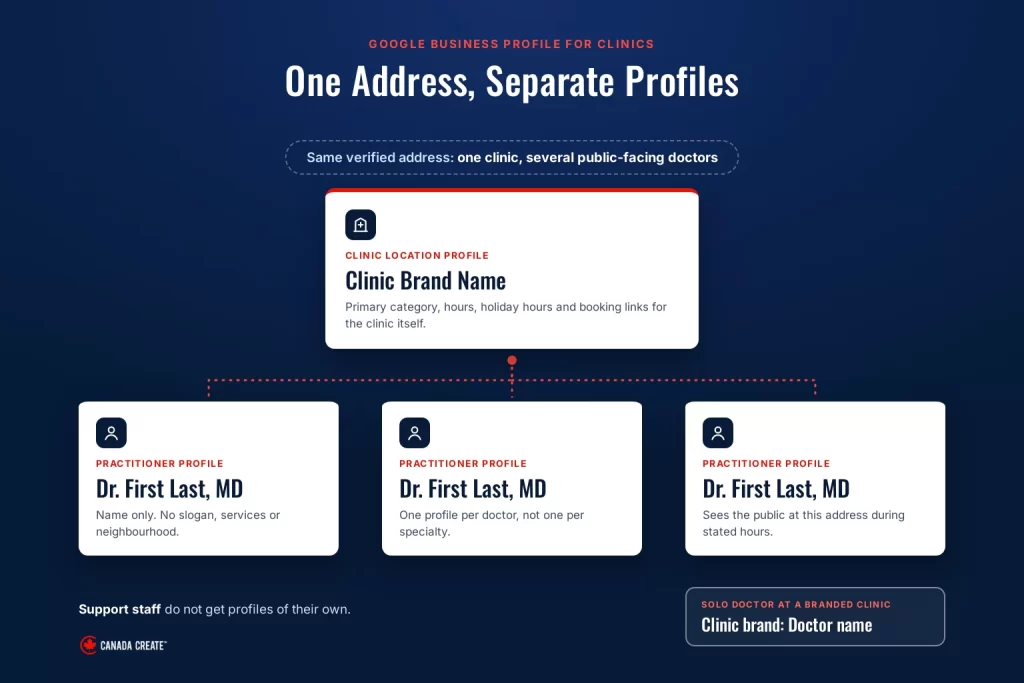
One profile for the clinic, one for each public-facing doctor
A doctor can have a Business Profile of their own when they see the public and can be reached at the clinic’s verified address during its stated hours. Support staff do not qualify. The clinic keeps its own location profile alongside the practitioner profiles, and each practitioner gets one profile rather than one per specialty. The details are in Google’s guidelines for representing your business.
How Google wants practitioner profiles named
A practitioner profile carries the practitioner’s name only. A title or degree such as Dr. or MD is allowed. Leave out the clinic’s slogan, service words and neighbourhood, because adding keywords or locations to a profile name can get it suspended. The neighbourhood belongs in the address, on the website, in the service area and in posts.
A doctor who is the only practitioner at a branded clinic shares one profile with the clinic, named “[Clinic brand]: [Doctor name]”.
When a doctor leaves
Google’s guidelines page does not cover what happens to a practitioner profile when a doctor leaves the clinic. Agree in writing who manages each practitioner profile and what happens to it if the doctor moves on.
Showing whether you accept new patients
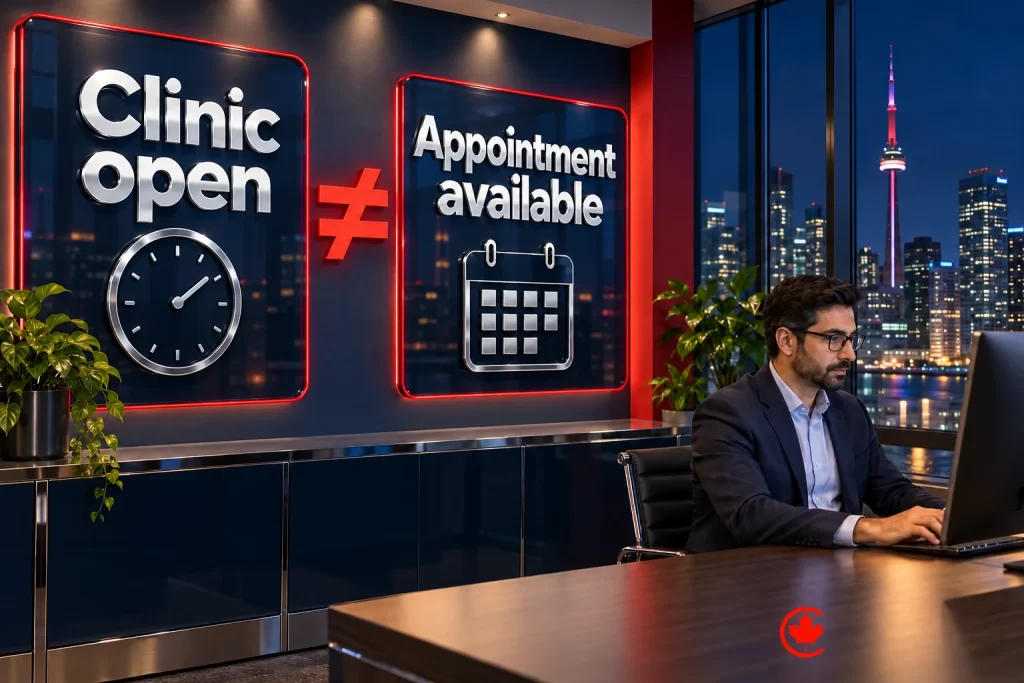
Being open is not the same as taking new patients, as Figure 4 at the end of this guide shows. Patients search for exactly this: “family doctor accepting new patients toronto” draws about 1,300 searches a month in Toronto.
Check the attribute list in your own profile. If there is no new-patient option, say plainly on your website whether you are accepting new patients, add it to the profile description if it is accurate, and update both whenever your intake changes.
Virtual care and booking links
A profile can carry a link to a services list, such as virtual care, and booking links for patients who want to book online, as Google’s help page on local business links explains. Make sure each link opens the right page for that service and location. Our guide to online booking for clinics covers how to set those links up.
Which college’s advertising rules apply
Each profession in a clinic follows its own college. A shared clinic profile or post that names a service has to fit the rules of the profession that provides it.
- Physicians: the CPSO Advertising policy requires accurate, factual advertising and rules out testimonials, comparisons with other health professionals and claims of a better or more effective service.
- Nurse practitioners: the College of Nurses of Ontario regulates them, so check CNO’s current standards before you advertise.
- Physiotherapists, chiropractors, RMTs, psychotherapists, naturopaths and pharmacists: each has its own college, so check each one before a shared clinic profile or post names that service.
Our guides to healthcare advertising rules in Canada and how allied health clinics get more patients go further. Confirm the details with your college.
Reviews: what CPSO advice warns physicians against
The CPSO’s Advice to the Profession on advertising says public review sites are not prohibited. It warns that these steps could breach the ban on testimonials:
- Directing patients to post reviews
- Linking to reviews in advertising, including review widgets on a physician’s website
- Posting reviews under other names
- Paying to have negative reviews removed
- Deleting only negative comments
Replying to a review without disclosing health information
Under Ontario’s Personal Health Information Protection Act, identifying someone’s health care provider is personal health information. A reply that confirms the reviewer is a patient is itself a disclosure, so never confirm it or mention any care.
A neutral reply works for any review: “Thank you for taking the time to share this. We would like to look into it. Please contact our clinic manager at [clinic phone or email] so we can follow up privately.”
Physicians who reply often to praise should keep the CPSO’s advice on managing comments in mind.
Checks for this week
- Clinic profile and each practitioner profile exist only where Google’s rules allow
- Profile names carry no keywords, slogans or neighbourhoods
- Hours, holiday hours and booking links match the website
- Intake status is current on the website, and in the profile where an option exists
- The right college’s rules are checked for every profession named in posts
- No review requests or review widgets on physician pages
- Review replies confirm nothing about care
If you want a second pair of eyes on your clinic’s profiles, book a free 20-minute consultation. Canada Create also offers Google Business Profile management for clinics that want help keeping clinic and practitioner profiles accurate.
Get Your Website to Rank for the Right Search Terms
Your GBP gets patients to call. Your medical practice website builds the trust that makes them follow through. For local SEO to work, both need to be optimized together, which is the core of our healthcare SEO in Toronto work.
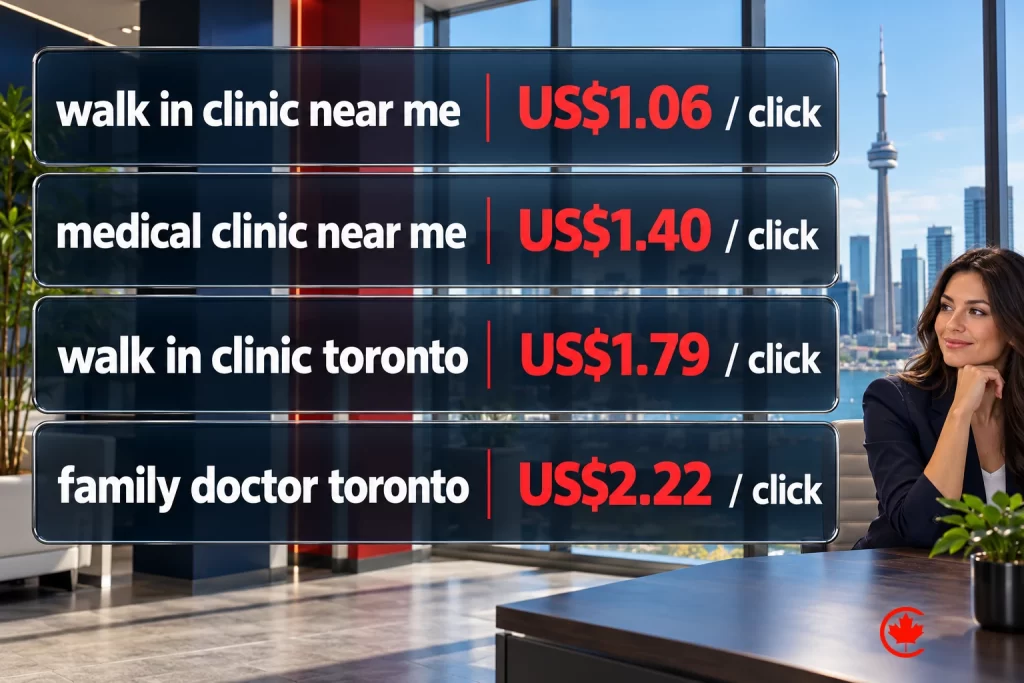
The keywords that drive new patient inquiries for Toronto clinics are highly specific. “Doctor” doesn’t convert. “Walk-in clinic open Sunday North York” does. Patients searching for care are looking for location, availability, and service type, all in the same query.
High-value keyword targets for Toronto medical clinics:
- “walk-in clinic [neighbourhood] Toronto”
- “family doctor accepting new patients [Toronto area]”
- “physiotherapy clinic near [landmark or neighbourhood]”
- “same-day appointment clinic Toronto”
- “urgent care [postal code or neighbourhood]”
Group searches by the service and patient need they represent, then build useful pages around those needs. A page about walk-in availability can answer several related searches without creating a separate page for every wording. Validate local demand and current competition before setting priorities.
We help clinics rank locally and turn searches into booked appointments.
On-page essentials for every service page:
- H1 that includes the service and location (e.g., “Walk-In Clinic in North York, Toronto”)
- First paragraph that directly answers what the page is about
- Your clinic’s full address and phone number on every page
- A Google Maps embed
- Clear booking CTA above the fold
Talk through your clinic’s local search with a specialist.
Canada Create helps Toronto healthcare and service businesses assess local search visibility and plan improvements around their services and capacity. Book a free consultation to discuss your Google Business Profile, your website and your next steps.
Build Neighbourhood-Level Pages
Toronto is not one market, it’s dozens of distinct neighbourhoods, each with its own search behaviour. Patients in Leslieville search differently than patients in Etobicoke. A patient in Scarborough looking for a physiotherapist is far more likely to search “physiotherapy Scarborough” than “physiotherapy Toronto.”
Creating dedicated pages for each neighbourhood you serve, not just your primary location, is a useful and often overlooked local SEO tactic for Toronto clinics. Each page should include references to local landmarks, TTC routes, and nearby streets to signal genuine local relevance to Google.
A clinic serving the Danforth area, for example, should have a page that mentions proximity to Broadview Station, the surrounding streets, and the communities it serves. This kind of local detail helps a clinic compete for searches in its own area instead of relying only on generic city-wide terms.
Online Reviews Are a Ranking Factor, And a Conversion Factor
Google says review count and positive ratings can help local ranking. Public feedback may also inform a patient’s decision, alongside location, availability, credentials and the care they need.
Before setting up review requests, identify the rules for the professionals involved. CPSO guidance warns Ontario physicians against directing patients to third-party review sites; independent patient posts are different. Where a profession permits requests, use a consistent, voluntary process with an appropriate contact permission basis, without incentives or selecting only happy patients.
What to focus on:
- Complete profile details help people assess whether your clinic fits their needs
- Reviews are one source of information alongside credentials, referrals and the clinic’s own service details
- Keep service information current and review feedback alongside the clinic’s actual enquiry data
Respond to feedback calmly without confirming that the reviewer is a patient or discussing their care. Give a general private contact route where appropriate, and follow the relevant professional guidance for public replies.

E-E-A-T: Why Google Holds Healthcare Clinics to a Higher Standard
E-E-A-T stands for Experience, Expertise, Authoritativeness, and Trustworthiness. For medical clinics, these standards carry extra weight because health information falls under Google’s Your Money or Your Life guidance.
This means your website content needs to demonstrate real clinical expertise, not just repeat generic health information available on every other site. Service pages should be written or reviewed by a qualified practitioner. Blog content should cite credible sources. Author bios for any health-related content should include credentials and professional background.
Practically, this translates to:
- Every service page attributed to or reviewed by a named, credentialed physician or practitioner
- An “About” section that clearly identifies your clinic’s healthcare providers, their qualifications, and their areas of practice
- FAQ sections on service pages that answer specific patient questions in plain language
- Content that directly addresses what patients in your area are searching for, not generic health articles copied from elsewhere
Make expertise visible through accurate credentials, clear sources and clinical review. These details help patients assess the information and give your team a sound basis for keeping it current.
Local Citations and Directory Consistency
A local citation is any online mention of your clinic’s name, address, and phone number. Google uses citation consistency as a trust signal, if your address is listed three different ways across different directories, it creates ambiguity that hurts your rankings.
For Toronto medical clinics, the listings to maintain usually include Google Business Profile, the College of Physicians and Surgeons of Ontario directory, RateMDs, Yellow Pages Canada, Yelp, and your local hospital or health network listings if applicable.
Keep the clinic’s actual name, address and phone number accurate across relevant listings. Prioritize wrong numbers, obsolete addresses, duplicate profiles and conflicting opening hours rather than treating equivalent abbreviations such as “St.” and “Street” as a proven ranking problem.
Optimize for How Patients Actually Search in 2026
Search behaviour has shifted. Patients in 2026 are asking more specific, conversational questions, both in text and by voice. Queries like “which walk-in clinic near me is open on Saturday evenings” or “can I get a same-day appointment at a family clinic in Scarborough” are increasingly common.
Google’s AI Overviews and AI Mode may include links to useful health information. Keep your pages crawlable, accurate and clear, and measure any resulting visits alongside other search traffic. Inclusion varies by query and is not something a clinic can purchase or guarantee.
To position your clinic for AI-powered search:
- Add FAQ sections to every service page that answer specific patient questions directly
- Use clear, factual language, no vague marketing copy
- Use appropriate MedicalClinic or Physician structured data and opening-hours properties that match the visible page
- Keep your GBP, website, and all directory listings consistent so AI systems can confidently surface your clinic as an authoritative local result
How Long Does It Take to See Results?
Local SEO takes ongoing work, and the pace of change depends on the starting point, competition and Google’s systems. A useful plan separates the work you can complete from the search and enquiry outcomes you monitor:
Start with profile accuracy, eligibility, booking links and material listing errors. Record the baseline before changes so you can compare profile activity and permitted captured calls or enquiries over time.
Next, improve the pages that explain your services, locations and intake requirements. Check whether Google can crawl and index the changes, and review which searches and pages bring relevant visitors.
Review progress over several months alongside seasonality, competition and clinic capacity. Adjust priorities using the available evidence, including tracking gaps, rather than assuming that every increase in search activity becomes a new patient.
Clinics that treat local SEO as ongoing work, rather than a one-time project, are better placed to keep their details accurate as things change.
For direct billing, payer streams and discipline specific guides, read our clinic marketing guide and the rules in healthcare advertising rules in Canada.
Frequently asked questions
How can a new Toronto medical clinic get found in local search?
Begin by completing the clinic's Business Profile on Google with correct details, then build service pages around what patients actually need. Toronto patients search by neighbourhood, availability and service type, so local relevance matters. An independent clinic that gets these basics right can compete with larger practices.
What do patients in Toronto check before contacting a clinic?
Many look at location, availability, services and public reviews first. Make those details easy to find and keep them current everywhere the clinic appears online. Then use your own enquiry data to learn which search journeys lead to appropriate bookings.
Should a Toronto clinic target searches about doctors accepting new patients?
Only while the clinic really is accepting new patients, and the page should say so plainly. Patients often combine location, availability and service type in one search, such as a family doctor accepting new patients in a named area. Group related wordings onto one useful page instead of creating a page for every phrasing.
How should a walk-in clinic set up its Google Business Profile?
Keep the clinic's name, street address and phone identical across the profile, the website and directories, and choose the right primary category, such as walk-in clinic. List each service with a clear description and keep hours current, including holidays. Add useful interior and exterior photos, with permission where people appear.
Can each doctor at a Toronto clinic have a Google Business Profile?
Yes, if the doctor sees the public and can be reached at the clinic's verified location during its stated hours. The clinic keeps its own location profile, and support staff do not get profiles.
How should a doctor's Business Profile be named?
With the practitioner's name only, optionally with a title such as Dr. or MD. A doctor who is the only practitioner at a branded clinic shares one profile named "Clinic brand: Doctor name".
Can a doctor have a separate profile for each specialty?
No. Google says a practitioner shouldn't have multiple Business Profiles to cover their specializations.
Is there an accepting new patients setting on Google in Canada?
Google's help pages do not document one for Canada, so check the attribute list in your own profile. If it is not there, state your intake status on your website and update it whenever it changes.
Can Ontario physicians ask patients to leave Google reviews?
CPSO advice says public review sites are not prohibited, but directing patients to post reviews, or linking to reviews in advertising, could breach the ban on testimonials. Reviews that patients post on their own are a different matter.
Do CPSO advertising rules apply to a nurse practitioner-led clinic?
The CPSO regulates physicians. Nurse practitioners follow the College of Nurses of Ontario, and other professions in a shared clinic follow their own colleges.
Do neighbourhood pages help a Toronto clinic rank locally?
They can, since patients in Scarborough tend to search for physiotherapy in Scarborough rather than across Toronto. Each page should mention real local details, such as nearby streets, landmarks and TTC routes. A clinic near the Danforth might reference Broadview Station and the communities it serves.
What should every clinic service page include for local search?
Use a main heading that names the service and location, such as walk-in clinic in North York, and answer what the page covers in the first paragraph. Show the clinic's full address and phone number and embed a map. Put a clear booking option near the top of the page.
Why does Google hold clinic websites to a higher standard?
Health information falls under Google's Your Money or Your Life guidance because it can affect someone's wellbeing. Service pages should be written or reviewed by a named, credentialed practitioner, and health articles should cite credible sources. An about section that identifies each provider's qualifications helps patients judge the information.
How should a medical clinic reply to a negative online review?
Keep the reply calm, and never confirm the person was treated at the clinic or mention any care details. Offer a general private contact route where it fits. Follow your professional college's guidance on public replies before posting anything.