
Toronto · Real estate photography
Real estate photography in Toronto
Bright, honest listing photos that show buyers the rooms as they really are, sized for MLS and listing sites and cropped for your social posts.
Real estate photography for Toronto and GTA listings, from North York to downtown: houses, condos, townhomes and rentals.
- BBB A+ accredited
- 18 years in business
- Mon to Fri 9 to 6, Sat 10 to 2
Book listing photos
Send the address, the property type and your target listing date. We reply within one business day.
Please do not share passwords or other sensitive details here. We never sell your contact information and we comply with Canadian privacy law
(privacy policy).
What a listing shoot gives you
Rooms that read true
Wide but honest interiors that show size and layout without stretching walls or hiding features.
Windows and rooms in balance
Bright interiors with the view outside still visible, instead of white blown out windows.
A set sized for the listing
Images in the count, order and dimensions the listing system and your feature sheet need.
Clear licence terms
A written licence to the brokerage that says where and how long the photos can be used.
What real estate photography includes
Each listing is scoped in a written proposal after a free consultation. These are the usual parts.
- Seller prep guideA plain list for the seller on decluttering, lights, personal items and what to do before the photographer arrives.
- Interior coverageEvery main room, kitchen, baths and finished basement photographed at natural eye height with straight verticals.
- Exposure blendingSeveral exposures combined so interiors are bright and the windows still show the yard or the skyline.
- Exterior and lotFront elevation, backyard, deck, garage and street view taken in the light that suits the house.
- Twilight exteriorsDusk photos with interior lights on, for homes where the evening view sells the feeling.
- Condo amenitiesLobby, gym, pool, party room and terrace photographed with the building's permission.
- Drone aerials where allowedAerial views of the lot and neighbourhood when the location and airspace rules permit.
- Listing and social formatsFull resolution files, MLS sized images and vertical crops for Reels, Stories and posts.
How listing photography is quoted
Fees are quoted in writing after a free consultation. Board and listing site fees, staging and cleaning are paid separately.
Condo or apartment set
Quoted in writing after a free consultation
Units, lofts and small rentals
- Interior coverage
- Balcony and view
- Building amenities where allowed
- MLS sized images
House listing set
Quoted in writing after a free consultation
Detached, semi and townhome listings
- Seller prep guide
- All main rooms
- Exterior and backyard
- Vertical social crops
Twilight and aerial add on
Quoted in writing after a free consultation
Homes where dusk and the lot matter
- Twilight exterior
- Interior lights staged
- Drone aerials where allowed
- Neighbourhood context
Brokerage or builder program
Quoted in writing after a free consultation
Teams and builders with steady listings
- Consistent style across listings
- Booking through one contact
- Brokerage licence terms
- Shared delivery folders
Ad spend and software licences are paid to the platform directly and shown separately from our fees.
Listing photography guide
How to photograph a home so buyers see it accurately
Show buyers the home as it really is, in photos that make them want to book a visit. Real estate photography in Toronto is the set of listing photos that presents a home before anyone visits: the rooms, the layout, the natural light, the exterior and, for condos, the view and the building. Canada Create has worked from its Toronto office at 126 Willowdale Ave., Suite #3, since 2008, and is a BBB Accredited Business with an A+ rating. We photograph houses, condos, townhomes and rentals for realtors, brokerages, builders’ sales teams, property managers and private sellers, bright but accurate.
A listing shoot covers six areas of work, and your proposal names the ones the listing needs:
- Interiors: wide, straight and true-to-size room photos.
- Window and light balance: bright windows and well-lit rooms in the same frame.
- Exteriors and twilight: front, back and evening exteriors where the home suits them.
- Drone aerials: lot and neighbourhood views where the airspace allows.
- Condo amenities: lobbies, gyms, views and shared spaces.
- MLS-ready sets: image order, sizes for listing sites and social crops.
This page is for agents, brokerages and sellers hiring a photographer for a listing.
- Booking real estate photography: what agents compare
- Wide, bright and honest rooms
- Bright windows and interiors together
- Preparing the home for the photographer
- Condos, townhomes and rentals
- Twilight exteriors and the seasons
- Drone aerials where they are allowed
- MLS sets, image order and social crops
- How listing photos connect to the rest
- Accuracy, privacy, copyright and drone rules
- How we work on a listing
- What real estate photography costs in Toronto
- How to compare real estate photographers in Toronto
- Book your listing photos
Booking real estate photography: what agents compare
Agents searching for a real estate photographer in Toronto or for listing photos, condo photography or twilight photos usually have a listing date already set. They compare a few portfolios, check whether the photographer can come before the listing goes live, and ask what the set includes.
The portfolio test
The question to ask of any portfolio is whether you could walk into the room and recognize it. Look for straight walls and door frames, windows that show the outside, true colours on floors and cabinets, and rooms that look their real size. A portfolio full of stretched living rooms and glowing grey skies may look striking but invites disappointment at the showing.
What is included
Listing sets differ widely. Some include exterior photos only in daylight, some add twilight; some include condo amenities, others do not. Agents also want to know how many images arrive, in what sizes and whether vertical crops for social posts are part of the set.
Booking and delivery
Booking windows, access arrangements with the seller or a lockbox, and when the photos arrive all matter to a listing calendar. Delivery timing is agreed in writing before the shoot, so the agent can plan the listing date around it. Photographers who want a client system for repeat agent bookings can see real estate photography CRM in Toronto.
Wide, bright and honest rooms
The aim of listing photography is a fair first look. Buyers who feel misled by photos often lose interest the moment they step inside, so accuracy serves the sale.
Lens choices
A wide angle is needed to show a small bathroom or a condo bedroom at all, but there is a point where wide becomes misleading. Rooms are photographed with a wide but honest angle that shows the space and the flow into the next room without bending furniture at the edges or turning a narrow kitchen into a hall.
Height and straight lines
Cameras are set at a natural height, roughly where a buyer’s eyes would be when standing or seated, and kept level so walls and door frames stay vertical. Tilted lines make a room feel off even when a viewer cannot say why.
True colour
Mixed light from windows, pot lights and lamps can turn white walls yellow or blue. Colour is corrected so hardwood, tile, countertops and paint look as they do in person. A buyer choosing between two similar units should be able to trust that the grey cabinets are really grey.
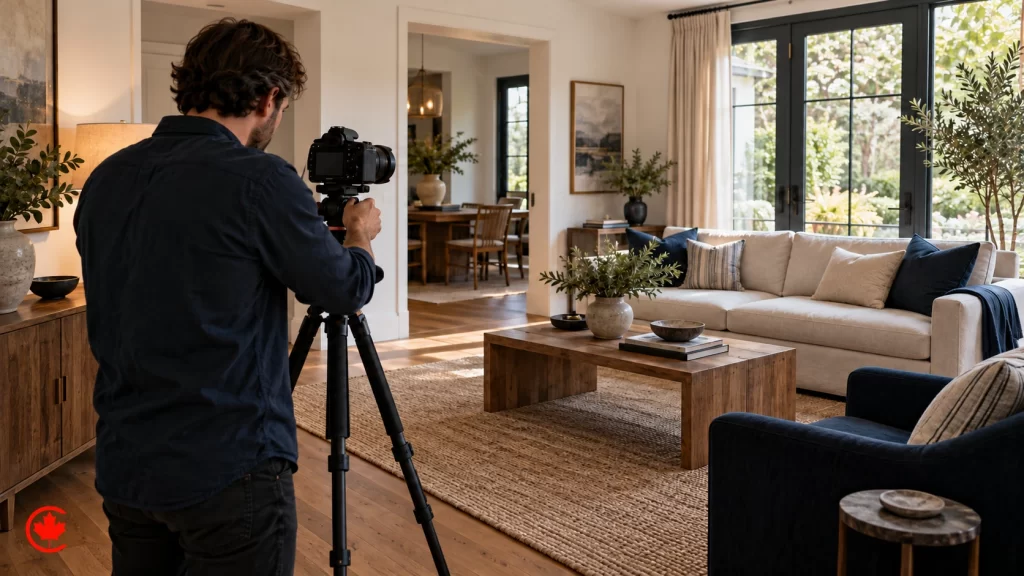
Bright windows and interiors together
A camera cannot see a sunny window and a dim room at the same time the way an eye can. Without care, either the room is dark or the window turns into a white rectangle that hides the yard, the ravine or the city view.
Exposure blending in plain words
The photographer takes several frames of the same view at different brightness levels, then combines them so the interior is bright and the window still shows what is outside. This is often called HDR style blending. Done well, it looks natural; done badly, it looks flat and grey with halos around windows, which is why the edit is kept restrained.
Flash where it helps
In some rooms, a little added light gives cleaner colour than blending alone, especially in dark kitchens or basements. The choice is made room by room, with the goal that the photo looks like a bright day in that room.
Views that sell
For condos with a skyline or lake view, and houses backing onto green space, the view out the window is part of the listing. Blending lets the photo show both the living room and the view in one frame, with a separate photo of the view from the balcony when it deserves its own place in the set.
Preparing the home for the photographer
The most important work on a listing shoot often happens before the camera arrives. A short seller prep guide, sent through the listing agent, prevents the common problems that editing cannot fix.
Room by room
- Kitchen: clear counters except one or two items, hide dish soap, sponges and the dish rack, empty the sink.
- Bathrooms: close toilet lids, remove toiletries, hang fresh towels, take bath mats off the floor.
- Bedrooms: make beds neatly, clear nightstands, close closet doors.
- Living areas: tidy cords, clear coffee tables of magazines and clutter, straighten cushions, open blinds evenly.
Personal items away
Family photos, children’s art, mail with names, medication, religious or political items and valuables are put away. This keeps the focus on the home and protects the household’s privacy.
Lights and exterior
Every light is turned on and dead bulbs replaced, ideally with bulbs of the same colour. Outside, cars leave the driveway, garbage bins go out of sight, hoses are coiled and in winter walks and steps are cleared. Pets should ideally be out of the home for the shoot.

Condos, townhomes and rentals
Different property types need different coverage. A Toronto condo listing is often as much about the building and the location as about the unit itself.
Condo units and buildings
Unit photos focus on the open living area, kitchen finishes, bedrooms, the balcony and the view. Building coverage can include the lobby, concierge desk, gym, pool, party room, guest suites and rooftop terrace. Condo corporations and property managers usually control access to those spaces and may set times, so the listing agent arranges permission before the shoot.
Neighbourhood shots
Short walks from the building to a park, a transit stop or a busy main street can be photographed to show what living there is like. These images are taken in public spaces with care to keep strangers and their faces out of focus or out of frame.
Townhomes and stacked units
Townhomes need careful exterior framing so the photo shows the unit for sale, not the whole row, and the private yard or rooftop terrace gets its own photos.
Rentals
Property managers and landlords photographing a rental between tenants want clean, empty rooms shown accurately, with laundry, storage and parking included, so the right applicants respond.
Twilight exteriors and the seasons
Timing the exterior photos is as important as framing them. The same house can look flat at noon and welcoming at dusk.
Twilight photos
Twilight exteriors are taken around dusk, when the sky turns deep blue and the interior lights glow through the windows. They suit homes with strong curb appeal, garden lighting, a pool, a large backyard or a striking modern facade. Twilight is usually a separate visit or a later start, because the window for the right light is short.
Orientation and sun
A house facing north may never get direct sun on its front in winter, while a west facing backyard looks its strongest late in the day. Front and back exteriors may be photographed at different times for that reason.
Toronto seasons
Snow, bare trees and early sunsets shape winter listings across the GTA. Snow cleared from walks and the driveway, lights on and a clean front step help. Sellers listing in late winter sometimes have summer photos of the garden from an earlier year; those should only be used if they still show the property accurately and are identified as taken in another season.
Drone aerials where they are allowed
Aerial photos help when the lot is the story: a large yard, a ravine lot, a waterfront property or a home close to a park or the lake. They also give a sense of the street and the neighbourhood that ground photos cannot.
Location comes first
Whether a drone can fly depends on the address. Parts of Toronto and the GTA sit near airports and in controlled airspace, and dense streets with neighbours close by add their own limits. Each request is checked against the location before it is promised.
Rules in general terms
Canadian rules require registration with Transport Canada for drones from 250 g upward, a pilot certified for the kind of flight planned, and added care near people, close to airports and inside controlled airspace. Neighbours’ privacy also matters, so aerials focus on the property for sale.
Full virtual tours, 3D walkthroughs and aerial video are covered on our page for virtual tours, 3D rendering and drone footage, and can be booked at the same visit as the photos.
MLS sets, image order and social crops
A listing photo set is a sequence, not a pile of files. The order tells the story of walking through the home.
Sized for the listing system
MLS systems and listing sites set their own rules on how many photos a listing can carry, file sizes and orientation. The set is delivered in the count and dimensions the agent’s board and listing sites accept, plus full resolution files for print feature sheets and brochures.
Order that makes sense
Most sets lead with the strongest exterior or the main living space, then follow the path a buyer takes: entry, living and dining, kitchen, family room, bedrooms, baths, lower level, yard. Files are numbered in that order so they upload correctly.
Vertical crops for social
Agents promoting listings on Instagram, Facebook and TikTok need vertical images. A selection of the strongest rooms is cropped for Stories, Reels covers and posts, so the agent does not have to crop wide photos on a phone and lose the strongest part of the room. Photographers who want to win more agent bookings can see real estate photography advertising in Toronto.
Delivery
Images arrive in a shared folder with clear file names that include the address, ready for the agent, the brokerage’s marketing team and any print vendor.

How listing photos connect to the rest
Listing photos are one part of how a property is presented. They work hardest when the other pieces use the same images and the same accurate picture of the home.
- Empty rooms can be furnished digitally through virtual staging for listings, with the staged images clearly disclosed.
- Pre-construction projects without a finished building can use architectural rendering until the real rooms exist.
- Walkthrough clips and feature films are part of our video production services in Toronto.
- Agents building their own brand can plan posts with social media for realtors, and the wider plan sits under marketing for real estate agents.
- Paid promotion of a listing or an agent is covered by Google Ads for real estate.
Brand, product and team portraits for a brokerage office sit under commercial photography services. Conferences, galas and brokerage events are covered by a separate service, Event photography, described on its own page.
Accuracy, privacy, copyright and drone rules
Listing photos are advertising for a regulated profession, taken inside someone’s home. A few rules shape how they are made and used. This is a marketing observation, not legal advice.
Accuracy under TRESA and RECO rules
In Ontario, TRESA and RECO advertising rules apply to registered brokerages and salespersons. Ads must identify the brokerage clearly and must not mislead. For photos, that means the property is represented accurately: permanent features and defects are not removed, and virtually staged or digitally altered images are disclosed. Other provinces have their own regulators and rules.
Seller authorization and privacy
The seller authorizes the photography and the use of the images. Personal items and identifying details stay out of the frame: family photos, names, mail, medication, security system panels and cameras, and licence plates in the driveway. People, especially children, are not photographed. Photos of identifiable people used in marketing need consent.
Copyright and the licence
The photographer owns the copyright unless it is assigned in writing. The brokerage receives a licence for the agreed uses, such as the listing, listing sites, feature sheets and the agent’s social posts. Reuse by a later agent, the seller or a builder is agreed separately in writing.
Drones
Aerial photos follow the federal drone rules set out in the aerials section above, including registration and pilot certification.
How we work on a listing
Each listing follows the same written steps, so agents and sellers know what to expect.
- Free consultation. The property type, its size, the listing plan, access and any features that need special attention, like a view or a pool.
- Written proposal. The coverage, any twilight, aerial or amenity add ons, the licence to the brokerage and fees quoted in writing. Brokerages and builders with steady listings can agree one proposal for the program.
- Seller prep. The prep guide goes to the seller through the agent before the shoot date.
- The shoot. Interiors, exteriors and any add ons are photographed, with a final walk through to check nothing was missed.
- Edited set. Images are blended, colour corrected and ordered, then delivered in MLS sizes, full resolution and social crops on the timing agreed in writing.
What real estate photography costs in Toronto and what changes the quote
Real estate photography is quoted in writing after a free consultation. Board fees, listing site fees, staging, cleaning and any printing are paid separately.
What moves the quote
- Property type and size: a one bedroom condo, a detached house with a finished basement or an estate with grounds.
- Number of levels and rooms, and outbuildings like a garage, a coach house or a cottage on the lot.
- Twilight exteriors, which usually need a separate visit or a late start.
- Drone aerials, where the location allows them.
- Condo amenity and neighbourhood coverage.
- Travel across the GTA or to a cottage property outside the city.
- Video, virtual tours or virtual staging booked with the photos.
- A single listing or a steady program for a brokerage, team or builder.
Matching coverage to the listing
A basement rental needs clean, accurate rooms and nothing more. A home with a ravine lot and a pool may justify twilight and aerials. The proposal matches the coverage to what the listing needs to show.
How to compare real estate photographers in Toronto
Before an agent or a brokerage books a photographer for listings, these questions are worth asking.
- Can we see a full listing set, not only the three strongest photos?
- How do you keep rooms looking their true size and walls straight?
- How do you handle bright windows and dark rooms in the same photo?
- What do you remove in editing, and what do you leave because it is a permanent feature?
- Do you check airspace for each address before promising drone photos?
- What does the licence allow, and can a builder or the seller reuse the photos?
- Who owns the accounts? The answer should be you: the delivery folder, any listing portal logins and the social accounts the photos are posted to stay in the brokerage’s or agent’s name, and the licence is written down.
- Who will shoot the listing, and can we read your Google reviews?
Canada Create answers each of these in writing in the proposal.
Book your listing photos
Request a custom proposal for listing photography. Send the address, the property type and the date you plan to list, and we will suggest the coverage, any add ons that would help and how the seller should prepare, then follow with a written proposal. Call (416) 273-9030, Monday to Friday, 9 am to 6 pm, and Saturday, 10 am to 2 pm. After hours, our 24/7 AI agent answers the toll-free line, +1 (800) 808-9235, and we’ll follow up the next business morning. You can also reach us through our contact page. We reply within one business day. Our office is at 126 Willowdale Avenue, Suite 3, Toronto.
Talk to a strategist
Ready when you are?
Request a custom proposal
Tell us your goals, budget and timeline. You get a custom proposal and a named strategist, so your next stage of growth starts now.
Steps in a real estate photography shoot
Every step is written down so the agent, the seller and the photographer know what happens and when.
- Free consultation First call
The property, the listing plan, access and what the photos must show.
- Written proposal Written proposal
Coverage, add ons, licence terms and fees quoted in writing.
- Seller prep and shoot Shoot booking
The prep guide goes to the seller, then the home is photographed on the booked date.
- Edited set Delivery
Edited images, MLS sizes and social crops delivered on the timing agreed in writing.
Why realtors choose Canada Create for listing photos
Since 2008
More than 18 years of websites, search and advertising work for businesses across Canada.
BBB Accredited A+
A BBB Accredited Business with an A+ rating and zero complaints.
Toronto office
126 Willowdale Avenue, Suite 3, Toronto, serving businesses across Canada.
English and French
Our team works in English and French.
Real estate photography Toronto: questions buyers ask
What does real estate photography cover for a listing?
Real estate photography is the set of listing photos that lets buyers or tenants see a home before they visit. It covers the main rooms, kitchen, baths and finished basement, the exterior and lot, and for condos the view and the building amenities. Canada Create photographs houses, condos, townhomes and rentals for realtors, brokerages, builders and private sellers.
How much does real estate photography cost in Toronto?
The price depends on the property type and size, how many rooms and images the set needs, and whether twilight exteriors, drone aerials or condo amenities are added. A brokerage or builder booking steady listings can be quoted as a program. Board and listing site fees, staging and cleaning are paid separately. Once we have discussed the listing in a free consultation, the fee for it comes to you in writing.
Why use professional photography for real estate instead of phone photos?
A phone struggles with a sunny window and a dim room in the same frame, so you get white windows or dark interiors. Listing photographers combine several exposures so the room is bright and the yard or skyline still shows outside. They also keep walls and door frames vertical and correct mixed light, so floors, cabinets and paint look the colour they are in person.
Can drone aerials be added to a real estate photo shoot?
Yes, aerial views of the lot and the neighbourhood can be added when the location and airspace rules permit. Canada regulates drone flights through Transport Canada, and some areas near airports or in dense parts of the city are restricted. Whether a flight is possible is checked for the address before it goes into the proposal.
How many photos come in a real estate photography set?
The count depends on the home: a one bedroom condo needs fewer frames than a detached house with a backyard and a finished basement. Images are delivered in the order and dimensions the listing system and your feature sheet need, along with full resolution files and vertical crops for social posts. The number of images is agreed in writing before the shoot.
How should a seller get the home ready for listing photos?
Sellers receive a plain prep list before the shoot. It covers decluttering counters and floors, turning on every light, putting away personal items such as family photos and mail, and anything else to finish before the photographer arrives. A tidy, well lit home photographs closer to how it feels in person.
What real estate photography packages are there for condos and houses?
A condo or apartment set covers the interior, the balcony and view, and building amenities where the building allows it. A house set covers all main rooms, the exterior and backyard, plus vertical crops for social media. Twilight exteriors and drone aerials can be added for homes where dusk or the lot matters, and brokerages or builders with steady listings can book a program with one contact.
How do I pick a real estate photographer in Toronto?
Look at a portfolio and ask whether you could walk into each room and recognize it: straight walls, windows that show the outside, true colours and rooms at their real size. Then confirm booking windows, access arrangements and delivery timing in writing, plus a written licence to the brokerage for the photos. Check live Google reviews and a published office address too.


Buyers meet the home on a screen first
Before anyone books a showing, they scroll the photos. Accurate, bright images give the home a fair first look. Request a custom proposal for listing photography.