
Multi location marketing strategy: how franchises and chains win in every local market

Running marketing for one location is hard enough. Running it for ten, fifty or two hundred locations, each with its own neighbourhood, staff and competitors, is a different discipline. Customers search locally, so every location needs to win its own market, but they also expect the same brand experience everywhere. This guide sets out a multi location marketing strategy for franchise systems, regional chains and owner run groups in Canada: how to structure it, what to centralize, what to localize and how to measure it.
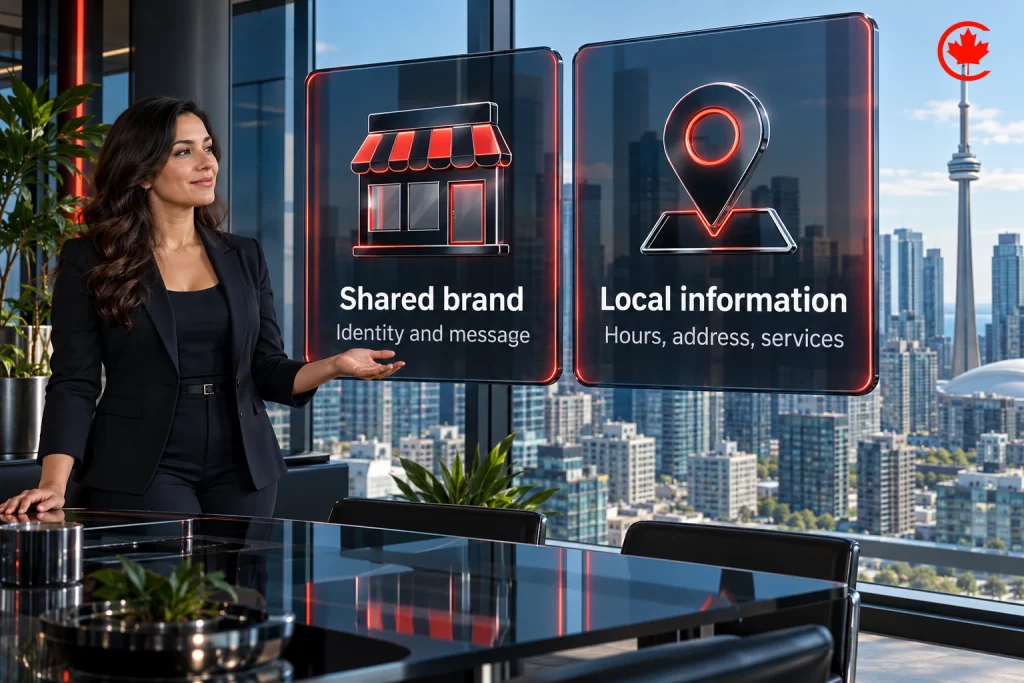
Decide what head office owns and what locations own
Most multi location marketing problems come from unclear roles. Before choosing tactics, agree on who does what:
| Area | Usually central | Usually local |
|---|---|---|
| Brand, logo, messaging | Yes | Follows guidelines |
| Website and location pages | Platform and templates | Local details and stories |
| Google Business Profiles | Ownership and standards | Photos, posts, review replies within rules |
| Paid search and social | Brand and national campaigns | Local offers within territory |
| Social media | Brand channels and calendar | Local pages or contributions |
| Community marketing | Guidelines and toolkit | Events, sponsorships, partnerships |
We plan and run franchise marketing for stores and retailers in Toronto and across Canada, scoped in writing after a free review.
Write the rules down, share them with every location and review them yearly. In franchise systems, the franchise agreement and operations manual often define parts of this already.
Build the local search foundation
Local search is where most multi location brands win or lose customers. Three pieces matter most.
One accurate Google Business Profile per location
Each eligible customer-facing location should have its own profile with the real business name (no added keywords), the right categories, accurate hours including holidays, services, photos and a phone number that reaches that location. Manage profiles centrally so information stays consistent and no one loses access when staff change. Close or update profiles promptly when locations move or close.
Useful location pages
Each location should have its own page on your website with address, map, hours, phone, services available at that location, local staff, parking and transit, and something genuinely local: neighbourhood information, community involvement, local reviews. Pages that only swap the city name rarely rank and do little for customers. Our franchise marketing service builds location pages at scale.
Consistent listings
Make sure name, address and phone match across maps services, directories and social profiles. Inconsistent listings confuse customers and weaken local visibility.
Manage reviews across the system
Reviews influence both rankings and decisions. A consistent review program helps every location:
- Invite customers consistently to share honest feedback using a direct link to that location’s profile.
- Never offer incentives or post fake reviews; the Competition Bureau treats fake reviews as deceptive marketing and platforms remove them.
- Reply to every review within a set time, using approved templates as a starting point and personalizing each reply.
- Escalate serious complaints to head office or the owner quickly.
- Share review themes across locations so everyone learns from them.
Structure paid campaigns by territory
Paid search and social ads can either power every location or waste money as locations compete with each other. A sound structure:
- Brand keyword campaigns run centrally, with location assets so searchers see the nearest location.
- Generic local campaigns (for example “oil change near me” or “tutoring”) run by territory, with targeting that matches each location’s area and no overlap.
- Local offers created from approved templates, with clear terms and participating locations named.
- Budgets split transparently between the central fund and local contributions.
- Tracking that sends calls and leads to the right location and records results.
See our Google Ads and social media ads services.
Run social media at two levels
Social media works best when brand and local efforts support each other. The brand channel sets the tone with national campaigns, product news and brand stories. Locations add local life: staff, events, community partners and local promotions. Options include one brand account with location content, separate local accounts managed within guidelines, or a mix. Whatever you choose, provide a content calendar, templates and an approval process, and make sure every photo of a customer or staff member has consent. Our social media management service supports both levels.
Keep promotions clear and fair
Multi location promotions often cause confusion. A customer sees a national offer and finds their local location does not honour it. To avoid that:
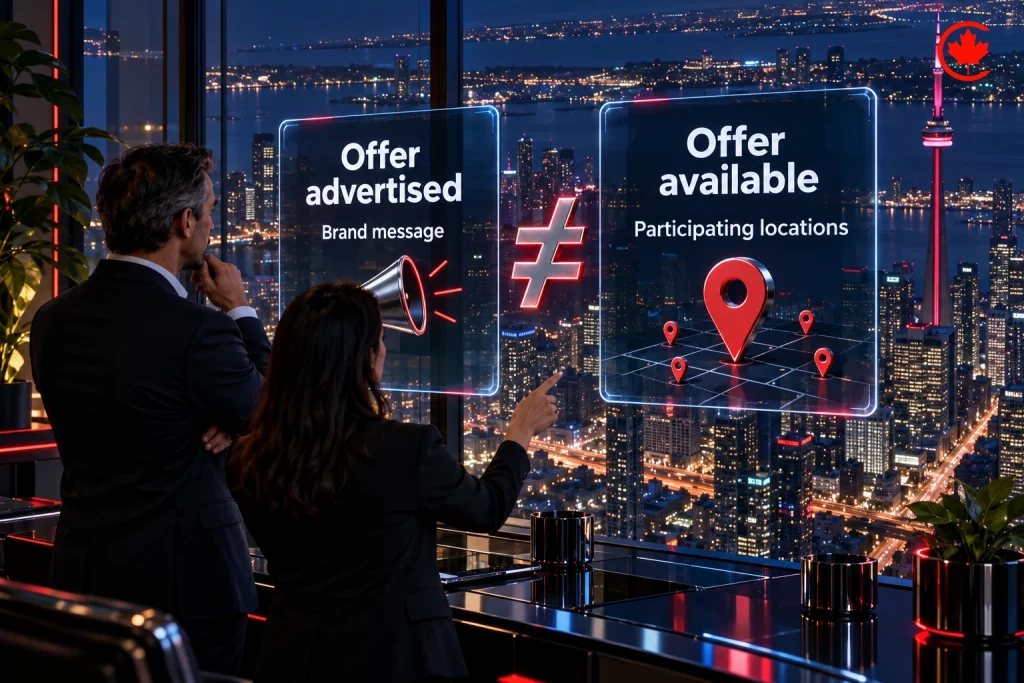
- State which locations participate and the dates the offer runs.
- Include fixed mandatory fees in advertised prices; explain government-imposed purchaser taxes and variable costs clearly.
- Say where prices apply when they differ by region.
- Give locations enough notice and materials to deliver the offer.
Respect language and provincial rules
If you have locations in Quebec, the Charter of the French Language sets French requirements for commercial communications, signage and websites aimed at Quebec customers. Commercial emails and texts in every province must follow CASL: consent, sender identification and an unsubscribe. Industry specific rules (for example health, alcohol or financial services advertising) apply at every location, so build them into templates centrally.
Support community marketing locally
Local owners and managers are often the best community marketers: sponsoring a youth team, joining a business association, hosting events, partnering with nearby businesses. Head office can multiply that effort with a community marketing toolkit, brand approved materials and a way to share success stories across the system.
Recruiting franchisees and new locations
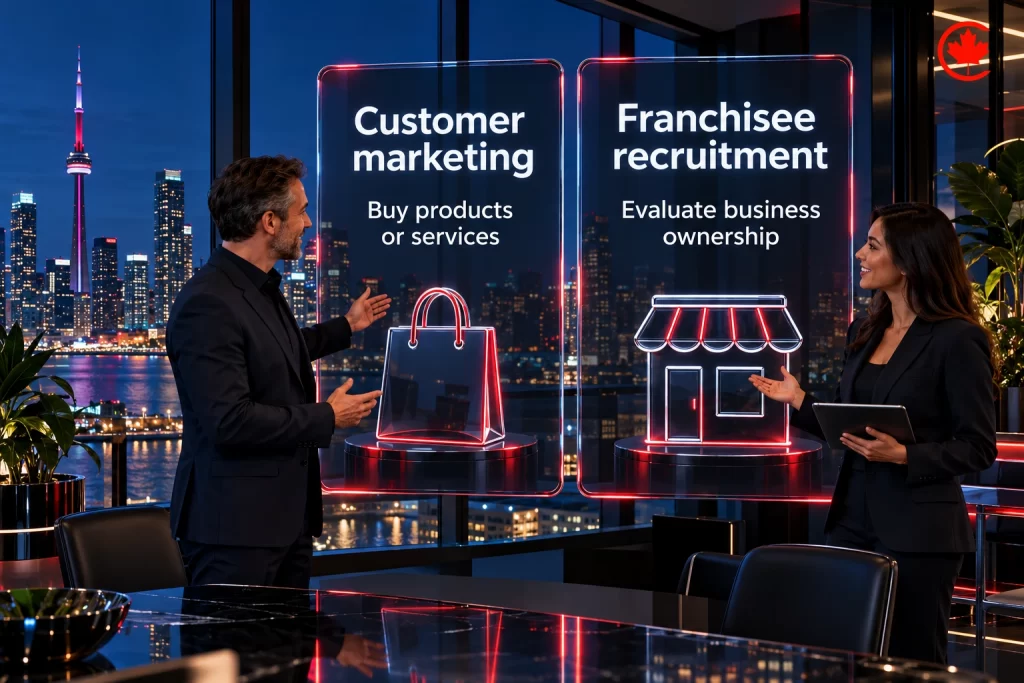
Growth brands also market to future franchisees or location partners. Keep that marketing separate from customer marketing, with its own pages, campaigns and CRM pipeline. Franchise disclosure laws apply in Ontario, Alberta, British Columbia, Manitoba, New Brunswick, Prince Edward Island and Saskatchewan; a disclosure document must reach prospects before they sign or pay, and recruitment marketing must never mislead about earnings, costs or support. Have your franchise lawyer review every claim.
Report in a way every location trusts
Locations, especially franchisees who contribute to a marketing fund, want to know what marketing does for them. Build reporting at two levels:
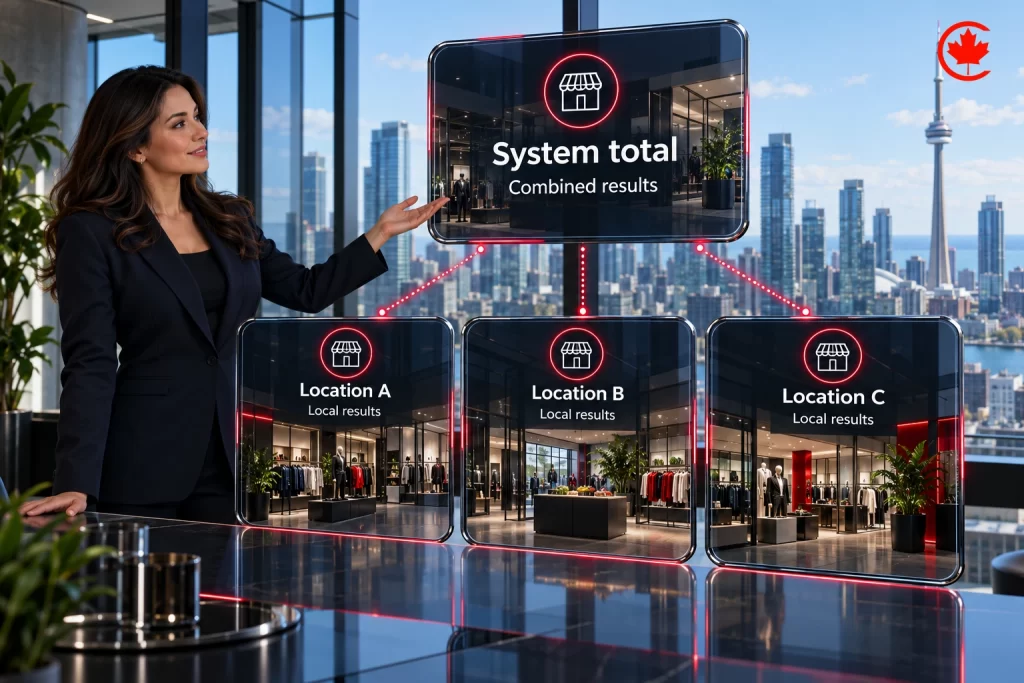
- System level: total visibility, leads, sales or bookings, cost per result and trends by region.
- Location level: profile views, calls, direction requests, website visits, leads, reviews and campaign results for each location.
Share reports monthly and meet with locations that are struggling to find the cause: profile issues, poor reviews, slow lead follow up or local competition. A CRM that routes leads to locations and tracks outcomes makes this possible. Our CRM service supports multi location lead routing.
Common mistakes to avoid
- Duplicate or unmanaged Google Business Profiles created by former staff.
- Location pages that are copies with the city name changed.
- Locations bidding against each other on the brand name.
- National offers that local locations cannot honour.
- No process for responding to reviews.
- Reporting only at system level, so locations feel invisible.
Open new locations with a launch plan
New locations need customers from day one. A repeatable launch plan saves every new opening from starting from scratch:
- Eight to twelve weeks before: create an eligible Google Business Profile and set its future opening date, publish a location page with a coming soon message and an email signup with consent.
- Four to eight weeks before: start local social campaigns, contact neighbouring businesses and community groups and plan an opening event.
- Opening week: launch local search and social ads within the territory, host the event and ask early customers for reviews.
- First 90 days: review local results weekly, fix profile and page issues quickly and share learnings with the next opening.
Use data to guide local decisions
With many locations, you can compare and learn faster than a single store business. Look for patterns: which locations have the most reviews, the fastest lead follow up, the best conversion from calls to bookings or sales? What do top performers do differently? Use that insight to coach weaker locations and refine templates. Be careful with averages; a downtown location and a suburban one may need different tactics even under the same brand.
Keep the brand consistent without slowing teams
Brand consistency builds recognition, but rigid control can frustrate local teams and slow responses. Find the balance with a few firm rules (logo use, colours, tone, legal and pricing rules) and flexibility elsewhere (local photos, community stories, event promotion). Provide ready to use templates in tools locations already use. Make approval fast for routine content and reserve detailed review for advertising, promotions and anything with legal implications.
Train local teams
Most local marketing is done by busy managers and owners. Short, practical training helps: how to reply to reviews, how to take good photos, how to post on the profile, how to follow up leads, how to run a community event. Record short videos, keep a simple handbook and hold a quarterly call to share wins. Recognize locations that do it well; peer examples motivate more than instructions.
Plan budgets across the system
Multi location budgets usually combine a central fund with local spend. Decide what the central fund pays for (brand campaigns, website, profile management, creative and reporting) and what locations pay for (local ads, events, sponsorships). Allocate local paid budgets by opportunity, not only equally: a new location or one in a competitive area may need more support for a period. Report spend and results transparently so everyone understands where money goes.
Handle lead routing and follow up
Leads lost between head office and locations are one of the most expensive problems in multi location marketing. A customer fills in a form on the main website, it lands in a shared inbox, and no one calls back for two days. Set up routing so every form, call and booking goes straight to the right location based on postal code or selected location, with a copy to head office for tracking. Set response time standards, send automatic confirmations to customers and review missed or late follow ups with locations every month.
Choose the right technology stack for your size
Systems with a handful of locations can manage profiles, pages and reporting with simple processes. Larger systems usually need dedicated tools for listing management, review monitoring, social scheduling across many accounts, call tracking by location and a CRM that supports territories. Whatever you choose, make sure head office owns the accounts and data, access is removed promptly when staff or franchisees change, and the system fits how your locations actually work day to day.
Get franchisee and manager buy in
A multi location strategy only works if local teams follow it. Involve franchisees and managers early: ask what they need, explain why rules exist, show the results of central programs and celebrate locations that do well. Create a small advisory group of franchisees or managers to review new campaigns and tools before rollout. When local teams feel heard and see results, they adopt central programs willingly instead of working around them.
Make it easy to ask for help as well. A clear contact at head office for marketing questions, a shared library of approved materials and a simple way to request local campaigns prevent locations from improvising.
Protect the brand when locations change
Locations open, move, change owners and sometimes close. Each change can leave behind duplicate profiles, wrong phone numbers, orphaned social pages and ads still running for a site that no longer exists. Create a simple checklist for every change: update or close the Google profile, redirect or update the location page, transfer or archive social accounts, pause local campaigns and update listings. Assign one person at head office to own the checklist so nothing is missed.
When a location changes owners, transfer access to profiles and accounts in a controlled way, keep the review history with the location where the platform allows it and brief the new owner on the brand’s local marketing standards from the first week.
A 90 day plan
Days 1 to 30: agree on central and local roles, audit every Google Business Profile and listing, and set up lead routing and tracking by location.
Days 31 to 60: fix profiles, rebuild location pages with local content, launch a system wide review program and publish a brand toolkit.
Days 61 to 90: restructure paid campaigns by territory, start monthly location reports and review results with each location. For broader search visibility, see our local SEO service.
Frequently asked questions
What is a multi location marketing strategy for franchises and chains?
It is a plan that lets every location win its own local market while customers get the same brand experience everywhere. It sets what head office centralizes, such as brand, website platform and national campaigns, and what each location localizes, such as photos, review replies and community events. It also covers how results are measured for each location.
How do head office and franchisees in Canada usually split marketing work?
Head office usually owns the brand, the website platform and templates, Google Business Profile standards and national ad campaigns. Locations supply local details and stories, photos, posts, review replies within the rules, and local offers inside their territory. In a franchise system the franchise agreement and operations manual often define parts of this, so write the rules down and review them yearly.
What makes marketing succeed across every location of a franchise?
Clear roles come first, because most multi location problems start when nobody knows who does what. After that, each location needs an accurate Google Business Profile, a useful location page and consistent listings. Steady review invitations, territory-based ad campaigns and reporting that every location trusts keep the system working together.
What should a chain look for in a platform that manages many locations?
Pick a setup that lets head office own and control every Google Business Profile, so access is not lost when staff change. It should handle review replies, location pages, lead routing to the right location, and reporting by location. Size matters too: a regional group rarely needs the same stack as a national system with hundreds of sites.
What is the most effective marketing tool for a brand with many locations?
For most multi location brands it is local search, starting with one accurate Google Business Profile per eligible location. Each profile needs the real business name with no added keywords, the right categories, holiday hours and a phone number that reaches that location. Pair it with a location page that has genuinely local content, since pages that only swap the city name rarely rank.
What marketing risks come with national promotions in a franchise system?
The usual problem is a customer who sees a national offer and finds that the local location will not honour it. State which locations take part and the dates, and say where prices apply when they differ by region. Include fixed mandatory fees in advertised prices, and give locations enough notice and materials to deliver the offer.
What happens when franchise locations compete with each other in paid search?
Locations end up bidding against one another and money is wasted. Run brand keyword campaigns centrally with location assets, and run generic local campaigns by territory with no overlap between areas. Tracking should send each call and lead to the right location, and budgets should be split openly between the central fund and local contributions.
Which provincial rules affect franchise marketing across Canada?
Locations in Quebec fall under the Charter of the French Language, which sets French requirements for commercial communications, signs and websites. Commercial emails and texts in every province must follow CASL, with consent, sender identification and an unsubscribe. Industry rules for areas such as health, alcohol or financial services apply at every location and are easiest to build into central templates.