
SaaS marketing playbook for Canadian software companies: pipeline, CAC and payback

SaaS marketing is judged on a small set of numbers: pipeline created, customer acquisition cost (CAC), how fast that cost is paid back, and whether customers stay and expand. Canadian SaaS companies face extra decisions on top of that: selling across provinces, presenting prices and taxes clearly and meeting French language requirements in Quebec. The agency-service search “SaaS marketing agency” is among the more expensive terms per click in Canada. That search concerns hiring marketing help; it does not establish a SaaS product’s customer acquisition cost or total growth spending. This playbook lays out the motions, channels and metrics that matter, so marketing spend can be defended in every board meeting.
Pick your growth motion
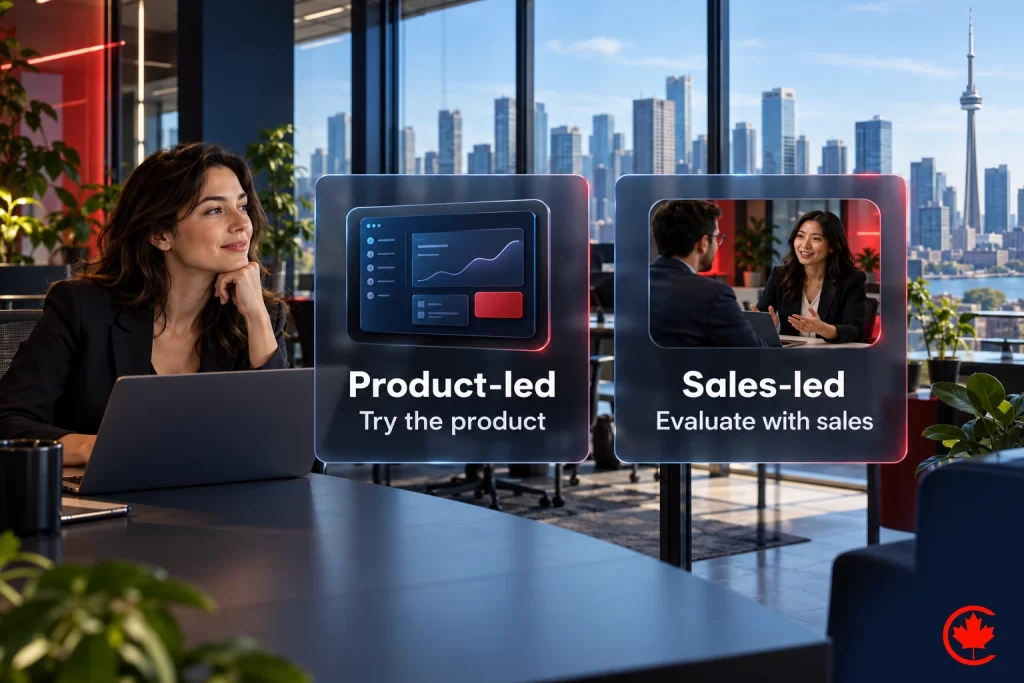
| Motion | How customers buy | Marketing’s main job |
|---|---|---|
| Product led | Sign up, try, upgrade | Drive sign ups and activation; reduce friction in the product |
| Sales led | Demo, evaluation, contract | Create qualified pipeline for account executives |
| Hybrid | Self serve for small accounts, sales for larger ones | Route users to the right path based on fit and usage |
We plan and run saaS marketing for B2B and software companies in Toronto and across Canada, scoped in writing after a free review.
Most marketing waste in SaaS comes from running the wrong motion for the price point. Low price products rarely support a heavy sales team, and complex enterprise products rarely sell self serve.
The metrics that matter
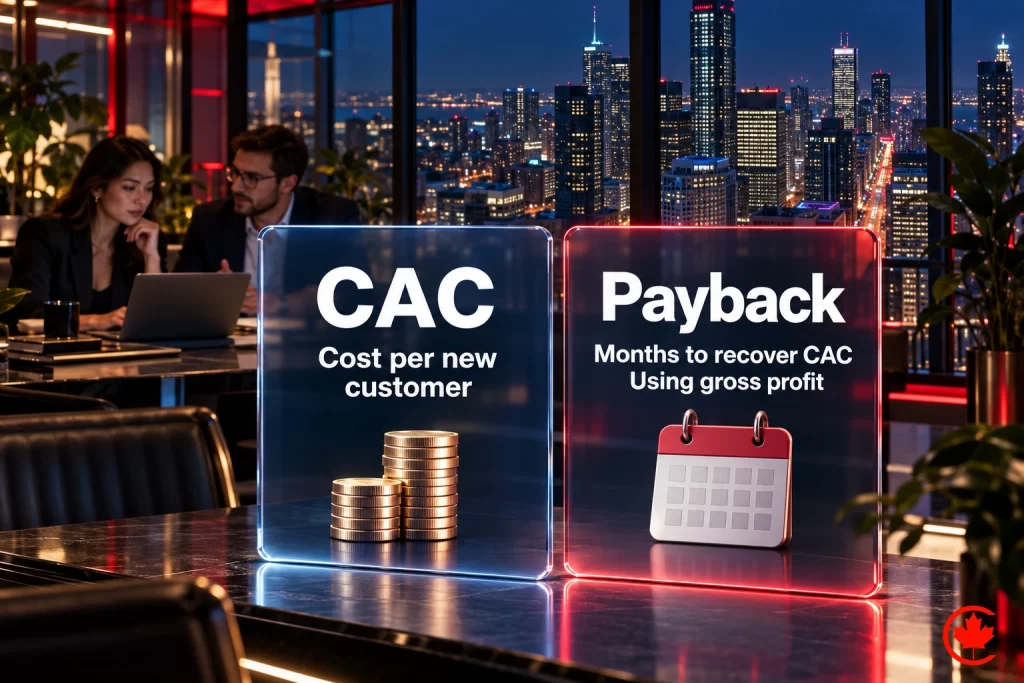
- CAC: sales and marketing acquisition costs divided by new customers acquired, with a consistent cost definition and a timing adjustment where sales cycles span several periods.
- CAC payback: months of gross margin needed to recover CAC.
- Customer lifetime value (LTV): margin from a customer over their life.
- Activation rate: the share of sign ups that reach the moment the product proves its value.
- Trial or demo to paid conversion.
- Churn and net revenue retention: whether customers stay and grow.
There is no universal “good” number for these. Track them by channel and segment, compare against your own history and plan targets with finance. Blended averages hide the channels that lose money.
Channels for SaaS
- SEO: comparison, alternatives, integration and use case pages capture buyers who are already shopping. See our SaaS SEO guide.
- Google Ads: high intent category and competitor searches, measured on qualified pipeline.
- LinkedIn: reaching the buying group by role and company. See how to target buying committees with LinkedIn Ads.
- Review sites and marketplaces: software buyers check review platforms and integration marketplaces before shortlisting.
- Partnerships and integrations: co marketing with complementary products.
- Lifecycle email: onboarding, activation and expansion sequences.
- AI search: appearing when buyers ask assistants for tool recommendations. See AI search optimization.

Canadian specifics
- Selling across Canada: buyers in different provinces and industries respond to different proof. Use separate campaigns, landing pages and customer examples for each key segment.
- Pricing: show prices clearly in Canadian dollars and be clear about which sales taxes apply.
- Quebec: Quebec’s Charter of the French Language, strengthened by Bill 96, sets French language requirements for commercial communications and products offered in Quebec.
- CASL: assess lifecycle and marketing emails under Canada’s anti-spam law. Commercial electronic messages generally need consent, sender identification and an unsubscribe mechanism unless an applicable exception changes the requirements; transactional content needs its own scope review.
- Privacy: explain data residency and privacy practices clearly. Canadian buyers ask.
Website pages every SaaS company needs
| Page | Purpose |
|---|---|
| Pricing | Clear plans and what each includes |
| Use case and industry pages | Show fit for each segment |
| Comparison and alternatives | Capture buyers evaluating options, written fairly and accurately |
| Integrations | Rank for “[tool] integration” searches and prove fit |
| Security and privacy | Answer procurement questions early |
| Customer stories | Real, approved results with context |
Connect marketing to revenue
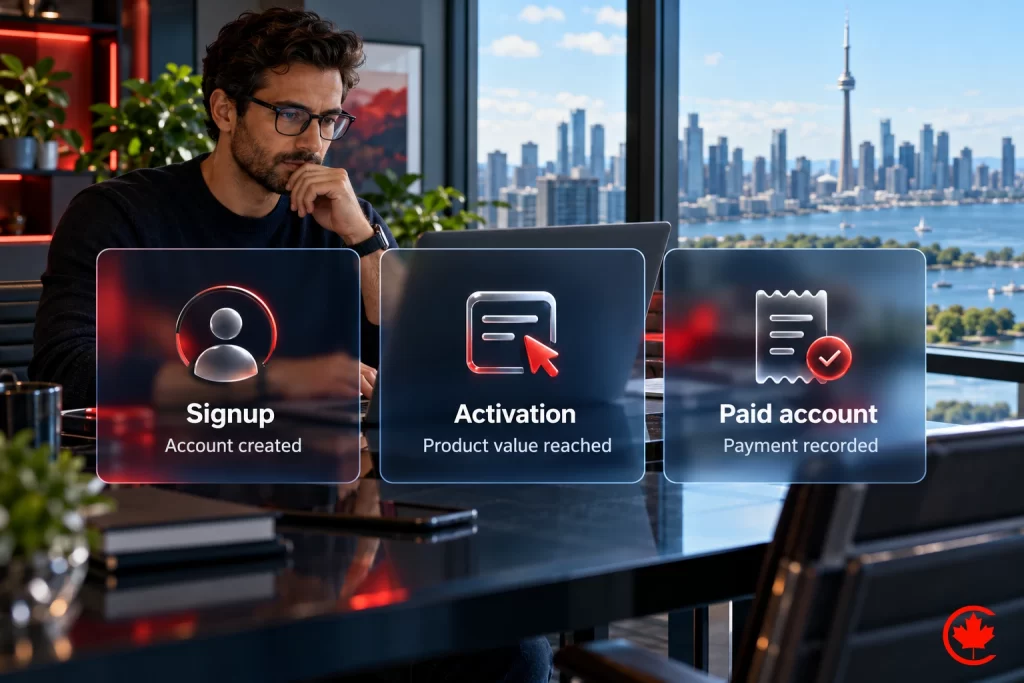
Connect permitted product sign ups, demo requests and closed won deals in your CRM. Send only eligible, appropriately minimized conversion signals to ad platforms after checking purpose, consent, sensitivity and the receiving platform’s policies. Without this, teams optimize for cheap sign ups that never pay. See CRM for SaaS companies and choosing a CRM.
Want help building the engine? See our SaaS marketing agency, SaaS marketing strategy and fractional CMO and SaaS SEO services, or read how to build a B2B sales pipeline in Canada.
Frequently asked questions
What is a SaaS technology company, and how is marketing one measured?
A SaaS company sells software that customers use online by subscription instead of installing a one-time purchase. Its marketing is judged on a short list of numbers: pipeline created, customer acquisition cost, how quickly that cost is paid back, and whether customers stay and expand. Sign-up counts on their own say little until they connect to paying accounts.
Why is selling SaaS hard for some software companies?
Much of the waste comes from running the wrong growth motion for the price point. Low-priced products rarely support a heavy sales team, and complex enterprise software rarely sells self-serve. Picking product-led, sales-led or a hybrid that routes small accounts to self-serve and larger ones to sales makes the job far easier.
Which metrics matter most for a SaaS company's marketing?
Customer acquisition cost and CAC payback, measured in months of gross margin, sit at the top. Lifetime value, activation rate, trial or demo to paid conversion, churn and net revenue retention complete the picture. Track each one by channel and segment, because blended averages hide the channels that lose money.
How much should a SaaS company spend on marketing?
There is no universal good number. Set spend from your own CAC, payback period and retention history, by channel and segment, and plan targets with finance. Search ad prices for agency terms are not a measure of a product's acquisition cost.
How do SaaS companies make money, and which marketing motion fits?
They earn recurring revenue from subscriptions, so keeping and expanding customers matters as much as winning them. In a product-led model people sign up, try and upgrade, and marketing drives sign-ups and activation. In a sales-led model buyers ask for a demo and an evaluation, so marketing creates qualified pipeline for account executives.
Why do SaaS companies fail to turn marketing into revenue?
A common reason is that marketing optimizes for cheap sign-ups that never pay. Connect permitted sign-ups, demo requests and closed won deals in the CRM, then pass only eligible, minimized conversion data to ad platforms once consent and platform policies are checked. Without that link, budgets drift toward the wrong channels.
What rules should SaaS companies in Canada plan for?
Quebec's French language charter, strengthened by Bill 96, sets French requirements for commercial communications and products offered there. Lifecycle and marketing emails fall under CASL, which generally needs consent, sender identification and an unsubscribe. Show prices in Canadian dollars, say which sales taxes apply and explain data residency, since Canadian buyers ask; check the current rules with an adviser.
Which marketing channels work for B2B SaaS companies?
Comparison, alternatives, integration and use case pages capture buyers who are already shopping, and Google Ads covers high-intent category and competitor searches measured on qualified pipeline. LinkedIn targets buyers by job role and company, while review sites, integration marketplaces and co-marketing partners help with shortlisting. Lifecycle email handles onboarding and expansion.
What pages should a Canadian SaaS company's website include?
Clear pricing with what each plan includes comes first, followed by use case and industry pages that show fit for each segment. Fair, accurate comparison pages, integration pages, a security and privacy page that answers procurement questions early, and customer stories with real, approved results round it out.