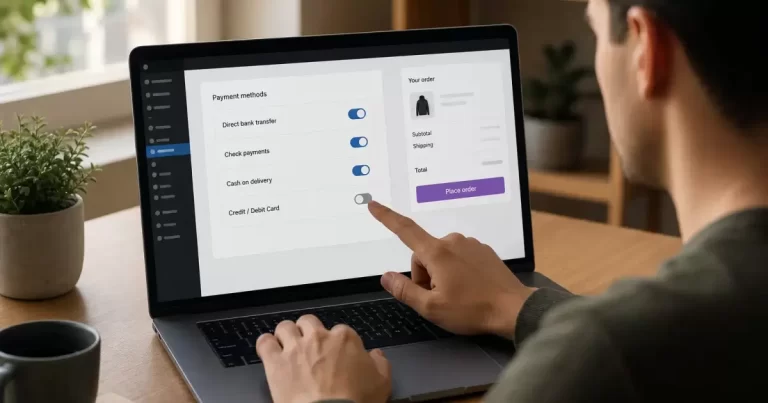

A purchase appearing in an analytics report does not prove that WooCommerce tracking is correct. The event might contain the wrong currency, omit products, fire twice or depend on a confirmation page that some customers never see. Before using the numbers to evaluate advertising, trace a controlled order from checkout to the reporting system.
The objective is straightforward: one genuine order should produce the intended purchase record, with a recognizable identifier and accurately defined values. This guide shows how to build that verification without replacing your entire analytics setup.
Inventory the sources that can send events
List the mechanisms currently installed: a WooCommerce analytics extension, Google Tag Manager, theme scripts, custom code, payment integrations and any server-side connection. Record the property or destination each one uses. Two different tools can both be working exactly as configured while reporting the same purchase twice.
The Google Analytics for WooCommerce documentation describes a direct integration for basic ecommerce and site analytics. Other extensions provide different event coverage. Check the documentation for the exact installed product and version instead of combining steps from several tutorials into one configuration.
Assign one owner to each event path. For example, decide which implementation sends the browser purchase event and whether a second route is deliberately configured. Document the arrangement before removing anything; an unfamiliar tag may support a separate business requirement.
Define what a purchase means
Agree on the business event being measured. Is the intended trigger a successful payment, an accepted order awaiting payment, or another milestone? A store selling physical products may use a different operating process from a store accepting deposits or manual payment methods.
Define revenue consistently as well. Record how product value, discounts, tax and shipping are represented in your chosen implementation. Do not compare reports labelled “revenue” until you know their definitions. A difference caused by reporting conventions requires explanation, whereas a missing order requires investigation.
Write the expected order identifier, currency, item identifiers, quantities and values before the test. That simple worksheet prevents a reviewer from accepting an event merely because its name resembles the desired outcome.
Place one controlled order
Use the payment provider’s supported test environment where practical. If production verification requires a real purchase, obtain the appropriate internal authorization and clearly identify the order as a test. Avoid submitting real customer information to a staging system or using a live payment method casually.
Choose a product with an unmistakable identifier and a known price. If the store uses variations, select one and record its attributes. Complete the checkout as a normal customer would, then preserve the WooCommerce order record and the corresponding event evidence from the analytics testing interface.
Check more than the event name. Confirm the destination property, transaction identifier, currency, product mapping and quantities. Inspect the value against your worksheet. A purchase event with incomplete item data may count toward a total while making product-level reports misleading.
Test the paths that produce duplicates or omissions
Reload the confirmation page, return to it later and test the supported payment-return journey. Observe whether the implementation sends additional purchase records for the same transaction. Keep those observations separate from what a reporting interface eventually displays, because a destination may apply its own processing rules.
Next, examine the opposite failure: a completed order that produces no event. Off-site payment, interrupted browser navigation, consent choices or an unusual checkout flow may change what the browser can send. The WooCommerce Datalayer documentation specifically discusses purchase recovery when a thank-you page is skipped. That capability belongs to that implementation; do not assume every plugin offers it.
Repeat the test with a guest customer and, where relevant, a logged-in customer. Test the checkout actually used on mobile. These checks are more informative than repeatedly loading the homepage to confirm that a general page-view tag exists.
Include cancellations and refunds
Record how a failed payment and a cancelled order behave. Neither should quietly become indistinguishable from the successful purchase you intended to measure. Check partial and full refunds if those events are important to your reports.
Feature coverage differs. WooCommerce’s Analytics Pro documentation, for example, describes additional events including full order refunds. If your installed implementation does not send the correction you require, document the limitation and choose an explicit reconciliation process. Do not claim net sales accuracy from an event stream that only records initial purchases.
Keep the store’s order ledger available as the commercial reference. Analytics serves acquisition and behavioural analysis; its totals can differ from order records because of collection and processing conditions. A useful dashboard explains those differences instead of hiding them.
Check consent and customer data
Test the site’s available consent choices and record which events occur under each one. Confirm that the implementation follows the consent design your organization has approved. A tag appearing in source code does not establish how it behaves before or after a visitor’s choice.
Inspect event parameters for unnecessary personal information. Customer names, email addresses and free-text order notes should not accidentally enter a general analytics payload. Review each destination’s rules and the store’s data-handling obligations before enabling additional fields.
Keep a reconciliation sheet
Maintain a small table containing the order identifier, expected event, observed event, value definition, test path and result. Mark unresolved cases as unresolved. Repeat the relevant checks after checkout changes, analytics updates or a payment-provider migration.
For wider reporting decisions, see Canada Create™’s analytics measurement guide. Reliable tracking begins with a traceable transaction and a clear definition, not a dashboard full of numbers. Once the controlled order reconciles, you can investigate larger differences with a much stronger baseline.
Include a discounted order in the worksheet. Compare its line items with the store record, not just the final total. That catches implementations that subtract a coupon twice or distribute its value differently from your reporting assumptions.
Frequently Asked Questions
Why doesn’t WooCommerce conversion tracking match my orders?
Consent banners, ad blockers, duplicate tags, refunds and currency settings all create differences.
How do I test WooCommerce conversion tracking?
Place a test order and confirm the purchase event, value and order ID appear once in GA4 and ad platforms.
Should I track purchases with GTM or a plugin?
Either works if it fires once per order with correct values. Avoid running both.
Who can audit my store’s tracking?
Our ecommerce website and Google Ads teams reconcile tracking with real orders.