
Toronto · Family law marketing
Family Lawyer Marketing in Toronto
Family lawyer marketing in Toronto helps people considering separation, parenting arrangements or a property settlement find your firm, understand what a first consultation involves and contact you discreetly.
Family lawyer marketing for Toronto and GTA family law firms: family law SEO, divorce search ads, websites and discreet intake, from North York to downtown.
- BBB A+ accredited
- 18 years in business
- Mon to Fri 9 to 6, Sat 10 to 2
Get a custom proposal for your family law marketing
Tell us which family matters you take, where your offices are and how clients reach you at present. A strategist answers within one business day.
Please do not share passwords or other sensitive details here. We never sell your contact information and we comply with Canadian privacy law
(privacy policy).
What your family-law practice needs from marketing
Visibility for relevant family matters
Help people find clear information about the family-law services your firm offers.
Trusted on first read
Calm matter pages, clear fee explanations and real lawyer profiles.
Discreet first contact
Explain the contact options and response arrangements your firm approves.
Spend you can justify
Review recorded enquiries, consultations and available retained-client outcomes alongside your marketing spend.
What marketing for family law firms can include
Separation, parenting and property work need different pages and contact paths; after discovery we propose a mix in writing.
- Family law SEOContent, technical SEO and local visibility for the family matters your firm accepts.
- Divorce lawyer Google AdsAdvertising support tied to the family-law services and consultation capacity you want to support.
- Family law website designCalm, fast pages with short forms and online booking.
- Google Business Profile for family lawyersFirm and lawyer profiles, posts and consistent listings.
- Reviews and referral partnersOptional review requests and resources partners can share.
- Family law intake and CRMAcknowledgements, booking, consented follow-up and call tracking.
- Family law content marketingLawyer-reviewed guides, newsletters and multilingual pages.
- Enquiry and client-outcome reportingReview available consultation and retained-client records with their reported source and matter type.
Family law marketing pricing
Family-law SEO, ads, websites and intake are each scoped in a written proposal after discovery. The first review costs nothing.
Family law SEO
Custom-scoped engagements; proposal after discovery
Content, local search and technical SEO for the family matters your firm accepts.
- Matter pages
- Google Business Profile
- Technical SEO
- Monthly reporting
Family law Google Ads management
Quoted in writing
Setup and monthly management quoted after discovery. Cost depends on matter types, service area and number of campaigns. Ad spend is paid to Google directly.
- Advertising for your family-law services
- Ongoing campaign management
- Landing pages
- Call and form tracking
Family law website
Quoted in writing
Fixed project quote. Cost depends on page count, custom design, multilingual content, booking and SEO migration.
- Custom design
- Matter pages
- Discreet forms and booking
- SEO migration
Intake and CRM setup
Quoted in writing
Cost depends on call tracking, booking, follow-up sequences and connection to your practice management software.
- CRM setup for your intake team
- Call tracking
- Consented follow-up
- Reporting on available client outcomes
Fees are quoted in writing after a free consultation. Advertising spend is paid separately to the platforms. Applicable taxes are additional.
Family-law service fit
Services, fit and expectations for your family law firm
Family lawyer marketing in Toronto helps people facing separation, divorce or a parenting dispute find a family law firm they can trust, and contact it safely. It brings family law SEO, local visibility, careful advertising, a calm website and private intake together around the matters your firm accepts. Canada Create has marketed professional firms since 2008 from 126 Willowdale Ave. in Toronto and is a BBB Accredited Business with an A+ rating. Every legal explanation, claim and contact arrangement is approved by your lawyers before it is published.
Our law firm work includes the website, Google Ads and social media advertising for Ghasemi Law and the website and YouTube advertising for Azimi Law.
Family law marketing covers six areas, and your custom proposal names the ones your firm needs:
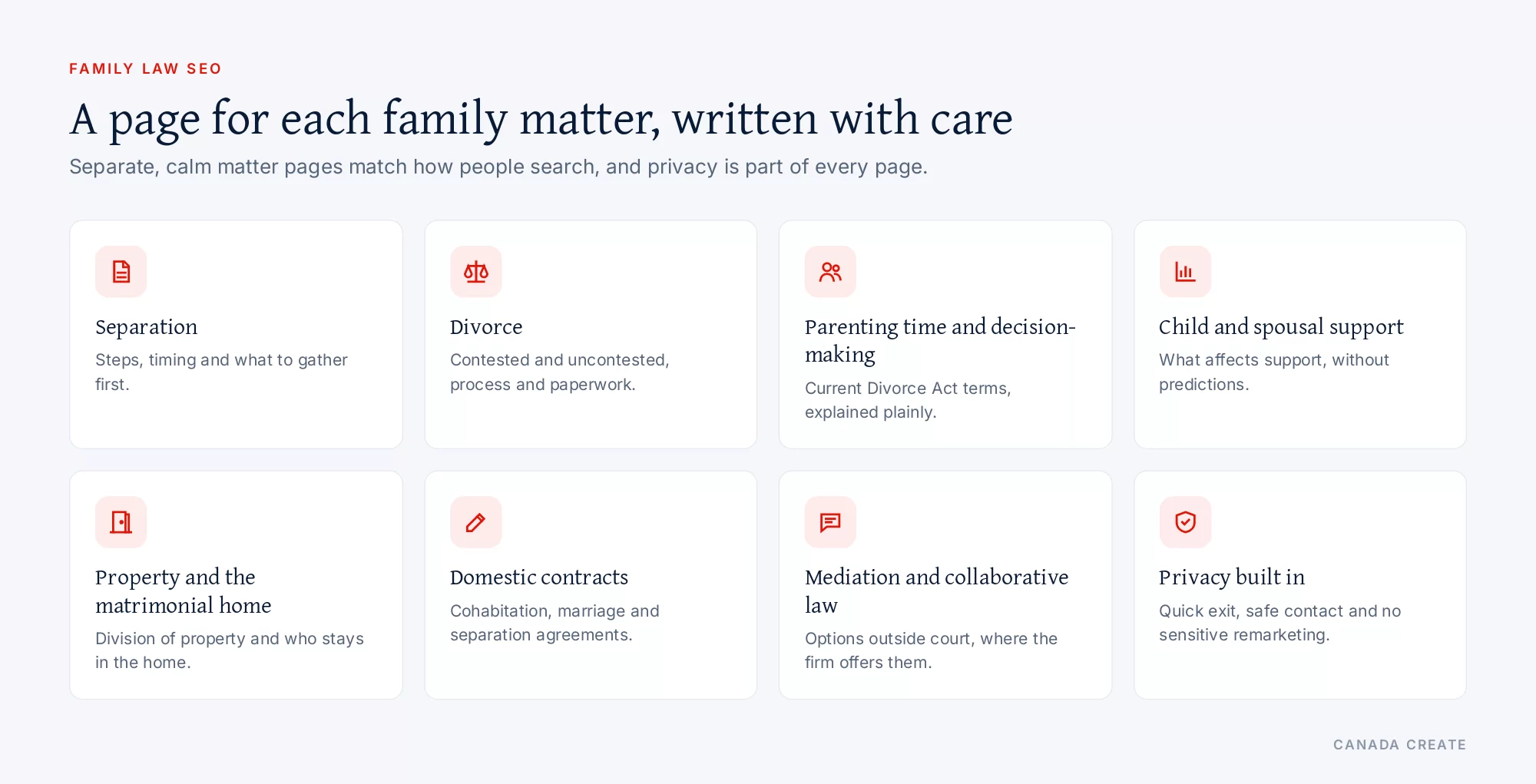
- Family law SEO: matter pages for separation and divorce, parenting, child and spousal support, property division and domestic contracts.
- Divorce lawyer SEO: pages and guides for the searches people make when a marriage is ending.
- Local visibility: accurate Google Business Profiles and listings for each real office.
- Discreet advertising: family law search ads limited to your area and intake hours, with no sensitive remarketing.
- Website and private intake: short, safe contact routes that work on a shared phone, with a quick exit option on sensitive pages.
- Reporting: enquiries followed through to consultations and retained matters.
For every practice area together, see our law firm marketing in Toronto. For search alone across practice areas, see SEO for lawyers and law firms in Toronto.
How people look for a family lawyer
Family law searches often begin long before someone is ready to call. A person may spend weeks reading about separation, child support or the matrimonial home before searching for a lawyer, and many search late at night on a phone they may share with a partner. Their searches move through stages:
- Understanding: “how to separate in Ontario”, “what is parenting time”, “how is child support calculated”.
- Planning: “separation agreement lawyer”, “mediation vs court divorce”, “who gets the house in a divorce Ontario”.
- Choosing: “family lawyer near me”, “divorce lawyer North York”, lawyer names and reviews.
- Urgent help: “emergency custody order”, “my ex won’t return the children”, “restraining order Ontario”.
Family law marketing works when each stage finds something useful from your firm: guides for understanding, clear matter pages for planning, profiles and reviews for choosing, and a fast, safe route to a person when the matter is urgent.
Family law SEO
Family law SEO is the work of helping a family law firm appear in organic results, the map pack and AI answers for the matters it handles. It rests on the same foundations as all SEO for lawyers and law firms in Toronto, with family-specific content and care.
Matter pages
One page for each matter you want to be found for usually performs better than one family law page. Common pages include separation, divorce, parenting time and decision-making responsibility, child support, spousal support, property division and the matrimonial home, separation and cohabitation agreements, marriage contracts, mediation and collaborative family law, and urgent motions where the firm handles them. Each explains who it helps, how the matter usually works in Ontario, the firm’s approach, how a first consultation works and how fees are discussed.
Current terminology
Since the federal Divorce Act changes of 2021, “parenting time” and “decision-making responsibility” are the terms used under that Act. Pages that still talk only about “custody” and “access” look dated to readers and miss the words people now see in court documents. Content should explain both where helpful and use the current terms.
Guides and FAQs
Guides on the questions people ask early, such as how to separate, what happens to the house, how support is calculated and what mediation involves, introduce the firm long before a consultation. Each guide stays general, explains what the answer depends on and links to the relevant matter page.
Lawyer profiles
People choosing a family lawyer want to know who they will be speaking with. Profiles should show the lawyer’s photo, year of call, family law focus, languages and any mediation or collaborative training. “Specialist” belongs only on the profile of a lawyer certified by the Law Society as a specialist in family law, under Rule 4.3-1.
SEO for divorce lawyers
Divorce searches are some of the highest-intent family law searches, and they come in several forms: “divorce lawyer Toronto”, “uncontested divorce Ontario”, “how much does a divorce cost in Ontario”, “joint divorce application”. A divorce practice benefits from separate pages for contested and uncontested divorce, a plain explanation of the process and paperwork, how long it usually takes, what affects cost, and how divorce connects to parenting, support and property issues.
Many people searching for a divorce lawyer are comparing firms on approach as much as price. A settlement-focused practice can explain that approach clearly; a firm that handles complex property or litigation can say so plainly. In both cases the wording stays calm and factual. The Law Society of Ontario’s commentary to Rule 4.2-1 lists suggesting or implying the lawyer is aggressive among marketing that may contravene the rule, so “aggressive divorce lawyer” is wording to avoid.
Local visibility for family law firms
“Family lawyer near me” and “divorce lawyer near me” searches show a map with three firms, and those firms take many of the calls. Local visibility depends on a complete Google Business Profile for each real office, an office page with directions, parking and accessibility details, consistent listings and genuine reviews. Many family law clients prefer an office that is easy to reach discreetly, and some prefer video meetings; where your firm offers them, say so on the profile and the website. Our local SEO services in Toronto describe the wider work.
Discreet advertising for family law
Google search ads can put a family law firm in front of people searching for a lawyer now. Family law campaigns work best when they are organized by matter, limited to the areas your offices serve, scheduled for the hours your team can respond and filtered with negative keywords for job searches, free advice requests and matters you do not accept.
Discretion matters more here than in most practices. We do not build remarketing lists from family law pages, because a reminder ad seen on a shared device could expose someone’s plans, and ad platforms restrict targeting by personal circumstances. Ads describe the firm’s services plainly, with no promises about outcomes and no aggressive wording. Our page on lawyer advertising in Toronto covers law firm campaigns in detail.
Privacy, safety and sensitive content
Some people reading a family law website are in unsafe situations. A considerate website protects them as far as it can:
- Quick exit: a button on sensitive pages that leaves the site in one tap, to a neutral page.
- Private contact: forms that ask how and when it is safe to reply, and a note not to send sensitive details before the firm agrees to act.
- Careful tracking: analytics and ad tags that record which page led to an enquiry, never the details of a family situation, and no sensitive remarketing.
- Calm design: clear headings, readable text and practical next steps, without dramatic imagery or fear-based wording.
- Honest availability: hours and response times stated truthfully, with information about where to get urgent help when the office is closed.
Your firm remains responsible for safety-related handling, conflicts, legal advice and accepting a client.
Reviews and referrals for family lawyers
Many family law clients arrive through referrals from friends, therapists, financial advisers, mediators and other lawyers, and they almost always check reviews. Genuine reviews help, but family law needs particular care: replies must never confirm that a reviewer was a client or mention anything about their family. Testimonials reused on your website become your marketing, and the Law Society’s commentary lists testimonials with emotional appeals among marketing that may contravene Rule 4.2-1. We prepare request wording and calm draft replies for your approval through our review management service, and never write or buy reviews.
Referral relationships are supported by a website referrers are comfortable sharing, profiles that explain each lawyer’s approach and occasional updates to contacts who have agreed to receive them under Canada’s Anti-Spam Legislation.
Intake for family law firms
Family law enquiries can be hesitant, emotional or urgent, and the first contact shapes whether a person books a consultation. Short forms, a clear explanation of what happens after someone gets in touch, online booking where your calendar allows and a prompt callback make the difference. An AI receptionist can take messages and book callbacks after hours, and a CRM for law firms gives each enquiry a responsible person and a next step.
Measuring family law marketing
Reporting follows enquiries through to consultations and retained matters by matter type and channel, where your records support it. Intake feedback separates suitable matters from enquiries outside the practice, conflicts and requests for free advice or legal aid. Attribution has limits, and family matters can take a long time, so reports focus on trends across several months rather than a single week.
Marketing mediation and collaborative family law
More people now look for ways to resolve a separation without going to court, and many search for “family mediation Toronto”, “collaborative divorce” or “how much does mediation cost in Ontario”. Firms that offer mediation, collaborative law or settlement-focused services can reach those searches with dedicated pages that explain how each option works, who it suits, when it may not be appropriate and how it fits with legal advice for each party. Lawyer profiles should list mediation or collaborative training accurately, and content should be careful not to suggest that any route ensures a result or suits every family.
Common family law marketing mistakes
These are the issues we see most often on family law websites and campaigns:
- One family law page for every matter, so none of them ranks well.
- Old custody and access wording with no mention of parenting time or decision-making responsibility.
- Aggressive or dramatic wording in ads and headlines.
- Remarketing ads that follow people from family law pages to shared devices.
- Contact forms that invite long, sensitive descriptions before the firm has agreed to act.
- No quick exit option on pages about family violence or child protection.
- Stock photos instead of the lawyers people will meet.
- Reviews answered in ways that confirm the reviewer was a client.
What family lawyer marketing costs in Toronto
Family law marketing is custom-scoped after discovery, and fees are quoted in writing after a free consultation. Scope depends on the matters targeted, the number of offices, the condition of the website, the content needed, the channels included and how much intake work is involved. Advertising spend is set by the firm and paid directly to the platforms.
How to compare family lawyer marketing companies in Toronto
Questions worth asking any agency, including us:
- What have you delivered for law firms, and can we see examples?
- How do you handle privacy, safety and quick exit options on family law pages?
- How do you keep ads and remarketing discreet?
- How do our lawyers review content before it is published?
- How do you report consultations and retained matters?
- Who owns the website, profiles and advertising accounts?
Related guides: how to get family law clients and what clients look for on a law firm website.
Talk to a strategist
Ready when you are?
Request a custom proposal
Tell us your goals, budget and timeline. You get a custom proposal and a named strategist, so your next stage of growth starts now.
How a family law marketing program starts
Agree the scope in writing, keep first contact discreet and report on the consultations and clients your family practice gains.
- Review your needs Discovery
Tell us about your family law services, capacity and current enquiries.
- Agree the scope Before work starts
Check the recommended matter pages, ads and intake work, the fees and each party's responsibilities ahead of any work.
- Confirm reporting At the start
Agree how intake records the matter type and contact preference, so consultations and retained clients can be counted privately.
- Review the content Before publication
A family lawyer reviews every page and ad, especially anything about parenting, support or property, before it is published.
- Receive the agreed work As agreed
Matter pages, campaigns and intake changes go live in the order set by your approved plan.
- Review progress Monthly
Review which family matters produced consultations and retained clients, and whether intake or the page plan needs adjusting.
Law firm work from our portfolio
Websites and advertising we delivered for law firms.


Calm, lawyer-approved copy: why firms choose us for family lawyer marketing
One accountable team
SEO, ads, website and intake run together.
Lawyer-reviewed copy
Pages about separation, parenting and support are written calmly, conflict-driven wording is marked for attention and nothing is published without a family lawyer's approval. Law society obligations stay with the firm.
Your approval first
Nothing published without your review.
Reporting tied to your practice
Review recorded enquiries, consultations and retained-client outcomes your team can share.
Family lawyer marketing in Toronto: questions firms ask
The basics
What does a family law marketing agency do?
It helps a family law firm reach people facing separation, divorce, parenting or support issues, and makes it easy and safe for them to get in touch. The work covers family law SEO, local visibility, discreet advertising, a calm website with private contact routes, reviews handled within the rules and reporting through to retained matters.
How should a family law firm market its services?
Calmly and specifically. Publish a page for each family matter you handle, keep your Google Business Profile complete, ask satisfied clients for honest reviews, run discreet search ads for the matters you want and make first contact private and easy. Avoid aggressive wording and any suggestion of how a case will end.
How do family lawyers get clients?
Mostly through referrals from friends, therapists, financial advisers, mediators and other lawyers, and through search, as people research separation and then look for a lawyer near them. Reviews, clear matter pages and a fast, considerate response to enquiries turn that interest into consultations.
What is family law SEO?
Family law SEO is the work of helping a family law firm appear in Google's results, the map pack and AI answers for matters such as separation, divorce, parenting time, support and property division. It includes matter pages, guides, lawyer profiles, local SEO, technical fixes and reviews, all written in current Ontario terminology and approved by the firm's lawyers.
Is SEO worth it for a family law firm?
Usually, because many people research family law questions for weeks before choosing a lawyer, and search is where they do it. A firm with clear matter pages, current guides and a strong local presence is there at each stage. SEO builds over months, so it suits firms planning for steady growth.
What makes family law marketing different from other legal marketing?
Privacy and tone. People may be reading on a shared device, in an unsafe situation or under great stress. That calls for quick exit options, private contact routes, no sensitive remarketing, calm language and honest availability, alongside the Law Society's general marketing rules.
SEO and content
Which pages should a family law website have?
Separate pages for separation, divorce, parenting time and decision-making responsibility, child support, spousal support, property division and the matrimonial home, domestic contracts and mediation or collaborative law where offered, plus lawyer profiles, office pages and guides. Each page should explain the matter, the firm's approach and how to book.
What terminology should family law websites use in Canada?
Since the 2021 Divorce Act changes, the terms under that Act are parenting time and decision-making responsibility rather than custody and access. Pages can mention the older terms because people still search for them, but should explain and use the current ones.
What blog topics work for a family law firm?
Questions people ask early: how to separate in Ontario, what happens to the house, how child and spousal support are calculated, what mediation involves, how long a divorce takes and what to bring to a first meeting. Each guide stays general information and links to the related matter page.
How should a family law website explain what a family lawyer does?
In plain words, by matter: what the lawyer helps with, how the process usually works in Ontario, what the firm's approach is, such as settlement-focused or litigation-ready, and what happens at a first consultation. The writing should be calm and avoid predicting outcomes.
What content should a divorce lawyer website include?
Pages for contested and uncontested divorce, a plain explanation of the process and paperwork, how long it usually takes, what affects cost, how divorce connects to parenting, support and property, and how to book a consultation. Profiles of the lawyers who handle divorces help people choose.
Should family lawyers explain fees on their website?
Many people want to understand costs before calling, so explaining what affects the cost of a family matter and how fees are discussed at the first meeting helps. If the firm advertises specific fees, Rule 4.2-2 requires the advertising to be reasonably precise, say what is extra and be honoured.
Should a family law website explain what makes a matter more expensive?
Yes, in general terms. Explaining that cost depends on factors such as whether the parties agree, the complexity of property and income, whether court is needed and how long the matter takes helps people prepare. It should not promise a cost or an outcome.
How often should family law content be updated?
At least once a year and whenever the law, court rules or support guidelines change. Outdated terminology or rules can mislead readers. Dating guides and reviewing them on a schedule, with a lawyer signing off changes, keeps the site accurate.
Should family law websites be multilingual?
If your lawyers serve clients in other languages, yes. Family matters are personal, and many people are more comfortable reading and speaking about them in their first language. Translated and reviewed matter pages, profiles that list the languages spoken and ads in those languages help people find the right firm.
Should a family law firm have a page for mediation?
Yes, if it offers mediation or collaborative law. A dedicated page explaining how the option works, who it suits, when it may not be appropriate and how legal advice fits alongside it reaches people searching for alternatives to court, and helps them see the firm as a calm, practical choice.
Local and reviews
How can a family lawyer appear in near me searches?
With a complete Google Business Profile for each real office, the family law category and services listed, accurate hours, real photos, an office page with directions and parking, consistent directory listings and genuine reviews. Mentioning video consultations where offered helps people who cannot travel easily.
Can family lawyers ask clients for Google reviews?
Yes, if the request is honest, neutral and well timed, such as after a matter is resolved. Never offer incentives or write reviews. Some family clients will prefer not to post publicly, and that choice should be respected without follow-up pressure.
How should a family lawyer reply to reviews?
Briefly and courteously, without confirming that the reviewer was a client or mentioning anything about their family or matter. A short thank you, or an invitation to contact the firm directly for a negative review, protects confidentiality and keeps the reply professional.
Do family law firms benefit from directories?
Accurate listings on the main legal and local directories help search engines and AI tools confirm the firm's details, and some rank for family law searches. Paid placements should be judged by the enquiries they bring, and paid award badges are best avoided under the Law Society's rules.
How do referrals work for family law firms?
Therapists, financial advisers, mediators, accountants and other lawyers often refer family matters. A clear website they are comfortable sharing, profiles that explain each lawyer's approach and occasional updates to contacts who agreed to receive them support those relationships. Referral fees between licensees follow the Law Society's rules.
Can a family law firm rank across the GTA from one office?
Partly. Google weighs distance from the searcher, so one office ranks best nearby. Video consultations, service area settings and content about the communities the firm serves can widen reach. A real second office with its own profile does more than copied city pages.
Advertising
Should a family law firm use Google Ads?
Often, yes, for people searching for a family or divorce lawyer now. Campaigns should be organized by matter, limited to the areas the firm serves, scheduled for hours when someone can respond and filtered with negative keywords. Ads describe services plainly and avoid aggressive or outcome language.
Can a family law firm use remarketing ads?
We advise against remarketing from family law pages. A reminder ad on a shared phone or computer could reveal that someone is considering separation, and ad platforms restrict targeting by personal circumstances. Search ads, which reach people as they search, are the safer approach.
Can a family law firm market itself as aggressive?
Avoid it. The Law Society of Ontario's commentary lists suggesting or implying the lawyer is aggressive among marketing that may contravene Rule 4.2-1. Firms can convey strength through experience, preparation and clear explanations of how they handle contested matters.
Should a family law firm advertise a free consultation in Toronto?
That is the firm's decision. If it does, the offer must be what everyone who responds receives, because bait and switch marketing contravenes the rule, and it should not be framed as a second opinion service, which Rule 4.2-1.2 prohibits marketing.
Do social media ads work for family lawyers?
They can build awareness and promote events such as information sessions, but they are weaker for urgent needs than search ads, and targeting by personal circumstances is restricted. Educational posts and short videos explaining common questions often work better than direct ads.
Should family lawyers use video?
Short videos of a lawyer explaining what happens at a first meeting, how mediation works or what parenting time means help people feel comfortable before they call. They can sit on YouTube and matter pages. Scripts stay calm and general, with no outcome promises.
Which keywords should a family law firm bid on?
Matter-specific terms such as separation agreement lawyer, divorce lawyer, parenting time lawyer and spousal support lawyer, combined with your city or neighbourhood, usually bring better enquiries than broad terms like family law. Negative keywords filter out jobs, free advice and legal aid searches the firm does not serve.
Privacy and intake
Should a family law website have a quick exit button?
Yes, on pages about separation, family violence and child protection. A quick exit button takes the reader to a neutral website in one tap if someone walks in. It is a small feature that shows care for people who may not be safe.
What should a family law contact form ask?
Only what the firm needs to call back and check for conflicts, such as name, contact details, the type of matter and the other party's name. It should ask how and when it is safe to reply, and include a note not to send sensitive details until the firm agrees to act.
How should family law firms handle tracking and privacy?
Track which page and channel led to an enquiry, never the details of anyone's family situation. Avoid sensitive remarketing, keep the privacy policy accurate and limit who can see enquiry data. Calls can be tracked by source without recording conversations.
How fast should a family law firm respond to enquiries?
Within the same business day at least, and faster where possible, because people often contact several firms. Urgent matters need a clear route, and the website should say honestly when the office is open and where to get urgent help when it is closed.
Can an AI receptionist help a family law firm?
It can take messages, answer simple questions about hours and booking and schedule callbacks outside office hours, so enquiries are not lost. It should not give legal advice or collect sensitive details, and it should hand people to the firm's staff for screening and conflict checks.
Should family law firms offer online booking?
It helps many family law clients, who may find it easier to pick a time online than to call. Booking should still allow a conflict check before the consultation and offer video meetings where the firm provides them. Urgent matters may need a phone-first route.
How can a family law firm make first contact feel safe?
State clearly what happens after someone gets in touch, ask how and when it is safe to reply, keep forms short, offer a quick exit button and avoid any marketing that could follow the person to a shared device. Honest hours and a prompt reply complete the picture.
Rules
What Law Society rules apply to family law marketing?
The same Chapter 4 rules as all lawyer marketing in Ontario: accurate, verifiable marketing under Rule 4.2-1, identifying licensed lawyers under 4.2-1.1, no second opinion marketing under 4.2-1.2, fee rules under 4.2-2 and specialist claims only with certification under 4.3-1. This is general information, not legal advice.
Can a family lawyer call themselves a family law specialist?
Only if the Law Society of Ontario has certified the lawyer as a specialist in family law, under Rule 4.3-1. Other family lawyers can describe their focus, years of practice and training, such as mediation or collaborative law, accurately.
Can a family law firm share client success stories?
Rarely, and only with informed permission. Family matters are deeply private and anonymized stories can still identify people. Any mention of results needs the statement that past results are not necessarily indicative of future results, and testimonials with emotional appeals may contravene the rules.
What red flags do people spot when choosing a family lawyer online?
Promises about outcomes, aggressive language, best lawyer claims, outdated pages using old terminology, no real lawyer photos, hidden contact details and reviews with angry, unanswered complaints. A calm, current, specific website with real people and clear next steps avoids those concerns.
Can a family law firm advertise on the basis of outcomes?
No promises should be made. The Law Society's commentary flags raising expectations, and stating results needs the past results statement. Family law marketing works better when it explains the firm's approach and what clients can expect from the process.
Can family lawyers use testimonials on their website?
With great care. Testimonials need the client's informed permission, must protect privacy and should avoid emotional appeals, which the Law Society's commentary lists among marketing that may contravene Rule 4.2-1. Many family firms rely on independent Google reviews instead of featuring testimonials.
Measurement and cost
What does family lawyer marketing cost?
Canada Create quotes family law marketing in writing after a free consultation, because cost depends on the matters targeted, offices, website condition, content needed, channels included and intake work. Advertising spend is set by the firm and paid directly to the platforms.
How long does family law SEO take?
Profile and technical fixes can help within weeks; new matter pages usually take several months to rank well in Toronto, longer for competitive divorce terms. Progress is best judged over six to twelve months, with monthly reviews of visibility, enquiries and consultations.
How do family law firms measure marketing results?
By following enquiries through to consultations and retained matters, by matter type and channel, where the firm's records allow. Intake feedback separates suitable matters from conflicts, out-of-area enquiries and requests for free advice. Trends over several months matter more than any single week.
How should a family law firm choose a marketing agency?
Look for law firm experience, a clear approach to privacy and quick exit options, discreet advertising without sensitive remarketing, lawyer review of all content, reporting on consultations and retained matters and clear account ownership. Ask to see work the agency has delivered for professional firms.
Who owns the family law firm's website and accounts?
Your firm does. The website, Google Business Profiles, analytics and advertising accounts are set up in the firm's name where the platform allows, and content we write is published under your name.
Do you market family law firms outside Toronto?
Yes. Our office is in Toronto and most of our family law work is in Toronto and the GTA, but we market firms elsewhere in Ontario and across Canada, following the family law terminology and law society rules of each province where the firm practises.
How do we start family law marketing with Canada Create?
Request a custom proposal or call (416) 273-9030. We discuss the family matters you want, your offices and intake, review your website and online presence, and send a written proposal with scope, fees and responsibilities before work begins.
Why do family law enquiries not always become clients?
Common reasons include conflicts, matters outside the firm's practice or area, people seeking free advice or legal aid, slow replies and enquiries made before the person is ready to proceed. Intake feedback helps separate those reasons so marketing can focus on the matters that fit.
Is family law marketing worth it for a small practice?
Often, because a small family practice can focus on a few matters and one neighbourhood, where competition is lower. A strong Google Business Profile, a handful of clear matter pages, genuine reviews and fast, private intake can bring steady consultations without a large budget.


Get a custom proposal for your next project
Review the offer, budget and enquiry process before committing your marketing spend.