
Toronto · Business cards
Business card design and printing in Toronto
Cards that look like your brand, read clearly and feel right in the hand, with print ready files and templates your business keeps.
Business card design and printing for Toronto and GTA owners and teams, from North York to downtown.
- BBB A+ accredited
- 18 years in business
- Mon to Fri 9 to 6, Sat 10 to 2
Get your business card quote
Send your current card or logo and tell us how many people need cards, and we will reply with design and printing quoted in writing. We reply within one business day.
Please do not share passwords or other sensitive details here. We never sell your contact information and we comply with Canadian privacy law
(privacy policy).
Signs of good business cards: brand match, clear details, files you keep
Cards that match your brand
Your logo, colours and type used correctly, matching your website and signs.
Clear information
Name, title, contact details and QR code in an order people can read quickly.
The right feel
Paper and finish chosen to suit your business and how the card is used.
Files you keep
Print ready files and editable templates for every future reorder.
What business card design includes
Your written proposal lists the exact scope; these are the usual parts of a business card project.
- Brand and content reviewLogo files, colours, type and the details each card should carry.
- Card design optionsFront and back layouts in your brand, refined to one final design.
- Team templateRules for names, titles, credentials and phone lines across staff.
- Bilingual versionsEnglish and French wording reviewed by French speakers.
- QR code setupA code linking to a page on your own site that you can update.
- Stock and finish adviceMatte, uncoated, soft touch, foil, spot gloss or letterpress options.
- Print ready files and proofBleed, safe zones and print colour checked, with a proof for approval.
- Printing and reordersPrinting quoted in writing and reorders handled from the template.
How business cards are priced
Design and printing are quoted in writing after a free review, as separate lines.
Single card design
Quoted in writing
Owners and solo professionals
- Front and back design
- One round of refinements
- Proof for approval
- Print ready files
Team card system
Quoted in writing
Firms, clinics and sales teams
- Team template
- Details collected per person
- Proofs for each card
- Reorder process
Premium finish cards
Quoted in writing
Brands wanting a luxury feel
- Stock and finish advice
- Foil, spot gloss or letterpress files
- Proof showing finish areas
- Printing arranged
Stationery set
Quoted in writing
Businesses refreshing all their materials
- Business cards
- Letterhead and envelopes
- Email signatures
- Bilingual versions
Ad spend and software licences are paid to the platform directly and shown separately from our fees.
Business card guide
What makes a good business card, from information to finish
Hand out a card that looks like your brand and gets kept. Business card design and printing in Toronto covers the layout, information, paper, finish and print ready files for one person or a whole team, matched to the logo, colours and type you already use. Canada Create has designed for Toronto businesses from its office at 126 Willowdale Ave., Suite #3, in Toronto, since 2008, and is a BBB Accredited Business with an A+ rating. Design and printing are quoted in writing.
A business card project has five areas of work:
- Information and layout: name, role, contact details and an order that reads at a glance.
- Brand match: your real logo files, colours and type, never a template look-alike.
- Paper and finishes: stock, thickness and finishes such as foil, spot gloss or rounded corners.
- Team templates and languages: templates for new staff, and English, French or bilingual versions.
- Print ready files and printing: proofs, coordinated printing and files you can reorder from.
This is for owners and professionals across the GTA, from a contractor handing out cards on site to a law firm ordering cards for every associate.
- Do business cards still matter
- What to put on a business card
- Designing a card that follows your brand
- Cards for a whole team and reorders
- English and French business cards
- Paper stocks and finishes
- QR codes and digital cards
- Print ready files, proofs and colour
- Language, titles and accessibility
- How a business card project works
- What business cards cost in Toronto
- How to compare business card designers in Toronto
- Send your current card for a business cards design proposal
Do business cards still matter
People ask whether business cards are still relevant, what is replacing them and what the new trend is. The honest answer is that the card has changed jobs. It is less often the only record of your phone number and more often a physical reminder that leads to your website, your booking page or your reviews.
Where cards still earn their place
- Trades and home services: a roofer, electrician or landscaper leaves a card with a homeowner, the neighbour asks for one, and it ends up on the fridge.
- Professional offices: a lawyer, accountant, financial adviser or architect hands a card across the table at the end of a first meeting, where a phone tap would feel casual.
- Trade shows, conferences and networking: cards exchanged at a booth are easier to sort afterwards than a stack of scanned badges.
- Retail counters and clinics: a card with the next appointment written on the back, or a QR code to rebook.
- Referrals: a happy customer can pass along a card, which carries more weight than a forwarded link.
What people search for
Searches range from custom business cards and luxury business cards to double sided cards, QR code cards and same day printing. Underneath, buyers want three things: cards that look like their brand, cards that feel like quality in the hand, and files they can reorder without starting again.
What to put on a business card
Most poor cards fail on information, not on looks: too many phone numbers, an old email, a social handle nobody checks, or a title that confuses the reader.
The usual order
- Name, set clearly enough to read at arm’s length.
- Title and, where relevant, credentials, written exactly as you are permitted to use them.
- One direct phone number, and a second only if it serves a different purpose such as a toll free line.
- Email on your own domain.
- Website, short and readable.
- Address if people visit you, such as a clinic, showroom or office; often left off for mobile trades.
- A QR code, when it leads somewhere useful.
Front and back
Double sided cards let the front carry the logo and a short line, and the back carry the details. A contractor might put the licence or registration number and service areas on the back; a salon might use it for an appointment reminder; a bilingual office might use one side for English and the other for French. Leaving space to write on, especially on uncoated stock, is a practical choice for anyone who books return visits.
What to leave off
Fax numbers nobody uses, every social platform you have an account on, slogans that repeat the name, and personal mobile numbers you would prefer not to circulate. Never print a team member’s personal details without their consent.
Designing a card that follows your brand
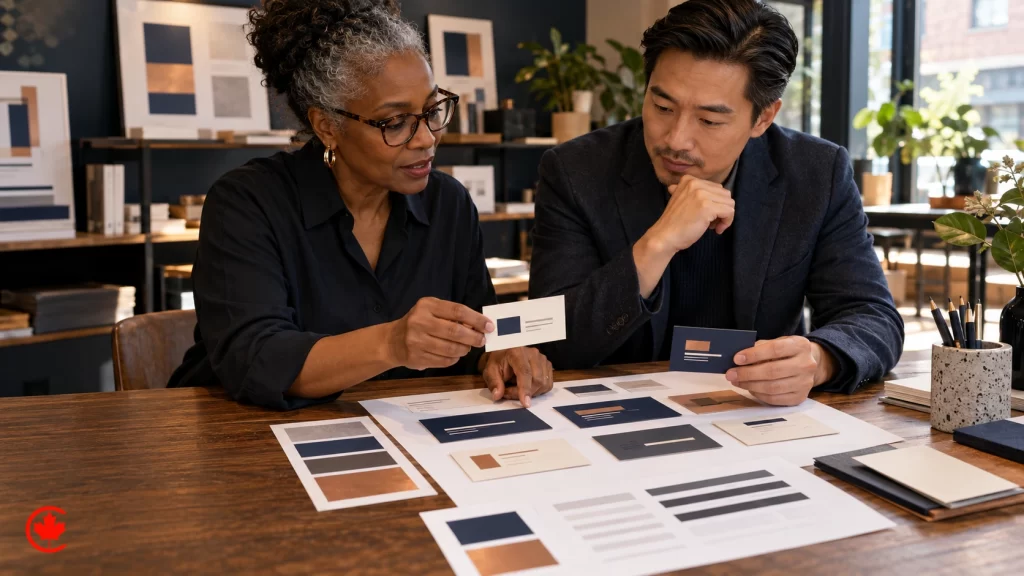
A business card is one of the smallest brand pieces you own, and it shows inconsistency more than anything else. A logo stretched to fit, a colour that does not match the van, or a typeface that differs from the website all make the business look less settled.
Logo, colour and type
We work from your existing brand: the logo files, the colour references for print, and the typefaces. If the logo exists only as a blurry image or a file from an old website, it is redrawn as a clean vector before any card is designed. Where the brand itself needs work, our brand identity and branding service sets the foundation, and custom logo design covers a new or refreshed mark.
Layout choices
Horizontal cards suit most professional offices and fit standard card holders. Vertical layouts stand out for creative businesses such as photographers, florists and boutiques. Minimal cards with lots of space feel premium for a law firm or a design studio; a busier card with a photo of the work can suit a renovation company. Real estate agents and some advisers like a portrait on the back; a recent, consistent headshot from a professional photography session keeps the whole team looking alike. The card should be designed at the standard size used in Canada, 3.5 by 2 inches, unless there is a reason to choose a square or slim format.
Readability
Small type on a dark textured stock looks elegant in a mock up and fails in a dim restaurant. Text size, weight and contrast are checked so the phone number and email can be read easily, including by people with lower vision.
Cards for a whole team and reorders
For one owner, a card is a single design. For a firm, a dealership, a clinic or a sales team, it is a system that has to stay consistent across dozens of people and years of staff changes.
A template for every role
A team card design fixes the layout, type sizes and colour, then sets rules for the variable parts: how long a title can be, how credentials are written, which phone lines appear, and how a person with a long name is handled. That keeps an associate’s card looking identical to a partner’s, apart from the details.
Ordering for new hires
When someone joins, the information is collected in a consistent way, checked against the template, proofed and sent to print. Keeping a simple order record of who has which card, and when it was last printed, avoids the common problem of a departed employee’s cards still sitting at reception.
Trade shows and events
Before a trade show, a sales team often discovers that many of its cards are out of date. Checking titles and numbers well before the booth is packed, and printing a fresh run with a QR code that leads to a show specific page, means every card handed out can be followed up. A short line on the back such as “Met us at the show? Book a demo” gives the card a job after the event.
Cards for the truck and the site
A plumber or landscaper hands out cards in wet boots, from a glovebox, to people standing in a driveway. Those cards need a heavier, coated stock that survives a pocket, large phone numbers, and the service area named clearly. A desk based professional can choose delicate textured paper; a field crew needs something sturdier.
Locations and departments
Businesses with several branches, such as a property management company or a chain of physiotherapy clinics, often need the same card with different addresses and phone lines. A franchise needs local details while protecting the head office brand. These variations are planned at the start so later orders are straightforward.
English and French business cards
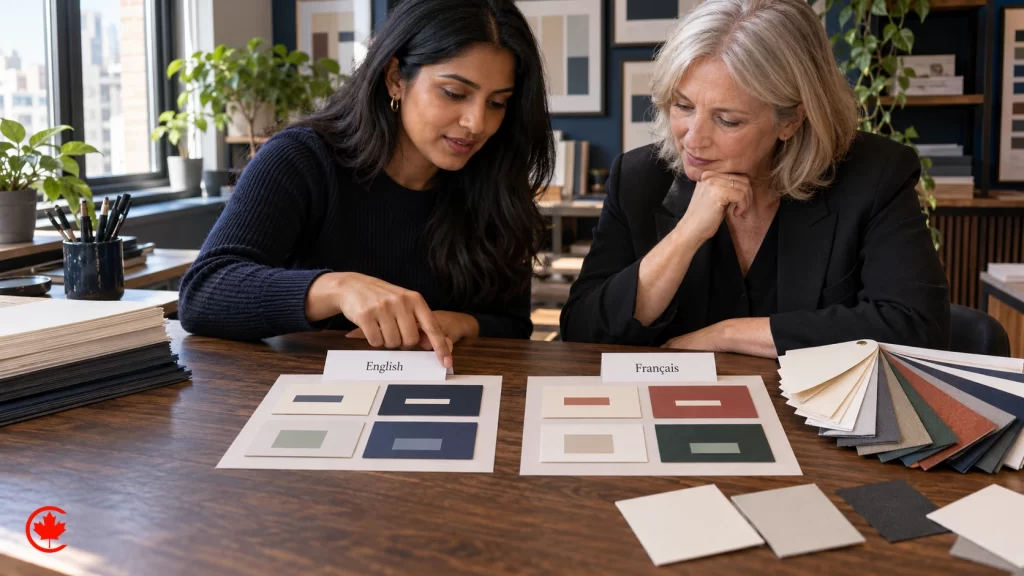
Bilingual cards are common for businesses that serve customers in Quebec, Ottawa and Gatineau, New Brunswick and francophone communities across Canada, and for federal suppliers. There are two usual approaches.
Two languages on one card
English on one side and French on the other gives each language equal space and keeps both clean. Titles, service lines and addresses are translated properly rather than word for word, and French typography (spacing before certain punctuation, accents on capitals) is respected.
Separate cards by market
Some businesses print a French card for Quebec clients and an English card elsewhere. That works when people clearly serve one market or the other. Our team works in English and French, so the French wording is reviewed by French speakers rather than run through a translation tool and left at that.
Paper stocks and finishes
The feel of a card does as much as the design. Paper and finish should match how your business wants to be seen and how the card will be used.
Common stocks
- Matte coated: smooth, clean and easy to read, a sensible choice for most offices.
- Uncoated: natural and textured, easy to write on, popular with designers, cafes and wellness practices.
- Soft touch: a velvety laminate that feels expensive and resists scuffing.
- Thick or layered stock: a heavier card, sometimes with a coloured core showing at the edge.
- Recycled and textured papers for businesses that want their materials to reflect their values.
Finishes for luxury business cards
Foil stamping adds metallic gold, silver, copper or colour to a logo or name. Spot gloss raises selected areas with a shine against a matte background. Embossing and debossing press the design into the paper. Letterpress gives a deep, tactile impression on thick cotton style paper. Painted edges and rounded corners finish the piece. A jeweller, a real estate brokerage or a boutique hotel might combine two of these; a trades business usually needs a durable card that survives a work truck more than it needs foil.
Choosing sensibly
Finishes add cost and can lengthen production, and some do not suit fine type. We recommend what fits the brand and the budget, and show the effect in a proof or a printed sample where practical.
QR codes and digital cards
A QR code turns a card into a doorway. It is only worth the space if the destination is useful and kept up to date.
Where the code should lead
Good destinations include a booking page, a contact page that saves your details to a phone, a portfolio, a menu, a price request form, or a page asking happy customers to review your Google Business Profile. The code should point to a page on your own website, not a third party link that might stop working, so you can change where it goes without reprinting. A tracked link lets you see how many people scan the card, and a review card handed out after a finished job is a small but steady part of online reputation management. If the destination page is weak, our website design team can build one that works on a phone.
Size and placement
The code needs enough size and contrast to scan easily in ordinary light, and a short line nearby that says what it does, such as “Book a visit” or “Save my contact”. A code squeezed into a corner on dark foil looks stylish and frustrates people.
Digital business cards
Digital cards, shared by phone, link or tap enabled card, are a useful companion rather than a replacement. They update when details change and work well at conferences. Many professionals carry both: a printed card for the person who prefers paper, and a digital one for the person already holding a phone.
Print ready files, proofs and colour
A good design can still print badly. Print ready files and a careful proof avoid most problems.
Bleed and safe zones
Any colour or image that runs to the edge extends past the trim line into the bleed, so no white sliver appears after cutting. Text and logos sit inside a safe zone away from the trim, so nothing important is cut off when the stack shifts slightly in the cutter.
Colour on paper
Screens show colour in light; paper shows it in ink. A bright brand colour can look duller in print, and the same colour looks different on coated and uncoated stock. Files are prepared in print colour, and where a brand colour must be exact, a matched spot ink can be specified.
Proofs
Before anything goes to press you approve a proof showing the final layout, text, size and finish areas. Read every number and email aloud; spelling errors in a name or phone number are the most common and most expensive mistakes on business cards. For larger runs or special finishes, a printed proof is worth considering. The final print ready files are delivered to you, so any printer can reorder from them. Our signs and commercial printing service handles the wider print work, from signs to brochures, when cards are part of a larger order.

Language, titles and accessibility
A few rules and good practices apply to what a business card says.
French language rules in Quebec
In Quebec, the Charter of the French Language applies to commercial documents, and business cards used there are generally expected to include French, with French at least as prominent as any other language. Businesses with Quebec staff or customers should plan bilingual or French cards from the start.
Professional titles and credentials
Many professions in Canada have protected titles, and regulators set how titles and designations may be shown. Engineers, nurses, accountants, lawyers, physiotherapists and other regulated professionals should print their title exactly as their regulator allows, and nobody should print a designation they do not hold.
Legible and accessible
Strong contrast between text and background, and type that is not too small or too light, make cards usable for more people. This is a marketing observation, not legal advice.
How a business card project works
We start with a free review of what you have now: your current card, logo files, brand colours, how you hand cards out and how many people need them. You receive a written proposal with design and printing quoted in writing.
Design and proof
We prepare design options in your brand, refine the one you choose, and send a proof with every detail visible. For teams, we set up the template and collect each person’s details in one format. Nothing is printed until you approve the proof in writing.
Print and reorders
Printing is arranged on the stock and finish you chose, and print timing depends on the finish and the printer’s schedule, so plan ahead of trade shows and launches. You keep the final files and the editable templates. Reorders for new hires or changed titles reuse the template rather than starting over. Canada Create can match letterhead, envelopes and email signatures to the cards through our graphic design services, so everything you send looks like it came from one business.
What business cards cost in Toronto and what changes the price
Design and printing are quoted in writing after the free review, as separate lines so you can see what each part costs.
What drives the design fee
Whether a usable logo and brand already exist, whether the card is for one person or a team template, the number of language versions, the number of concepts you want to compare, and how much copy needs writing or checking.
What drives the print cost
Quantity per person, the number of people, paper stock and thickness, single or double sided printing, and finishes such as foil, spot gloss, embossing, letterpress, painted edges or rounded corners. Rush printing, when a printer can offer it, adds cost. A plain matte card and a foil stamped letterpress card can differ greatly in price for the same quantity, which is why we quote both design and printing in writing for your exact choice.
How to compare business card designers in Toronto
Online card templates and print shops can produce a card quickly. The question is whether the result looks like your brand, holds up in the hand and can be reordered consistently. Ask any designer or printer:
- Who owns the accounts? The answer should be you: the final print ready files, editable templates and any QR link should belong to your business.
- Will the card use my real logo files and brand colours, or a template look alike?
- Can you build a team template so new staff cards match?
- Will I see a proof with every detail before printing?
- Can you prepare French or bilingual versions properly?
- Where will the QR code point, and can I change it later without reprinting?
- Who does the design work, and can I see cards you have designed and read your Google reviews?
Send your current card for a business cards design proposal
Whether you need one card for a new business or a template for a whole firm, book a free business card review. Send your current card and logo files and tell us how many people need cards; we reply with a written proposal covering design and printing. Call (416) 273-9030, Monday to Friday, 9 am to 6 pm, and Saturday, 10 am to 2 pm. After hours, our 24/7 AI agent answers the toll-free line, +1 (800) 808-9235, and we’ll follow up the next business morning. You can also send your card details through our contact page; we reply within one business day. Our office is at 126 Willowdale Avenue, Suite 3, Toronto.
Talk to a strategist
Ready when you are?
Request a custom proposal
Tell us your goals, budget and timeline. You get a custom proposal and a named strategist, so your next stage of growth starts now.
Our business cards process: review, proof, print and reorders
Every step is written down, and the final files and templates belong to your business.
- Free review First call
We look at your current card, logo files and how cards are used.
- Written proposal Written proposal
Design and printing quoted in writing as separate lines.
- Design and proof Agreed milestones
Options, refinements and a proof you approve before printing.
- Print and reorder Ongoing
Printing arranged and new staff cards made from the template.
Toronto design team since 2008, BBB A+, for your business cards
Since 2008
More than 18 years of websites, search and advertising work for businesses across Canada.
BBB Accredited A+
A BBB Accredited Business with an A+ rating and zero complaints.
Toronto office
126 Willowdale Avenue, Suite 3, Toronto, serving businesses across Canada.
English and French
Our team works in English and French.
Business cards Toronto: questions buyers ask
How much should a business pay for business cards in Toronto?
The total depends on how many people need cards, the stock and finish, whether the card is double sided or bilingual, and how many you print. Plain cards for one owner cost far less than foil, spot gloss or letterpress cards for a whole team. We list design and printing as separate lines in a written quote once we have looked at your current card or logo, which costs nothing.
Does ordering more business cards lower the price per card?
Usually, yes. Printers spread setup work across the whole run, so a larger quantity tends to cost less per card than a small one. Ordering more only helps if the details will stay accurate, so think about titles, phone numbers and staff changes before choosing a big run.
What makes a good business card for a Canadian business?
A good card matches your brand, so the logo, colours and type agree with your website and signs. The details appear in an order people can read at a glance, and the paper and finish suit how the card is used. You should also keep the print ready files and an editable template, so reorders do not start from scratch.
Are cheap online business cards good enough?
Cheap online cards can be fine for a quick need if you upload a proper print file. Problems start when a generic template does not match your brand, the logo is a low resolution copy or nobody checks bleed and safe zones. Thin stock also says something about a business before you speak.
What size are business cards in Canada?
The common size in Canada is three and a half by two inches, the same as most card holders and wallets expect. Square and slim cards exist, but they may not fit standard holders. Print files need bleed beyond that trim size and a safe zone inside it, so nothing important gets cut off.
What should a business card include, and what should be left off?
Put your name, title or permitted credentials, one direct phone number, an email on your own domain and a short website address. Add an address only if people visit you. Leave off fax numbers nobody uses, every social platform you have joined and personal mobile numbers you would rather not circulate.
Should business cards have a QR code?
A QR code helps when it leads somewhere useful, such as a booking page, your reviews or a contact page. Point it at a page on your own website that you can update, so the printed code keeps working after details change. Test the code on several phones before printing.
Can business cards be printed in both English and French?
Yes. A bilingual office often uses one side for English and the other for French, and the French wording is reviewed by French speakers before printing. Titles and credentials should read correctly in both languages.
Can business cards be printed the same day in Toronto?
Plain digital printing can be quick at some print shops, but premium finishes such as foil or letterpress take longer to produce. The proof has to be approved before anything prints, and checking it carefully saves a reprint. Delivery timing for your order is confirmed in writing once the stock and finish are chosen.
How do we keep business cards consistent across a whole team?
A team template sets rules for names, titles, credentials and phone lines, so every card follows the same layout. Details are collected per person and each card gets its own proof. New hires are then added from the template without redesigning anything.


Hand out a card you are proud of
An outdated or mismatched card undercuts every first meeting. A short review shows what to change and what it will cost. Book a free business card review.