
Toronto · Architect SEO
Architect SEO in Toronto
Architect SEO in Toronto gets your practice found for the projects you want: custom homes, laneway suites, additions, multi-residential, commercial and heritage work.
SEO for architects in Toronto and the GTA, from North York to downtown: project pages, building type and service pages, map listings and fast portfolio sites.
- BBB A+ accredited
- 18 years in business
- Mon to Fri 9 to 6, Sat 10 to 2
Get a custom proposal for your architect SEO
Tell us the project types you want more of, the areas you practise in and your website address. We reply with a custom proposal.
Please do not share passwords or other sensitive details here. We never sell your contact information and we comply with Canadian privacy law
(privacy policy).
Signs architect SEO is working: projects found and studio on the map
Projects that can be found
Portfolio work rewritten so each project page can be found for its building type and place.
Pages for the work you want
Building type and service pages that match the commissions the practice is looking for.
A studio that shows on the map
A complete Google Business Profile and consistent directory details for the studio.
Enquiries you can trace
Monthly reporting of enquiries by project type and the pages that produced them.
What is included in architect SEO
We choose the parts after a free review of your practice. These are the ones architecture firms use most.
- Project page rewritesDescriptive titles, briefs, site constraints and design decisions added to portfolio projects.
- Building type pagesCustom homes, laneway and garden suites, additions, multi-residential, commercial, institutional and heritage.
- Service pagesDesign phases, permits and approvals coordination, feasibility studies and interior architecture.
- Location pagesPages only for the neighbourhoods and towns where the practice really works.
- Client question articlesFees, architect versus designer, permit overviews and laneway suite feasibility, approved by the principal.
- Google Business ProfileCategories, services, project photos, posts and review replies for the studio.
- Technical workImage sizing, alt text, crawlable project navigation, structured data and speed fixes.
- Monthly reportingRankings, project page visits and enquiries by project type and source.
Architect SEO: fees quoted in writing
SEO is quoted in writing after a free review. Ad spend and software licences are paid to the platform and shown separately.
Studio SEO
Quoted in writing after a free consultation
Sole practitioners and small studios in one city
- Project page rewrites
- Core building type pages
- Google Business Profile
- Monthly reporting
Practice SEO
Quoted in writing after a free consultation
Firms working across several building types
- Building type and service pages
- Client question articles
- Directory consistency
- Technical fixes
Multi-location SEO
Quoted in writing after a free consultation
Firms with several studios or regions
- Location pages for real work areas
- Profiles for each studio
- Structured data
- Reporting by studio
Portfolio rebuild
Quoted in writing
Practices whose site holds only galleries
- Site structure plan
- Image optimization
- Project templates
- Hosting and maintenance
Ad spend and software licences are paid to the platform directly and shown separately from our fees.
Architect SEO
A portfolio that search engines can read
Architecture clients search for the project, not the practice name. Architect SEO in Toronto is the organic search work that gets an architecture practice, its projects and its services found on Google, in Google Maps and in AI search answers when a homeowner, developer, school board or business owner starts looking for an architect. It is for residential studios, custom home and laneway suite designers, multi-residential and commercial practices and heritage specialists who want more of the right project enquiries from search, not just more visitors to a portfolio. Canada Create has worked with Canadian businesses since 2008, is BBB Accredited with an A+ rating and works from 126 Willowdale Ave. in Toronto. This page sets out what search work a practice actually needs, and it sits within our SEO services in Toronto.
Our architect SEO covers six areas:
- Project pages that tell the story of each commission in words search engines can read.
- Building type and service pages for additions, custom homes, laneway suites, multi-residential, commercial and heritage work.
- Location pages for the areas you really practise in, without swapped-city copies.
- Google Business Profile and directories for the studio, with accurate use of the protected title.
- Technical SEO for image heavy portfolio sites: speed, image files and indexing.
- Reporting on enquiries by project type and source, not only rankings.
- How clients look for an architect
- Project pages that work as search assets
- Pages by building type and by service
- Location pages for the areas you really practise in
- Content that answers client questions
- Google Business Profile and directory listings for the studio
- Technical SEO for an image heavy portfolio
- How search fits with the rest of your practice marketing
- Title protection, image permissions and privacy
- How we work with architecture practices
- What architect SEO costs in Toronto and what changes the fee
- How to compare architect SEO companies in Toronto
- Send your portfolio for an architect SEO review and custom proposal
How clients look for an architect
Very few clients type the name of a practice. They type the project. A couple with a tired bungalow in Willowdale searches architect for second storey addition. A family with a deep lot in the east end searches laneway house architect or garden suite designer. A developer assembling a site on an avenue searches multi-residential architect Toronto. A church committee searches heritage architect for restoration. Then come the broad terms: architect near me, residential architect, architecture firm Toronto, commercial architect. Each of these is a different person with a different budget and a different set of worries, and each needs a page on your site that speaks to their project.
What a client weighs before the first call
Architecture is a trust purchase with a long tail. Clients compare portfolio fit first: have you designed something like what they want, at a similar scale, on a similar lot? Next they look at project type experience, the way you describe your process, how fees are structured (percentage of construction, fixed fee by phase or hourly), and whether the principal seems like someone they could spend a few years of decisions with. Search results that show a relevant project, a clear explanation of phases and a few honest reviews put you on the shortlist before a single email is sent.
The second group of searches: cost and comparison
Before calling anyone, many homeowners search how much does an architect cost, architect vs architectural designer, do I need an architect for an addition, or how long does a building permit take in Toronto. These questions arrive early in the project, when the client is still deciding whether to hire an architect at all. A practice that answers them clearly is the one the client remembers when they are ready to talk.
Project pages that work as search assets
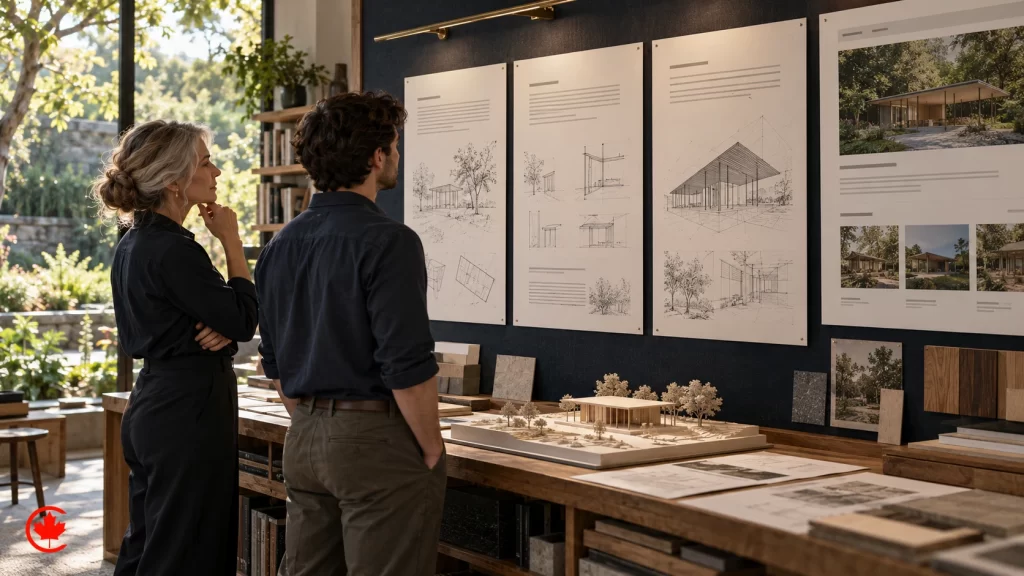
Most architecture sites hold their strongest material in a gallery: twenty large photographs, a project name such as Ravine House, and perhaps a line of text. Search engines cannot read a photograph the way a client does, so a gallery like that ranks for almost nothing. A project page built for search keeps the photography but adds the words a client would use: the building type, the neighbourhood or town, the scope, the constraints and how the design answered them.
What a strong project page contains
- A plain descriptive title alongside the poetic name, for example a rear addition and full interior renovation of a semi in Leslieville.
- The brief and the site: a narrow lot, a ravine setback, a heritage district, a sloping grade or a tight laneway.
- The approvals path described in general terms, such as whether a minor variance was needed, without promising anything about anyone else’s file.
- Design decisions: why the stair moved, why the clerestory, why brick rather than cladding.
- Credits for the builder, engineer and photographer, with permission.
- Links to the matching building type page and to related projects.
Case narratives without invented outcomes
A project story should describe what was designed and why, in the firm’s own voice. It should not claim savings, property value gains or approval odds that cannot be shown. A story that says the owners wanted light in the kitchen and a way to see the kids in the yard, and then shows how the section achieved it, is more persuasive to a future client than any number, and it stays accurate.
Over time, a body of well written project pages becomes the backbone of your search presence: each one can be found for its own combination of building type and place, and together they show a prospective client the range of the practice.
Pages by building type and by service
Clients search by what they are building, so the site needs a page for each kind of work the practice wants more of. These pages do the heavy lifting for searches like custom home architect or architect for a multi-unit building, and they are where a visitor decides whether you are the right fit.
Building type pages
- Custom homes and replacement homes: teardown and rebuild on an existing lot, zoning envelope, the sequence from feasibility to construction drawings.
- Laneway and garden suites: what makes a lot suitable, servicing and fire access questions in general terms, and how a suite sits beside the main house.
- Additions and renovations: second storey, rear and side additions, basement underpinning and interior reconfiguration.
- Multi-residential: multiplexes, low-rise and mid-rise rental, and infill on main streets.
- Commercial and retail: office fit outs, storefronts, restaurants and mixed-use buildings.
- Institutional: schools, places of worship, community and health facilities.
- Heritage: restoration, adaptive reuse and additions to designated or listed buildings.
Service pages
A second set of pages describes what the practice does across project types: architectural design from concept through construction documents, permits and approvals coordination, committee of adjustment applications explained generally, contract administration during construction, feasibility and zoning studies, and interior architecture. Each service page should explain what the client receives at each phase and how the work is billed, because fee structure is one of the main things architects are compared on. Interior design studios that work alongside you can be mentioned in passing, but these pages stay focused on architectural services.
Choosing which pages to build first
A practice that wants fewer small renovations and more custom homes should not build ten renovation pages. We start from the work you want, the work you can show and the searches clients actually use, and build those pages first. A studio with three strong laneway suites and a passion for them gets a laneway page before it gets a commercial page it cannot support with projects.
Location pages for the areas you really practise in
Clients often add a place to their search: architect Oakville, residential architect North York, heritage architect Cabbagetown. Location pages can capture these, but only when they are real. A page for a town where the firm has never worked, filled with generic text, adds nothing for the reader and can drag down the rest of the site.
What makes a location page worth having
A strong location page talks about building in that place: typical lot sizes and house types, the kinds of projects the practice has completed there, the planning context described in general terms, and links to the projects nearby. Toronto neighbourhood pages might cover the character of Victorian semis in Riverdale or postwar bungalows in Don Mills; a page for a cottage region might cover building on rock, septic and water access, and seasonal construction. Each page should only exist if the practice can write it from experience.
These pages also support the map listing for the studio. Our local SEO work for Toronto practices covers how the address, service area and local pages fit together so the studio shows up when someone nearby searches for an architect.
Content that answers client questions
The questions clients ask on the first call are the same ones they type into Google beforehand. Writing clear answers on your site brings these early researchers to you and lets them get to know your thinking before they meet you.
Questions worth answering on an architect’s site
- How much does it cost to hire an architect? Explain the common fee structures and what changes the fee, such as scope, complexity, phases included and contract administration, without printing a rate card.
- Architect or architectural designer? Explain the difference in licensing and scope accurately and respectfully.
- How does the permit process work? An overview of drawings, zoning review, building permit and inspections, stated generally.
- What is a minor variance? A plain explanation of when a committee of adjustment application may be needed.
- Can my lot take a laneway or garden suite? The questions that decide feasibility.
- What happens in each design phase? Schematic design, design development, construction documents and construction administration.
Our content writers work from interviews with the principal so the answers sound like the practice, not like a textbook. The principal approves every article before it goes live.
Being cited in AI search answers
More clients now ask an AI assistant the same questions, for example what to ask an architect before hiring one. These tools draw on clear, well structured pages that answer a question directly and show who wrote them. Question pages with short direct answers, named authors, project examples and consistent studio details give the practice a better chance of being cited. Our AI search optimization service covers this in more depth; no one can promise that a particular answer engine will name you.

Google Business Profile and directory listings for the studio
When someone searches architect near me, the map results appear above the organic list. The studio’s Google Business Profile decides whether you show up there and what a client sees when you do.
Setting up the profile for an architecture practice
The profile should carry the correct primary category, the studio address and hours (or by appointment), a description of the practice and the project types it takes on, photographs of finished buildings and the studio itself, and services listed in the words clients use. Posts about completed projects and site visits keep it current. Reviews matter as well: past clients can be asked politely after occupancy, and every review gets a considered reply. We handle this through our Google Business Profile management and keep it consistent with the website.
Directories and consistency
Architects are listed in professional association directories, local business directories, design publications and builder networks. The studio name, address, phone number and website should read identically everywhere. A firm that moved studios or changed its name after a partner left often has old details scattered across the web, which confuses both clients and search engines. Cleaning these up is unglamorous and useful.
Technical SEO for an image heavy portfolio
Architecture sites are beautiful and often slow. Full bleed photographs exported straight from the photographer, sliders on every page and heavy animation make a site that impresses on a studio monitor and stalls on a phone in a client’s kitchen. Search engines measure that experience and rank accordingly.
What we look at on a portfolio site
- Image sizing and format: serving modern formats at the size the screen needs, with lazy loading below the first view.
- Descriptive file names and alt text: a rear addition kitchen with skylights in Leslieville instead of IMG_4482.
- Page structure: one clear heading per page, project text that is real text and not baked into images.
- Crawlable navigation: projects reachable by building type and place, not only through a filtered gallery script.
- Structured data for the studio, its address and its projects where appropriate.
- Hosting and maintenance: a fast, secure server and updates kept current.
Many practices built their site on a template that was chosen for looks. Sometimes the fix is a set of changes inside it; sometimes the site needs rebuilding, which our website design for construction and design firms handles. Fast, secure website hosting supports either path.

How search fits with the rest of your practice marketing
Search is one channel of several. The wider plan for a practice, including brand, portfolio presentation, publications and referral relationships with builders, is covered on our architecture marketing page, and the construction and design marketing hub shows how we serve the whole building sector. Strong photography and drone work from our architectural photographers feed every project page, and photoreal renderings let you show work that is still on the boards, labelled clearly as concepts. Builders you partner with may have their own search needs, covered by SEO for builders and contractors. For practices that design for developers, the pages in this batch called Real estate developer marketing and Real estate developer CRM describe the developer side of the same projects.
Enquiries from search should land somewhere organized. A short form that asks project type, location, approximate budget range and timing, routed into CS+, our CRM, lets the principal see which pages produce serious enquiries and which produce tyre kickers.
Title protection, image permissions and privacy
The word architect is a protected title in Canada. Only licensed members of the provincial association may call themselves architects (in Ontario that is the OAA), and firms offering architectural services need a certificate of practice. Advertising by architects is expected to be factual. For search, this means page titles, profile categories and directory listings must use the title accurately, and a designer who is not licensed must not be described as an architect anywhere on the site, including in alt text and structured data. This is a marketing observation, not legal advice.
Photographs and project details
Project photographs need permission from the clients whose homes appear and licence terms from the photographer that allow web use. Some private clients prefer that their street or neighbourhood is not named; their project page can describe the building without giving away the address.
Enquiry data
Contact forms collect personal information, so the site needs a clear privacy policy and handling in line with PIPEDA in general terms. Any newsletter or follow-up email needs consent under CASL, a clear sender identification and an unsubscribe link. Analytics and any advertising audiences must not carry sensitive personal details about prospective clients.
How we work with architecture practices
- Free review. We look at your site, project pages, map listing, directory details and where enquiries come from now, and talk with the principal about the work you want more of.
- Custom proposal. A plan that names the building type, service, location and question pages to build or improve, the technical fixes and the profile work, with fees quoted in writing.
- Build and improve. We write and rebuild pages in agreed milestones, with the principal approving project stories and any wording about licensure and approvals.
- Monthly reporting. Rankings for the searches that matter to you, visits to project and service pages, and enquiries by project type, so you can see which work search is bringing in.
Every account, from Google Business Profile to analytics, sits in the practice’s name. If a partner leaves or the firm restructures, the search history and profile stay with the studio.
What architect SEO costs in Toronto and what changes the fee
The fee for a practice is quoted in writing after the free review. Several things move the fee for an architecture firm:
- The number of project pages to write or rebuild, which depends on how much of the portfolio is currently only photographs.
- How many building types and locations the practice wants to be found for.
- The state of the site: a slow, image heavy template needs more technical work than a lean one.
- Content volume: how many client question articles and guides are written each month.
- Photography, if projects need new shoots or the existing images lack web licences.
A sole practitioner focused on additions in two neighbourhoods needs far less than a multi-studio firm working across residential, institutional and heritage projects in several cities. Any paid advertising or software licences are paid to the platform and shown separately from our fees.
How to compare architect SEO companies in Toronto
Questions worth asking any agency before you hand over the keys to the studio’s search presence:
- Who owns the accounts? The answer should be you: the domain, analytics, search console and Google Business Profile all in the practice’s name.
- Who writes the project stories? Look for writers who interview the principal and understand phases, approvals and building types.
- How will they treat the protected title? They should check every page, listing and alt text for accurate use of the word architect.
- Will they keep the design intact? Search improvements should respect the visual quality of the portfolio rather than cover it in keyword blocks.
- What do they report? Enquiries by project type and source, not only rankings and traffic.
- Are the reviews real? Read Google reviews from other professional firms, not only the agency’s own case studies.
- Do they promise rankings? Rankings depend on competitors and search engine changes, which no agency controls. Be wary of anyone who promises first place.
Related guide: how architects and interior designers win better projects in Canada.
Send your portfolio for an architect SEO review and custom proposal
Send us the address of your portfolio site and tell us which commissions you want more of, whether that is laneway suites in the east end, custom replacement homes north of Lawrence or institutional work across the province. We will go through your project pages, building type coverage, studio map listing and image loading on a phone, and come back with a custom proposal and fees quoted in writing. The free review costs nothing. Call (416) 273-9030, Monday to Friday, 9 am to 6 pm, and Saturday, 10 am to 2 pm. After hours, our 24/7 AI agent answers the toll-free line, +1 (800) 808-9235, and we’ll follow up the next business morning. We reply within one business day. You can also reach us through our contact page. Canada Create works from 126 Willowdale Avenue, Suite 3, Toronto, for architecture practices across Canada.
Talk to a strategist
Ready when you are?
Request a custom proposal
Tell us your goals, budget and timeline. You get a custom proposal and a named strategist, so your next stage of growth starts now.
How we build your search presence
Clear steps, fees quoted in writing and every account in the practice's name.
- Free review First call
We look at your site, project pages, map listing and current enquiry sources.
- Custom proposal Written proposal
Pages, fixes and profile work by priority, with fees quoted in writing.
- Build and improve Agreed milestones
Pages written and rebuilt, with the principal approving project stories.
- Reporting Every month
Rankings, page visits and enquiries by project type and source.
Why architecture practices choose Canada Create
Since 2008
More than 18 years of websites, search and advertising work for businesses across Canada.
BBB Accredited A+
A BBB Accredited Business with an A+ rating and zero complaints.
Toronto office
126 Willowdale Avenue, Suite 3, Toronto, serving businesses across Canada.
English and French
Our team works in English and French.
Architect SEO in Toronto: questions practices ask
How can an architecture firm get more clients from search?
Give clients a page for the project they have in mind, because very few of them type the name of a practice. A couple planning a second storey addition, a family with a deep lot looking at a laneway house, and a developer assembling a multi-residential site all search in different words. Portfolio projects rewritten to name the building type and the place, plus a complete Google Business Profile, put the studio in front of those searches.
Which SEO strategies suit architectural firms?
Begin with the portfolio, since most practices keep their strongest material there, and add the brief, site constraints, and design decisions to each project page. Next come building type pages and service pages for the commissions the practice wants, such as custom homes, additions, permits coordination, or feasibility studies. Location pages make sense only for neighbourhoods and towns where the studio has real work. Articles on fees or on hiring an architect versus a designer help clients who are still deciding, once the principal approves them.
How much does SEO for an architecture practice cost in Canada?
The price follows the scope: how many building types and services need pages, how many studios or regions you cover, how competitive your project types are, and whether the portfolio site needs rebuilding. A sole practitioner in one city needs less work than a firm with several studios. After a free consultation, the studio receives a custom proposal with the fee set out in writing. Ad spend and software licences go to the platform and appear on their own line.
Is SEO for an architect paid or free?
Organic listings on Google carry no charge per click, which is how they differ from paid search ads. Earning them still takes time or budget, because someone has to rewrite project pages, size images properly, fix site structure, and keep the studio profile current. Plenty of practices keep part of it within the studio and hire outside help for what remains.
Will AI search replace SEO for architecture firms?
AI answers still draw on web pages, so a practice needs pages that an AI tool can read and quote. A gallery of twenty photographs and a project name gives it almost nothing to work with. A project page that states the building type, location, brief, and design approach does, and the same page helps on Google and in Maps.
What does an SEO agency for architects do?
It handles the organic search work that gets a practice, its projects, and its services found on Google, in Google Maps, and in AI answers. At Canada Create that can mean project page rewrites, building type and service pages, client question articles, studio profile work, technical fixes for an image heavy site, and monthly reporting of enquiries by project type. Which parts you need is decided after a free review of the practice.
How does local SEO for architects work?
Local SEO helps a studio appear on the map when someone nearby looks for an architect. Most of it rests on a complete Google Business Profile with the right categories, services, project photos, posts, and replies to reviews. The studio name, address, and phone number should also match across directories, and neighbourhood pages should exist only where the practice has real projects.
What keywords should an architect's website target?
Target the phrases clients use for their project, such as laneway house architect, heritage architect for restoration, or architect for second storey addition, along with broad terms like residential architect. Each of those searchers has a different budget and different worries, so each group deserves its own page. Questions about architect fees or permit timing are worth answering in articles, because clients ask them before they pick up the phone.
Can interior designers use the same SEO approach as architects?
Yes, interior design studios benefit from the same project pages, service pages, and Google Business Profile work. Ontario reserves the title architect for members licensed by the Ontario Association of Architects, so a designer's pages should describe the services offered without claiming that title. Confirm the present wording rules with the OAA before a page goes live.


A gallery of photos ranks for almost nothing
Clients search by project type and place, and a portfolio without words cannot answer them. Start with a free review of your project pages and map listing.