
How plumbers win more emergency and drain calls in Canada

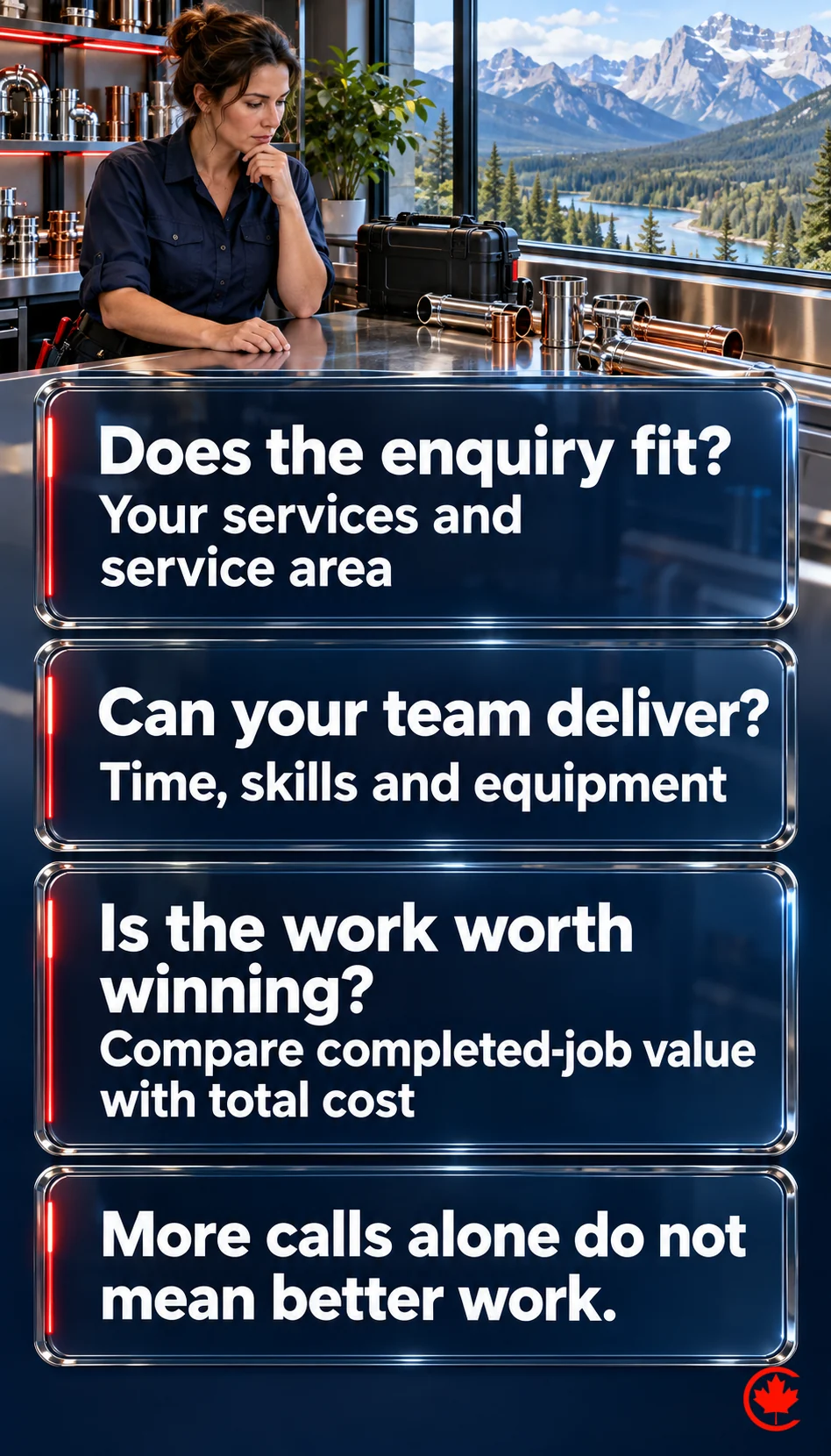
An emergency plumbing enquiry is not automatically a profitable job. The caller may be outside the service area, need equipment the business does not have available, expect a visit sooner than anyone can arrive or decline once the service fee is explained. Even a suitable call can be lost between answering, dispatch and completion. For a plumbing owner, getting more calls is only useful when the business can turn the right enquiries into work it can deliver responsibly.
Emergency repairs, routine drain cleaning, water heater work and larger sewer projects also have different economics. A short callout and a multi-stage investigation should not be judged as if they have the same labour requirement, purchase timeline or amount left from collected revenue after direct job costs, before marketing and fixed overhead. Marketing becomes more useful when those differences are visible before the business buys additional demand.
This guide explains how to evaluate plumbing marketing as an owner: the meaning of search estimates, the limits of a 24-hour promise, channel choices, service-area trade-offs, completed-job economics and the evidence needed to judge a provider. It is not a plumbing-repair tutorial or an advertising setup manual. The practical aim is suitable work, clear customer expectations and a business case that survives more than an attractive lead-count headline.
For example, a hypothetical two-van company with spare daytime capacity faces a different decision from a company receiving more night calls than its on-call team can handle. The first may need additional discovery among nearby customers. The second may need a narrower promise, stronger handoff or a different service mix. Buying the same marketing package for both would ignore the problem that actually needs solving.
How much plumbing Google Ads cost per click
National search figures can help identify the kinds of plumbing services people look for. They are a useful starting point for a discussion about demand, not proof that a particular company can acquire a predictable number of local jobs. The historical Canada-wide estimates below distinguish broad local plumbing interest from more specific drain, emergency and water heater searches.
| Search | Estimated monthly searches in Canada | Estimated cost per click, relative |
|---|---|---|
| plumber near me | 49,500 | High |
| drain cleaning | 9,900 | Lowest of the six |
| emergency plumber | 6,600 | Highest of the six |
| drain cleaning near me | 3,600 | High |
| water heater replacement | 1,900 | Moderate |
| sewer line repair | 720 | Lower |
We run search ads, Local Services Ads and websites for plumbing companies.
Search counts and click costs are estimates, not measured results from a particular advertiser or current prices.
The difference between “drain cleaning” and “drain cleaning near me” is useful to notice, but it should not be overinterpreted. Local wording can suggest that someone wants a nearby provider. The CPC difference alone does not prove urgency, reveal why advertisers bid a certain amount or establish which phrase will produce better customers for your business. Those conclusions require evidence beyond the table.
Likewise, a search for an emergency plumber is not a verified emergency service opportunity. The person may be researching prices, contacting several businesses, looking for a different location or seeking a service the company does not offer. That does not make the enquiry worthless; it means the commercial model must allow for the distance between expressed interest and accepted, completed work.
National volume also includes demand outside the territory you can serve. An urban company with a compact route, a rural operator facing long travel times and a specialist undertaking larger projects should not translate the same total into the same budget. Related searches may overlap, and repeated searches are not necessarily different households. Summing the table is not a reliable estimate of unique available customers.
Click cost estimates are not the same as the price quoted by a marketing provider, the final charge in an advertising account or a cost per booked job. A fair commercial comparison identifies media costs, provider fees and any answering or other incremental services instead of blending unlike numbers.
Even urgent-service demand should not be forced into a simple seasonal story. Across Canada, monthly “emergency plumber” searches are estimated at about 14,800 in September and about 2,900 in February. That pattern does not identify the cause or predict the next local peak. It is a reason to compare assumptions with actual observations rather than automatically treating cold weather as the only source of urgent demand.
The useful question is what the evidence changes. It may justify distinguishing urgent calls from planned water heater enquiries, or evaluating whether a drain specialist needs a different proposition from a general plumbing company. If the research does not affect the service mix, territory, customer promise or measurement approach, a long keyword table has not yet become a useful business decision.
Be reachable when it matters
“Open 24 hours,” “calls answered 24 hours” and “a plumber can attend now” describe different services. An owner should decide which promise the business can genuinely make. An answering service may be available while technicians are not. A technician may be on call but already committed to another job. A customer in distress needs an honest next step, not an availability claim that becomes less clear after the call.
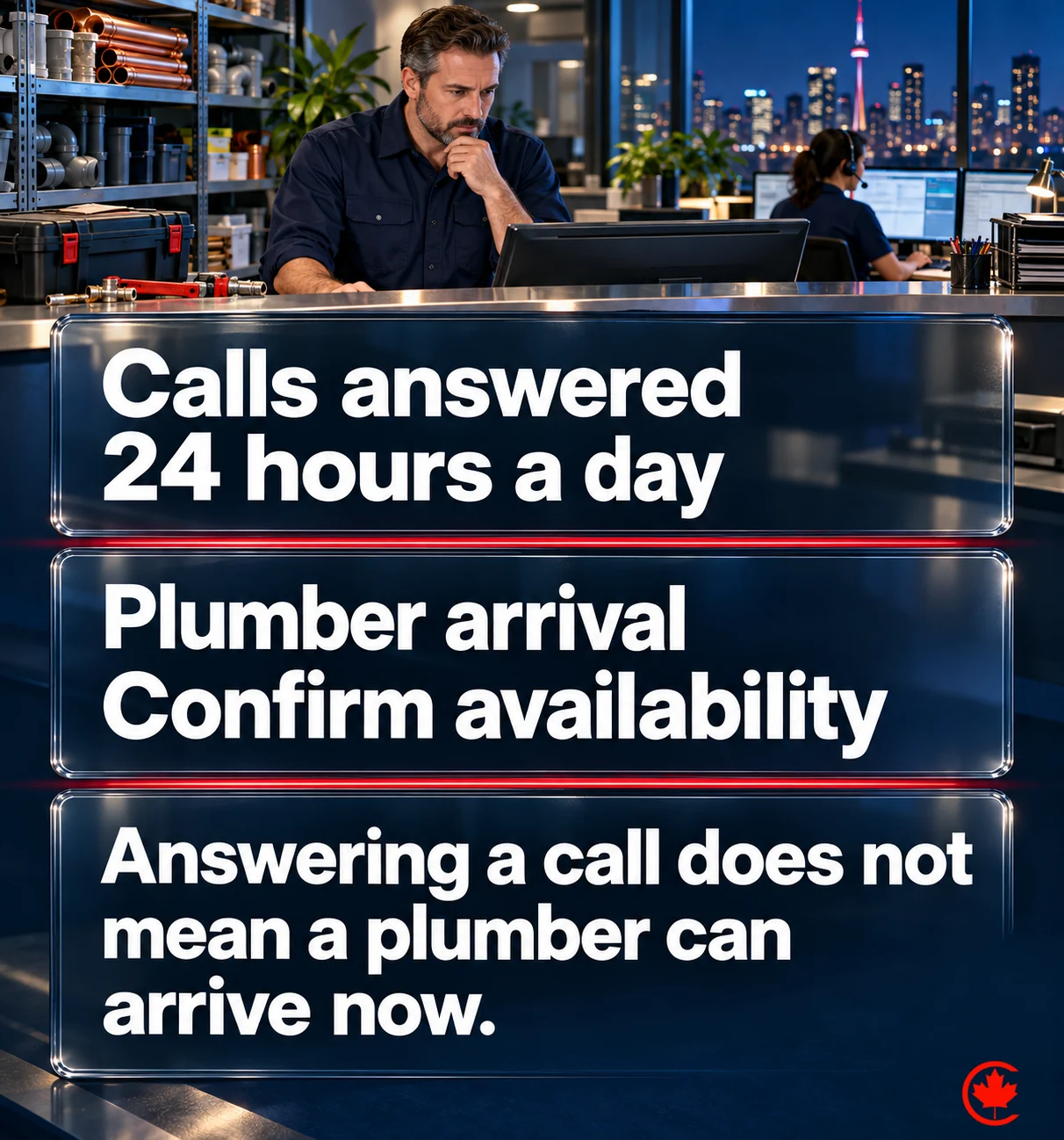
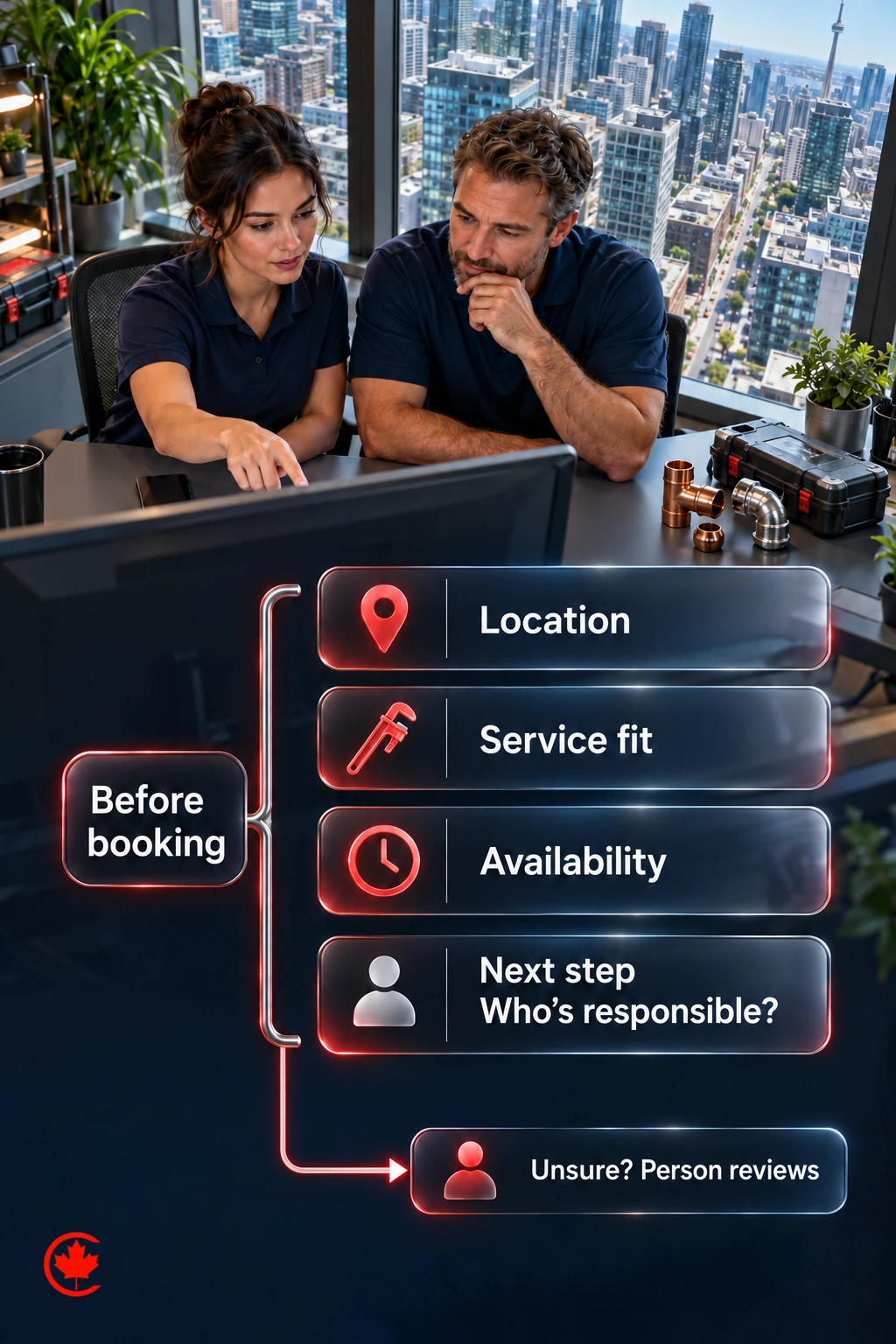
The important boundary is between receiving the enquiry and accepting the work. Before a booking is confirmed, someone needs enough information to establish location, broad service fit, availability and the relevant next step. This does not require an unqualified person or an automated system to diagnose the problem. It requires clarity about what the company can responsibly agree to do.
An AI receptionist may be worth considering when missed contact or inconsistent information capture is the main gap. Its value should be judged against a defined role. The owner needs to understand what it can communicate, when a person takes over, how an uncertain request is handled and whether it can make commitments the dispatch team can actually honour. Answering more calls is not the same as delivering more service.
Human answering arrangements need the same scrutiny. A friendly response is useful, but the handoff can still fail if messages arrive without essential details, no one owns the callback or appointment promises do not reflect the current schedule. Comparing providers by price per answered call alone can overlook the much more important question of whether suitable customers reach the correct next step.
A hypothetical evening illustrates the risk. The company has one on-call plumber available, already attending a job of uncertain duration. Three new callers request immediate help. The business cannot responsibly treat all three as confirmed immediate appointments. It may be able to explain a realistic callback or availability process, but the decision must reflect actual capacity rather than the wish to record three conversions.
After-hours coverage also changes the cost structure. Labour arrangements, answering, travel, access difficulties and the likelihood of a second visit can affect contribution. Those costs should be considered before the company chooses to acquire additional night or weekend work. A higher invoice does not automatically mean a better job if the extra delivery expense absorbs the difference.
The owner’s review should distinguish unanswered calls, answered but unsuitable requests, suitable requests without availability and accepted work that later failed to complete. These are different problems. More advertising might help none of them. Seeing the distinction makes it possible to improve the relevant part of the customer journey instead of buying more enquiries into the same unresolved gap.
Help nearby customers assess your plumbing service
Visibility in local search matters because a customer often needs a nearby business with appropriate availability. However, “winning” should mean earning suitable work through a credible local presence, not a promise of a particular position on a screen. A prominent appearance cannot compensate for inaccurate hours, misleading service claims or a phone conversation that contradicts what the customer just read.
Google Business Profile provides a way for a business to present information on Search and Maps. An owner evaluating local marketing does not need a tutorial in profile settings. The more useful questions are whether the representation is accurate, whether the service area is real and whether customers can tell the company handles their kind of work.
That distinction matters for specialists. A drain-focused business may not accept every plumbing request. A company doing water heater work may have limits on the systems or arrangements it supports. A broader public description can generate more contact while reducing the proportion that fits. A trustworthy marketing proposal explains the business’s actual scope rather than treating the largest possible list of services as the goal.
Customer proof should also be relevant and genuine. Real examples, accurate credentials and clear explanations of how the service works can help someone evaluate a business. They should not imply that a photograph proves the outcome of every job or that a review ensures the same experience for the next customer. Credibility depends on a consistent picture, not the number of trust symbols placed beside a phone number.
Review practices need particular care. Google’s contribution policy prohibits incentives and other manipulation, including selective solicitation of positive feedback. The owner’s objective should be authentic customer experience, not an artificially favourable record. Offering a benefit for a positive review is different from thanking a customer for choosing the business.
A local marketing review is stronger when it connects visibility with real customer fit. If enquiries increase but most are outside the operating area, for unavailable services or based on incorrect expectations, the apparent gain may not help the business. The appropriate result is not simply more exposure. It is a credible local presence that supports the work the company is equipped and prepared to accept.
Google Ads for emergencies
Paid search can be a sensible option when the company has a clear service offer, available capacity and enough financial room to test whether suitable local demand can be acquired economically. It can also create rapid spending exposure. The fact that a caller’s need is urgent does not mean that the business will win the job or recover the cost of reaching that person.
The owner should first distinguish the work being purchased. Urgent repair, planned drain maintenance, water heater replacement and a larger sewer investigation may require different customer conversations and completion timelines. A single blended lead count can make a programme look successful while concealing that the enquiries are concentrated in the wrong service. The proposal should explain the intended commercial mix.
Availability is another condition of fit. A business with reliable night coverage may reasonably evaluate after-hours demand. A business without that capacity should not be sold a plan whose economics depend on immediate attendance. The owner’s approval should concern the actual service promise and financial exposure, not a technical advertising schedule that appears sophisticated without solving the operating constraint.
Local Services Ads are a separate option to consider. Google’s Canadian Local Services Ads page includes plumbing and drain-related categories and describes payment when potential customers get in touch through the ads. Availability, eligibility and screening must still be checked for the particular business and location. The charging model is for leads, not a promise of accepted or completed jobs.
The broader how Google Local Services Ads work in Canada guide provides context. For this decision, compare the usefulness of the opportunities and the all-in cost of obtaining completed work. A lead that fits the advertised service may still decline an appointment or choose another provider. Pay-per-lead should not be mistaken for payment only when your invoice is collected.
Other channels solve different problems. Referrals and past customers may bring valuable work, but their volume is not automatically predictable. Local visibility may strengthen discovery over time without resolving tomorrow’s empty schedule. Information about pricing and service scope may improve customer confidence without creating demand by itself. A useful plan explains what each proposed service is meant to contribute and why the company does not need every channel at once.
There are also circumstances in which additional paid demand is the wrong next purchase. Persistent missed calls, an unreliable booking handoff, unclear fees or insufficient capacity can make new enquiries expensive. Addressing those problems may improve the value of demand the company already receives. The ability to recommend a smaller or later advertising commitment can be a sign of a better commercial diagnosis.
Emergency-call economics: measure completed work
An emergency-service budget should be grounded in the money left after the job is delivered, not the largest possible invoice. For this discussion, contribution means collected revenue less the direct cost of providing the work, before acquisition, fixed overhead and profit. A business should use its own accounting definitions and actual cost structure. The following figures are hypothetical illustrations, not industry averages, service prices or promised results.
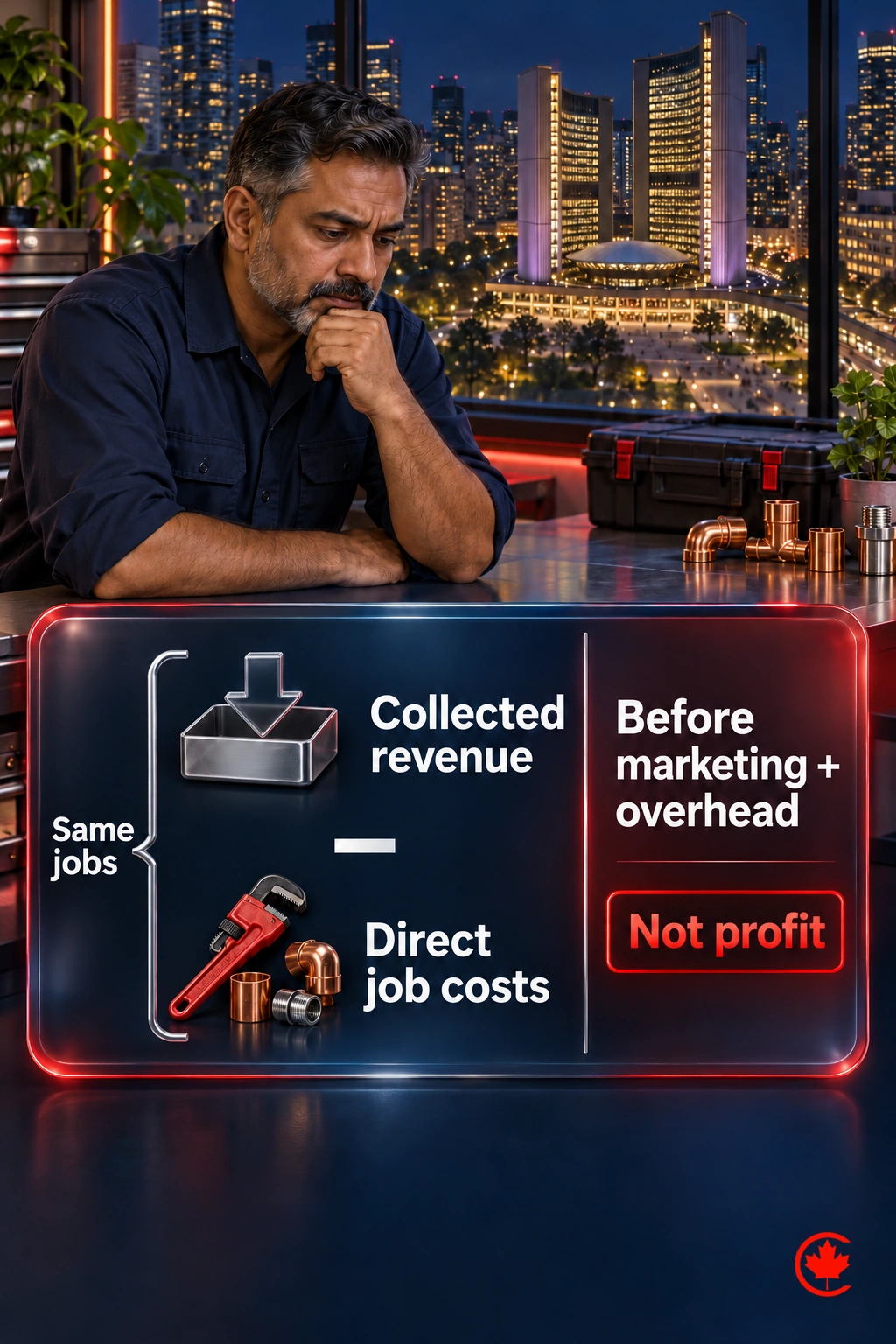
Suppose a completed callout produces $210 of contribution before acquisition and fixed overhead. The owner wants to retain $130 for overhead and profit, leaving an $80 acquisition allowance. All amounts in this example are Canadian dollars, with tax excluded for simplicity. That allowance expresses the owner’s financial requirement; it does not prove the market can supply customers at that cost.
Now imagine a programme creates 80 enquiries. Of those, 56 fit the territory and service scope, 40 become accepted bookings, and 32 become completed, collected jobs. If media costs $2,000 and incremental management and answering cost another $800, the total acquisition cost is $2,800. Dividing by 32 produces $87.50 per completed job, above the chosen $80 allowance. Dividing by 80 would produce an attractive $35 enquiry figure while hiding the shortfall.
The same arithmetic helps evaluate a changed outcome. At 40 completed jobs, $2,800 represents $70 each. At 24, it is about $116.67 each. Those differences may arise from customer fit, availability, price acceptance, completion or collection. A provider should not attribute every movement to advertising quality when other parts of the journey can change the result.

Include media and the incremental management, answering or other acquisition costs counted in the programme. Match those costs to the same enquiry group and its service timeline, not unrelated work from an older pipeline. Divide by jobs from that group that are completed and paid, using a consistent cost basis. If no jobs are completed and paid, there is no cost-per-job result yet. A group with unfinished or unpaid work is not a final outcome. Compare the result with your acquisition allowance; cost per enquiry answers a different question.
After-hours work needs its own assumptions. Suppose a night job has a higher selling price but also greater direct labour and travel costs. Its contribution might be similar to a daytime job rather than substantially larger. If that job also displaces the next day’s productive capacity, the business may face an additional trade-off. The owner should evaluate the complete service model instead of assuming that an emergency premium is mostly profit.
Larger drain or sewer opportunities create another distinction. An initial diagnostic visit may lead to an estimate for more substantial work, but that later work is not certain. The first visit and the possible project should not both be counted as completed revenue when only the visit has occurred. The report needs to show whether a project was proposed, accepted, completed and collected.
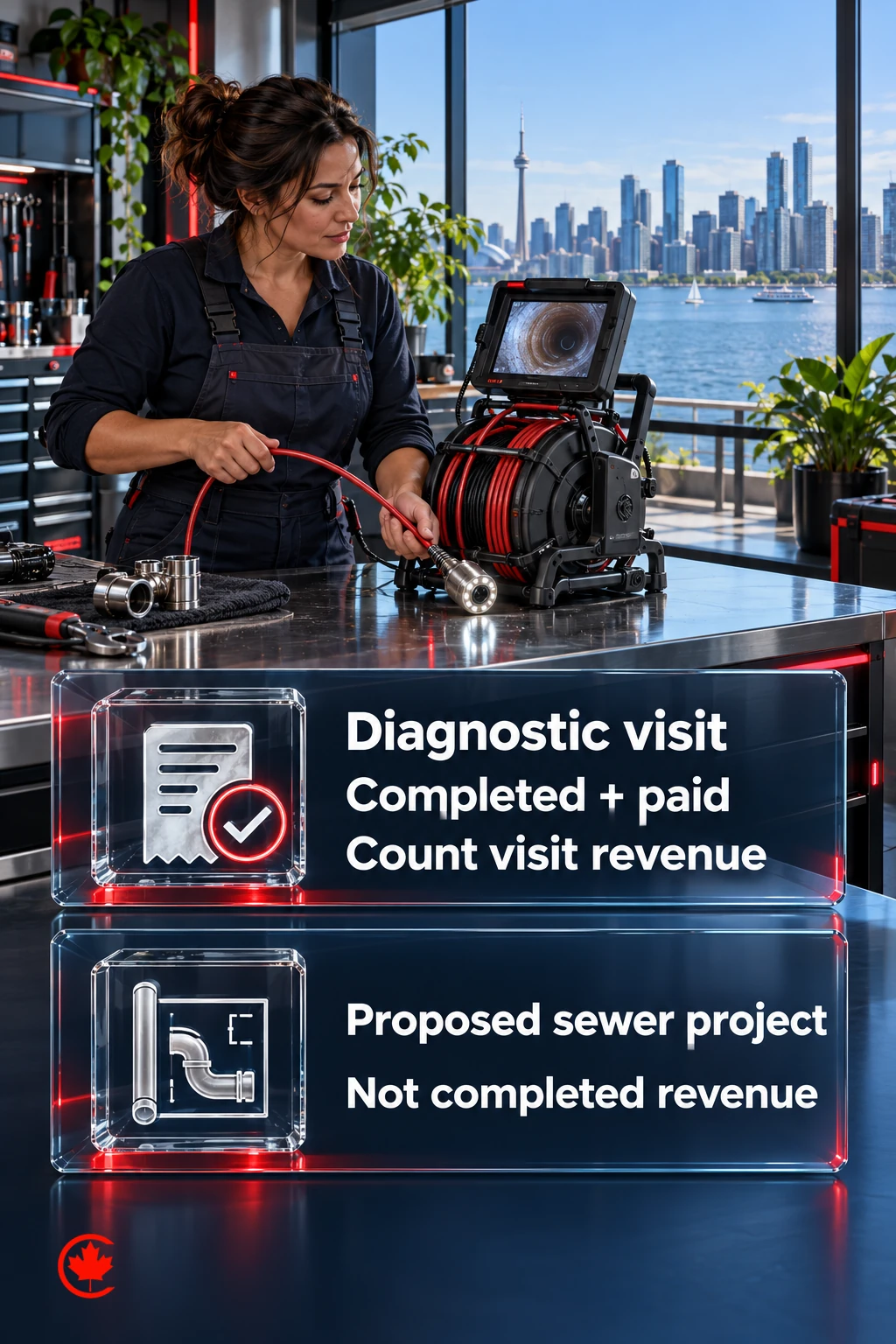
A separate hypothetical example makes this visible. An acquisition programme costs $4,800 and ultimately produces six completed projects, each contributing $1,600 before acquisition and fixed overhead. Acquisition costs $800 per completed project, leaving $800 from each project before fixed overhead and profit. If only four projects complete, acquisition rises to $1,200 each and the remaining contribution falls to $400. The owner’s decision depends on whether that remainder is sufficient, not on the attractiveness of the original estimate totals.
Cash timing can matter even when the eventual economics look viable. Advertising, staff, materials or subcontractor costs may be due before the final customer payment arrives. A company should understand that exposure and avoid treating open estimates as funds available to spend. A growing pipeline is useful information, but it is not a substitute for collected cash or a considered working-capital decision.
Future repeat work belongs in the evaluation only when its assumptions are explicit. A customer acquired through an emergency might return, refer a neighbour or never need the company again. An optimistic lifetime-value figure should not quietly justify a first job that fails the owner’s financial requirements. Measured repeat contribution can strengthen the case later without being invented at the point of purchase.
A better outcome can come from a clearer booking decision
Consider two hypothetical months with the same 60 suitable enquiries. In the first, 45 callers accept a visit but only 27 jobs complete and are collected. In the second, only 38 accept a visit, but 32 jobs complete and are collected. The second month has fewer bookings and more useful completed work. A report that rewards only accepted appointments would favour the weaker outcome.
The reason for the difference must be investigated rather than assumed. The first month might include misunderstood fees, unrealistic arrival expectations, customers calling off visits or another issue entirely. The second might have a different service mix or more available capacity. The lesson is not that fewer bookings are always better. It is that the owner needs the explanation behind the progression, not just a bigger number at an early stage.
This matters when defining a paid lead or a provider’s result. A contact can be relevant to the advertised service while still failing the business’s booking or completion requirements. The agreement and the commercial review may therefore use different definitions for legitimate reasons. Understanding that distinction before buying helps prevent an argument later in which one party points to valid enquiries and the other points to insufficient completed revenue.
For a small business, a reasonable starting review can be straightforward: what the person needed, whether the company could help, whether a visit was accepted, what was completed and what was collected. The owner does not need false precision or an elaborate technology project before those questions become useful. The level of detail should be proportionate to the decision and handled with appropriate care for customer information.
Service area, travel and the next available job
A broad service area can appear to create more opportunity, but distance changes the work the company can deliver. Time travelling is time unavailable for another appointment. A long trip for a modest callout may be less attractive than a nearby job, while a larger project may justify a different travel decision. The owner needs a service-area policy that reflects the business, not simply a large circle on a map.
Consider a hypothetical eight-hour working period in which six hours are already committed to customer work and necessary travel. The remaining two hours do not necessarily mean two more appointments are available. A callout might require travel, assessment, access coordination and unexpected time on site. The value of an additional enquiry depends on whether the business can realistically accommodate it without breaking an existing commitment.

Include all necessary travel, access coordination, assessment and on-site work. Allow for delay or uncertainty, then compare the whole visit with the time actually available while protecting commitments already accepted. An empty part of the diary is not automatically another appointment, and time fit does not replace checking the required skills and equipment.
Equipment and skills create further limits. A company may accept routine drain work but not have the appropriate specialist resource available for every larger request. An enquiry can be geographically close and still fall outside the available scope. Marketing should communicate a credible offer, with an honest next step when the request needs something different. Overclaiming capability can create cost and disappointment for both parties.
Travel decisions can also change during a busy period. A territory that is workable when the diary is light may be difficult when urgent requests cluster. The owner might choose to protect a smaller reliable service area rather than accept a wider range of appointments with uncertain arrival times. That is a customer-service and contribution decision, not merely a way to alter advertising reach.
Existing commitments deserve weight in that choice. Maintenance arrangements, commercial customers or previously promised appointments may have expectations that cannot be ignored when a new emergency enquiry appears. A new lead should not automatically outrank a customer already waiting. The acquisition plan should acknowledge how the company balances new demand with obligations it has already accepted.
For a provider comparison, a useful question is whether the proposed growth plan understands these constraints. A target for more calls without reference to service type, travel or availability may encourage the wrong behaviour. A better commercial plan explains what suitable demand looks like and which kinds of work should not be treated as success merely because they produce a phone call.
Pages that convert urgent visitors
The website’s practical role is to help a potential customer decide whether to contact the business and what to expect afterward. Someone facing an urgent problem may not want a long sales pitch. They need a clear service fit, real coverage and an understandable next step. A homeowner considering planned work may need more context before committing to an assessment.
| Customer need | Information that supports a decision |
|---|---|
| Urgent plumbing help | Actual availability, service territory and what requesting a visit means |
| Drain-related service | Scope of assessment and how further work or uncertainty will be discussed |
| Water heater work | Supported service scope and the distinction between assessment, repair and replacement proposals |
| Basement or sump-pump concerns | Relevant service boundaries and reliable references for any current local programme claims |
| Fees and pricing | What is known before attendance, what depends on assessment and how additional work is authorized |
Price clarity is especially important at the boundary between an enquiry and a visit. A callout or diagnostic charge is not necessarily the price of completing a repair. The customer should understand what the initial payment covers, what remains uncertain and when a further decision may be needed. This does not require publishing a universal price for work that cannot responsibly be priced without assessment.

Arrival expectations need similar precision. A general service-hours statement does not establish an exact response time. If the company cannot confirm immediate attendance, the next step should be described honestly. An attractive promise that the dispatcher later has to withdraw can undermine confidence before a technician ever reaches the property.
Drain and sewer enquiries also involve uncertainty. A customer’s description may not establish the cause, extent or appropriate remedy. Marketing can explain how the business approaches assessment and authorization without diagnosing the situation through a generic page. The important decision support is the process for resolving uncertainty, not an assurance that every apparently similar symptom has the same solution.
Water heater and property-related work may involve someone other than the caller. The person requesting help could be a tenant, a property manager or someone dealing with an existing rental or service arrangement. The business needs appropriate authority before accepting work, but an advertising page should not give sweeping legal conclusions about who may approve it. Clear service boundaries reduce the risk of promising a simple transaction where another decision is required.
Municipal subsidy or prevention-programme references should be current and specific. A benefit available in one municipality does not establish eligibility elsewhere, and a programme mention does not ensure funding for a particular property. If such information is relevant to the service, its source, date and limitations should be visible. An outdated incentive can distract from an otherwise credible offer.
The result should be a clearer customer decision, not a fixed quota of pages. A provider’s website proposal is stronger when it explains which uncertainty each piece of work addresses and how accuracy will be maintained. More content is not inherently more useful if it repeats generic promises or obscures the information a customer needs before accepting a visit.
Turn emergencies into repeat customers
A successful emergency visit can begin a continuing relationship, but it should not be treated as permission to sell every other service immediately. The customer may be relieved, tired or focused on restoring normal use of the property. A relevant optional next step is different from pressure to commit to work that has not been explained or justified.
Repeat business starts with the original service experience. Clear information, appropriate authorization and reliable follow-through matter before any future promotion. A marketing programme cannot build durable trust if the initial appointment leaves the customer uncertain about the charges or dissatisfied with how the work was handled. The first commercial responsibility is delivering what was agreed.
There may be sensible opportunities for later maintenance, an inspection or another service, depending on the actual circumstances. These should be presented as choices with a clear purpose and scope, not as automatic requirements following every emergency. Any technical recommendation needs the appropriate professional basis. A marketing article should not turn a general retention idea into a diagnosis or a mandatory service prescription.
For planned customer communications, the CRTC’s CASL guidance explains the importance of consent, identification and a functioning unsubscribe mechanism for commercial electronic messages, subject to the applicable provisions and exceptions. A telephone number collected to arrange a visit is not a reason to assume unlimited permission for promotional contact. The owner should understand the communication scope being purchased.
Referral relationships can also be valuable without being overengineered. A customer who recommends the company may do so because the experience was genuinely useful. That is different from paying for a positive public review or pressuring someone to provide praise. The business should keep honest feedback, referrals and marketing offers conceptually separate rather than treating them as interchangeable ways to generate a rating.
Retention economics should be measured after the work occurs. Useful distinctions include first-time customers who return, the contribution from their later work and the costs of the ongoing communication or membership arrangement. A larger customer list alone does not establish value. If customers rarely return, the explanation may be the nature of the service or the experience delivered, not simply too few reminders.
Trust signals and claims that can be checked
Plumbing credentials should be described precisely. Skilled Trades Ontario identifies plumber as a compulsory trade and explains the qualifications and registration arrangements relevant to practising it in Ontario. The accurate description is more nuanced than saying every person on a team holds the same independent licence. A business should be able to substantiate the credentials it presents for the work and people involved.
Provincial context matters. An Ontario example should not be used to imply that the same terminology, registration or rules apply everywhere in Canada. Marketing for a company operating in another province needs the appropriate local basis. An owner evaluating a provider should expect it to recognize that difference rather than recycle a national claim without qualification.
Insurance is another separate consideration. A statement that a company is insured should have a factual basis and an appropriate scope. It is not a promise that every loss, service issue or customer expense will be covered. Marketing should not promise insurance outcomes or present a general trust statement as an assurance about a particular incident.
Customer stories and work examples should also be honest. Hypothetical illustrations belong in a guide only when they are labelled as hypothetical; they are not case studies. Real testimonials should reflect genuine experience and applicable permissions. Claims about speed, price, success rates or superiority need support proportionate to what is being promised.
Safety and urgency deserve particular restraint. A stressed caller should not be pressured with an unverified diagnosis or a claim that an expensive service is necessary before appropriate assessment. The marketing role is to make qualified help and the service process understandable. It is not to manufacture fear or replace the judgement required on the actual job.
The owner can use these boundaries when comparing providers. A proposal should identify who verifies technical facts, who approves offers and how inaccurate or outdated claims are corrected. A general assurance that all marketing is compliant does not remove the need for clear responsibilities or qualified advice where a legal or technical question arises.
Compare marketing providers on complete scope
The best comparison begins with the plumbing company’s problem, not a catalogue of services. A business with little local awareness needs a different case from one with adequate demand but poor response. A drain specialist seeking planned projects may not need the same package as an emergency-led general plumber. A proposal should explain that fit in terms the owner can challenge.
All-in cost is the next distinction. Media spending, management, website work, answering, software and reporting may be priced separately. Some may be ongoing commitments and others one-time work. A low headline fee can be misleading if the essential supporting services sit outside it. The owner should understand the expected total, the assumptions behind it and what would trigger an additional charge.
Scope should be concrete enough to compare. “More leads” is an outcome aspiration, not a complete description of what is being purchased. A useful agreement makes clear the work included, the responsibilities of each party and the limits of the provider’s role. It should not imply that advertising management includes dispatch, customer authorization, technical assessment or collecting invoices unless those services are actually part of the arrangement.
Reporting needs the same clarity. The owner should know whether the provider can distinguish suitable enquiries, accepted bookings, completed work and collected revenue, and where those distinctions depend on information from the business. Incomplete data should be acknowledged. A convincing chart cannot compensate for a definition of success that counts unanswered calls or unrelated requests as valuable new customers.
Access and exit terms should be understood before commitment. Stopping media spending does not necessarily end other contractual obligations.

Experience is most useful when it resembles the decision being made. A success story from a different market may show capability without predicting your result. Relevant evidence identifies the starting problem, service mix, period, work undertaken and result, including enough cost context to make the outcome meaningful. An impressive revenue figure without delivery or acquisition costs does not establish a profitable model.
The owner also needs to know how changes are handled. If service capacity falls, fees change or a particular offer is no longer available, someone must decide what public promises remain appropriate. The point is not an elaborate approval bureaucracy. It is a clear arrangement for keeping marketing aligned with the real business rather than letting old assumptions continue after conditions change.
Review the complete customer journey
A review should answer whether the investment is producing the work the company intended to acquire. That requires looking beyond exposure and enquiries without pretending that every source can be identified perfectly. Customers may encounter the business through several routes, return after an earlier visit or ask a neighbour before calling. Attribution is useful evidence, not an excuse to claim certainty that the records cannot support.
Different stages should remain visible. An enquiry may be suitable but lack an available appointment. A booking may be accepted but called off. A completed visit may produce a larger estimate that is still undecided. A sold project may not yet be completed or paid. Combining those stages into one revenue number makes it harder to understand what the marketing actually achieved and what remains uncertain.
Time periods should be chosen with the service journey in mind. Emergency callouts can progress differently from larger planned projects. Comparing one month’s acquisition cost with unrelated work completed from an older pipeline can distort the result. A coherent group of enquiries followed through the relevant stages gives a more useful view than a dashboard that simply puts every current total beside every other one.
Seasonality and operating changes also deserve context. Weather, staffing, service availability and the kinds of work accepted may differ between periods. A change in completed jobs is not automatically caused by marketing alone. An owner should look for a plausible explanation that fits both the acquisition evidence and what happened in the business.
Continuing is easier to justify when suitable work arrives at an acceptable all-in cost and the company can deliver it well. Refining may make sense when demand exists but too much is outside scope, fails in the handoff or creates an unsuitable mix. Limiting additional spending may be responsible when cash, capacity or service quality is under pressure. Those are distinct decisions, not a single verdict that marketing either works or does not.
A practical starting brief contains the services the business wants more of, its real territory, available hours and resources, the financial exposure it can accept and the main gap it currently sees. That brief lets a provider propose a relevant response. It also gives the owner a fair basis for reviewing the engagement later, instead of discovering after purchase that both sides meant something different by more emergency calls.
Explore our advertising for plumbers, plumbing leads and plumbing website design, or compare the broader options in the home services marketing guide.
Frequently asked questions
How do plumbers get more emergency calls?
First identify whether the constraint is discovery, response, service fit or available capacity. More suitable demand can help only when the business can explain its availability, accept appropriate work and progress bookings into completed service.
How much does an emergency plumber click cost in Canada?
“Emergency plumber” is among the more expensive plumbing searches per click in Canada, well above terms such as “drain cleaning”. That estimate is not a local campaign quote or a cost per completed job.
Should plumbers run ads 24 hours a day?
Only evaluate after-hours demand against a service promise the business can genuinely deliver. Calls answered around the clock and immediate technician attendance are different commitments; an answering arrangement does not create service capacity.
Are Local Services Ads good for plumbers?
They can be worth evaluating for an eligible company with appropriate availability and a workable cost model. Google lists plumbing-related categories on its Canadian page, but a paid lead is not a promise of an accepted or completed job.
What pages should a plumbing website have?
The useful information explains service fit, real availability, territory, fees and what happens after contact. Different customer needs may justify different explanations, but a fixed page count is not a substitute for clear and accurate decision support.
How can plumbers turn emergencies into repeat business?
Deliver the original service well, explain any relevant optional next step without pressure and respect permission boundaries for later contact. Measure actual repeat contribution rather than assuming every emergency customer will become a repeat account.
Why does drain cleaning near me cost more than drain cleaning?
The historical table shows a higher estimate for the local wording. That wording may suggest a nearby-provider search, but the CPC difference alone does not prove urgency or explain advertiser behaviour. Actual suitability and completed-job economics need separate evidence.
Should plumbers show their licence?
Present the credentials that accurately apply to the company, work and personnel. Skilled Trades Ontario identifies plumber as a compulsory trade and describes relevant registration and qualification arrangements; avoid implying all workers hold the same credential.
How do plumbers reduce missed calls?
Distinguish missed contact from unsuitable requests, lack of available appointments and failures after booking. Answering support may address the first issue but not all of the others. The right investment depends on the actual gap.
When should plumbers ask for reviews?
Seek genuine feedback without incentives, pressure or selective solicitation of positive reviews. The aim is an honest account of the service experience, not a rating produced by excluding unhappy customers.