
Best Etsy alternatives in 2026: where handmade and vintage sellers can sell next
Sellers look for Etsy alternatives for the same few reasons: fees that eat into margins, rising competition, search changes that cut traffic overnight, and the feeling of building a business on someone else’s land. The answer is rarely to leave Etsy completely. Most successful makers keep a marketplace for discovery and add at least one channel they control. This guide compares the main alternatives for handmade, vintage, craft supply and design sellers in 2026, explains the trade off between marketplace traffic and ownership, and gives you a step by step plan to move customers to your own store. Marketplace fees and rules change often, so check each platform’s current fee page before you list.
Quick picks by situation
| Your situation | Where to start | Why |
|---|---|---|
| Established seller with repeat customers | Your own Shopify, Squarespace or WooCommerce store | More control of your brand, prices and customer data, subject to privacy and consent requirements |
| Handmade seller who wants another large marketplace | Amazon Handmade | Huge shopper base for genuinely handmade goods |
| Vintage, collectibles and one of a kind items | eBay, or Ruby Lane for higher end vintage | Buyers searching for specific older items |
| Small artist or maker who wants a simple store | Big Cartel | Easy, low cost store built for artists |
| Illustrators and designers who do not want to ship | Print on demand such as Redbubble, Society6 or a print on demand app on your own store | Products printed and shipped for you |
| Makers ready to sell to shops | Faire | Wholesale marketplace connecting brands with independent retailers |
| Sellers with a strong social following | Instagram, Pinterest and TikTok shopping features where available | Sell where your audience already watches |
We plan, build and optimize e-commerce stores on WooCommerce and Shopify for Canadian sellers.
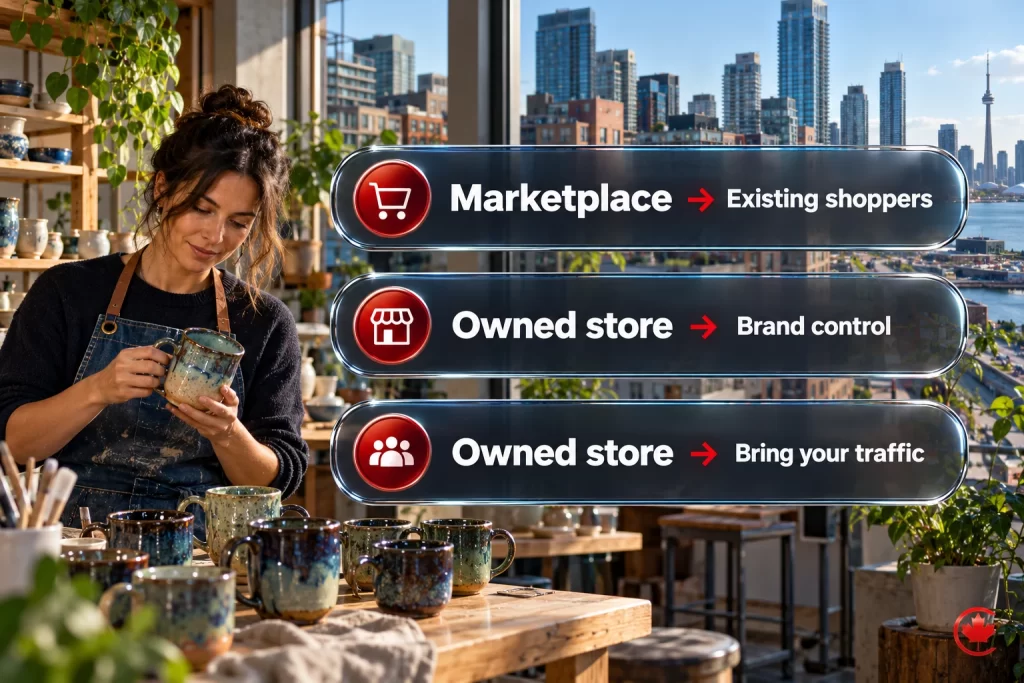
Marketplace vs your own store
| Marketplace (Etsy, Amazon, eBay) | Your own store | |
|---|---|---|
| Traffic | Built in shoppers searching the marketplace | You bring every visitor through search, social, email and ads |
| Fees | Listing, transaction, payment and sometimes advertising fees per sale | Platform or hosting costs plus payment processing |
| Customer data | Access and marketing use are restricted by marketplace rules | More control over customer records and consent-based email marketing |
| Branding | Your shop sits inside the marketplace’s design | Your brand from home page to checkout |
| Rules and risk | Policy or search changes can cut sales or suspend a shop | You set the rules, within payment and legal requirements |
| Competition | Competitors listed beside you | No competitors on your pages |
The strongest setup for most makers is both: a marketplace to be found, and an owned store where repeat customers buy without marketplace fees.
The main alternatives in detail
Your own online store
Shopify is the most common choice for makers moving beyond marketplaces, with themes, apps for personalization and print on demand, and point of sale for markets and pop ups. Squarespace and Wix suit sellers who want a design led site with a store attached, and WooCommerce suits sellers who want maximum control on a self hosted site. Budget for a hosted platform plan or self-hosted running costs, payment processing and any paid apps or extensions. WooCommerce’s core plugin is free, but hosting and maintenance still need a budget. You must build your own traffic. Our Shopify vs Etsy margin comparison for Canadian sellers walks through how the numbers change.
Amazon Handmade
Amazon Handmade requires an application and accepts eligible handcrafted, hand-altered, hand-designed, repurposed and upcycled goods from approved makers and collaborative groups. It offers access to Amazon shoppers, with referral fees and product rules to check before listing. Eligible products can use Fulfilment by Amazon, but personalized Amazon Custom products must be fulfilled by the seller.
eBay
eBay remains strong for vintage, collectibles, craft supplies and unique items, with both auctions and fixed price listings and a large international audience. Presentation matters less than accurate descriptions and photos.
Big Cartel
Big Cartel is a simple store builder aimed at artists and makers, with low cost plans and limits on the number of products. It suits small catalogues and sellers who want a clean store without complexity.
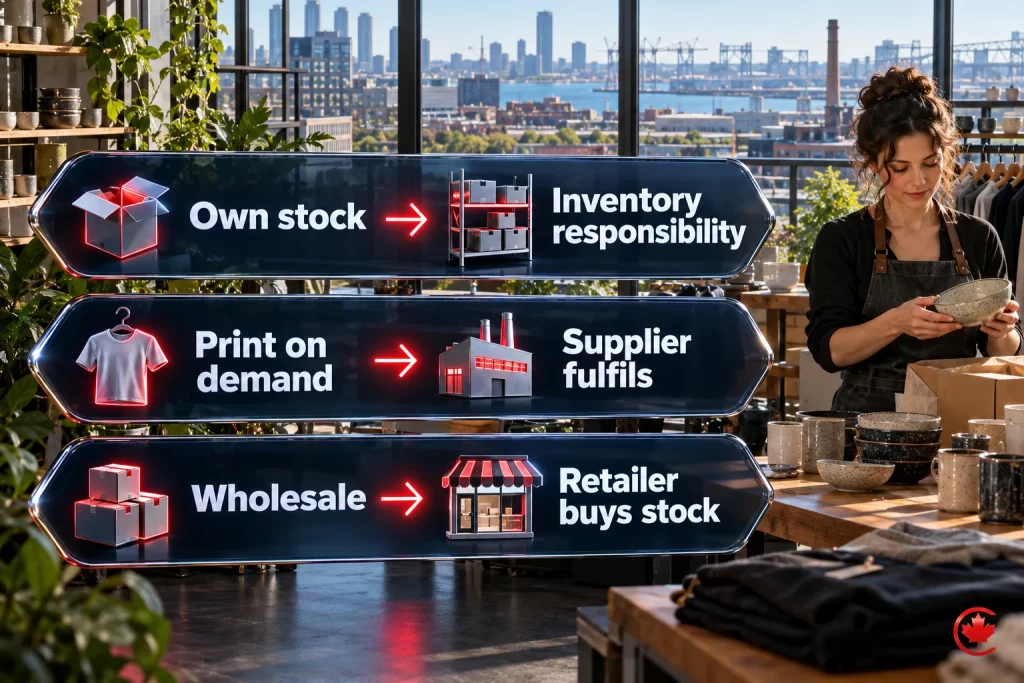
Print on demand
Redbubble, Society6 and similar marketplaces print your designs on products and ship them, paying you a margin per sale. Alternatively, print on demand apps connect to your own store so products are made to order under your brand. You hold no finished inventory; compare selling prices, supplier charges, fulfilment, returns and acquisition costs before judging margin.
Wholesale with Faire
Faire connects independent brands with boutiques and gift shops. Wholesale means lower prices per unit but larger orders and repeat stockists. It suits makers who can produce consistently.
Social selling
Instagram, Facebook, Pinterest and TikTok offer shopping features, but availability and checkout options differ by country and change often. Social platforms are excellent for discovery; link them to your own store for the sale where possible.
Specialist marketplaces
Niche marketplaces exist for vintage (Ruby Lane), fabric and surface design (Spoonflower), regional handmade goods and local makers’ markets. They have smaller audiences but buyers who want exactly what you make.

Understanding fees before you move
Compare the full cost per order, not the headline fee:
Cost per order = listing fees + transaction or referral fee + payment processing + advertising fees + shipping labels + platform subscription share
Marketplaces charge mostly per sale, so costs grow with revenue. Your own store charges mostly per month, so costs fall as a share of revenue once sales grow, but you pay for traffic through ads, content and email. Run the numbers on your last three months of orders for each option.
Canadian sellers: what to check
- Currency and payouts. Check whether payouts arrive in Canadian dollars and what conversion fees apply.
- Shipping. Cross border shipping to the US is often the biggest cost; compare carriers and consider pricing shipping into products.
- Sales tax. Marketplaces collect and remit some taxes in some places; on your own store you are responsible for registering and charging GST, HST, PST or QST where required. Ask an accountant.
- Duties and customs. Check import costs and each channel’s shipping rules. For US-bound Etsy orders, use Delivery Duty Paid (DDP) and include applicable import costs upfront. Etsy allows only limited exceptions where DDP is genuinely unavailable, with explicit buyer confirmation and an estimate of charges.
- Availability. Some social selling features are not available in Canada or work differently; confirm before building a plan around them.
How to move customers to your own store
- Keep your marketplace shop open while your store grows.
- Build an opt-in email list through your own site and social channels. Do not add marketplace buyers without consent; check marketplace rules before using packaging inserts or other promotions.
- Promote exclusive products, bundles, early access or custom work through your own channels. Do not use Etsy listings or messages to divert a purchase, offer off-platform buying incentives or direct members away with QR codes.
- Use the same product photos and names so customers recognize you.
- Invest in search. Product pages, collection pages and helpful content bring free traffic over time.
- Track where sales come from and shift effort to the channels that work.
Our ecommerce website team builds stores for makers and small brands, and our Shopify website service focuses on Shopify specifically.
Common mistakes to avoid
- Leaving a marketplace before your own store has steady traffic.
- Spreading across too many platforms and keeping none of them updated.
- Ignoring the cost of traffic on your own store.
- Breaking a marketplace’s rules by sending its customers elsewhere in messages.
- Copying listings word for word everywhere instead of writing strong product pages for your own site.
Product listings that sell on any platform
- Photos: a clean main photo on a plain background, then lifestyle, scale, detail and packaging shots. Most buyers judge handmade goods by photos alone.
- Titles: lead with what the item is and who it is for, then key details such as material, size or personalization. Avoid stuffing every keyword.
- Descriptions: answer the questions buyers ask: size, materials, care, processing time, shipping and personalization options.
- Pricing: include materials, time, platform fees, packaging, shipping and a profit margin. Undercharging is the most common maker mistake.
- Policies: clear shipping times, returns and custom order rules reduce disputes on every platform.
Choosing your mix of channels
| Stage | Suggested mix |
|---|---|
| Just starting | One marketplace plus a social profile; learn what sells |
| Steady sales | Marketplace plus your own store and an email list |
| Growing brand | Own store as the main channel, one or two marketplaces for discovery, wholesale through Faire or direct to shops |
| Established business | Own store, wholesale accounts, markets and events, with marketplaces as a supporting channel |
Keep inventory in sync across channels with your store platform’s inventory tools or a multichannel app, so you never sell the same one of a kind item twice.

Driving traffic to your own store
- Write product and collection pages that answer what buyers search, such as “personalized leather dog collar” or “handmade ceramic mugs Canada”.
- Post your work in progress and finished pieces on Instagram, Pinterest and TikTok, and link to product pages.
- Send a regular email with new pieces, restocks and behind the scenes stories.
- Sell at local markets and events and hand out cards that point to your store.
- Collaborate with complementary makers and local shops.

The bottom line
The best Etsy alternative for most growing sellers is an owned store, run alongside a marketplace that brings discovery. Add Amazon Handmade for handmade goods with broad appeal, eBay for vintage and collectibles, print on demand to sell designs without inventory, and Faire when you are ready for wholesale. Calculate the full cost per order on each channel, build an email list from day one, and give customers a reason to buy from you directly.
Frequently asked questions
Which marketplaces work like Etsy for handmade and vintage goods?
Amazon Handmade is the closest large marketplace for genuinely handmade goods, though it requires an application. eBay remains strong for vintage, collectibles and craft supplies, Ruby Lane serves higher end vintage, and Spoonflower serves fabric and surface designers. Redbubble and Society6 suit artists who want products printed and shipped for them, and Faire connects makers with independent retailers for wholesale.
Why are sellers leaving Etsy for other platforms?
The usual reasons are fees that eat into margins, rising competition, search changes that can cut traffic overnight, and the feeling of building a business on someone else's land. Few sellers leave completely, though. Most successful makers keep a marketplace for discovery and add at least one channel they control.
Is Big Cartel better than Etsy for a small artist?
They do different jobs. Big Cartel is a simple store builder aimed at artists and makers, with low cost plans and limits on the number of products, so it suits a small catalogue under your own brand. Etsy brings shoppers already searching its marketplace, while on Big Cartel you have to bring every visitor yourself through social, email, search and ads.
Should I sell on Shopify or Etsy?
Etsy gives you built in shoppers but charges mostly per sale, restricts how you use customer data and lists competitors beside you. A Shopify store puts your brand on every page and gives you more control over customer records, but you pay mostly per month and must build your own traffic. For most makers the strongest setup is both: a marketplace to be found and an owned store where repeat customers buy.
How do I compare what Etsy takes from a sale with other platforms?
Compare the full cost per order rather than the headline fee: listing fees, the transaction or referral fee, payment processing, advertising fees, shipping labels and your share of any platform subscription. Marketplace costs grow with revenue, while an own store's costs fall as a share of revenue once sales grow, though you pay for traffic. Run the numbers on your last three months of orders for each option.
What should sellers in Canada check before moving off Etsy?
Check whether payouts arrive in Canadian dollars and what currency conversion fees apply. Cross-border shipping is often the biggest cost, so compare carriers and consider building shipping into product prices. On your own store you are responsible for registering and charging sales tax where required, so confirm your GST/HST obligations with the CRA.
Can an Etsy seller list products on Amazon Handmade?
Yes, if the maker is approved, since Amazon Handmade requires an application and accepts eligible handcrafted, hand-altered, hand-designed, repurposed and upcycled goods. It offers access to Amazon shoppers, with referral fees and product rules to check before listing. Eligible products can use Fulfilment by Amazon, but personalized Amazon Custom items must be fulfilled by the seller.
What Etsy alternatives suit artists who do not want to ship orders?
Print on demand marketplaces such as Redbubble and Society6 print your designs on products, ship them and pay you a margin per sale. Print on demand apps can also connect to your own store so products are made to order under your brand. You hold no finished inventory, but compare selling prices, supplier charges, fulfilment, returns and marketing costs before judging the margin.