
How to get clients for a staffing agency in Canada: a practical guide
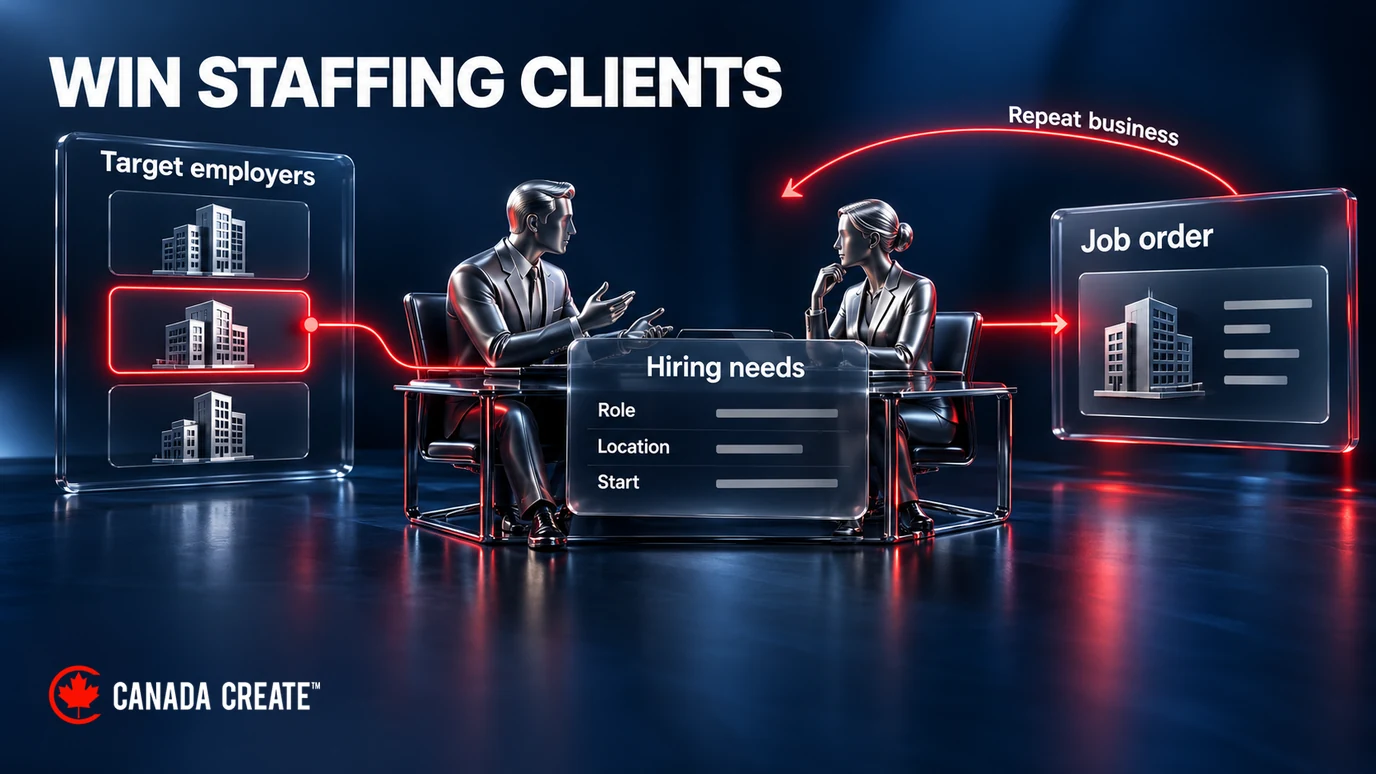
Every staffing and recruitment agency eventually hits the same wall. You have good recruiters and a healthy candidate pool, but not enough client companies sending job orders. Placements are the revenue, and placements need clients. This guide explains how staffing agencies in Canada get clients in a repeatable way, from choosing a niche to building a target list, getting found, reaching decision makers, winning the first order and turning it into an account.
It is written for owners and business development leads at temporary staffing firms, permanent placement recruiters, contract and IT staffing firms and executive search boutiques. Most of the advice works whether you are a one person recruiter or a multi branch agency.
Choose a niche you can win
Generalist agencies compete on fee and speed against everyone. Specialist agencies compete on knowledge. When an operations director needs forklift operators by Monday or a CFO needs a senior controller, they want an agency that already knows the role, the market and the candidates.
Pick a niche using three filters:
- Where you already have candidates. Your existing database and recruiter experience are your strongest assets.
- Where demand is steady. Sectors with ongoing hiring needs (warehousing, manufacturing, healthcare support, accounting, IT, skilled trades) give you repeat orders.
- Where fees are worth it. Some roles bring higher fees or longer contract assignments. Balance volume against value.
You can serve more than one niche, but market each one separately with its own pages, messages and target list.
Build a target client list
Random cold calling burns recruiters out. A target list focuses effort on companies that match your niche and are likely to hire.
- Firmographics: sector, size, number of locations and distance from your branches.
- Hiring signals: companies posting many roles, opening new facilities, winning contracts, expanding shifts or announcing funding. Their own careers pages and job boards show who is hiring.
- Decision makers: for volume staffing, operations managers, plant managers and HR leads; for professional roles, hiring managers, department heads and HR business partners; for executive search, CEOs and boards.
- Existing connections: past clients, former candidates now in management roles and referral partners.
Keep the list in a CRM, score each company and work the best ones first. Our recruitment CRM page explains how agencies organize this.
Get found when employers search
Not every client starts with a cold call. Many hiring managers search for a staffing agency, temp agency or recruiters in their specialty when a role becomes urgent. If you are not visible, you are not on the short list.
Google Business Profile for each branch
Each eligible staffed branch can have its own profile with the actual business name, correct category, address, hours and services. Check Google’s location and customer-contact requirements before adding a branch. Genuine client reviews build trust. Invite feedback consistently rather than only after successful outcomes, never offer incentives, and respond professionally without exposing candidate information. Do not solicit Google reviews from employees or others with a disqualifying conflict of interest.
Specialty and service pages
Create a page for each niche (for example warehouse staffing, accounting recruiters, IT contract staffing) and each service type (temporary, contract, temp to perm, permanent placement, executive search). Explain the roles you fill, how you screen, typical timelines and how pricing models work. Our SEO service builds this structure.
Paid search for urgent needs
Employers with urgent orders often search and call immediately. Search campaigns built around employer keywords, with job seekers excluded through negative keywords, can produce job orders quickly. Route calls to the right branch and track each call to a job order. See our Google Ads service.
Reach decision makers directly
Outbound remains essential for staffing agencies. The difference between outreach that works and outreach that annoys is relevance.
- Lead with a reason. Reference a specific hiring signal: a new facility, a hard to fill role they have posted for weeks, a seasonal peak.
- Offer value. A short market update on pay rates or candidate availability for their roles is more useful than a brochure.
- Use several touches. A call, a LinkedIn connection, a relevant post and a follow up over a few weeks works better than one long email.
- Follow CASL. Commercial email requires consent or a valid implied consent (for example a business email address conspicuously published without a no messages statement, where your message relates to the person’s role), plus sender identification and an unsubscribe. Purchased lists are not consent.
Use LinkedIn as a recruiter and as a business
LinkedIn is where hiring managers and HR leaders spend professional time. Recruiters who post useful content (salary trends, hiring tips, candidate market updates, short stories about placements with permission) become familiar names. Company pages with regular posts add credibility, and targeted campaigns can put your agency in front of HR and operations leaders at your target accounts. For a structured approach, see our B2B marketing service.
Referrals and partnerships
Satisfied clients and placed candidates are your best referral sources. Ask hiring managers for introductions to peers in other departments or companies after a successful placement. Stay in touch with candidates you placed; many become hiring managers themselves. Partner with businesses that serve your target clients without competing: payroll providers, HR consultants, accountants, industry associations and chambers of commerce. Sponsoring or speaking at association events in your niche puts you in a room full of potential clients.
Show licensing and compliance as a strength
Employers want an agency that protects them from risk. In Ontario, temporary help agencies and recruiters have needed a licence since 1 July 2024, and clients that knowingly use unlicensed agencies face consequences. Make your licence status visible on your website and proposals. Explain how you handle health and safety orientation, worker classification, payroll and privacy. Remember that charging workers fees for finding them jobs is prohibited, and that job ads must not express preferences based on protected grounds. Check the current rules on Ontario’s licensing page and with your legal adviser.
Build a website that converts employers
Your website should split visitors immediately into employers and job seekers. The employer side needs:
- Clear specialty and service pages.
- A request staff form asking for role, number of workers, start date, location and contact details.
- Branch pages with real addresses and contacts.
- Information on your screening, safety and compliance processes.
- Case studies with client permission and genuine reviews.
- A phone number that rings a person during business hours.
Mobile speed, accessibility and secure forms matter on both sides. See our staffing and recruitment agency marketing service for how we build agency websites.
Win the first job order
Many clients test a new agency with one difficult role or a small temporary order. Treat it as an audition:
- Take a thorough intake. Ask about the role, the team, the shift, the pay range and what made past hires succeed or fail.
- Set expectations. Agree on timelines, number of candidates to present and how feedback will work.
- Present quality, not volume. A short list of well screened candidates beats a pile of resumes.
- Communicate often. Update the hiring manager even when there is no news yet.
- Follow up after the start. Check in with the client and the worker in the first week and month.
Proposals and pricing conversations
When a prospect asks for a proposal, keep it short and specific: their roles, your approach, screening steps, timelines, safety and compliance, and the pricing model (markup on pay rate for temporary staff, percentage of first year salary for permanent placement, retained or contingent for search). Explain what drives the rate rather than competing on the lowest number. Clients who choose you on value stay longer than those who choose you on fee.
Turn first orders into accounts
- Hold regular reviews with active clients on fill rates, time to fill and retention.
- Share market data that helps them plan: pay trends, candidate availability, seasonal peaks.
- Expand into other departments, shifts and locations once you have proven yourself.
- Ask for testimonials and case study permission when results are strong.
Do not forget the candidate side
Clients come back when you fill roles reliably, and that depends on candidates. Mobile friendly job pages, structured job data for Google’s job features, social video, talent pool nurture by text and email with consent, and good candidate reviews all support client growth. An agency known for treating candidates well finds it easier to fill orders quickly.
What to measure
- New client accounts and job orders by source.
- Fill rate and time to fill by niche.
- Placements and gross profit per client.
- Client retention and repeat orders.
- Cost per job order for paid channels.
- Candidate applications and placements by source.
Use content to show expertise
Hiring managers read content that helps them do their jobs. Agencies that publish useful material become trusted advisers rather than vendors:
- Pay and market updates for the roles you fill, written in plain language.
- Hiring guides on writing job descriptions, structuring interviews or onboarding temporary staff safely.
- Seasonal planning articles for peaks such as holiday warehousing, construction season or year end accounting.
- Compliance explainers on topics employers worry about, written as general information with a note to check current rules.
Share content on your website, LinkedIn and in a consent based newsletter. Each piece gives your business development team a reason to reach out that is not a sales pitch.
Know the 80/20 rule in recruiting
In most agencies a small share of clients produces a large share of placements and gross profit. Find out who those clients are, what they have in common and how you won them. Then look for more companies like them, and protect the relationships you already have with regular reviews and excellent service. The same idea applies to recruiters: study what your best recruiters do with clients and make it the standard for the team.
Hire and coach business developers
Many agencies ask recruiters to win clients in their spare time, and client development suffers. As you grow, consider dedicated business development roles or clearly protected time for client work. Give them a target list, a weekly activity rhythm, scripts based on real hiring signals and a CRM that shows their pipeline. Review results by source and coach on what works.
Answer the questions clients ask before they sign
Employers comparing agencies ask similar questions. Prepare clear answers on your website and in proposals:
| Client question | What to show |
|---|---|
| How fast can you fill this role? | Your process and realistic timelines for the role type |
| How do you screen candidates? | Interview, skills, reference and background steps you actually perform |
| Who handles payroll and safety? | Your responsibilities for temporary staff, orientation and records |
| What if a placement does not work out? | Your replacement policy, explained in writing in your agreement |
| Are you licensed? | Your licence status where required |
| How do your fees work? | The model and what drives the rate |
We plan and run staffing agency marketing for B2B and software companies in Toronto and across Canada, scoped in writing after a free review.
Common mistakes that cost agencies clients
- Sending too many resumes. Clients want a few strong matches, not a stack to sort.
- Going quiet. Silence makes hiring managers assume nothing is happening.
- Generic outreach. Messages that could go to any company are ignored.
- Ignoring small clients. Today’s small client may be tomorrow’s multi site account.
- Weak candidate care. Poor candidate experiences become poor reviews that clients read too.
- No tracking. Without source data, you cannot tell which efforts actually bring clients.
Expand within existing accounts
Your easiest new business is often inside companies you already serve. Once a hiring manager trusts you, ask who else in the company hires the roles you fill, whether other locations or departments need help, and whether they plan seasonal peaks. Offer a short review meeting each quarter to plan ahead. Each introduction inside an account is warmer than any cold call.
Use events and associations
Industry associations, chambers of commerce, HR professional groups and trade events put you in rooms with decision makers. Speaking on a practical topic, such as onboarding temporary staff safely or hiring in a tight market, positions you as an expert. Sponsoring a local HR event or hosting a roundtable for operations managers can produce several qualified conversations at once. Follow up within days with the information you promised.
A 90 day plan to get staffing clients
Days 1 to 30: choose your niches, build a target list of 100 companies, update Google Business Profiles and set up CRM tracking for every lead and job order.
Days 31 to 60: publish specialty and service pages, start a structured outreach sequence to your top 50 targets, post on LinkedIn weekly and ask recent clients for reviews and introductions.
Days 61 to 90: launch an employer focused search campaign, attend or sponsor one association event, review sources by job orders and placements, and double down on what works.
Getting clients for a staffing agency is a discipline rather than a lucky break. Specialize, focus on companies with real hiring needs, be visible when they search, reach out with relevance, deliver on the first order and keep earning the next one.
Frequently asked questions
How do staffing agencies get clients?
By choosing a niche, building a target list, being visible when employers search, reaching decision makers with relevant outreach, earning referrals and delivering on the first order. See our staffing and recruitment agency marketing service.
How do you get companies to use your staffing agency?
Show you understand their roles, offer useful market information, make your licensing and safety processes visible and ask for a single order to prove your service.
What is the best niche for a staffing agency?
The best niche is one where you already have candidates, demand is steady and fees justify the effort. Common choices are light industrial, skilled trades, accounting, IT and healthcare support.
Should a staffing agency use Google Ads?
For urgent employer searches, yes, with job seekers excluded and calls routed to the right branch. See our Google Ads service.
Does SEO help a recruitment agency get clients?
Yes. Specialty, service and branch pages bring employers searching for an agency. See our SEO service.
Can staffing agencies send cold emails in Canada?
Commercial email must follow CASL: consent or valid implied consent, sender identification and an unsubscribe. Purchased lists are not consent.
Do recruiters need a licence in Ontario?
Yes. Temporary help agencies and recruiters have needed a licence since 1 July 2024. Check the current rules with the province.
How should a staffing agency use LinkedIn?
Recruiters post useful market content, the company page shows activity and targeted campaigns reach HR and operations leaders. See our B2B marketing service.
How do staffing agencies keep clients?
Regular reviews on fill rate and retention, useful market data, fast communication and expanding to other departments once trust is earned.
What CRM should a staffing agency use?
Any system that tracks client leads, job orders and placements by source and connects to your ATS. See our recruitment CRM page.