
Toronto · Negative review help
Remove negative reviews in Toronto
Find out which reviews may break Google's policies, report those the proper way, answer the rest calmly and fix what customers are telling you.
Help with negative reviews for businesses in Toronto and the GTA and across Canada: policy checks, flagging through Google's own process, evidence records, careful replies and genuine new reviews.
- BBB A+ accredited
- 18 years in business
- Mon to Fri 9 to 6, Sat 10 to 2
Get help with negative reviews
Send links to the reviews that concern you and tell us what you know about each, and we will send a custom proposal with fees quoted in writing. We reply within one business day.
Please do not share passwords or other sensitive details here. We never sell your contact information and we comply with Canadian privacy law
(privacy policy).
Each negative review sorted: flag, reply or fix, with the reason
A clear sort of each review
Every review you are worried about marked flag, reply or fix, with the reason.
Reports made the proper way
Policy breaking reviews reported through Google's own process and tracked.
Replies you approve
Calm public replies that protect privacy and speak to future customers.
Notes on the real causes
Complaint themes grouped so you can decide what to change.
What negative review work includes
Your custom proposal sets the exact scope; these are the usual parts of the work.
- Policy checkEach review compared with Google's published review policies.
- Evidence recordCustomer record checks, timing patterns and profile notes kept for the owner.
- Flagging supportReports made through the Business Profile, naming the policy category.
- Status and appeal trackingEach report followed through Google's own tools, with appeal notes where offered.
- Reply draftsShort, neutral replies with no customer details, sent to you for approval.
- Complaint theme reviewNegative and mixed reviews grouped by cause, with practical notes.
- Genuine review routine notesHow to ask every customer the same way, with no reward and no gating.
- Legal handoff recordA dated file of the review and reports if you choose to consult a lawyer.
How negative review work is priced
Every engagement is quoted in writing after a free consultation. Google charges nothing to report a review.
Review check
Quoted in writing after a free consultation
Owners worried about a few specific reviews
- Policy check for each review
- Flag, reply or fix sort
- Evidence notes
- Custom proposal
Flagging and follow up
Quoted in writing after a free consultation
Businesses with reviews that may break policy
- Report support
- Status tracking
- Appeal notes where offered
- Outcome record
Replies and causes
Quoted in writing after a free consultation
Businesses with a backlog of unanswered complaints
- Reply drafts for approval
- Privacy check on each reply
- Complaint theme review
- Change notes for the owner
Ongoing monitoring
Quoted in writing after a free consultation
Businesses that want new reviews watched
- New review checks
- Reports and outcomes
- Reply drafts
- Monthly note
Ad spend and software licences are paid to the platform directly and shown separately from our fees.
Negative review guide
What you can legitimately do about a bad review
When owners search how to remove negative reviews, what they usually need is a clear sense of what is actually possible. A business cannot delete a Google review itself. It can check each review against Google’s published policies, flag the ones that break them through Google’s own reporting process, reply calmly to the genuine ones, fix what caused the complaint and earn more real reviews so one bad day carries less weight. Google decides what comes down, and nobody can promise removal. Canada Create is a Toronto agency that does this work for businesses across Canada, for owners upset by an unfair, fake or abusive one star review.
- What is possible and what is not
- The review policies Google applies
- Checking each review and keeping evidence
- Flagging through Google’s own process
- Writing calm public replies
- Fixing what caused the complaint
- Earning genuine new reviews
- Removal services and shortcuts to avoid
- When a review may be defamatory
- Competition and privacy rules to plan for
- How the work runs
- Paying for help with negative reviews in Toronto: what drives cost
- Choosing help to remove negative reviews: questions to ask first
- Preparing a negative review check: links and notes to gather
What is possible and what is not
A harsh review feels personal, especially when it seems unfair. Before deciding what to do, it helps to separate the reviews Google may take down from the ones it will leave up, because the right response is different for each.
What the owner controls
- Reporting a review that breaks Google’s policies, using the tools Google provides to business owners.
- Following the status of that report and, where Google offers it, asking for the decision to be looked at again.
- Replying publicly to any review, in a way that future customers will read as fair.
- Fixing the problem the review describes, where it is real.
- Asking real customers for honest reviews, so the overall picture reflects normal service.
What only Google or the reviewer controls
Only Google decides whether a reported review breaks its policies and comes down. Only the person who wrote a review can edit or delete it. A review that is negative, blunt or one sided but describes a real experience is usually allowed to stay, even when the owner disagrees with every word. Knowing this early saves owners time, money and stress spent chasing reviews that will not move.
For the reporting steps one by one, see our guide on how to delete Google reviews posted by others. This page covers the service side: checking each review, preparing the report, writing the reply and fixing the cause.
The review policies Google applies
Google publishes policies on what user contributions, including reviews, may contain. The categories below are the ones most often relevant when a business looks at a negative review. The wording on Google’s own policy pages is what counts, and it changes from time to time.
Spam and fake engagement
Reviews that do not reflect a genuine experience, such as reviews from people who were never customers, bursts of reviews posted by the same person under several names, or reviews bought or arranged to harm or help a business.
Off topic content
Reviews that are not about an experience with the business, such as political rants, comments about a news story or complaints meant for a different company with a similar name.
Conflict of interest
Reviews written by people with a stake in the result, such as a competitor reviewing a rival, a former employee reviewing an old employer, or a business owner reviewing their own business.
Offensive, hateful or harassing content
Reviews containing obscenity, hateful remarks about protected groups, threats, or harassment aimed at a named staff member.
Personal information and impersonation
Reviews that post someone’s private details, such as a home address or phone number, and reviews written by someone pretending to be another person or organization.
Checking each review and keeping evidence
The work starts with a careful read of each negative review the owner is concerned about. The question is not whether the review is unkind; it is whether it falls within one of Google’s policy categories.
Sorting the reviews
Each review goes into one of three groups: likely breaks a policy and worth flagging, genuine but unfair and worth a careful reply, or genuine and pointing to a real problem. A dental office might find that one review mentions a treatment the clinic does not offer, which suggests the wrong business; another names a hygienist with an insult, which may fall under harassment; and a third complains about a long wait, which is fair comment.
Documenting what you know
For reviews that may break a policy, we help the owner write down the facts: no record of the reviewer as a customer in the booking or sales system, a cluster of reviews posted within a short time, a reviewer profile that also reviewed a direct competitor favourably, or details that match a former employee. This record stays with the owner. It supports the report and keeps the facts straight if questions come up later.
What not to do while checking
Owners should not contact a reviewer to pressure them, offer them anything to change their review, or publish anything about them. A calm record and the proper channels protect the business far better.

Flagging through Google’s own process
Reviews that appear to break a policy are reported through the reporting option Google gives business owners on their Business Profile. Each report names the policy category that applies. There is no fee to Google for reporting, and no back channel that skips the process.
Following up
Google provides owners with a way to check the status of reviews they have reported, and in some cases to ask for the decision to be reviewed again with more context. We help the owner use those tools in order, keep track of which reviews were reported and when, and prepare a short, factual explanation where an appeal is available.
Accepting the decision
Some reports succeed and some do not. When Google decides a review stays, repeated reporting of the same review rarely changes the result. The better use of time is a good reply and attention to genuine reviews. Your profile itself is covered by our Google Business Profile management service, which keeps the listing accurate while this work goes on.
Writing calm public replies
A reply is written for the next customer, not the reviewer. People reading reviews often look at how the owner responds before they look at the star count, and a measured answer to a harsh review can say more about the business than the review itself.
What a good reply does
- Thanks the person for the feedback without sounding scripted.
- Acknowledges the specific issue in neutral words.
- Explains briefly what has changed, if anything has.
- Invites the person to continue the conversation by phone or email.
- Stays short, polite and free of blame.
What a reply must never include
Replies must never confirm that the reviewer was a customer if that would reveal private information, mention appointment details, health information, account balances or anything else about the person, or argue line by line. For clinics, law offices and other professional practices, even confirming that someone is a client can be a privacy breach. We draft replies the owner reviews and posts, so the business’s own voice and judgment stay in charge.
Replies to reviews that may be fake
When a review appears fake but Google has not removed it, a short, factual reply can help: for example, saying the business has no record matching the description and inviting the person to call. It should never accuse the reviewer of lying or guess at who they are.
The same tone on social pages
Angry comments often appear on a business’s social pages at the same time as a bad review, sometimes from the same person. The reply should match in tone and facts, and the conversation should move to a private channel quickly. Where you want help keeping those pages answered consistently, our social media management covers day to day replies.
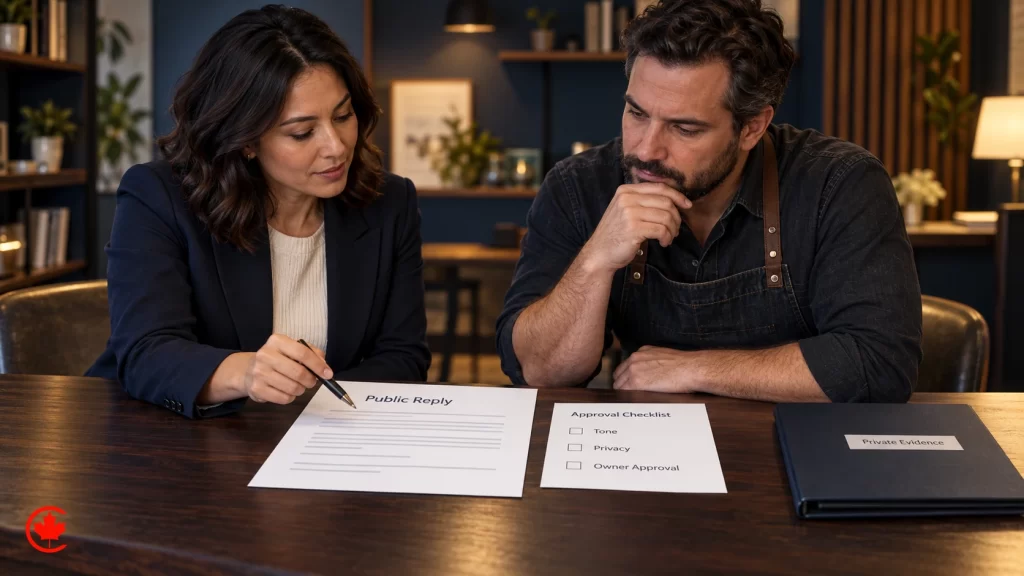
Fixing what caused the complaint
Many negative reviews point to something real: a missed callback, a confusing invoice, a long wait at the counter. Fixing the cause is the only response that reduces the next review like it.
Finding the pattern
We read negative and mixed reviews together and group them by theme: scheduling, staff manner, pricing surprises, product quality, cleanliness, communication after the sale. A restaurant may find that most complaints mention takeout wait times on Friday nights; a contractor may find that the issue is not the work but the silence between site visits.
Turning themes into changes
Each theme becomes a short note for the owner: what customers say, how often it comes up, and one or two practical changes to consider. Whether to change a process, train staff or update the website is the owner’s call. When a change is made, a reply to the related review can mention it honestly.
When the website is part of the problem
Some complaints trace back to information customers saw before they ever arrived: old hours, a menu or price list that no longer applies, a booking page that hides the deposit rule. Correcting that information removes the surprise that led to the review. Where the fix means rebuilding pages, our website design team in Toronto can handle it, and the profile is updated to match.
Earning genuine new reviews
A single negative review weighs heavily on a profile with only a handful of reviews and much less on one with a steady stream of recent, honest ones. The lasting answer to an unfair review is usually more real reviews from real customers.
That means asking every customer the same way, not only the happy ones, with no reward attached and no hint about what they should write. The routine of asking, answering and using reviews over time belongs to our review management service; on this page, the point is that genuine volume makes the occasional unfair review matter less. Our guide to the Google review link and QR code shows owners where to find both and how to ask within the rules. Where requests go by email or text, consent rules apply, and our CRM setup and connection can keep a clean record of who agreed to hear from you.

Removal services and shortcuts to avoid
Owners searching for help with a bad review quickly find services promising to delete it. Many of these offers are a reason for caution.
Warning signs
- A promise that a review will be deleted, or a fee only charged if it disappears.
- Claims of a special contact inside Google or a private way around the reporting process.
- Offers to post positive reviews to bury the bad ones.
- Suggestions to pay or reward customers for reviews, or to ask only satisfied customers.
- Requests for your Google account password so the service can act for you.
Why these shortcuts backfire
Fake or paid reviews break Google’s policies and can lead to reviews being removed in bulk, warnings on the profile or restrictions on the listing. They can also breach Canadian competition law. Giving a stranger your account password puts the whole profile at risk. A slower, legitimate approach protects the business you have built. Our broader online reputation management work takes the same view across every platform.
When a review may be defamatory
Occasionally a review goes beyond opinion and makes a specific false statement of fact that could harm the business, such as accusing it of a crime. Whether a review is defamatory, and what legal steps are available, is a legal question. That belongs with a lawyer, not a marketing agency.
What we can do is help the owner keep a clean, dated record of the review, any related posts, the policy report made to Google and its outcome, so a lawyer has the facts in order if the owner decides to consult one. We do not give legal advice and we do not contact reviewers on the owner’s behalf.
Competition and privacy rules to plan for
Review work sits inside rules that apply to every business that markets itself online. These are the general points to keep in mind.
- Google’s review policies forbid offering incentives for reviews, asking only happy customers for reviews (often called review gating), fake reviews and reviews written by staff or the business itself.
- Under the Competition Act, posting or buying fake reviews and making misleading claims can be treated as deceptive marketing, and the Competition Bureau has taken action in such cases. Hiding genuine negative reviews or rewarding reviewers without saying so can fall under the same concern, which is why a removal shortcut can create a bigger problem than the review itself.
- Regulated professions such as dentists, physicians and lawyers have extra limits on testimonials set by their own regulators.
- CASL applies to review requests sent by commercial email or text: consent, sender identification and an unsubscribe.
- PIPEDA applies to the personal information a business holds about customers, so replies must never reveal customer details, and sensitive information stays out of analytics and ad targeting.
This is a marketing observation, not legal advice.
How the work runs
A free first look
We start with a conversation about the reviews that concern you, what you know about each one and how you currently ask for and answer reviews. Send links to the specific reviews if you can.
A custom proposal
You receive a custom proposal that sorts each review into flag, reply or fix, sets out the evidence to gather and any reply drafts needed, with fees quoted in writing.
Reports, replies and follow up
The owner submits reports through the Business Profile, or we work inside the profile where you have given us our own manager access. Reply drafts go to you for approval before posting. We track the status of each report and prepare appeal notes where Google offers that step.
Monthly notes where agreed
Where ongoing help is agreed, a monthly note covers new reviews that may break policy, reports and their outcomes, reply drafts and the complaint themes worth acting on.
Paying for help with negative reviews in Toronto: what drives cost
Review work is quoted in writing after the free consultation. Google charges nothing to report a review, and no legitimate fee can buy a removal.
What drives the quote
- How many reviews need checking, and across how many locations or profiles.
- How much evidence gathering each review needs, for example checking booking or sales records.
- How many reply drafts are needed, and whether replies run in English, French or both.
- Whether the work includes a complaint theme review and notes on process changes.
- Whether you want ongoing monthly monitoring of new reviews.
A single location bakery with two suspicious reviews is a short piece of work; a home services company with several profiles, a burst of reviews from unknown accounts and a backlog of unanswered complaints is larger.
Choosing help to remove negative reviews: questions to ask first
The provider you choose will speak for your business in public replies and will see your profile. Ask these questions first:
- Who owns the accounts? The answer should be you, with any provider added as a manager you can remove at any time.
- Do you explain that Google decides, and avoid promising that any review will come down?
- Which policy category would you cite for each review, and why?
- Will every reply be sent to me for approval before it is posted?
- How do you make sure replies never reveal customer details?
- Do you refuse to post, buy or arrange reviews of any kind?
Signs of a weak answer
Walk past any provider who promises deletion, asks for your account password, suggests rewarding customers for reviews or offers to write reviews for you. Accurate reports, careful replies and honest new reviews are the standard to expect. For a wider look at how your business appears in local search, our local SEO in Toronto page covers the listing and ranking side.
Preparing a negative review check: links and notes to gather
Before the call, gather links to the reviews that concern you, a note of anything you know about each reviewer, and how you currently ask customers for feedback. With that, Canada Create can sort each review into flag, reply or fix in a free review check and send a custom proposal afterward.
Call (416) 273-9030, Monday to Friday, 9 am to 6 pm, and Saturday, 10 am to 2 pm. After hours, our 24/7 AI agent answers the toll-free line, +1 (800) 808-9235, and we’ll follow up the next business morning.
You can also send us the reviews that concern you. We reply within one business day.
Our office is at 126 Willowdale Avenue, Suite 3, Toronto, and we work with businesses across Canada.
Talk to a strategist
Ready when you are?
Request a custom proposal
Tell us your goals, budget and timeline. You get a custom proposal and a named strategist, so your next stage of growth starts now.
Steps to report or answer negative reviews, from first call onward
Each step is written down, and your Business Profile stays in your name with any manager access yours to remove.
- Free conversation First call
The reviews that concern you, what you know about each and how you ask for reviews now.
- Custom proposal Written proposal
Each review sorted into flag, reply or fix, with fees quoted in writing.
- Reports and replies Agreed milestones
Policy reports made and tracked, reply drafts approved by you and posted.
- Monitoring Every month
Where agreed, new reviews checked, outcomes recorded and themes noted.
Why work with Canada Create on negative reviews
Since 2008
More than 18 years of websites, search and advertising work for businesses across Canada.
BBB Accredited A+
A BBB Accredited Business with an A+ rating and zero complaints.
Toronto office
126 Willowdale Avenue, Suite 3, Toronto, serving businesses across Canada.
English and French
Our team works in English and French.
Negative review questions
Can a bad review be taken off Google?
Only if it breaks one of Google's published policies, such as fake engagement, off topic content, conflict of interest, harassment or posting personal information. Google alone decides whether a reported review comes down, and a blunt review describing a real experience is usually allowed to stay. Nobody can promise removal.
Can business owners delete negative Google reviews themselves?
No. Editing or deleting a review is up to its author, and taking one down after a report is up to Google. What the owner controls is reporting reviews that break policy, following the report's status, replying publicly and fixing whatever caused a fair complaint.
What does getting a negative Google review removed cost?
Google charges nothing to report a review, and no fee to anyone buys a removal. Help with checking reviews against policy, keeping evidence, drafting replies or watching new reviews is priced by how many reviews and how much follow up is involved. Canada Create gives that figure in writing after a free consultation, without any promise about what Google decides.
How do I get a Google review removed through the proper process?
Report it through the option Google gives owners on the Business Profile, naming the policy category that applies. Keep a short factual record, such as no matching customer in your booking system or a burst of reviews posted together. Then follow the status with Google's tools and, where an appeal is offered, add context once.
Can you pay to remove negative reviews?
There is no paid back channel into Google's review decisions. Services that promise removal for a fee, buy positive reviews to bury bad ones or pressure reviewers can put the listing and the business at risk. The legitimate route is reporting through Google, replying well and earning genuine reviews.
Is it legal for a company to hide or delete bad reviews?
A business cannot delete Google reviews at all, and on its own website, showing only the good ones can leave customers with a misleading picture. Canada's Competition Act prohibits misleading representations, and fake or bought reviews raise the same concern. If you think a review is defamatory, keep a dated record and speak with a lawyer, and look up the Competition Bureau's latest guidance.
How do you remove fake negative reviews from Google?
Reviews from people who were never customers, several reviews from one person under different names, or reviews written by a competitor or former employee may fall under Google's spam or conflict of interest rules. Write down what you know, then report each one naming that category. If Google leaves it up, a short reply saying you have no matching record and inviting the person to call is better than any accusation.
How long does Google take to act on a reported spam review?
Google does not commit to a set response time, and outcomes vary. The status of each report can be checked through Google's own tools, and some decisions can be appealed once with more context. Repeatedly reporting the same review rarely changes the result, so the time is better spent on a good reply.
How should a Toronto business reply to a negative Google review?
Write for the next customer reading it: thank the person, name the issue in neutral words, say briefly what has changed and invite them to continue by phone or email. Never confirm someone was a client if that reveals private details, which matters for clinics and law offices. We draft replies for the owner to approve and post in the business's own voice.
How do I choose a service to help with negative reviews?
Be wary of anyone who promises removal, charges per review taken down or offers to post reviews. A sound service sorts each review into flag, reply or fix, works only through Google's own reporting tools, keeps the evidence record with you and helps you ask every customer for reviews the same way, with no reward. Canada Create's own Google reviews are live, and the Better Business Bureau lists the Toronto agency as accredited, rated A+.
How do I remove a Google review I wrote myself?
The person who wrote a review can edit or delete it from the Google account used to post it. A business cannot do this on the reviewer's behalf, and it should never offer anything in exchange for a review being changed or removed, because Google prohibits that.
How many positive reviews does it take to offset one negative review?
There is no fixed number. Your star rating is an average, so each new genuine review reduces the weight of any single one, and a profile with a steady flow of recent reviews absorbs a bad day far better than a quiet one. Readers also look at recency and at how you replied.


Know which reviews you can report
Some negative reviews break Google's policies and can be reported; most deserve a good public reply instead. A short check sorts each one and shows the next step. Get a free review check.