
Toronto · RMT marketing
Massage therapist marketing in Toronto
Fill your treatment hours with returning clients and referrals, with marketing that stays truthful and respects health information.
A full marketing plan for registered massage therapists and clinics in Toronto and the GTA and across Canada: modality focus, Google profile, booking, direct billing messages, rebooking, referral partners and workplace days.
- BBB A+ accredited
- 18 years in business
- Mon to Fri 9 to 6, Sat 10 to 2
Get a custom proposal for your RMT marketing
Send your Google listing, website and booking link, and we will send the first fixes and a custom proposal with fees. We reply within one business day.
Please do not share passwords or other sensitive details here. We never sell your contact information and we comply with Canadian privacy law
(privacy policy).
Deliverables from massage therapist marketing for RMT clinics
A clear focus
The modalities and setting your practice leads with, on every page and profile.
Direct billing explained
Plain wording on billing and receipts, without promising anyone's coverage.
Steadier rebooking
A habit at the end of each session and reminders sent with consent.
Referral and workplace plan
Referral material for nearby clinics and offices that already work with you.
What massage therapist marketing includes
Your written proposal sets the exact scope; these are the usual parts of a massage practice plan.
- Modality positioningSports, prenatal, deep tissue, lymphatic or relaxation focus, matched to training.
- Google Business ProfileCategories, services, room photos, hours, booking link and billing note.
- Therapist and modality pagesEach RMT's focus, training and languages, plus a page for each kind of massage.
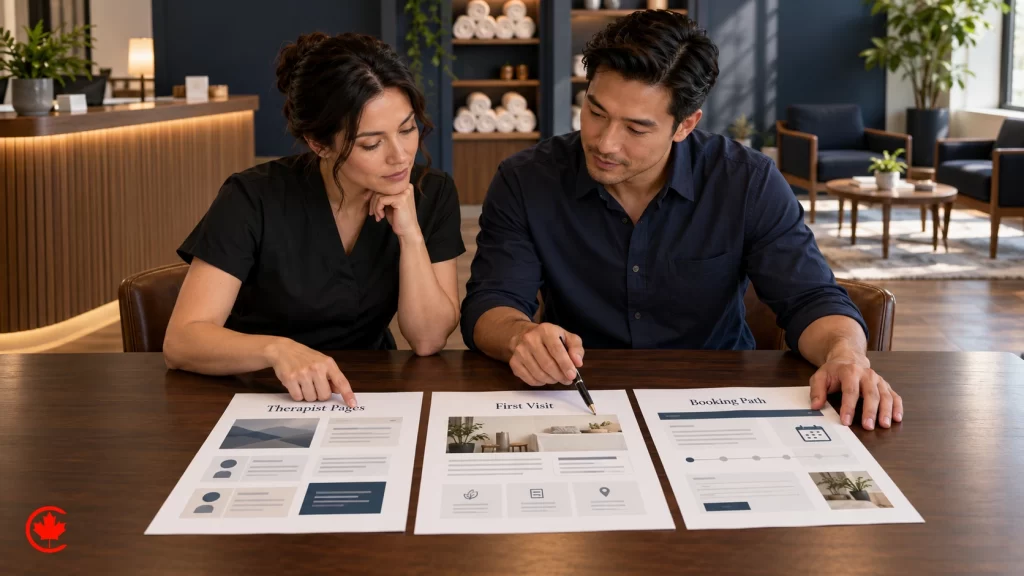
- Booking path reviewAppointment lengths, first visit details and booking policy wording.
- Direct billing wordingBilling and receipt messages for the profile, website and confirmations.
- Rebooking and remindersEnd of session prompts, reminder timing and follow up from the therapist.
- Referral partner kitIntroduction note and referral card for physio, chiropractic and family practices.
- Workplace day offerA one page offer for HR teams and a booking form for on site chair massage.
How massage practice marketing is priced
Every engagement is quoted in a custom proposal after a free review; ad spend and software are paid to the vendor separately.
Practice review and plan
Quoted in writing after a free consultation
RMTs who want a clear plan first
- Profile and website review
- Booking path walk through
- Modality focus notes
- Custom proposal and calendar
Profile, pages and booking
Quoted in writing after a free consultation
Practices hard to find or book
- Google Business Profile cleanup
- Therapist and modality pages
- Direct billing wording
- Booking policy wording
Monthly practice marketing
Quoted in writing after a free consultation
Clinics wanting ongoing help
- Rebooking and reminder messages
- Content calendar
- Schedule gap focus by therapist
- Monthly report
Referral and workplace material
Quoted in writing after a free consultation
Practices growing beyond search
- Referral partner kit
- Workplace day offer
- Event booking form
- Follow up plan
Ad spend and software licences are paid to the platform directly and shown separately from our fees.
Massage practice guide
How an RMT practice fills its schedule with clients who come back
Massage therapist marketing is the complete plan that keeps an RMT’s schedule full with clients who return: what kind of massage you are known for, how you show up when someone searches “RMT near me”, how the website and online booking work, how you explain direct billing and receipts, and how referral partners, workplaces and gift cards add to the regulars. It is marketing for therapists in every kind of practice: solo registered massage therapists, mobile RMTs and clinic owners filling the schedules of several therapists. Canada Create is a Toronto agency serving businesses across Canada, and this page sets out what a massage practice plan covers and what you receive.
- How people look for an RMT and decide
- Positioning by modality and setting
- Your Google profile and the near me search
- Website pages and online booking
- Direct billing and receipts as a clear message
- Returning clients and rebooking
- Solo practice or several therapists
- Referral partners, workplace days and gift cards
- Content that answers questions without claims
- College standards, privacy and consent
- How we work with a massage practice
- What a massage practice plan costs
- How to choose a partner for your practice
- Book a massage therapist marketing review for your RMT practice
How people look for an RMT and decide
Someone with a stiff neck from a desk job, a runner training for a fall race, or a client in her second trimester rarely searches for “massage marketing” words. They type “RMT near me”, “registered massage therapist Toronto”, “sports massage Liberty Village”, “prenatal massage” or “massage direct billing”, usually on a phone, often on a lunch break. Then they compare a short list.
The questions in their head
The deciding points for massage clients are practical. Is this person a registered massage therapist, so my benefits plan will accept the receipt? Can the clinic bill my insurer directly? Is there an opening this week, ideally after work or on Saturday? Does the therapist know the kind of work I need? Is there parking or transit nearby, and is the room easy to reach? What do other clients say about the therapist, not just the space? Your marketing has to answer each of these before the booking screen.
Who decides besides the client
Many first visits come through someone else: a physiotherapist who says “see an RMT for the soft tissue work”, a chiropractor down the hall, a family practice that suggests massage, a coach, or a friend who swears by her therapist. A plan that only chases searches misses half of how massage practices actually fill.
Positioning by modality and setting
“Massage therapy” is broad. A practice that says clearly what it focuses on is easier to find, easier to refer to and easier to remember.
Choosing a focus
Common focuses include sports massage for runners, climbers and recreational leagues; prenatal and postpartum massage; deep tissue work for desk workers and trades; manual lymphatic drainage where the therapist has that training; relaxation massage; and care for older adults. You can offer several and still lead with one. Each focus needs its own page and its own photos, written in words clients use, and each must match what you are trained and permitted to provide.
The setting shapes the message
- Mobile RMT. The message is convenience: which neighbourhoods you travel to, what you bring, how home visits are booked and how parking or building access works.
- Clinic inside a gym or studio. Members already trust the building; the plan is about visibility at the front desk, in the member app and in class announcements.
- Multidisciplinary clinic. Massage sits beside physiotherapy, chiropractic or naturopathy, so the message is about coordinated care and easy internal referrals.
- Standalone massage clinic. The rooms, the calm and the team of therapists are the story, with each therapist’s focus explained.
Your Google profile and the near me search
When someone types “RMT near me”, Google shows a map with a few listings. The Google Business Profile is where many clients decide, so it deserves as much care as the website.
What a massage profile should carry
- A primary category that fits, such as massage therapist, and secondary categories only where accurate.
- Services named the way clients search: registered massage therapy, sports massage, prenatal massage, deep tissue massage.
- Photos of the treatment rooms, the entrance, the waiting area and the street, so a first visit starts calmly.
- Hours that match the real booking calendar, including evenings and weekends.
- A booking link that opens massage, not another service in a shared clinic.
- A note on direct billing in plain words, where you offer it.
If you would rather hand off the ongoing upkeep, our Google Business Profile management covers it.
Search beyond the map
The organic results below the map favour practices with clear pages for each modality and each location. Building those pages and the rest of the search work sits with our SEO services, so that a clinic can be found for “prenatal massage Etobicoke” as well as its own name.
Website pages and online booking
A massage website has a few jobs: show who the therapists are, explain what a first visit involves, make direct billing clear, and get a time booked in as few taps as possible.
Pages a practice needs
A therapist page for each RMT with their focus, training and languages spoken; a page for each modality; a first visit page that covers the intake form, what to wear, how consent to treatment works and how long the appointment runs; a direct billing and receipts page; and a location page with parking, transit and accessibility details. Physiotherapy and massage often share a building, and a practice next to a physio clinic can learn from how our physiotherapy SEO work handles condition questions carefully.
The booking path
We book an appointment on your site as a new client would, on a phone, and note every step that slows it down: unclear appointment lengths (30, 60 or 90 minutes is clearer when each is described), therapists listed without a focus, an intake form demanded before a time is shown, or no option for “first available RMT”. The booking policy for late arrivals and missed appointments is written once, shown before the client confirms and repeated in the confirmation, in a kind tone.
Direct billing and receipts as a clear message
For many massage clients, extended health benefits decide whether they book at all. A practice that explains this clearly removes a reason to hesitate.
What to say
Say whether you bill insurers directly, and say it on the profile, the website and the booking confirmation. Explain that receipts are issued by a registered massage therapist, which is what many plans ask for. Remind clients that their insurer decides what their plan covers and how much, and that they should check their own plan. Never imply a service is covered for everyone.
Timing around benefit years
Many benefit plans have a yearly maximum that resets on a set date, and some clients with unused coverage try to book before it does. A simple reminder ahead of that point, sent to clients who agreed to hear from you, written as “check what is left on your plan”, is helpful and honest. We plan the timing; we never claim to know a client’s coverage.
Returning clients and rebooking
Regulars are the base of every full massage schedule. A client who comes every four or six weeks is worth more to the practice than several one time visits, and she is far easier to keep than a stranger is to find.
Booking the next visit before they leave
The simplest habit is asking at the end of the session, while the client is still relaxed: “Would you like to book your next visit now?” with two time options. Clinics where the therapist steps out and the front desk takes payment need the same question asked there. Online clients get a gentle prompt in the follow up message.
Reminders and gentle follow up
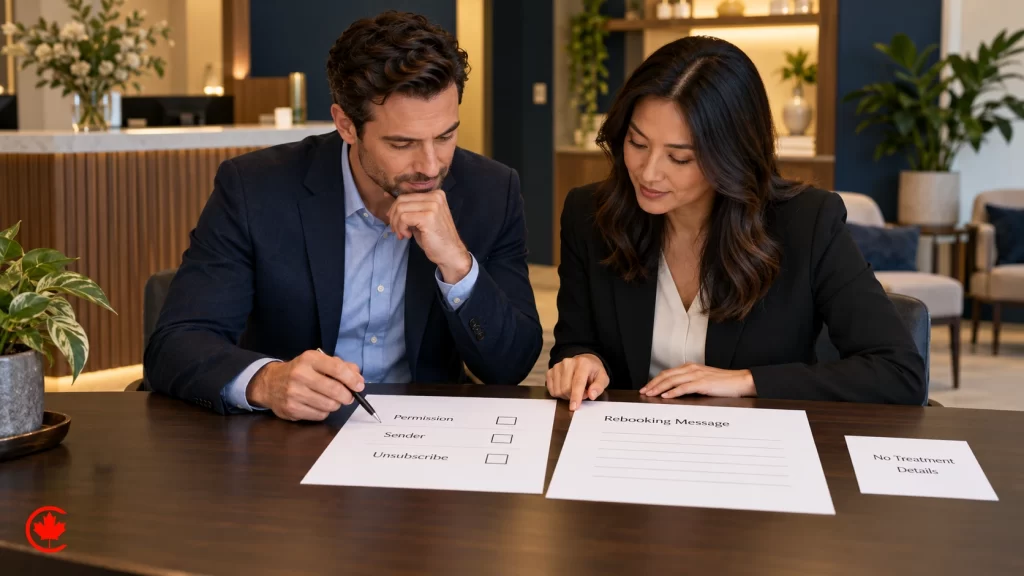
Appointment reminders reduce missed visits. A short message a few weeks after a first appointment, from the therapist the client saw, brings back clients who meant to rebook. Keep messages free of treatment details, and send them only to clients who gave consent, with an easy unsubscribe. Our email marketing service can write and send these where your booking system does not.
Clients who stopped coming
Some clients pause because a benefit plan ran out, a schedule changed or a therapist left. A plain note that their usual therapist has new evening openings, or an introduction to another therapist with a similar focus, respects the client and keeps the relationship with the practice.
Solo practice or several therapists
The marketing a solo RMT needs is not the marketing a clinic owner with six therapists needs.
Solo RMTs and mobile therapists
For a solo practice, the therapist is the brand. The plan puts your name, focus and photo first, keeps your profile and booking link in your name, and builds a small, steady set of referral partners. Your capacity is fixed, so the goal is filling the hours you want to work with clients who return, not adding volume you cannot serve.
Clinics with several therapists
A clinic owner has a different problem: one therapist is booked three weeks out while another has gaps every afternoon. The plan gives every therapist a clear focus and page, steers new clients toward open schedules by focus and time of day, and introduces newer therapists through the front desk and messages to returning clients. When a therapist leaves, client records and reviews stay with the clinic, which is why accounts belong in the clinic’s name.
Referral partners, workplace days and gift cards
Much of a massage practice’s growth happens off the search page.
Physiotherapists, chiropractors and family practices
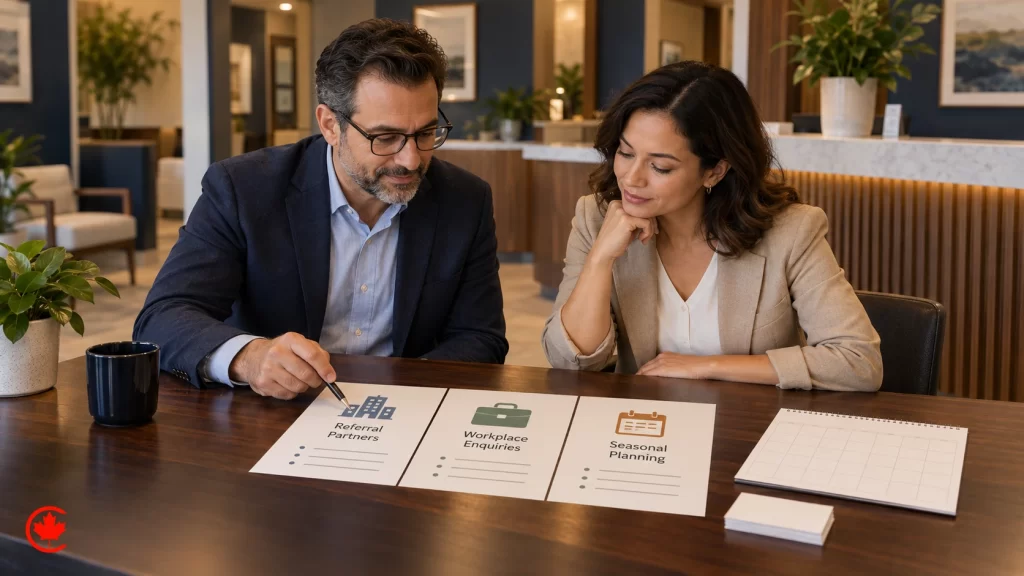
Referral relationships are built on trust and convenience. Introduce yourself to nearby physiotherapy and chiropractic clinics and family practices with a short note on your focus and availability, keep a simple referral card, and follow up when a referred client visits, with the client’s permission and without sharing treatment details beyond what the client agreed to.
Workplace and corporate wellness days
Offices, warehouses and teams sometimes bring chair massage on site for a wellness day. A one page offer for HR and office managers, a booking form for the event and a follow up for staff who want a full appointment later turn one day into returning clients. Enquiry funnels for these accounts are covered on our massage therapist lead generation page.
Gift cards
Massage gift cards sell before Mother’s Day, Valentine’s Day and the December holidays. Make them easy to buy online, promote them to returning clients a few weeks ahead, and state clearly whether a gift card can be used for a receipt to an insurer, according to your own practice policy.
The massage year
Bookings move with the calendar. Spring and fall race seasons bring runners looking for sports massage; the weeks before the December holidays bring gift card buyers and stressed office workers; September brings people back to routines and desks. Summer can be quieter in some neighbourhoods as regulars travel. Plan content, reminders to returning clients and gift card pushes a few weeks ahead of each turn, and use quiet weeks to introduce a newer therapist or a modality you want to grow.
Community presence
Local running clubs, prenatal classes, recreational leagues and neighbourhood events are natural places for a massage practice to be known. A table at a race package pickup, a short talk on what to expect from a first massage at a prenatal class, or a referral card on a partner’s front desk keeps your name in the places your clients already are. Ask organizers first, keep any sign up list private and follow up only with people who agreed.
Content that answers questions without claims
Clients ask the same questions before they book: what happens at a first visit, what to wear, the difference between deep tissue and relaxation massage, whether prenatal massage is offered in each trimester, how direct billing works. Answering them on your site, in short posts and on social media builds trust.
Keeping it truthful
Content describes the service, the therapist’s training and what to expect. It does not promise pain relief, recovery or any treatment outcome, and it does not compare your practice to others as superior. Photos of clients, even on a table with only a back visible, need written consent.
Where the rest fits
Paid campaigns for massage clinics are run by our massage therapy advertising team and, more widely, by our Google Ads management service; the plan sets which modalities and quiet hours they support. Enquiries can flow into CS+, our CRM, which we set up and connect so that calls, forms and returning client lists sit together. The wider wellness picture is on our beauty and wellness hub, and studios close to your practice may find our yoga studio marketing page useful. Two related pages in the same panel, Marketing for hair salons and Fitness marketing agency, cover those trades.
College standards, privacy and consent
- A regulated profession. Massage therapy is a regulated health profession in Ontario, overseen by the College of Massage Therapists of Ontario, and in some other provinces. RMT is a protected title there, so only registered therapists may use it.
- Advertising standards. College advertising standards require claims to be truthful and verifiable, and they limit testimonials and outcome claims. Plan your reviews, website copy and social posts with that in mind.
- Health information. Intake forms and treatment notes are personal health information. No treatment details in analytics, ad audiences or retargeting.
- Benefits. Insurers decide what a plan covers; your marketing explains billing, never coverage.
- Reviews. Google’s review policies ban incentives, review gating and fake reviews, and the Competition Act prohibits fake or misleading reviews.
- Messages and privacy. CASL applies to commercial email and texts (consent, sender identification, unsubscribe), and PIPEDA applies to personal information in general.
This is a marketing observation, not legal advice.
How we work with a massage practice
- Free review. We look at your Google profile, website, booking path, therapist pages and how you explain direct billing, as a new client on a phone would.
- Custom proposal. You receive a focus by modality and setting, profile and page fixes, a rebooking and reminder plan, a referral partner and workplace plan, and a content calendar, with fees quoted in writing.
- Setup. We make the agreed changes, write therapist pages and messages, and set up follow up with your front desk or with you, if you work alone.
- Monthly reporting. New and returning clients, rebooking, open hours by therapist, profile activity and the next month’s focus.
The Google profile, website, booking system and client lists stay in your practice’s name.
What a massage practice plan costs
We quote massage practice marketing in writing after the free review. A mobile RMT working alone and a clinic with several rooms need very different amounts of work. What drives the fee:
- How many therapists, rooms and locations the plan covers.
- How many modality and therapist pages need writing or rewriting.
- Whether the booking path and direct billing messages need rebuilding.
- The size of the referral partner and workplace material you want.
- Photo or video of the clinic and therapists, done with consent.
- Whether paid campaigns run too, with ad spend paid to the platform and shown separately.
- Work in English and French where your clients use both.
Booking and billing software subscriptions are paid to their vendors directly.
How to choose a partner for your practice
- Who owns the accounts? The answer should be you: the Google profile, website, booking system and client list.
- Do they know the College rules? Ask how they handle testimonials and outcome wording in massage marketing.
- How do they treat health information? Treatment details must never reach analytics or ad audiences.
- Will they look at therapist schedules? Filling the quiet therapist matters as much as attracting new clients.
- Do they understand direct billing? They should explain billing without promising coverage.
- What will they promise? A promised number of clients or a full schedule by a date is a warning sign.
Read more about Canada Create before you call.
Book a massage therapist marketing review for your RMT practice
Ask for a free massage practice review. Send us your Google listing, your website and your booking link, tell us which modalities you want to grow and which hours sit empty, and say whether you work alone or run a clinic. We will look at everything as a new client would and send back the first fixes and a custom proposal with fees quoted in writing.
Call (416) 273-9030, Monday to Friday, 9 am to 6 pm, and Saturday, 10 am to 2 pm. After hours, our 24/7 AI agent answers the toll-free line, +1 (800) 808-9235, and we’ll follow up the next business morning. Or tell us about your practice in writing, and we reply within one business day. Canada Create is at 126 Willowdale Avenue, Suite 3, Toronto.
Talk to a strategist
Ready when you are?
Request a custom proposal
Tell us your goals, budget and timeline. You get a custom proposal and a named strategist, so your next stage of growth starts now.
How a massage practice plan starts
Each step is in writing, and your profile, website and client lists stay in your practice's name.
- Free review First call
Profile, website, booking path and billing messages, seen as a new client sees them.
- Custom proposal Written proposal
Focus, fixes, rebooking, referral and workplace plans, with fees in writing.
- Setup Agreed milestones
Pages, profile, messages and follow up put in place with you or your front desk.
- Report Every month
New and returning clients, open hours by therapist and next month's focus.
Why RMTs and clinic owners choose Canada Create
Since 2008
More than 18 years of websites, search and advertising work for businesses across Canada.
BBB Accredited A+
A BBB Accredited Business with an A+ rating and zero complaints.
Toronto office
126 Willowdale Avenue, Suite 3, Toronto, serving businesses across Canada.
English and French
Our team works in English and French.
Massage therapist marketing questions
What should a massage therapist marketing strategy cover?
Start with how clients actually look for an RMT: they type phrases like "RMT near me" or "prenatal massage" on a phone and then compare a short list. A strategy answers their practical questions before the booking screen, such as whether receipts come from a registered massage therapist, whether you bill insurers directly and when the next opening is. It also plans for the referrals that come from physiotherapists, chiropractors, coaches and friends, since many first visits come through someone else's recommendation.
What belongs in a massage therapy marketing plan?
A typical massage practice plan includes modality positioning, a well kept Google profile, pages for every therapist and each kind of massage, and a review of the booking path. It adds direct billing wording for the profile, website and confirmations, rebooking prompts and reminders, a referral partner kit and a one page workplace day offer. Your written proposal sets the exact scope for your clinic.
Which words work in massage advertising without breaking college rules?
Plain descriptions work best: the modality, the appointment length, who the session suits, whether you direct bill and how to book. Leave out any promise to cure or fix a condition. Ontario regulates massage therapists through CMTO, and its advertising standards apply to every ad, profile and post, so an RMT should read the college's current standard before any campaign starts.
How should a Toronto massage clinic talk about direct billing?
Say clearly whether you bill insurers directly, and repeat it on the Google profile, the website and the booking confirmation. Explain that receipts are issued by a registered massage therapist, which many benefit plans ask for. Remind clients that their insurer decides what is covered, and never imply a service is covered for everyone.
Are there free ways to advertise as a massage therapist?
Yes, several of the strongest channels cost time rather than ad spend. A complete Google Business Profile with room photos, real hours and a booking link is free to run. Asking clients to book their next visit before they leave, and building referral relationships with nearby physio, chiropractic and family practices, also fill a schedule without paying a platform.
What massage therapy marketing ideas bring clients back?
Regulars are the base of a full massage schedule, so most good ideas focus on rebooking. Ask at the end of the session, while the client is relaxed, with two time options, and have the front desk ask the same question at payment. A short note from the therapist a few weeks after a first visit brings back people who meant to rebook, sent only to clients who consented and kept free of treatment details.
How do I choose a firm for massage therapist marketing in Toronto?
For an RMT clinic, sensible checks are a listed office address, live Google reviews, knowing which person on the team writes your ads and plain monthly reports, with the clinic's Google profile and ad accounts in its own name. Ask how the firm handles college advertising standards and client privacy. Canada Create, a Toronto marketing agency working with clinics since 2008, has A+ BBB accreditation and plans RMT marketing in English or French.
How much does massage therapist marketing cost?
The cost depends on how many therapists and modalities you market, how much your current listing and site need, and whether you want ongoing rebooking, referral and workplace wellness pages. Our fees come in writing, as a custom proposal for your RMT practice that follows a free consultation. If a clinic runs ads or booking software, the RMT pays those vendors directly, separate from our fees.


Someone nearby is searching for an RMT
A new client is checking who is registered, who bills directly and who has an opening this week. Make sure your profile and booking page answer all three. Book a free massage practice review.