
Toronto · Church enquiries
Church leads in Toronto
We build the path from a first enquiry to a first visit and a real connection, so no one who reaches out to your church is forgotten. Fees are quoted in writing.
Plan a visit forms, connect cards, course, event and community program registrations, and welcome team follow up for churches in Toronto and the GTA and congregations across Canada.
- BBB A+ accredited
- 18 years in business
- Mon to Fri 9 to 6, Sat 10 to 2
Get a custom proposal for your church welcome path
Tell us how visitors and families contact your church today, and we will review where enquiries go. We reply within one business day.
Please do not share passwords or other sensitive details here. We never sell your contact information and we comply with Canadian privacy law
(privacy policy).
What your church gets from an enquiry flow
Every enquiry seen
Forms, cards and registrations arrive in one place with a named person responsible.
The right ministry replies
Youth, courses, life events and community programs routed to the right leader.
A welcome that happens
Follow up planned before Christmas and Easter, not after the rush.
A clear view for leaders
Monthly reports on enquiries, replies, first visits and returning visitors.
What a church enquiry flow includes
The forms, routing and follow up a congregation needs to welcome people who reach out.
- Plan a visit formShort, mobile friendly and confirmed with a personal next step.
- Digital connect cardA code in the bulletin or on screen opening a quick card.
- Paper card routineSunday cards entered into the same path the next day.
- Course and group sign upsBaptism, marriage preparation, faith courses and small groups.
- Event registrationsChristmas and Easter services, concerts, meals and camps.
- Ministry routingEach enquiry type sent to a named role with a backup.
- Follow up templatesWarm replies drafted with your church for the office and welcome team.
- CS+ path and reportingStages from enquiry to connected, with a plain monthly report.
How a church enquiry flow is priced
Each church receives a quote in writing after a free review. Ad spend and CS+ licences are shown separately from our fees.
Visitor welcome setup
Quoted in writing
Churches starting with first time visitors
- Plan a visit form
- Digital connect card
- Welcome team routing
- Follow up templates
Ministry and course routing
Quoted in writing
Churches with many groups and courses
- Course registrations
- Small group sign ups
- Routing by ministry
- Backup assignments
Seasonal registrations
Quoted in writing
Churches preparing for Christmas and Easter
- Service registrations
- Event and camp forms
- Follow up plan
- Season report
Ongoing support and reporting
Quoted in writing
Churches wanting help after launch
- Form changes
- New volunteer training
- Routing updates
- Monthly report
Ad spend and software licences are paid to the platform directly and shown separately from our fees.
Church enquiries guide
Welcoming people who reach out to your church
Church leads, in the way a congregation would use the phrase, are the people who raise a hand: someone who fills in a plan a visit form, a family that registers for the Christmas Eve service, a couple asking about marriage preparation, a newcomer who signs up for an ESL class in the church hall. This page is about catching those enquiries, sending each one to the right person and following up warmly until a visitor feels connected. It is written for pastors, welcome team leaders, parish administrators and church councils of any denomination. Canada Create is a Toronto agency with an office at 126 Willowdale Avenue, Suite 3, building enquiry and follow up flows for churches across Canada.
- What a church enquiry looks like
- Plan a visit forms that people actually finish
- Connect cards, on paper and on a phone
- Welcome team follow up and routing
- Courses, groups and community programs as first steps
- Christmas, Easter and event registrations
- A CS+ path from first contact to connected
- Where enquiries come from and how this fits the rest
- Consent, charity rules and privacy for enquiries
- How we build an enquiry flow for a church
- What a church enquiry flow costs
- Choosing a partner for church enquiries and follow up
- Set up church leads and visitor follow up with a custom proposal
What a church enquiry looks like
People who have already decided to look
Nobody fills in a form at a church website by accident. A person who requests information about a youth group, asks what time the Sunday service starts or registers for a community meal has already done something brave. Treating that enquiry as a person to welcome, rather than a number to report, is the starting point for everything on this page.
The usual kinds of enquiry
- Plan a visit requests from people thinking about a first Sunday.
- Connect cards filled in during or after a service, on paper or a phone.
- Course and small group sign ups: baptism classes, marriage preparation, faith exploration courses, youth programs.
- Event registrations for Christmas and Easter services, concerts, camps and community meals.
- Community program enquiries for food banks, ESL classes and newcomer support.
- Wedding, baptism and funeral enquiries that need a quick, careful answer from the office.
What leaders are searching for
Church leaders search phrases like church leads, how to get more people to come to church and church outreach ideas. What they usually need is not more traffic but a reliable path: an enquiry that arrives somewhere visible, reaches someone who will respond, and is not forgotten when that volunteer goes on holiday.
Plan a visit forms that people actually finish
Ask little, answer much
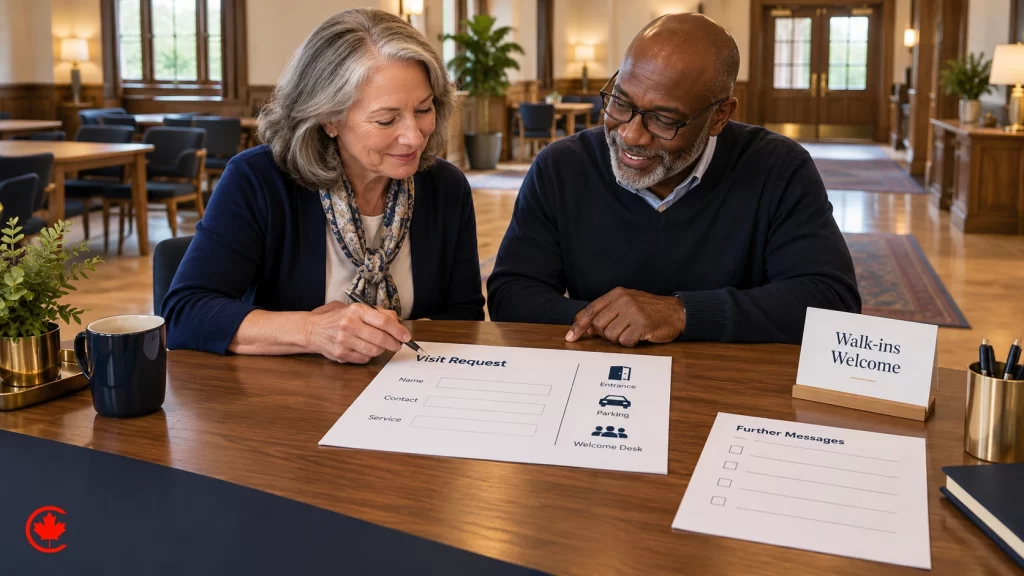
A plan a visit form should take under a minute. Name, email or phone, which service they plan to attend, how many are coming and whether there are children is usually enough. Every extra field, such as a home address, a denomination or a question about their faith background, gives a nervous visitor a reason to close the page. The page around the form should answer what to wear, where to park, which door to use and what happens for kids.
What happens after they press send
The confirmation should say what happens next in a human voice: a greeter will look out for you at the main doors, here is a map, here is the children’s check in. A short confirmation email with the same details arrives straight away. Then a person from the welcome team sends a note before Sunday, so the visitor knows a real face is expecting them.
Visitors who come without telling you
Many first time visitors never fill in anything; they simply walk in. The plan a visit form is not a gate, and the page should say plainly that everyone is welcome without registering. Its value is for the people who want reassurance first, often parents, people with mobility needs and those returning after a hard season, who appreciate knowing someone will meet them.
Pages that carry the form
The form works well on a dedicated page linked from the home page, the Google listing and every ad or social post that invites people to visit. Design and build of those pages belongs to our church website design work; here we make sure each form is connected, tested and routed.
Connect cards, on paper and on a phone
Keeping the paper card
Many congregations still hand out paper cards, and some visitors prefer them. The difficulty is what happens on Monday: cards sit in the offering bag, then the office, then a drawer. We set up a simple routine so a named volunteer types in Sunday’s cards the same day or the next morning, using a short form that puts them into the same follow up path as online enquiries.
A digital connect card
A code on the screen or in the bulletin opens a short mobile form: name, contact, first time or returning, and a few boxes such as I would like to join a small group, I would like prayer, I would like to know about baptism. The form takes seconds during the announcements and arrives before the person has reached the parking lot. Prayer boxes should be handled with care, with a note on who will see the request.
Cards in more than one language
Where a parish holds services in French, Tamil, Portuguese or another language, the connect card should exist in each one, with the same options in the same order. A card filled in at the Portuguese Mass then reaches the leader of that community, and the welcome reply goes out in Portuguese rather than an English form letter the family cannot easily read.
Returning visitors and members using the card
Connect cards are not only for newcomers. Members use them to sign up for a group, offer to volunteer or ask a pastor to call. Each tick routes to a different person, which is why the card design and the routing are planned together.
Welcome team follow up and routing
Speed with warmth
An enquiry answered the same week feels like hospitality; one answered three weeks later feels like an afterthought. We help the church agree a simple rule, such as every plan a visit request receives a personal reply before the service it mentions, and set reminders to the welcome team so nothing waits silently over a long weekend.
Sending each enquiry to the right ministry
A youth group enquiry should reach the youth pastor, a marriage preparation question the person who runs the course, a food bank enquiry the program coordinator, a funeral enquiry the parish office straight away. We map each form and card option to a named role, with a backup when that person is away, so enquiries never land in a general inbox that nobody owns.
Weddings, baptisms and funerals
Life event enquiries carry emotion and often time pressure. A funeral enquiry may need a reply within hours; a wedding enquiry may need dates, membership expectations and preparation requirements explained gently. We draft reply templates the office can personalize, so each answer is quick, kind and accurate, and the clergy member responsible is informed at once.
After hours calls
Some enquiries arrive by phone on a Saturday night or during a funeral. Churches that want calls answered and recorded when the office is closed can look at an AI receptionist for after hours calls that takes the message, gives service times and passes urgent pastoral calls to the person on duty.

Courses, groups and community programs as first steps
Courses that open a door
Marriage preparation, baptism classes, parenting courses, grief support groups and faith exploration evenings often bring people who would not attend a Sunday service first. Each course needs its own registration page with dates, what is covered, who leads it and whether childcare is offered. Registrations should reach the course leader with contact details and any questions, and the leader should know whether this is the person’s first contact with the church.
Small group sign ups
A person who joins a small group is far more likely to keep coming. We set up small group sign ups so the person can see a few options by day, area and life stage, and the group leader receives the request and makes contact personally. Groups that are full can offer a waiting list rather than silence.
Community programs
Food banks, ESL classes, newcomer support circles, seniors’ programs and summer day camps serve the wider neighbourhood. Their enquiries need clear forms in plain language, sometimes in several languages, and a reply from the coordinator rather than a membership invitation. Some participants later ask about the church on their own; the follow up should leave that choice with them.
Christmas, Easter and event registrations
Registering for the busy services
Christmas Eve and Easter Sunday bring visitors who may come once a year or for the first time. Some churches ask people to reserve a seat at popular services or to register for a family service; others simply invite people to say they are coming. Either way, a short registration gives the church a way to say thank you afterward and invite people to something gentle in January or after Easter.
Concerts, meals and camps
Choir concerts, community dinners, vacation Bible school, youth retreats and summer camps each have a registration with its own needs: ticket counts, dietary notes, emergency contacts and medical information for minors, payment where a fee applies. Camp and youth registrations should collect only what is needed and be visible only to the leaders responsible.
Seats, overflow and waiting lists
When a Christmas Eve family service fills, a registration form that closes without explanation turns people away. It should offer the next service time, an overflow room with the livestream or a waiting list, and the welcome team should know who was redirected so they can greet them personally on the night.
Following up after a big service
The week after Christmas or Easter is the most important follow up week of the year and often the one with the least energy. We plan the follow up before the season: a thank you note the next day, an invitation to a newcomers lunch or a short course, and a personal call to families who asked to hear more. The plan is written down so it happens even when staff are exhausted.
A CS+ path from first contact to connected
Stages in the church’s own words
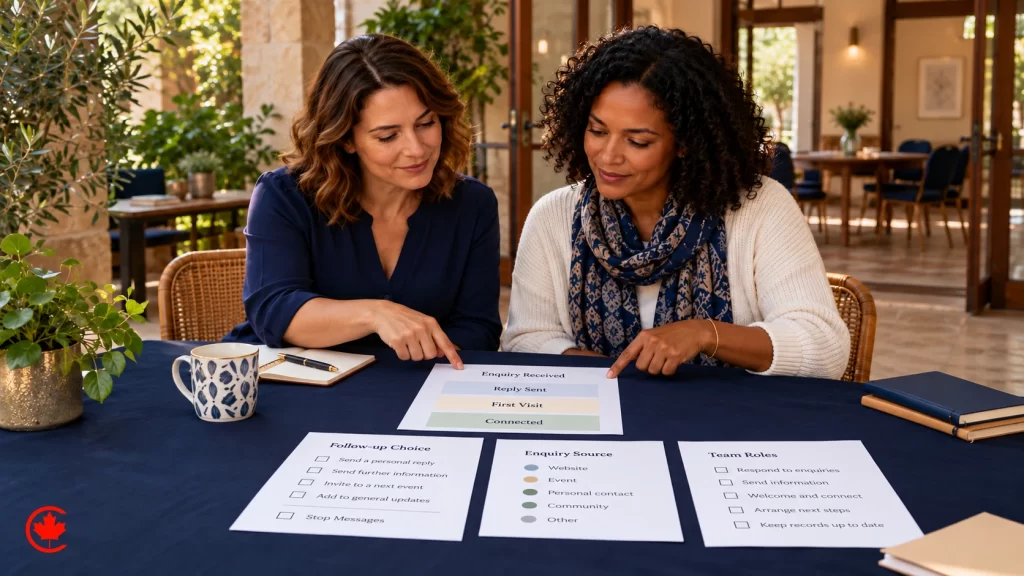
We set up a path in CS+ with stages such as enquired, first visit, second visit, joined a group or course and connected. The church chooses the words and the definition of connected, which might be serving on a team, joining a group or becoming a member. Each enquiry moves along the path as the welcome team records what happened.
Visitors who attend more than one congregation
In a building shared by an English service and a Spanish or Korean congregation, an enquiry may be meant for either. The form asks which service the person is interested in, and the path sends the enquiry to that congregation’s welcome team, in its language, so a family is not greeted by people who cannot speak with them.
Measuring without turning people into numbers
Leaders reasonably want to know whether their outreach is working. We report on enquiries received by type and source, how many were answered within the church’s own target, how many led to a first visit and how many visitors returned or joined something. Reports describe direction over the church year rather than chasing totals, and the church decides which measures matter.
Where the records go next
Once someone is connected, the record belongs in the church’s ongoing member and group records, which are covered on our Church CRM page. Enquiry flow and member records can sit in the same CS+ account so nothing is typed twice.
Where enquiries come from and how this fits the rest
Most enquiries start with a personal invitation, a Google search or a social post. Organic search work for listings and pages is described on our SEO for churches page. Paid campaigns for seasons and programs are on our church advertising page, and the overall outreach and welcome plan is on marketing for churches. Follow up emails to people who registered for events can be planned with our email marketing for charities and congregations.
Members remain the church’s strongest inviters. A short invitation link each member can share by text or social message, leading to the plan a visit page for a particular Sunday or event, makes inviting easier and lets the welcome team know a friend is coming. The member can be told when the friend registers, so they can sit together.
Every source should carry a tag so the church can see which invitations lead to visits. A plan a visit form reached from a Christmas ad, from the Google listing and from a member’s shared link should all land in the same place, marked with where they came from. Canada Create sets up that tagging as part of the enquiry flow, using the general approach on our lead generation page adapted to the welcome a church offers.
Consent, charity rules and privacy for enquiries
Enquiry forms are where a church first collects personal information, so a few rules apply from the start. Registered charities follow Canada Revenue Agency rules on official donation receipts and on political activities, so event registrations and follow up messages should not be used for partisan campaigning. Under CASL, registered charities’ fundraising messages are treated specifically, but a newsletter or an invitation to the next event sent to someone who filled in a plan a visit form still needs care with consent: a clear, unticked box for further messages works better than assuming.
Photos of members, and especially children, need consent before they appear online, including in event recap posts. Privacy laws apply to churches in ways that vary by province and activity, so registration forms for camps and youth programs should collect only what is needed, and prayer boxes on connect cards should say who will read them. This is a marketing observation, not legal advice.
How we build an enquiry flow for a church
Free review
We start with a free review of every way people contact the church today: forms on the site, paper cards, the office phone, social messages and event sign ups. We trace a few test enquiries to see where they land and who replies.
Custom proposal and fees in writing
The proposal lists each form and card, the routing to ministries, the follow up messages and templates, the stages in CS+ and the reports. Fees are quoted in writing, with CS+ licences shown separately.
Build, test and train
We build or connect the forms, set up routing and reminders, write templates with the church, test every path and train the welcome team, ministry leaders and office. Accounts are set up in the church’s name.
Report and refine
Each month we report on enquiries, response and first visits in plain words, and adjust forms or routing where enquiries are stalling.
What a church enquiry flow costs
Each church receives a quote in writing after the free review. The drivers are specific to how the congregation welcomes people:
- How many forms and card types are needed: plan a visit, connect card, courses, events, community programs, life events.
- How many ministries and roles enquiries must be routed to, including backups.
- Whether forms need several languages.
- How many seasonal registrations, such as Christmas and Easter, need setup each year.
- How much template writing and welcome team training the church wants.
If the church also runs paid campaigns, that ad spend is paid directly to the platform and shown separately from our fees.
Choosing a partner for church enquiries and follow up
The right partner treats an enquiry as a person, understands how a welcome team works and keeps pastoral information private. Ask:
- Who owns the accounts? The answer should be you, the church.
- Who sees prayer requests and youth registrations, and how is that limited?
- What happens to an enquiry when the assigned volunteer is away?
- How will consent for later messages be recorded on each form?
- What will the monthly report show, and will our council understand it?
- Will follow up stay personal, or is the plan to automate the welcome?
Be wary of anyone who promises a number of new members or talks about visitors only as conversions. A good enquiry flow helps people feel expected, and helps leaders see where welcome needs attention.
Set up church leads and visitor follow up with a custom proposal
Ask for a free review of how your church receives and answers enquiries. Call (416) 273-9030, Monday to Friday, 9 am to 6 pm, and Saturday, 10 am to 2 pm. After hours, our 24/7 AI agent answers the toll-free line, +1 (800) 808-9235, and we’ll follow up the next business morning. You can also reach us through our contact page. We reply within one business day. Our office is at 126 Willowdale Avenue, Suite 3, Toronto, and our wider work for charities and faith groups is on the nonprofit and religious marketing page.
Talk to a strategist
Ready when you are?
Request a custom proposal
Tell us your goals, budget and timeline. You get a custom proposal and a named strategist, so your next stage of growth starts now.
How a church enquiry flow is built
Four plain steps, approved by your pastor or council.
- Free review First call
Every way people contact your church traced and reviewed.
- Custom proposal Written proposal
Forms, routing, templates and reports set out, with fees quoted in writing.
- Build and train Agreed milestones
Forms connected, routing tested and the welcome team trained.
- Report and refine Every month
Enquiries, replies and first visits reported, and routing adjusted.
Toronto church leads support since 2008, BBB Accredited A+
Since 2008
More than 18 years of websites, search and advertising work for businesses across Canada.
BBB Accredited A+
A BBB Accredited Business with an A+ rating and zero complaints.
Toronto office
126 Willowdale Avenue, Suite 3, Toronto, serving businesses across Canada.
English and French
Our team works in English and French.
Church enquiry questions
What are church leads, in a congregation's terms?
They are the people who raise a hand: someone filling in a plan a visit form, a family registering for the Christmas Eve service, a couple asking about marriage preparation or a newcomer signing up for an ESL class in the church hall. Nobody fills in a church form by accident, so each one is a person to welcome rather than a number to report. The work is catching those enquiries, sending each to the right person and following up warmly until the visitor feels connected.
What types of church leads should a congregation plan for?
Most churches receive plan a visit requests, connect cards on paper or a phone, course and small group sign ups, and registrations for Christmas, Easter, concerts, camps and community meals. Community programs such as food banks and newcomer support bring their own enquiries, and the office handles wedding, baptism and funeral requests that need a quick, careful answer. Each type needs its own form option and a named person who replies.
What is the price of a church enquiry and follow up flow?
It depends on what the church needs first: a visitor welcome setup with a plan a visit form and digital connect card, routing for many ministries and courses, seasonal registrations for Christmas and Easter, or ongoing support after launch. Services in several languages add cards and replies in each one. A free look at how visitors reach your church comes first, then a quote on paper, with any ad spend and CS+ licences listed apart from our fees.
Is a church enquiry flow part of the cost to make a church website?
No, they are separate pieces of work. Designing and building the church website is its own project, while the enquiry flow covers the forms, connect cards, routing to ministry leaders, follow up templates and the CS+ path behind them. A church with a website it likes can add the enquiry flow to the pages it already has.
Does the 5 minute rule for leads apply to church visitors?
Not in the sales sense, but timing still matters: an enquiry answered the same week feels like hospitality, while one answered three weeks later feels like an afterthought. A sensible rule is that every plan a visit request gets a personal reply before the service it mentions. Reminders to the welcome team keep anything from waiting silently over a long weekend, and funeral enquiries go to the office at once.
How many times should a church contact a first time visitor?
Usually a few warm touches are enough: an automatic confirmation with a map and children's check in details, a personal note from the welcome team before Sunday, and an invitation to one next step afterward, such as a small group or course. After that, leave the choice with the visitor. People who come to a community program rather than a service should hear from the coordinator, not receive a membership invitation.
Churches talk about an 80/20 rule; what does it mean for welcoming visitors?
The saying holds that a small group of members does most of the work, and visitor follow up often rests on one or two volunteers. When one of them goes on holiday, enquiries pile up unseen. Mapping each form and card option to a named role with a backup spreads the load and means a youth enquiry reaches the youth pastor even when the usual person is away.
What red flags in a church's follow up put visitors off?
Long forms that ask for a home address, denomination or faith background give a nervous visitor a reason to close the page. Replies that arrive weeks late, or an English form letter sent to a family who filled in a Portuguese card, signal that nobody was really listening. Paper connect cards left in a drawer until Thursday are another quiet warning sign.
Should a church measure cost per lead for visitor enquiries?
Cost per lead is a sales measure and says little about whether people feel welcomed. A plain monthly report on enquiries received, replies sent, first visits and returning visitors tells leaders far more. If the church does run ads for Christmas or a community event, whatever the parish pays Meta or Google can be set beside with the registrations it brought.


Who answers the visitor who filled in your form last Saturday night?
An enquiry that waits weeks for a reply feels like a closed door. A clear path from form to welcome team lets your church respond with warmth every time. Ask for a free enquiry flow review.