
Toronto · B2B email
B2B email marketing in Toronto
We organize your business contacts by role and account, plan the emails each group needs and connect email activity to your CRM so sales sees which accounts are paying attention.
Email for companies that sell to companies in Toronto and the GTA and across Canada: consented lists, segments by role and account stage, corporate inbox delivery and reporting by account.
- BBB A+ accredited
- 18 years in business
- Mon to Fri 9 to 6, Sat 10 to 2
Get your B2B email review
Tell us where your contacts live and which roles you sell to. We reply within one business day.
Please do not share passwords or other sensitive details here. We never sell your contact information and we comply with Canadian privacy law
(privacy policy).
Deliverables from B2B email marketing your sales team can use
A list you can stand behind
Contact sources mapped and consent noted for every person you email.
Emails written for each role
Users, budget owners, purchasing and leadership each get what they read for.
Sales and marketing in step
Clear rules on which emails come from reps and which from marketing.
Engagement by account
Reports that show which companies clicked and replied, shared with sales.
What B2B email marketing includes
The scope is set in your written proposal; these are the parts many B2B email programs contain.
- List source mapCustomers, distributors, events, enquiries and sign ups traced and recorded.
- Consent recordsExpress or implied consent noted with source and date for each contact.
- Role and stage segmentsRole families, markets served and prospect, customer and lapsed stages.
- Email types planProduct and price updates, invitations, account newsletters, onboarding and re engagement.
- Sales and marketing rulesWho sends what, sending from named people and pauses during active deals.
- Domain authentication checkSPF, DKIM and DMARC reviewed with whoever manages your domain.
- CRM connectionEmail clicks and replies shown on contact and company records.
- Account level reportingAccounts engaged, roles reached, replies and list health each month.
How B2B email marketing is priced
Every program is quoted in writing after a free review. Email platform and CRM licences are paid to the vendor and shown separately.
List and consent foundation
Quoted in writing
Companies with contacts scattered across systems
- Source map
- Consent notes
- Role tagging
- Domain check
Customer email program
Quoted in writing
Companies emailing existing accounts and distributors
- Product updates
- Account newsletter
- Onboarding emails
- Monthly report
Full B2B program
Quoted in writing
Sales led companies with several roles and stages
- Role and stage segments
- Event invitations
- CRM connection
- Account level reporting
Quiet account review
Quoted in writing
Lists with many lapsed accounts
- Lapsed account audit
- Re engagement emails
- Bounce clean up
- Results by account
Ad spend and software licences are paid to the platform directly and shown separately from our fees.
B2B email guide
How B2B email works and how to choose a partner
B2B email marketing is email for companies that sell to other companies: manufacturers writing to distributors, software firms writing to customer admins, engineering and service firms writing to facility managers, buyers and owners. It is for marketing managers and sales leaders who have contacts scattered across a CRM, trade show scans and old spreadsheets, and want email that reaches the right people at the right accounts and shows sales which accounts are paying attention. Canada Create is a Toronto agency at 126 Willowdale Avenue that plans and runs email for business to business companies across Canada, built on consented lists and reported by account.
- How business buyers read email
- Where a B2B list comes from
- Segments by role, market served and account stage
- The emails a B2B company sends
- Sales emails and marketing sends
- Getting into corporate inboxes
- Seeing which accounts read and click
- Reporting by account, not open rate
- How email fits your B2B marketing
- CASL, privacy and truthful claims
- How we set up B2B email with you
- What B2B email marketing costs
- How to choose a B2B email partner
- Book a B2B email marketing review with our Toronto team
How business buyers read email
A homeowner deciding on a sofa is usually one person. A company deciding on a new packaging supplier, a software platform or a maintenance provider is often several: the person who uses the product, the manager who owns the budget, someone in purchasing and sometimes an executive who signs. Each of them gets your email in a work inbox crowded with internal messages, and each reads it for a different reason.
What each role is looking for
- The user, such as a plant supervisor or a clinic office manager, wants to know whether the product works, how to get more out of it and what has changed.
- The budget owner wants cost, timing and what the change means for their team.
- Purchasing wants price lists, lead times, supply conditions and who to call.
- The executive rarely reads product detail but will read a short note on a direction, a risk or an industry change.
Why this changes the email
One newsletter to the whole list ends up written for nobody. B2B email works better when the plan starts from these roles and the stage each account is in, then decides what each group needs to hear this quarter. Buying cycles are long and often tied to budgets, fiscal years and trade show seasons, so the email plan follows those, not a retail calendar.
Where a B2B list comes from
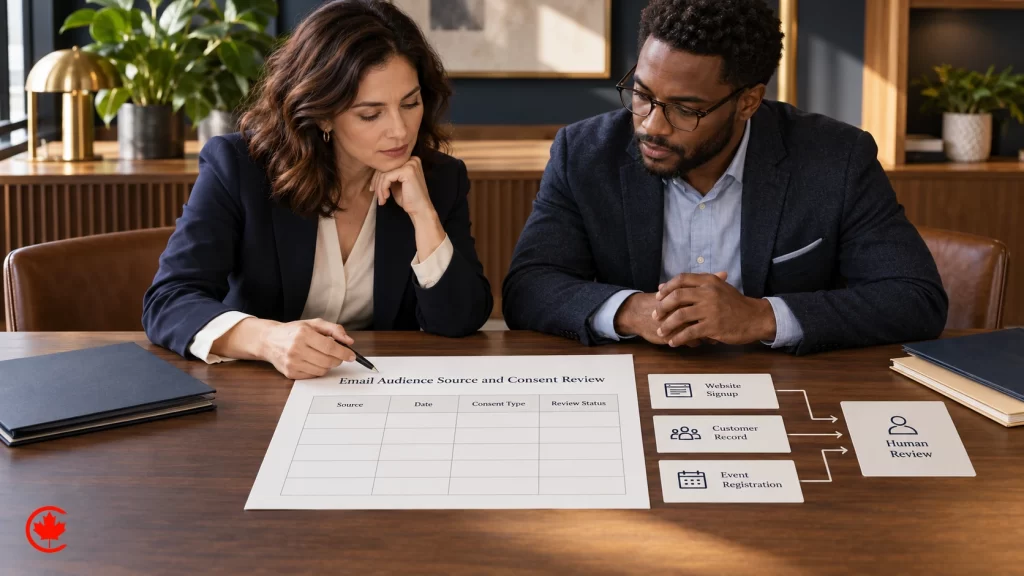
The quality of a B2B email program is set by the list long before anyone writes a subject line. We start by mapping where your contacts actually came from.
Common sources that can support consent
- Existing customers and their contacts in your CRM or accounting system, with a documented business relationship.
- Distributors, dealers and resellers you already supply, who often need price, product and marketing updates.
- Event and webinar sign ups, where people registered and agreed to hear from you.
- Trade show and booth contacts, when the scan or card exchange is recorded with the event name and date.
- Website enquiries and quote requests, including people who downloaded a spec sheet or guide with a clear sign up box.
- People who asked to hear from you through a newsletter form or a request to a sales rep.
Sources to leave out
Purchased or rented lists and addresses copied from websites are left out. They tend to bounce, draw complaints, damage the sending reputation of your domain and create consent problems. Prospecting outside your consented list is a different activity from the email program on this page and is not part of it.
Consent records for each contact
For every contact, the record should say how they joined, when, and the kind of consent: express (they ticked a box or asked) or implied (a current business relationship or an enquiry). Trade show leads get the show name and date. Imports from a sales rep’s spreadsheet get a note on where they came from. This record lets marketing answer a purchasing manager who asks why they are on the list.
Segments by role, market served and account stage
B2B segments work on two levels at once: the person and the company they work for.
By role
Job titles in a B2B list are messy. “Ops”, “Operations Lead” and “Director, Plant Operations” may all be the same role for your purposes. We group titles into a few role families that match how you sell, such as technical users, budget owners, purchasing and leadership, and set a rule for new contacts so the groups stay usable.
By the market each account serves
A supplier of commercial flooring may sell to healthcare builds, schools and retail fit outs; a software company may serve clinics and law firms. Each market has its own concerns, standards and busy seasons. Tagging accounts by the market they serve lets one product update go out in two or three versions, each with the examples that market will recognize.
By account stage
- Prospects who enquired or met you at an event but have not bought.
- New customers in their first months, who need onboarding rather than offers.
- Active customers, who get product updates, account news and expansion ideas.
- Lapsed or quiet accounts, who have not ordered or engaged for a while.
- Partners and distributors, who need material they can pass on to their own customers.
Where you already pick a short list of named target accounts, our account based marketing service covers the wider plan around them; email then becomes one of the channels that plan uses.
The emails a B2B company sends
Many B2B email programs use a handful of email types, each with its own audience and job.
Product and price updates
New SKUs, discontinued lines, revised price lists, new lead times or a new feature release. These go to purchasing and users at active accounts and to distributors, and they should be factual, dated and easy to forward internally.
Event and webinar invitations
Invitations to a booth at a trade show, a plant tour, a customer day or a webinar. They usually run as an invitation, a reminder and a short follow up with the recording or slides for people who could not attend.
Account newsletters
A regular newsletter for customers and partners with product tips, project stories told with the client’s permission, staff contacts, service changes and industry notes. It keeps your name in front of accounts between orders.
Onboarding emails for new customers
A short run of emails after the first order or signed agreement: who their contacts are, how to place an order or open a ticket, where to find documentation, what to expect in the first weeks. Good onboarding reduces calls to your team and starts the relationship well. Where these are set up to send on their own, that is a sequence, which we scope separately.
Re engagement of quiet accounts
A plain note to an account that has not ordered or opened in a long time, asking whether their needs have changed, pointing to what is new and offering a direct contact. Accounts that still do not respond are moved out of regular sends so they stop weighing on deliverability.
Sales emails and marketing sends
In B2B, two kinds of email go to the same accounts: one to one emails written by sales reps, and marketing sends to many contacts at once. When nobody coordinates them, a buyer can get a price increase announcement from marketing the same morning a rep asks to discuss a large order.
Who sends what
We help you write down which messages come from the marketing platform and which from a rep’s own inbox or the CRM. Broad announcements, newsletters and event invitations usually belong to marketing. Quotes, supply discussions and follow ups after a meeting belong to sales. Some messages, such as an invitation to a private customer event, land better when sent by the rep from the CRM using an approved template.
Sending from a real person
Many B2B buyers respond better to an email from a named person than from a generic brand address. Marketing sends can use the account manager’s or a product lead’s name and a reply address that reaches a real inbox. Replies are then handled, not lost in an unmonitored mailbox.
Quiet periods around deals
When an account is in an active negotiation, sales may want marketing sends paused or limited for that account. Flags in the CRM make that possible without manual list editing each time.

Getting into corporate inboxes
Workplace email is filtered more strictly than personal email. Corporate mail servers and security filters check whether a message really comes from the domain it claims, how the sending domain has behaved before and whether the content looks like spam.
Domain authentication in plain words
Your domain should publish records that tell receiving servers which services are allowed to send email on your behalf and that let them check a message has not been altered. These are known as SPF, DKIM and DMARC. When your marketing platform, your CRM and your office email all send from the same domain, each one must be included correctly. We list what needs to be set and work with whoever manages your domain to put it in place.
Clean lists and steady sending
Bounces from people who left a company are common in B2B lists, because staff change roles and employers. Removing those addresses after each send, keeping complaint levels low and sending at a steady pace protects your reputation with corporate filters. A large send to an old trade show list after a year of silence is the kind of pattern that lands in junk.
Content that survives filters
Plain, readable layouts with real text, a modest number of links, no attachments and clear sender details tend to reach corporate inboxes more reliably than heavy image layouts. Spec sheets and price lists are better linked from a page on your website than attached.
Seeing which accounts read and click
The real value of B2B email for a sales team is knowing which accounts are paying attention. When the email platform is connected to the CRM, clicks and replies from each contact show on that contact’s record and roll up to the company.
What sales sees
A rep opening an account can see that three people at that company clicked the new product announcement and one registered for the webinar. That is a reason to call, with something specific to talk about. A quiet account shows nothing, which is also useful to know before a quarterly review.
Setting up the connection
CS+ is our CRM, and we set it up and connect it to your email so contacts, companies and email activity live together; our CRM setup service covers that work. If you already use another CRM, we work with what you have. Either way, contacts are linked to their company records, so reporting can show accounts and not only individuals.
Reporting by account, not open rate
Open rates are a weak measure in B2B. Privacy features in some email apps register opens that never happened, and corporate security filters often open and click links automatically while scanning a message. A spike of instant clicks from one company may be a filter, not a buyer.
What the report shows instead
- Accounts engaged: how many target and customer accounts had at least one real click or reply.
- Depth within accounts: how many contacts and which roles at each account engaged.
- Replies and meeting requests sent back to the rep.
- Event and webinar registrations by account.
- Website visits after the email, such as spec sheet or pricing page views.
- List health: bounces, unsubscribes, complaints and new consented contacts by source.
Reading it with sales
We review the report with marketing and sales together where possible, because the numbers only matter when they are tied to accounts sales recognizes. The report describes engagement; it does not promise pipeline, meetings or revenue, and we never present it that way.

How email fits your B2B marketing
Email is one channel within our B2B marketing services, and it is planned alongside our general email marketing services. Email is most useful when it has good things to send: guides, case notes written with permission, product pages and event content. Our content marketing team can produce that material, and B2B content marketing and B2B social media marketing are planned as their own services. Companies building wider demand can see our demand generation work, and B2B search engine optimization helps prospects find the pages your emails link to.
Wholesale and ecommerce sellers
Brands that sell through distributors and retailers have their own needs, covered by our wholesale marketing service; their email usually includes reseller updates and dealer material. If you run a wholesale store on Shopify, the Shopify email service covers store driven emails. The regular template and the month by month sending are also offered separately as Email newsletter design and Email campaign management.
CASL, privacy and truthful claims
Some companies assume Canada’s anti spam law only covers email to consumers. It applies to commercial email sent to business addresses too.
- CASL. In general terms, you need express consent or implied consent, such as a documented existing business relationship, before sending commercial email. Every email must identify the sender, give contact details including a mailing address and carry a working unsubscribe that is honoured promptly. Implied consent can lapse over time, so the consent record and its date matter.
- PIPEDA. Business contact details used to market to someone are still personal information in many situations. In general terms, collect what you need, explain how it is used, keep it secure and limit who can export the list.
- Truthful claims. The Competition Act, in general terms, prohibits false or misleading representations. Claims about performance, savings, lead times or comparisons with competitors in your emails should be accurate and supportable.
- Accessibility. Real text, alt text and good contrast follow WCAG and help readers who rely on screen readers.
- Quebec. Email to Quebec accounts can bring French language and Quebec privacy rules into play.
This is a marketing observation, not legal advice. Your own counsel can confirm how these rules apply to your list and your consent wording.
How we set up B2B email with you
Every engagement starts with a free review of where your contacts live, how they were gathered, what you send today and how sales and marketing share the accounts.
- Free review. A conversation with marketing and sales leads and a look at your lists, CRM and recent emails.
- Written proposal. The segments, email types, CRM connection, reporting and fees quoted in writing.
- List and consent work. Sources mapped, consent notes added, role and stage tags set and domain authentication checked.
- Plan and launch. An email plan by segment and quarter, approved by you, then the first sends.
- Monthly reporting. Engagement by account and role, list health and recommendations, reviewed with sales.
The email platform, CRM and every list stay in your company’s name, with our access added as users you control.
What B2B email marketing costs
B2B email marketing is quoted in writing after the free review. The fee reflects the state of your data and how much the program has to cover.
What drives the quote
- How scattered your contacts are today and how much consent and role clean up is needed.
- How many role families, markets served and account stages the segments need.
- Which email types are in scope: updates, invitations, newsletters, onboarding, re engagement.
- Whether the CRM connection is new, needs repair or already works.
- How many versions each send needs, including English and French.
- Whether we produce the content each email links to or your team supplies it.
- How much account level reporting sales needs and how often it is reviewed together.
Email platform and CRM licences are paid to the vendor and shown separately from our fees.
How to choose a B2B email partner
A consumer email agency and a B2B one can look alike on a call. The difference shows in how they talk about lists, roles and accounts. Questions worth asking:
- How will you segment by role and account stage, not just by list?
- Where will our contacts come from, and how will consent be recorded?
- Will you use purchased lists? The answer should be no.
- How will marketing sends and our reps’ emails be coordinated?
- What will you do to reach corporate inboxes, and how will you check our domain setup?
- Will the report show engagement by account, and how do you treat automated clicks from security filters?
- Who owns the accounts? The answer should be you, along with the platform, the CRM data and every list.
A partner who answers these clearly understands how companies buy from companies. You can read about our team on the about Canada Create page.
Book a B2B email marketing review with our Toronto team
Start with a free B2B email review. Tell us where your contacts live today, which roles you sell to and how sales and marketing share accounts, and we will show you which segments your data supports and where consent records or domain settings need work first. Call (416) 273-9030, Monday to Friday, 9 am to 6 pm, and Saturday, 10 am to 2 pm. After hours, our 24/7 AI agent answers the toll-free line, +1 (800) 808-9235, and we’ll follow up the next business morning. You can also reach us through our contact page. We reply within one business day. Our office is at 126 Willowdale Avenue, Suite 3, Toronto, and we work with business to business companies across Canada.
Talk to a strategist
Ready when you are?
Request a custom proposal
Tell us your goals, budget and timeline. You get a custom proposal and a named strategist, so your next stage of growth starts now.
Four stages of setting up B2B email marketing
Each step is written down, and every platform and list stays in your company's name.
- Free review First call
Your contact sources, CRM, recent emails and sales process.
- Written proposal Written proposal
Segments, email types, CRM work, reporting and fees quoted in writing.
- List and consent work Agreed milestones
Sources mapped, consent noted, segments tagged and domain checked.
- Send and report Every month
Approved sends, then engagement by account reviewed with sales.
Toronto team behind your B2B email marketing, since 2008
Since 2008
More than 18 years of websites, search and advertising work for businesses across Canada.
BBB Accredited A+
A BBB Accredited Business with an A+ rating and zero complaints.
Toronto office
126 Willowdale Avenue, Suite 3, Toronto, serving businesses across Canada.
English and French
Our team works in English and French.
B2B email marketing questions
How do you do B2B email marketing well?
Start from the roles that read your email, such as users, budget owners, purchasing and leadership, and the stage each account is in, from prospect to lapsed. Plan sends around buying cycles, fiscal years and trade show seasons rather than a retail calendar. Coordinate with sales so a rep's one to one email and a marketing send do not collide.
Is B2B email marketing still worth it for companies that sell to companies?
It is when it reaches consented contacts at accounts you already serve or have met, with something each role needs: price updates for purchasing, product tips for users, invitations for prospects. Reporting by account shows sales which companies are paying attention, which a single open rate never could. A newsletter blasted to everyone tends to be written for nobody.
Is mass emailing business contacts illegal in Canada?
Mailing business contacts is legal when you follow CASL: you need consent, every message must say who sent it, and the unsubscribe has to work. Consent can be express, when someone ticked a box or asked, or implied, such as a current business relationship or a recent enquiry, and each contact's record should show which applies, with source and date. Before a large send, confirm the current requirements on the CRTC's CASL pages.
How is B2B email marketing different from B2C?
A consumer buying a sofa is usually one person, while a company choosing a supplier often involves a user, a budget owner, purchasing and an executive. B2B email is read in crowded work inboxes, follows long buying cycles and is judged by which accounts engage. Segments therefore work at two levels: the person's role and the company's market and stage.
What is B2B email marketing?
It is email for companies that sell to other companies, such as manufacturers writing to distributors, software firms writing to customer admins and service firms writing to facility managers and buyers. It suits marketing managers and sales leaders whose contacts are scattered across a CRM, trade show scans and old spreadsheets. The goal is to reach the right people at the right accounts and show sales who is paying attention.
Can we buy B2B email marketing lists?
We leave purchased or rented lists out, along with addresses copied from websites. They tend to bounce, draw complaints, hurt your domain's sending reputation and create consent problems. A sound list comes from customers, distributors, event sign ups, recorded trade show contacts and website enquiries.
What are B2B email marketing best practices for reaching corporate inboxes?
Have SPF, DKIM and DMARC reviewed with whoever manages your domain, send from named people and keep the list clean of bounces. Move accounts that never respond out of regular sends so they stop weighing on deliverability. Write plainly, date product and price updates and make them easy to forward internally.
What are examples of B2B email marketing?
Common types are product and price updates for active accounts and distributors, invitations to a trade show booth, plant tour or webinar, and a regular account newsletter. A short onboarding run after a first order explains contacts, ordering and documentation. A plain re engagement note asks a quiet account whether its needs have changed.
What do B2B email marketing services cost?
Cost depends on how scattered your contacts are, how many roles, markets and stages need their own versions, whether a CRM connection and account level reporting are included and how many lapsed accounts need attention. We go through your lists in a free review and then give you the program price on paper. Email platform and CRM licences are paid to the vendor and kept separate from our fees.
How do I choose a B2B email marketing agency?
Ask how they record consent for each contact, how they handle titles that do not fit a neat role and whether reports go by account rather than open rate. Make sure they will coordinate marketing sends with your sales team. Canada Create plans B2B email from Toronto for companies across Canada, writes in English and French and connects email activity to CS+ or your existing CRM.


Know which accounts are listening
Business buyers rarely say they are interested until they are close to deciding. Email organized by role and account, connected to your CRM, shows sales who is paying attention before that. Book a free B2B email review.