
Law firm SEO agency
Law Firm SEO Services
Law firm SEO services that put your practice in the map pack, the organic results and the AI answers when people search for legal help. A legal SEO agency that reports consultations, not only rankings.
As a law firm SEO company we build practice-area pages with your lawyers, run a Google Business Profile that earns reviews, fix the technical basics and plan content for the matters you want more of, all within your law society marketing rules. Results are reported as consultations by practice area.
Get a free lawyer SEO audit
Tell us your practice areas and the searches you want to win. A strategist replies within one business day.
By submitting, you agree that Canada Create™ may contact you about your request. No spam, ever.


What law firm SEO changes for your practice
Found for each practice area
A strong page for every area you want clients for.
In the map pack
Firm and lawyer profiles matched to local legal searches.
Cited in AI answers
Clear, consistent content that AI tools can quote.
Consultations you can count
Calls, forms and bookings tracked by practice area.
What is included in law firm SEO services
Scope is set after the free audit and confirmed in writing.
- Law firm SEO auditSite, profile, directories and ranking firms reviewed.
- Legal keyword mapEvery practice area mapped to the searches that hire.
- Practice-area pagesWritten with your lawyers, reviewed by you before publishing.
- Google Business ProfileFirm and lawyer profiles, categories, services and reviews.
- Legal directoriesConsistent listings on the directories that matter.
- Technical legal SEOSpeed, mobile, structured data and secure intake forms.
- Legal content and GEOGuides and FAQs built to rank and to be cited by AI tools.
- ReportingConsultations by practice area, every month.
How law firm SEO is priced
We quote after a free audit, in writing. No ranking guarantees.
Law firm SEO audit
Free
Your site, profile and directories reviewed against the firms that rank.
- Technical review
- Practice-area gaps
- Local search review
- Written priorities
Law firm SEO program
SEO from CAD 1,500 a month
Firms focused on one or two practice areas from one office.
- Practice-area pages
- Local search
- Technical SEO
- Monthly reporting
Multi-practice or competitive
Quoted in writing
Several practice areas, several offices or highly competitive areas such as personal injury.
- Content program
- Authority building
- Lawyer profiles
- Consultation tracking
Scope is driven by the number of practice areas, competition, offices, languages and the state of your website. Setup, monthly management and any ad spend are shown separately and confirmed in writing after the free audit. No long-term contract.
Search, map pack and AI answers
How we run SEO for law firms
Law firm SEO is the work that puts your firm in front of people at the moment they search for legal help: in the map pack, in the organic results and in the AI answers that now sit at the top of Google. Our law firm SEO services build one strong page for each practice area, a Google Business Profile that earns steady reviews, lawyer profiles that prove experience and content your lawyers approve, and we judge the program by consultations rather than rankings, all within your law society’s marketing rules.
This guide is written for managing partners, sole practitioners and marketing leads who want to understand what a legal SEO program really involves before they hire anyone. It explains how legal clients search, which searches are worth winning, what a law firm SEO agency should do in the first six months, what drives the cost and how to tell a good law firm SEO company from a weak one. If you want the wider view of search marketing for individual practitioners, see our guide to SEO for lawyers and attorneys.
What law firm SEO is, and what SEO stands for
SEO stands for search engine optimization: improving a website and its presence across the web so that Google and other search tools show it to people looking for what it offers. Law firm SEO, often called legal SEO, applies that work to a practice. It covers three places on the results page. The map pack shows three firms and a map for searches such as “family lawyer near me”. The organic results show practice-area pages and guides for searches such as “how to contest a will”. And the AI answer at the top increasingly summarizes what the law says and which firms to consider.
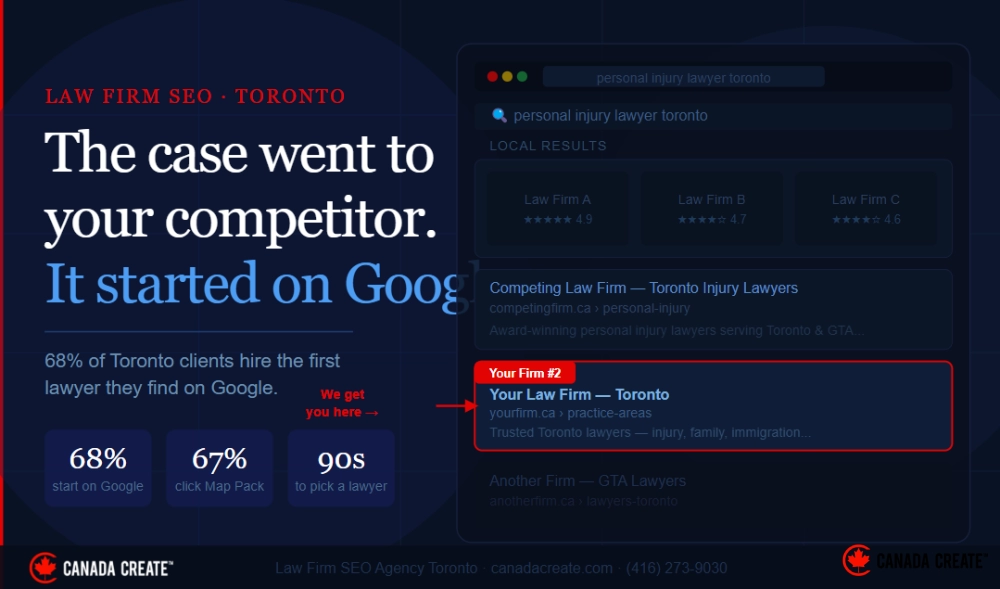
Legal search is demanding for two reasons. First, the value of a client is high. A single personal injury, employment or litigation file can be worth more than a year of marketing, so established firms and referral networks invest heavily in search. Second, Google holds legal content to a high standard. Legal topics are what Google calls “your money or your life” subjects, where its quality raters look closely at the experience, expertise, authoritativeness and trustworthiness of a page and the people behind it. Thin pages with no named lawyer and no proof of experience rarely hold a position for long.
A note on terms, because people search for them: in legal careers, “SEO” can also refer to Sponsors for Educational Opportunity, a nonprofit that runs a law fellowship program for students. An “SEO law fellow” is a participant in that program. It has nothing to do with search engine optimization, and nothing on this page relates to it.
Canada Create™ has worked on search marketing since 2008 for clients across Canada and the United States. Law firm SEO is part of our law firm marketing services and follows the same method as our SEO services, adapted to the rules and realities of legal practice.
Does SEO work for law firms?
Yes, when it is planned around practice areas and measured by consultations. Most people who need a lawyer start with a search, whether they type it, speak it into a phone or ask an AI assistant. A firm that appears for the right searches, with pages that answer the question and make contact easy, receives enquiries without paying for every click.
SEO fails for law firms in predictable ways. It fails when the firm chases one broad term such as “lawyer” plus a city and ignores the specific searches that bring clients. It fails when pages are generic, written by someone with no access to the lawyers, or copied from another jurisdiction. It fails when the Google Business Profile is neglected, when reviews are never requested and when nobody tracks which calls came from search. And it fails when the firm expects results in weeks for practice areas where competitors have been building for years.
It works when four things are in place: a clear list of the practice areas and matters the firm wants more of, one strong page for each, a local presence that earns trust, and reporting that connects the work to booked consultations. Everything below explains how each of those is built.
How legal clients search today
Google is no longer ten blue links. On a typical legal search a person sees ads, an AI summary, a map pack with three firms, a few organic results, a “people also ask” box and often directory listings, all before scrolling. Each of those spots is won in a different way, and a firm that only thinks about organic rankings misses most of the page.

Legal clients also search in stages. Early on they search for their problem, not a lawyer: “what happens if my employer fires me without cause”, “how is child support calculated”, “can I sue after a slip and fall at a store”. A few days later they search for help: “wrongful dismissal lawyer”, “family lawyer near me”, “personal injury lawyer free consultation”. Finally they compare firms, reading reviews, lawyer profiles and fee information before they call. A program that covers all three stages captures the client early, converts the hiring search and wins the comparison.
Three habits shape how a legal SEO program is built:
- Phone searches in stressful moments. Many people search on the bus, at work or late at night. Click-to-call, fast pages and a short intake form decide whether they contact you or the next result.
- Local and “near me” searches. People add their town, their neighbourhood or “near me”, and Google uses their location even when they do not.
- Searches in many languages. Clients search in English, in French and in the languages spoken at home. Firms whose lawyers serve clients in Farsi, Mandarin, Punjabi, Tamil, Spanish or other languages can rank for those searches with properly written pages in that language, reviewed by the lawyer who speaks it.
What law firm SEO services include
A complete legal SEO program has eight parts. Some agencies sell them separately; they work best together, planned from one audit and measured with one set of numbers.
Law firm SEO audit
The audit is the starting point. We review your website, your Google Business Profile, your directory listings and the firms that rank for your practice areas, and we compare them page by page. You receive written priorities: what to fix first, which pages to build and which searches are realistic in the next six months.
Keyword research and strategy
Keyword research for law firms maps every practice area to the searches clients use, grouped by intent. The strategy turns that map into a site structure and a publishing plan, so each search has one page that answers it.
On-page SEO
On-page work covers titles, headings, page copy, internal links, images and structured data. Each practice-area page is written to answer the search completely and to lead the reader to a consultation.
Technical SEO
Technical work makes sure Google can crawl, index and understand the site: speed, mobile layout, secure forms, redirects, duplicate pages and schema markup for the firm, its lawyers and its offices.
Local SEO
Local work covers the Google Business Profile, directory listings, reviews and location pages. Is local SEO important for law firms? For most practices it is the single biggest source of calls, because nearly every legal search has local intent.
Content marketing
Guides and FAQs answer the questions clients ask before they hire, and they are what AI answers and featured snippets draw on.
Link building and digital PR
Links and mentions from credible sites show Google that the firm is a recognized authority. For law firms the best links come from real professional activity.
Tracking and reporting
Calls, forms and bookings are tracked by the page and search that produced them, and reported every month in plain language.
Keyword research: the searches that hire
Many firms ask to rank first for “lawyer” plus their city. It is the wrong first goal. The term is dominated by directories and the largest firms, the people searching it often have no clear need yet, and it tells you nothing about the practice area. The searches that fill a calendar are more specific, and there are many more of them.
We group legal searches for each practice area into three sets and give each set the right kind of page:
- Hiring searches such as “family lawyer near me”, “real estate lawyer for closing” or “employment lawyer free consultation”. These belong on practice-area pages, location pages and in the map pack.
- Problem searches such as “wrongful dismissal severance” or “what happens at a first appearance in criminal court”. These are answered in guides and FAQs that lead to the practice-area page.
- Comparison and cost searches such as “how much does a divorce lawyer cost”, “contingency fee lawyer” or reviews of your own firm. Honest answers to cost and process questions build trust and bring enquiries from people close to a decision.
We weigh each set by how many people search it, how much advertisers compete for it and the kind of results Google shows. That avoids spending months ranking for broad terms that bring students and researchers rather than clients, and it points the budget at the pages closest to revenue. The result is a written keyword map that shows, for each practice area, the page that owns each search. It also prevents one of the most common problems on law firm websites: several pages competing for the same search and none of them winning.
Practice-area pages that rank and convert
The practice-area page is the most important asset in law firm SEO. It has to satisfy Google that it is the best answer for the search and satisfy the reader that your firm is the right one to call. The pages that rank share a pattern: one practice area per page, written or reviewed by a named lawyer, clear about the process and the first step, and complete enough that the reader does not need to go back to Google.
We build each page with your lawyers. A short interview gives us the questions clients ask, the misconceptions they arrive with, the steps of a typical matter, what you need from them at the first meeting and how fees work. We write the page in plain language, add FAQs based on real searches, link to the relevant guides and lawyer profiles, and send it to you for legal review before it goes live. Nothing is published without your approval.
A strong practice-area page usually includes:
- who the firm helps and the matters it takes on, in plain words;
- how the process works in your province, step by step, and how long each stage usually takes;
- what the first consultation involves and what to bring;
- how fees work, whether hourly, flat, contingency or a mix, stated clearly;
- the lawyers who handle this work, with links to their profiles;
- the communities and courts the firm serves, where that is true;
- answers to the questions people search, and a clear way to book.
For firms with several practice areas, the structure matters as much as the pages. A clear hierarchy, for example family law with separate pages for divorce, parenting time and support, helps Google understand which page answers which search and stops your own pages from competing with each other. Internal links follow the same logic: guides point up to the practice-area page, the practice-area page points to the lawyers who do the work, and every page offers a way to book.
Google Business Profile, the map pack and Local Services Ads
Most legal searches have local intent, so the map pack is where many consultations start. Google ranks map results by relevance, distance and prominence. We improve relevance by setting the right primary and secondary categories, listing your practice areas as services and writing a description that explains what the firm does. We improve prominence through reviews, consistent listings on legal and business directories, and local links. Distance we cannot change, which is why office location and honest location pages matter.
Law firms have extra options. Individual lawyers can have their own profiles in addition to the firm’s, which helps in practice areas where clients search for a lawyer rather than a firm. Photos of the real office and team, accurate hours, a booking link and regular posts about the firm’s work all make the profile more useful to the person comparing firms.
Firms with several staffed offices need a profile for each office and a location page for each one with real local detail: the lawyers who work there, the courts and communities it serves, parking and transit, and reviews from clients of that office. Virtual offices and meeting rooms that are not staffed should not be listed as locations. They breach Google guidelines and can lead to suspended listings, which is far more costly than the visibility they promise.
Reviews carry more weight for lawyers than in most fields, because a legal problem is stressful and personal and people want evidence that others trusted you with something similar. We set up a simple request after a matter closes, sent in a way that respects confidentiality, and help you reply to every review professionally without confirming anyone is a client or discussing a file.
Google Local Services Ads, the listings marked with a Google screening badge where available, sit above the map pack for many legal searches. They are paid per lead rather than per click and require verification of the firm and its lawyers. They are not SEO, but they draw on the same reviews and profile information, so a firm with a well-run profile gets more from them. Our local SEO services and Google Business Profile management cover this work in detail.
Lawyer bios and trust signals
Short bios with a photo and a contact button miss one of the best ranking and trust signals a firm has. Detailed profiles show Google and potential clients who stands behind the advice on your site. A strong bio includes the year of call, education, practice focus, the kinds of matters the lawyer handles, languages spoken, publications, speaking, memberships and community involvement, all stated accurately.
We connect each bio to the content that lawyer writes or reviews, mark it up with structured data and link it from the relevant practice-area pages. When someone asks an AI assistant about a lawyer at your firm, a detailed, consistent profile on your site and on legal directories gives that tool a reliable source.
Other trust signals matter as much. Clear fee information, a real address and phone number, the name of the lawyer who reviewed each guide, the date it was last updated, and plain statements about what the firm does and does not handle all tell the reader, and Google, that the site is run by accountable professionals.
Legal content, AI answers and GEO
Guides and FAQ content bring people to your site before they are ready to hire a lawyer, and they are what AI answers and featured snippets draw on. The best legal content answers one question fully and accurately for the reader’s province, explains when the reader needs a lawyer, and invites them to book a consultation.
We plan content from search data for your practice areas, grouping questions into clusters that support each practice-area page. Each article is written for the reader, attributed to a lawyer who reviews it, dated and updated when the law changes. We do not publish generic articles written for another jurisdiction, and we avoid anything that could be read as legal advice for a specific situation.
Generative engine optimization, or GEO, is the work of being cited in AI answers from Google, ChatGPT, Gemini, Perplexity and similar tools. It builds on the same foundations as SEO, with a few habits that matter more: a direct answer near the top of each section, plain headings that match the question, accurate names for courts, tribunals and statutes, and consistent firm details across your site, your profile and legal directories. AI tools repeat what they find most often and most consistently, so outdated addresses, old partner names or conflicting practice-area descriptions can follow a firm into AI answers for months.
Short videos of lawyers explaining common situations help too. They can sit on practice-area pages, on YouTube with accurate titles, and on your Google Business Profile, and they build trust before the first call.
Technical legal SEO and intake
A law firm website has to be fast, secure and easy to use on a phone. We audit and fix the technical basics: page speed, mobile layout, broken links, duplicate pages, indexing problems and redirects left from old site versions. We add structured data that tells Google your firm’s name, address, phone number, practice areas and lawyers, and FAQ markup where it applies.
Ranking without converting is wasted effort. We look at every step between the search and the consultation: a visible phone number and click-to-call on mobile, a short intake form that collects only what you need at first contact and does not invite confidential details before a retainer, clear next steps, and chat tools that do not cover the page on a phone. Forms are protected against spam and every call and form is tracked by the page it came from. Where the firm wants it, enquiries can flow into a CRM such as CS+ so that no lead waits.
Most firms we work with run WordPress, and our WordPress development team can fix what an audit finds. If your website is outdated or slow, our law firm website design and web design teams can rebuild it with SEO built in from the start, and our hosting keeps it fast and secure afterwards.
Where does your firm appear today?Tell us your practice areas, your offices and the searches you want to win. We reply within one business day with a proposal and a comparison with the firms that rank.
Law society marketing rules
Every provincial and territorial law society sets rules for how lawyers market their services, and they share the same core ideas: marketing must be true, accurate and verifiable, must not be misleading, and must be in the best interests of the public. Many law societies also restrict certain claims, such as describing a lawyer as a specialist without the certification the society requires, and expect statements about fees to be clear about what is included. Firms regulated by the Law Society of Ontario, the Law Society of British Columbia, the Barreau du Québec or another society should check the current rules of their own regulator.
We build these principles into every page. Copy avoids unverifiable superlatives such as “best lawyer in the city”, guaranteed outcomes and misleading comparisons. Past results are only described when you confirm they are accurate and appropriate to publish, with the context your rules require. Testimonials and review requests respect confidentiality. You remain responsible for your marketing under the rules, so every page goes to you for review, and we flag anything we think needs your judgment. This is marketing support, not legal or regulatory advice.
Link building for law firms
Links from other websites remain one of the signals Google uses to judge prominence. How does link building help law firms? It shows search engines that other credible organizations know and refer to your firm, which supports rankings for your most competitive practice areas.
For law firms the best links come from real activity: bar associations and legal organizations, law school involvement, community groups and charities you support, articles and interviews in local and legal publications, speaking engagements, podcasts and professional directories. We find those opportunities, help you turn existing activity into mentions and links, and avoid paid link schemes that can damage your site.
Consistency is part of authority. Firms that have moved offices, changed names or added partners often have outdated details on directories and business listings. Cleaning them up strengthens map-pack rankings and stops AI tools from repeating old information.
Legal SEO by practice area
Each area of law has its own search patterns, competitors and client expectations, so each practice-area page is planned on its own. Which practice areas benefit from SEO? All of them, though the approach differs.
Personal injury
Personal injury is among the most competitive legal searches in the country. Winning requires detailed pages by accident and injury type, clear explanations of contingency fees and limitation periods, strong reviews and a steady stream of authoritative links. Injured people and their families often search close to home and call from the map pack, so a well-run profile with genuine reviews can win calls while organic rankings for broad terms take longer. See our personal injury lawyer SEO page for the full approach.
Family law
Clients search in stressful moments and often late at night. Pages on separation, divorce, parenting time and support that explain the process in plain language, with a calm and private way to make contact, perform best.
Immigration
Immigration searches are often made in several languages and include specific program names. Content must be accurate and kept current as federal programs change, and it should make clear the difference between a licensed lawyer and other representatives.
Criminal defence
Many searches are urgent and made on phones. Map-pack visibility near the courthouses you attend, a clearly displayed after-hours contact option where the firm offers one, and pages for specific charges matter most.
Real estate, wills and estates
These practice areas are often price-sensitive and local. Pages that explain fees, timelines and what the client needs to bring convert well, and reviews from previous clients carry a lot of weight.
Employment law
Both employees and employers search, with very different needs. Separate pages for each audience, and guides on severance, wrongful dismissal and workplace investigations, help the firm reach the clients it wants.
Corporate and business law
Owners search for help with incorporation, contracts, shareholder issues and buying or selling a business. Pages that speak to founders and family businesses, with clear process and fee information, outperform generic corporate pages.
Law firm SEO and paid search together
SEO and paid search work well together for law firms. Google Ads and Local Services Ads can produce enquiries from the first weeks while SEO builds, and the search term data from ads shows which searches convert, which helps prioritize the SEO work. Over time, strong organic rankings reduce how much you need to spend on ads for the same volume of consultations.
Paid search stops the moment the budget stops. SEO keeps working after the pages are built, which is why most firms treat it as the long-term base and ads as the accelerator. Our lawyer PPC management and Google Ads management run alongside SEO with shared tracking, so you see the full picture.
Your first six months with a law firm SEO company
Law firm SEO is a long-term program, but the first six months follow a clear sequence so you can see progress along the way.
- Weeks 1 to 2: audit of your site, Google Business Profile, directory listings and the firms that rank for your practice areas; priorities agreed in writing.
- Weeks 2 to 4: call and form tracking set up; urgent technical issues fixed; profile categories and services corrected.
- Months 1 to 3: interviews with your lawyers; the most valuable practice-area pages rewritten or built and approved by you; lawyer bios expanded; review requests running.
- Months 3 to 6: guides and FAQs published around each practice area; directory clean-up completed; authority built from real activity; location pages for additional offices where they exist.
How long does law firm SEO take? Technical fixes and improvements to existing pages can show movement within weeks. New practice-area pages usually take three to six months to settle, and the most competitive searches, such as personal injury in large cities, can take a year or more of steady work. Every month you receive a short report in plain language: what we did, what changed, the calls, forms and consultations it produced by practice area, and what comes next.
What law firm SEO costs
Our SEO programs start from CAD 1,500 a month, with higher tiers quoted in writing by proposal. The audit is free. The right budget for a firm depends on a handful of cost drivers, and a good proposal explains each one rather than quoting a round number.
| Cost driver | Why it changes the scope |
|---|---|
| Number of practice areas | Each practice area needs its own page, content cluster and tracking. |
| Competition in each area | Personal injury, family and employment law need more content and links than a niche practice. |
| Number of offices | Each staffed office needs its own profile, location page and reviews. |
| State of the website | A slow or outdated site needs technical work, or a rebuild, before content pays off. |
| Languages | Pages in French or other languages need writing and review in that language. |
| Speed you want | Publishing more pages each month shortens the timeline and raises the monthly scope. |
Setup work, monthly management and third-party costs such as ad spend or software are shown separately in the proposal. There is no long-term contract; you stay because the work performs.
What is the typical cost of SEO for a law firm? It varies widely between agencies, and published averages rarely match a real firm’s situation. Judge a fee against the work it buys: how many pages are written each month, who writes them, how local search and links are handled, and whether reporting shows consultations. A very low monthly fee for a competitive practice area usually means very little work is being done.
How to choose a law firm SEO agency
People often search for the top 10 SEO companies in Canada or the best SEO for law firms. Lists and rankings are a reasonable place to start, but no public list measures which agency will do the best work for your practice. The right law firm SEO agency is the one that can show its thinking about your practice areas. Ask any agency you are considering:
- Where does our firm rank today for our main practice areas, and what would you change first?
- How do you rank for your own services, and what have you done for other professional firms?
- Who writes the legal content, and how does our review fit into the process?
- How do you handle our law society’s rules on marketing, testimonials and specialization?
- Which other services do you offer, such as websites, ads and hosting, and can you implement what you recommend?
- Who will work on our account, and how will you report consultations rather than only rankings?
- Will our firm own the website, content, analytics and Google Business Profile?
Red flags include guaranteed first-page rankings, link packages from unrelated websites, very low monthly fees for competitive practice areas, reports with no calls or consultations, and contracts that lock you in without clear deliverables.
Agency or in-house? Some larger firms build internal marketing teams, and there are useful levers a firm controls on its own: lawyers who review content promptly, a habit of asking for reviews, and partners who share speaking and publishing activity. Most firms still work with a legal SEO company for the specialist work of strategy, technical fixes, writing and link building, and keep the internal levers running alongside it.
Canada Create™ has helped businesses grow through search since 2008 from our office at 126 Willowdale Avenue in Toronto. We are a BBB Accredited Business with an A+ rating, we work with clients across Canada and the United States, our sales and support line is open 24/7 at +1 (800) 808-9235, and there is no long-term contract. Tell us your practice areas and the searches you want to win, and get a proposal in one business day.
Talk to a strategist
Ready when you are!
Get a proposal in one business day.
Tell us your goals, budget and timeline. You get a plan, a price and a named strategist, with no long-term contract.
How a lawyer SEO program runs
The foundation is built in the first two to three months; content, reviews and links grow every month after that.
- Free audit Weeks 1 to 2
Site, profile, directories and competitors reviewed; priorities agreed.
- Tracking and technical fixes Weeks 2 to 4
Consultation tracking set up; technical issues fixed.
- Practice-area pages Months 1 to 3
Interviews with your lawyers, pages written and reviewed by you.
- Local search Months 1 to 2
Profiles, directories and review requests in place.
- Content and links Monthly
Guides published, authority built from real activity.
- Report and refine Monthly
Consultations by practice area and next steps.
Related law firm services
Lawyer SEO works best as part of a complete law firm marketing program.
What clients say on Google
Reviews pulled live from our Google Business Profile.




Free review, no obligation
Not sure where to start? Send us what you have.
Share your current site, campaign or brief. A strategist reviews it and replies within one business day with a written recommendation and a fixed quote.
Why law firms choose Canada Create™ for SEO
Rules built in
Copy written to your law society marketing rules.
Your review first
Nothing published without your approval.
Measured by consultations
Reporting by practice area, not just rankings.
No link schemes
Authority from real professional activity.
One team
SEO, Google Ads, websites and intake automation together.
One accountable team
Strategy, writing and technical work under one roof.
Since 2008
Eighteen years of search marketing.
BBB A+, zero complaints
Accredited by the Better Business Bureau.
Law firm SEO: questions firms ask
What is law firm SEO?
The work that makes a law firm appear in Google and AI answers when people search for legal help: practice-area pages, the map pack, lawyer bios, legal content, technical fixes and authority building.
Does SEO work for law firms?
Yes, when it is planned around practice areas and measured by consultations. It fails when firms chase one broad term, publish generic pages or never track which calls came from search.
What is the typical cost of SEO for a law firm?
Our SEO starts from CAD 1,500 a month. Several practice areas, several offices or competitive areas such as personal injury are quoted in writing. The audit is free and there is no long-term contract.
How long does law firm SEO take?
Technical and profile fixes can show movement within weeks. New practice-area pages usually take three to six months, and the most competitive searches can take a year or more.
What do law firm SEO services include?
An audit, keyword research, practice-area pages, Google Business Profile work, directory listings, technical SEO, legal content, link building and monthly reporting on consultations.
Is legal SEO different from SEO for other businesses?
Yes. Google holds legal content to a higher standard, law society rules limit what firms may claim, and reviews and lawyer profiles carry more weight in the decision to hire.
How do law society rules affect our SEO content?
Marketing must be accurate, verifiable and not misleading, and many societies limit specialist claims. Every page goes to you for review because your firm remains responsible.
Should each lawyer at our firm have a Google Business Profile?
Often yes, alongside the firm profile, especially in practice areas where clients search for an individual lawyer.
How do we choose a law firm SEO agency?
Ask for a plan based on your own rankings, how legal content is written and reviewed, how law society rules are handled and how consultations are reported. Avoid guaranteed rankings and lock-in contracts.
What does SEO stand for?
Search engine optimization. In legal careers SEO can also mean Sponsors for Educational Opportunity, a nonprofit that runs a law fellowship program, which is unrelated to search marketing.


Plan your next project
Review the offer, budget and enquiry process before committing your marketing spend.
