
SEO for dentists
SEO for Dentists
A dental SEO company that puts your practice in the map pack for the areas you serve and on page one for the treatments you want to grow.
Dentist SEO from a team that knows dental advertising rules: we optimize your Google Business Profile, build treatment pages with your dentists, grow your reviews and fix the technical basics, measured by calls and bookings rather than rankings alone.
Get a free dental SEO audit
Tell us your location and the treatments you want to grow. A strategist replies within one business day.
By submitting, you agree that Canada Create™ may contact you about your request. No spam, ever.


What dental SEO changes for your clinic
Seen in the map pack
Your practice in the top three for the areas you realistically serve.
Treatments found
Implants, Invisalign, emergency care and other treatments with their own pages.
Chosen over competitors
Strong, recent reviews and clear practical information on every page.
Bookings you can count
Calls, online bookings and forms tracked by source and treatment.
What is included in dental SEO
Scope is set after the free audit and confirmed in writing.
- Dental SEO auditProfile, website, reviews and top competitors reviewed.
- Profile optimizationCategories, services, hours, booking links and photos.
- Treatment pagesWritten with your dentists, clinically reviewed.
- Review programRequests after appointments, privacy-safe replies.
- Technical dentist SEOSpeed, mobile, structured data and booking visibility.
- Citations and linksConsistent listings and real community links.
- Patient question contentAnswers from your team to the questions patients search.
- Booking-based reportingCalls, bookings and map visibility every month.
How dental SEO is priced
We quote after a free audit, in writing. No ranking guarantees.
Dental SEO audit
Free
Your profile, site and reviews compared with the clinics that rank around you.
- Profile review
- Technical review
- Competitor comparison
- Written priorities
SEO for dentists program
SEO from CAD 1,500 a month
Single-location practices growing general and treatment patients.
- Profile management
- Treatment pages
- Review program
- Monthly reporting
Multi-location groups and specialists
Quoted in writing
Several clinics, specialist practices or highly competitive areas. Cost depends on locations, treatments, competition, website condition and content needed.
- Per-location profiles
- Location pages
- Content program
- Grid tracking
Setup work, monthly management and ad spend or third-party tools are shown separately. Scope is confirmed in writing after the free audit. No long-term contract.
Map pack, search and AI answers
How we run SEO for dental clinics
SEO for dentists is the work that puts your practice in front of patients at the moment they search for a dentist or a treatment, in the Google map pack, in the organic results below it and in the AI answers that now sit at the top of many searches. A good dental SEO company does not chase one ranking. It builds a profile, a website and a reputation that make Google, and the patient reading the results, confident that your clinic is the right choice for that search, today. This page explains how that work is done, what it covers, how long it takes, what drives the cost and how to judge any dental SEO agency, including ours.
What SEO for dentists means for a dental practice
SEO for dentists is search engine optimization built around how patients look for dental care. It covers three places where patients decide. The first is the map pack, the three clinics Google shows with a map for searches such as “dentist near me” or “family dentist open Saturday”. The second is the organic results below it, where treatment searches such as “dental implants”, “Invisalign consultation” or “emergency dentist” are won by strong treatment pages. The third is the AI summary that appears above both for many questions, which draws on your Google Business Profile, your reviews and the clarity of your website.
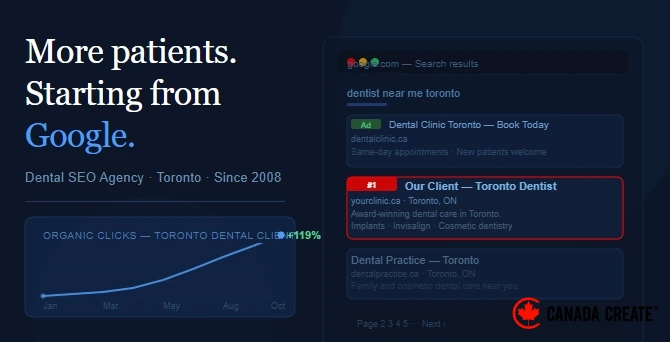
When people ask what SEO is in dentistry, the short answer is this: profile accuracy, reviews, treatment pages, site speed, structured data and links from your community all feed one decision, which is whether your clinic deserves to be shown for a search. General SEO advice covers the same basics, but dentistry adds its own layer: advertising standards set by provincial regulators, health privacy rules for reviews and photos, insurance and coverage questions, and treatments whose value to the practice differs a great deal from one to the next.
Canada Create™ has worked on search marketing since 2008 for clients in Canada and the United States. This service is part of our dental marketing services and follows the method of our SEO services, adapted to dentistry. For an overview of the core discipline and how we set up a program, see our dental SEO service page. This page goes deeper into how a dental SEO company runs the work week to week.
Why a specialist dental SEO company outperforms a generalist
A generalist agency can fix page titles and speed. A dental SEO company knows which searches bring patients who stay for years, which treatments need their own pages, what a dental regulator will and will not allow in advertising, and why a review reply must never confirm that someone is a patient. Those details decide whether the work brings bookings or only traffic.
Treatment value varies. A new implant or aligner patient is worth far more to a practice than a single cleaning, but a family that books hygiene for four people twice a year is worth more over time than either. A dental SEO expert plans pages and profile work around the mix of patients you want, not around whichever keyword looks biggest.
Rules shape the copy. Superiority claims, guarantees, unverifiable statements and use of the word specialist are restricted by dental regulators. Copy that ignores them can create problems with your College that no ranking is worth.
Competition is local and dense. In most cities several clinics sit within a short walk of each other, and dental groups run paid search, professional content and review programs across many locations. An independent clinic wins by being more specific: stronger pages for its real treatments, better answers for its own area and a review profile that mentions the things patients care about.
How patients choose a dentist online
Most new patients begin with a local search. Someone has moved, started a new job, lost a dentist to retirement, cracked a tooth on a weekend or decided it is time for aligners. They search, look at the three clinics in the map pack, compare ratings and recent reviews, open one or two websites and call or book.
Convenience decides a lot. Patients look for a clinic near transit or with parking, evening and weekend hours, direct billing to their insurance plan, and online booking. Commuters often search near work rather than home, so a clinic in a business district sees different searches on weekdays than a clinic in a residential area serving families.
That tells us where SEO for dentists has to work. Your Google Business Profile must be complete and accurate, your reviews must be strong and recent, your website must answer practical questions within seconds on a phone, and every treatment you want to grow needs its own page that can rank. Miss any one of those and patients who found you choose the clinic next door.
What our dentist SEO service covers
Every program begins with an audit of your profile, website, reviews and the clinics that currently hold the top positions around you. The work then focuses on four areas.
Google Business Profile for dentists
Categories, services, hours, accessibility attributes, booking links, photos and posts, plus profiles for individual dentists where appropriate, compared against the clinics in the top three near you.
Treatment pages from a dental SEO expert
A page for each treatment you want to grow, such as implants, Invisalign, whitening, emergency care and family dentistry, reviewed by your dentists before publishing.
Reviews and reputation for dental clinics
A simple review request after appointments, replies that never disclose patient information, and monitoring for fake or policy violating reviews.
Technical dentist SEO
Site speed, mobile usability, structured data for your clinic and dentists, consistent listings on directories and links from your community.
Tracking ties the work to patients. Calls, online bookings and form submissions from search are measured, and with your front desk we can report new patient appointments by source. Leads can also flow into CS+, our CRM, so you can see which searches turned into appointments and which did not.
Ranking in the map pack as a dental clinic
Google ranks local results by relevance, distance and prominence. For a dental clinic, relevance comes from the right primary category, the services listed in the profile, treatment pages on the website and a description that explains what the clinic offers. Prominence comes from reviews, consistent listings, links and how well known the clinic is. Distance cannot be changed, which is why the goal is to win the areas you can realistically serve rather than a whole city.
We track visibility on a grid of points across your area, so you can see exactly where you appear in the top three and where competitors dominate. A clinic might rank well around its own intersection and fall away a kilometre in either direction. The grid shows that pattern, and the work targets it: location details in the profile, local references on the location page, reviews from patients who mention the area, and links from local organizations.
Profile details that most dental clinics miss
The primary category should be the one that matches your main service, with secondary categories only for services you actually provide. The services list should name each treatment in the words patients use. Hours must include holiday changes, because a patient with a toothache who finds a closed clinic listed as open will not try again. Photos of the exterior, entrance, reception and treatment rooms help patients recognize the clinic when they arrive. Booking links, accessibility attributes and languages spoken all add relevance and help patients choose.
SEO keywords that bring dental patients
Patients do not all search the same way, and the searches that bring the most valuable patients are rarely the most obvious ones. Before we write or change a page, we map the searches that matter for your practice into groups and give each group one page that is responsible for ranking. That prevents two of your own pages from competing for the same search.
- “Near me” and area searches such as “dentist near me” or “dentist” plus a neighbourhood name. These are won mainly in the map pack and on your location page.
- Treatment searches such as “dental implants”, “Invisalign cost” or “wisdom teeth removal”. These need dedicated treatment pages.
- Urgent searches such as “emergency dentist open now” or “broken tooth dentist”. Accurate hours and a clear emergency page decide who gets the call.
- Coverage searches such as “dentist that accepts CDCP” or “direct billing dentist”. A page that explains your billing and plan participation answers them.
- Language and community searches for a dentist who speaks a particular language. These are high intent searches that few practices target properly.
- Question searches such as “how long does a root canal take” or “are veneers permanent”. These belong in FAQs and articles that link to the treatment page.
For each group we look at the pages Google currently ranks in your area and how hard those pages would be to beat. That tells us which groups are worth a page, which can be won quickly and which will take longer. The best SEO keywords for dentists are the ones that match the treatments your practice wants more of and that your site can realistically win.
Treatment pages that rank and convert
A single services page listing twenty treatments rarely ranks for any of them. High value treatments such as implants, Invisalign and cosmetic dentistry need their own pages that explain who the treatment is for, how it works, how many visits it takes, what affects the cost, how insurance usually applies and what to do next. Emergency dental care needs a page that loads fast and puts the phone number first.
We write each page from an interview with your dentists and your team, in plain language, with the questions patients actually ask. Every page goes to your dentists for clinical review before publishing, and nothing promises outcomes.
What a strong treatment page includes
When we rebuild a treatment page, we compare it with the pages that currently rank for that treatment in your area and make sure it answers more of the patient’s questions, more clearly. A strong treatment page usually covers:
- What the treatment is and who it is for, in plain language.
- How the consultation works and what happens at each appointment.
- Recovery, aftercare and how long results usually last.
- Cost factors, plus insurance, direct billing, Canadian Dental Care Plan participation and financing where they apply.
- The dentist who provides the treatment, with credentials.
- Case photos and patient reviews used only with consent and within College standards.
- Frequently asked questions drawn from the searches patients make.
- A clear way to book, call or ask a question, visible on a phone without scrolling far.
Each page is marked up with structured data for the practice, the service and the questions, and linked from related treatments so patients and search engines can move between them.
On-page SEO and site structure for dental websites
Site structure tells Google which pages matter most. A dental website works best with a clear hierarchy: the home page, a page for each location, a page for each major treatment grouped under general, cosmetic, restorative and emergency care, team pages for each dentist, and a patient information section for insurance, billing, first visits and forms.
On each page, the title tag and main heading name the treatment in the words patients use. The meta description gives a reason to click. Headings follow the questions a patient has in the order they have them. Images carry descriptive file names and alternative text. Internal links connect related treatments, such as implants to bone grafting and dentures, so authority flows through the site and patients find the next answer without going back to Google.
Topical authority grows the same way. A practice that publishes a treatment page, supporting answers to the common questions around it and a dentist profile that shows who performs it gives Google a complete picture. A practice with one thin page and nothing around it does not.
Technical SEO for dental websites
Many dental websites are built on templates that load slowly on phones, hide the booking button and repeat the same content across locations. We fix the technical basics: speed, mobile layout, crawlability, duplicate pages and redirects. We add structured data that tells Google your clinic’s name, address, hours, services and dentists, and we check that search engine and AI crawlers can reach your treatment pages.
Speed matters most on mobile, where most patients search. Large sliders, unoptimized photos and heavy booking widgets are the usual causes of slow pages. Online booking and click to call should be visible on every page. If your website holds you back, our dental website design team can rebuild it with SEO built in, keeping every URL that already ranks. For WordPress sites we also offer WordPress development and managed website hosting.
Trust signals and dental advertising standards
Google gives extra weight to experience, expertise, authoritativeness and trust on health topics. For a dental practice that means real dentist profiles with education and registration, clinical review on every treatment page, clear contact and location information, and content that never overstates what a treatment can do.
Dental advertising is also regulated. In Ontario, the Royal College of Dental Surgeons of Ontario sets advertising requirements, and each province has its own regulator. In practical terms, marketing must be accurate, verifiable and not misleading. Claims of superiority, guaranteed results and unverifiable statements are out. Only dentists registered in a recognized specialty may describe themselves as specialists, which matters for general dentists who offer orthodontic, periodontal or surgical services.
We write every page, profile description and post with those requirements in mind and flag anything that needs your judgment. You remain responsible for your practice’s advertising under your regulator’s rules, so every page goes to you for approval before it is published. Nothing on this page is legal advice; when a question is unclear, your own adviser or your College is the right source.
Patient photos, testimonials and privacy
Before and after photos can help patients understand cosmetic and restorative work, but they need written patient consent and must represent typical results honestly. Review replies must never confirm that someone is a patient or discuss their care, because health privacy law applies to dental records. We draft replies that thank the reviewer and invite them to contact the clinic directly, and we never write, buy or reward reviews.
Where does your clinic appear today?Tell us your location and the treatments you want to grow. We reply within one business day with a free dental SEO audit comparing you with the clinics in the top three around you.
Reviews that patients trust
Reviews influence both ranking and choice. People compare ratings in the map pack before they click, and they read recent reviews for signs of how the clinic treats patients: whether the hygienist was gentle, whether the front desk explained billing, whether the dentist took time to answer questions.
We set up a simple way for patients to leave a review after their appointment, by text or email with their consent. Reviews that mention the treatment and the area in the patient’s own words are especially useful, because they help Google and AI tools connect your clinic with those searches. We never script what patients write. Steady, recent reviews matter more than a burst of reviews in one month followed by silence.
Directory profiles matter too. Patients also check listings such as RateMDs and booking platforms, and those sites often rank on page one for dentist searches. We make sure your practice information there is accurate and consistent with your Google Business Profile.
Links, citations and listings for dentists
Links from other websites are still one of the strongest signals Google uses to judge which practice deserves to rank. For dentists, the best links are not bought. They come from real relationships in the community and the profession.
- Professional and alumni directories and the profiles of dentists who teach or hold hospital appointments.
- Neighbourhood associations, business improvement areas, schools, sports teams and charities the practice supports.
- Suppliers, laboratories and specialists you refer to or receive referrals from.
- Local news and community publications, when the practice has something worth reporting, such as a new location or a community program.
- Insurance, CDCP and financing directories where the practice is listed.
Citations are the listings of your name, address and phone number across directories, maps and data aggregators. Old phone numbers, previous practice names or former addresses confuse Google and patients, and a clean up often produces a visible map pack improvement. We avoid link schemes, paid guest posts on unrelated sites and private blog networks. They can produce a short rise in rankings followed by a penalty that takes months to undo.
Content that answers patient questions
Patients search for answers before they book: how long implants last, whether Invisalign works for their case, what to do about a cracked tooth at night, whether insurance covers a crown. Clear answers reviewed by your dentists build trust and help your site appear in featured snippets and AI answers.
Some of the questions patients type are about rules of thumb they have heard, such as what the “50 40 30 rule” in dentistry means, what a “two year rule” refers to with their insurance or treatment, or what the “3 3 3 rule” is. These are clinical and coverage questions, and the right answers come from your dentists and your team, not from a marketing agency. We identify which of these questions patients in your area actually ask, interview your team, and publish their answers in plain language on your site. That is how a clinic becomes the source that search engines and AI tools quote.
Coverage questions have grown since the federal Canadian Dental Care Plan began accepting patients. A clear page about the plans you accept, how direct billing works at your clinic and what patients should bring to the first visit helps them choose you. A good content plan for a dental practice usually includes treatment FAQs, first visit guides, insurance explanations, aftercare instructions and short articles on seasonal topics such as sports mouthguards or holiday hours.
Dentist SEO for AI answers and voice search
Patients increasingly ask Google, Siri or ChatGPT questions such as “who is a good family dentist near me that is open Saturday”. These tools pull from the Google Business Profile, reviews, directories and well structured websites. The clinics they recommend tend to share a few traits.
- One consistent identity. The same practice name, address, phone and hours on your website, Google, Apple Maps, Bing and every directory.
- Treatments a machine can read. Each treatment on its own page, with structured data that names the service, the dentist and the location.
- Reviews that name treatments. Patients describing the visit in their own words, which gives AI tools evidence of what you do well.
- Third party mentions. Professional directories, community organizations and local media that confirm who you are.
- Direct answers. FAQs written in plain sentences that answer the question in the first line.
The same work that improves map pack rankings also improves the chance of being named in these answers, which is why we treat AI visibility as part of SEO for dentists rather than a separate product.
SEO for multilingual dental practices
Many patients prefer a dentist who can explain treatment in their first language, and practices with multilingual dentists or staff often under use this advantage online. We help practices show it properly: language information in the Google Business Profile and on team profiles, dedicated pages in the languages the practice serves where patients search for them, and reviews from patients in those communities.
Translated pages are written by fluent speakers and reviewed for dental terminology, never produced by machine translation alone, and each language version is linked correctly so Google shows the right one to each searcher. Competition for language searches is usually lower than for the English equivalents, which makes this one of the faster wins for practices that can offer it.
A dental SEO agency for multi-location groups
Groups with several clinics need a page and a profile for each location, each with its own address, hours, dentists, photos and reviews. Copying the same text across locations produces thin pages that do not rank and profiles that compete with each other. We build each location page from what is specific to it, link it to the shared treatment pages and manage each Google Business Profile separately, with reporting by location so you can see which offices need attention.
Groups also benefit from shared assets: one set of well written treatment pages that every location links to, one review process that runs the same way at every front desk, and one reporting view that compares locations fairly.
SEO for dental specialists
Orthodontists, periodontists, endodontists, pediatric dentists and oral surgeons compete differently from general practices. Many patients arrive by referral, but a growing share search directly, especially for orthodontics, implants and wisdom teeth. Specialist SEO focuses on a smaller set of high value searches across a wider area, on content that referring dentists can share with their patients, and on the credentials that set a specialist apart. Only dentists registered as specialists may present themselves as such, so profile titles and page wording are checked carefully.
SEO for a new dental practice
A new practice starts without reviews, links or search history, so the first months focus on what can be controlled. The Google Business Profile is set up correctly before opening, with verified address, hours, categories and photos. The website launches with complete treatment and location pages rather than a placeholder. Every early patient is asked for a review. Google Ads for dentists can fill the schedule while organic visibility builds. New practices that follow this order usually start to appear in the map pack close to the clinic first, then expand outward as reviews and links grow.
Problems a dental SEO expert fixes most often
Most dental websites we audit share a handful of problems. None is dramatic on its own, but together they keep a practice on page two.
The wrong primary category
A Google Business Profile under a broad or incorrect primary category, or with specialist categories the practice does not qualify for, weakens map pack rankings for the searches that matter.
Treatment pages that say almost nothing
A paragraph about implants and a stock photo cannot outrank pages that explain candidacy, the procedure, recovery, cost factors and financing. We rewrite thin pages into complete answers.
Duplicate location pages
Practices with several locations often have near identical pages for each one. Each location page needs its own team, hours, directions, parking details, reviews and services.
Old website platforms and slow pages
Templates from dental website vendors can be slow, hard to edit and owned by the vendor rather than the practice. We fix or migrate them, keeping every ranking URL.
No tracking
Without call tracking and booking measurement, a practice cannot tell whether search brings patients or only visits. We set up tracking before we change anything, so progress is measured from a known starting point.
Can a dentist do SEO without an agency?
Yes, for the basics. A dentist or office manager can claim and complete the Google Business Profile, ask every patient for a review, keep hours accurate and use an SEO plugin to write clear titles and descriptions. Those steps alone help many clinics.
What usually needs a dental SEO company is the rest: competitor research across your area, a page plan that stops your own pages from competing, treatment pages written and reviewed to clinical standard, technical fixes, structured data, citation clean up, link building and monthly reporting tied to bookings. That work takes steady time every month, and most practices would rather that time go to patients.
How long SEO for dentists takes
Fixes to the Google Business Profile and to technical problems can improve visibility within a few weeks. Treatment pages typically take three to six months to reach stable positions, depending on how competitive the treatment is in your area. Implant and orthodontic searches in large city centres are among the most competitive; family dentistry in a specific neighbourhood is usually faster. Practices with an established website tend to move faster than brand new ones.
A typical first 90 days looks like this: an audit and tracking setup in the first two weeks, profile and technical fixes in the first month, the first priority treatment pages and a running review process by the end of the third month. We report early indicators every month, such as map pack positions across your area, impressions in Search Console and calls from search, so you can judge progress well before the most competitive searches are won.
How we measure dental SEO results
We track rankings for your treatment searches, map pack visibility across your area and traffic from search, but monthly reports lead with calls, online bookings and forms from search and your Google Business Profile. With your team’s input we connect those to new patient appointments, so the report answers the question that matters: how many new patients came from search this month, and for which treatments.
SEO for dentists or Google Ads?
The two work best together. Google Ads can bring patients in the first week, which is useful for a new practice, a new associate with open time or a treatment you want to grow quickly. Click costs for dental searches are high, so relying only on ads gets expensive. SEO takes longer but lowers the cost of each new patient over time, because organic clicks are not paid for. Ads data also shows which searches turn into bookings, which helps decide where SEO effort should go.
A simple way to decide the split is to look at your schedule. If the chairs have open time this month, ads fill it fastest. If the schedule is healthy but you depend on paid clicks for new patients, moving part of the budget into SEO reduces that dependency over the following year. For the full picture of how SEO, ads, your website and reviews fit together, see our dental marketing services.
What a dental SEO company costs
Our SEO programs start from CAD 1,500 a month, with higher tiers by proposal. For a dental clinic the main cost drivers are the number of locations, the treatments you want to grow, how many strong competitors sit around your clinic, the state of your website and how much new content is needed.
We separate the costs so you can see them clearly. One time setup work, such as a technical rebuild or a batch of new treatment pages, is quoted in writing on its own. Monthly management covers the ongoing profile, review, content, link and reporting work. Ad spend and any third party booking or tracking tools are billed separately. The audit is free and yours to keep, and there is no long-term contract.
Choosing a dental SEO agency
When you compare proposals, ask each dental SEO agency to show where your practice ranks today for your main treatments across your area, what they would change first and why, and how they will report new patients rather than only rankings. Ask who writes the treatment content and who reviews it, and whether they know your regulator’s advertising requirements. Confirm that you will own the website, the content and the Google Business Profile. Be cautious of guaranteed rankings; no one can promise them.
Canada Create™ works from 126 Willowdale Avenue in North York, is a BBB Accredited Business with an A+ rating and has worked in search marketing since 2008 for clients in Canada and the United States. Our team is available 24/7 on our toll-free line at +1 (800) 808-9235. A free review of your site and map listing is the usual first step, and you get a proposal in one business day.
Talk to a strategist
Ready when you are!
Get a proposal in one business day.
Tell us your goals, budget and timeline. You get a plan, a price and a named strategist, with no long-term contract.
How a dental SEO program runs
The foundation is built in the first two months; pages, reviews and links grow every month after that.
- Free audit Week 1
Profile, site, reviews and competitors reviewed.
- Profile and tracking Weeks 2 to 3
Profile optimized, call and booking tracking set up.
- Technical fixes Weeks 3 to 6
Speed, mobile and structured data fixed.
- Treatment pages Months 1 to 3
Pages written with your dentists and approved.
- Reviews and content Monthly
Review requests running, patient questions answered.
- Report and refine Monthly
Bookings, visibility and next steps.
Related dental services
Dental SEO works best as part of a complete dental marketing program.
What clients say on Google
Reviews pulled live from our Google Business Profile.




Free review, no obligation
Not sure where to start? Send us what you have.
Share your current site, campaign or brief. A strategist reviews it and replies within one business day with a written recommendation and a fixed quote.
Why dental clinics choose Canada Create™ for SEO
RCDSO rules built in
No superiority claims, guarantees or misleading copy.
Clinical review
Your dentists approve every treatment page.
Measured by bookings
Calls and appointments, not just rankings.
Patient privacy
Review replies that never disclose care.
One team
SEO, ads, website and booking automation together.
24/7 support
Toll-free +1 (800) 808-9235, any time.
Since 2008
Eighteen years of search marketing.
BBB A+, zero complaints
Accredited by the Better Business Bureau.
SEO for dentists: questions practices ask us
What is SEO for dentists?
It is search engine optimization built around how patients find dental care: your Google Business Profile in the map pack, treatment pages in the organic results and the signals AI answers rely on, all written within dental advertising rules.
How much does a dental SEO company charge?
Our SEO starts from CAD 1,500 a month. Multi-location groups, specialists and highly competitive areas are quoted in writing after a free audit, with setup work, monthly management and ad spend shown separately.
What SEO keywords should a dentist target?
The searches that match the treatments you want more of: near me and area searches, treatment searches, urgent searches, coverage searches such as CDCP and direct billing, language searches and patient questions. Each group gets one page responsible for ranking.
How long does dentist SEO take to work?
Profile and technical fixes can improve map visibility within weeks. Treatment pages usually take three to six months, and implant or orthodontic searches in large city centres take longer.
What does a dental SEO expert do that a general agency does not?
Plans pages around treatment value, writes within your regulator advertising rules, handles reviews without disclosing patient care, and reports new patient bookings rather than traffic alone.
How do I choose a dental SEO agency?
Ask where you rank today by treatment and area, what they would change first, who writes and reviews treatment content, how they report bookings and whether you keep ownership of your site and profile. Avoid anyone who guarantees rankings.
Can a dentist do SEO without an agency?
Yes, for the basics: a complete Google Business Profile, steady review requests, accurate hours and clear page titles. Competitor research, treatment pages, technical fixes, links and booking-based reporting usually need a specialist.
Does SEO for dentists help with AI answers?
Yes. AI tools draw on your profile, reviews, directories and clearly structured treatment pages, so the same work that improves map pack rankings improves the chance of being named.
Do you guarantee first place on Google?
No one can guarantee rankings. We commit to the work, the measurement and honest monthly reporting.
Do you work with practices across Canada?
Yes. We work with dental practices across Canada and the United States and write to the advertising standards of the regulator where you practise.


Plan your next project
Review the offer, budget and enquiry process before committing your marketing spend.
