
What Do Prospective Clients Actually Look For on a Law Firm’s Website?

Executive summary. A law firm website should help a prospective client decide whether the firm handles their situation, who they would deal with, what the first step involves and whether the practical arrangements work for them. Good design makes those answers easier to find; it does not replace them. For a firm buying a new website, the useful question is not simply whether the homepage looks more impressive. It is whether the proposed work resolves the uncertainties that stand between an appropriate enquiry and an informed conversation. This guide explains those uncertainties, the choices worth funding and how to compare website proposals without mistaking attractive examples for evidence of business results.
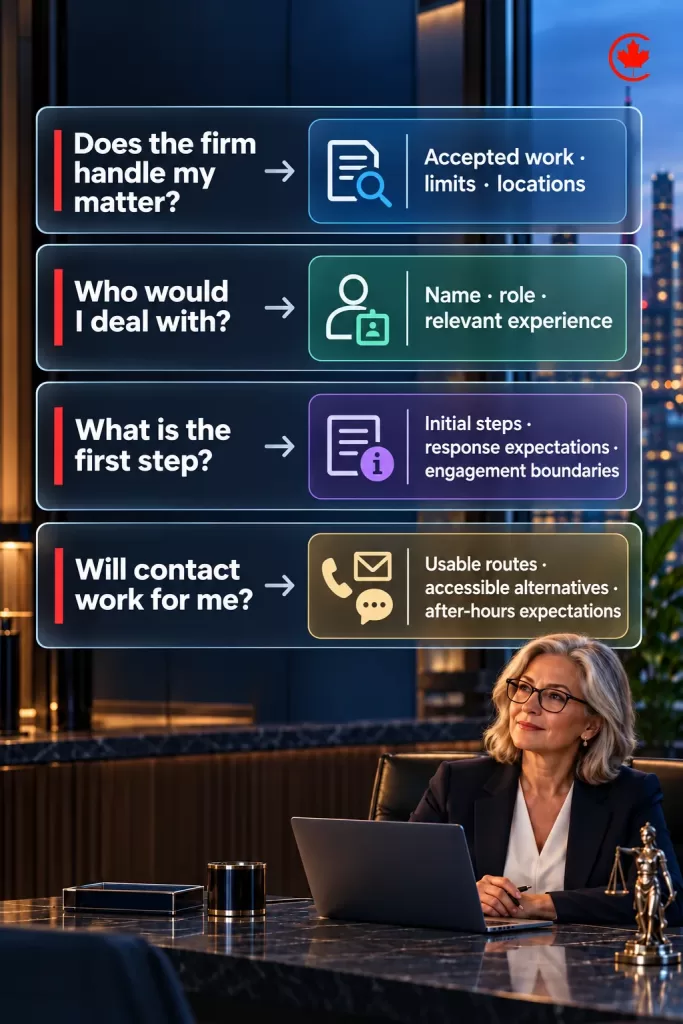
Clients research first and contact second
A referred prospect and someone who has never heard of your firm may arrive with different questions. The referral visitor may already trust the recommendation but still need to check the lawyer’s practice, appointment arrangements and office location. Someone comparing unfamiliar firms may need more explanation of relevant experience and fees. Neither journey requires the visitor to read the entire website. Your purchase should support both a quick confirmation and a more considered decision, without making either person navigate the firm’s internal departments.
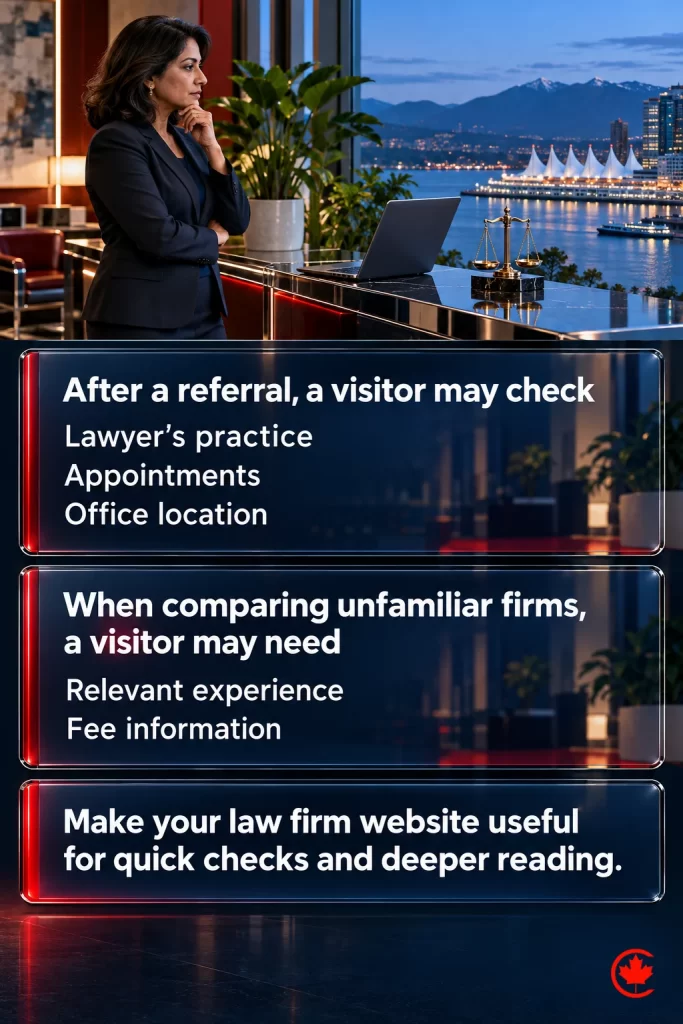
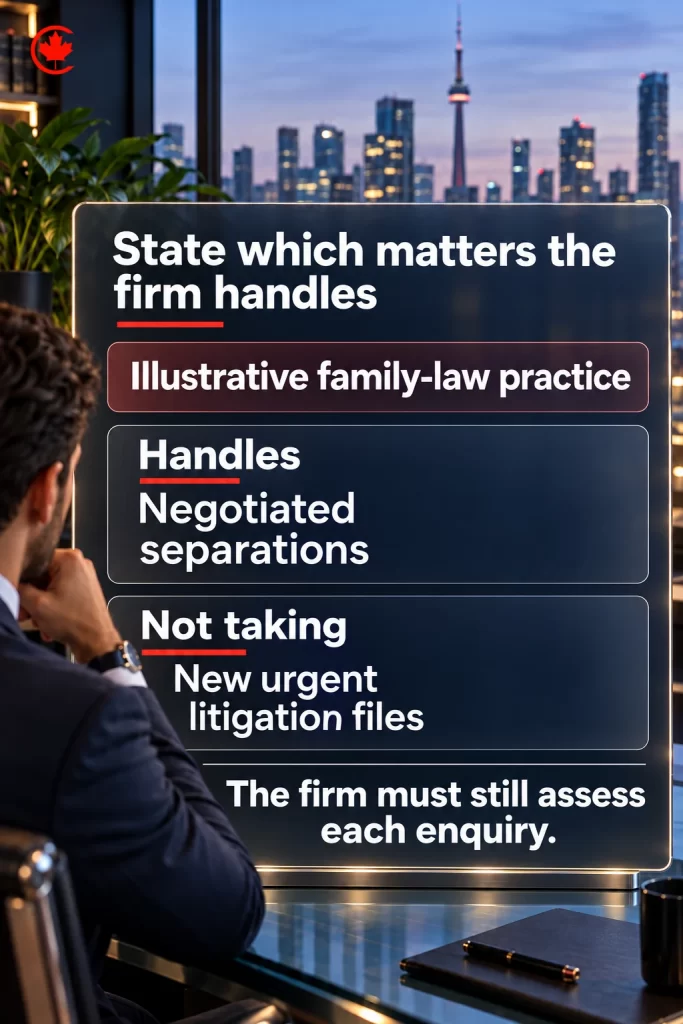
Start with the matter rather than the firm’s preferred label for its department. A person worried about a separation may not know whether their immediate concern belongs under parenting, support or property. A business owner reviewing a commercial agreement may need a defined review rather than ongoing general counsel. A useful service description helps them recognise the situation and understand the boundaries of the work. It should not suggest that every question in a broad practice area will be accepted.
Consider a hypothetical family firm that handles negotiated separations but does not accept new urgent litigation files. A beautiful page promising help with every family dispute creates an expectation the intake team cannot fulfil. A clearer description of the matters currently accepted, the geographic reach and the first assessment is a better purchase than additional decorative pages. The website does not make the legal decision about suitability. It gives the prospect enough accurate context to ask the right firm for that decision.
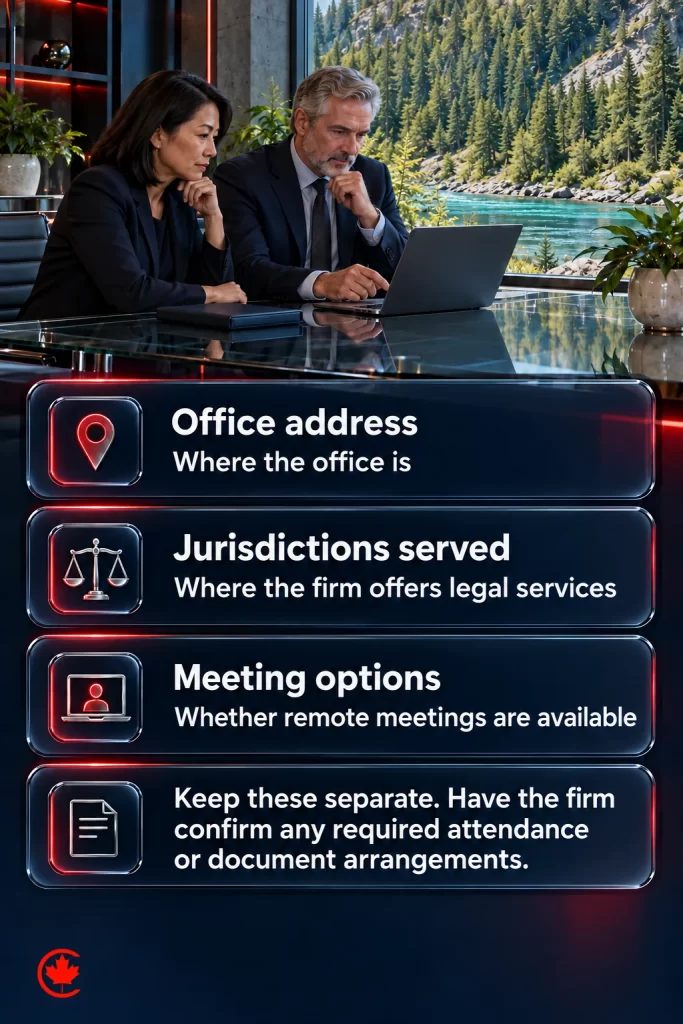
Geography also needs a practical explanation. An office address, the jurisdictions in which services are offered and the availability of remote meetings answer different questions. A Toronto address does not tell a visitor whether an initial meeting must be in person or whether the firm handles their matter elsewhere. Ask for this distinction in the content scope. Where a service requires particular attendance or document arrangements, the firm should approve the explanation rather than let a designer infer it from another practice’s website.
Reviews help, but they do not tell the whole story
For a law firm owner, the distinction between reputation and proof matters. A review may describe someone’s experience of communication; it cannot establish what will happen in another case. A credential can support a factual statement about a lawyer; it does not guarantee a result. The website should let a prospect distinguish these categories instead of placing a rating beside an outcome claim in a way that implies a connection.
If reviews appear on the site, ask what the visitor will actually see. Is the display a selected excerpt, a live feed or a link to the full public profile? Does the presentation make that clear? Who will check that names, quotations and permissions are appropriate for the intended use? These are reasonable scope questions for the firm and its provider. A display that looks complete but silently selects only certain entries can give a different impression from what the firm intends.
Experience examples deserve similar care. A plain description of the kind of work the firm handles can be useful without naming a client or revealing a matter. Any proposed case story, testimonial or outcome example needs the firm’s approval of its accuracy and permitted use. Do not treat a website project as permission to repurpose confidential files. If suitable public evidence is limited, precise service descriptions and accurate biographies are better than invented testimonials, impressive-looking numbers without context or a list of awards that no one can explain.
A clear contact path needs a real response behind it
How the firm answers a call or an email belongs in the same discussion as the website. The site creates the enquiry; the response decides what happens next.
Separate three events: receiving an enquiry, arranging an initial conversation and agreeing to act. A confirmation message can tell a person that their request arrived without implying that a lawyer has reviewed it or accepted the matter. The firm’s approved wording should explain the next step and any limits on reliance. An urgent visitor should not be left to infer that a form is monitored continuously merely because it is available at all hours.
The right contact options depend on the people the firm serves. A caller may want a short conversation before sharing details. Someone in a shared home or workplace may prefer a discreet written reply. Another person may need an accessible alternative to a telephone call. A useful project considers those differences and the firm’s ability to support them. Adding chat, appointment booking and messaging channels is not automatically an improvement if each creates another inbox without a responsible person.
A form should request enough information for the approved first step, not invite a complete case history by default. Decide with the firm which information is appropriate before a conflict or suitability review, what documents should wait and what contact preferences can be accommodated. The provider should be able to explain where enquiries go, who can access them and what is retained. This is a buying conversation about responsibilities and exposure, not a reason to send private client material to a marketing agency.
Imagine a solo practice with eight initial-consultation slots each week. At an assumed thirty minutes per meeting plus fifteen minutes of preparation and administration, those slots represent six hours. Increasing availability to twelve slots would require nine hours, three more than the original plan. This shows why a website promising more immediate access must be discussed with the person doing the work. A booking feature cannot create the missing time.
Contact preferences can be consequential in sensitive matters. In a hypothetical separation enquiry, the person may be comfortable receiving an email but not a voicemail that identifies the practice area. The firm should decide how to ask about a safe way to reply and how that preference reaches the people handling the enquiry. A generic claim that every message is confidential does not answer those practical questions. Ask the provider to support the firm’s approved arrangements without promising protections it cannot substantiate.
A connection to an intake or client-management system can reduce disconnected records, but the owner still needs a clear service scope. Ask which channels are included, what happens when a message fails, who reviews unresolved enquiries and which ongoing costs apply. Distinguish a system acknowledgement from a substantive reply. The firm’s response commitment should reflect its actual coverage, including holidays and absences, rather than a promise borrowed from a website example.
For a multi-office firm, confirm whether a visitor is contacting the whole practice or a particular location. Different telephone hours, languages or accepted matters can make a single undifferentiated form misleading. The purchase should support the actual service arrangement without multiplying pages or channels simply to appear larger. If enquiries are centrally handled, say so in an appropriate way. If offices operate differently, the firm needs to supply those differences before the provider can represent them accurately.
The website itself must also be usable on the devices clients bring to it. Do not assume that every first visit is on a phone, but do not make a phone visitor pinch and zoom to find an address, read a fee explanation or contact the office. During project review, ask to see those ordinary tasks on representative mobile and desktop screens. A large screen in a design presentation can conceal small text, obstructive panels or a form that becomes awkward on a phone.
Discuss loading behaviour in the same practical terms. A visually elaborate introduction is poor value if the visitor has to wait for it before reaching essential information. There is no universal loading-time promise that guarantees more retained clients. Ask the provider what performance assessment is included and whether major media or third-party features affect the experience. If a proposed feature introduces noticeable delay, compare its actual client benefit with a simpler alternative rather than approving it only because it looks impressive.
Fees and process: make the first commitment understandable
The useful objective is informed expectations, not a price for every possible case. A prospective client may want to know whether the initial conversation is paid, what it covers and what happens afterwards. They may also need to distinguish a consultation charge from a retainer or the fees for ongoing work. A website can explain the firm’s approved approach without suggesting that a general description is a personal estimate or that representation starts with a payment button.
A defined document service and disputed litigation call for different explanations. In a hypothetical estate-planning practice, the firm might offer a specific service with clearly stated inclusions, eligibility and additional-work boundaries. A litigation team may instead explain the assessment needed before it can discuss scope and likely costs. Neither approach is inherently less transparent. The important question is whether the visitor understands what the firm can explain now, what remains uncertain and how a written engagement will resolve that uncertainty.
Where a price or range is appropriate, ask the firm to approve what it includes and excludes. Taxes, disbursements, third-party charges and work outside the stated scope should not become surprises because the website used a short headline. Where pricing depends on the situation, describe the factors in ordinary language rather than promising a misleading universal figure. The agency’s job is to present approved information clearly, not decide the firm’s legal fees or certify a professional advertising interpretation.
Payment arrangements can also affect suitability. A visitor may need to know whether the firm offers a paid initial review, accepts a particular payment method or has a process for discussing affordability. Include only arrangements the firm actually offers and keep qualifications beside the statement. Avoid the assumption that a prospective client asking about cost is unsuitable. The website should help both sides reach an informed conversation, not shame someone for comparing options.
Finally, show how the relationship begins. A short explanation of the enquiry, the firm’s review and the subsequent engagement discussion can be more useful than a prominent button with no context. The actual sequence must come from the firm. Some practices cannot offer open appointment booking before preliminary checks; others can offer a general initial conversation with clear limits. Commission the explanation that fits the service, and make sure the wording remains accurate when staffing or intake arrangements change.
What clients need to confirm on the website
| What the prospect wants to confirm | What answers it on the page | What leaves the question unanswered |
|---|---|---|
| Does this firm handle my exact problem? | Plain-language practice information explaining accepted matters, important limits and relevant locations | A broad service list without enough context to assess fit |
| Who will actually work on my file? | Accurate lawyer biographies, professional roles, relevant experience and available languages | A group photograph without a clear explanation of who receives the enquiry |
| Can I trust them? | Verifiable credentials, carefully presented genuine reviews and a link to the full review source where used | Unsigned praise, unsupported comparisons or unexplained result claims |
| What will it cost? | The approved billing approach, consultation policy and meaningful scope qualifications | A fee headline without inclusions, or no explanation of how fees will be discussed |
| What happens after I reach out? | The firm’s real initial steps, response expectations and engagement boundaries | A form submission that appears to promise immediate representation |
| Can I reach them in a way that works for me? | Usable contact options, accessible alternatives and accurate after-hours expectations | Contact details that are difficult to use or channels without reliable coverage |
We design law firm websites that make credentials clear and consultations easy to book.
Biographies should explain the people behind the service
A firm history can explain continuity, but it cannot answer every question about the person receiving an enquiry. A useful biography identifies the lawyer’s actual role, relevant practice focus and verified background in a way a non-lawyer can understand. Give the firm an opportunity to approve each factual statement, including credentials, professional status, dates and descriptions of experience.
The difference between personal and team experience is especially important. A hypothetical five-lawyer practice may receive every new enquiry through an intake coordinator before allocating it to a suitable lawyer. If its website features one senior partner throughout, a prospect could reasonably expect that partner to handle the file. The design should not create an expectation the firm does not intend. Explain how the team works and when the individual lawyer will be identified, without promising a particular person unless that is the arrangement.
Specificity is more useful than inflated praise. A family law biography can describe the kinds of matters a lawyer accepts and their relevant experience, provided the firm verifies those statements. It does not need to promise an outcome or describe the lawyer as the best in a city. A photograph can help someone recognise the person they will meet, but the accuracy of the surrounding information matters more than the number of portraits commissioned.
Language information needs the same precision. A translated page does not by itself mean that legal services, support staff or documents are available in that language. If a firm offers consultations in English and Farsi, for example, clarify which part of the experience that describes and confirm current availability. A purchaser should ask whether translation, professional review and later updates are included. An outdated translated version can create conflicting expectations even when the main-language page is accurate.
Plan for changes after launch. Lawyers join, move, change focus or take leave. Decide who will request and approve profile updates and whether the firm can make ordinary edits itself. A website that requires a separate design project for every staff change may be the wrong fit for a growing team. This is not an argument for giving everyone unrestricted editing access; it is a reason to buy a manageable content arrangement with clear responsibilities.
Professional approval and accessibility belong in the scope
Ontario lawyers and paralegals have separate professional rules. The firm’s appropriate reviewer should approve public claims, service descriptions, fee wording, reviews and client examples under the rules that apply to its practice. In a personal injury context, for example, a description of experience should not drift into a promise about another person’s result. A marketing provider can help organise the material, but that is not a substitute for the firm’s professional judgement or independent advice where needed.
Accessibility is both a service-experience issue and, for relevant organizations, a specific obligation. Ontario’s website guidance covers designated public-sector organizations and businesses or non-profits with at least fifty employees. Its web-content rules have date and exception limits. That threshold is not a blanket exemption from every accessibility obligation for smaller firms.
For a website purchase, ask what accessibility work is included rather than accepting an unexplained badge or a promise that the theme handles everything. The proposal should identify the agreed standard, the pages and functions covered, the assessment to be delivered and responsibility for correcting identified issues. If the project includes booking, document downloads or third-party forms, ask whether those experiences are within the agreed review. An attractive homepage says little about a difficult appointment form.
Consider a hypothetical visitor who uses a keyboard rather than a mouse. They may be able to read the practice description but struggle to reach or submit the contact form. Another visitor may enlarge text or use assistive technology to read a fee document. A credible buying discussion considers the full path to help, not only the visual presentation. Ask the provider to demonstrate the agreed user tasks and describe any known limitations in language the firm’s decision-makers can evaluate.
Readable content and alternative contact routes matter even when a visitor does not identify a disability. Long blocks of professional terminology can obscure a straightforward next step. A downloadable form may not suit someone using a phone or a shared device. The point is not to remove all detail. It is to offer a usable route to the essential information, with additional detail available where necessary. The firm should help decide what information must remain precise and where an explanation can be simpler.
Keep responsibility after launch visible. New documents, edited pages and replacement booking tools can change the experience. Decide who checks additions and what ongoing review is purchased. For Canada Create engagements, accessibility conformance must be an expressly specified deliverable in the agreement; it is not automatically warranted as part of every website. Agreeing that scope early makes the purchase more useful than discovering after launch that the firm and provider understood the same word differently.
Commission content that answers a real decision
Video can introduce a lawyer’s manner or explain what an initial meeting involves. It is not inherently more persuasive than clear text, and a particular length does not guarantee a better result. Start with the question the content should answer. If the main uncertainty is whether the firm offers remote consultations, a short written explanation may be enough. If a personal introduction would genuinely help, discuss a video together with captions, a useful text alternative and the firm’s approval responsibilities.
Written guides should have an equally clear purpose. A prospect may want to understand the difference between an introductory conversation and a detailed consultation, what general categories of information to prepare or how the firm communicates during an engagement. The website can explain the approved service experience without giving an individual legal opinion. Do not commission a large library merely because a proposal counts pages. Ask which decisions each piece helps a prospective client make and who will keep it accurate.
A hypothetical small employment practice might choose an informative lawyer profile and a careful first-meeting explanation before commissioning several filmed interviews. A larger firm with distinct teams may find introductions useful where clients want to understand who handles which work. Neither choice requires a claim that younger people universally prefer video or older people avoid it. Offer information in forms that suit the audience and the firm’s resources, then review actual use rather than treating a demographic stereotype as evidence.
Content ownership and upkeep should be considered while buying, not after delivery. Who approves the words spoken on camera? Can a changed service description be corrected without remaking a large production? Are captions, transcripts, photography rights and future editing needs included? For written content, ask about the number of substantive pages, review rounds and who supplies the factual information. A smaller, accurate collection that the firm can maintain is more useful than an ambitious launch library that becomes unreliable.
Choose the website work that fixes the client’s uncertainty
Not every problem requires a complete redesign. If the existing site is usable and the main gaps are outdated biographies, unclear practice boundaries and a weak contact explanation, a focused content and usability project may be enough. If staff cannot maintain essential information, the structure no longer fits the practice or important functions are unreliable, a larger rebuild may be justified. Ask the provider to connect the proposed scope to the problem you need solved, rather than treating a new visual style as the diagnosis.
A phased project can be appropriate when the firm has a genuine budget or approval constraint. For example, a hypothetical practice might first correct inaccurate service information and improve its enquiry experience, then consider a wider visual redesign after the partners approve their future practice mix. Agree what the first phase will deliver independently and what would need to be redone later. Phasing is not automatically cheaper: repeated migration, design changes or duplicated reviews can make an apparently modest first phase more expensive overall.
A template can be a sensible choice for a small firm with familiar page types and straightforward contact needs. It may reduce bespoke design work, but it does not remove the need for accurate content, appropriate accessibility scope and testing of the finished experience. The label alone tells you little about the quality of the result. Ask to see how the proposed approach handles a realistic practice page, a lawyer profile and the contact journey, not just an attractive demonstration homepage.
More custom work can be justified when the firm has a larger team, several genuinely different audiences, complex content relationships or particular integration needs. It also introduces decisions about maintenance and dependence on the original provider. A custom design that only one person can update may be inconvenient; a template stretched beyond its intended use may be equally awkward. Compare the actual capabilities and ongoing responsibilities, not an assumed hierarchy in which custom always means better.
Examples are most useful when you examine the relevant experience. A website for a national firm may look impressive but tell a solo practitioner little about affordable editing or a simple enquiry path. Ask what the provider actually delivered in each example and whether it resembles your scope. A portfolio demonstrates work, not necessarily retained-client results. If performance is discussed, ask for the period, the meaning of the measure and the limits on attributing it to design alone.
Separate the launch project from ongoing services. Website design, content, search support, advertising and intake systems can work together, but they are not interchangeable purchases. A firm whose immediate problem is unclear service information may not need a new advertising commitment to fix it. Conversely, a polished site does not by itself establish a dependable source of suitable enquiries. Buy the combination that addresses the firm’s current need, with each responsibility and cost stated separately.
Compare proposals by scope and first-year commitment
A useful comparison starts with the same business brief. Tell each provider how many lawyers and practice areas need accurate representation, which existing material must remain, the required contact arrangements and who will approve the content. Identify any languages, accessibility requirements and integrations that materially change the work. Without that common starting point, a low price may simply cover fewer responsibilities, while a higher price may include services the firm does not currently need.
Consider two hypothetical proposals in Canadian dollars. Proposal A shows a $7,000 build, $1,500 for content work, $500 for migration and $150 per month for the agreed hosting and support. Its first-year total is $10,800 before tax. Proposal B includes build, content and migration for $11,000, plus $200 per month for its ongoing package, for $13,400 before tax. The difference is $2,600, assuming twelve monthly payments in each case. Advertising, other third-party charges and the firm’s staff time are excluded.
Those totals do not establish which proposal offers better value. Suppose A’s content allowance covers entering and lightly editing supplied copy, while B includes interviews and drafting subject to firm approval. If the firm’s lawyers cannot supply finished copy on time, A’s lower price may not solve the real constraint. Conversely, if approved copy already exists, B’s larger writing allowance may be unnecessary. Confirm whether each content charge covers entry, editing or substantive writing. A page count alone does not answer that question.
| Decision | What to establish in each proposal | Why it matters to the firm |
|---|---|---|
| Content responsibility | Pages included, drafting versus entry, factual inputs and approval rounds | The project cannot depend on finished copy nobody has agreed to produce |
| Existing-site transition | Content, important existing addresses, forms and integrations included in migration | A new appearance should not conceal lost information or interrupted enquiries |
| Accessibility | Agreed standard, covered functions, assessment and correction scope | A broad assurance is not a defined deliverable |
| Ongoing service | Hosting, licences, support, maintenance, updates and exclusions | Recurring packages may cover materially different work |
| Ownership and exit | Operational control depends on more than receiving a login |
Budget the firm’s participation as well as the supplier’s invoice. One partner may approve professional claims, an administrator may check contact details and a practice manager may confirm intake arrangements. If all three must review every page, the project needs a realistic decision schedule. That does not mean publishing before the necessary approval. It means recognising approval capacity as part of the purchase, especially when the firm’s busy season or staff leave overlaps the proposed launch.
Ask how additions will be handled. A new practice area, extra language, changed booking system or additional round of revisions can affect both price and timing. The agreement should distinguish an error against the approved scope from a later request for different work. For recurring services, understand the term, renewal, cancellation and refund provisions before committing.
Make exclusions visible in the decision, not just in the small print. If translation, photography or an external booking licence is essential to the intended experience but excluded from both bids, neither headline total is the full project budget. Ask for the missing cost or a clearly stated allowance before choosing. An uncertain item is still uncertain; do not treat an unpriced requirement as free simply to make one proposal appear affordable.
Protect continuity, ownership and maintainability
A redesign should account for the useful parts of the existing website. Ask which pages, documents, contact routes and familiar addresses are being retained, changed or retired. The provider should explain the proposed transition in terms of continuity for visitors and the firm, without asking you to judge technical implementation details. If a client follows an old email link to an appointment page, the new website should not leave that experience outside the project simply because the homepage was the focus of the presentation.
Launch timing should account for the firm’s operating calendar. A hypothetical practice with a major filing period may prefer a planned transition when its administrator is available to verify contact routes and respond to unexpected issues. Ask who coordinates launch approval, what the firm must check and what support is included if an agreed function does not work. Do not accept an assumed interruption to email, enquiries or scheduling without discussing its consequences. A new website and a new email system are separate scopes unless the agreement says otherwise.
Ownership has several parts. A domain, the website’s finalized custom work, licensed software, stock media and reusable provider tools are not necessarily governed by the same conditions. Confirm which accounts are in the firm’s name, what access is provided and what can move to another provider. Do not assume that paying for a site transfers every component without restrictions.
Maintenance also differs from correcting a defect in the delivered project. Future software changes, content edits, licence renewals and ongoing checks should have an identified owner and budget. Canada Create’s project support is limited; ongoing website maintenance requires a separately agreed package rather than being automatically included in marketing work. Resolve questions before engaging a provider.
Plan the handover around the work the firm will actually do. An administrator may need to update a lawyer profile or office hours, not redesign entire pages. Ask for the agreed training, operating access and a clear route for support requests. Establish who retains approved content and essential business records. Avoid assuming that a hosting backup is the firm’s complete records plan or that a provider relationship removes the firm’s responsibility for its information and professional obligations.
Judge improvement by the right part of the journey
Traffic, form submissions, suitable enquiries, attended consultations and retained matters describe different stages. A new site can receive more enquiries without improving practice fit. It can also make important information clearer while total enquiries fall because people recognise that their matter is outside the firm’s services. Decide what the firm wants to learn before buying a reporting package. The relevant measures should reflect the purpose of the project, not whichever number looks most impressive in a monthly presentation.
For example, imagine reviewing one group of twenty-four enquiries through its consultation and engagement decisions. Fourteen are judged suitable; twelve of those are offered consultations; nine of those attend; and five of those become retained matters. These are invented numbers illustrating distinctions, not a benchmark or forecast. The owner would want to understand the unsuitable enquiries, suitable people not offered consultations, and offers that did not lead to attendance separately. An unaccepted offer is not the same as a booked appointment that someone missed. Treating all twenty-four submissions as new clients would hide the actual experience. Small samples also make strong conclusions risky, particularly when practice mix or staff availability changes.
Attribution needs similar restraint. A person may hear about the firm from a colleague, read the website and then call a number saved elsewhere. A retained matter may involve several interactions and a lengthy decision. Ask what a report can reliably establish and what remains uncertain. Compare similar periods and consider changes in availability, services and referral activity before crediting the design alone. Neither a website example nor a single favourable month supports a promise of a particular commercial result.
Agree when the first meaningful review should occur in light of the firm’s volume and decision cycle. A low-volume specialist practice may need more time to understand retained-matter patterns than to identify an unusable form. Immediate functional problems and longer-term commercial questions should not wait for the same reporting date. Ask for a clear distinction between checking that the agreed website works and evaluating whether the wider marketing and intake arrangement is producing the kind of work the firm wants.
Useful feedback can also be qualitative. An administrator may notice that callers consistently misunderstand a consultation fee, or that referred visitors cannot identify the relevant lawyer. Bring those observations into the review without turning one comment into a universal conclusion. The question is whether a recurring source of confusion deserves a clearer explanation or a different service arrangement. A website cannot resolve a disagreement within the firm about what it offers; that decision needs to precede the public message.
Measurement should not require exposing case details. Agree what business-level information is useful to share, who receives it and which systems retain it. Keep the reporting discussion separate from access to private files. If the firm wants more detailed analysis, define the privacy and professional review needed before expanding the scope. The aim is to understand whether suitable people can find and use the service, not to collect every detail merely because a reporting tool can accept it.
Choose a clear next step for your firm
Before requesting a proposal, bring the current website, an approved description of the work you want to accept and the practical limits of your intake team. Explain where prospects or staff encounter uncertainty: finding the appropriate lawyer, understanding fees, arranging a suitable contact method or getting reliable information after a referral. Those details help distinguish a focused improvement from a full rebuild. There is no need to share confidential matter files to describe these business needs.
Canada Create’s law firm website design service can be discussed around that scope. Where the brief also involves discovery or enquiry management, consider SEO for lawyers and CRM for law firms as distinct services with defined responsibilities. We reply within one business day. After discovery, you receive a written proposal with scope and fees before work starts. That reply target is not a proposal-delivery deadline or a promise of business results.
For a new or redesigned site, see law firm website design in Toronto. For paid campaigns, see lawyer advertising in Toronto.
The firm remains responsible for reviewing its professional claims and client-facing information.
Your website is one part of the picture. For channels, budgets and rules by practice area, read our law firm marketing playbook and the guide to lawyer advertising rules in Canada.
Frequently asked questions
What should a law firm website help a prospective client decide?
It should show whether the firm handles their situation, who they would deal with, what the first step involves and whether the practical arrangements suit them. Good design makes those answers easier to find but never replaces them. Someone worried about a separation may not know whether their concern is parenting, support or property, so describe situations in plain terms.
What should a law practice look for when comparing website quotes?
Judge each proposal by whether it resolves the doubts standing between a suitable visitor and an informed conversation. Attractive portfolio examples are not evidence of business results. A clearer description of the matters currently accepted, the geographic reach and the first assessment is often worth more than extra decorative pages.
Can online booking fix consultation access for a solo law practice?
Only if the lawyer has the time behind it. In a hypothetical practice, eight weekly consultation slots at thirty minutes each plus fifteen minutes of preparation take six hours, and twelve slots would need nine. A booking feature cannot create the missing hours, so discuss any promise of quicker access with the person doing the work.
Can a law practice get by with a template-built site?
A template can work if the finished site still answers what visitors need: the matters accepted, the people involved, the first step and practical arrangements. Pick the work that fixes the client's real uncertainty, whatever the build method. Compare the scope and first-year commitment of each option, including who maintains the site and owns it.
How should a law firm's website explain its location and meeting options?
An office address, the jurisdictions served and remote meeting availability answer different questions. A Toronto address alone does not tell someone whether a first meeting must be in person or whether the firm handles matters elsewhere. The firm should confirm any required attendance or document steps before they are published.
How should a law firm display client reviews on its website?
Make clear whether visitors see a selected excerpt, a live feed or a link to the full public profile. A review describes someone's experience of communication and cannot show what will happen in another case, so never place a rating beside an outcome claim in a way that links them. Someone at the firm should check names, quotations and permissions for each use.
What should a law firm's online contact form ask for?
Ask only for what the approved first step needs, not a full case history by default. Offer contact preferences, since someone in a shared home may want a discreet written reply over a voicemail naming the practice area. The confirmation message should say the request arrived without suggesting a lawyer has reviewed or accepted the matter.
What should lawyer biographies on a firm's website explain?
A good biography tells a visitor who they would actually deal with, what that lawyer practises and the factual credentials behind the service. A credential supports a factual statement but does not promise a result. Precise biographies and service descriptions build more trust than invented testimonials or impressive numbers without context.