

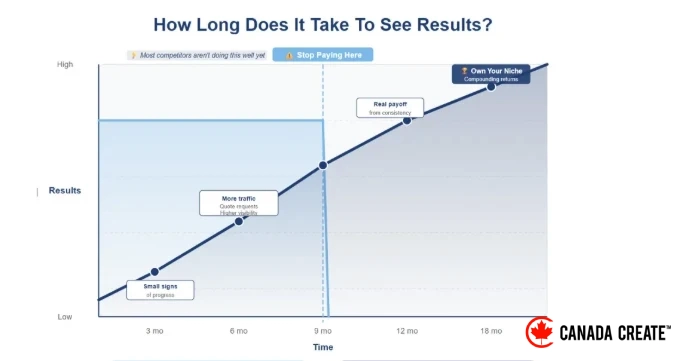
Most Toronto business owners ask this question after they’ve already spent money on SEO and seen nothing. So here’s the honest answer first, then the full reasoning behind it, industry by industry, so you know exactly what to expect before you sign with anyone.
The short answer: most Toronto businesses start seeing measurable movement in rankings and traffic within 60 to 90 days, and real, revenue-moving results between month 6 and month 9. If someone promises page-one rankings in two weeks, that’s not SEO, that’s a red flag, and it usually means shortcuts that get penalized later.
Below is the realistic timeline, broken down month by month, plus what changes the pace depending on your industry and current site condition.
Why Toronto Specifically Takes Longer Than Other Markets
Toronto isn’t a small city with light competition. A dentist searching “dentist near me” in a mid-size Ontario town might be up against 15 competitors. In Toronto, that same search can pull up hundreds of clinics, many of which have been actively running SEO for years and have already built domain authority, review counts, and backlink profiles.
That competitive density is why generic national SEO timelines don’t apply cleanly here. Ranking for “personal injury lawyer Toronto” or “real estate agent downtown Toronto” takes real authority building, not a handful of on-page tweaks. Our Local SEO services are built around this reality, which is why we scope timelines by industry and neighbourhood instead of giving one blanket number to every client.
Toronto also behaves like several smaller markets stacked together. Ranking for “physiotherapist Yorkville” is a different campaign than “physiotherapist Leslieville,” and both need their own dedicated pages, citations, and localized content rather than one generic Toronto page trying to cover everything.
Not sure how long SEO will actually take for your site? We’ll show you exactly where you stand and what’s realistic.
Canada Create has run SEO for Toronto businesses since 2008. We audit your site, benchmark it against your real competitors, and give you an honest timeline and action plan, no guesswork, no fluff.
The Realistic SEO Timeline, Month by Month
Month 1 to 2: Foundation Work
This is the part nobody sees in their rankings yet, but it decides whether everything after it works. This phase typically includes a full technical audit, keyword mapping, Google Business Profile cleanup, citation consistency checks, and fixing structural issues like duplicate content, broken links, or missing metadata.
If your site has never had proper technical SEO, this stage can take longer, since Google needs to recrawl and reindex the fixed pages before anything else has a chance to move. A brand new website usually needs an extra 30 to 60 days here compared to an established domain, simply because Google hasn’t built up trust in it yet.
Month 3 to 4: Early Signals
This is usually when the first real movement shows up. Long-tail keywords, meaning lower competition and more specific searches, start climbing first. You might see a new keyword enter page two, or jump from position 40 to position 18. Organic traffic in Google Search Console starts trending upward, even if it’s not dramatic yet.
This is also the stage where local pack visibility starts to shift, especially if citation building and Google Business Profile optimization were part of the plan from month one.
Month 5 to 6: Momentum Builds
By now, content published in month one or two has had time to earn authority. Backlinks built earlier start passing more value. Competitive local keywords, the kind that actually drive calls and bookings, start moving into page one or the top of page two.
This is typically the stage where clients notice actual leads coming from organic search instead of just watching a rank tracker move.
Month 7 to 12: Compounding Results
This is where SEO starts paying for itself. Rankings stabilize higher, organic traffic becomes a consistent lead source, and the content and backlinks built in earlier months keep compounding without requiring the same monthly spend just to maintain them. Businesses in less saturated categories or neighbourhoods often see this stage arrive earlier, sometimes by month 5.
How Timelines Differ By Industry in Toronto
Not every industry moves at the same speed, and this is where a lot of generic SEO advice falls apart. Here’s what we typically see across the categories we work in most:
Dental clinics: 4 to 7 months to meaningful movement in competitive areas like downtown Toronto or North York, faster in less saturated suburbs. See our approach on the dental SEO services page. Law firms: 6 to 12 months for competitive practice areas like personal injury or family law, since legal search is one of the most contested spaces online. Details on our law firm SEO services. Restaurants: often faster, 2 to 4 months, since local pack and Google Maps visibility respond quickly to Google Business Profile and review signals. More on our restaurant SEO services. Real estate: 5 to 9 months, since it combines local competition with a constant need for fresh, neighbourhood-specific content. See our real estate SEO services.
If your business falls outside these categories, the same logic still applies: the more saturated the search results are with well-optimized competitors, the longer the runway.
What Speeds Up Results
A few factors consistently shorten the timeline:
Domain age and history: an older domain with no penalties gives Google less reason to hesitate before ranking it higher. Low to moderate competition: ranking for “physiotherapist Leslieville” moves faster than “downtown Toronto dentist” simply because fewer sites are fighting for it. Existing content and backlinks: if there’s already a foundation, SEO builds on it instead of starting from zero. Fast technical fixes: sites that fix Core Web Vitals and mobile usability issues early tend to see faster indexing and ranking gains, since Google can crawl and understand the site more efficiently. Consistent publishing: businesses that stick to a steady content schedule instead of publishing in bursts tend to see steadier ranking gains.
What Slows Results Down
Frequent redesigns or URL changes: every major site change resets some of the trust signals Google has already built for that page. Thin or duplicate content: Google needs a real reason to rank a page above the competition, not just a page that technically exists. Inconsistent NAP data: mismatched business name, address, or phone number across directories confuses local ranking signals and slows local pack visibility. Highly competitive categories: law, real estate, and dental in downtown Toronto require more time and more content simply because of who else is competing for the same searches. Switching strategies too early: the single biggest timeline killer we see is businesses changing agencies or direction every 60 to 90 days, which resets momentum before it has a chance to compound.
How to Know If SEO Is Actually Working Before Month 6
You don’t have to wait six months blind. Three things worth checking monthly:
Keyword movement: are target keywords climbing in Search Console or a rank tracker, even if they’re not yet on page one. Indexed pages: is Google indexing new content and pages as they’re published, visible under the Pages report in Search Console. Referring domains: is the site earning new backlinks over time, not just the same three links from month one.
If none of these are moving after three months, that’s worth a direct, specific conversation with whoever is running the campaign about what’s actually blocking progress.
Common Myths About SEO Timelines
“SEO is a one-time project.” It isn’t. Rankings that stop being maintained tend to slide backward as competitors keep publishing and building links. “More keywords targeted means faster results.” Spreading a budget across 50 keywords usually moves nothing. Focusing on 10 to 15 high-intent, achievable keywords first produces faster, more visible wins. “Paid ads and SEO are interchangeable.” They solve different problems. Ads deliver traffic immediately but stop the moment spending stops. SEO takes longer to build but keeps working without ongoing spend once it compounds.
The Bottom Line
SEO in Toronto isn’t slow because agencies are padding timelines. It’s slow because Toronto is one of the most competitive digital markets in Canada, and real rankings require real authority, not shortcuts that Google eventually penalizes. Businesses that stick with a proper strategy for 6 to 9 months consistently outperform the ones that switch agencies every 90 days chasing faster promises.
If you want an honest look at where your site actually stands and a realistic timeline based on your specific industry and competition, we’ll walk through it on a free call, no scripted pitch, just a straight answer. Book your free 20-minute strategy call, explore our full SEO services, or see how we’ve done it for other Toronto businesses in our portfolio.




